

How to Write a Follow-Up Email on a Request That Actually Gets a Reply
You sent a clear, polite follow-up email on a request - specific ask, reasonable tone. Three days later, nothing. Now you're staring at a blank compose window, caught between sounding like a doormat and sounding like a debt collector. That tension kills more follow-ups than bad subject lines ever will.
The psychology is real. The Zeigarnik Effect says unfinished tasks stick in people's minds. Your recipient probably does remember your request - they just haven't prioritized it yet. Your job isn't to remind them you exist. It's to give them a reason to act now.
Here's the uncomfortable truth: the biggest variable isn't your wording. It's whether your email actually landed in an inbox.
What 16.5 Million Emails Reveal About Follow-Up Success
A study of 16.5 million cold emails across 93 business domains found that reply rates decline with every additional email in a sequence. Your first email averages 8.4%. Each follow-up chips away at that number. Cross the four-email threshold and unsubscribe rates plus spam complaints more than triple.
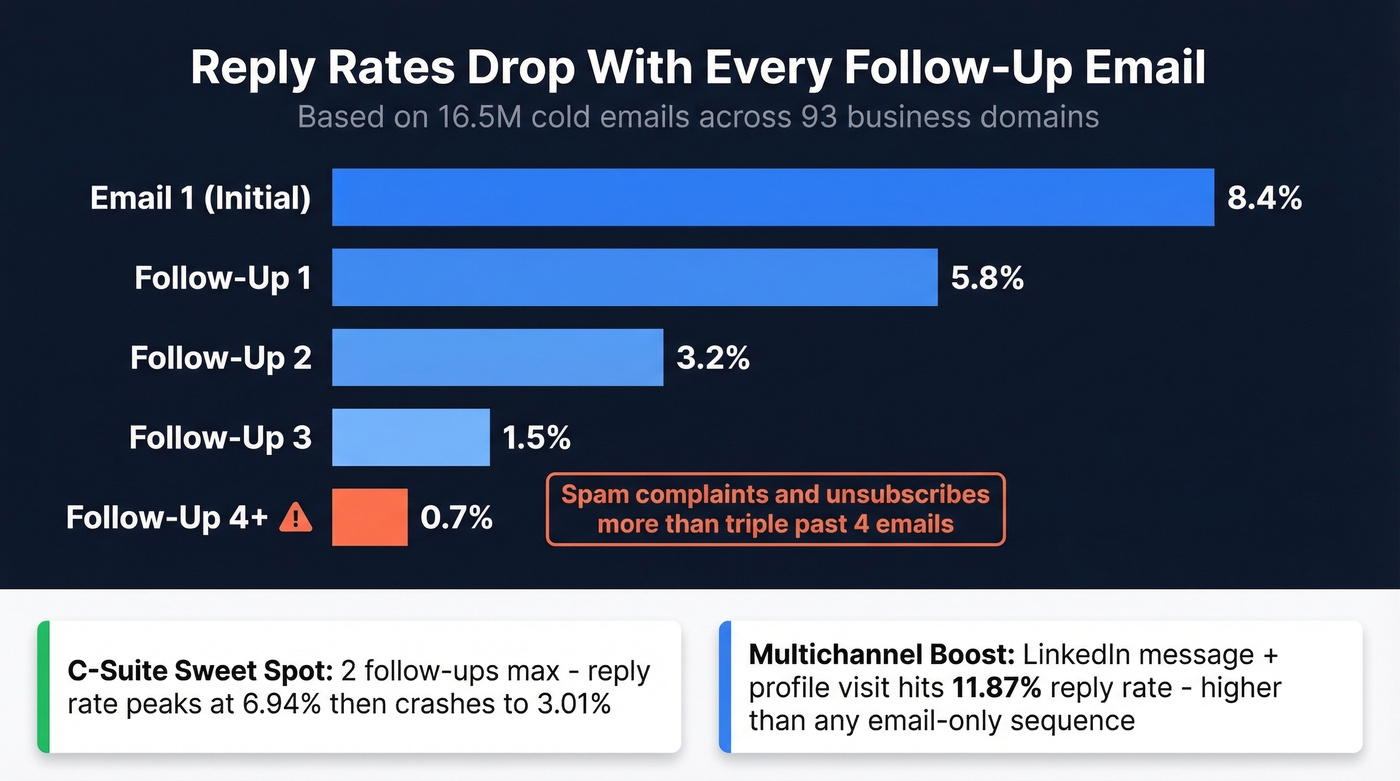
Company size matters more than most people realize. Small businesses (2-50 employees) are relatively tolerant - reply rates dip on the first follow-up, then actually bounce back on the second. Enterprises with 1,000+ employees show much lower tolerance for persistence, with reply rates dropping faster as sequences get longer.
The C-suite data is particularly telling. Response rates stay flat after one follow-up (6.64% to 6.66%), peak at the second (6.94%), then crash to 3.01% by the fourth. Two follow-ups is the ceiling for senior decision-makers. Push past that and you're burning the relationship.
The same study found that a paired LinkedIn message and profile visit hit 11.87% reply rate - higher than any email-only sequence. Multichannel isn't optional anymore.
Community benchmarks (r/b2b_sales): Average reply rate sits around 5-6%. Above 10% is strong. Bounce rate over 5% means you've got a list hygiene problem, not a messaging problem.
Follow-Up Timing by Scenario
Timing depends on what you're following up about.
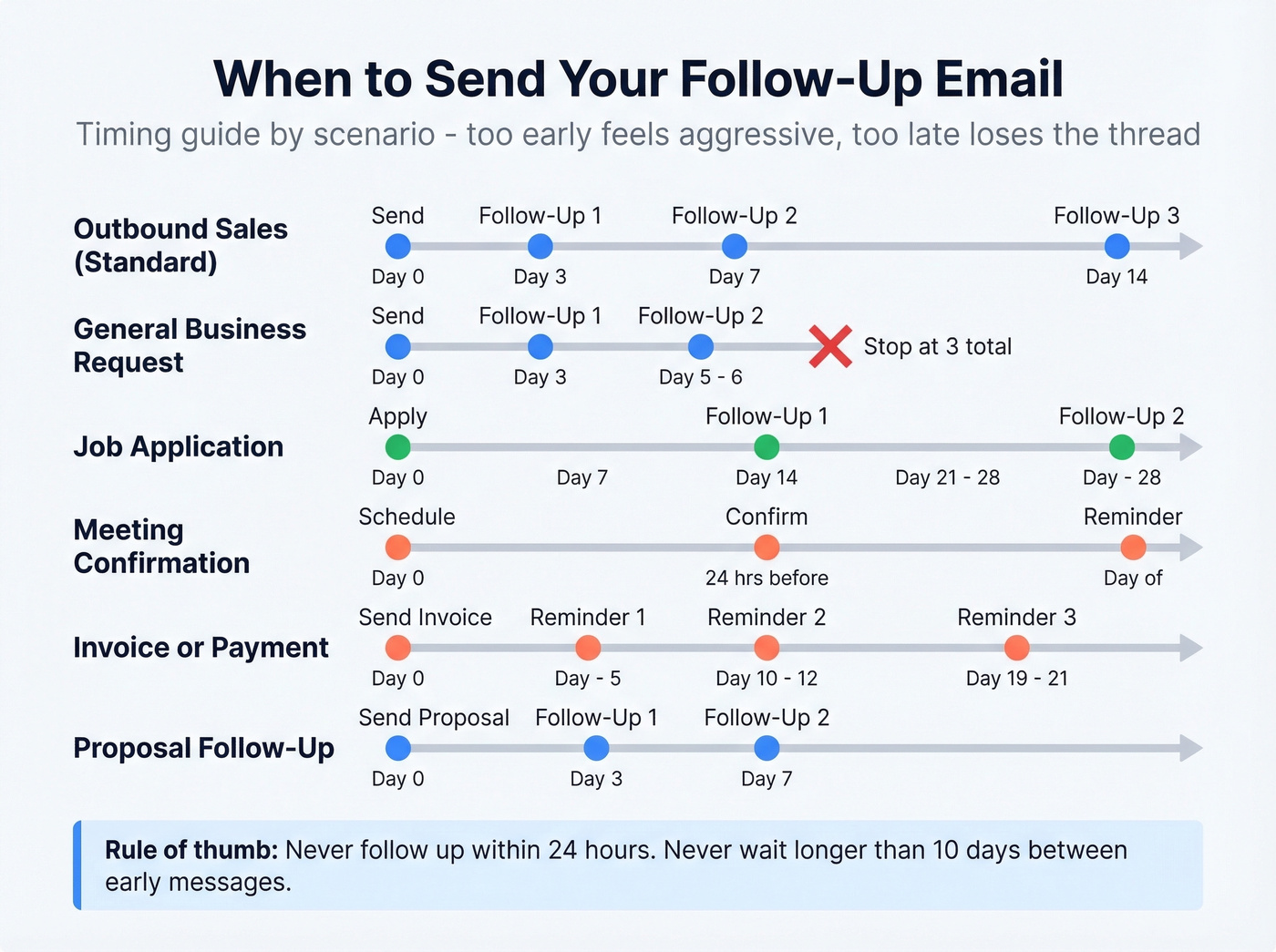
For outbound sequences:
| Cadence | Email 1 | Follow-Up 1 | Follow-Up 2 | Follow-Up 3 |
|---|---|---|---|---|
| Standard | Day 0 | Day 3 | Day 7 | Day 14 |
| Extended | Day 0 | Day 4 | Day 9 | Day 16 |
| Compressed | Day 0 | Day 2 | Day 5 | Day 10 |
Use compressed for time-sensitive offers. Extended works better for enterprise prospects who need breathing room.
For non-sales contexts:
| Scenario | First Follow-Up | Second Follow-Up | Max Attempts |
|---|---|---|---|
| General business | 3 business days | 2-3 business days later | 2 follow-ups (3 total) |
| Job application | 1-2 weeks | 2 weeks later | 2-3 |
| Meeting confirmation | 24 hrs before | Day of | 2 |
| Invoice/payment | 3-5 days | 7 days | 3-4 |
Following up within 24 hours feels aggressive in almost every context. Waiting longer than 10 days between early messages loses the thread entirely. Atlassian's guide recommends three business days before following up in most professional contexts, and we've found the same in our own outreach.
Five Components That Make Follow-Ups Work
1. Subject line. Reply to the same thread. "Re: [original subject]" preserves context and looks like a real conversation. Something like "Follow-up on [Request] - [Deadline]" works when you need a fresh thread. If you need ideas, pull from these email subject lines and adapt them to your request.
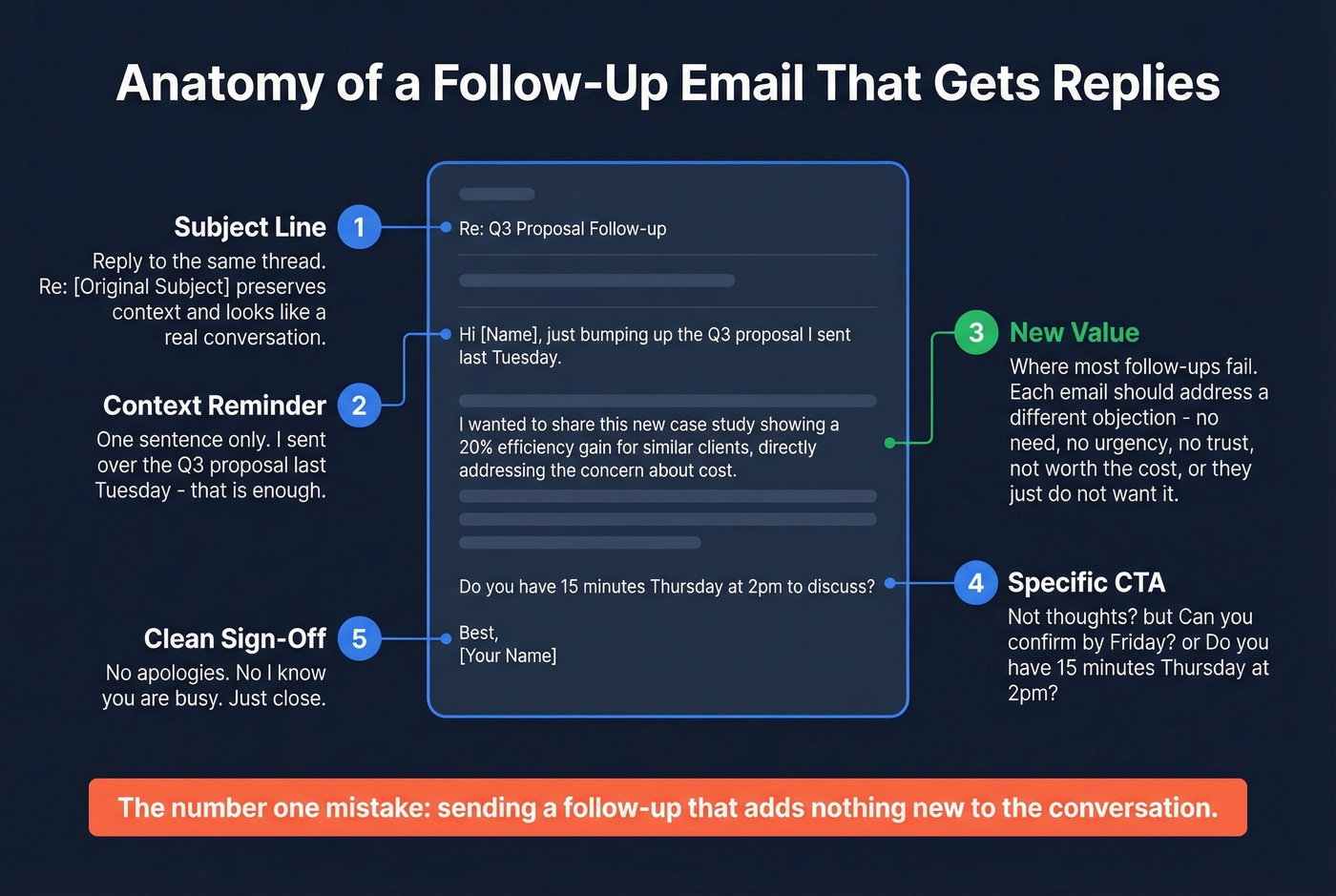
2. Context reminder. One sentence reconnecting the reader to your original ask. "I sent over the Q3 proposal last Tuesday" - that's enough.
3. New value. This is where most follow-ups fail. The GMass framework identifies five objections: no need, value not worth the cost, no urgency, don't want it, or don't trust you. Each follow-up should address a different one. (If you want more examples, these sales follow-up templates show how to add value without adding fluff.)
4. Specific CTA. "Let me know your thoughts" isn't a CTA. "Can you confirm by Friday?" is. "Do you have 15 minutes Thursday at 2pm?" is better. Give them something concrete to say yes or no to. For more options, see these email call to action patterns.
5. Clean sign-off. Don't apologize for following up. Don't say "I know you're busy." Just close.

Bounce rates above 5% signal a list hygiene problem, not a messaging problem. Prospeo's 5-step email verification delivers 98% accuracy - so your carefully crafted follow-ups actually reach inboxes instead of destroying your domain reputation.
Fix your data before you fix your follow-up copy.
Mistakes That Kill Your Reply Rate
Most follow-up failures aren't about tone. They're about mechanics. We've seen sequences with perfect copy fail entirely because the email addresses were six months stale.
- "Just following up" with no new information. If your follow-up doesn't add something the original didn't have, it's noise. If you need alternatives, use this guide on how to say just checking in professionally.
- Generic subject lines like "Following up" or "Checking in." They signal you know you're being repetitive. Thread your reply instead.
- No CTA or a vague one. "Thoughts?" is an invitation to procrastinate.
- Sending 4+ follow-ups. The 16.5M-email study is unambiguous - it more than triples your spam risk.
- Bad contact data. Wrong email address means zero chance of a reply and active damage to your domain reputation. Verify your list before launching any sequence - bounces hurt deliverability and make future emails more likely to land in spam. (If you’re diagnosing bounces, start with these email bounce rate benchmarks and fixes.)
- Broken personalization. "Hey [FIRSTNAME]" is worse than no personalization at all. If you’re building a system, this personalized outreach playbook helps.
- Rich formatting in cold emails. Plain text typically performs better for replies and deliverability.
Templates for Every Follow-Up Scenario
Each template below is short, specific, and progressively more direct. Use them as a starting point whenever you need a sample email to follow up a request - then customize with your own context and CTA. (For more variations, use these cold email follow-up templates.)
After a Meeting or Call
Hi [Name], great speaking with you on [day]. I've attached the [resource/proposal] we discussed. Would a 15-minute call next week to walk through next steps make sense? Happy to work around your calendar.
After Sending a Proposal
Hi [Name], following up on the proposal I sent on [date]. I've pulled together a comparison showing how [specific benefit] would impact your [metric] based on similar implementations. Worth 10 minutes this week?
This works because it doesn't just remind - it adds a new deliverable that gives the prospect a reason to re-engage.
Job Application Follow-Up
Hi [Name], I applied for the [role] on [date] and wanted to reiterate my interest. Since applying, I [completed a relevant project / earned a certification] that directly relates to [specific requirement]. Is there a good time this week or next to discuss?
How to Write a Follow-Up Email for Approval
Hi [Name], following up on the [document/approval] I requested on [date]. I need this by [deadline] to keep [project] on track - without it, we'll push the [milestone] back a week. Could you send it by end of day [specific day], or point me to someone who can help?
This names the consequence of inaction. Internal follow-ups stall because the recipient doesn't feel urgency - this creates it without being aggressive. Knowing how to write a follow-up email for approval is especially important when a delayed sign-off blocks an entire team.
Client Invoice / Payment Reminder
Hi [Name], friendly reminder that invoice #[number] for [amount] was due on [date]. I've reattached it for convenience. Could you confirm receipt and expected payment date?
Follow-Up Email Requesting Information
First follow-up (addresses urgency):
Hi [Name], I reached out last [day] about [specific problem]. Quick update - we just helped [similar company] [specific result with numbers]. Given [prospect's company] is [relevant trigger], the timing might be right. Worth a quick call?
Second follow-up (addresses trust):
Hi [Name], one more note - [client name] in [their industry] saw [specific metric improvement] within [timeframe]. I put together a 2-minute case study if useful. Otherwise, I'll assume the timing isn't right.
Breakup Email
Hi [Name], I've reached out a couple of times about [topic] and haven't heard back - totally understand. I'll close the loop on my end, but if [specific problem] becomes a priority, I'm here.
The breakup email removes pressure. Counterintuitively, it often generates the most replies because it gives the recipient an easy way to say "no" without feeling cornered.
The Deliverability Angle Nobody Talks About
None of your follow-ups matter if they're landing in spam. Gmail tightened enforcement starting February 2024, and penalties for unauthenticated email have only increased since. SPF, DKIM, and DMARC aren't optional - they're table stakes. Google's sender guidelines spell this out explicitly. If you need the full checklist, start with this email deliverability guide.
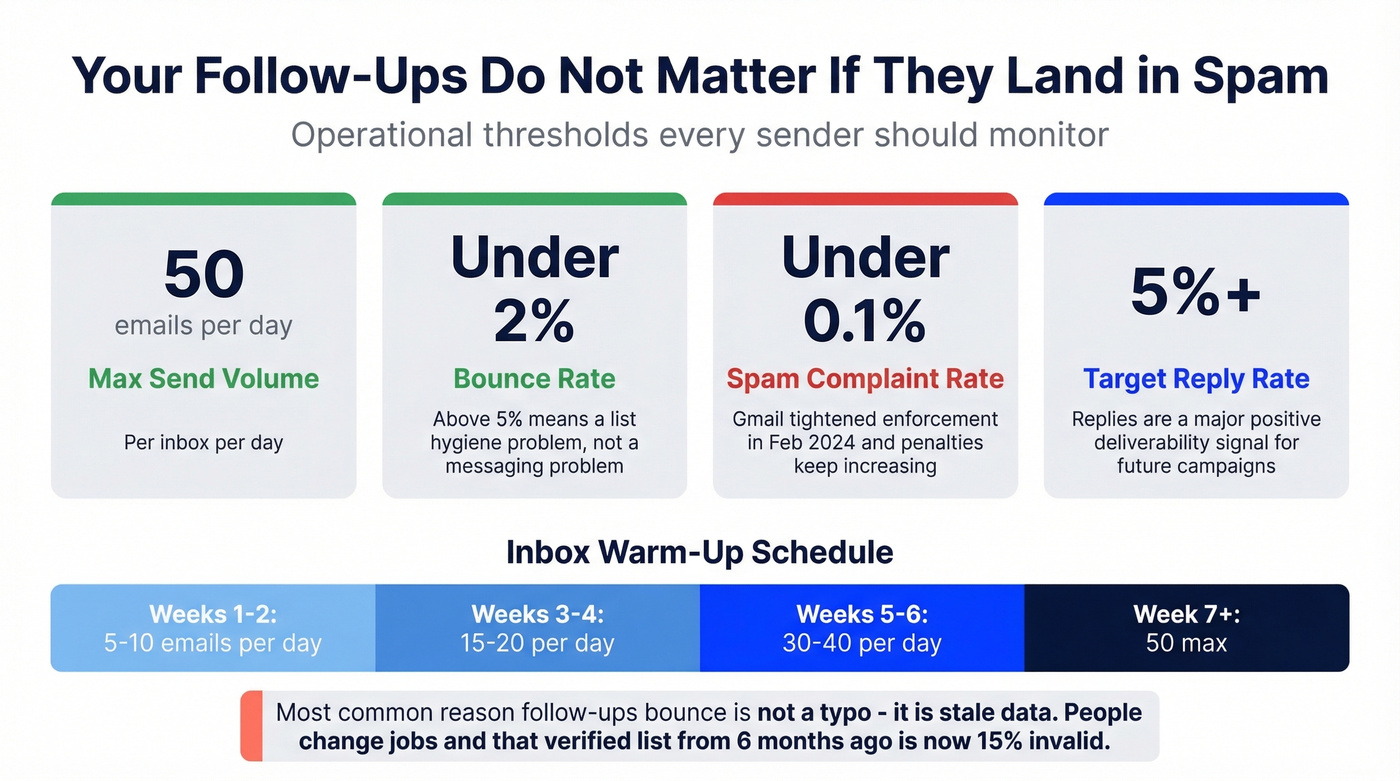
Here's what most guides skip: reply rates are a major positive deliverability signal. A follow-up that generates even a 2-3% reply rate gets significantly better inbox treatment than one with high opens but zero replies. Your follow-up strategy directly affects whether your next campaign reaches inboxes.
Let's be honest about something. If your bounce rate is above 5%, stop writing better follow-ups and start fixing your data. I've watched teams spend weeks A/B testing subject lines while sending to lists that were 15% invalid. No amount of copywriting overcomes a dead address.
Operational Thresholds (per SuperSend):
- Max 50 emails/day per inbox
- Bounce rate under 2%, spam complaints under 0.1%
- Target reply rate: 5%+
- Warm-up: 5-10/day (weeks 1-2) → 15-20 (weeks 3-4) → 30-40 (weeks 5-6) → 50 max (week 7+)
The most common reason follow-ups bounce isn't a typo - it's stale data. People change jobs, companies switch providers, and that "verified" list from six months ago is now 15% invalid. Tools like Prospeo catch invalid addresses, handle catch-all domains, and remove spam traps before you send, with data refreshing every 7 days instead of the industry-standard 6 weeks. That means you're not sending to contacts who left the company last quarter. (If you’re scaling outbound, it also helps to manage safe email velocity per inbox.)
Skip the verification step if you're only emailing a handful of people you know personally. For anything at scale - outbound sequences, job application follow-ups to HR teams you found online, invoice reminders to a client list - verify first.
The data is clear: two follow-ups is the ceiling for decision-makers. You can't afford to waste one on a bad email address. Prospeo refreshes 300M+ contacts every 7 days - not every 6 weeks - so your follow-up sequences hit real, active inboxes at $0.01 per email.
Every bounced follow-up is a burned opportunity. Start with clean data.
FAQ
How many follow-up emails should I send after a request?
Two to three is the sweet spot. The 16.5M-email study shows four or more emails in a sequence more than triples your unsubscribe and spam rates. For non-sales contexts like job applications or internal requests, cap it at three total attempts. New value per touch matters far more than volume.
How long should I wait before sending a follow-up?
Three business days for general business requests. Job applications warrant one to two weeks. Cold outreach follow-ups work best at three-to-seven-day intervals. The one universal rule: never follow up within 24 hours unless it's a same-day meeting confirmation.
Should I reply to the same thread or start a new one?
Reply to the same thread in most scenarios. It preserves context, looks like a genuine exchange, and avoids cluttering the recipient's inbox. Start a new thread only if the original subject was irrelevant or you're fundamentally changing the topic.
Does verifying email addresses before follow-ups actually matter?
Keeping bounce under 2% is a standard cold-email deliverability threshold, and higher bounce rates damage your sender reputation - meaning future emails, not just the bounced one, start landing in spam. Verifying your list is one of the highest-ROI steps in any follow-up workflow, and it takes minutes.