

Follow-Up Email Wording That Gets Replies (2026)
You sent the proposal three days ago. Silence. Now you're drafting a follow-up and the cursor is blinking on an empty line after "Hi [Name]." You type "Just wanted to follow up..." and immediately delete it because you know exactly how that sounds. Across 16.5 million cold emails analyzed by Belkins, the highest reply rate was 8.4% - from the first email. Every follow-up after that performed worse. The problem isn't persistence. It's your follow up email wording.
The Short Version
Three rules for every follow-up you send:
- Add new information. No "just checking in." Give them a reason to reply.
- Anchor to a specific date, action, or deadline. Vague emails get vague silence.
- Keep it under 125 words with one clear ask. One question. One next step.
The 3-5-7 rule: Follow up after 3 business days, then 5 more, then 7 more. After that, send a breakup email or switch channels.
Words That Kill Your Reply Rate
Every follow-up that says "just checking in" deserves to be ignored. It tells the recipient nothing new, asks for nothing specific, and signals you couldn't think of a real reason to email them. We cut "just checking in" from our outreach vocabulary a while back, and reply rates jumped almost immediately.
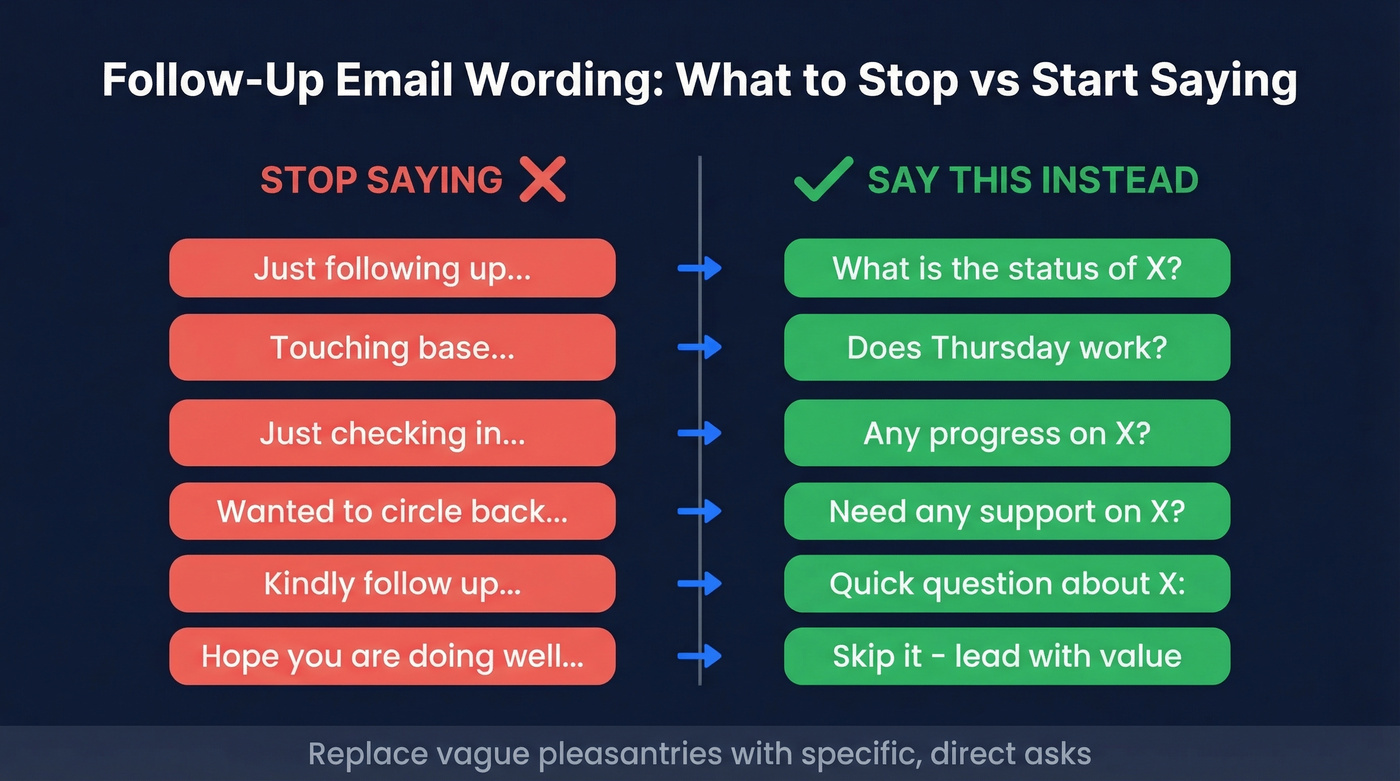
The word "kindly" is another trap. Non-native speakers often use "kindly follow up" thinking it sounds polite - but in American and British professional English, it reads as passive-aggressive. It lands like you're scolding someone.
And don't put "follow-up" in your subject line. It screams "you ignored me" and adds zero value. NetHunt's research calls this out specifically - it's the weakest possible framing.
| Stop Saying | Say This Instead |
|---|---|
| "Just following up..." | "What's the status of X?" |
| "Touching base..." | "Does Thursday work?" |
| "Just checking in..." | "Any progress on X?" |
| "Wanted to circle back..." | "Need any support on X?" |
| "Kindly follow up..." | "Quick question about X:" |
| "Hope you're doing well..." | Skip it - lead with value |
The pattern is simple: replace vague pleasantries with specific, direct asks. "Where are we with X?" beats "Just wanted to touch base" every single time.
If you still catch yourself writing "checking in," use these alternatives from our guide on how to say just checking in professionally.
Subject Lines That Get Opened
A study of 5.5 million email subject lines makes this clear: personalized subject lines hit a 46% open rate versus 35% without personalization. That's a 31% lift from adding a name, company, or specific reference.
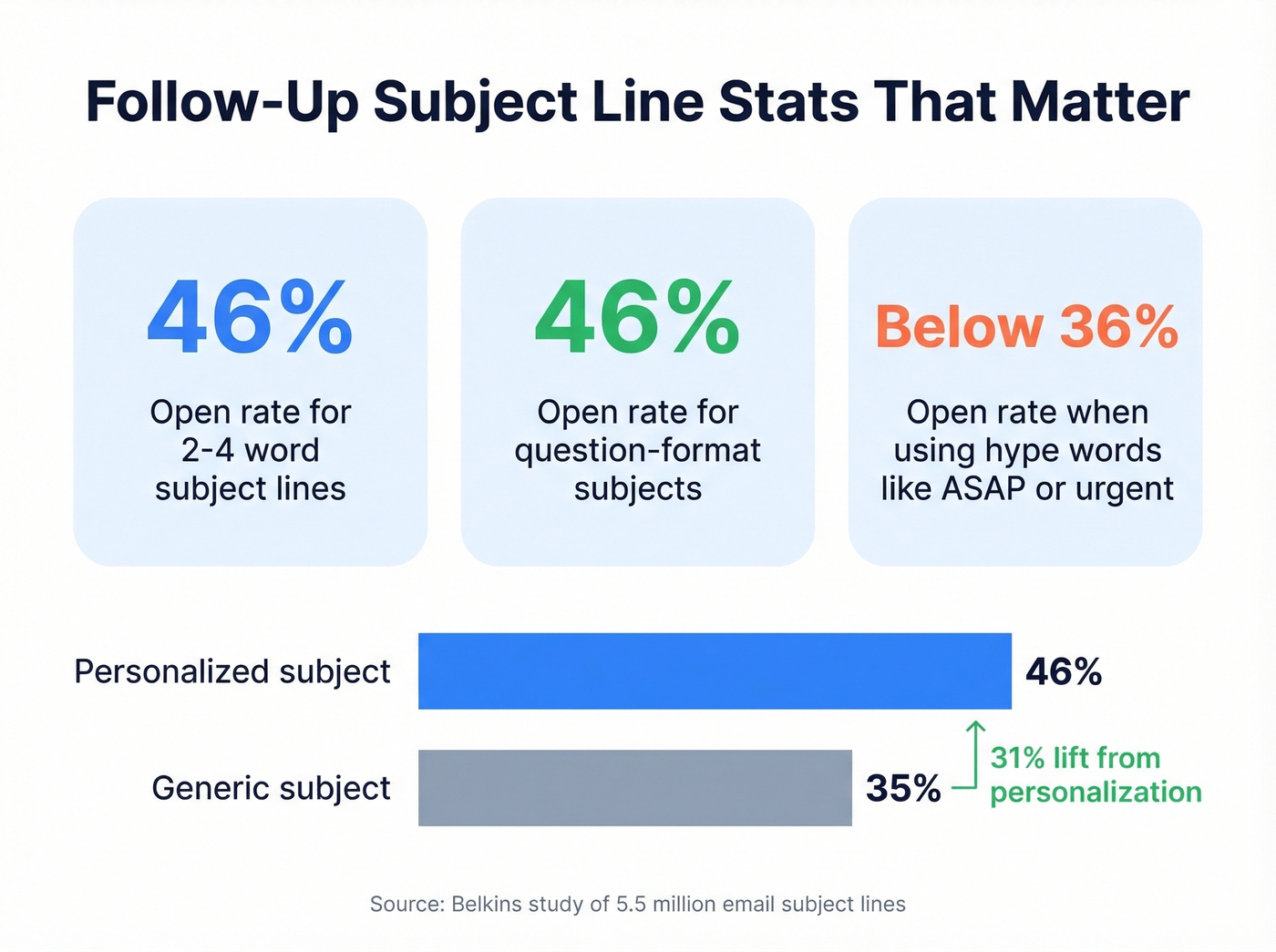
Three findings worth memorizing: 2-4 words is the sweet spot at 46% open rate. Question-format subject lines match that 46%. And hype terms like "ASAP" and "urgent" drag opens below 36%.
So instead of "Following up on my proposal," try "Thursday still work?" or "One question about [project name]." If you want more options, pull from these email subject line examples.

Personalized subject lines lift open rates by 31%. But personalization requires accurate data. Prospeo gives you 50+ data points per contact - job title, company size, tech stack, recent funding - so every follow-up references something real. 98% email accuracy means your carefully worded follow-ups actually land.
Stop perfecting emails that bounce. Start with verified contacts.
How to Word a Follow-Up Email by Scenario
You don't need 15 templates. You need a handful and the discipline to add new value every time. The right language depends entirely on context, so let's walk through the scenarios that matter most.
If you do want plug-and-play options, start with these sales follow-up templates and customize with one new data point.
No Response to a Cold Email
Most people rewrite their original email, just shorter. Don't. Here's what a before/after looks like:
Before: "Hi [Name], just wanted to follow up on my previous email. Let me know if you have any questions."
After: "Hi [Name], since I last reached out, [new data point about their company]. Would 15 minutes on [specific day] make sense?"
The difference is one sentence of new value. That's all it takes. (For a full sequence approach, see our B2B cold email sequence guide.)
After a Meeting or Demo
Subject: [Specific topic discussed] - next step
Hi [Name], great conversation about [specific challenge they mentioned]. I pulled together [resource/proposal] based on what you said about [their priority]. Does [day] work to walk through it?
Notice the structure: reference something specific they said, deliver something new, propose a concrete time. Three sentences, done. If you’re trying to lock a time cleanly, use this framework for email wording to schedule a meeting.
After Sending a Quote
Subject: [Project name] - one thought
Hi [Name], I was reviewing the proposal and realized I didn't include [additional value - ROI calc, timeline, case study]. Attached. Does [day] work for a quick call?
This replaces the "Did you get my quote?" pattern that r/sales threads consistently flag as a reply killer. The consensus there is blunt: if you're not adding something new, you're just nagging.
Job Application Follow-Up
Skip the template format here - just remember the framework from a hiring manager who's interviewed 1,000+ candidates on Reddit: reference their specific problem from the job posting, then position yourself as the solution with one concrete result. Two sentences of substance beat five paragraphs of enthusiasm.
Networking or Breakup
For networking, keep it to three lines: what you discussed, one piece of value like an article or intro, and a soft ask for coffee.
For your final follow-up, keep it clean: "I've reached out a few times and haven't heard back - totally understand. I'll close this out on my end. If things change, I'm here." No guilt-tripping. No "I'm disappointed." Just a door left open. If you want more breakup options, use these polite chaser email templates.
When to Send (and When to Stop)
The 3-5-7 rule gives you structure: follow up after 3 business days, then 5 more, then 7 more. Three follow-ups total. (If you want a deeper timing breakdown, see when should I follow up on an email.)
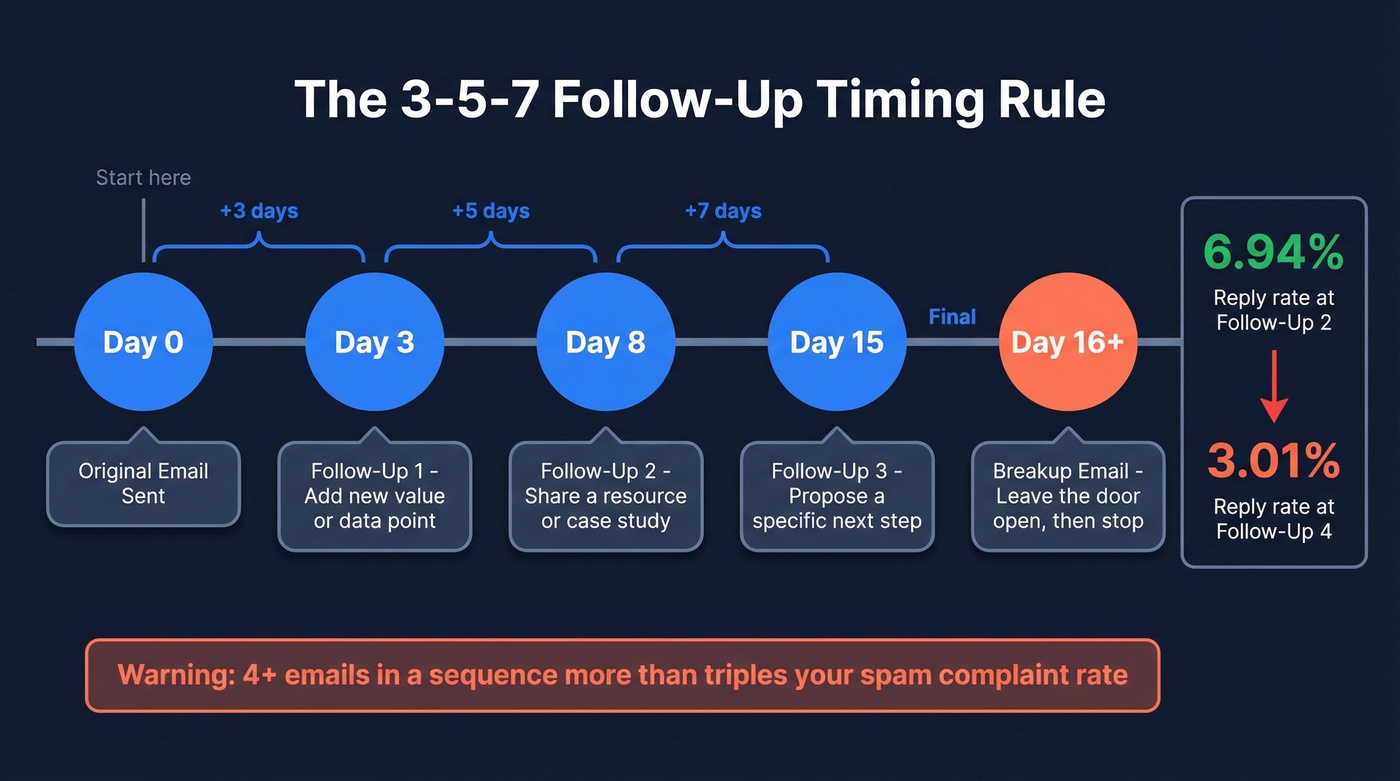
You've probably seen the stat that "80% of sales require 5+ follow-ups." The data tells a different story. Sending 4+ emails in a sequence more than triples your unsubscribe and spam complaint rates. Persistence without new value isn't persistence - it's spam.
Here's the thing: founder-level contacts hold steady through the second follow-up, with reply rates ticking up to 6.94%. Then they drop sharply to 3.01% by the fourth. For longer B2B sales cycles, some teams extend to 8-12 touchpoints across channels, but most deals are won or lost in those first few emails. If you're going to keep going past three, you need a real reason and real new value each time. (More benchmarks here: follow-up email reply rate.)
Deliverability Checklist Before You Hit Send
Perfect follow up email wording is worthless if the email bounces. Once you've nailed the phrasing, run through this:
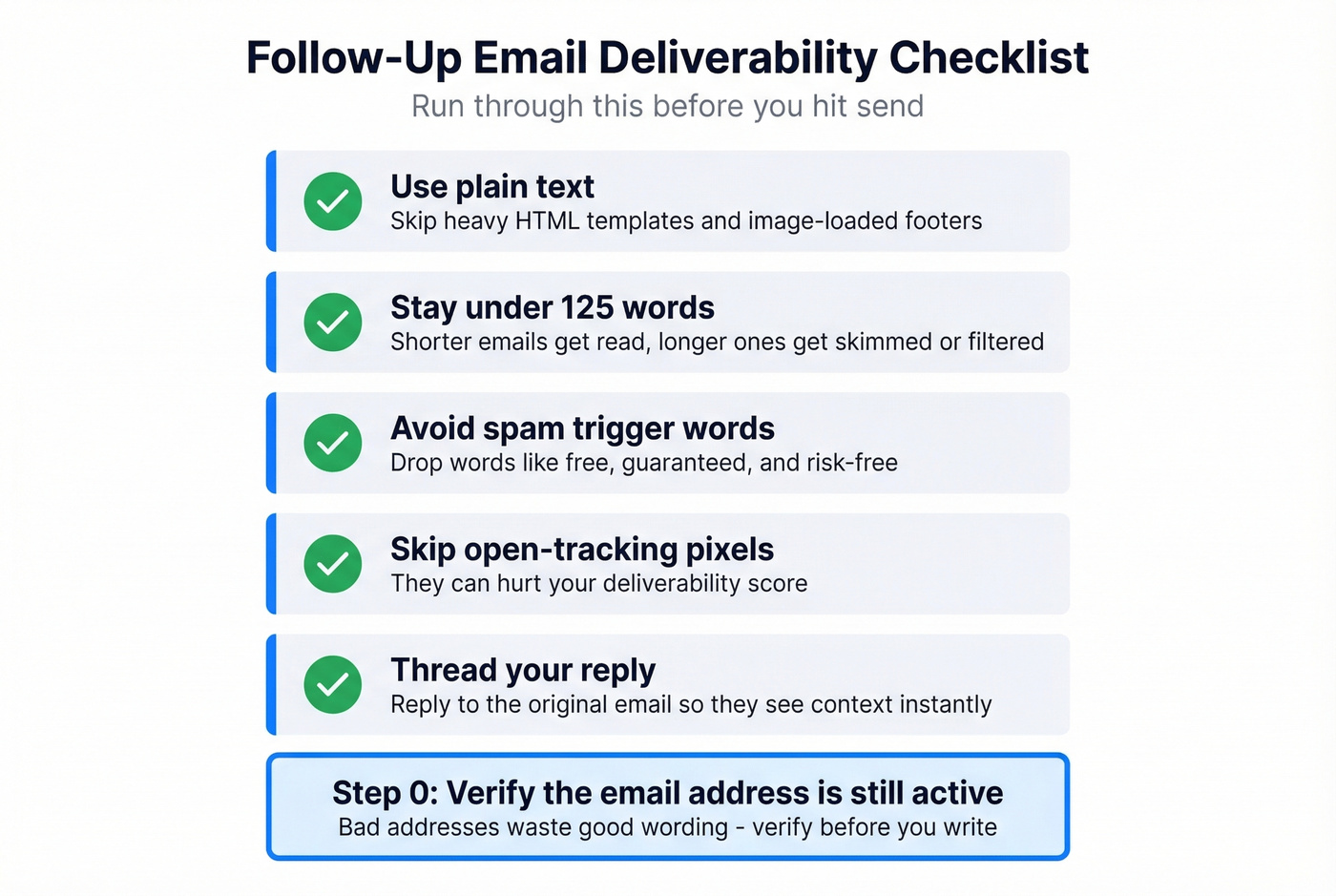
- Use plain text. Avoid heavy HTML templates and image-loaded footers for follow-ups.
- Stay under 125 words. Shorter emails get read. Longer ones get skimmed or filtered.
- Avoid spam triggers. "Free," "guaranteed," and "risk-free" are inbox killers.
- Skip open-tracking pixels. They can hurt deliverability. (More detail: email tracking pixel.)
- Thread your reply. Reply to the original email so the recipient sees context instantly.
A carefully crafted follow-up means nothing if the address is dead. We've seen teams burn through weeks of perfectly worded sequences only to discover half their list was outdated. Bad addresses waste good wording. Prospeo verifies emails in real time with 98% accuracy and refreshes data every 7 days, so your message actually reaches someone. If you’re troubleshooting inboxing issues, use our email deliverability guide.
You just read that half a team's follow-up sequences can go to dead addresses. Prospeo refreshes every record on a 7-day cycle - not the 6-week industry average - so the emails you're following up on are still active. At $0.01 per verified email, fixing your list costs less than one wasted hour of writing follow-ups to nobody.
Great follow-up wording deserves a list that's actually alive.
FAQ
How many follow-up emails should I send?
Three follow-ups is the sweet spot for most outreach. After the second, reply rates drop sharply (from 6.94% to 3.01% for founder-level contacts), and spam complaints more than triple at 4+ emails. Use the 3-5-7 day spacing rule, then send a breakup email.
What's a polite way to follow up without sounding pushy?
Lead with new value - a relevant case study, data point, or resource - instead of reminding them you exist. Pair it with a specific ask like "Does Thursday at 2 work?" rather than open-ended phrases like "Let me know your thoughts." Specificity reads as helpful, not desperate.
Should I use "follow up" in my subject line?
No. Subject lines containing "follow up" or "following up" signal that the recipient already ignored you, which tanks open rates. Use 2-4 word subject lines tied to a specific topic or question instead, like "Thursday still work?" Personalized subjects hit 46% open rates versus 35% for generic ones.
How do I make sure my follow-up emails actually get delivered?
Start with verified contact data - bounced emails destroy sender reputation fast. Beyond that, use plain text, stay under 125 words, and avoid spam-trigger phrases like "guaranteed" or "risk-free." Threading your reply to the original email also helps inbox placement.