

Follow Up Messages That Actually Get Replies: Templates, Data & Strategy
You sent the proposal three days ago. Radio silence. You're staring at a blank draft, cursor blinking, trying to figure out how to say "did you get my email?" without sounding like you're begging.
Here's what most guides on follow up messages won't tell you: your first email matters more than your fifth follow-up. A dataset of 2M+ emails found that 79.4% of all replies come from the initial outreach - not from some magical persistence sequence. That doesn't mean follow-ups are useless. It means they need to earn their spot in someone's inbox.
The Cheat Sheet
- Most replies come from email #1. 79.4% of replies happen at step 1. Obsess over your first email.
- 4-7 touchpoints is the sweet spot. Beyond that, diminishing returns unless each touch adds something new.
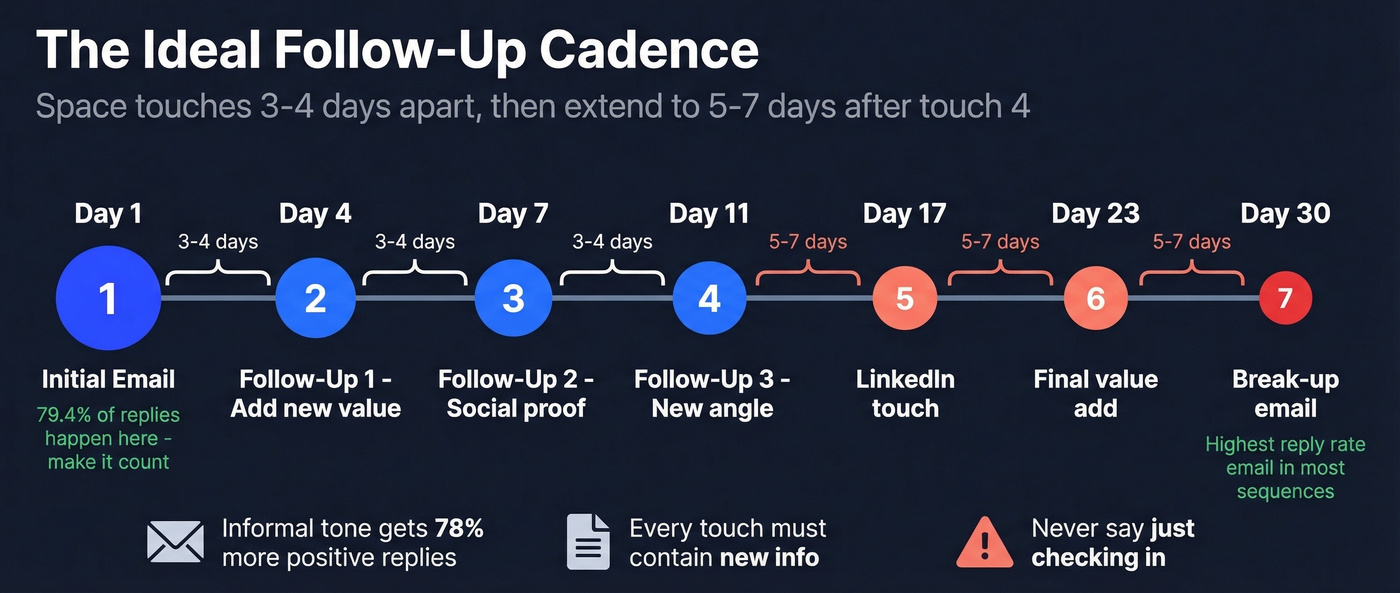
- Space touches 3-4 days apart. Extend to 5-7 days after touch 4.
- Informal tone wins. Informal emails generate 78% more positive replies than formal ones.
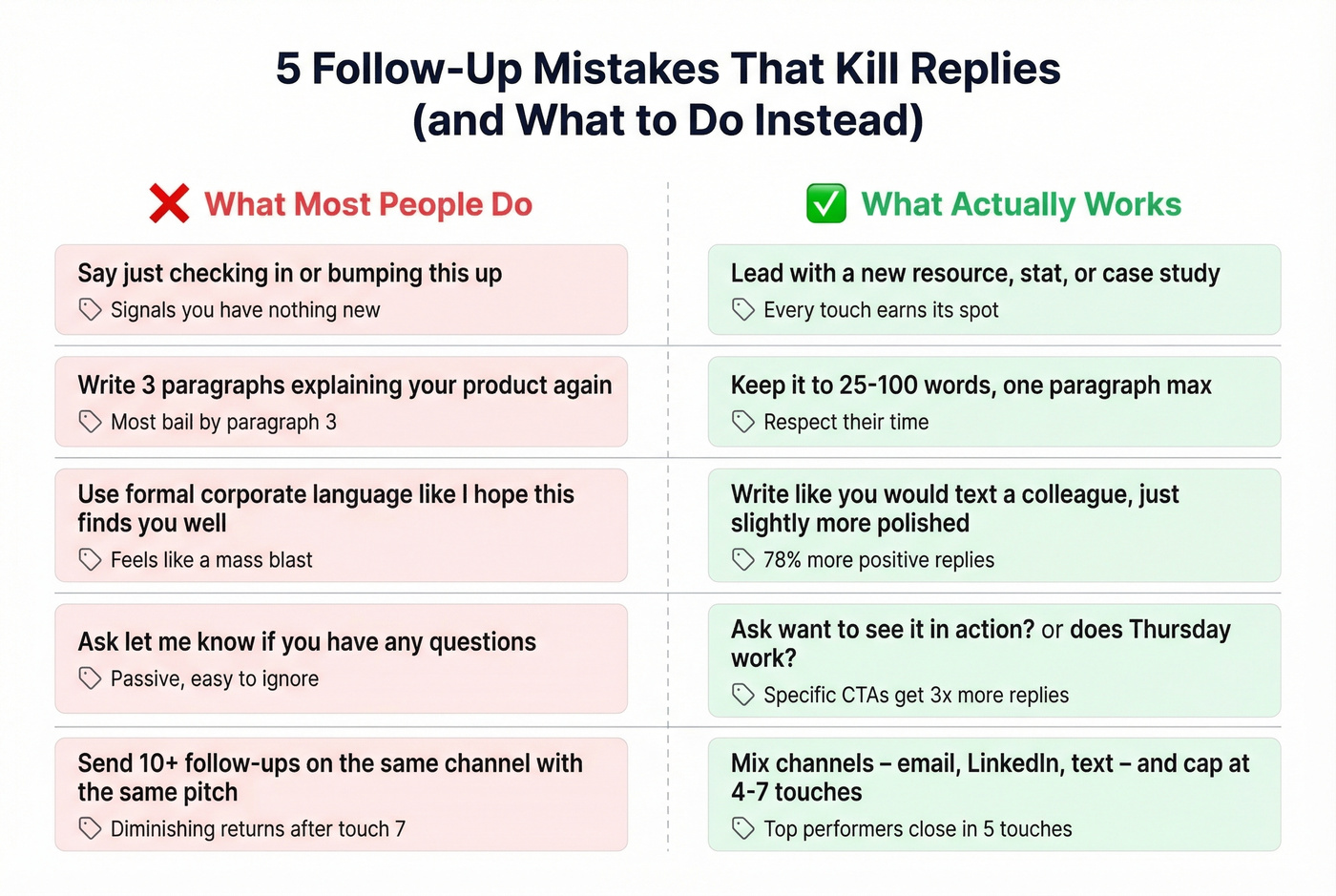
- Never say "just checking in." It signals you have nothing new to offer.
- Verify your list first. Bounced emails destroy your sender reputation faster than bad copy ever will.
Jump to: Email Templates | Text Templates | [Social Templates](#social - linkedin-follow-up-messages) | Cadence Builder | Mistakes to Avoid
Do Follow-Ups Actually Work?
The Sales.co dataset - 2M+ emails and 61,770 replies across 1,369,823 contacts - tells a blunt story. The average reply rate is 2.09%. Only 14.1% of those replies are positive, which means roughly 1 in 157 contacts you email will express genuine interest. That's a 0.64% effective "interested reply rate."
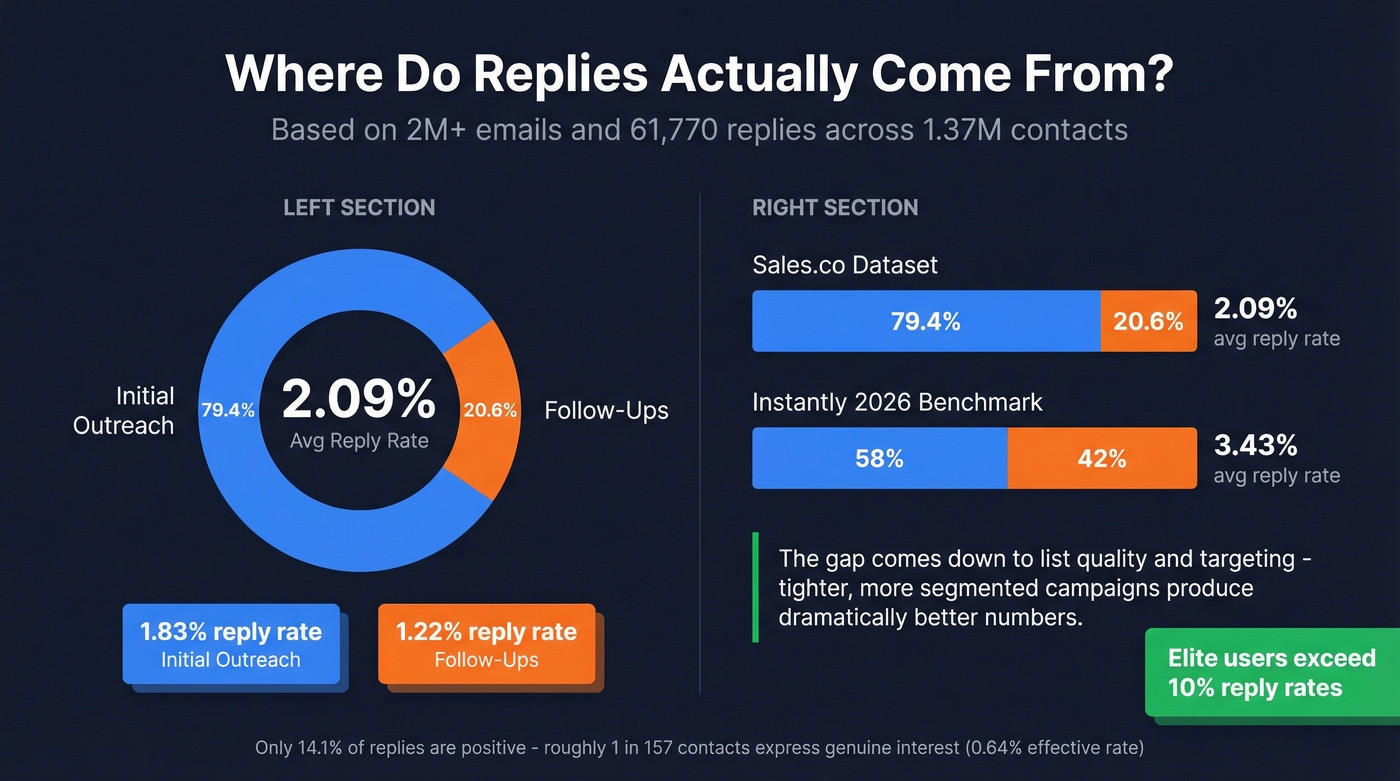
Initial outreach drives 79.4% of all replies at a 1.83% reply rate, while follow-ups contribute 20.6% at a 1.22% reply rate.

Instantly's 2026 benchmark report paints a more optimistic picture: 3.43% average reply rate, with 58% of replies from step 1 and 42% from follow-ups. Their elite users exceed 10% reply rates. The gap between these two datasets comes down to list quality and targeting - tighter, more segmented campaigns produce dramatically better numbers.
RAIN Group's research across 489 sellers found it takes an average of 8 touchpoints to book an initial meeting. Top performers get there in 5. One founder on r/Entrepreneur reported that three follow-ups over two weeks landed a $4,000/month client who never responded to the first email. The takeaway isn't "send more emails." It's that the right message at the right time, across the right channels, collapses the touchpoint count.
Here's the thing: if your deal size is under $5k and your list isn't verified, you're better off spending two hours improving your first email than building a seven-step sequence. Most teams over-invest in persistence and under-invest in relevance.
How to Write Follow-Ups That Get Replies
Five rules. Memorize them.
1. Every follow-up must contain new information. A case study. A relevant stat. A competitor insight. A resource. If you can't articulate what's new in this email, don't send it. "Bumping" with no new info is the cardinal sin of follow-ups - treat each touch as a fresh conversation starter, not a reminder.
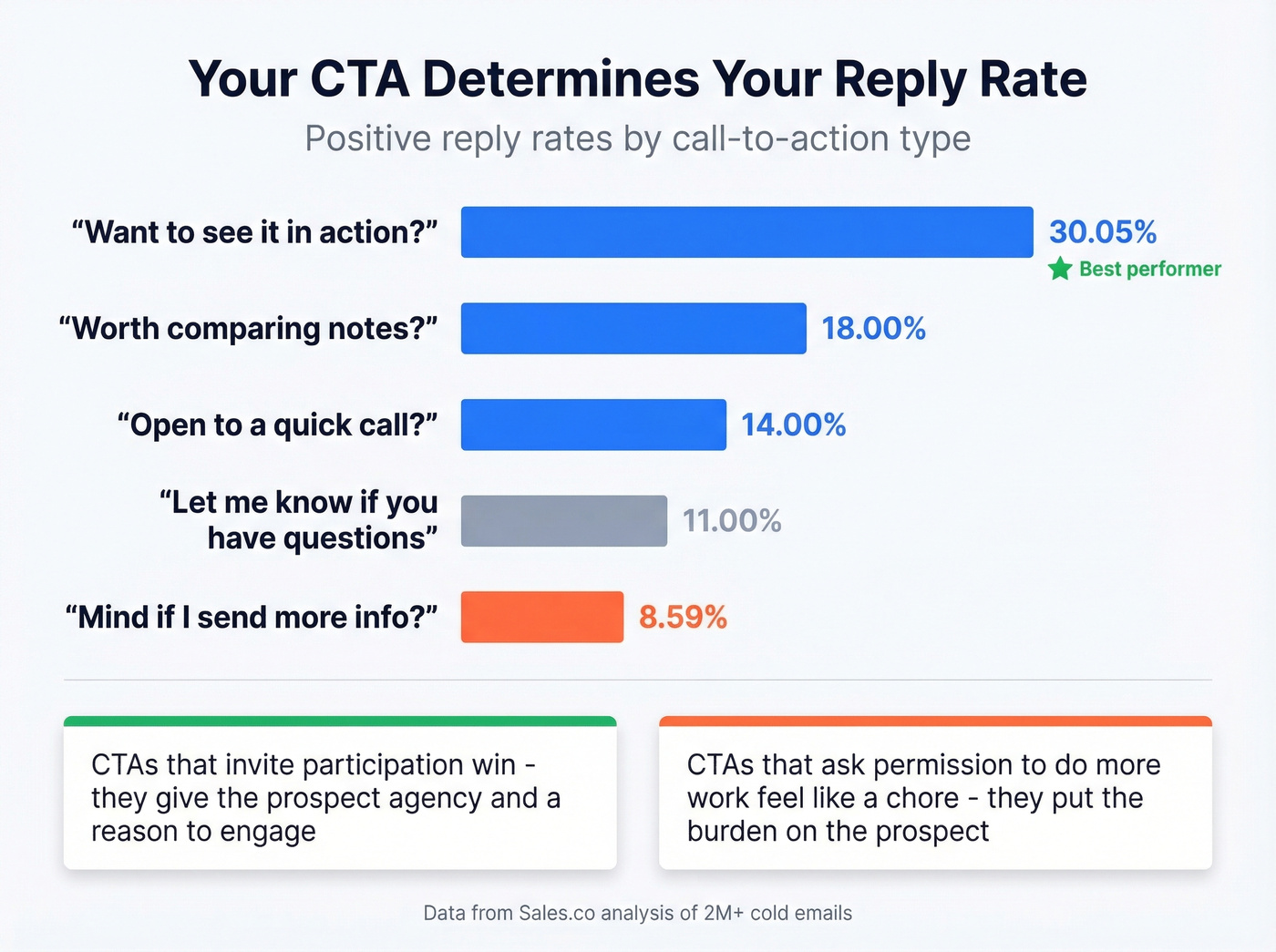
2. Your CTA determines your reply rate. This isn't opinion - it's data. "Want to see it in action?" generates a 30.05% positive reply rate. "Mind if I send more info?" gets 8.59%. The difference is agency. The first CTA invites participation; the second asks for permission to do more work.
3. Write like a human, not a "sales professional." Informal emails generate 78% more positive replies than formal ones. Instantly's benchmark data also found that step 2 emails that feel like replies - not reminders - outperform formal follow-ups by roughly 30%. Drop the "I hope this email finds you well." Use contractions. Write like you'd text a colleague, just slightly more polished.
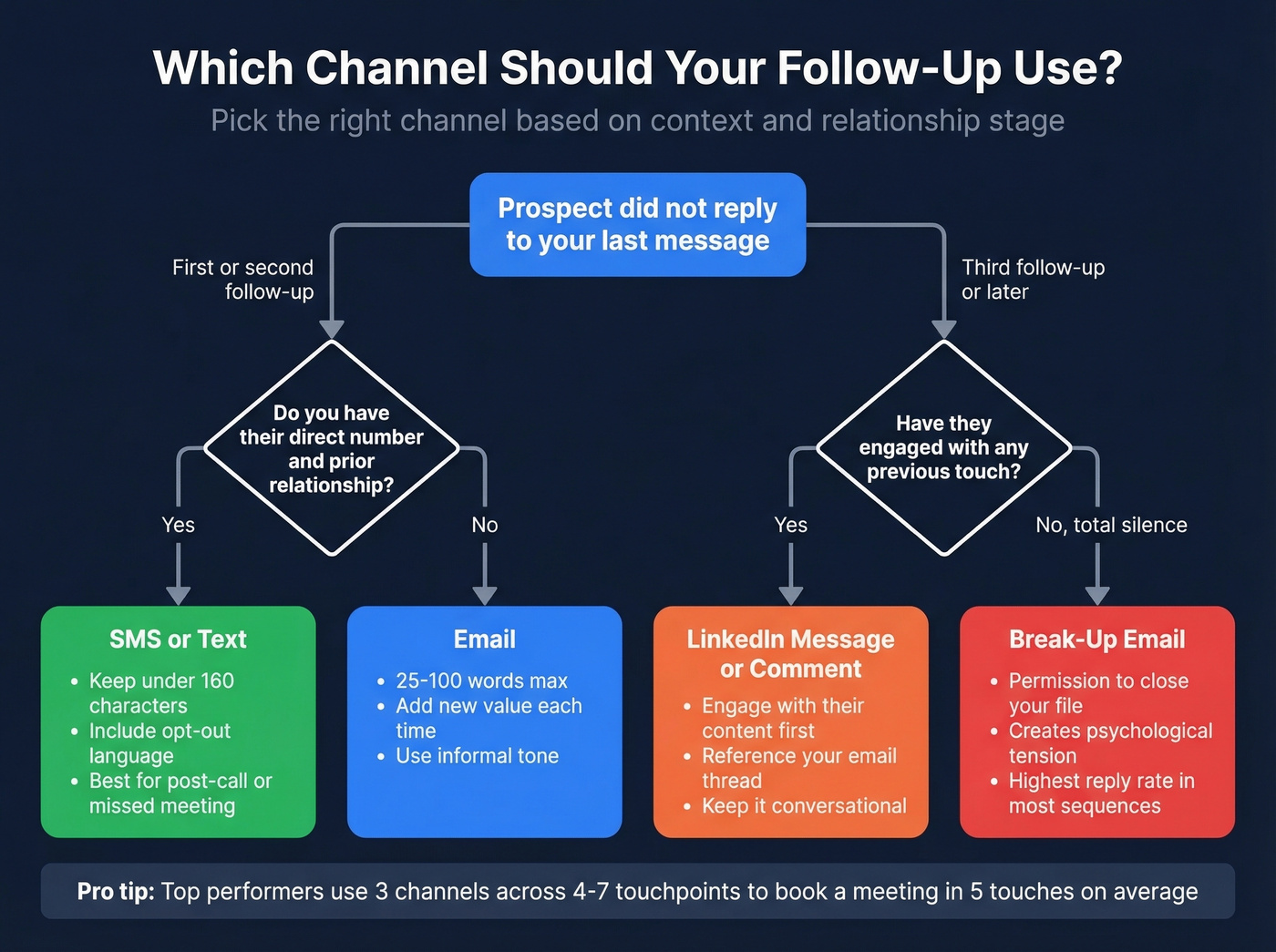
4. Keep it short. 25-100 words. That's it. If your follow-up has three paragraphs, you've already lost. Most recipients bail by the third paragraph. One paragraph is the max.
5. Ban these phrases. "Just checking in." "Touching base." "Circling back." "Bumping this to the top of your inbox." They all translate to the same thing: "I have nothing new to say but I want your attention." The consensus on r/sales is brutal - these phrases signal desperation, not persistence.
Templates by Channel
Email Follow-Up Templates
Each template is annotated with the persuasion principle it uses. Grab the subject lines as-is or adapt them.
No Response - Value Add (Reciprocity)
Subject: Quick resource on [their challenge]
Hi [Name],
Sent you a note on [day] about [topic]. Since then, I pulled together [resource/stat/case study] that's relevant to what [Company] is doing with [initiative].
Worth a look: [link]
Want to see how this applies to your team specifically?
What NOT to Send vs. What Works (Social Proof)
Most reps default to something like this:
Hi [Name], just following up on my previous email. Let me know if you have any questions.
That email says nothing. Compare it to this:
Subject: How [similar company] solved this
[Name],
[Similar company in their space] was dealing with the same [problem] last quarter. They [specific result - e.g., "cut their bounce rate from 35% to under 4%"].
Happy to walk you through what they did differently. Does Thursday work?
The second version earns the reply because it delivers proof, not a reminder.
Post-Meeting - Commitment & Consistency
You mentioned something specific in the meeting. Use it. This template works because it anchors to a commitment the prospect already made.
Subject: Re: [Meeting topic]
[Name],
Great conversation on [day]. You mentioned [specific thing they said] - I put together [deliverable] based on that.
[Attachment or link]
You said [next step they agreed to]. Want to lock in [specific date] to move forward?
Post-Demo - Scarcity
Subject: Before your eval window closes
[Name],
You mentioned your team needs to decide by [date]. I've reserved [resource/pricing/slot] through [deadline].
Two quick things that came up after our demo: [insight 1] and [insight 2].
Worth 10 minutes to finalize?
Post-Proposal - No Response (Reciprocity)
Subject: Updated the numbers for you
[Name],
I revisited the proposal and adjusted [specific section] based on what you shared about [their priority]. Updated version attached.
If the pricing structure doesn't fit, I'd rather know now so we can find something that does. Open to a quick call?
Trigger Event - New Angle (Authority)
Subject: Saw the news about [event]
[Name],
Noticed [Company] just [trigger - funding round, new hire, product launch, expansion]. Congrats.
That usually means [relevant challenge]. We helped [similar company] navigate that - [one-line result].
Worth comparing notes?
The Scheduling Frame
A practitioner on r/sales reported this consistently outperformed generic follow-ups in field sales. It creates a natural deadline without manufactured urgency.
Subject: Finalizing my schedule for next week
[Name],
I'm locking in my calendar for next week. Does Tuesday at 2pm or Thursday morning work for a quick sync on [topic]?
If neither works, throw me a time - happy to flex.
Re-Engagement - Cold Lead (Social Proof)
Subject: Things have changed since we last talked
[Name],
We spoke [timeframe] ago about [topic]. Since then, we've [new feature/result/case study].
[X companies] in [their industry] made the switch in Q[X]. Worth revisiting?
The Break-Up Email (Zeigarnik Effect)
This is the highest-reply-rate email in most sequences. It works because people feel psychological tension around unfinished business - "closing your file" signals finality, which triggers a response from prospects who were interested but distracted.
Subject: Permission to close your file
[Name],
I've reached out a few times about [topic] and haven't heard back - totally fine.
I'm going to close out your file on my end. If [problem] comes back up, you know where to find me.
[Your name]
"I Forgot to Mention" - Curiosity Hook
Subject: I forgot to mention...
[Name],
One thing I didn't include in my last email: [compelling stat, feature, or insight relevant to them].
That changes the math on [their initiative]. Quick call to walk through it?
This subject line replaces "follow-up" or "checking in" - it triggers curiosity instead of eye-rolls.
Partnership or Referral Follow-Up (Liking)
Subject: Quick idea for [Company]
[Name],
I've been thinking about our conversation on [topic]. There's a way to [mutual benefit - co-marketing, referral exchange, integration].
[One specific idea with a concrete next step].
Worth 15 minutes to explore?
Recruitment Follow-Up (Reciprocity)
Subject: Thought this might help your search
[Name],
I know you're evaluating options. I put together [resource - salary benchmark, team structure example, onboarding timeline] that's useful regardless of where you land.
[Link or attachment]
Happy to chat if it raises any questions.
Generate custom follow-ups with AI. Paste this into ChatGPT: "Write a 50-word follow-up email to a [role] at [company type] who didn't respond to my email about [topic]. Use the [reciprocity/social proof/scarcity] principle. Include one specific CTA." Swap the bracketed variables for each prospect. We've tested this across dozens of campaigns - it produces solid first drafts in seconds. If you want a deeper system for automation, see AI tools for automating sales follow-ups and this AI sales follow-up playbook.
Text Message Follow-Up Templates
SMS follow-ups work best when they're short, time-sensitive, and have a clear CTA. The sweet spot is 160 characters. Don't send novels over text. And always include "Reply STOP to opt out" in your first SMS to any new contact - TCPA violations carry $500-$1,500 per unsolicited text. (More on compliance and risk: cold texting.)
Post-Call
Hi [Name], great chat today. I'll send the [resource] to your email now. Any questions, just text back. - [Your name]
Missed Meeting
Hey [Name], looks like we missed each other at [time]. No worries - want to reschedule for tomorrow or Thursday? - [Your name]
Post-Event
[Name], good meeting you at [event]. I'll send over that [resource] we discussed. Worth a 15-min call next week? - [Your name]
Cold Lead Reactivation
Hi [Name], we connected a few months back about [topic]. Things have changed on our end - worth a quick catch-up? - [Your name]
Post-Purchase Check-In
Hey [Name], just wanted to make sure everything's running smoothly with [product]. Any questions, I'm a text away. - [Your name]
Inbound Lead - Speed to Response
Hi [Name], saw you just [downloaded/signed up/requested]. I'm [Your name] - happy to walk you through it. Free in the next 30 min?
For inbound leads, speed matters more than polish. 77% of customers expect immediate interaction. Respond within minutes, not hours.
Scheduling Confirmation
[Name], confirming our call for [day] at [time]. I'll send a calendar invite now. Looking forward to it. - [Your name]
Social & LinkedIn Follow-Up Messages
LinkedIn's inbox sorts messages into Focused and Other tabs. Cold outreach often lands in Other, where it dies quietly. The routing matters: connection request notes typically go to Other, InMails go to Focused, and messages sent after a connection is accepted go to Focused. So the play is simple - get the connection accepted first, then message.
Post-Connection (600-700 characters)
[Name], thanks for connecting. I noticed [Company] is [specific observation - hiring for X, expanding into Y, using Z technology]. We've helped [similar companies] with [specific result]. Would it make sense to compare notes on [their challenge]? No pitch - genuinely curious how you're approaching it.
Post-Engagement (they liked/commented on your content)
[Name], appreciate the [like/comment] on [post topic]. Sounds like [challenge] is top of mind for you. We just published [resource] that digs into that - want me to send it over?
InMail Follow-Up (after no response to connection request)
[Name], I sent a connection request last week - it might've gotten buried. I'm reaching out because [specific reason tied to their role/company]. [One-line value prop]. Worth a 10-minute conversation?
Mutual Connection Intro
[Name], [mutual connection] mentioned you're working on [initiative]. We helped [similar company] with [specific result] - thought it'd be relevant. Open to a quick chat?
Cross-Channel Escalation
If you've sent two LinkedIn messages with no response, don't send a third. Switch to email as a fresh cold email. Don't reference the LinkedIn messages - it comes across as tracking someone across platforms. Start clean with a new angle. If you need a structure for that reset, use a proven B2B cold email sequence.
Let's be honest about LinkedIn outreach: keep messages under 700 characters, don't include links in your first message (it triggers message filtering), and follow a 4-touch structure - connection request, main message, follow-up with new angle, light reminder with added value.

The data is clear: 79.4% of replies come from email #1, and bounced emails kill your sender reputation before follow-ups even get a chance. Prospeo's 98% email accuracy and 7-day data refresh mean every message in your sequence actually reaches a real inbox - not a dead end.
Stop following up with ghosts. Start with verified contacts.
Build Your Multi-Channel Cadence
Here's a concrete cadence skeleton. Adapt the timing to your sales cycle, but the structure holds for most B2B outbound.
| Day | Channel | Action |
|---|---|---|
| Day 1 | Value-first cold email | |
| Day 3 | Social | Engage with their content |
| Day 5 | Social DM | Reference the email |
| Day 7 | New angle + case study | |
| Day 10 | Call/Video | Personal touch |
| Day 14 | Break-up email |
Start with 2-3 day spacing for the first few touches. After touch 4, extend to 5-7 days. Early in the sequence, you're building familiarity. Later, you're giving them breathing room while staying present.
The multi-channel piece isn't optional. Across cold-email benchmarks, 4-7 touchpoints is the sweet spot, and follow-ups account for a meaningful share of total replies when each touch adds new value. A prospect who sees your name in their inbox, their feed, and hears your voicemail in the same week processes you differently than someone who got three identical emails. If you want more ways to widen top-of-funnel without spamming, use these sales prospecting techniques.
When to stop: if a couple of weeks pass with no measurable reaction, disengage. You're not being persistent at that point - you're being noise. Move the contact to a nurture list and revisit in 60-90 days with a trigger-based re-engagement.
Best Day and Time to Send
| Day | Reply Rate | Positive Reply % | Best For |
|---|---|---|---|
| Monday | 1.96% (highest) | Mid-range | Volume / first touches |
| Tue-Wed | Peak overall | Mid-range | General outreach |
| Thursday | Moderate | 10.5% (highest) | Decision-stage follow-ups |
| Weekends | -27% drop | Low | Avoid |
Monday gets the most replies overall, but Thursday gets the highest-quality replies - 10.5% positive rate. If you can only optimize one thing: send decision-stage follow-ups on Thursday. Send volume plays on Monday morning. For a deeper breakdown, see the best time to send cold emails data.
For SMS, stick to business hours - nobody wants a sales text at 9pm. LinkedIn messages perform best on weekday mornings, when professionals are checking notifications with their coffee.
Five Follow-Up Mistakes That Kill Replies
1. "Just checking in" with no new value. Every follow-up needs to earn its place. If you can't articulate what's new - a resource, a stat, a case study, a relevant trigger event - don't hit send. "Bumping this" is the email equivalent of tapping someone on the shoulder and having nothing to say.
2. Putting "follow-up" in the subject line. It's the fastest way to signal "this email isn't worth opening." Use curiosity hooks instead: "I forgot to mention..." or "Quick thought on [their initiative]." The subject line's only job is to get the open. If you need options, steal from these email subject line examples.
3. Writing a novel. Keep follow-ups under 100 words. Ideally under 75. Your prospect doesn't owe you their attention - you have to earn it in the first two lines. If they need to scroll, you've already lost.
4. Repeating the same message across touches. Each follow-up should feel like a new conversation, not a reminder of the old one. Vary your angle: resource, then social proof, then trigger event, then break-up. We've seen this single mistake tank sequences that had solid first emails.
5. Following up on bad data. This is the invisible killer. You can write the perfect sequence, but if 15% of your list bounces, your sender reputation takes a hit that affects every email you send - not just the ones that bounced. If your bounce rate is above 2%, your templates aren't the issue. Your data is. Run your list through a verification tool before you touch a single template. (Benchmarks + fixes here: email bounce rate.)
Why Follow-Ups Land in Spam
None of these templates matter if your emails hit the spam folder. And the rules got stricter.
Since mid-2025, bulk sender rules from Google, Yahoo, and Microsoft require SPF, DKIM, and DMARC authentication, one-click unsubscribe headers, spam complaint rates under 0.3%, and bounce rates under 2%. Miss any of these and your deliverability craters. 70% of emails show at least one spam-related issue - and most senders don't even know it. If you want the full checklist, start with this email deliverability guide.
There's an important distinction here that trips people up. Delivery means the mail server accepted your email. Deliverability means it landed in the inbox, not spam or promotions. You can have high delivery and still have terrible inbox placement. If your inbox placement drops below 90%, investigate immediately. A quick diagnostic pass with an email spam checker can surface obvious issues fast.
Before you send follow-up #1, verify the list. In our experience, bad data is the number-one reason good sequences underperform - Snyk's 50 AEs saw bounce rates drop from 35-40% to under 5% after switching to verified contact data, and their AE-sourced pipeline jumped 180%. Prospeo checks emails in real-time with 98% accuracy across 143M+ verified emails, so your follow-up actually reaches a human.
For new domains, warm up gradually: 5-10 emails per day, ramping over 4-6 weeks. Use a custom tracking domain. Keep copy lean. And if you're running sequences through tools like Instantly or Smartlead, verify before the sequence fires, not after the damage is done. For sending limits and safe ramping, use this email velocity guide.
You just read that tighter targeting produces dramatically better reply rates. Prospeo gives you 30+ filters - buyer intent, job changes, technographics, headcount growth - so your follow up messages land with prospects who actually fit. At $0.01 per email, a bad list is no longer an excuse.
Build the list that makes every follow-up worth sending.
FAQ
How many follow-up messages should I send?
Four to seven touchpoints is the sweet spot based on 2026 benchmark data. Top performers book meetings in about 5 touches. After two weeks with zero engagement, move the contact to a nurture list and revisit in 60-90 days with a trigger-based re-engagement.
How long should I wait between follow-ups?
Start with 3-4 days between your first few touches, then extend to 5-7 days after touch 4. Never follow up same-day or next-day - it reads as desperate and pushes you toward spam filters. The goal is persistent presence, not pressure.
Should I reply to the same thread or start a new one?
Reply to the same thread for touches 2 and 3 - it keeps context visible and feels natural. For touch 4 and beyond, start a new thread with a completely fresh angle. A stale thread with four unanswered replies looks bad for both of you.
Is email or text better for follow-ups?
Email works best for detailed value-adds, case studies, and formal business contexts. Text works for time-sensitive touchpoints like missed meetings and scheduling confirmations. Multi-channel cadences that combine both consistently outperform single-channel approaches.
How do I keep follow up messages out of spam?
Authenticate your domain with SPF, DKIM, and DMARC. Keep bounce rates under 2% and spam complaints under 0.3%. Verify your contact list before sending - catching invalid addresses before they damage your sender reputation is the single highest-ROI thing you can do for deliverability.