

Gatekeeper Marketing: How to Navigate Gatekeepers in B2B
You dial the main line. An automated system picks up. You press 3 for sales, get transferred, hear "let me take a message," and the call dies. Repeat that forty times a day and you've got the modern gatekeeper problem - IVR trees, AI screening, and "I'll pass that along" loops that practitioners on r/b2bmarketing describe as worse than even two years ago. But gatekeeper marketing isn't just about getting past the front desk. It's also a legitimate audience strategy, and most teams miss that entirely.
Here's the thing: the teams obsessing over gatekeeper scripts are solving the wrong problem. The real win is making the gatekeeper irrelevant - or marketing directly to them.
What Is a Gatekeeper in Marketing?
This concept carries two distinct meanings in B2B.
The first is tactical: navigating the people and systems between you and a decision-maker. Receptionists, executive assistants, IVR menus, spam filters, AI call screening. Every outbound rep deals with this daily. A gatekeeper in marketing is any person or technology that stands between your message and the person who can say yes.
The second is strategic: deliberately marketing to gatekeepers as an audience. The junior marketer evaluating tools for the VP. The IT analyst building a shortlist for the CTO. The procurement lead buying on behalf of three departments. These influencers shape the purchase decision without holding the budget, and ignoring them is one of the most expensive mistakes in B2B.
Kurt Lewin introduced gatekeeping theory in 1947); David Manning White applied it to journalism in 1950 with his famous "Mr. Gates" study. Today, algorithms act as technological gatekeepers - determining which emails land in primary inboxes and which calls get flagged as spam.
Why Gatekeepers Are Multiplying
B2B buying got complicated. The average purchase now involves 13 stakeholders, with 89% of decisions crossing multiple departments. Gartner puts complex buying groups at 6-10 decision-makers, each bringing 4-5 pieces of independent research. Buyers spend just 17% of their total purchase time meeting with vendors - split across every vendor in the running. And 41% of B2B buyers already have a preferred vendor before formal evaluation, which means the gatekeeper isn't just blocking access. They're often protecting an already-decided buyer.
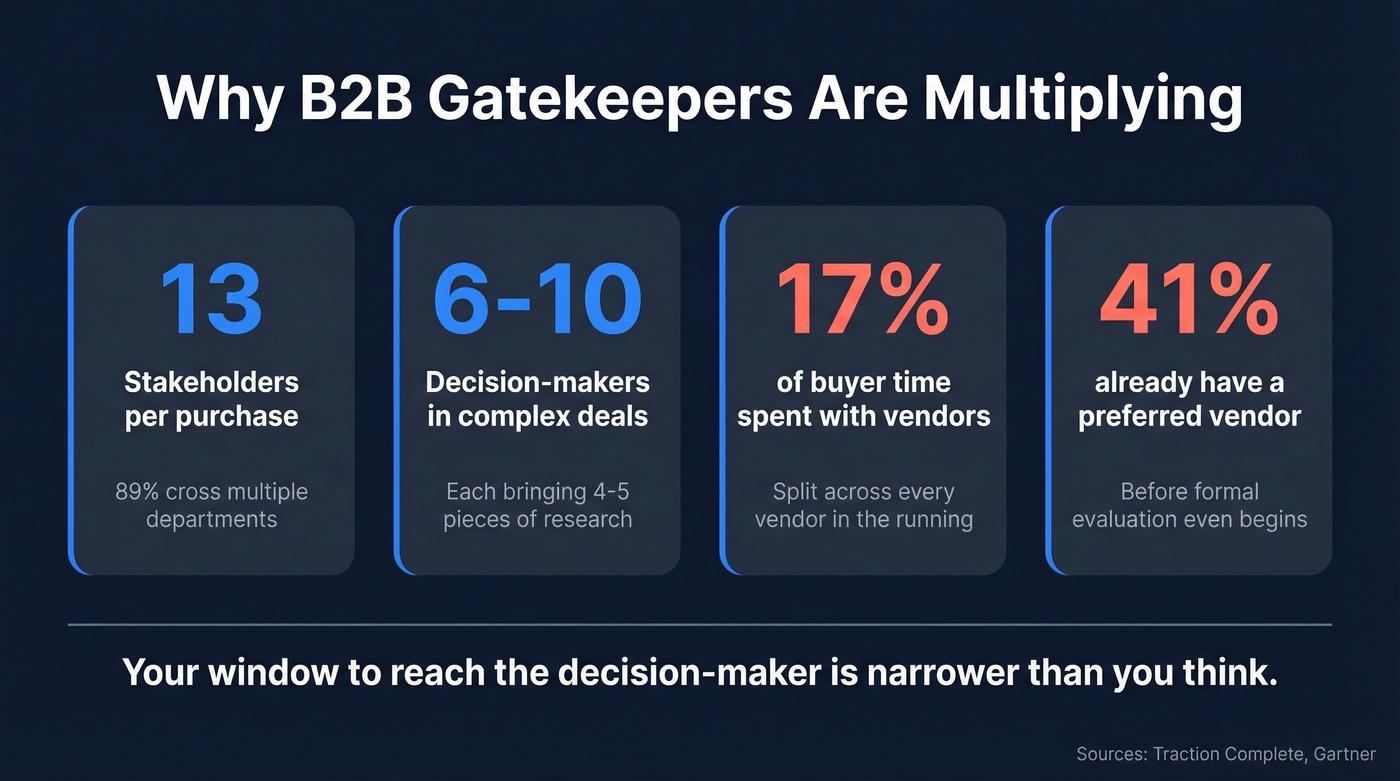
Your window is narrower than you think.
Thomas V. Bonoma's classic Harvard Business Review framework (1982) identified six buying-center roles that still hold:
| Role | Function |
|---|---|
| Initiator | Identifies the need |
| Influencer | Shapes requirements |
| Decider | Has budget authority |
| Purchaser | Executes the buy |
| User | Uses the product |
| Gatekeeper | Controls access |
Layer on remote work, AI receptionists, spam-labeled caller IDs, and flooded inboxes - the gatekeeper role isn't shrinking. It's multiplying across every channel.
7 Strategies to Navigate Gatekeepers
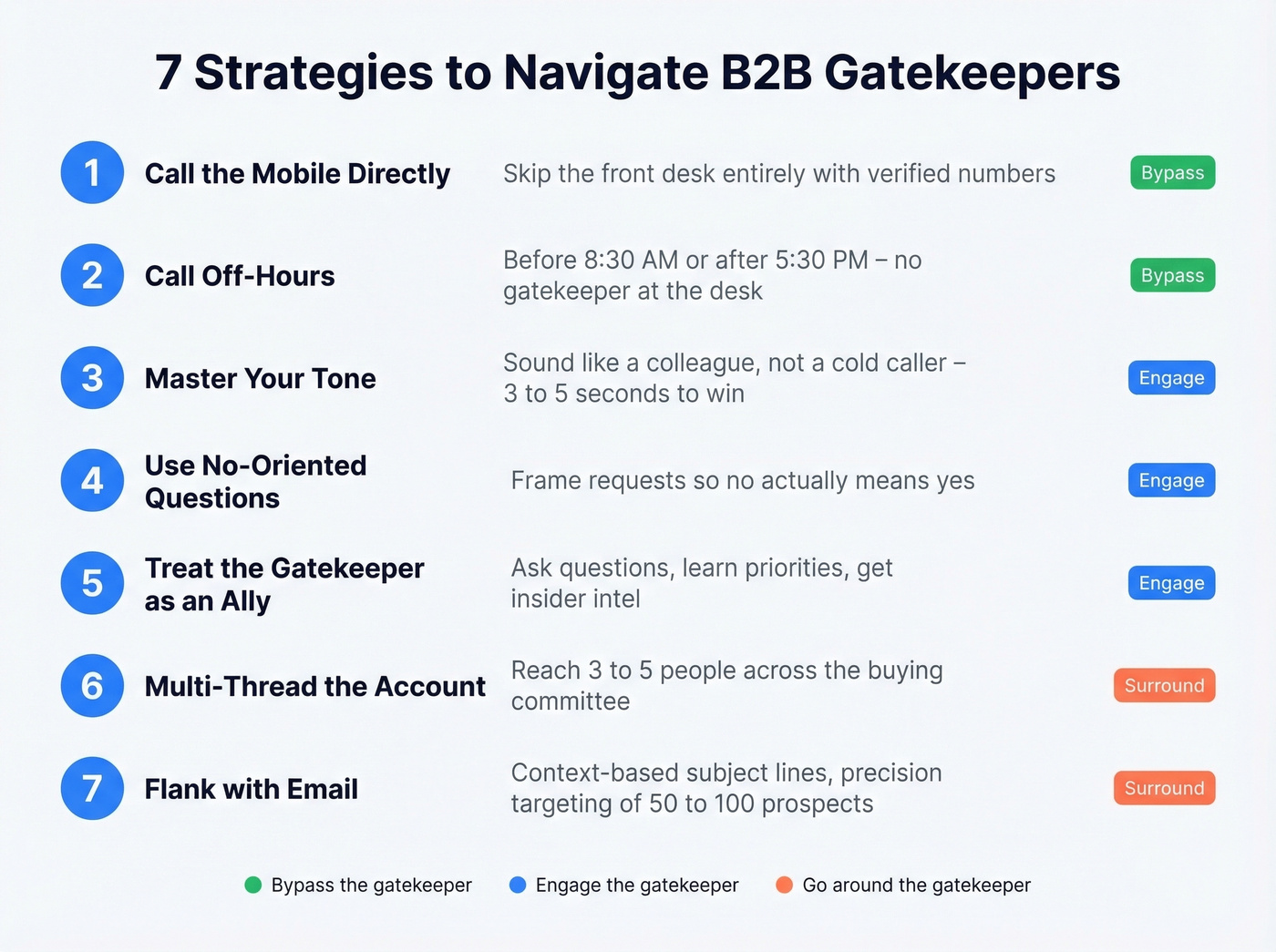
1. Call the Mobile Directly
The best strategy is making the gatekeeper irrelevant. Cognism calls this the "easiest and best way" to bypass screening, and they're right - calling a prospect's verified mobile sidesteps the front desk entirely. No IVR tree. No message-taking.
We've seen this play out with our own team's outbound. Prospeo maintains 125M+ verified mobile numbers with a 30% pickup rate, refreshed every 7 days. Data that's six weeks old - the industry average - means you're dialing dead numbers. At roughly $0.01 per email lead, it's one of the cheapest bypasses that exists.
2. Call Off-Hours
Before 8:30 AM or after 5:30 PM, the gatekeeper usually isn't at their desk. The decision-maker is more likely to pick up directly when the office is quiet. This is the simplest tactic most reps ignore because it means adjusting their schedule. But if you're serious about pipeline, shifting your call blocks by an hour in either direction pays for itself fast.
3. Master Your Tone
Gatekeepers decide whether to route or block you in 3-5 seconds. Tone is 80% of the battle. Sound like you belong - calm, direct, unhurried. The moment you sound like a cold caller reading a script, the gate closes. Think "colleague calling back," not "stranger asking for a favor."
4. Use No-Oriented Questions
Instead of asking for permission, frame your request so "no" moves you forward. "Would it be a terrible idea if I spoke with John for two minutes?" The gatekeeper's instinct is to say no - and "no, it wouldn't be terrible" is actually a yes. Small psychological shift, big results.
5. Treat the Gatekeeper as an Ally
Look - gatekeepers are the decision-maker's right hand. Don't work around them. Ask questions. Learn the team's priorities. A gatekeeper who likes you will tell you when to call back, what the decision-maker cares about, and whether you're wasting your time. That intel is worth more than getting transferred.
One distinction worth knowing: a gatekeeper controls access, but a blocker actively works against your deal - maybe they're championing a competitor or protecting their turf. Multi-threading is your defense against blockers. Charm won't work on someone who doesn't want you in the building.
6. Multi-Thread the Account
As SalesLoft SVP Derek Grant puts it, the worst mistake in B2B sales is staying single-threaded. If your only contact goes on vacation, changes roles, or gets blocked by internal politics, the deal dies. Reach out to 3-5 people across the buying committee. Arm influencers with comparison docs and one-pagers they can take to the decision-maker.
If you want a repeatable system for this, borrow from account-based selling and treat each stakeholder like a separate mini-deal.
7. Flank with Email
The subject line is the inbox gatekeeper. Short, context-based subjects win - "Congrats on the Series A" beats "Quick question about your sales stack." One team switched to a tight ICP targeting CMOs at mid-market firms post-Series A, referenced funding context in the opener, and hit ~70% open rates with ~20% reply rates. Precision targeting of 50-100 best-fit prospects beats blasting 5,000 names every time.
If you need ideas, start with proven email subject line examples and adapt them to your ICP.

Why fight gatekeepers when you can skip them? Prospeo's 125M+ verified mobile numbers connect you straight to decision-makers - no IVR trees, no "I'll pass that along." With a 30% pickup rate and data refreshed every 7 days (not the 6-week industry average), you're dialing numbers that actually ring.
Stop leaving voicemails. Start reaching direct dials at $0.01 per lead.
Scripts That Actually Work
In our experience, the voicemail-then-confirm play works best with enterprise prospects, but all three of these earn their keep:
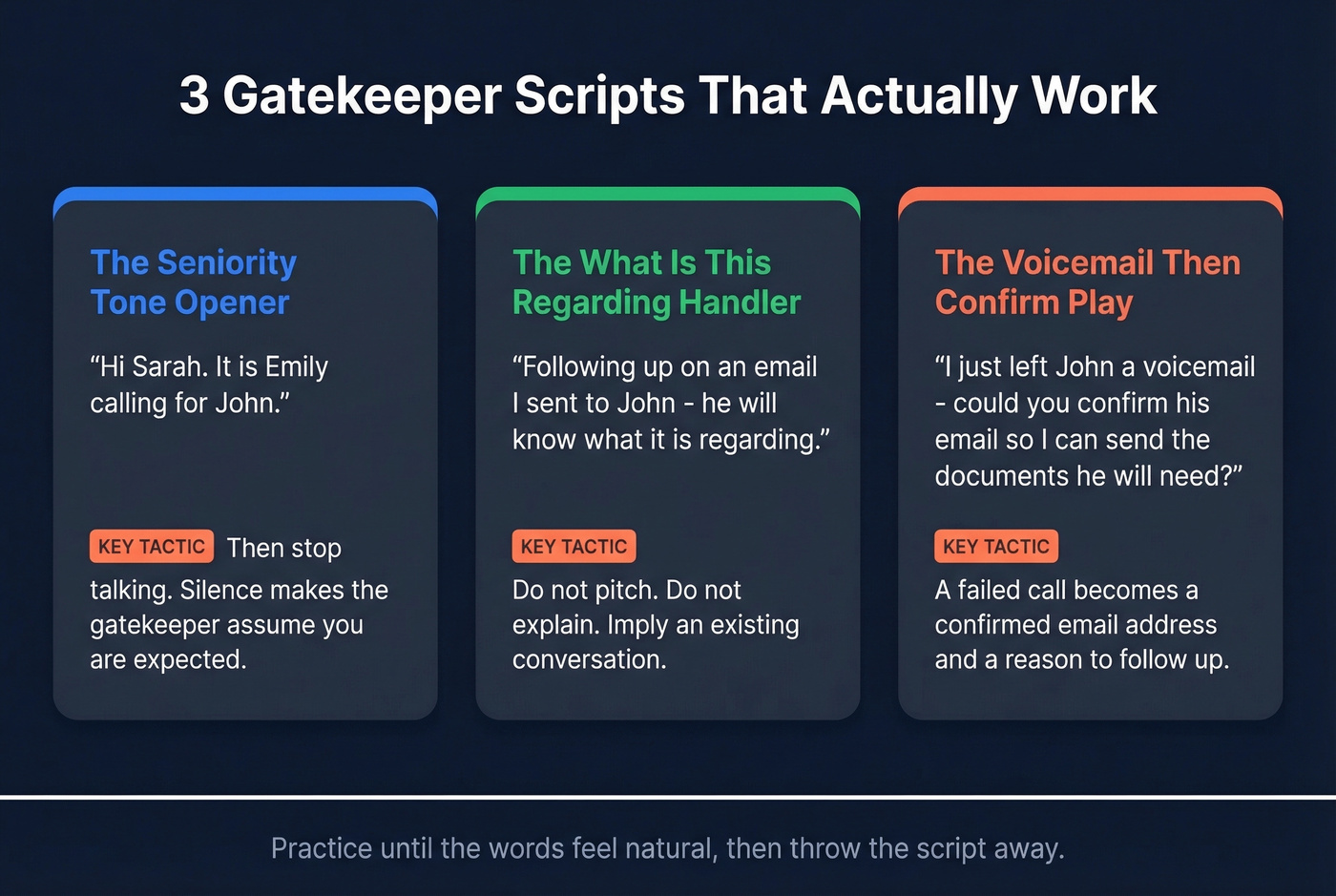
The seniority tone opener: "Hi Sarah. It's Emily calling for John." Then stop talking. Silence is the tactic. The gatekeeper assumes you're expected.
The "what is this regarding?" handler: "Following up on an email I sent to John - he'll know what it's regarding." Don't pitch. Don't explain. Imply an existing conversation.
The voicemail-then-confirm play: Leave a voicemail. Call back five minutes later. "I just left John a voicemail - could you confirm his email so I can send the documents he'll need?" A failed call becomes a confirmed email address and a reason to follow up.
Mistakes That Get You Blocked
| Don't | Do This Instead |
|---|---|
| Pitch the gatekeeper on features | State who you're calling for and why - one sentence |
| Ask for "the person in charge of marketing" | Use the decision-maker's first name |
| Get evasive about why you're calling | Give a clear, brief reason without a full pitch |
| Talk for more than 30 seconds | Name, reason, request - then stop |
| Read from a script | Practice until the words feel natural, then throw the script away |
Let's be honest: most reps know these rules intellectually. The problem is execution under pressure. Record yourself on five calls, listen back, and you'll catch every bad habit faster than any coaching session.
If you're building a full outbound motion, these sales prospecting techniques help you stack wins across calls, email, and social.
Targeting Gatekeepers as an Audience
There's a second, underused meaning of this strategy: deliberately targeting the people who influence a purchase on behalf of the end user.
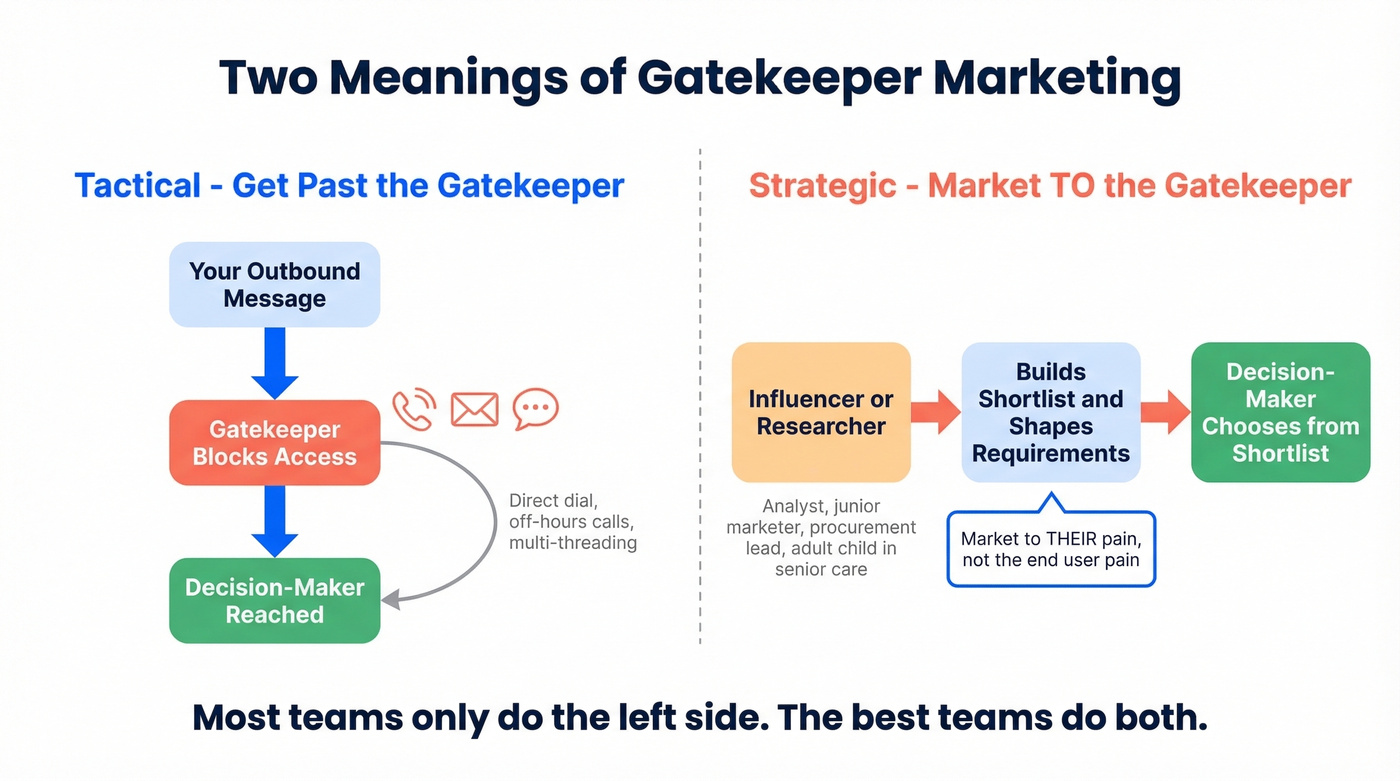
In senior care, the "gatekeeper" is often an adult child researching assisted living for a parent. They're not the end user, but they're doing the Google search, reading reviews, and making the shortlist. Marketing to their pain - "worried about Mom falling when no one's home" - rather than the end user's pain is the entire strategy. In B2B, the same dynamic plays out constantly. The analyst evaluating your category doesn't hold the budget, but their shortlist determines who gets the meeting. Skip them and you won't even know you lost.
This is where intent based segmentation and clean targeting matter more than clever copy.
For teams that want to find these researchers and influencers at scale, Prospeo's 30+ search filters - including buyer intent signals powered by Bombora across 15,000 topics - let you identify which influencers are actively researching solutions in your category right now. Pair that with 98% email accuracy and you're reaching the right person with a message that actually lands.
To keep those messages landing, it helps to understand email deliverability and the basics of improve sender reputation.
FAQ
What is a gatekeeper in marketing?
Any person or system controlling access to a decision-maker - receptionists, spam filters, IVR systems, or AI screeners. In audience strategy, gatekeepers are influencers who research and shortlist solutions on behalf of buyers.
How do you get past a gatekeeper on a cold call?
Call the prospect's verified mobile directly - this bypasses the front desk entirely. If you must go through the main line, call before 8:30 AM or after 5:30 PM with a confident, familiar tone.
What's the difference between a gatekeeper and a decision-maker?
Gatekeepers control access to the buying process; decision-makers hold budget authority. In Bonoma's framework, they're two of six distinct buying-center roles, and a single person can occupy multiple roles simultaneously.
Can you market directly to gatekeepers?
Yes - target influencers who research or purchase on behalf of end users. This approach is common in senior care, B2B SaaS evaluation, and healthcare procurement where the researcher and buyer are different people.
What tools help bypass gatekeepers?
Data platforms with verified mobile numbers and emails let reps reach prospects directly, skipping the front desk. Look for providers with weekly data refresh cycles and high accuracy rates - stale data means dialing numbers that no longer connect.
Multi-threading an account means reaching 3-5 contacts with verified data - not guessing at email formats. Prospeo's 300M+ profiles with 98% email accuracy and 30+ search filters let you map entire buying committees by role, seniority, and department. Arm every thread with the right contact on the first try.
Build your buying committee list in minutes, not days.