

Generect vs RocketReach: Which B2B Data Tool Deserves Your Budget?
Two tools, two different philosophies. Generect charges per email found and validates in real time, while RocketReach leans database-first - and those records can go stale fast. B2B contact data decays at roughly 33% per year. Pick the wrong tool and you're paying to prospect with dead emails.
30-Second Verdict
Pick Generect if you want pay-as-you-go pricing and real-time email validation with minimal bounce risk.
Pick RocketReach if you need the largest possible database, recruiting use cases, or native Outreach/Salesloft integration.
Feature Comparison at a Glance
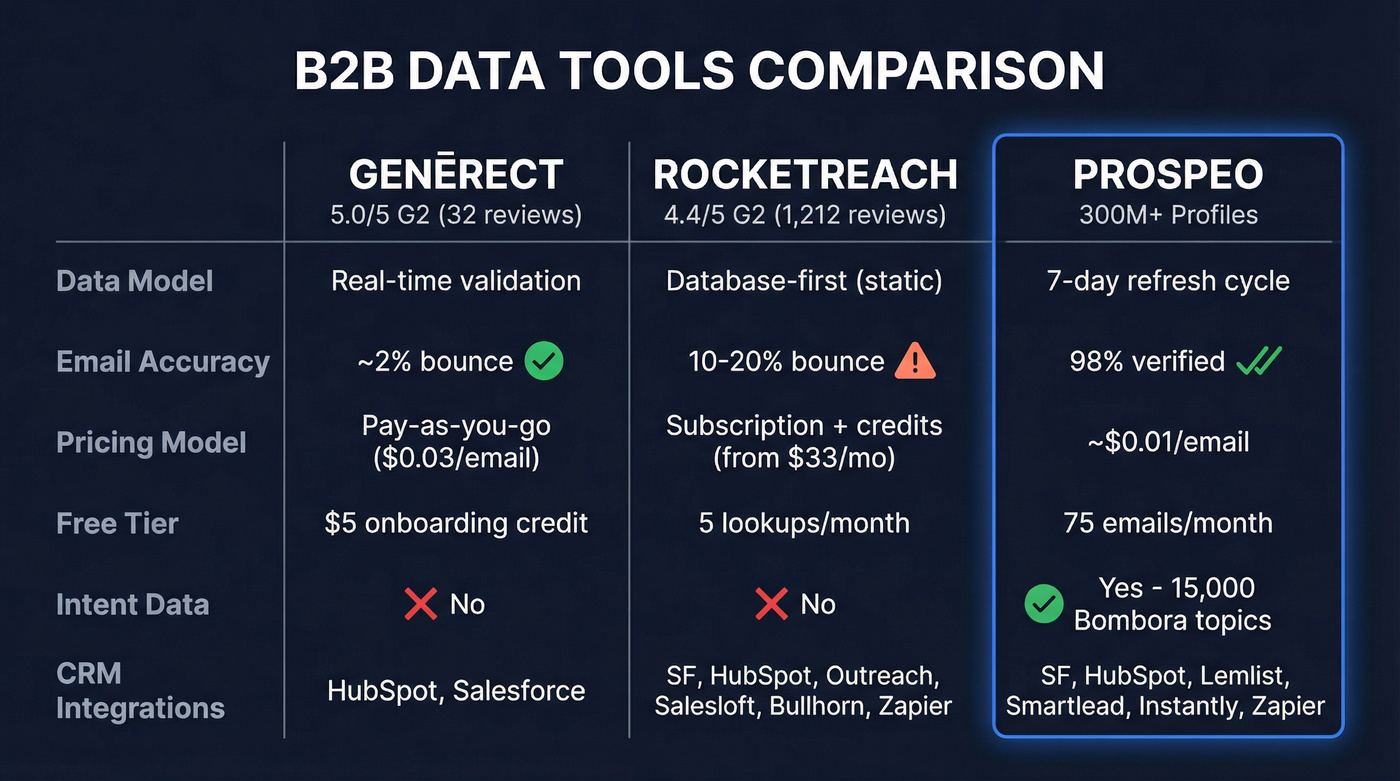
| G2 Rating | 5.0/5 (32 reviews) | 4.4/5 (1,212 reviews) | - |
| Database Size | Not disclosed | 700M+ profiles | 300M+ profiles |
| Data Model | Real-time validation | Database-first | 7-day refresh |
| Email Accuracy | ~2% bounce | 10-20% bounce (varies by niche) | 98% verified |
| Pricing Model | Pay-as-you-go | Subscription + credits | ~$0.01/email |
| Free Tier | $5 onboarding credit | 5 lookups/month | 75 emails/month |
| Chrome Extension | Yes | Yes | Yes (40,000+ users) |
| CRM Integrations | HubSpot, Salesforce | SF, HubSpot, Outreach, Salesloft, Bullhorn, Zapier | SF, HubSpot, Lemlist, Smartlead, Instantly, Zapier |
| Intent Data | No | No | Yes (15,000 Bombora topics) |
Data Quality Head-to-Head
Generect validates emails in real time - every search hits live data rather than pulling from a cache. Across 32 G2 reviews, data accuracy shows up 11 times as a positive theme, with bounce rates as low as 2%. That's a small sample, but the signal is consistent. We've found that real-time validation tools like Generect consistently return cleaner lists than static database pulls, and the user reviews back that up. If you're comparing verification-first tools, see our breakdown of email verification options.
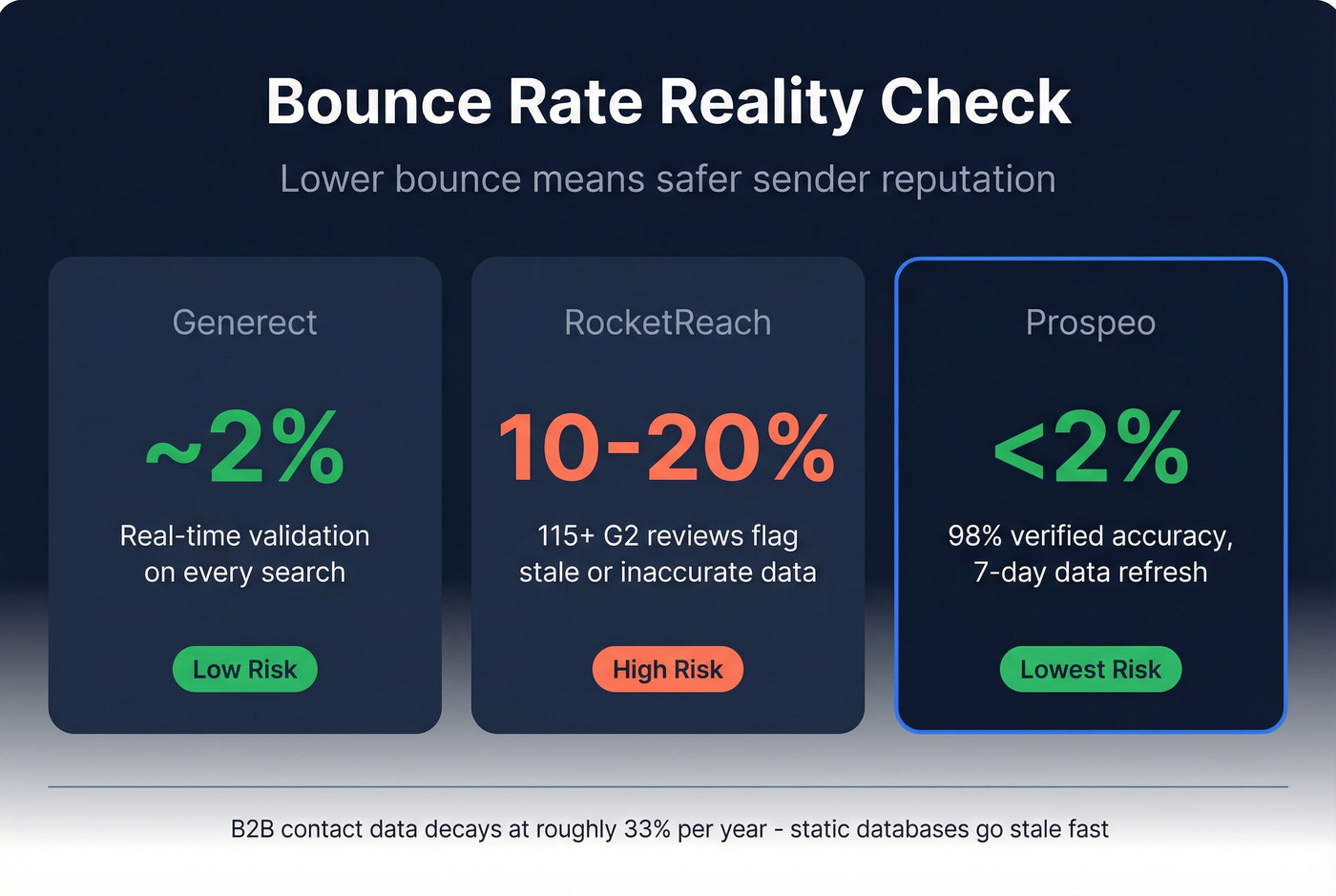
RocketReach has the volume advantage at 700M+ profiles and 35M companies, but volume doesn't equal accuracy. On G2, 115 reviews flag inaccurate data and 111 mention outdated contacts. Reddit sentiment tracks the same direction - one SMB sales team using HubSpot + RocketReach described the data as "frequently incorrect or incomplete."
Here's the thing: a 700M-profile database sounds impressive until 15% of your sends bounce. Real-time validation is a fundamentally different approach, and for outbound-heavy teams, it's the safer bet. If bounces are already hurting you, use these bounce rate benchmarks to sanity-check your list quality.

Generect validates in real time but won't disclose database size. RocketReach has 700M profiles but 115+ reviews flag stale data. Prospeo gives you 300M+ profiles refreshed every 7 days with 98% verified email accuracy - at $0.01 per email.
Stop choosing between accuracy and scale. Get both free.
Pricing Breakdown
Generect's model is dead simple. Searches are free. You pay $0.03 per valid email and $0.02 per export, and new accounts get a $5 credit. No subscription, no annual lock-in - just top up your wallet (minimum $20) and go. If you're building lists at scale, it helps to understand list building cost drivers beyond just per-email pricing.
RocketReach runs tiered subscriptions billed annually. Essentials starts at $33/mo with email-only access and 100 lookups/month (1,200/year), which is barely enough for a single SDR's weekly workflow. Pro jumps to $83/mo with email + phone and 3,600 lookups/year. Ultimate hits $207/mo for 10,000 lookups/year and API access. If you're evaluating other databases in this category, compare against the broader landscape of sales prospecting databases.
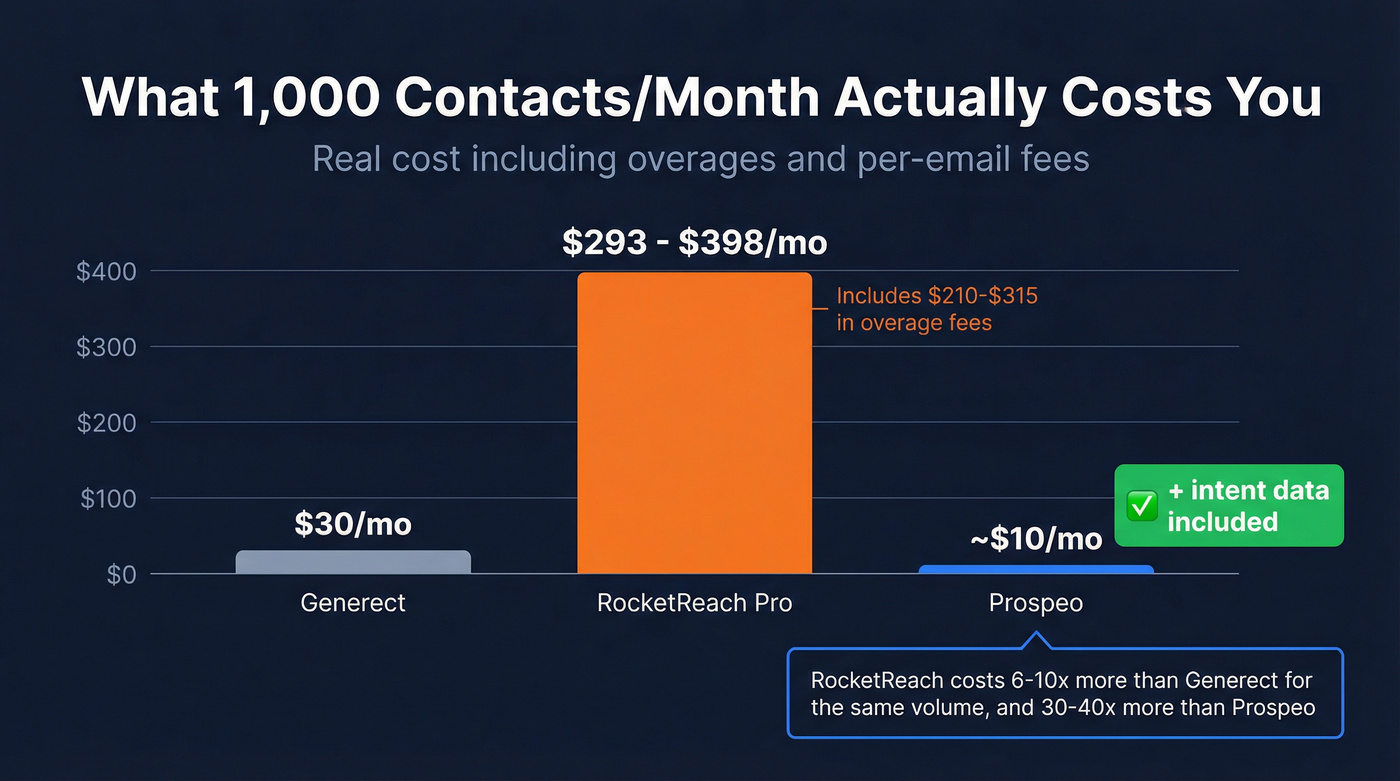
Now let's do the math that actually matters. Say you need 1,000 contacts per month. With Generect, that's roughly $30 for 1,000 valid emails, plus a bit more for exports. With RocketReach Pro, you get 300 lookups/month and the remaining 700 cost $210-$315 in overages at $0.30-$0.45/lookup - pushing your actual monthly spend to $293-$398. That's 6-10x more than Generect for identical volume, and the accuracy is worse. Ouch.
Integrations and Workflow
RocketReach wins on integration breadth. If your stack already includes Outreach, Salesloft, or Bullhorn, RocketReach connects to all three, plus Salesforce, HubSpot, and Zapier. For recruiting teams specifically, the Bullhorn integration is a differentiator nobody else in this comparison offers. If you're standardizing your stack, it can help to map this to your SDR tools and handoff process.
Skip RocketReach if you need built-in sequencing or bulk automation - it doesn't offer multichannel sequencing, so you'll be exporting contacts and pushing them into a separate tool. For outbound teams, pairing data with a solid cold email sequence matters as much as the source.
Generect integrates with HubSpot and Salesforce, but the ecosystem is thinner. Four reviews mention integration issues, which is notable when you've only got 32 reviews total. Test it during the free credit window before committing.
Who Should Pick Which
Generect fits if you prioritize low bounce rates over database size, want pay-as-you-go without annual commitments, run smaller-volume outbound under 2,000 contacts/month, and care more about data accuracy than integration breadth. If you're still dialing in targeting, start with an ideal customer profile so you’re not paying to validate the wrong people.
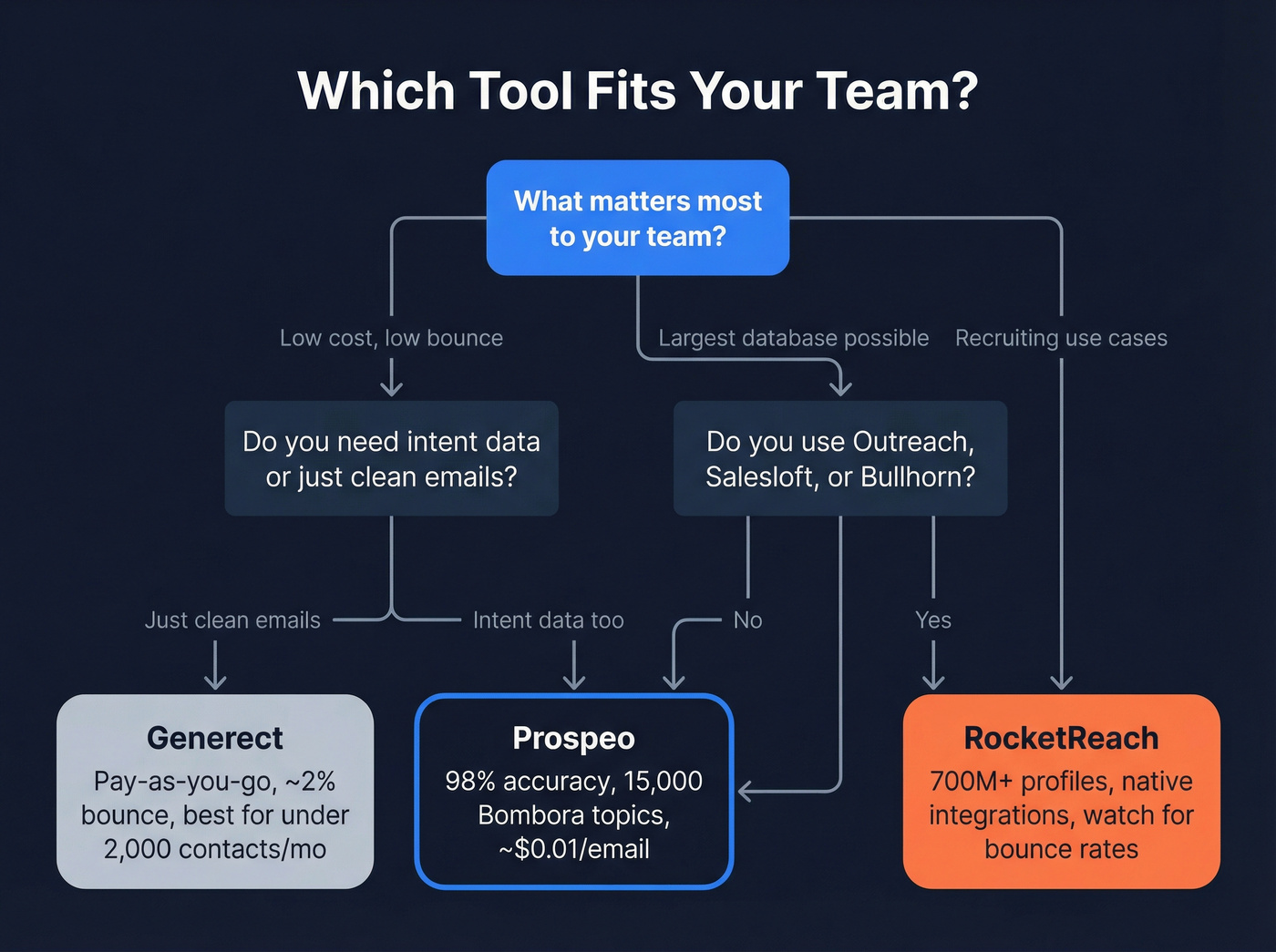
RocketReach fits if you need recruiting-grade contact search (the consensus on r/sales is that it's solid for finding passive candidates), want the largest possible database for broad prospecting, or already run Outreach/Salesloft and need native integration.
Let's be honest: if your average deal size sits below five figures, neither tool's accuracy gap will make or break your pipeline. But if you're running high-volume outbound where every bounced email chips away at your domain reputation, the data source matters more than the database size. We've seen teams torch sender domains in weeks because they trusted a stale database - don't be that team. If deliverability is a priority, follow a structured email deliverability guide and keep an eye on sender reputation.
If Neither Fits: Consider Prospeo
Neither Generect nor RocketReach offers intent data or hits 98% email accuracy. Prospeo does both - 300M+ professional profiles on a 7-day refresh cycle, plus 15,000 Bombora intent topics so you're targeting buyers already in-market. Pricing runs ~$0.01 per email with 75 free emails/month, no contracts, and GDPR compliance with opt-out enforcement and DPAs available. If you're comparing vendors in this lane, see our guide to data enrichment services.
Real results back it up: Snyk cut bounce rates from 35-40% to under 5% and grew AE-sourced pipeline 180% after switching. Stack Optimize built from $0 to $1M ARR while keeping client deliverability above 94% and bounce rates under 3% - zero domain flags across all clients. You get enterprise-grade accuracy without enterprise pricing, and you can start without talking to a sales rep.

At 1,000 contacts/month, you'd pay $30 with Generect or up to $398 with RocketReach - and neither offers intent data. Prospeo costs ~$10 for the same volume, adds 15,000 Bombora intent topics, and keeps bounce rates under 5% like it did for Snyk's 50-AE team.
Pay less per email than either tool and target buyers already in-market.
FAQ
How does data accuracy compare between Generect and RocketReach?
Generect delivers bounce rates around 2% through real-time validation. RocketReach typically lands in the 10-20% bounce range depending on niche, with 115+ G2 reviews flagging inaccurate data. For outbound campaigns, that accuracy gap compounds fast - every bounce hurts sender reputation and can land your domain on blocklists.
Does RocketReach offer a free plan?
RocketReach provides 5 free lookups per month - enough to test the interface, not enough for real prospecting. Paid plans start at $33/mo billed annually for email-only access with 100 monthly lookups.
Is Generect cheaper than RocketReach for high-volume prospecting?
Significantly. At 1,000 contacts/month, Generect costs roughly $30 while RocketReach Pro runs $293-$398 after overages. That's a 6-10x price difference for identical volume, making Generect the clear budget pick for teams scaling outbound.