

GetProspect vs Grata: 2026 Comparison Guide
A PE associate asks you to "find a tool like Grata but for email outreach." A sales rep asks for "something like GetProspect but with company intelligence." Both requests reveal the same confusion: the GetProspect vs Grata comparison doesn't really make sense because these tools don't compete. Comparing them is like comparing a fishing rod to a fish market - one helps you catch individual contacts, the other maps entire oceans of private companies.
Let's break this down so you can stop wasting time evaluating the wrong tool.
30-Second Verdict
Sourcing M&A deals or mapping private markets? Grata. It covers 21M+ private companies with a 4.8/5 G2 rating, and nothing in GetProspect's world touches that.
Need affordable email finding for outbound prospecting? GetProspect has a free plan, and paid plans start at $49/mo. It keeps the same feature access across tiers - limits scale by volume, not functionality.
Skip both if your core need is verified contact data with high deliverability. Prospeo delivers 98% email accuracy at roughly $0.01/email with no contract and a free tier to prove it.
What Is Grata?
Grata is a private market intelligence platform built for dealmakers - PE firms, investment banks, and corporate development teams hunting acquisition targets. Its proprietary dataset covers 21M+ private companies, and its search engine matches against a company's entire website rather than just industry codes or short descriptions. The "Similar Search" feature uses qualitative and quantitative website factors to surface lookalike companies, which is a meaningful edge when you're trying to find bootstrapped industrial services businesses in the Midwest doing $5-15M in revenue.

Grata joined Datasite in 2025 as part of a $500M commitment to data and intelligence, merging with Sourcescrub to deepen private market coverage. Recent launches include Agentic Search (released Q4 2025) and expanded European coverage pulling from Companies House, INSEE, and Handelsregister filings, plus a Filings Lookup tool covering 25+ countries. The platform also runs an on-demand Contact Enrichment Program where users can request executive contact searches for up to 1,500 companies per week.
Typical users report 2-6x more deals and a 30% efficiency gain in sourcing workflows. The 1,000+ customer base and that 4.8/5 rating across 79 reviews signal real traction in the deal sourcing space. Pricing isn't public - expect $10k-$100k/year depending on seats, CRM integration, and add-ons.
What Is GetProspect?
GetProspect is a straightforward email finder. You search its 18M-contact database or use the Chrome extension to grab emails while browsing professional profiles and other websites, then export contacts to your CRM or sequencer. Plans differ by quantity, not feature access.
Here's how the tiers break down:
- Free: 50 valid emails, 100 verifications
- Starter: $49/mo for 1,000 valid emails
- Growth 5k: $99/mo for 5,000 valid emails

Annual billing saves 30%, credits roll over up to one month's allowance, and you're never charged for duplicates. One detail worth knowing: emails found through GetProspect's own search are pre-verified and don't count against your verification credits - a distinction that matters at scale. Reviewers rate it 4.0/5 across 41 reviews, praising the simplicity and affordability while flagging inconsistent email accuracy and more limited database coverage than larger platforms.

Both Grata and GetProspect share the same weakness: contact accuracy gaps that cost you deals and domain reputation. Prospeo covers 300M+ profiles with 98% email accuracy, refreshed every 7 days - not every 6 weeks. At ~$0.01/email, it's the accuracy layer that makes either tool actually work.
Stop burning sender domains on unverified data.
Side-by-Side Feature Comparison
| Category | Grata | GetProspect |
|---|---|---|
| Primary purpose | Deal sourcing & M&A | Email finding |
| Target buyer | PE, IB, corp dev | SDRs, sales teams |
| Database type | Companies | Contacts |
| Database size | 21M+ companies | 18M contacts |
| Pricing model | Annual, quote-based | Monthly, self-serve |
| Entry price | ~$10k/yr+ | Free ($0) |
| Chrome extension | Company enrichment (employee count, ownership, funding stage) | Email finding from profiles and websites |
| CRM integration | Basic push; advanced bi-directional sync available | Standard CRM integrations |
| G2 rating | 4.8/5 (79 reviews) | 4.0/5 (41 reviews) |
| Best for | M&A deal sourcing | Outbound email finding |
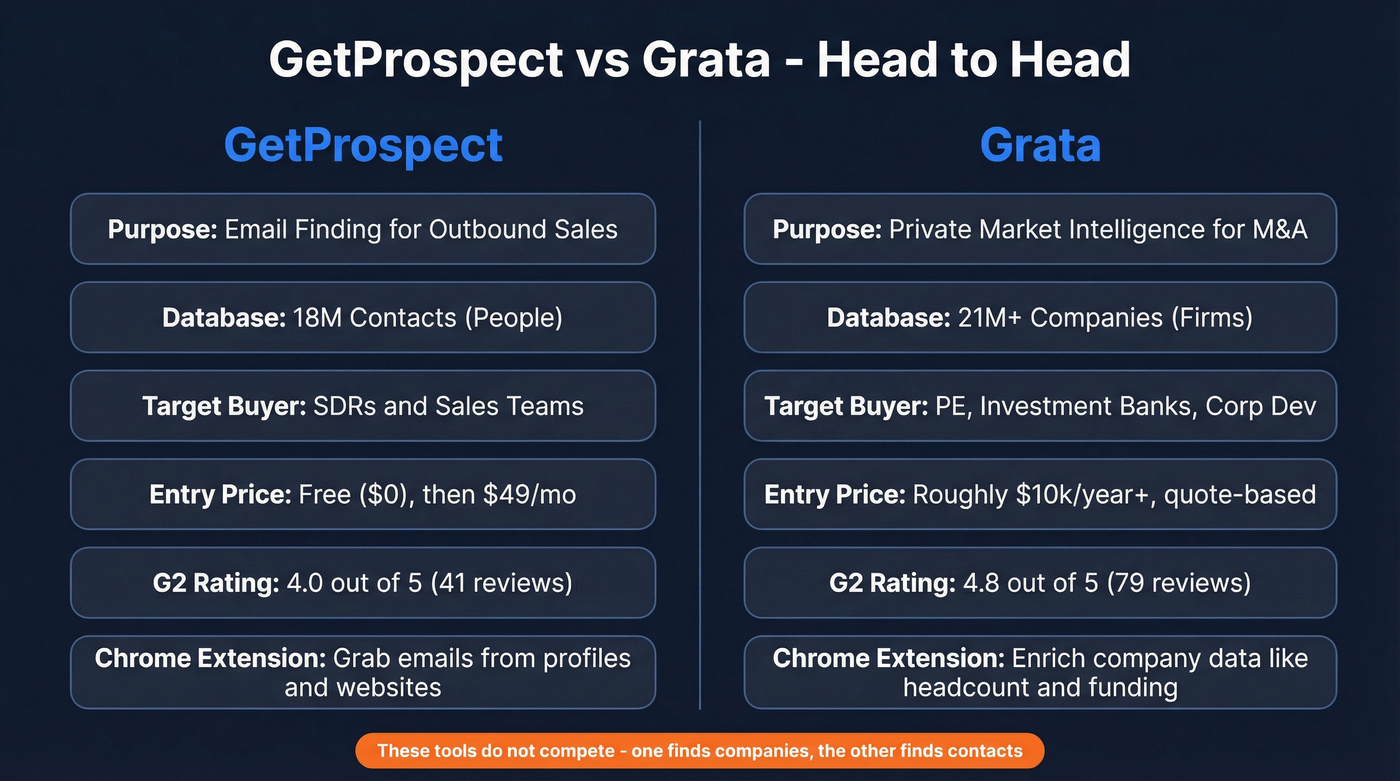
This table almost shouldn't exist. These tools occupy entirely different categories. Grata helps you identify which companies to pursue. GetProspect helps you find email addresses for people at companies you've already identified. One feeds the other. They don't replace each other.
The Contact Data Gap
Both tools share a documented weakness: contact accuracy. Across 79 reviews, Grata's most common complaint theme is data inaccuracy (18 mentions), with users calling out contact gaps for smaller companies. GetProspect reviewers flag inconsistent email accuracy leading to bounces - a problem that compounds fast when you're running cold outbound at scale.
If you're actively working on lead enrichment or data enrichment services, this is the exact failure mode to watch: the tool can be great at discovery, but weak at verification.
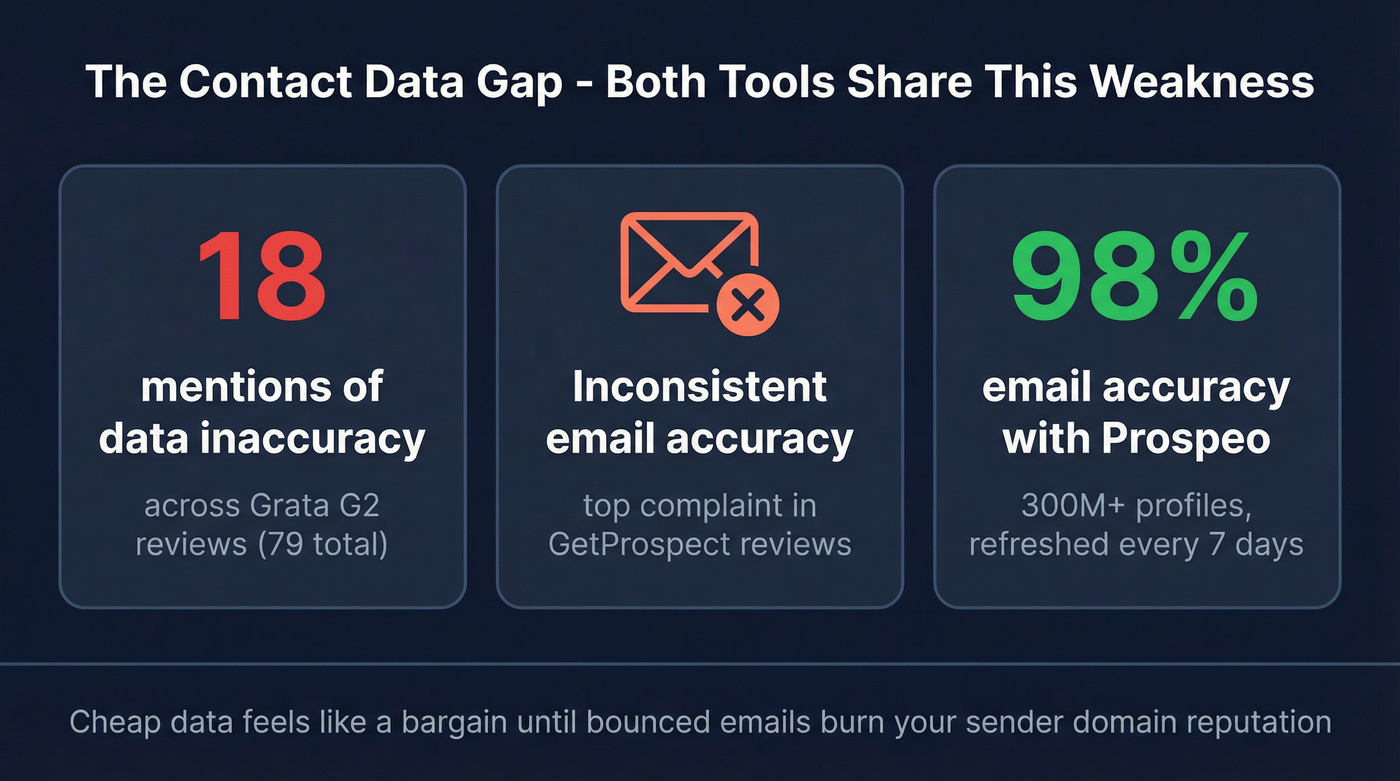
Here's the thing: if your deal size sits below $50k, you probably don't need Grata-level intelligence or GetProspect-level simplicity. You need accurate emails and direct dials, full stop. We've seen teams burn through sender domains chasing volume with tools that can't verify properly. Prospeo covers 300M+ professional profiles with 98% email accuracy and a 7-day data refresh cycle - at roughly $0.01/email, it's the accuracy layer you pair with whatever sourcing tool you're already using.
If bounces are already creeping up, fix the root cause with an email deliverability guide and track your email bounce rate before scaling volume.

Which Tool Fits Your Workflow?
PE/IB analyst mapping acquisition targets: Grata, no question. Nothing in GetProspect's feature set helps you find bootstrapped companies by revenue range, ownership type, or market fragmentation. In our experience, the teams that get the most from Grata pair it with a dedicated email verification tool - Grata finds the companies, the verification tool ensures you actually reach the executives.
If you're building a repeatable outbound motion around those targets, align it with proven sales prospecting techniques and a clean lead generation workflow.
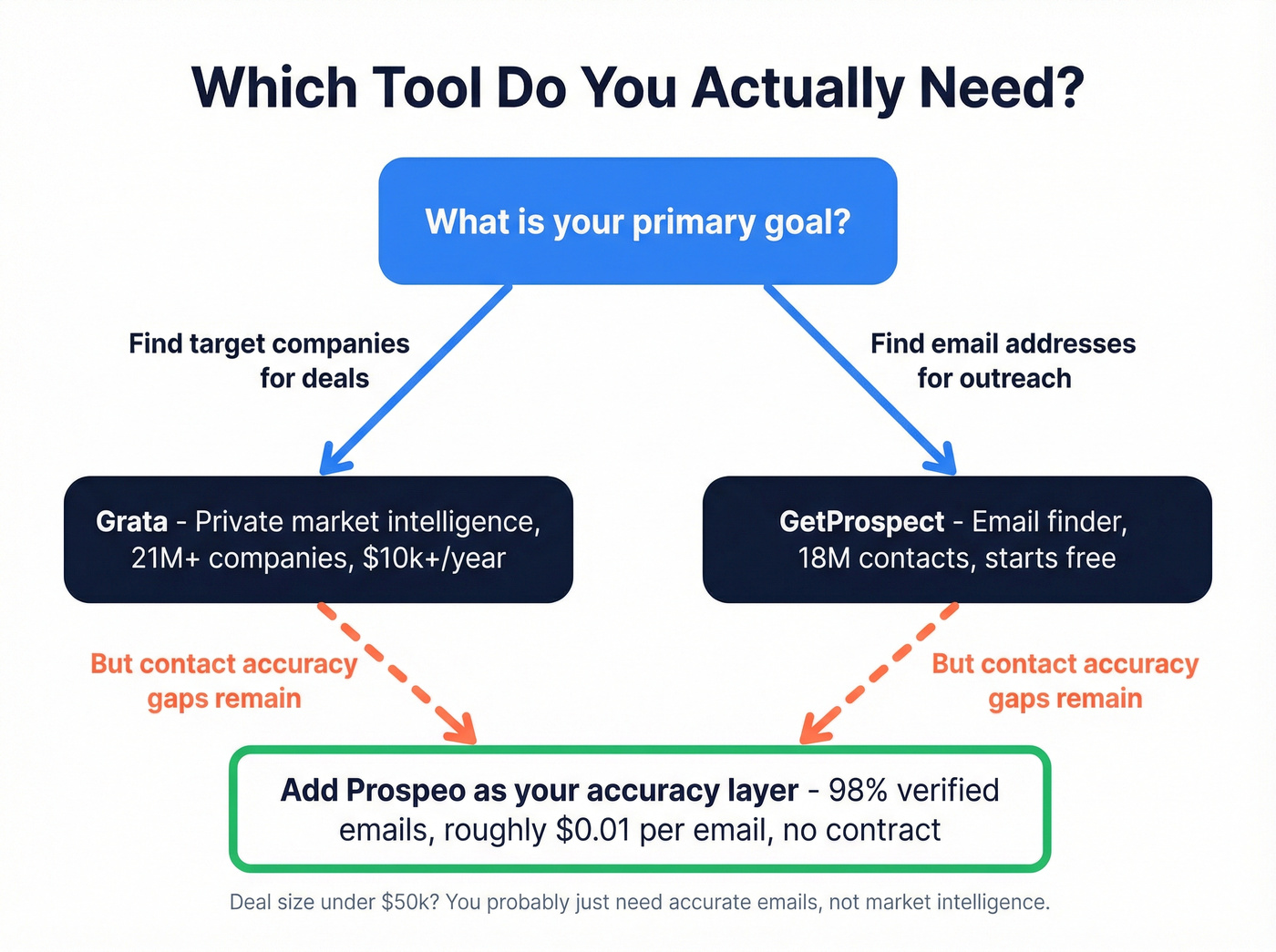
SDR running outbound sequences: GetProspect works if budget is tight and volume is low. For teams scaling past a few hundred emails per week, the accuracy gaps start costing more than the subscription saves. The r/sales community tends to echo this - cheap data feels like a bargain until your domain reputation tanks.
To keep reply rates up while you scale, tighten your B2B cold email sequence and use battle-tested cold email follow-up templates.
Grata maps 21M+ private companies. Prospeo verifies emails across 300M+ contacts. Pair deal intelligence with the deliverability layer your outreach actually needs - 98% accuracy, 125M+ verified mobiles, and a free tier with 75 emails/month to prove it.
Find the company in Grata. Reach the buyer with Prospeo.
FAQ
Is Grata an email finder?
No. Grata is a private market intelligence platform for M&A dealmakers. It includes executive contacts within company profiles, but contact finding isn't its core function. For outreach at scale, pair it with a dedicated email finder.
Can I use Grata and GetProspect together?
They don't overlap, so yes - Grata identifies target companies, and you'd use an email finder for outreach contacts. The key is pairing Grata with whichever email tool gives you the highest deliverability, since Grata's own contact data has known gaps for smaller companies.
What's the cheapest way to get verified B2B emails?
Several email finders offer free tiers ranging from 50-75 verified emails per month. Prospeo's free plan includes 75 emails with full verification; GetProspect offers 50. Paid plans across the category run roughly $0.01-$0.05 per email. The real cost isn't the subscription - it's bounced emails burning your sender domain reputation.