

Go-to-Market (GTM) Strategy Playbook: Frameworks, Benchmarks, and Mistakes to Avoid in 2026
Your CEO wants a GTM plan by Friday. You've got a product that works, a team that's ready, and exactly zero alignment on who you're selling to, how you're pricing it, or which channels to prioritize. That's not a launch - it's a coin flip.
A go-to-market GTM strategy is the cross-functional system that connects your product to the people who'll pay for it. It covers your ICP, positioning, pricing, channels, sales motion, and the metrics that tell you whether any of it's working. Think of it as the operating plan that sits between "we built something" and "we have revenue."
Here's what you need, quick version: validate your ICP with 15 interviews before you do anything else, pick your GTM motion using the ACV framework below, and build a clean, verified prospect list and start selling. Everything else - the messaging docs, the enablement decks, the Slack debates about positioning - is secondary to those three things.
What's Changed for GTM in 2026
A few shifts are reshaping how companies go to market, and ignoring them will cost you quarters of wasted effort.
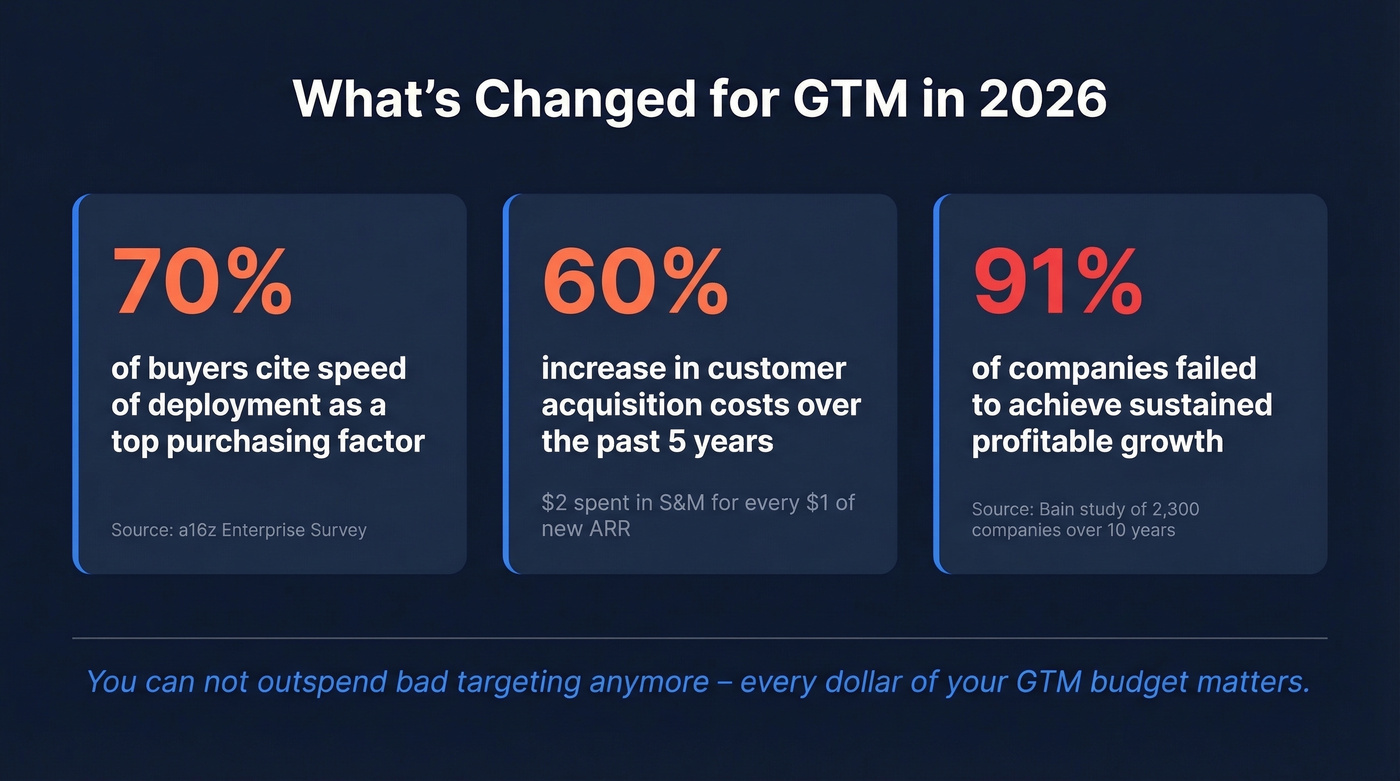
Buyers want speed, not pilots. An a16z enterprise survey found that 70% of buyers cite speed of deployment as a top purchasing factor. In AI sales especially, demo-first evaluation is replacing traditional POC-heavy cycles. The best GTM teams now prove value in the first meeting - sandbox environments seeded with real or synthetic data, live demos that mirror the buyer's actual workflow. If your process delays time-to-value, you're losing to someone who can show results immediately.
CAC keeps climbing. Customer acquisition costs have increased 60% over the past five years. The median SaaS company now spends roughly $2 in sales and marketing for every $1 of new ARR - and that ratio rose 14% in 2024. You can't outspend bad targeting anymore. Every dollar matters, which means your ICP definition and channel selection need to be sharper than ever.
Trust is a differentiator, not a checkbox. Buyers are asking harder questions about data handling, compliance, and security - especially for AI-powered tools. Red-teaming, SOC 2, GDPR compliance, and transparent data practices aren't optional. They accelerate or kill deals.
Here's the uncomfortable context: a Bain study of 2,300 global companies over a decade-long period found that only 9% achieved sustained profitable growth. The other 91% had strategies. They just didn't have systems that adapted fast enough.
GTM Strategy vs. Marketing Plan
These get conflated constantly, and the confusion creates real problems.
A GTM strategy is a time-bound, cross-functional system for launching a product or entering a new market. A marketing plan is the ongoing demand-generation playbook that runs after launch. They're related, but they aren't the same thing, and treating them interchangeably means marketing ends up owning decisions - pricing, sales motion, channel mix - that should involve product, sales, and leadership.
| Dimension | GTM Strategy | Marketing Plan |
|---|---|---|
| Scope | Full launch system | Demand generation |
| Timeframe | 3-6 month sprint | Ongoing / annual |
| Ownership | Cross-functional | Marketing team |
| Output | Revenue from new market | Pipeline & awareness |
Your go-to-market strategy decides who you're selling to and how. Your marketing plan decides how you keep filling the funnel once the motion is running.
How to Choose Your GTM Motion
This is where most teams overthink it. Your ACV tells you which motion to run. Everything else is refinement.
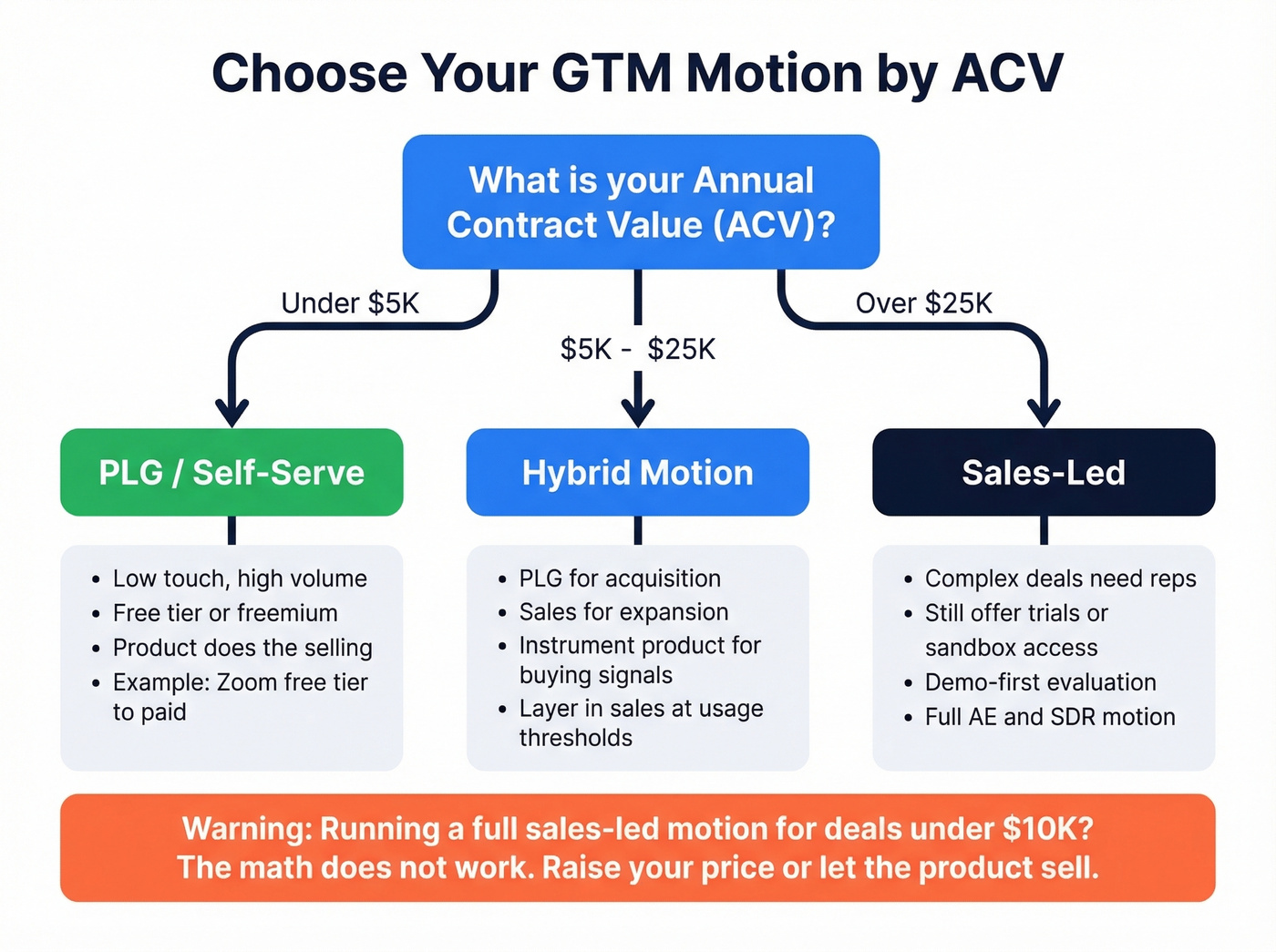
| ACV Range | Recommended Motion | Why |
|---|---|---|
| Under $5K | PLG / self-serve | Low touch, high volume |
| $5K-$25K | Hybrid | PLG for acquisition, sales for expansion |
| Over $25K | Sales-led | Complex deals need reps |
PLG is a distribution mechanism, not a strategy. It's how people discover and try your product. It doesn't replace positioning, ICP work, or sales enablement. Zoom is the clearest proof - per their 2019 10-K, 55% of customers contributing over $100K in revenue started with at least one free host. PLG got them in the door. Sales closed the enterprise deal.
Hybrid GTM only works if you actually instrument the product to surface buying signals. If your "hybrid" motion means a free tier nobody monitors and a sales team that ignores product usage data, you've built two disconnected motions and called it a strategy.
For teams in the $5K-$25K range, let the product drive initial adoption - free tiers, trials, self-serve onboarding - then layer in sales-assisted expansion when accounts hit usage thresholds or show buying signals. The mistake is picking one motion and ignoring the other. Pure PLG leaves enterprise money on the table. Pure sales-led ignores the reality that many B2B buyers want to evaluate on their own before they talk to a rep.
Above $25K ACV, sales-led is the right call, but that doesn't mean gating everything behind a demo request. Offer trials or sandbox access for evaluation. The demo-first approach a16z describes isn't just for AI companies - it's becoming a default expectation across enterprise software.
Look, if you're closing deals under $10K and running a full sales-led motion with SDRs, AEs, and a 45-day cycle, you're probably burning cash. The math doesn't work. Either raise your price or let the product do the selling.

CAC is up 60% in five years. The fastest fix? Stop wasting outbound on bad data. Prospeo gives you 300M+ profiles with 30+ filters - buyer intent, technographics, funding, headcount growth - so your GTM motion targets the right ICP from day one. 98% email accuracy. $0.01 per lead.
Sharpen your ICP targeting before you burn another quarter.
How to Build a Go-to-Market Strategy
Before jumping into the steps, figure out which growth quadrant you're in. The Ansoff Growth Matrix frames this well: are you launching a new product into an existing market, taking an existing product into a new market, or going full greenfield? Each requires different depth. A new product in an existing market can lean on existing customer relationships and do less channel validation. A new-market entry needs the full playbook below.
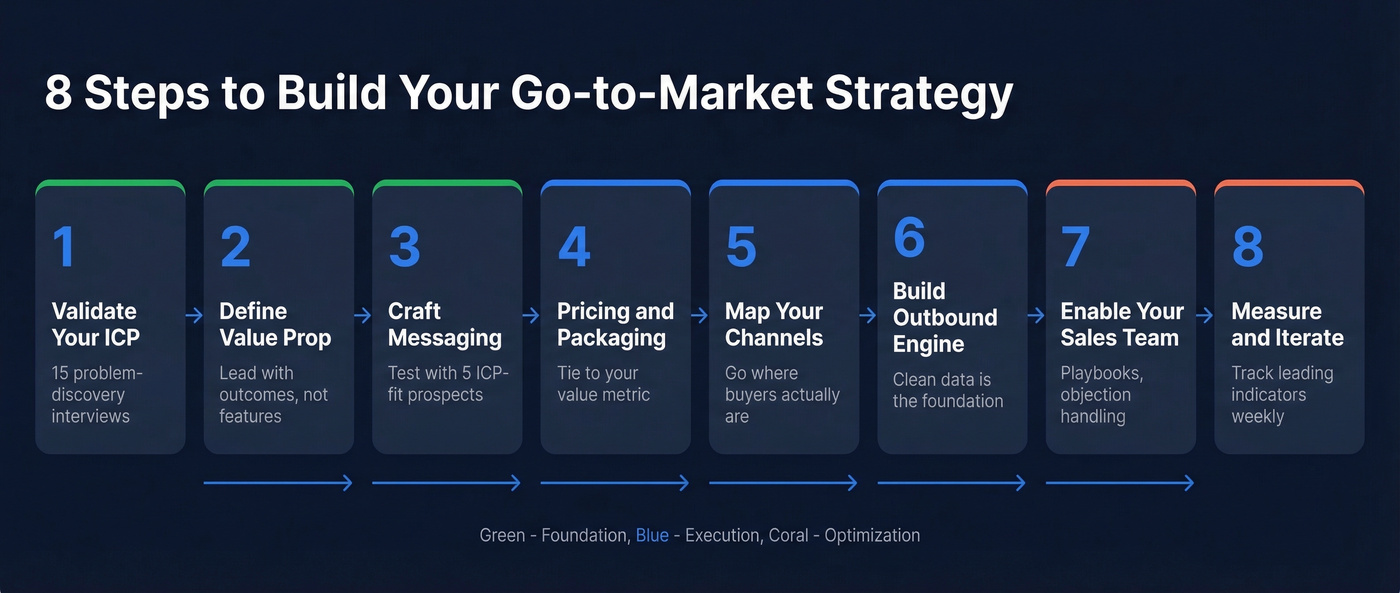
Eight steps. Some take a week, some take an afternoon. The order matters.
Validate Your ICP
Skip this and everything downstream breaks. We've seen teams burn entire quarters running outbound to the wrong persona because nobody talked to actual buyers first.
Run 15 problem-discovery interviews: 5 with existing customers if you have them, 5 with competitor customers, and 5 from your target market. If 8 or more describe the same pain in similar language, you've got signal. Fewer than that means your ICP hypothesis needs work.
Use the a16z five-question framework to pressure-test your definition: Which customers get the most value? What traits do your best customers share? What objections come up in lost or churned deals? Who's easiest to upsell, and why? What do competitor customers have in common?
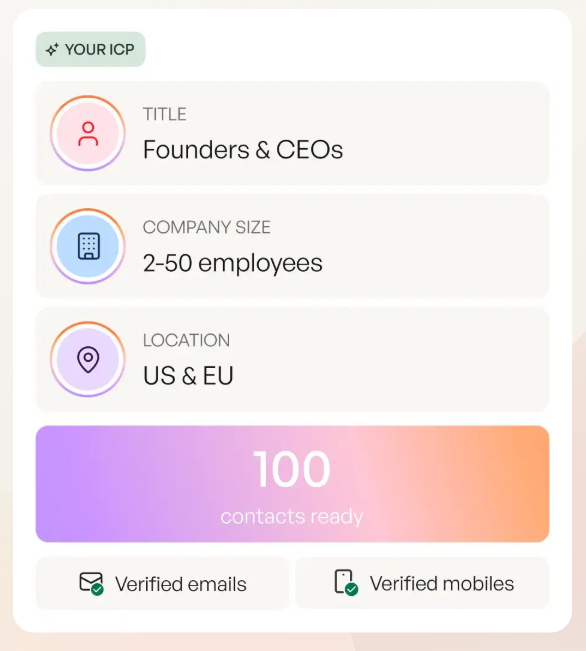
Build a one-page ICP card with these fields: industry, company size, ARR range, tech stack, buyer title, trigger event, core pain, dream outcome, and proof points. This card becomes the single source of truth for every downstream decision - messaging, channel selection, pricing, and sales enablement. Tape it to the wall. Seriously.
Define Your Value Proposition
Feature-led positioning is the default, and it's almost always wrong. "We offer AI-powered analytics with real-time dashboards" tells the buyer what you built. It doesn't tell them why they should care.
If you want a deeper positioning system, treat this like B2B brand positioning: pick a category, define the contrast, and make the tradeoffs explicit.
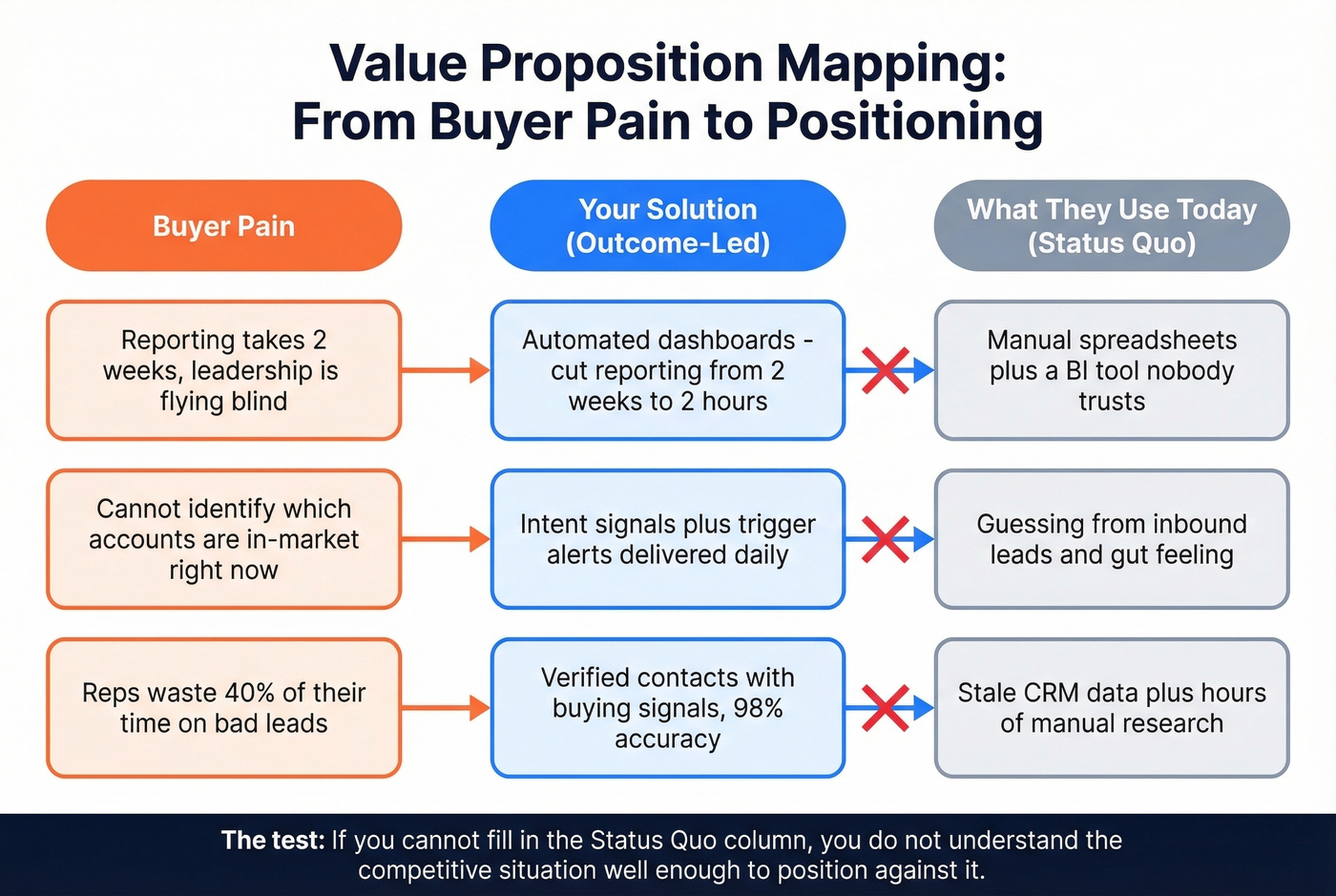
Lead with outcomes. "Cut your reporting cycle from 2 weeks to 2 hours" beats a feature list every time. Then use contrast positioning - define what you are by what you replace. "We're not another BI tool. We're the reporting layer your ops team actually uses." That contrast gives buyers a mental anchor.
A simple value mapping matrix sharpens this fast:
| Buyer Pain | Your Solution | What They Use Today |
|---|---|---|
| Reporting takes 2 weeks | Automated dashboards, 2-hour cycle | Manual spreadsheets + BI tool |
| Can't identify in-market accounts | Intent signals + trigger alerts | Guessing from inbound leads |
| Reps waste time on bad leads | Verified contacts with buying signals | Stale CRM data + manual research |
If you can't fill in the "What They Use Today" column, you don't understand the competitive situation well enough to position against it.
Craft Your Messaging
Your messaging has one job: make the buyer feel like you understand their problem better than anyone else. The failure mode is sounding interchangeable with competitors. Swap your company name for a competitor's - if the messaging still works, it's not specific enough.
Test message-market fit by running your core pitch past 5 ICP-fit prospects. If they can repeat back the value prop in their own words, you're close. If they look confused or default to "so it's like [competitor]?", you need another pass.
If you need a fast starting point for the actual words, pull from these sample elevator pitches and adapt them to your ICP language.
Pricing and Packaging
Pricing isn't a finance exercise - it's a GTM lever. Your price point determines your motion, your sales cycle length, and your unit economics. Get it wrong and you'll either leave money on the table or price yourself out of deals you should win.
Tie packaging to the value metric your buyer cares about. Seats, usage, outcomes - pick the one that scales with the value they receive. And don't treat pricing as set-and-forget. Revisit it every quarter for the first year.
Map Your Channels
Default channel selection kills GTM plans. "We'll do content, LinkedIn ads, and cold email" isn't a channel strategy - it's a checklist copied from a blog post.
If you're building around outbound, it helps to map channels to a repeatable lead generation workflow so you can see where the bottlenecks actually are.
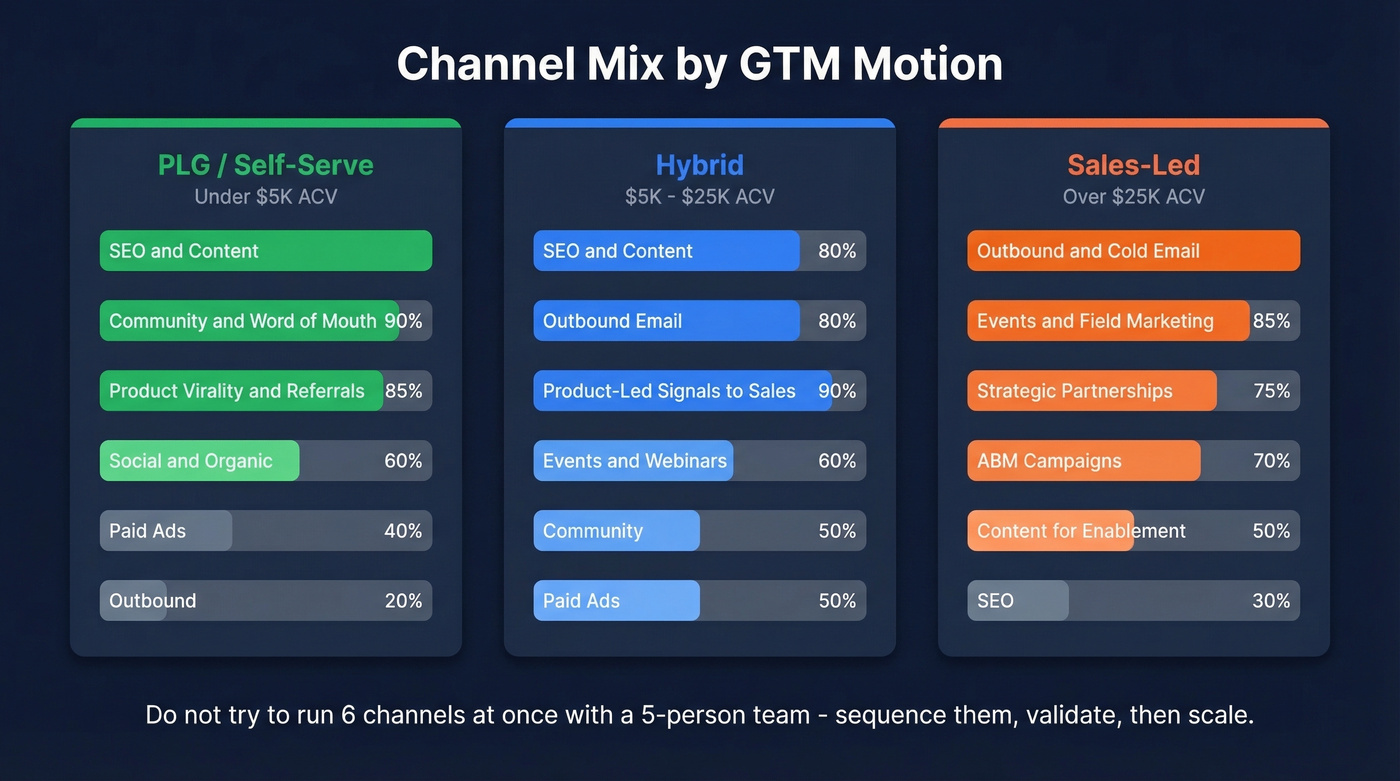
Design your channel mix around where your buyers actually spend time and how they make decisions. For sales-led motions, outbound and events typically drive the most pipeline. For PLG, SEO, community, and product virality matter more. For hybrid, you need both - but sequence them. Don't try to run six channels at once with a five-person team.
One tactic worth stealing from Clay's early GTM: they joined the Slack and WhatsApp groups where their ICP hung out, set up keyword notifications using tools like Syften, and responded to relevant conversations in real time. That's not scalable forever, but it's how they found their first wedge - and it works for any team trying to validate channels before committing budget.
Build Your Outbound Engine
Your strategy is a plan. Outbound is where the plan meets reality.
The single biggest execution risk in outbound isn't your messaging or your sequences - it's your data. A 30% bounce rate doesn't just waste sends. It tanks your domain reputation, which means even your good emails stop landing in inboxes. We've watched teams debug "low reply rates" for weeks before realizing the problem was deliverability, not copy. The consensus on r/coldemail is consistent: teams routinely overspend on sequencing and personalization while their lists are full of dead emails.
If you want the deeper mechanics, start with email bounce rate and work backward into list quality and sending practices.
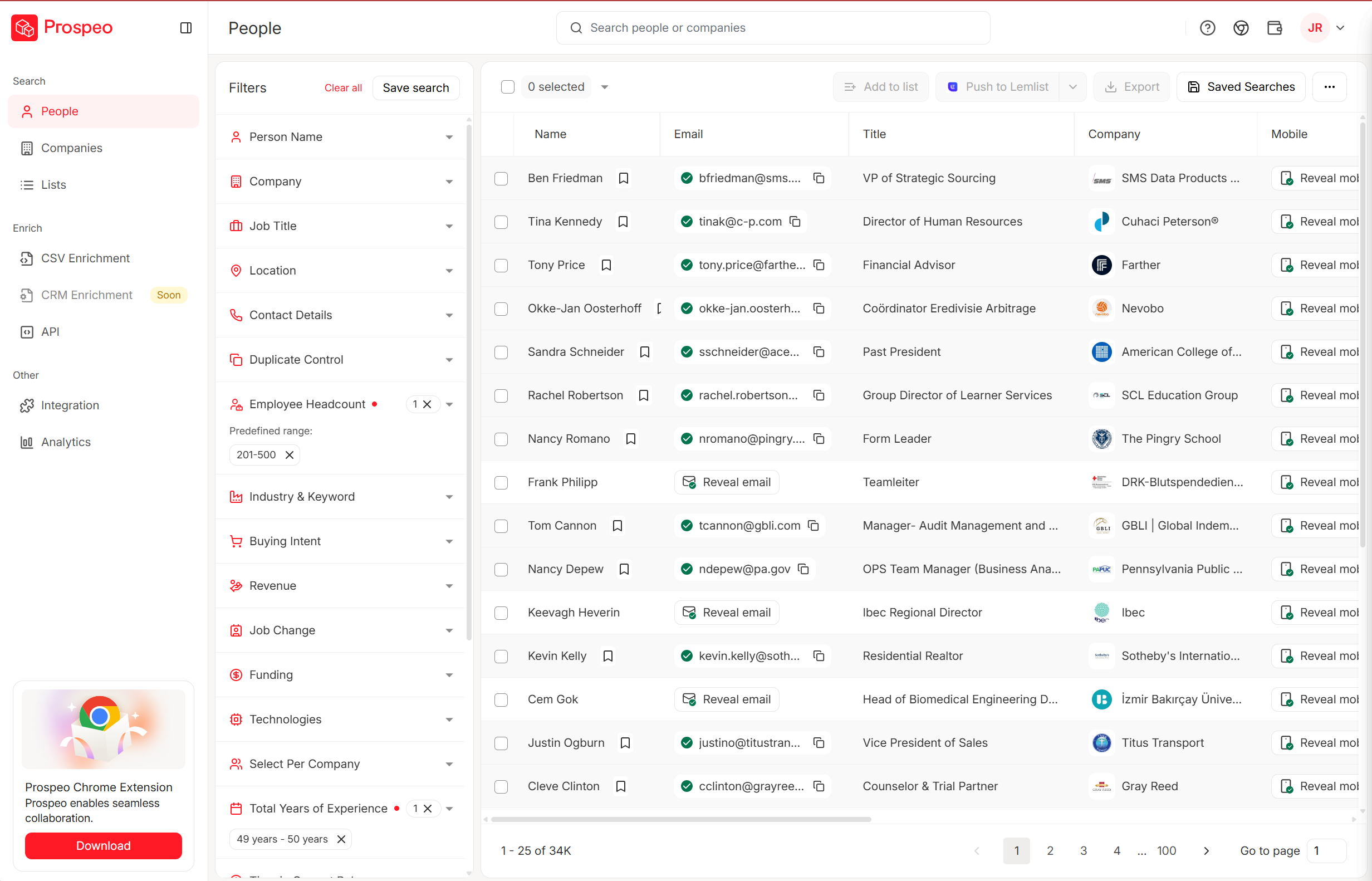
Prospeo fixes this at the data layer. With 300M+ professional profiles, 98% email accuracy, and a 7-day data refresh cycle, you're building prospect lists on data that's actually current. Search by 30+ filters - buyer intent, technographics, job changes, funding events, headcount growth - and export verified contacts directly to your sequencer. At roughly $0.01 per email, it's a fraction of what legacy platforms charge.
The proof is in the numbers: Meritt switched to Prospeo and saw pipeline jump from $100K to $300K per week. Their bounce rate dropped from 35% to under 4%. That's not a marginal improvement - it's the difference between a working outbound channel and a broken one.
Align Sales and Marketing
"Aligned on paper" is the most common failure mode here. Marketing defines an MQL one way, sales defines it another, and nobody realizes the disconnect until pipeline reviews get ugly.
Fix this with shared definitions. What specific actions qualify a lead as marketing-qualified? What criteria must be met before sales accepts it? Write these down, get both teams to sign off, and review them monthly. RevOps should own this process - not marketing, not sales. A neutral party with access to the data keeps everyone honest.
If you're formalizing this function, the RevOps role definition is a useful baseline.
Define Metrics Before Launch
Don't launch and then figure out what to measure. Define your success metrics upfront, tie them to the benchmarks in the next section, and build dashboards before day one.
The metrics that matter: CAC by channel and blended, LTV:CAC ratio targeting 3:1 or better, CAC payback period targeting under 12 months, and pipeline velocity measuring how fast deals move through stages. "We sent 10,000 emails" is activity. "We generated 47 qualified opportunities from outbound at $180 CAC" is impact. Measure impact.
Your GTM deliverables should include a product roadmap, competitor analysis, launch plan with owners and KPIs, and an ROI tracking template. Set review cadences - weekly for the first month, biweekly after that. If CAC is climbing without proportional LTV gains, your motion needs adjustment. Don't wait a quarter to notice.
You validated your ICP and picked your motion. Now you need a clean, verified prospect list - fast. Prospeo's database refreshes every 7 days (not 6 weeks), so your GTM launch hits real buyers at real companies with real contact data. Teams using Prospeo book 26% more meetings than ZoomInfo users.
Launch your GTM with data that actually connects you to buyers.
Mistakes That Kill GTM Launches
Seven patterns we see repeatedly. Most are avoidable if you're honest about them upfront.
Targeting too broad. "Our ICP is any company with 50+ employees" isn't an ICP - it's a census. Broad targeting dilutes your messaging, wastes budget, and produces leads that never convert. Narrow your wedge. You can expand later.
Treating launch as a switch-flip. A go-to-market launch isn't a press release and a prayer. It's a campaign with enablement, feedback loops, and iteration built in. The teams that treat launch day as the start of learning - not the finish line - win.
Measuring vanity metrics. Website traffic, social impressions, email opens - none of these pay the bills. If your dashboard doesn't connect to pipeline and revenue, you're measuring the wrong things.
Defining "qualified lead" differently across teams. Marketing celebrates MQLs. Sales rejects half of them. This is the single most common source of GTM friction, and it's entirely preventable with shared definitions and a RevOps referee.
Feature-first positioning. Nobody buys features. They buy outcomes. If your pitch leads with "AI-powered" or "real-time" instead of the problem you solve, you sound like everyone else.
Ignoring the competitive situation. If you can't articulate why a buyer should pick you over the two alternatives they're also evaluating, your positioning isn't done. Contrast matters.
Launching on unverified data. You built the strategy, crafted the messaging, aligned the teams - then fed it all into a prospect list with 30% invalid emails. Real-time email verification and weekly data refreshes are the difference between your outbound actually reaching the people you spent weeks identifying and watching your domain reputation crater.
Go-to-Market Examples That Worked
Only 13% of SaaS companies reach $10M ARR after 10 years. These three beat those odds by being ruthlessly specific about their approach.
Clay: Narrow the wedge, then expand. They grew revenue 10x in 2022, 10x in 2023, and 6x in 2024 - reaching a $1.25B valuation with 5,000+ customers. The key move: they narrowed their initial wedge to data enrichment for cold email agencies, even though the product could serve a much broader market. Most of their original customers churned after the ICP shift. That's fine. The narrow focus let them nail messaging, build community, and create word-of-mouth that a broader positioning never would have. In our experience, this is the hardest advice for founders to follow - it feels like leaving money on the table, but it's actually how you build the foundation to grab it later.
Zoom: PLG as the enterprise on-ramp. The free tier wasn't a marketing gimmick - it was the GTM engine. 55% of customers contributing over $100K in annual revenue started with at least one free host. The product sold itself at the individual level, and sales closed the enterprise deal once usage hit critical mass. That's hybrid GTM executed perfectly.
Slack: The product is the channel. They launched to 8,000 users within 24 hours and hit a $1B valuation in just 1.25 years. Their insight was that every user who joined a workspace invited colleagues, creating organic viral loops. They didn't need outbound at scale because the product's collaboration model made every user a distribution mechanism.
GTM Metrics and Benchmarks
You need baseline numbers to know whether your strategy is working. Here are the benchmarks that matter, based on the most recent industry data.
CAC by Industry
| Industry | Avg. CAC |
|---|---|
| B2B SaaS | $239 |
| Ecommerce | $86 |
| Cybersecurity | $387 |
| Financial Services | $784 |
| Fintech | $1,450 |
| Legaltech | $299 |
Cost Per Lead by Channel
| Channel | Avg. CPL |
|---|---|
| Google Ads | $70.11 |
| LinkedIn Ads | $110+ |
| Facebook Ads | $50-$75 |
| Organic / SEO | $15-$40 |
| Average B2B | $84 |
The target ratios haven't changed: LTV:CAC of 3:1 or better, and CAC payback under 12 months. If you're below 3:1, you're either acquiring the wrong customers or your product isn't retaining well enough to justify the spend.
What has changed is the trend line. CAC rose 60% over five years, and bottom-quartile SaaS companies now spend $2.82 to acquire $1 of new ARR. If your go-to-market GTM strategy doesn't explicitly address efficiency - through tighter ICP targeting, better data quality, and channel discipline - you're fighting a losing battle against rising costs.
FAQ
What is a go-to-market strategy?
A go-to-market strategy is a cross-functional plan that defines your ICP, positioning, pricing, channels, and sales motion for launching a product or entering a new market. It's the system that connects what you've built to the people who'll pay for it - owned jointly by marketing, sales, and product leadership.
How long does it take to build one?
A focused team can build a working GTM plan in 2-4 weeks. ICP validation - those 15 discovery interviews - is the bottleneck. Once you've confirmed who you're selling to and what they care about, positioning, channel, and pricing decisions follow much faster.
What's the difference between PLG and sales-led GTM?
PLG lets the product drive acquisition and works best for deals under $5K. Sales-led uses reps to close and fits deals above $25K. Most B2B SaaS in 2026 runs a hybrid - PLG for initial adoption, sales-assisted for expansion and enterprise contracts.
How do you measure GTM success?
Track CAC, LTV:CAC ratio (target 3:1+), CAC payback period (target under 12 months), and pipeline velocity. If CAC is rising without proportional LTV gains, your motion needs adjustment. Review weekly for the first month post-launch.
What tools do you need to execute a GTM strategy?
At minimum: a CRM like HubSpot or Salesforce, a B2B data platform for verified prospect lists, an outreach tool like Instantly or Lemlist, and analytics. Start lean - add tools as you scale past the first motion.