

Your Go-to-Market Pitch Deck Slide Is Probably a Bingo Card. Here's How to Fix It.
You're three days from your seed pitch and your go-to-market pitch deck slide reads "Content Marketing → SEO → Inbound Leads → Sales." Maybe you added a partnership logo and an arrow pointing to "Scale." Investors have seen this slide a thousand times. In 2023, Waveup reviewed 300+ pitch decks from pre-seed to Series C and found that only 7% of founders have a genuinely good GTM slide. The other 93%? Channel bingo cards dressed up in nice fonts.
The slides that actually work explain who you're targeting, how you'll reach them, and how that turns into revenue. Whether you're building a full go-to-market strategy deck or refining a single slide, the principles don't change.
Here's the short version: structure your slide as Segment → Channels → Conversion mechanism, include at least one real metric from actual testing, and match your GTM motion to your ACV. Let's break down each piece.
Five Mistakes Killing Your GTM Slide
Channel bingo. Listing "SEO, social media, partnerships, events" without explaining who you're targeting, why those channels, or what conversion looks like. As one practitioner put it, it's a "bingo card of vagueness." That's not strategy. That's a wish list.
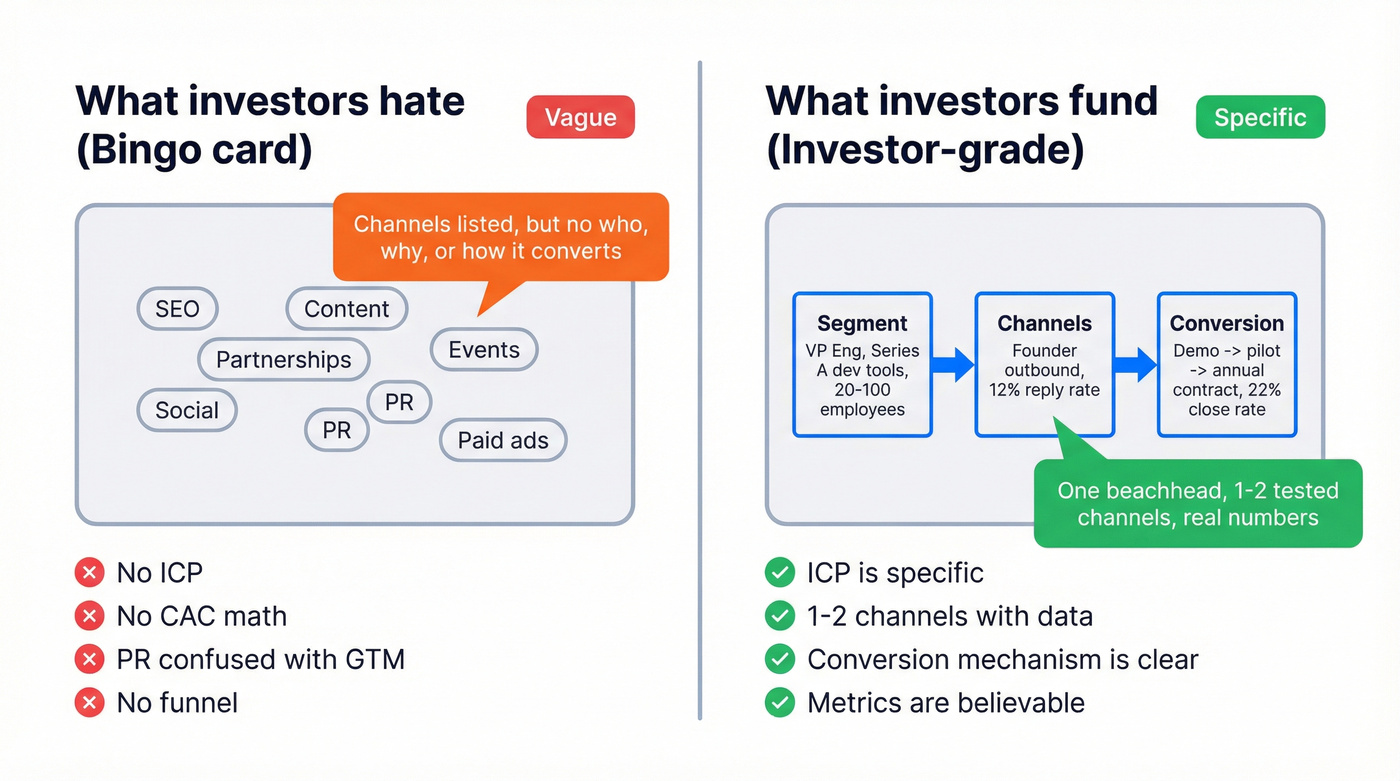
No CAC math. You don't need perfect unit economics at pre-seed. But zero numbers tells investors you haven't tested anything, and that's worse than showing imperfect data. (If you need a clean definition and what to include, see cost to acquire customer.)
Confusing PR with GTM. Press coverage isn't a predictable revenue channel. Putting "media outreach" as a primary acquisition lever is a red flag investors will call out immediately.
"Partnerships" without specifics. Signed or aspirational? Revenue share or integration? If you can't name the partner and the deal structure, leave it off the slide entirely.
No funnel, no customer journey. A list of channels without a discover → evaluate → buy → retain flow tells investors you're thinking about tactics, not strategy. The slide should answer how someone goes from unaware to paying - not just where you'll post content. (If you want a simple model, use the AIDA sales funnel.)
The 3-Part GTM Slide Framework
Forget the channel list. SlideModel's research nails the right structure: organize your go-to-market strategy slide around three components that tell a complete acquisition story.
| Component | What to Write | Example |
|---|---|---|
| Segment | Your ICP now + where it expands | "VP Eng at Series A dev tools, 20-100 employees" |
| Channels | 1-2 tested channels with data | "Founder outbound, 12% reply rate" |
| Conversion | How interest becomes revenue | "Demo → pilot → annual contract, 22% close rate" |
Early traction almost always comes from narrow communities, not broad campaigns. Show your ICP today, then sketch how it evolves at 6, 18, and 24 months. Investors want to see you've picked a beachhead, not that you're trying to boil the ocean. (A quick way to tighten this is an ideal customer profile template.)
Pick Your Motion (and Prove It Fits)
PLG isn't the default. A GoodFit analysis of 30,000 B2B SaaS companies on G2, cited by Notion Capital, found that 71% are sales-assisted, not product-led. Your go-to-market plan needs to justify why you chose your motion, not just name it.
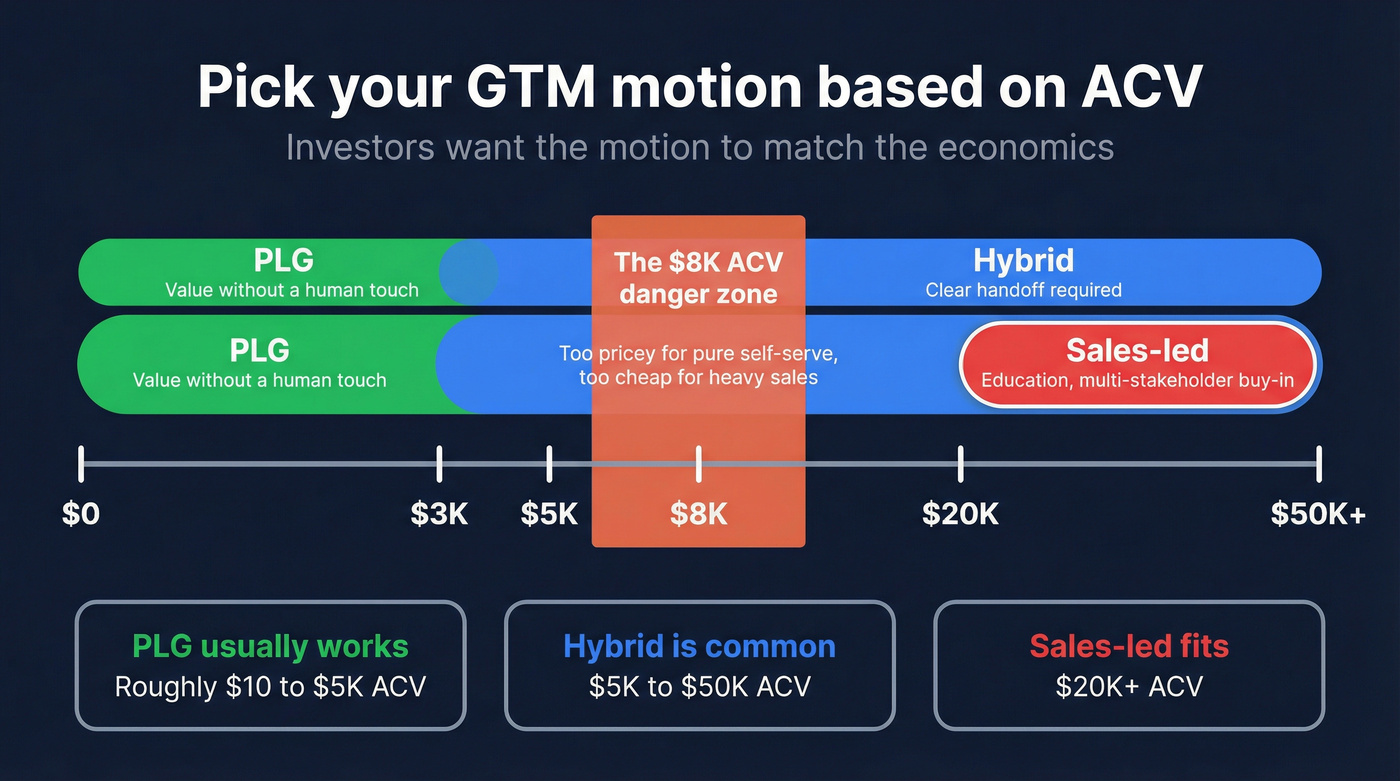
PLG works best when your ACV runs from roughly $10 to $5K and the product delivers value without a human touch. Sales-led fits $20K+ deals requiring education or multi-stakeholder buy-in. Hybrid covers the $5K-$50K range - but you need to explain the handoff clearly. (If you’re selling bigger contracts, it helps to frame it like enterprise B2B sales.)
Here's the thing: the $8K ACV zone is where most venture-backed startups quietly die. Too expensive for pure self-serve, too cheap to support traditional sales commissions. If you're sitting there, investors will ask why you haven't moved pricing up or down. A sales-led motion on sub-$4K deals means your unit economics are almost certainly underwater - an instant red flag. Skip this section if your ACV is clearly above $25K or below $3K; the motion choice is obvious and you should spend your slide real estate elsewhere.

Your GTM slide lives or dies on real numbers. Run a founder-led outbound test with 98% verified emails at $0.01 each - then put actual reply rates and CAC on your pitch deck instead of guesses.
Turn your GTM slide from a channel bingo card into proof that converts.
What Metrics to Include on Your GTM Slide
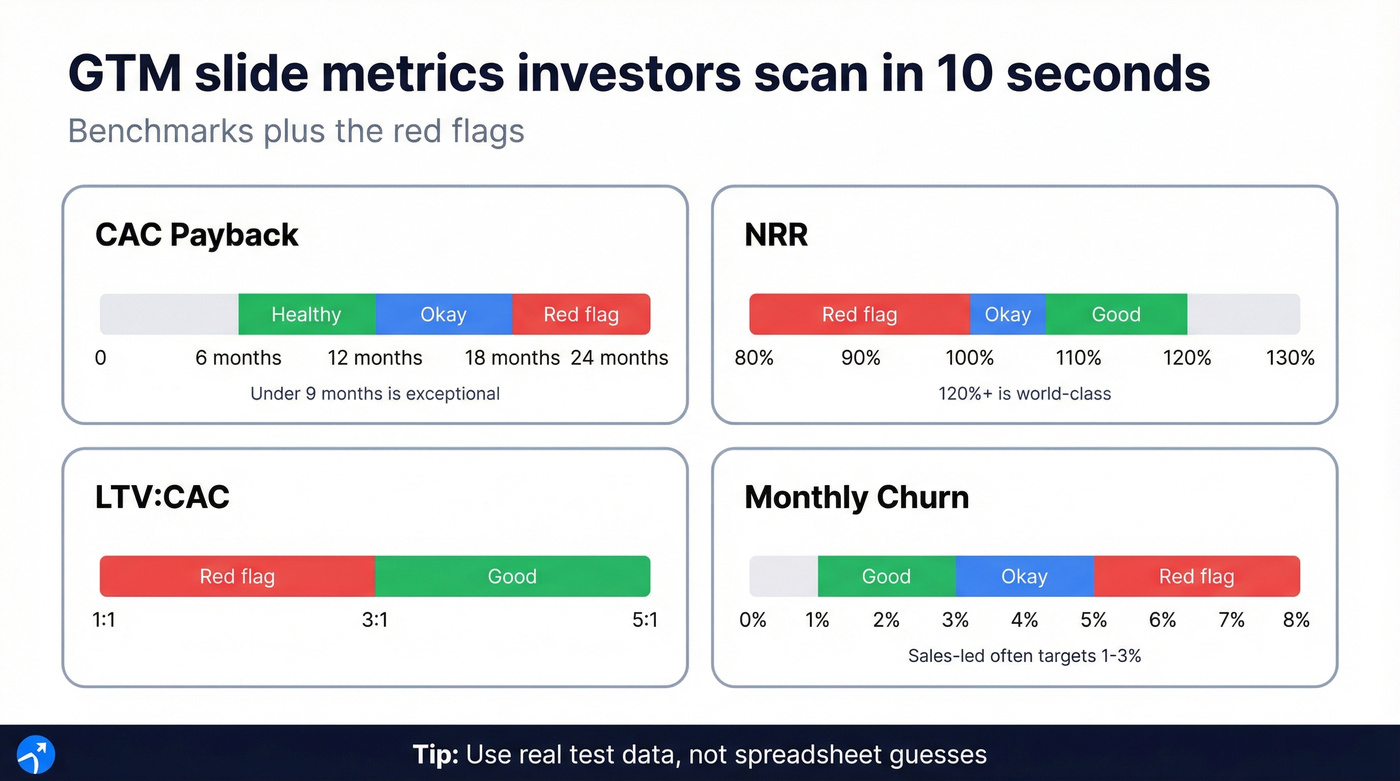
These are common SaaS benchmarks. If your numbers fall outside them, you need a compelling explanation - or you need to fix the numbers first.
| Metric | PLG | Sales-Led | ABM | Red Flag |
|---|---|---|---|---|
| CAC Payback | 6-12 mo | 12-18 mo | 18-24 mo | >18 mo |
| NRR | ~105% | ~102% | ~100% | <100% |
| LTV:CAC | >3:1 | 3:1 | 3:1+ | <3:1 |
| Monthly Churn | 3-5% | 1-3% | 1-2% | >5% |
CAC payback under 9 months is a rocket ship. Around 12 months is healthy. Beyond 18 months, you're burning cash faster than you're recovering it and investors will flag it immediately. NRR above 120% is world-class; below 90% is terminal. (If you need to diagnose retention, start with churn analysis.)
Before you put a CAC number on your slide, make sure it's based on verified outreach data - not a spreadsheet guess. We've seen founders inflate their numbers by counting bounced emails as "sent," which tanks their real cost-per-lead. Run a real outbound test with verified contact data from a tool like Prospeo so the number you present reflects actual market response. (Also: keep an eye on email bounce rate so your math isn’t built on bad sends.)
No Metrics Yet? Show Leading Indicators
An analysis of 85 winning pitch decks that collectively raised $375M found a consistent pattern: the best early-stage GTM slides pair a leading indicator with the outcome it drove. "$180K pipeline at proposal stage → $47K closed in 60 days." That single line communicates more than a full page of channel strategy. (If you want to pick the right inputs, use a simple funnel metrics view.)
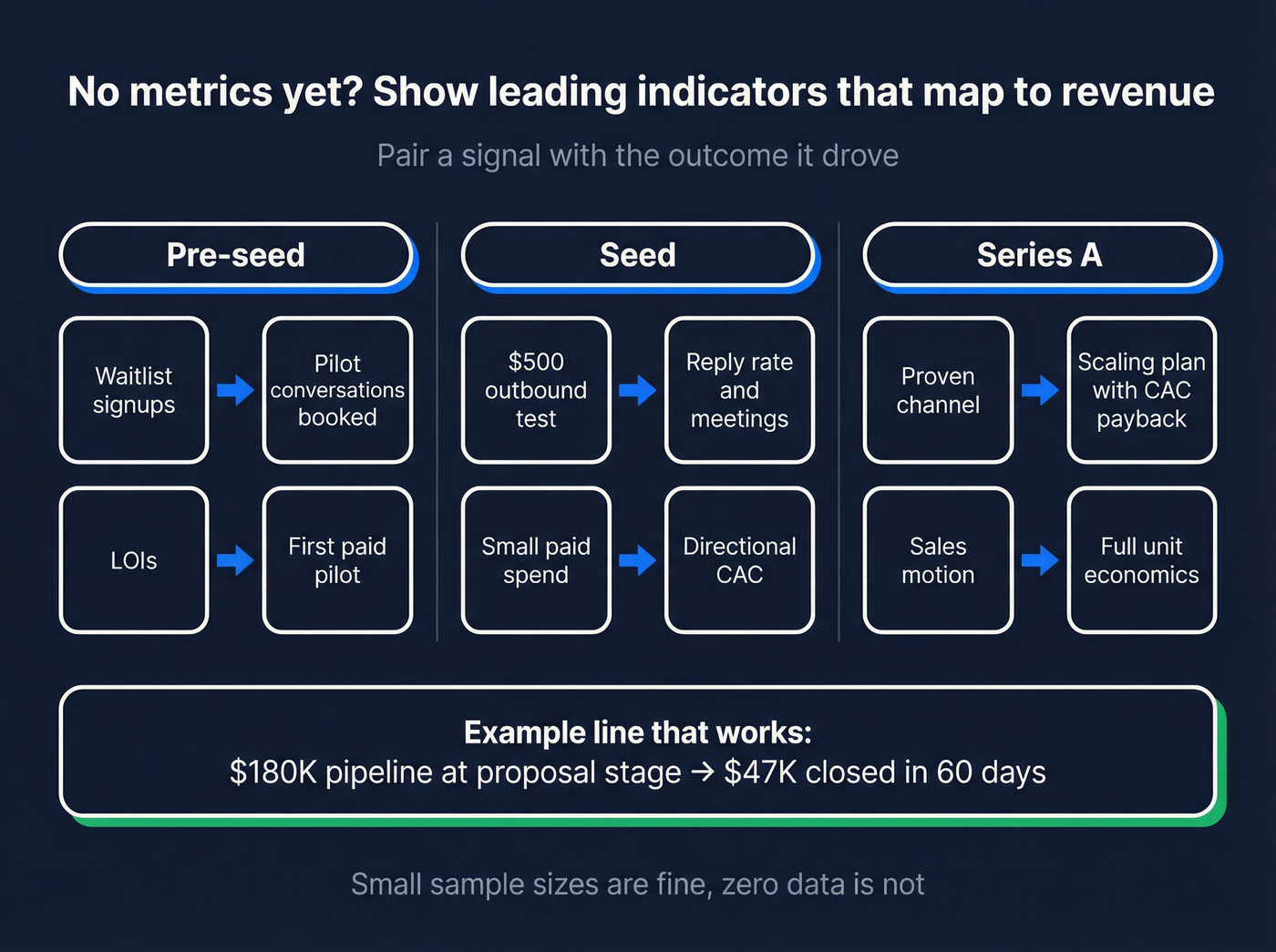
What's appropriate depends on your stage:
- Pre-seed: Hypothesis + early signals like waitlist size, LOIs, or pilot conversations
- Seed: Tested channels + directional CAC from real spend
- Series A: Proven motion with full unit economics and a scaling plan
In our experience, the slides that get follow-up questions are the ones with real numbers - even small ones. A $500 ad test with a clear conversion rate beats a beautiful funnel diagram every time. The consensus on r/startups echoes this: investors forgive small sample sizes but don't forgive zero data.
Before and After Rewrites
Two rewrites that show the difference between a forgettable GTM slide and an investor-grade one.
Before: "Channels: SEO, paid ads, partnerships, events"
After: "15 long-tail terms at <$2 CPC converting to trial at 9.2%. $50 CAC on $300 ACV. Scaling spend from $2K to $8K/month post-funding."
Before: "We'll use outbound sales and content marketing"
After: "Founder-led outbound to 200 VP Engineering prospects. 12% reply rate, 4% conversion. $170 CAC, 3.5x LTV:CAC. Hiring 2 SDRs to scale to 1,000 prospects/month." (If you’re building this motion, borrow a few sales prospecting techniques.)
The difference isn't design. It's specificity. Every number on the "after" version tells investors you've actually tested something. Investors rarely push back on early metrics - even if the metrics aren't great yet. What kills deals is the absence of data, not imperfect data.
Go-to-Market Pitch Deck Slide Checklist
- ICP defined with specifics (title, company size, industry)
- GTM motion justified by ACV
- Channels are specific, not a bingo card
- At least one real metric from actual testing
- Funnel or customer journey shown (discover → buy → retain)
- ICP evolution timeline (6/18/24 months)
- GTM motion aligns with current team capabilities
- No "partnerships" without named partners and deal terms
- Slide readable in 10 seconds - one idea, clear hierarchy
Investors spot inflated CAC numbers instantly. Prospeo's 5-step email verification keeps bounce rates under 4%, so your outbound test reflects real market response - not wasted sends to dead inboxes.
Get the verified contact data that makes your GTM metrics investor-grade.
FAQ
What should a go-to-market slide include?
A strong GTM slide covers three things: your target segment with specific ICP details like titles, company size, and industry; 1-2 tested acquisition channels with real data; and a conversion mechanism showing how interest becomes revenue. Skip the channel bingo card - investors want a customer journey backed by numbers.
How many slides should a go-to-market deck have?
Most founders embed GTM in a single slide within a 10-15 slide pitch deck. If your motion is complex - say, a marketplace with supply and demand sides - use two slides max. Anything beyond that signals you can't distill your strategy clearly enough.
What metrics should I put on my GTM slide at pre-seed?
Lead with whatever you've tested: waitlist signups, LOI count, pilot conversion rates, or directional CAC from a small ad spend. Even $500 worth of outbound data gives you a real reply rate to cite. Investors forgive small sample sizes; they don't forgive zero data.
Should I use PLG or sales-led on my GTM slide?
Match your motion to your average contract value. PLG works best below $5K ACV where the product delivers value without human touch. Sales-led fits $20K+ deals requiring education or multi-stakeholder buy-in. The $5K-$20K range often needs a hybrid approach - explain the handoff clearly on your slide.