

How to Build a Go-to-Market Plan for Your Startup (Without the Fluff)
The median B2B SaaS company now spends $2 in sales and marketing for every $1 of new ARR. That ratio climbed 14% since 2024. If you're a startup with 12 months of runway, burning three of those months building a go-to-market plan that reads like an MBA thesis isn't strategy - it's procrastination.
Most startup GTM plans fail because they're built for investors, not for execution. Beautiful TAM slides, zero clarity on who to call first, what to charge, or which channel to test this week. The plan you actually need fits in a weekend and gets you into market on Monday.
What a Startup GTM Plan Actually Needs
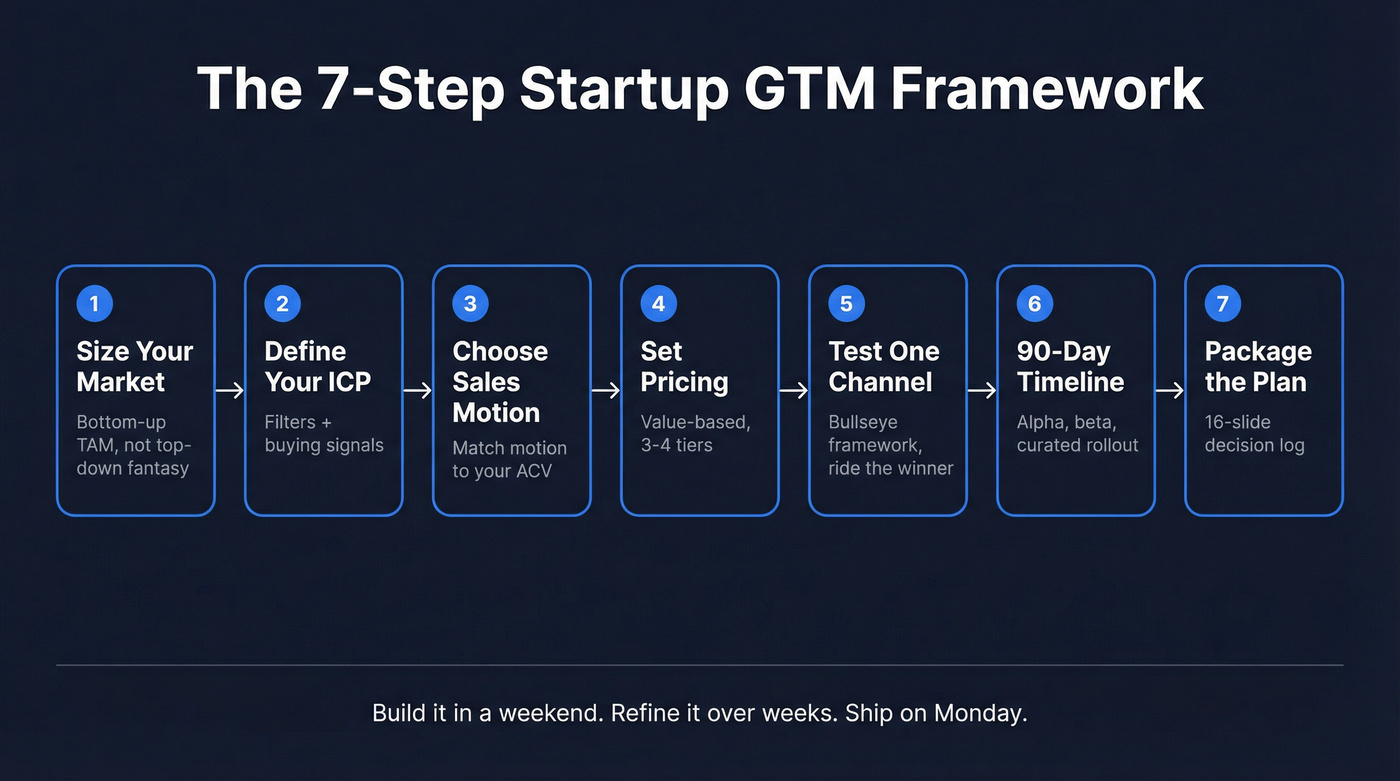
Seven things, no more:
- A bottom-up TAM number (not a top-down fantasy)
- A signal-driven ICP (not just firmographic filters)
- A sales motion matched to your ACV
- A pricing model backed by data
- One tested channel
- A 90-day founder-led sales timeline
- A 16-slide document that ties it together
We've watched dozens of early-stage teams overcomplicate this. The founders who ship fastest treat the GTM plan as a decision log, not a strategy document. Build it in a weekend, refine it over weeks as real customer feedback rolls in.

You just defined your ICP with filters and signals. Now you need to actually find those buyers. Prospeo layers 30+ search filters - including buyer intent across 15,000 topics, job changes, funding rounds, and headcount growth - so you reach companies ready to buy, not just companies that fit a spreadsheet.
Turn your ICP definition into a live prospect list in minutes.
The 7-Step Framework
Step 1: Size Your Market Bottom-Up
Forget the "the global SaaS market is $300B" slide. Investors see through it and it doesn't help you plan. Use the bottom-up formula:
(# of companies you can actually sell to) x (your ACV) = TAM
Worked example: you sell DevOps tooling to mid-market companies with 200-2,000 employees. Roughly 50,000 exist globally. Your ACV is $25,000. That's a $1.25B TAM - credible, specific, and useful for planning.
Now get realistic. Your serviceable obtainable market in year one is 0.5-2% of your SAM, according to Series A launch benchmarks. For that $1.25B TAM, you're targeting $6.25-$25M in year-one revenue at the high end. That's the number your hiring plan and burn rate should be built around, not the fantasy number on slide three.
Step 2: Define Your ICP with Signals
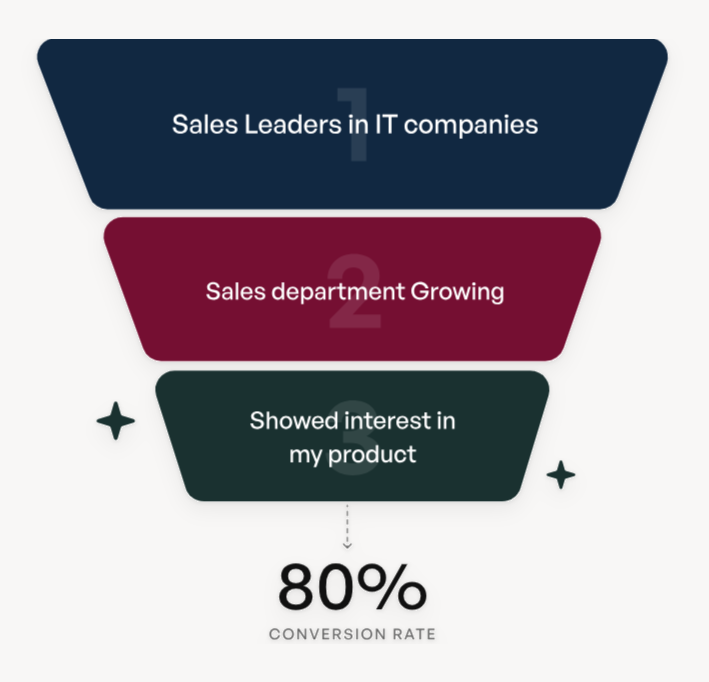
Most startups define their ICP with static filters - industry, headcount, geography, tech stack. That's the minimum. The teams that convert 40-50% better layer dynamic buying signals on top.
| Type | Examples | Nature |
|---|---|---|
| Filters | Industry, headcount, geo, tech stack | Static attributes |
| Signals | Funding rounds, leadership changes, job posts, tech adoption, intent data | Dynamic buying indicators |
Filters tell you who could buy. Signals tell you who's ready to buy right now.
A 500-person fintech company is a filter match. That same company posting three DevOps engineering roles and researching your category on review sites? That's a signal match - and the conversion difference is enormous.
Here's a stat that makes this concrete: 97% of B2B buyers research vendor websites before engaging sales. If you're not tracking those research signals, you're waiting for buyers to find you instead of meeting them mid-journey. When scoring segments, weight your criteria: market attractiveness (35%), urgency and pain intensity (35%), and ability to win (30%). This keeps you honest about where you can actually compete, not just where the market looks big. (If you want a more operational approach, use a simple lead scoring model.)
Step 3: Choose Your Sales Motion
Your ACV determines your motion. Don't overthink this.
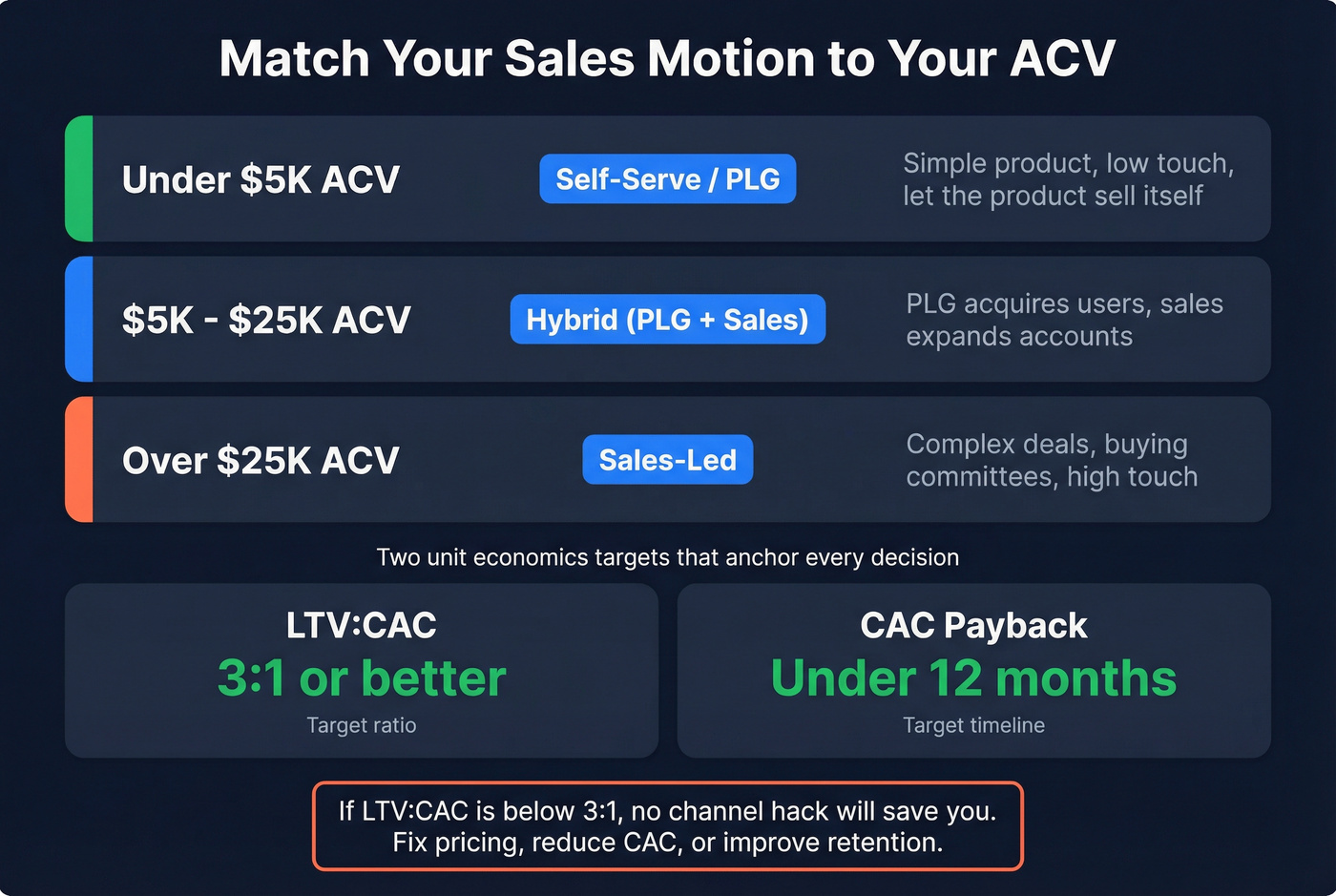
| ACV Range | Motion | Notes |
|---|---|---|
| Under $5K | Self-serve / PLG | Simple product, low touch |
| $5K-$25K | Hybrid (PLG + sales) | PLG acquires, sales expands |
| Over $25K | Sales-led | Complex deals, committees |
| Complex committees | Sales-led (any ACV) | Trials support evaluation |
Two unit economics targets should anchor every decision:
| Metric | Target |
|---|---|
| LTV:CAC | 3:1 or better |
| CAC payback | Under 12 months |
If your LTV:CAC is below 3:1, you either need to raise prices, reduce acquisition costs, or improve retention. There's no channel hack that fixes broken unit economics. We've seen teams pour money into outbound while their CAC payback sat at 18 months - that's a math problem, not a pipeline problem.
For context on why this matters beyond survival: only 11-30% of private SaaS companies hit the Rule of 40, but those that do trade at a 121% valuation premium. Getting unit economics right early compounds into everything.
Step 4: Set Your Pricing
Pricing is the highest-leverage decision in your GTM plan. A 1% improvement in pricing yields an 11% boost in profits. Yet most founders spend weeks on their pitch deck and 20 minutes on pricing.
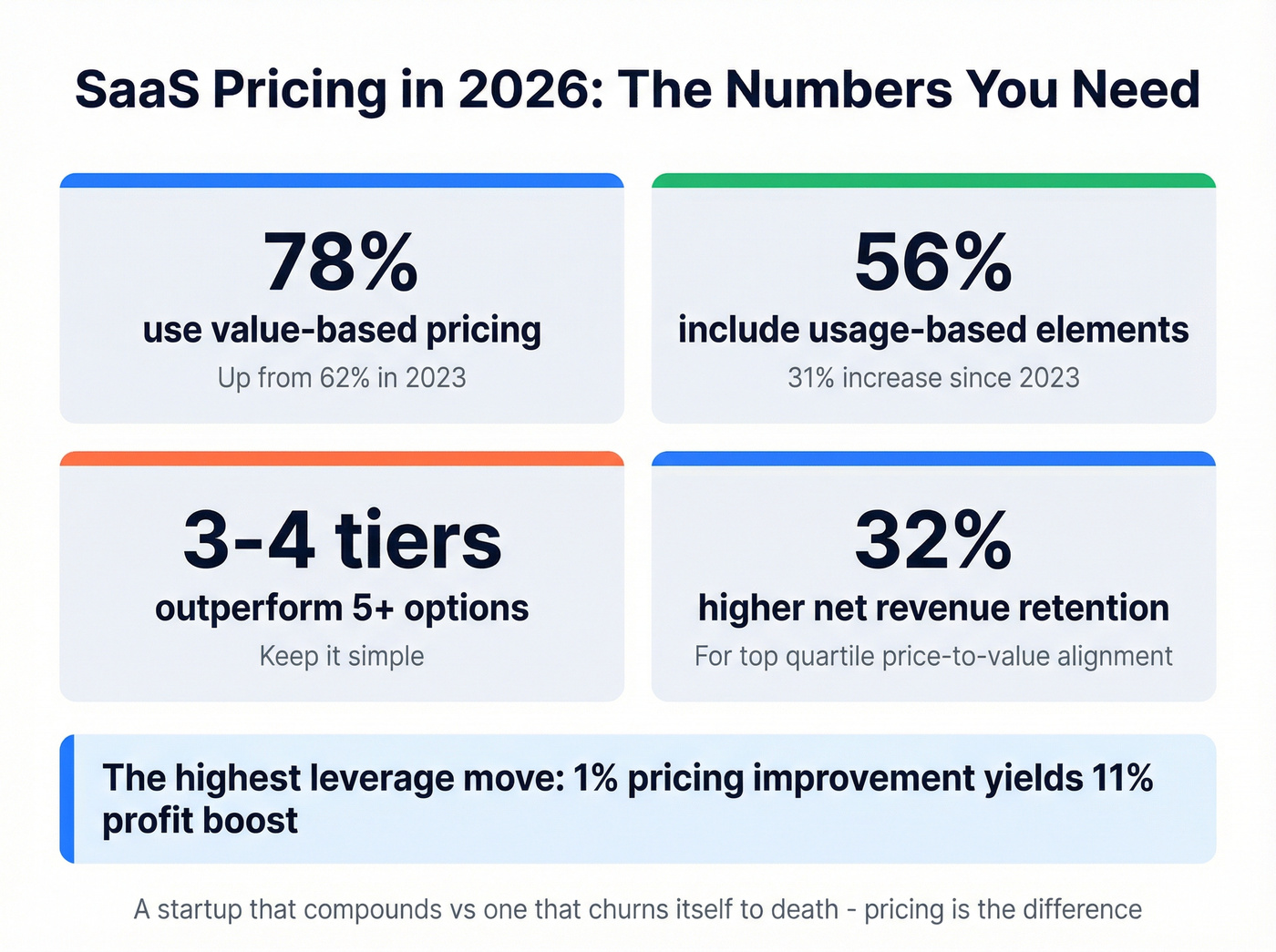
Here's where the market has landed in 2026:
- 78% of SaaS companies now use value-based pricing, up from 62% in 2023
- Usage-based pricing increased 31% over the same period - 56% of companies incorporate consumption-based elements
- 3-4 tiers outperform 5+ options consistently
- Self-serve purchasing works well for plans under $1,000/month
Companies in the top quartile for price-to-value alignment see 32% higher net revenue retention and 41% lower CAC. That's not a marginal improvement - it's the difference between a startup that compounds and one that churns itself to death.
Here's the thing: don't launch with freemium unless you have a clear conversion mechanism. Freemium anchors customers to "free" and makes monetization harder later. Start with a trial or a low-cost entry tier, then expand. Every founder I've talked to who started freemium wishes they'd started with a paid tier and added a free plan later - not the other way around.
Step 5: Pick and Test One Channel
Use the Bullseye framework. It's simple and it works.
Brainstorm every possible channel - outbound, content, partnerships, communities, paid, PLG, events. Test 3-5 with cheap, fast experiments: 100 outbound emails, one partnership conversation, a $500 ad spend, two-week sprints. Focus on one - the channel that shows the best signal-to-noise ratio. Ride it until it saturates before adding a second. (If outbound is your first bet, start with these sales prospecting techniques.)
Don't underestimate partnerships. In the Dell/Unidesk case, for every $1 Unidesk earned, Dell earned $10 in associated revenue. Dell sent referrals back - and 1 in 3 converted into Unidesk customers. That's the kind of asymmetric advantage a startup needs. Stripe did something similar by making their developer docs so good that developers became the sales channel. If you can make someone else's job easier, they'll sell for you.
The trap is spreading across five channels simultaneously. You don't have the team or budget to run five experiments well. Pick one, learn, then expand.
Step 6: Build a 90-Day Founder-Led Timeline
Let's be honest - founder-led sales probably never fully ends. Some prospects will always want to talk to the person who built the thing. But the first 90 days are where you learn whether your launch plan actually works.
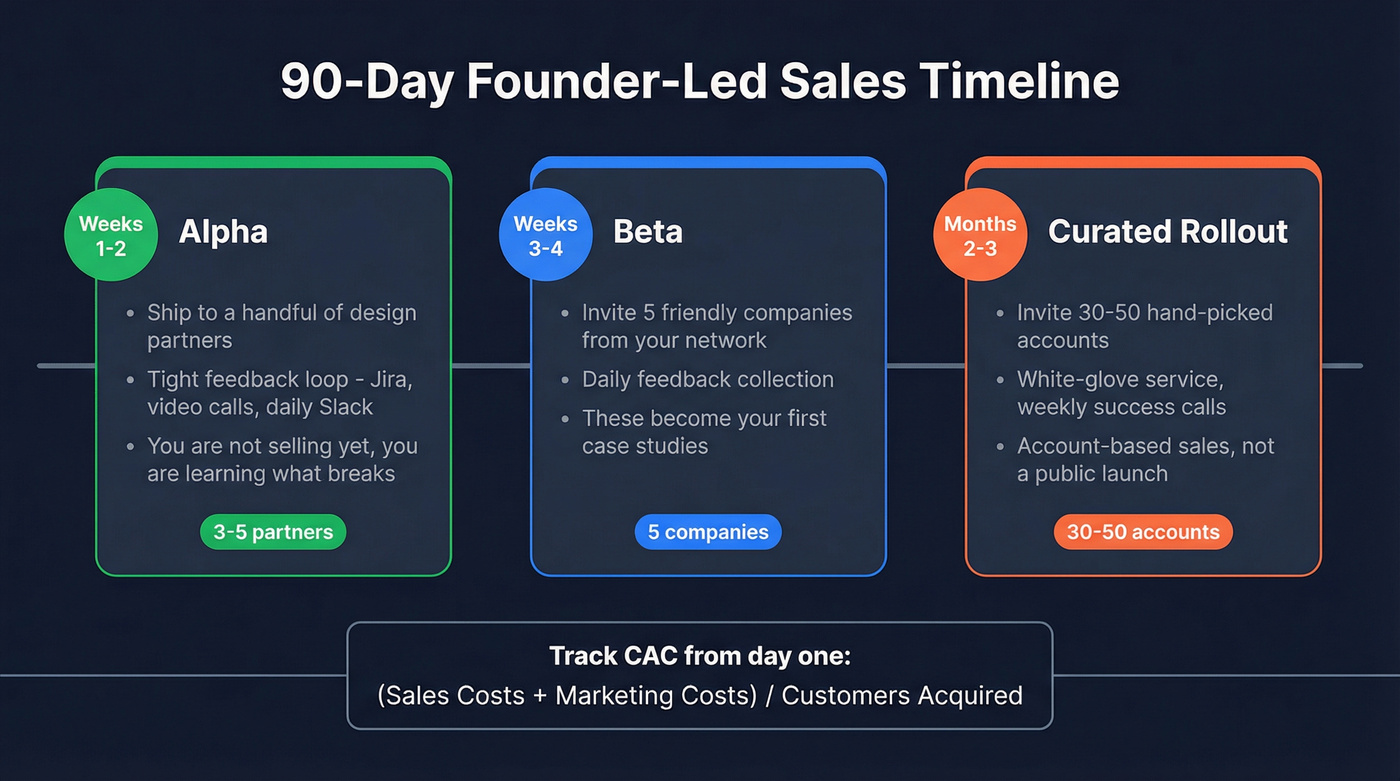
Weeks 1-2: Alpha. Ship to a handful of design partners. Tight feedback loop - Jira tickets, video calls, daily Slack threads. You're not selling yet. You're learning what breaks.
Weeks 3-4: Beta. Invite 5 friendly companies from your network. Daily feedback. These are your first case studies if things go well.
Months 2-3: Curated rollout. Invite 30-50 hand-picked accounts. White-glove service, weekly success calls. This is account-based sales, not a public launch. The Maxio benchmarks report provides interactive filtering for CAC payback and NRR by GTM motion - useful for calibrating your targets at this stage.
Track your CAC from day one: (Sales Costs + Marketing Costs) / Number of Customers Acquired. Even rough numbers matter. You can't optimize what you don't measure. (If you want a clean definition + benchmarks, see CAC.)
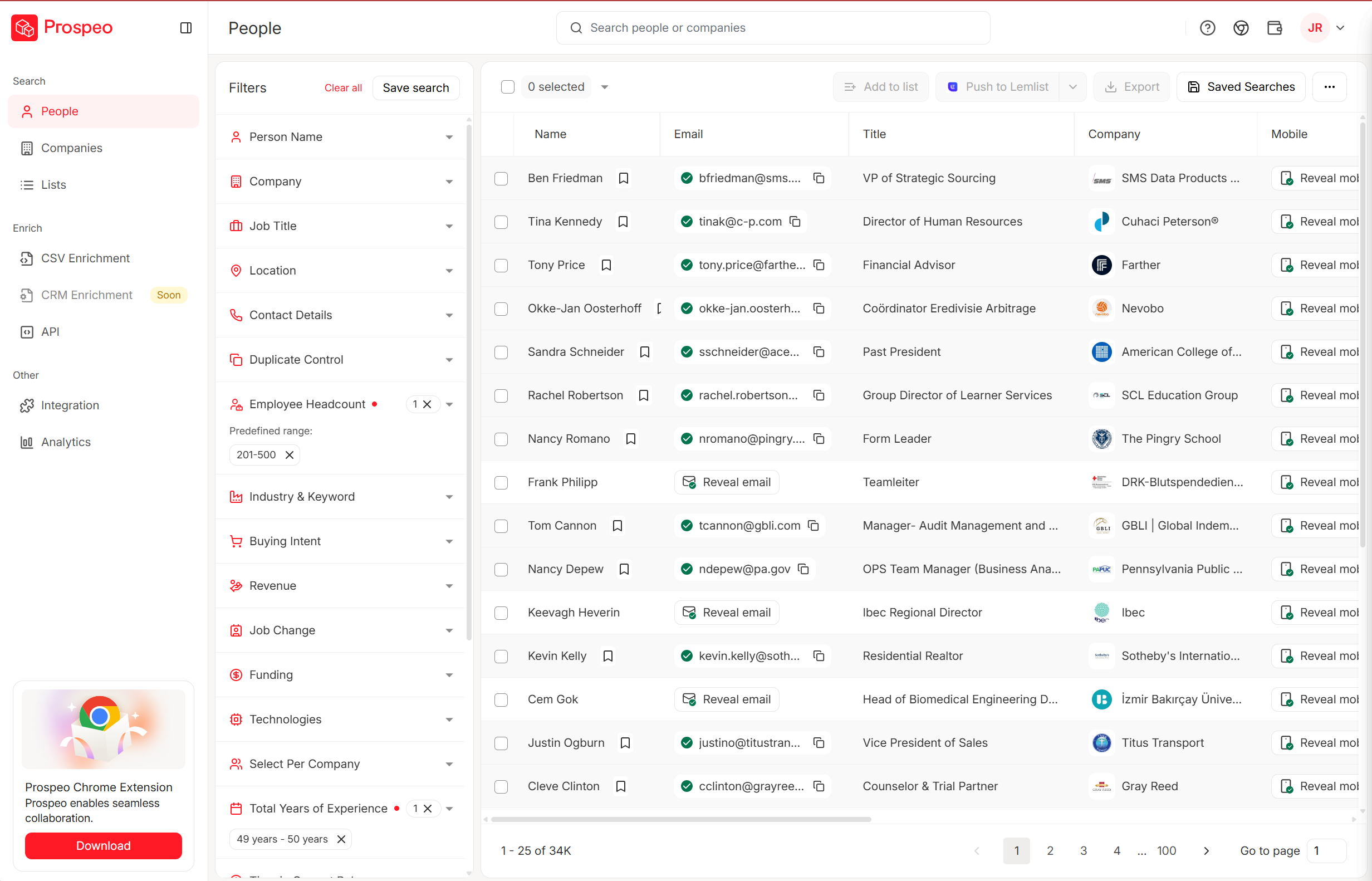
When you're ready to reach those 30-50 curated accounts, you need verified contact data. Prospeo lets you filter by ICP criteria - industry, headcount, technographics, and buyer intent across 15,000 topics - then export verified emails at 98% accuracy. The free tier gives you 75 emails and 100 Chrome extension credits per month, enough to test outbound before committing budget.
Step 7: Package It Into a GTM Document
Your GTM plan lives in a 16-section slide deck. Here's the structure, adapted from Startmate's framework:
Title page, executive summary, product offer, pricing model, segmentation, value matrix, buyer personas, sales funnel, TOFU/MOFU/BOFU breakdown, sales strategy, demand generation, content strategy, yearly goals, quarterly goals, Q1 goals, appendix. (If you need a reference structure for the funnel slides, use a B2B sales funnel template.)
Build it in Miro or Google Slides. Keep each slide to one key decision or data point. If you prefer a product-management lens, ChatPRD's free template organizes the same ground into four blocks: product analysis, market analysis, customer analysis, and GTM strategy. For a fill-in-the-blank version with worked examples, InnMind sells a GTM strategy bundle for EUR 25.
Don't let the document become the work. The document captures decisions you've already made. If you're spending more time formatting slides than talking to customers, you've lost the plot.
GTM Mistakes That Kill Startups
Five anti-patterns we see repeatedly in early-stage go-to-market execution:
Scaling assumptions too early. You don't need a demand gen team when you have 3 customers. Founder-led sales is how you learn the language, triggers, and objections that make everything else work.
Hiring sales before validating the market. Founders on r/startups and r/SaaS repeat the same regret: they hired an AE before closing 10 deals themselves. An AE can't fix a product that doesn't have product-market fit. Skip this hire until you can hand them a repeatable playbook.
Spreading across too many channels. Three channels at 30% effort each will all fail. One channel at 100% effort might work. This is frustrating advice because it feels like you're leaving opportunity on the table, but the math is unforgiving at the seed stage.
Formalizing funnels prematurely. You don't need a 7-stage pipeline in Salesforce when your total pipeline is 12 companies. A spreadsheet is fine. (If you do need a lightweight system, start with contact management software before a full CRM migration.)
Neglecting metrics and iteration. Set KPIs tied to revenue, adoption, and retention from week one. Early GTM is about learning the truth, not proving readiness to scale. (A simple set of funnel metrics will keep you honest.)
Founder-led outbound only works when your emails actually land. Prospeo delivers 98% email accuracy with a 7-day data refresh - so you're not burning your domain reputation on stale data during the 90 days that matter most. At $0.01 per email, it costs less than the coffee you'll drink while writing the sequences.
Protect your domain and triple your pipeline from day one.
FAQ
How long does it take to build a go-to-market plan?
A focused founder can build a working plan in a weekend using the 7-step framework above. The 16-slide structure keeps scope tight. Refine it over weeks as customer feedback rolls in - don't wait for perfection before starting outbound.
What's the difference between a GTM strategy and a marketing plan?
A GTM strategy covers your entire path to revenue - ICP, sales motion, pricing, channels, and timeline. A marketing plan is one subset: the specific campaigns and demand-gen tactics within your chosen channels. Build the GTM strategy first; the marketing plan flows from it.
How do I build a prospect list for my first outbound campaign?
Define your ICP filters - industry, headcount, tech stack - then use a B2B database to search and export verified contacts. Prospeo's free tier (75 emails/month) lets you test with 50-100 prospects, iterate on messaging, and measure response rates before scaling volume.
When should a startup hire its first salesperson?
After the founder has personally closed 10-15 deals and can articulate the repeatable sales process - typical objections, average deal cycle, and conversion benchmarks. Hiring before that point means paying someone to discover product-market fit, which is the founder's job.