

A Go-to-Market Plan Sample You Can Actually Copy
Every go-to-market plan sample online is the same thing: a blank template with placeholder text that says "[Insert your ICP here]" and "[Add budget]." That's not a plan. That's homework.
The r/ProductMarketing subreddit is full of people asking for a filled-in example - something with real numbers, actual timelines, and decisions already made. Whether you're a PMM building a launch plan for Monday or a candidate staring down a take-home GTM exercise, you need a completed plan you can steal and adapt. Not ten frameworks with "[TBD]."
In 2026, top-quartile B2B companies ($25M-$100M ARR) grew ARR 93% YTD. They didn't get there with placeholder text.
The Complete GTM Plan
Here's a filled-in GTM plan for Beacon Analytics - a fictional B2B SaaS product that helps mid-market e-commerce brands optimize ad spend using predictive attribution. Everything below is a realistic go-to-market plan sample you can adapt.
Executive Summary
Beacon Analytics launches in Q3 2026 targeting mid-market DTC e-commerce brands ($5M-$100M revenue) frustrated with last-click attribution. We'll enter with a freemium model, convert through self-serve and inside sales, and target $500K ARR within 12 months by owning the "predictive attribution for Shopify brands" positioning.
ICP Definition
| Dimension | Detail |
|---|---|
| Firmographics | DTC e-commerce, $5M-$100M revenue, 20-500 employees |
| Technographics | Shopify Plus, running Meta + Google Ads, using GA4 or Triple Whale |
| Psychographics | Data-curious but not data-science-staffed; frustrated by attribution black boxes |
| Buying behavior | Budget held by VP Marketing or Head of Growth; 14-30 day sales cycle; prefers self-serve trial before committing |
| Geography | US and UK (Phase 1) |
Competitive Positioning
| Criteria | Beacon | Triple Whale | Northbeam | Rockerbox |
|---|---|---|---|---|
| Predictive models | ✅ Native | ❌ Descriptive only | ✅ Native | Partial |
| Shopify integration | Deep | Deep | Moderate | Moderate |
| Self-serve pricing | Free tier | $100/mo+ | Custom only | Custom only |
| Time to value | <1 hour | <1 hour | 2-4 weeks | 1-2 weeks |
| Multi-touch attribution | ✅ | ✅ | ✅ | ✅ |
Messaging Framework
| Layer | Copy |
|---|---|
| Value prop | Know which ads actually drive revenue - before you spend the budget |
| Headline | Stop guessing. Start predicting. |
| Proof point | Beacon's predictive model identified $47K in wasted ad spend for a $12M DTC brand in its first week |
Pricing Strategy
| Tier | Price | Includes |
|---|---|---|
| Free | $0/mo | 1 ad account, basic attribution, 30-day lookback |
| Growth | $49/mo | 3 ad accounts, predictive models, Slack alerts |
| Pro | $149/mo | Unlimited accounts, custom models, API access |
| Enterprise | Custom | SSO, dedicated CSM, SLA |
Freemium gets us into the workflow. The $49 tier is priced below Triple Whale's entry point to win on switching cost. The $149 tier pays for itself if it saves one bad ad decision per month.
Channel Mix and Budget
Total Q3-Q4 budget: $200,000
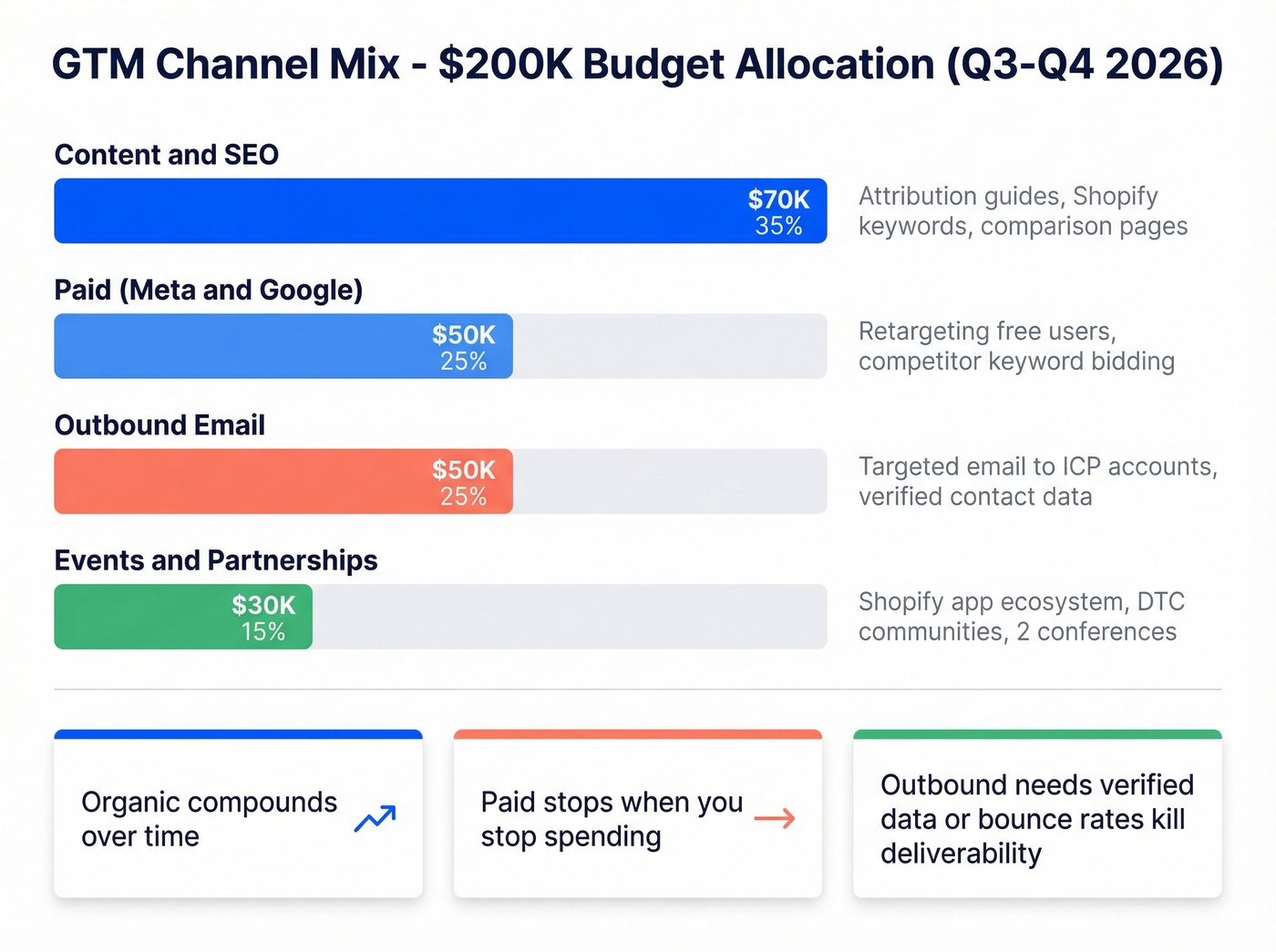
| Channel | Allocation | Budget | Tactic |
|---|---|---|---|
| Content/SEO | 35% | $70K | Attribution guides, Shopify-specific keywords, comparison pages |
| Paid (Meta/Google) | 25% | $50K | Retargeting free users, competitor keyword bidding |
| Outbound | 25% | $50K | Targeted email to ICP accounts using verified contact data |
| Events/partnerships | 15% | $30K | Shopify app ecosystem, DTC Slack communities, 2 conferences |
About 70% of B2B companies now report moderate-to-full AI adoption in GTM workflows. Factor AI-assisted prospecting and content creation into your channel budget rather than treating them as separate line items.
Sales Model
Hybrid self-serve + inside sales. Free and Growth tiers convert through product-led onboarding. Pro and Enterprise tiers get a 2-rep inside sales team running demos from inbound and outbound pipeline.
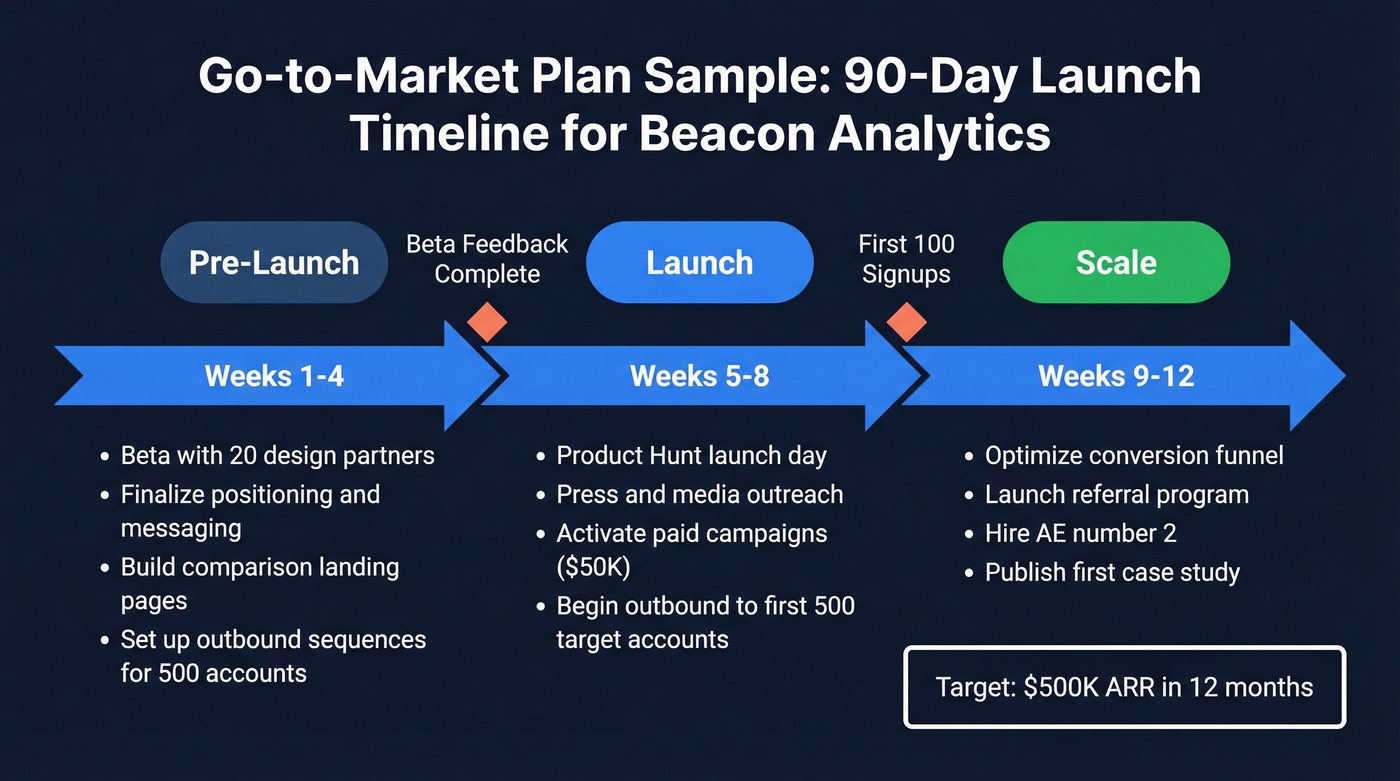
90-Day Launch Timeline
| Phase | Weeks | Key Actions |
|---|---|---|
| Pre-launch | 1-4 | Beta with 20 design partners, finalize positioning, build comparison landing pages, set up outbound sequences |
| Launch | 5-8 | Product Hunt launch, press outreach, activate paid campaigns, begin outbound to first 500 target accounts |
| Scale | 9-12 | Optimize conversion funnel, launch referral program, hire AE #2, publish first case study |
KPI Targets
| Metric | Target | Benchmark |
|---|---|---|
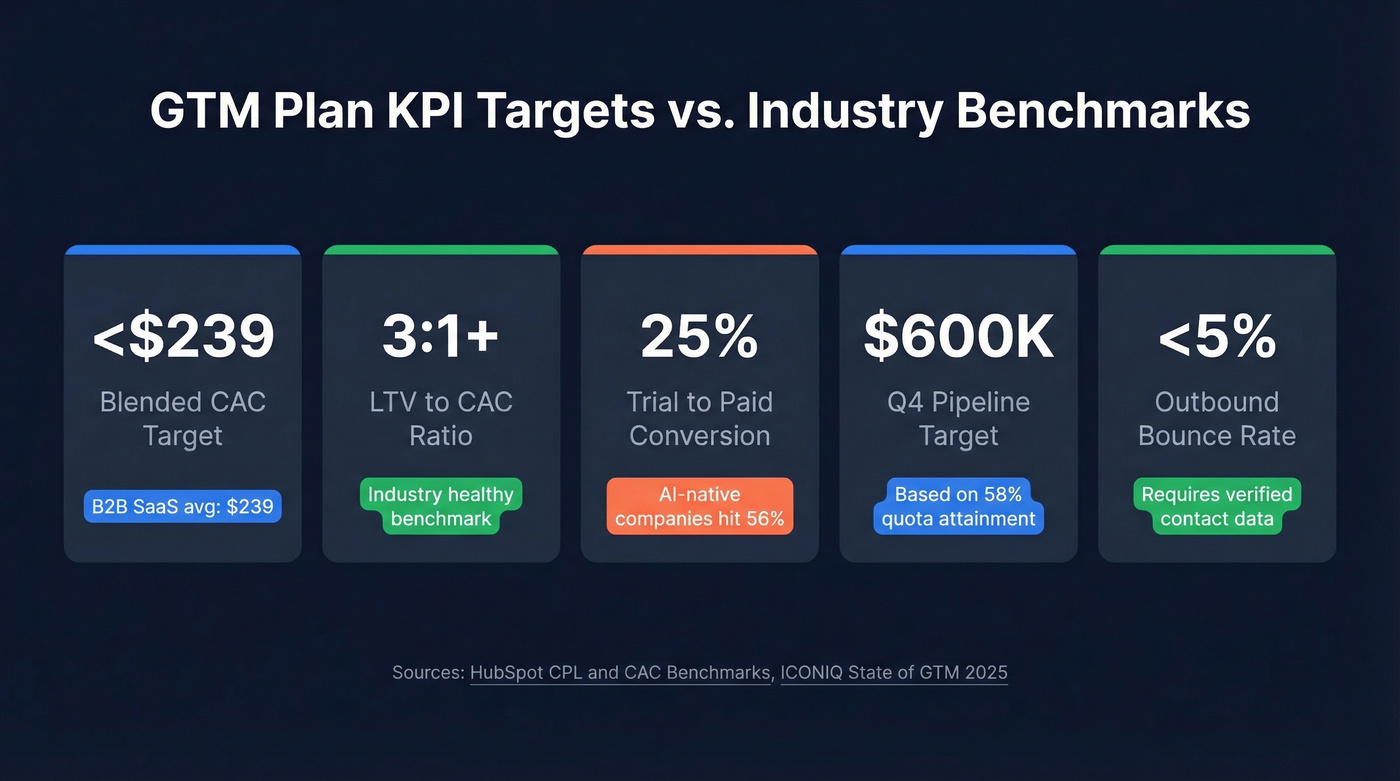
| CAC (blended) | <$239 | B2B SaaS average: $239 (organic $205, inorganic $341) |
| LTV:CAC | 3:1+ | Industry healthy benchmark |
| Trial-to-paid | 25% | AI-native companies at $100M+ ARR hit 56%; 25% is conservative for early-stage non-AI |
| Pipeline (Q4) | $600K | Based on 2-rep team, ~58% quota attainment |
| Bounce rate (outbound) | <5% | Requires verified contact data |
Tools and Tech Stack
| Function | Tool |
|---|---|
| CRM | HubSpot (Starter) |
| Analytics | Amplitude + GA4 |
| Outbound sequencing | Instantly |
| Prospect data | Prospeo - 30+ search filters that map directly to ICP dimensions, with a 7-day data refresh cycle |
| Attribution (own product) | Beacon Analytics |
| Project management | Linear |
Breaking Down Each Section
Define Your ICP
Firmographics alone don't cut it. Saying "mid-market e-commerce" describes thousands of companies - most of whom won't buy your product.
The sample plan layers in technographics (Shopify Plus, running paid ads on specific platforms) and psychographics (data-curious but under-resourced). Buying behavior matters too: who holds the budget, how long they take to decide, and whether they prefer self-serve or want a demo. These inputs - demographics, firmographics, needs, technographics, psychographics, and buying behavior - are what separate a useful ICP from a vague persona slide that collects dust in a shared drive.
Nail Positioning and Messaging
April Dunford's positioning framework asks five questions: what is it, who is it for, what's the alternative, what makes you different, and why should they care now. The sample plan's messaging compresses that into three layers - value prop, headline, and proof point.
Notice the proof point uses a specific dollar figure. "We save you money" is a claim. "$47K in wasted spend identified in week one" is a story. I've watched teams spend weeks debating taglines while ignoring the proof point entirely. The proof point does more selling than the headline ever will.
If you want a deeper walkthrough, start with B2B brand positioning.
Set Your Pricing Strategy
The sample uses freemium + tiered pricing - a penetration strategy designed to get into the workflow fast and expand later. This works when your product has a natural "aha moment" in the free tier and a clear upgrade trigger like more ad accounts or predictive models.
If your product requires heavy onboarding or customization, skip freemium entirely and go with a sales-led trial. The pricing model should match the sales model, not the other way around.
Choose Channels and Budget
The sample allocates 35% to content/SEO - the highest single line item. That's intentional. WorkCompOne, a B2B insurance company, generated nearly 100% of traffic, leads, and sales through organic search by targeting geo-specific keywords. Organic compounds over time; paid stops the day you stop spending.
But organic takes 3-6 months to kick in, so the sample pairs it with paid and outbound for immediate pipeline. Your channel mix should reflect your timeline pressure, not just your budget.
If you're building the content engine, use this as your baseline: what is B2B content marketing.
Build Your Target Account List
Here's the thing: your ICP definition is useless until it's a list of real people with verified contact information. For the sample plan's outbound channel ($50K, 25% of budget), you need verified emails and direct dials for 500+ target accounts before launch week.
We've seen teams burn through their entire launch budget on stale prospect lists. A 20% bounce rate will tank your sender domain before the GTM plan gets past week two. A data platform with a 7-day refresh cycle - versus the 6-week industry average - is the difference between hitting your outbound KPIs and explaining to leadership why deliverability cratered.
If you're operationalizing this, how to automate target account lists is the next step.


The sample GTM plan targets 500 accounts with <5% bounce rate on outbound. That's only possible with verified data. Prospeo's 30+ search filters map directly to ICP dimensions - firmographics, technographics, headcount growth, funding - so your outbound channel actually hits the accounts in your plan.
Stop planning outbound with placeholder data. Start with 300M+ verified profiles.
Set KPIs with Real Benchmarks
Don't invent targets. Use benchmarks. B2B SaaS average CAC is $239. A healthy LTV:CAC ratio is 3:1. AE quota attainment across B2B SaaS sits at 58% - so if you're modeling pipeline off two reps, assume they'll hit about 60% of quota, not 100%.
Optimistic targets feel good in a deck. Realistic targets keep you funded.
To pressure-test your funnel assumptions, use funnel metrics and sales pipeline benchmarks.
PLG vs. Sales-Led GTM Plans
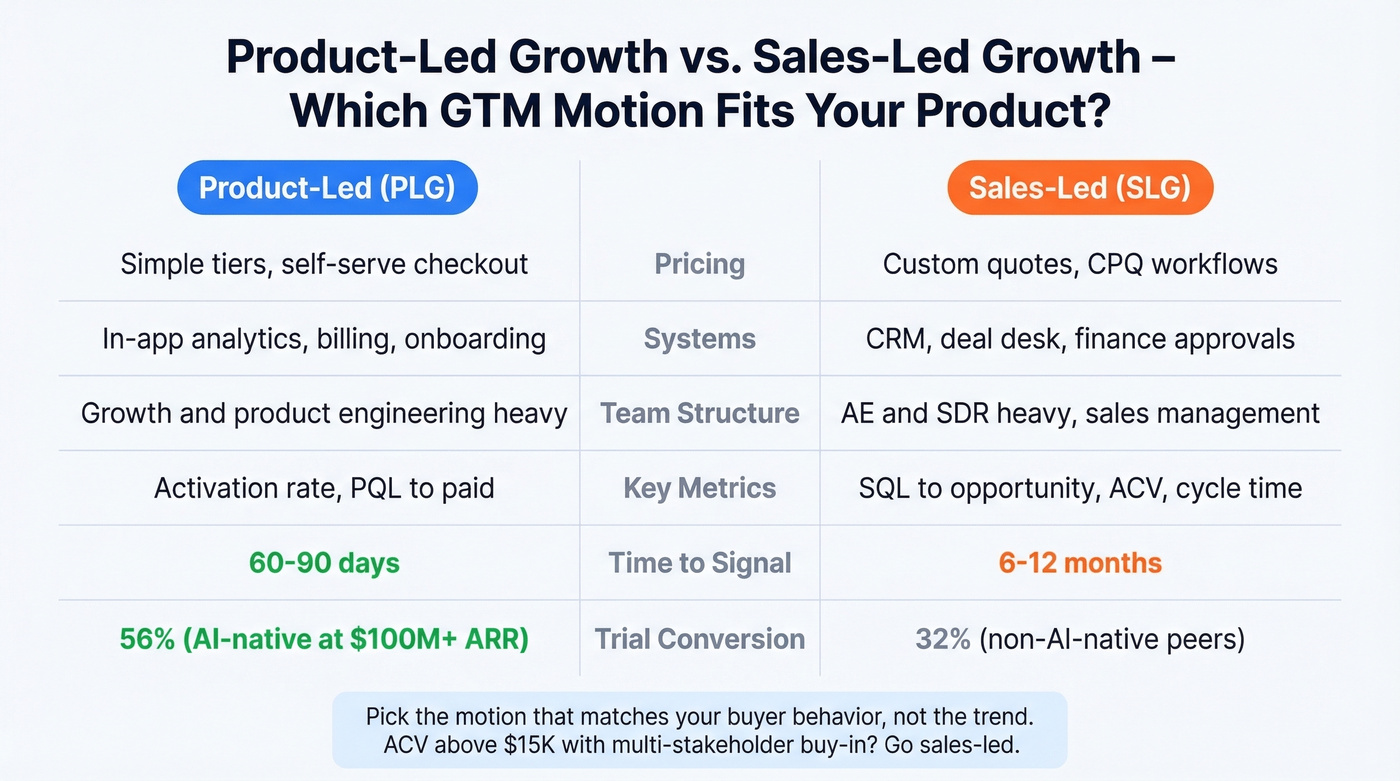
The sample plan uses a hybrid motion. But if you're choosing between pure PLG and pure sales-led, the plan changes significantly across product, sales, marketing, and pricing. Sapphire Ventures research breaks down the structural differences:
| Dimension | Product-Led (PLG) | Sales-Led (SLG) |
|---|---|---|
| Pricing | Simple tiers, self-serve checkout | Custom quotes, CPQ workflows |
| Systems | In-app analytics, billing, onboarding | CRM, deal desk, finance approvals |
| Org structure | Growth + product eng heavy | AE/SDR heavy, sales management |
| Key metrics | Activation rate, PQL-to-paid | SQL-to-opportunity, ACV, cycle time |
| Plan length | 60-90 days to first signal | 6-12 months to meaningful pipeline |
| Post-sales headcount | AI-native: 31-34% of GTM headcount | Non-AI-native: ~23% of GTM headcount |
AI-native companies with $100M+ ARR convert free trials at 56% vs. 32% for non-AI-native peers. If your product has a fast time-to-value and a natural viral loop, PLG is the obvious play. If it requires configuration, training, or multi-stakeholder buy-in, don't force a self-serve motion just because it's trendy.
Let's be honest about something: most B2B SaaS teams default to PLG because it sounds cheaper. It isn't. PLG requires serious investment in product engineering, in-app analytics, and onboarding flows. If your ACV is above $15K and your buyer needs internal approval, a 2-rep sales team will outperform a self-serve funnel every time. Pick the motion that matches your buyer's behavior, not the one that's popular on Twitter.
If you're building the outbound side of the hybrid motion, start with sales prospecting techniques.
The GTM plan above budgets $50K for outbound and targets <$239 blended CAC. At $0.01 per verified email, Prospeo keeps your prospect data costs near zero - so more of that budget goes to sequences, not bad contacts. 98% email accuracy means your 500-account launch list actually lands.
Every dollar saved on bad data is a dollar spent on pipeline.
One-Page GTM Canvas
If you've got 48 hours and a take-home GTM exercise - the exact scenario r/ProductMarketing candidates face constantly - you don't need the full plan above. You need a one-page canvas. This is adapted from Wes Bush's One-Page Endgame framework, designed to be completed in under 20 minutes.
Here's the canvas filled in for Beacon Analytics:
| Field | Entry |
|---|---|
| Obvious choice statement | The predictive attribution tool DTC brands switch to after outgrowing Triple Whale |
| ICP (one sentence) | VP Marketing at $5M-$100M Shopify Plus DTC brands running $50K+/mo in paid ads |
| Core problem | Can't tell which ads actually drive revenue vs. which get false credit |
| Product | Predictive attribution SaaS with Shopify-native integration |
| Primary channels | Content/SEO, Shopify app marketplace, outbound to ICP list |
| Geography | US + UK |
| 3 moats | Proprietary predictive model, Shopify-deep integration, freemium network effects |
| 90-day priorities | 20 beta partners, Product Hunt launch, first 100 paying customers |
For interview exercises, this canvas shows you can prioritize. Hiring managers don't want a 40-page deck. They want to see that you can identify the ICP, pick channels that match the motion, and set measurable priorities - all on one page.
One note: GTM plans shift by region. APAC markets often require localized compliance considerations and different channel mixes than US/UK launches, so flag that in your assumptions if the exercise involves international expansion.
Five Reasons GTM Plans Fail
1. Misaligned market understanding. You validated the problem with 5 friendly customers, not 50 cold prospects. Run 20+ discovery calls with people who don't know you before finalizing the ICP.
2. No agreement on what "qualified" means. Marketing generates leads that sales can't convert because nobody defined MQL/SQL criteria jointly. Nail this before launch, not after the first pipeline review where everyone's pointing fingers.
3. Features-over-outcomes messaging. Your landing page lists 12 features. Nobody knows why they should care. Lead every message with the outcome ("save $47K in wasted spend"), not the mechanism ("predictive multi-touch attribution engine").
4. Inadequate sales enablement. Reps don't have battle cards, objection handlers, or demo scripts on day one. In our experience, the teams that build a sales enablement kit during pre-launch (weeks 1-4 in the sample timeline) close at 2x the rate of teams that scramble after reps start losing deals.
5. The plan gets approved and never revisited. Schedule a weekly GTM standup for the first 90 days. Review KPIs against benchmarks. Kill channels that aren't converting. The plan is a living document or it's a dead one.
Real-World GTM Strategy Examples
8,000 Signups in 24 Hours: Slack's PLG Playbook
Slack hit 8,000 signups within 24 hours of launch. The GTM plan was simple: make the free product so good that teams invite other teams. Viral loops replaced outbound.
The lesson isn't "copy Slack." It's that PLG works when the product has built-in network effects and near-zero time-to-value. Most products don't have either, and that's fine - it just means your GTM plan needs a different engine.
WorkCompOne: Organic-Only GTM
A B2B insurance company that built its entire GTM around content and SEO. They targeted geo-specific keywords like "California workers' compensation insurance" and generated nearly 100% of traffic, leads, and sales through organic search. No paid ads. No outbound. Proof that a single-channel GTM can work - if you pick the right channel and commit to it for 12+ months.
Instrumentl: ABM for Nonprofits
Instrumentl targeted ICP-fit nonprofits with personalized email campaigns and custom landing pages. Instead of broad demand gen, they ran account-based plays - identifying specific organizations, personalizing outreach, and driving them to tailored experiences. Even niche markets benefit from tight ICP targeting over broad awareness campaigns. If your total addressable market is small, ABM isn't optional. It's the whole strategy.
If you're running ABM-style outbound, use account-based selling best practices.
FAQ
What should a go-to-market plan include?
Nine core sections: executive summary, ICP definition, competitive positioning, messaging framework, pricing strategy, channel mix with budget, sales model, launch timeline with milestones, and KPI targets with benchmarks. If it doesn't have specific numbers and dates, it's a strategy deck - not a plan.
How long does a GTM plan take to write?
A one-page canvas takes under 20 minutes and works for alignment meetings or interview exercises. A full plan with budget, timeline, and KPIs typically takes 2-4 weeks for a new product - less if you're adapting an existing plan for a new market or segment. Don't let perfect be the enemy of shipped.
What's the difference between a GTM strategy and a marketing plan?
A GTM strategy covers the entire path from product to customer - including pricing, sales model, and channel selection. A marketing plan is one component, focused on demand generation and awareness. Every GTM plan contains a marketing plan; not every marketing plan is a GTM plan.
How do I build a target account list for outbound GTM?
Start by translating your ICP into searchable filters: industry, revenue range, tech stack, headcount. Then use a B2B data platform to pull verified contacts matching those criteria. We've found that mapping ICP dimensions directly to database filters - rather than manually assembling lists from scattered sources - cuts list-building time from days to hours and keeps bounce rates under 5%.