

The Go to Market Plan Template That Tells You What to Write
Your CEO wants a GTM plan by Friday. You download three templates - one's a Notion page with empty headers, one's a 47-slide deck from a consulting firm, and one's a SaaS landing page disguised as a resource. None of them explain what actually goes in "market sizing" or how to pick between PLG and sales-led.
Most go to market plan template downloads floating around aren't planning tools. They're lead magnets with nice formatting and zero substance.
Here's a different approach: a section-by-section GTM plan template with benchmarks, filled-out examples, and the context you need to write something your exec team will actually use.
What You Need (Quick Version)
Your GTM plan needs 10 sections, but only three matter on day one: ICP, positioning, and channel strategy. Everything else builds on those.
Pick your GTM motion first. If your average deal is under $10K, lean product-led. Over $25K, go sales-led. In between, hybrid is the right call for most B2B SaaS startups. Then fill in each section with real data - not placeholder text, not "insert your value proposition here."
Below: the full template section by section with benchmarks so you know what "good" looks like, a filled-out example, the best free GTM templates worth grabbing, and the five mistakes that kill launches before they start.
What a GTM Plan Actually Is
A GTM plan isn't a marketing plan with a new title. It's a cross-functional operating system that aligns product, marketing, sales, and customer success around pipeline generation from day one. Marketing plans cover demand gen tactics. GTM plans cover the entire path from "who do we sell to" through "how do we know it's working." If you've been searching for a go-to-market strategy template, make sure you're not accidentally downloading a demand gen checklist - the scope is fundamentally different.
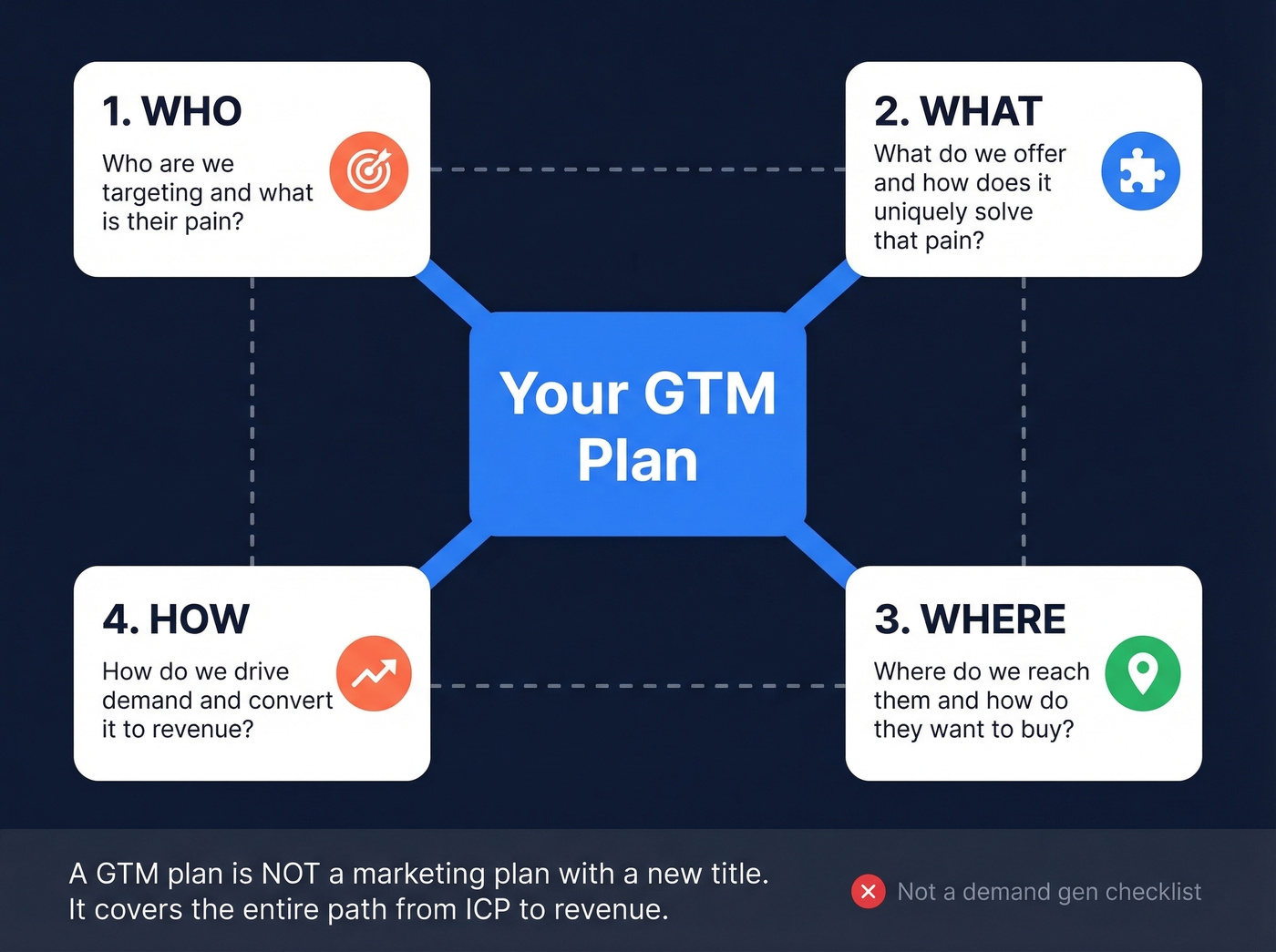
The Warmly GTM framework breaks this into four core questions every plan must answer:
- Who are we targeting, and what's their pain?
- What do we offer, and how does it uniquely solve that pain?
- Where do we reach them, and how do they want to buy?
- How do we drive demand and convert it to revenue?
If your plan doesn't answer all four, it's incomplete. And if it lives in a Google Doc that nobody opens after launch week, it's dead.
Let's be honest about the buying environment: per Gartner research, 75% of B2B buyers now prefer a rep-free sales experience, and the average organization runs 23 tools in their GTM tech stack. Your plan needs to account for how buyers actually buy in 2026 - not how your sales VP bought software in 2018.
Pick Your GTM Motion First
Before you fill in a single template section, decide your motion. This choice shapes everything downstream - your pricing, your channels, your KPIs, your team structure.
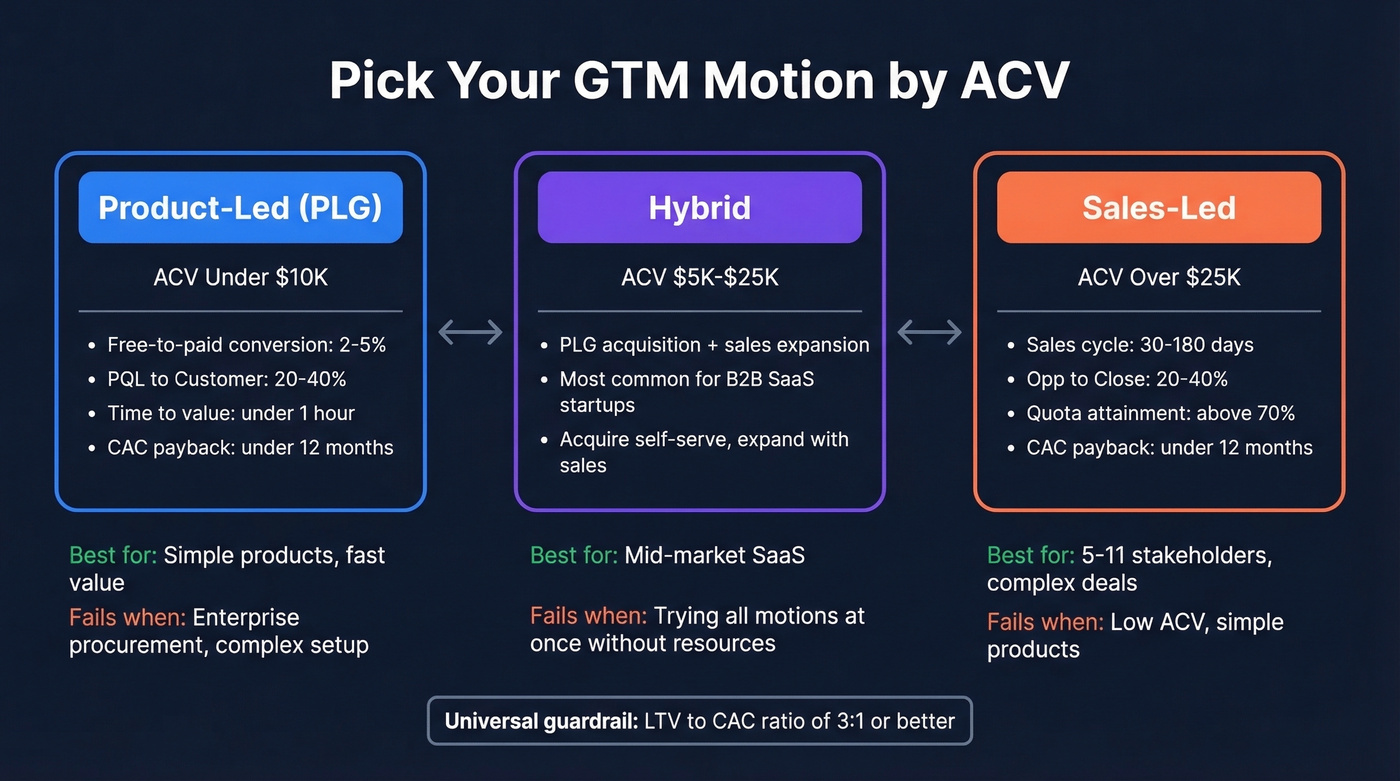
The simplest decision framework is ACV-based:
| Motion | ACV Range | Works When | Fails When |
|---|---|---|---|
| Product-led (PLG) | Under $10K | Value in under 1 hour, low friction | Enterprise procurement, complex setup |
| Hybrid | $5K-$25K | PLG acquisition + sales expansion | Trying to do both equally from day one |
| Sales-led | Over $25K | 5-11 stakeholders, complex implementation | Low ACV, simple products |
Hybrid works for most B2B SaaS startups in the $5K-$25K range. You acquire through self-serve, then expand through sales-assisted motions. But most companies fail by trying to run all three motions simultaneously without the resources to support any of them well.
Here are the benchmarks that matter for each motion:
PLG targets:
- Free-to-paid conversion: 2-5%
- PQL to Customer: 20-40%
- Time-to-value: under 1 hour
- CAC payback: under 12 months
Sales-led targets:
- Sales cycle: 30-180 days
- Opportunity to Close: 20-40%
- Quota attainment: above 70%
- CAC payback: under 12 months
These ranges come from a synthesis of 2026 GTM benchmarks and the Sprug Agency's B2B SaaS framework. Use them as guardrails, not gospel.

A GTM plan without accurate contact data is just a strategy deck collecting dust. Prospeo gives you 300M+ profiles with 30+ filters - buyer intent, technographics, headcount growth, funding - so you can go from ICP definition to live pipeline in minutes, not weeks. 98% email accuracy means your outbound actually lands.
Turn your GTM plan into booked meetings. Start for free.
The Template - Section by Section
Ten sections, each with what goes in it, why it matters, and a concrete benchmark or example. Fill these out in order - each one builds on the last.
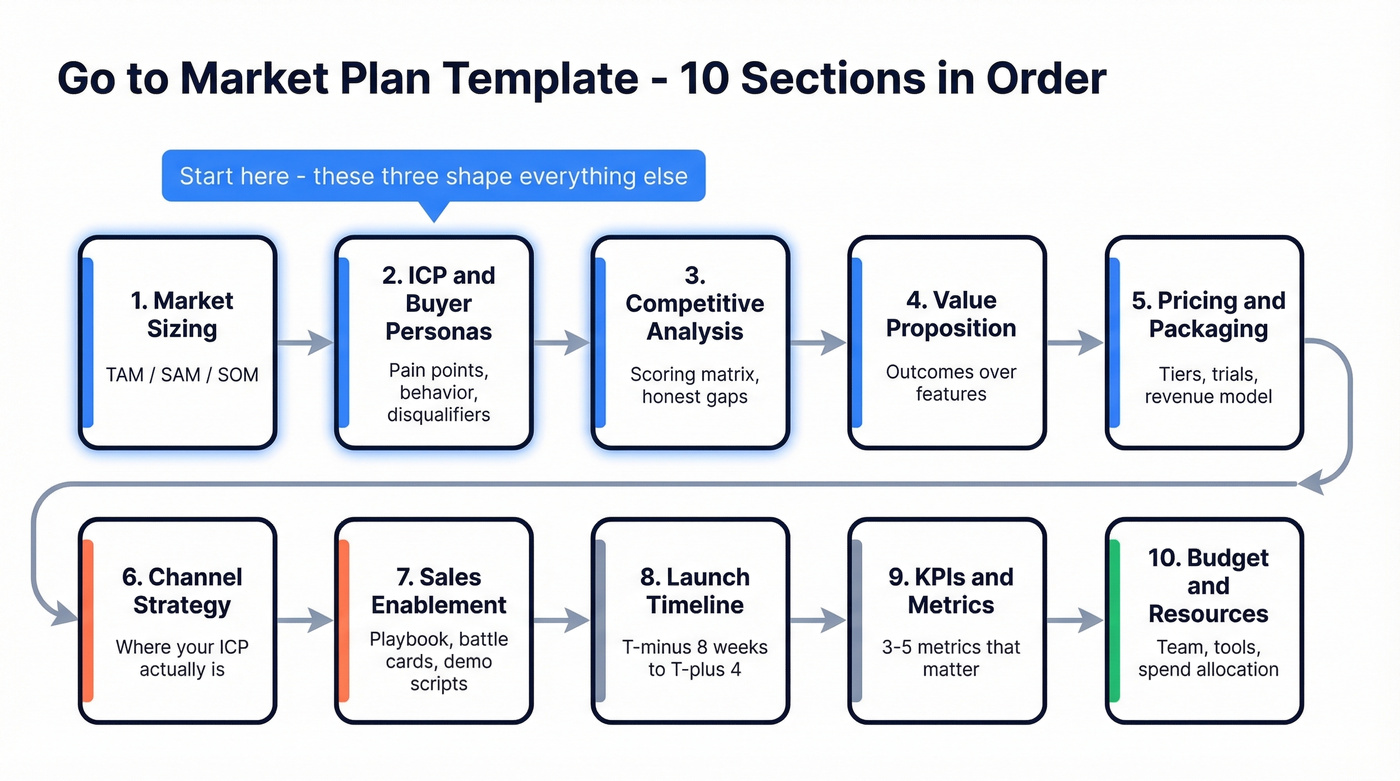
Market Sizing (TAM/SAM/SOM)
Use three calculation methods and cross-validate. Top-down takes industry size and narrows by relevant segment percentage. Bottom-up multiplies target companies by average annual spend. Value theory estimates annual value delivered times addressable companies. The ZoomInfo pipeline research recommends running all three - if the numbers diverge wildly, your data quality is poor and you need better inputs before proceeding.
Don't inflate TAM to impress investors. A realistic SAM is more useful than a fantasy TAM. If your SAM is under $500M, own it - a focused market you can dominate beats a sprawling one where you're invisible.
ICP and Buyer Personas
Go beyond firmographics. Industry and company size are table stakes. Your ICP profile must include:
- Top 3 pain points, ranked by urgency
- Buying behavior (committee vs. champion-led, budget cycle timing)
- Information consumption habits (podcasts, communities, events, search)
- Messaging hooks that resonate (outcomes, not features)
- Disqualification criteria (who is NOT your ICP)
Analyze your best 20 customers - not your average ones - and build a scoring model from what they have in common. We've seen teams skip this step and end up targeting three different ICPs with one message. It never works.
Competitive Analysis
Build a scoring matrix across five dimensions for your top three competitors:
| Dimension | Competitor A (1-10) | Competitor B (1-10) | Competitor C (1-10) | You (1-10) |
|---|---|---|---|---|
| Product capabilities | ||||
| Pricing competitiveness | ||||
| Positioning clarity | ||||
| Distribution reach | ||||
| Support quality | ||||
| Your advantage vs. them | (write it) | (write it) | (write it) | - |
| Their advantage vs. you | (write it) | (write it) | (write it) | - |
Those last two rows are the ones most people forget. Honesty here prevents embarrassment later. If you need a more rigorous approach, use a competitive intelligence workflow to keep this updated quarterly.
Value Proposition and Positioning
Outcomes over features. Always. Your positioning statement should fit one sentence: "We help [ICP] achieve [outcome] by [mechanism], unlike [alternative] which [limitation]."
If you can't fill in every bracket with something specific and differentiated, your positioning isn't ready. Go back to the competitive analysis and ICP sections. "We have AI-powered analytics" means nothing. "We cut your monthly reporting from 3 days to 3 hours" means everything.
Pricing and Packaging
Pricing signals value. Don't copy competitors and don't guess.
Test three tiers if you're PLG. If you're sales-led, establish a pricing framework your reps can articulate in 30 seconds. One of the most common startup mistakes is neglecting pricing strategy entirely - treating it as an afterthought when it's actually a core positioning lever. Include a free tier or trial if your motion is product-led. For sales-led, consider evaluation licenses for technical buyers. Pair this section with a revenue planning template that maps pricing tiers to projected ARR - it forces you to pressure-test whether your packaging actually supports your growth targets.
Channel and Distribution Strategy
This is where most GTM plans either succeed or fail silently. The average software company runs 10.5 GTM efforts across five core channels plus 5.5 experiments. You don't need to be everywhere - you need to be where your ICP actually spends time.
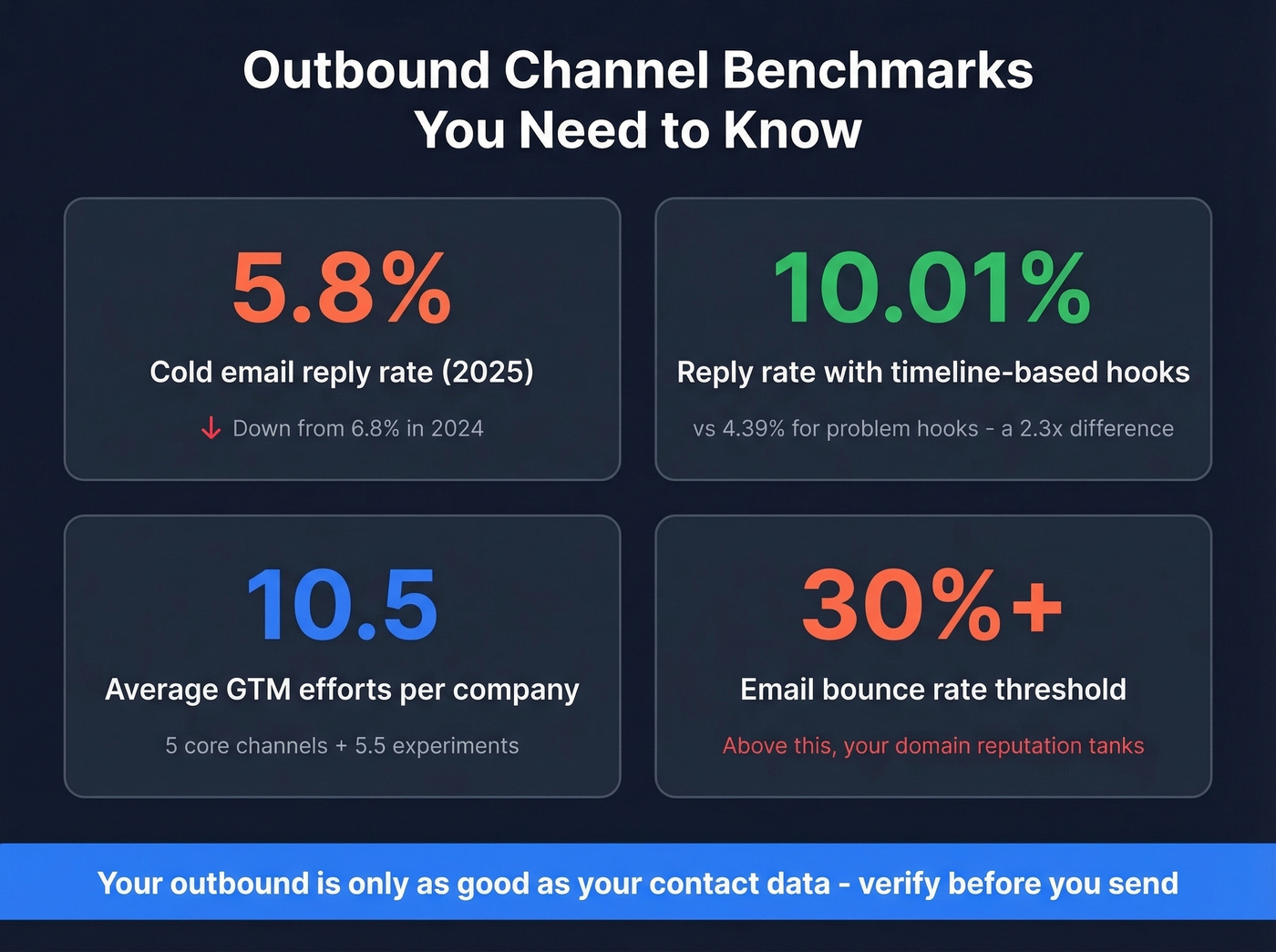
Outbound is getting harder. Cold email reply rates dropped from 6.8% in 2024 to 5.8% in 2025. But the right approach still works: timeline-based hooks pull a 10.01% reply rate versus 4.39% for problem hooks - a 2.3x difference.
Your outbound channel is only as good as your data. If 30%+ of emails bounce, your domain reputation tanks and your GTM timeline slips. Build verified prospect lists before launch using a tool like Prospeo - 98% email accuracy and a 7-day data refresh cycle mean you're not burning your sender reputation on day one. Bad contact data is the most common reason outbound GTM motions fail silently, and we've watched it happen to teams with otherwise solid plans. (If you want to go deeper on bounce prevention, start with email bounce rate benchmarks and fixes.)

Sales Enablement and Playbook
Your reps need five things on launch day. No exceptions.
- Playbook with talk tracks for each ICP segment
- Objection handling doc covering the top 10 objections
- Competitive battle cards for your top 3 competitors
- Demo script with branching paths by persona
- Verified contact lists - have reps validate emails before loading sequences, a 2-minute step that prevents wasted outreach cycles
If your reps don't have these on launch day, they're improvising. And improvisation doesn't scale. A go to market playbook template can give you the structure for items 1-4, but the substance has to come from your ICP research and competitive analysis - not from generic fill-in-the-blank prompts.
Launch Timeline and Milestones
Work backward from your launch date:
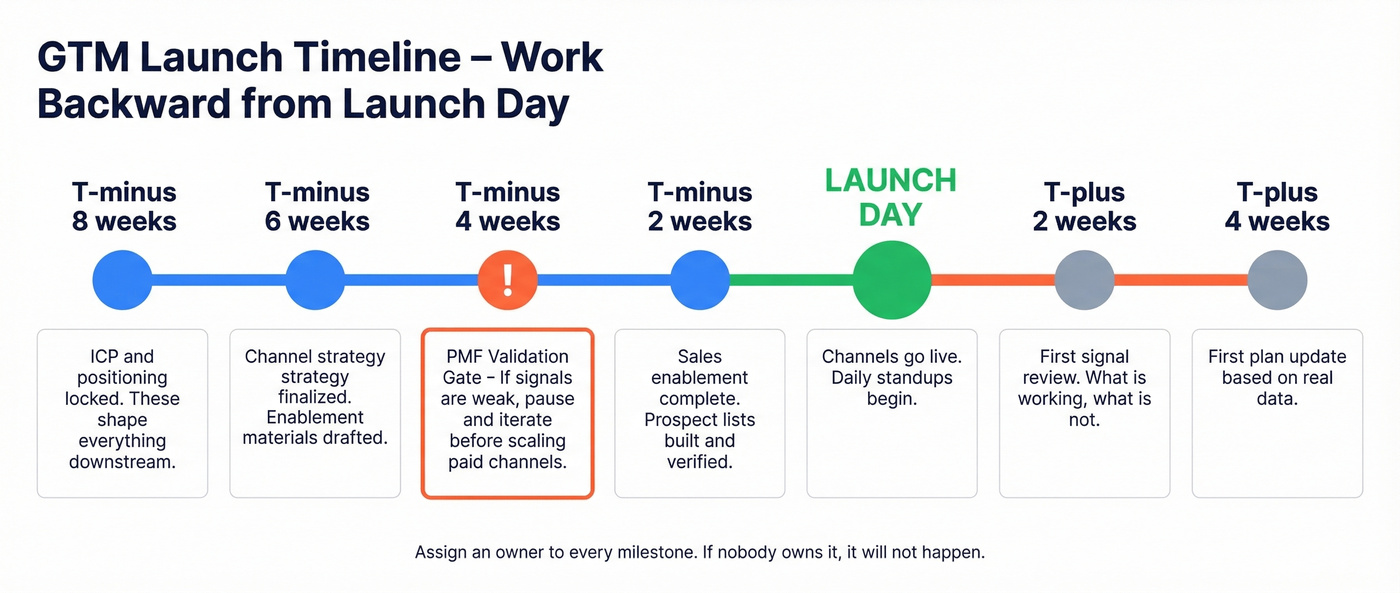
- T-minus 8 weeks: ICP and positioning locked
- T-minus 6 weeks: Channel strategy finalized, enablement materials drafted
- T-minus 4 weeks: PMF validation gate - if signals are weak, pause and iterate before scaling paid channels
- T-minus 2 weeks: Sales enablement complete, prospect lists built and verified
- Launch day: Channels go live, daily standups begin
- T-plus 2 weeks: First signal review - what's working, what's not
- T-plus 4 weeks: First plan update based on real data
Assign owners to every milestone. If nobody owns it, it won't happen. If you need a ramp plan for new reps tied to this timeline, use a 30-60-90 day plan structure.
KPIs and Success Metrics
You don't need 10 KPIs. Pick three to five that tell you whether the launch is working.
Two unit economics guardrails belong in every GTM plan regardless of motion: LTV:CAC of 3:1 or better, and CAC payback under 12 months. For PLG, track activation rate - top 10% of companies hit 65%+, while the average sits at 33%. For sales-led, track quota attainment with a target above 70%. Best-in-class net revenue retention runs above 120%. To keep this measurable end-to-end, map KPIs to funnel metrics and review weekly.
Feedback Loops and Iteration
A GTM plan is a living system, not a launch document. Weekly signal reviews, monthly plan updates, quarterly strategy reassessment. The number one way GTM plans die is "set-and-forget" - the team launches, moves on to execution, and never revisits whether the plan's assumptions still hold.
Filled-Out Example: Slack's GTM Plan
A common request when people look for GTM templates is a filled-out example from a real company. Let's map Slack's product go to market plan to the 10 template sections.
| Template Section | Slack's Approach |
|---|---|
| Market Sizing | Enterprise collaboration - massive TAM, narrowed SAM to tech-forward teams frustrated with email overload |
| ICP | Small engineering and product teams at startups, expanding to enterprise |
| Competitive Analysis | Positioned against email, not HipChat or Campfire - made the market feel bigger |
| Value Proposition | "Be less busy" - outcome-driven, not feature-driven |
| Pricing | Generous free tier letting teams use Slack indefinitely; bottom-up adoption forced IT to consolidate onto paid plans |
| Channel Strategy | Word-of-mouth plus integrations as a distribution moat; every new integration made Slack stickier |
| Sales Enablement | Minimal at launch - the product was the sales team; enterprise sales layered in after PLG traction proved the model |
| Launch Timeline | Months in private beta, obsessing over onboarding and time-to-value before opening up |
| KPIs | DAU, free-to-paid conversion, team expansion rate |
| Feedback Loops | Iterated on onboarding constantly, treating every friction point as a bug |
The results: 8M daily active users and 3M paid users by 2019, culminating in a $27.7B Salesforce acquisition. The template sections are the same for every company - what changes is the substance inside them.
Best Free GTM Templates
If you want a starting structure to fill in, these are worth downloading. None of them tell you what to write - that's what the section above is for - but they give you formatting and organization. For teams that prefer spreadsheets, look for a go to market plan template in Excel format; Google Sheets and Smartsheet both offer solid options that let you build timelines and scoring models in the same workbook.
| Template | Format | Best For | Strengths | Limitations |
|---|---|---|---|---|
| Notion GTM Plan | Notion doc | Collaboration | 4.8/5 rated, easy to update | Requires Notion |
| Google Docs/Sheets | Spreadsheet | Max flexibility | Free, universal access | No built-in structure |
| Smartsheet | Spreadsheet | Timelines | GTM templates for planning + tracking | Best if your team already uses Smartsheet |
| Asana | Project board | PM integration | Task tracking built in | More guide than plug-and-play template |
| Mural | Visual board | Workshop-style planning | Collaborative, visual | Requires team buy-in |
| Reforge | Mixed | Learning from examples | Strong GTM learning library | Requires membership |
Skip Canva. It optimizes for looking good in a board meeting, not for actually running a launch. Pick whatever your team will actually open and update - a beautiful deck that nobody touches after week one is worse than a messy Google Doc that gets edited every Monday. In our experience, the Notion template is the best starting point for most teams: it's collaborative, easy to update, and structured enough to keep you honest.
5 Mistakes That Kill GTM Plans
We've watched enough launches to see the same failure patterns repeat. These are the five that kill the most plans.
1. Misaligned market understanding. Launching without validating that your ICP actually has the pain you think they have. Assumption-based GTM plans look great in slides and fall apart on the first sales call.
2. No cross-functional alignment. Marketing says one thing, sales says another, product ships something different. Your GTM plan exists to prevent this - if teams aren't reading it, it isn't working.
3. Features over outcomes in positioning. We've seen this more than any other messaging mistake. Lead with the transformation, not the technology. Nobody buys "AI-powered analytics." They buy three days of their life back every month.
4. Scaling before product-market fit. Pouring budget into paid channels and outbound before you've validated that your product actually solves the problem. This is how startups burn through runway - they mistake early traction for PMF and scale prematurely.
5. No iteration loop. Treating the GTM plan as a one-time document instead of a living system. If you haven't updated your plan in 60 days, it's a dead document.
And a bonus that compounds all five: neglecting pricing and retention. Teams obsess over acquisition channels and ignore two levers that compound over time. Pricing is a positioning tool, not an afterthought - get it wrong and your entire funnel economics break. If your net revenue retention is below 100%, you're filling a leaky bucket no matter how good your top-of-funnel is. The best GTM plans include an expansion playbook alongside the acquisition playbook. (If retention is a blind spot, start with churn analysis.)
One more thing: if your GTM plan is longer than 10 pages, you've already failed. Length is a symptom of unclear thinking. The best plans we've seen fit on five pages with an appendix for supporting data. If you can't explain your channel strategy in half a page, you don't understand it well enough to execute it.
You just defined your ICP, competitive positioning, and channel strategy. Now you need verified emails and direct dials to reach those buyers. Prospeo delivers 143M+ verified emails at $0.01 each and 125M+ mobile numbers with a 30% pickup rate - plus intent data across 15,000 topics to prioritize accounts that are actively in-market.
Stop planning. Start reaching decision-makers today.
FAQ
What's the difference between a GTM strategy and a GTM plan?
Strategy is the "why" and "what" - your market thesis, positioning, and chosen motion. The plan is the "how" and "when" - specific channels, timelines, owners, and KPIs. Lock the strategy first; the plan operationalizes it.
How long should a GTM plan be?
Five to ten pages for the full plan, plus a one-page executive summary. Anything over 15 pages signals unclear thinking - trim ruthlessly and move supporting data to an appendix.
When do I need a GTM plan?
Any time you're changing who you sell to, what you sell, or how you sell it - new product launch, new market entry, repositioning, or a major pricing overhaul. If none of those apply, a campaign brief is enough.
Can I use the same template for PLG and sales-led?
The 10 sections are identical, but the content changes dramatically. PLG plans prioritize onboarding, activation metrics, and self-serve conversion. Sales-led plans prioritize enablement, pipeline stages, and prospect data quality - bad contact data silently kills outbound motions before they launch, which is why verifying emails before loading sequences matters more than most teams realize.
Is there a good free option for startups?
The Notion GTM Plan template is free, collaborative, and covers all 10 sections outlined above. Google Sheets works well if your team prefers spreadsheets. Pick whichever format your team will actually update weekly - not the one that looks best in a screenshot.