

How to Build a Go-to-Market Pricing Strategy That Works
Your co-founder just asked "so what do we charge?" and nobody has a real answer. The spreadsheet has cost estimates, a competitor's pricing page screenshot, and a gut feeling. That's not a go-to-market pricing strategy - that's a coin flip with your margins on the line.
McKinsey research shows a 1% price improvement can boost operating profit by 8-11%. Flip that around and a 1% mispricing bleeds profit fast. A [Bain survey of 2,300 global companies](https://www.bain.com/about/media-center/press-releases/20252/70-of-companies-struggle-to-integrate-their-sales-plays-into-crm-and-revenue-technologies-finds-bain - company-survey/) found only 9% achieved at least 5.5% annual revenue and profit growth over a decade. Pricing isn't the only reason the other 91% fell short, but it's the GTM lever most teams ignore entirely.
Most GTM guides bury pricing under "the 4 Ps" and move on. This one doesn't. If you need the broader context, start with the components of a GTM strategy.
The Framework in Four Moves
If you're short on time, here's the whole thing:
- Triangulate your inputs. Value-based pricing is your anchor. Cross-reference with competitor pricing and your cost floor.
- Validate with real buyers. Run 10+ ICP-matching buyer conversations, then do willingness-to-pay research - Van Westendorp at minimum - with a real sample.
- Package in three to four tiers (plus enterprise). Use anchoring and decoy psychology to push mid-tier conversion.
- Test and iterate quarterly. Pricing isn't a launch decision. It's a quarterly discipline (a lightweight quarterly business review format helps).
Six GTM Pricing Models
Value-based is the best default for most B2B SaaS. Cost-plus is lazy. But you should know all six so you can triangulate intelligently - understanding how to price a B2B product starts with knowing which model fits your market, your cost structure, and your buyer's perception of value.
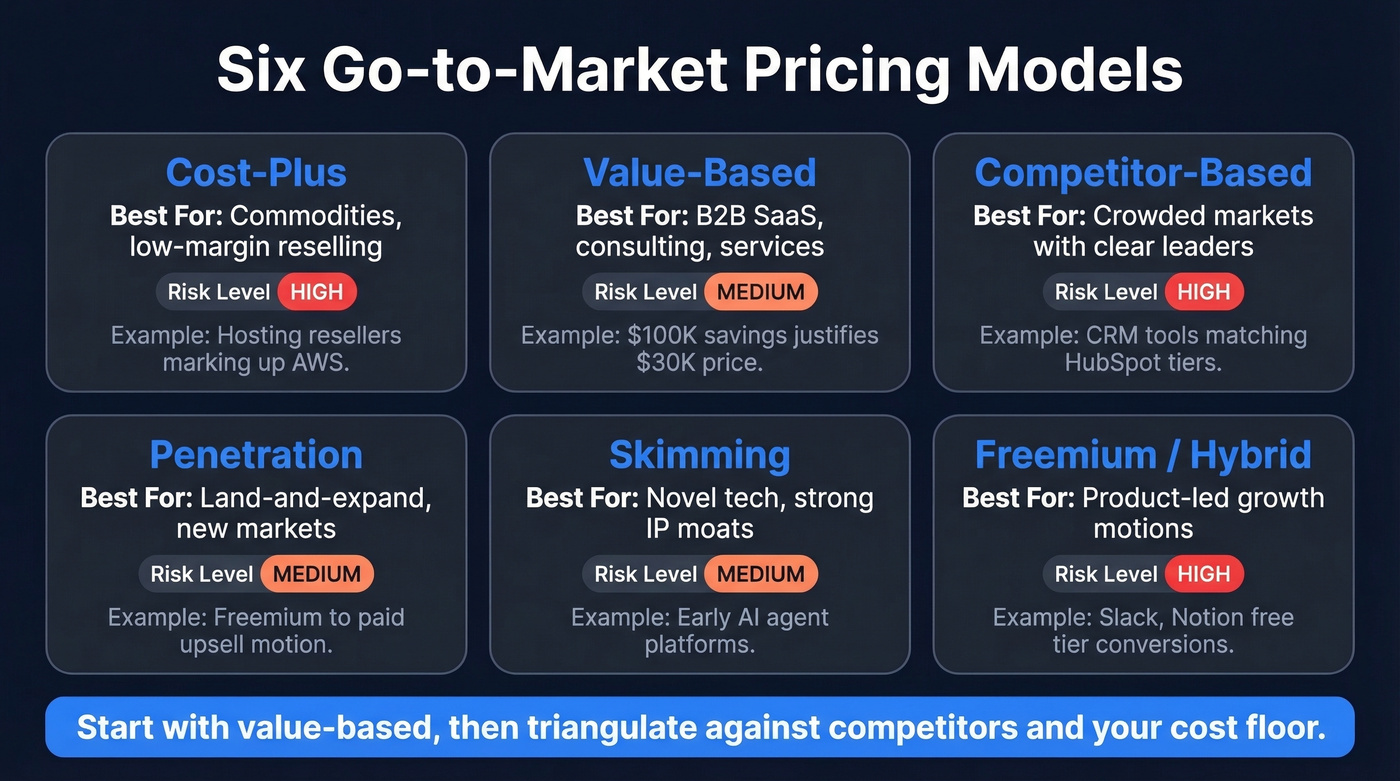
| Model | Best For | Risk | Example |
|---|---|---|---|
| Cost-plus | Commodities | Ignores buyer value | Hosting resellers |
| Value-based | B2B SaaS, services | Requires WTP research | $100K savings -> ~$30K price |
| Competitor-based | Crowded markets | Race to bottom | CRM tools matching HubSpot |
| Penetration | Land-and-expand | Hard to raise later | Freemium -> paid upsell |
| Skimming | Novel/IP-heavy | Invites competitors | Early AI agents |
| Freemium/hybrid | PLG motions | Free users never convert | Slack, Notion |
Start with value-based pricing, sanity-check against two or three competitors and your cost floor. That triangulation gives you a defensible starting price rather than a guess. (If you're building the full motion, pair this with a go to market playbook.)
How to Set Your Initial Price
Step 1: Quantify the value you deliver. If your product saves a customer $100,000/year, that's your ceiling. A common value-based approach is pricing at around 30% of the value delivered - so that $100K savings supports a ~$30K annual price, not the $5K you'd get from cost-plus math.
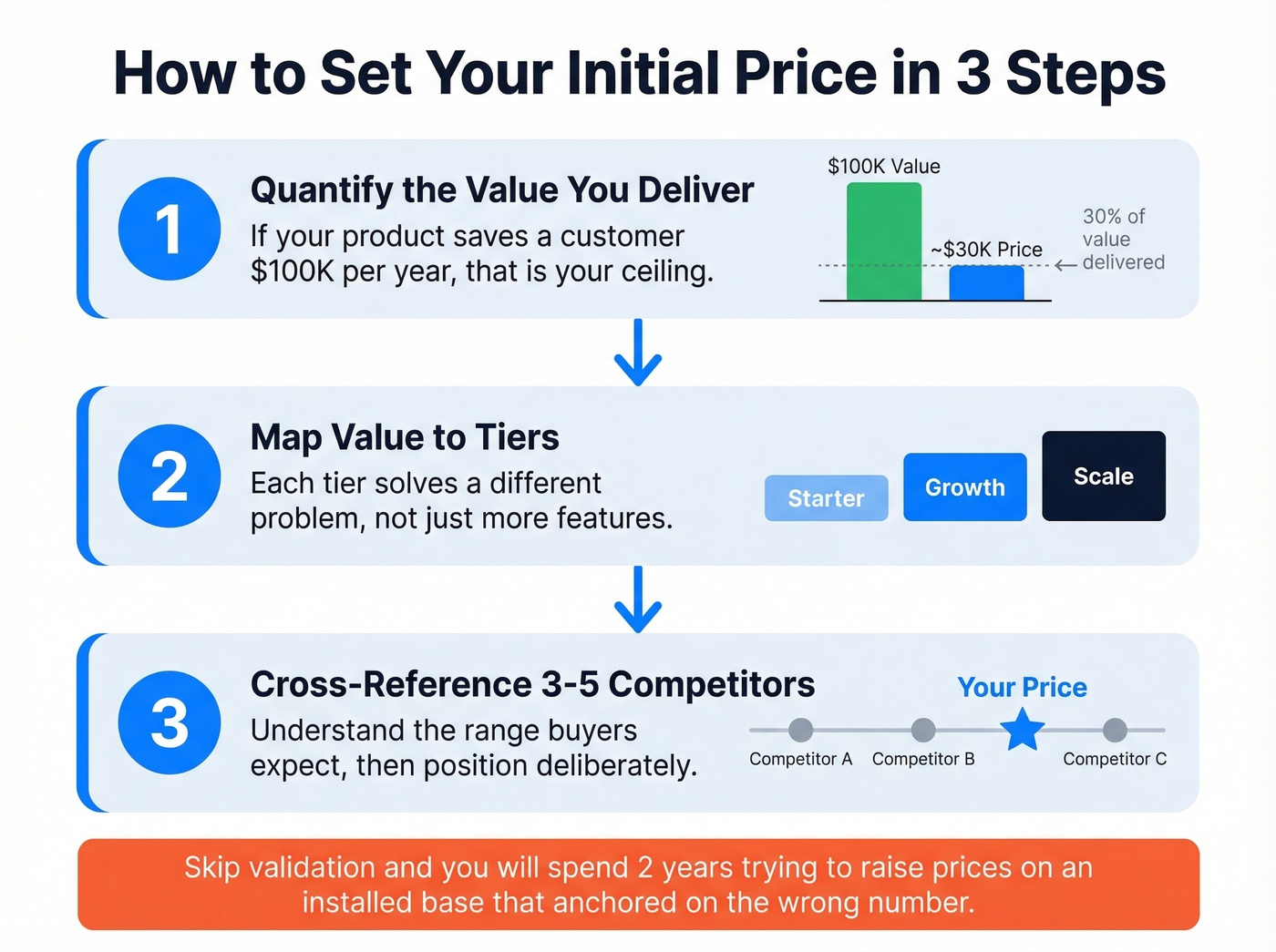
Step 2: Map value to tiers. Each tier should unlock a measurably different outcome. Don't differentiate by feature count alone - differentiate by the problem each tier solves.
Step 3: Cross-reference competitors. Pull pricing from three to five direct competitors. You're not matching them. You're understanding the range buyers expect.
These conversations reveal whether your price triggers sticker shock or feels like a bargain. With median B2B SaaS revenue growth down to ~28% and churn climbing to 12.5%, your pricing has to do more heavy lifting than ever. We've seen teams skip validation and launch too low, then spend two years trying to raise prices on an installed base that anchored on the original number. Don't be that team. (If you're pressure-testing the economics, run a quick CAC calculator alongside pricing.)

A perfect pricing strategy means nothing if you can't reach the right buyers to test it. Prospeo gives you 300M+ profiles with 30+ filters - buyer intent, technographics, funding, headcount growth - so your GTM launch targets the exact ICP segments your pricing was built for.
Validate your pricing with real buyers, not guesswork. Find them first.
Seat vs. Usage vs. Hybrid in 2026
Here's the thing: if you're launching an AI feature in 2026, pure seat pricing is financial malpractice.
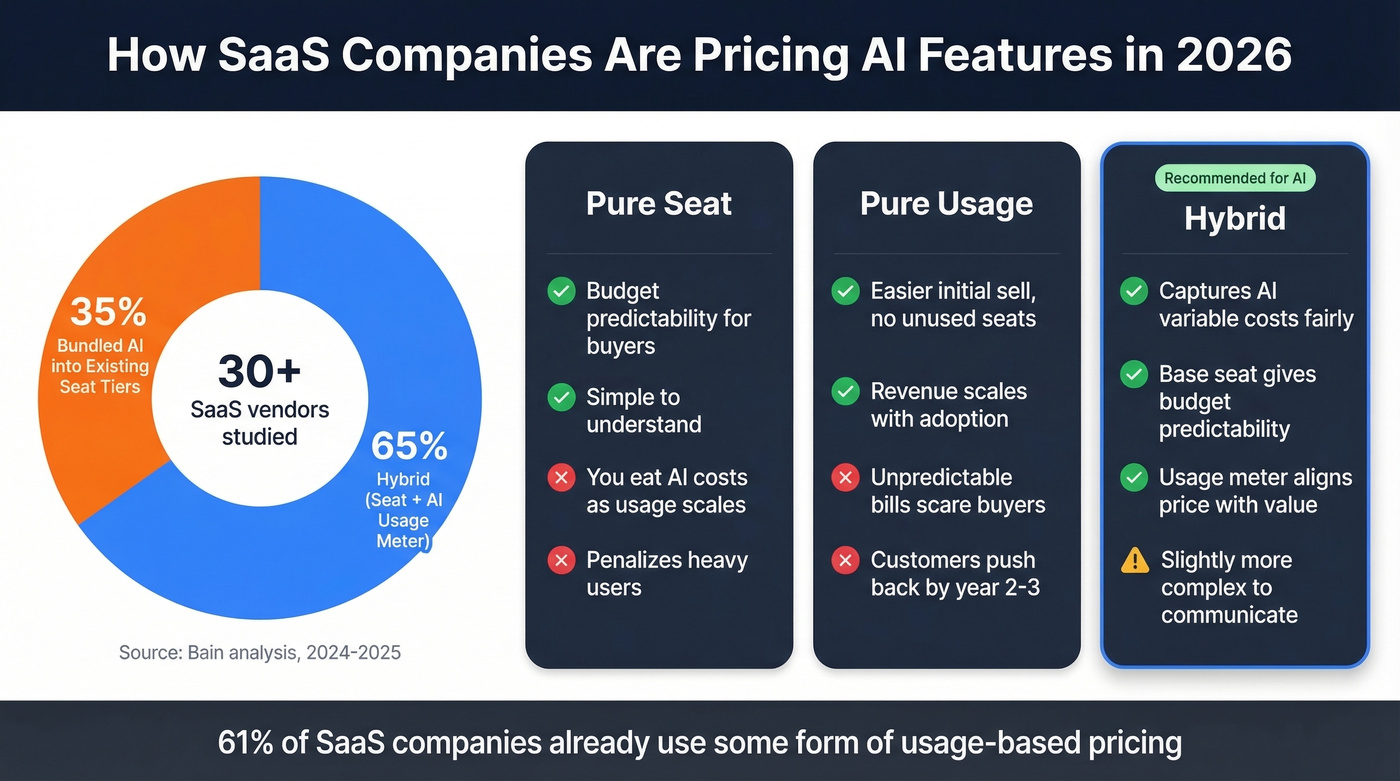
AI features carry real variable costs - inference, compute, fine-tuning. Pure seat pricing means you eat those costs as usage scales. Pure usage pricing scares buyers who can't predict their bill. Bain's analysis of 30+ SaaS vendors adding genAI found ~65% adopted hybrid models (seat + AI usage meter), while ~35% bundled AI into existing seat tiers. None fully shifted to pure usage or outcome-based pricing. By 2022, 61% of SaaS companies already used some form of usage-based pricing, and Gartner projected 30%+ of enterprise SaaS would incorporate outcome-based components by 2025.
The Reddit consensus mirrors this tension. Founders on r/SaaS report usage-based pricing is an easier initial sell because customers avoid paying for unused seats. But by years two and three, as usage grows, those same customers start asking for seat pricing to cap their costs. Pricing agility matters as much as the model you pick - look at what happened to Nokia when Samsung adapted its pricing and positioning faster as the smartphone market shifted, gaining nearly six points of share while Nokia fell roughly the same amount. (This is also where revenue optimization becomes an operating cadence, not a project.)
Use hybrid if you have AI or variable-cost features and your value scales with usage. Use seat pricing if your product's value is tied to human users and your buyers need budget predictability.
How to Test Your Pricing
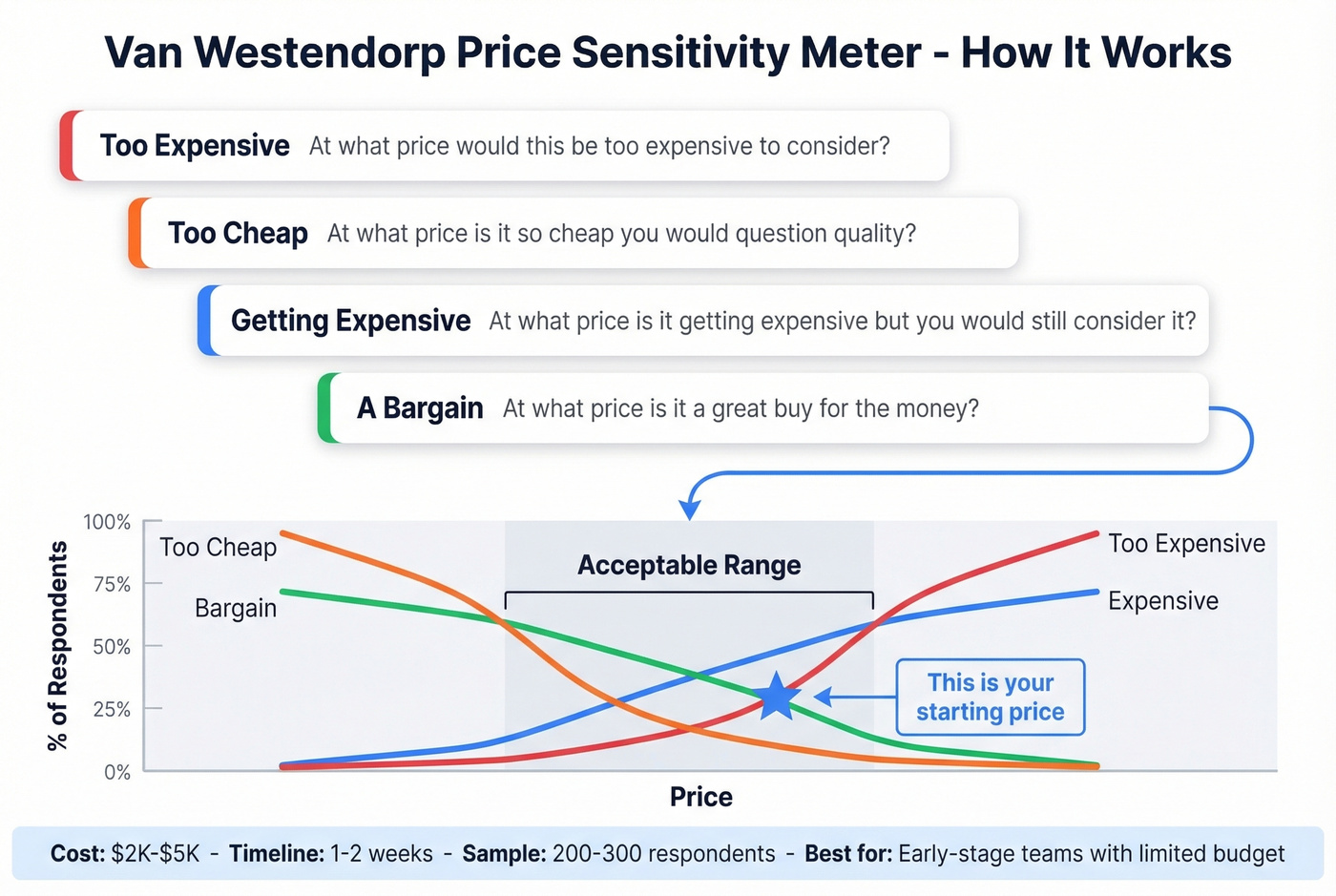
Don't guess. Test. We've run Van Westendorp studies that completely overturned a founding team's pricing assumptions in under two weeks - it's the single highest-ROI activity in pre-launch GTM.
| Method | Timeline | Cost | Sample Size |
|---|---|---|---|
| Van Westendorp | 1-2 weeks | $2K-$5K | 200-300 |
| Gabor-Granger | 1-2 weeks | $3K-$7K | 300-400 |
| Conjoint | 3-4 weeks | $10K-$30K | 300-500 |
| A/B (live) | 2-6 weeks | $5K-$50K | 1,000+ |
Van Westendorp asks four questions:
- At what price would this be too expensive to consider?
- At what price would it be so cheap you'd question quality?
- At what price is it getting expensive but you'd still consider it?
- At what price is it a bargain - a great buy?
Plot the intersections and you get your acceptable range plus an optimal price point. For early-stage teams with $5K to spend, this is the move. Save conjoint for when you're optimizing an established product with multiple feature bundles. (If you're recruiting interviewees, a tighter ideal customer profile makes the sample far more reliable.)
Packaging and Pricing Psychology
Three tiers plus enterprise. That's it.
The Economist's famous pricing experiment showed that adding a decoy option shifted 84% of buyers to the most expensive tier, up from 32% without it. Price anchoring can increase mid-tier conversions by 25-60%, and tiered pricing overall lifts revenue 25-40% versus single-tier models. Those aren't marginal gains - they're the difference between a business that scales and one that stalls.
Your pricing page needs a few non-negotiable elements:
- "Best for" labels on each tier
- A monthly/annual toggle with ~15-30% annual discount
- A usage calculator if you have variable components
- Differentiated CTAs - "Start free" for self-serve, "Talk to sales" for enterprise

Skip the feature matrix with 47 rows. If a prospect can't figure out which tier they belong in within 10 seconds, you've already lost them.
Pricing Mistakes That Kill Launches
1. Pricing off costs only. Anchor to customer value, not your AWS bill.
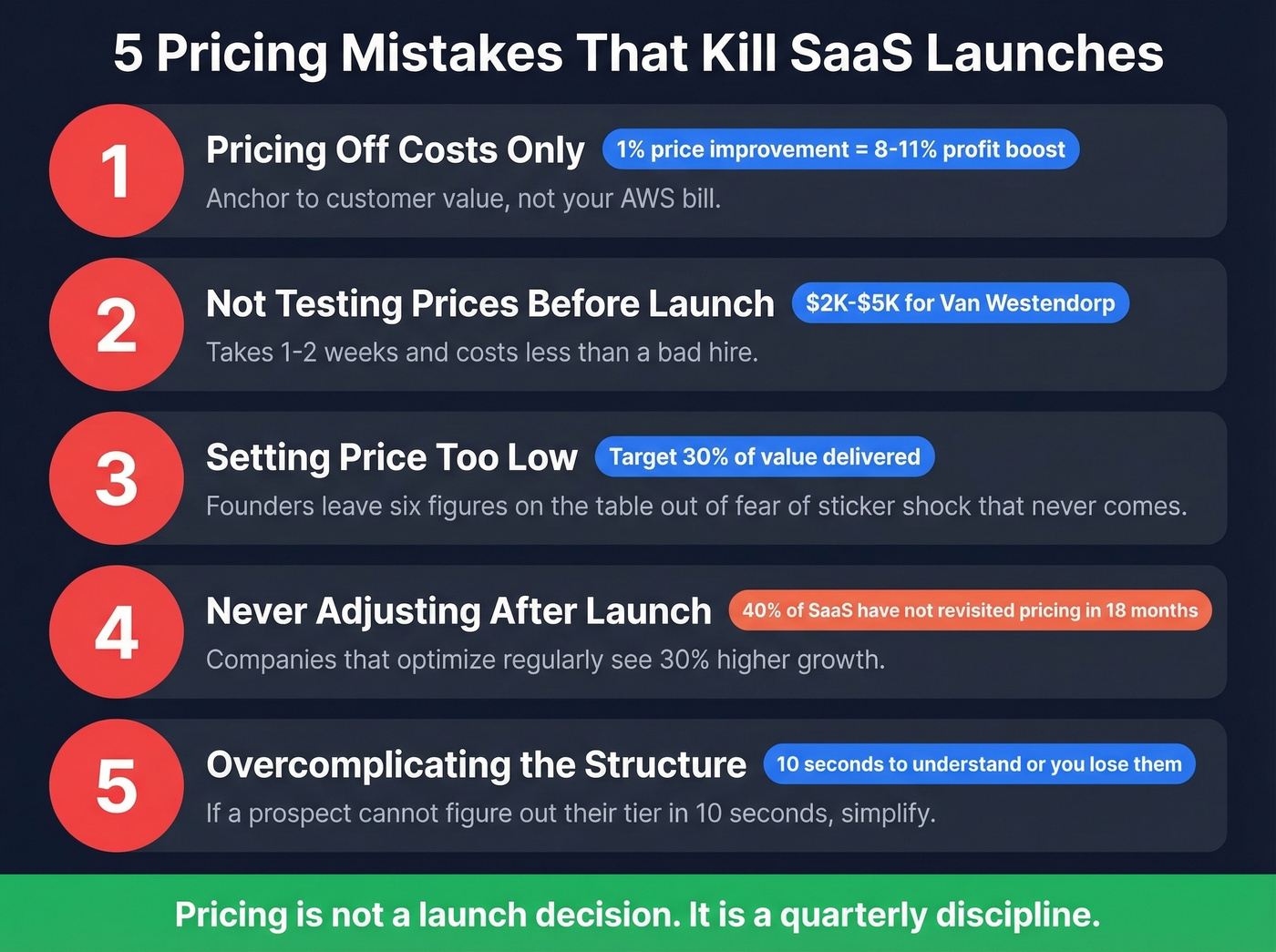
2. Not testing prices. Run Van Westendorp before launch. It takes 1-2 weeks and costs less than a bad hire.
3. Setting too low. Price around 30% of value delivered, not what "feels fair." We've watched founders leave six figures on the table because they were afraid of sticker shock that never materialized.
4. Never adjusting. Nearly 40% of SaaS companies haven't revisited pricing in 18 months. Companies that optimize regularly see 30% higher growth. (Tie the work to monthly recurring revenue and retention metrics so it doesn’t drift.)
5. Overcomplicating structures. If a prospect can't understand your pricing in 30 seconds, simplify.
A solid go-to-market pricing strategy isn't a one-time decision - it's a system you revisit every quarter, informed by buyer feedback, competitive shifts, and your own usage data.
You just built a three-tier pricing model with smart packaging and anchoring psychology. Now you need 200-300 ICP-matching prospects for that Van Westendorp study. Prospeo delivers verified emails at 98% accuracy and $0.01 each - so your WTP research actually reaches real decision-makers, not dead inboxes.
Stop bleeding budget on bounced emails during your most critical GTM research.
FAQ
What's the best pricing approach for a SaaS launch?
Value-based pricing anchored at roughly 30% of the measurable outcome you deliver. Validate with 10+ prospect interviews, run a Van Westendorp study ($2K-$5K, 1-2 weeks), then package into three tiers plus enterprise. This gives you a defensible price backed by real buyer data, not gut feel.
How often should you revisit pricing?
Run quarterly pricing sprints for incremental adjustments and a full annual packaging refresh. Top SaaS companies achieve 115-125% net revenue retention - that depends on pricing that evolves alongside product value and market conditions.
How do you price a B2B product with no market data?
Start with the dollar value you deliver, not your costs. Run 10+ prospect interviews to gauge willingness to pay, then use Van Westendorp to find the acceptable range. Even without competitor benchmarks, structured WTP research gives you a defensible starting point you can iterate on quarterly.
How do you find prospects for pricing validation calls?
Upload a CSV of target companies to a B2B data platform like Prospeo, which returns verified contacts at 98% accuracy with a 7-day refresh cycle. Book 10+ calls with ICP-matching prospects - not existing customers - to test price sensitivity before launch.