

The 8 Components of a GTM Strategy That Actually Drive Pipeline
72-slide GTM decks are easy to approve and hard to execute. Meanwhile, 15.4% of companies still don't have a defined go-to-market strategy at all - which tells you how messy the components of a GTM strategy get in practice.
The relay-race handoff model is dead. Product doesn't "finish" and toss a baton to marketing, who tosses it to sales. Modern GTM is a system where every part feeds the others. Buyers spend 83% of the journey researching independently before they ever talk to you, so your strategy better hold up without a rep in the room.
Start With 3, Then Layer
You don't need 10 go-to-market elements. You need 3 done well, then you layer the rest.
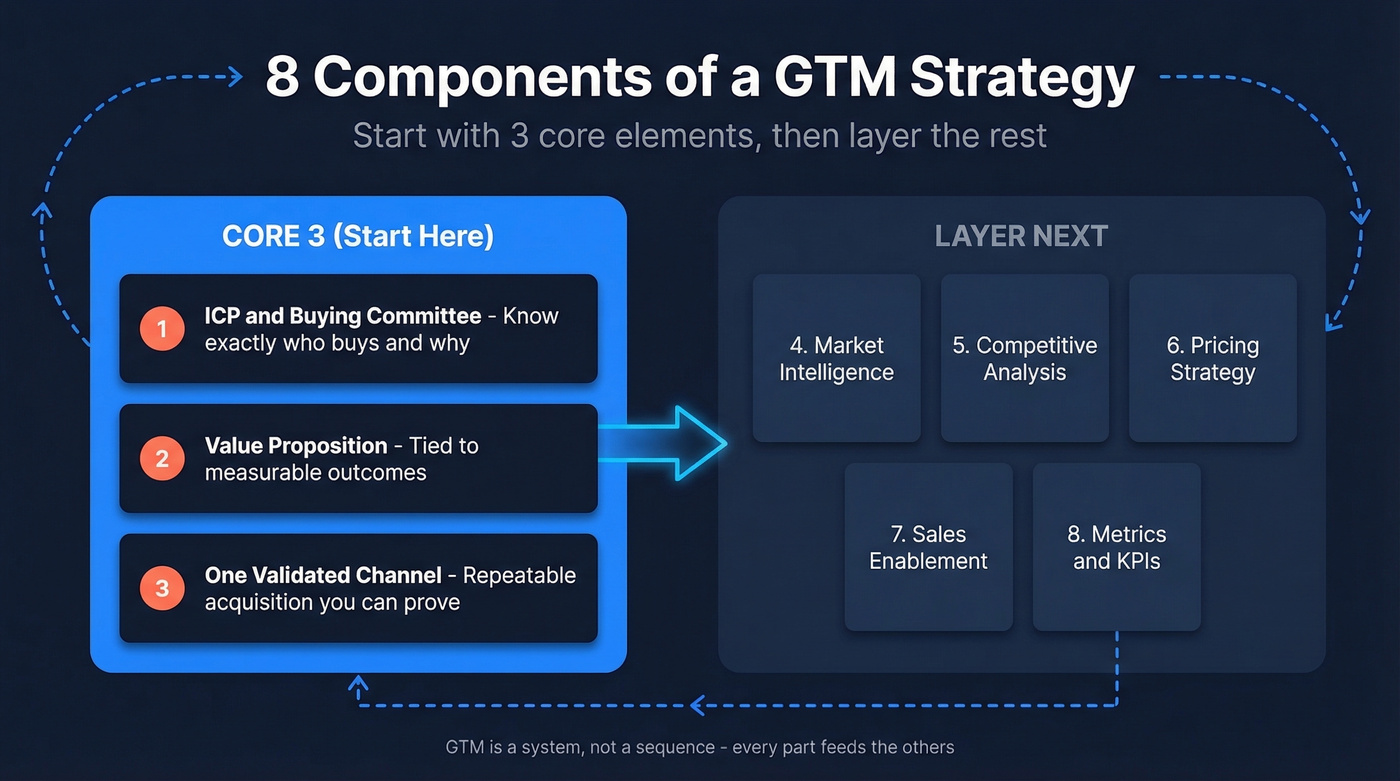
The 3 must-haves: an ICP and buying committee you can actually name, a value prop tied to measurable outcomes, and one validated acquisition channel you can repeat. That's it. Everything else is optimization on top of those three.
A practical 8-part GTM system looks like this: market intelligence, ICP and buying committee, value proposition and positioning, competitive analysis, pricing, channel and distribution, sales enablement, and metrics. Let's break each one down with the benchmarks that matter.
The 8 Core Elements
1) Market Intelligence
Good research isn't "read a report, pick a TAM number, move on." The best teams we've worked with run a 3-layer analysis - surface (what everyone knows), hidden (what customers do in practice), and deep (what's shifting underneath the market). Lean Labs' breakdown of this framework is one of the few that matches how GTM actually works in production.
If your research doesn't include review sites, communities, and real call notes, you're building strategy on vibes.
2) Ideal Customer Profile & Buying Committee
Your ICP isn't "SaaS companies, 50-500 employees." That's a filter, not an ICP.
A real ICP includes the buying committee, the trigger that creates urgency, and the internal politics that slow deals down. B2B deals involve an average of 6.3 stakeholders, and 73% of evaluation time gets spent building internal consensus - not comparing features. The fastest way to tighten ICP is to prioritize contextual triggers over demographics: new VP hired, a compliance deadline, a tool consolidation mandate, a churn spike. Those signals tell you when to reach out, not just who to reach out to.
If you need a starting point, use an ICP scoring rubric instead of a one-line persona.
3) Value Proposition & Positioning
A value prop that works has two ingredients most teams skip: measurable outcomes and "why now" urgency. "Save time" isn't measurable. "Cut onboarding time from 21 days to 7" is.
Feature-heavy messaging is the most common failure mode we see in early GTM. If your homepage could be swapped with any competitor's and still make sense, your positioning isn't doing its job. This is the go-to-market component that trips up even experienced teams - positioning must be specific enough to exclude buyers who aren't a fit.
If you're pressure-testing messaging, treat it like B2B brand positioning, not copy tweaks.
4) Competitive Analysis
Stop doing feature matrices. They're comforting and mostly useless.
Competitive analysis should be workflow-level: how a buyer evaluates, implements, and gets value over the first 30-90 days. That's where differentiation lives - in setup time, data quality, admin overhead, and change management. Journeys that start on review sites are 63% shorter (around 70 days), so your competitive story needs to show up where comparisons happen, not just in sales decks.
5) Pricing Strategy
Pricing is positioning with numbers attached. Triangulate: value to the customer, competitor anchors, and your cost-to-serve.
Watch out for underpricing. Setting prices 70% below competitors reduces trust. I've watched teams "win" trials and then lose deals because the buyer assumed the product was lightweight. If you're cheaper, you need a clear reason why - self-serve model, narrower scope, automation that cuts your costs. Without that story, low price reads as low quality.
6) Channel & Distribution
Here's the thing: most GTM plans fail at distribution because teams pick channels based on what they want to be true. The reality is brutal. B2B deals take 62.4 touches across 3.5 channels on average.
Outbound is still the fastest path to pipeline for most B2B teams, but only if your contact data is actually deliverable. This is where we've seen teams waste months - building beautiful sequences that bounce into the void because the underlying list was stale. Prospeo's 7-day data refresh cycle and 98% email accuracy exist specifically to solve that problem, so your channel strategy doesn't collapse at the deliverability layer.
If you're building outbound as a repeatable channel, start with proven sales prospecting techniques and then systematize list building.
7) Sales Enablement & Process
Enablement isn't "make a deck." It's playbooks, battlecards, qualification rules, and stage exit criteria that keep the team consistent. And GTM doesn't end at close - onboarding and retention loops are where compounding growth happens. The consensus on r/SaaS is clear: founders who underestimate time-to-value end up churning the customers they fought to win.
Speed-to-lead is the simplest high-impact SLA. Respond to inbound demo requests within 15 minutes during business hours, then follow up 5-7 times over 10 days. If you can't hit that SLA, your demand gen spend is leaking. RevOps should own this number.
To keep follow-ups consistent, use a shared set of sales follow-up templates instead of everyone freelancing.
8) Metrics & KPIs
Pick a small set of metrics that force tradeoffs. Start with pipeline velocity, because it ties execution to revenue:
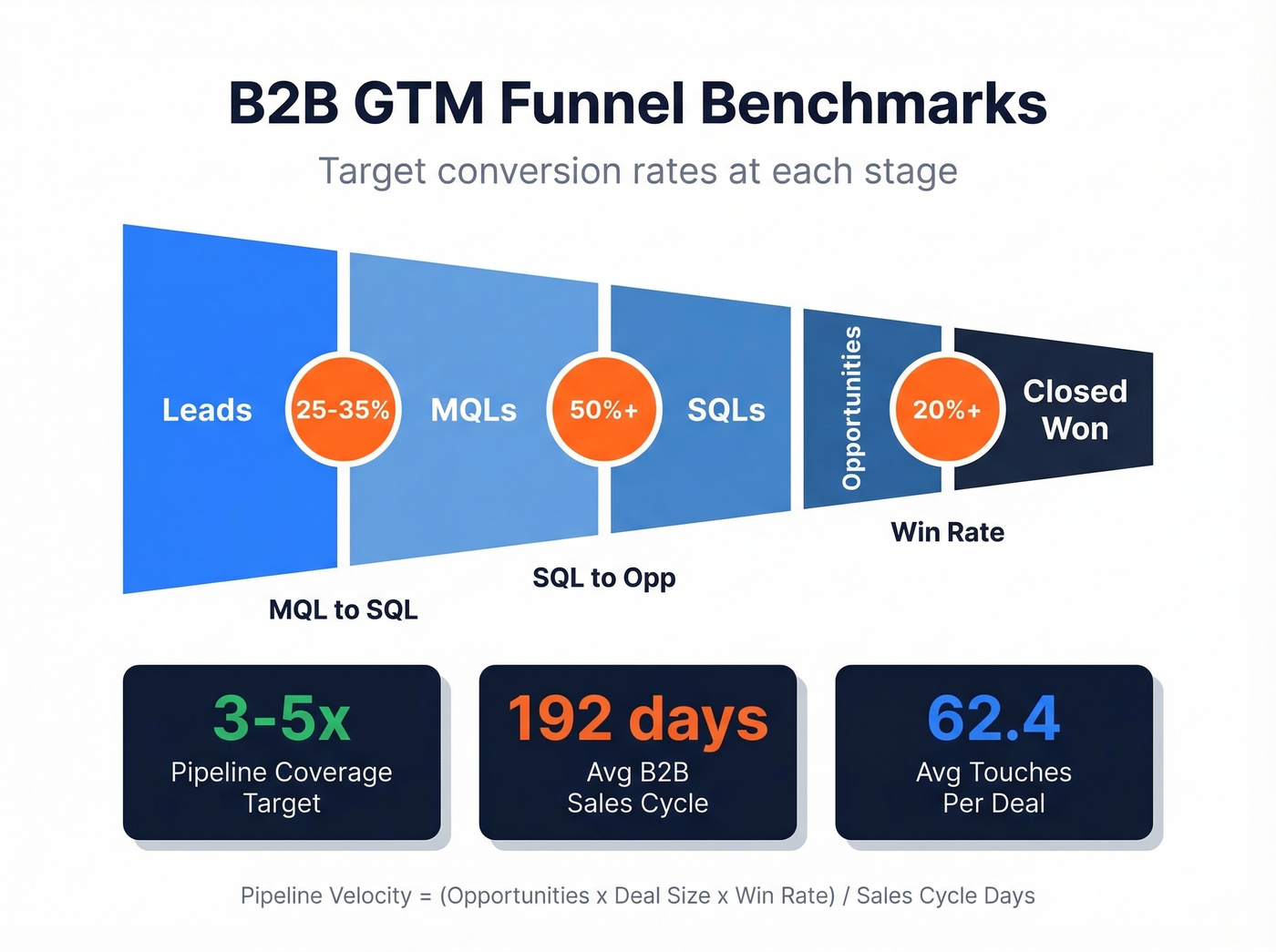
Pipeline Velocity = (# Opportunities x Avg Deal Size x Win Rate) / Sales Cycle (days)
Benchmarks worth tracking: MQL-to-SQL at 25-35%, SQL-to-Opportunity at 50%+, win rate at 20%+, pipeline coverage at 3-5x quota, and sales cycle averaging 192 days in B2B. Teams obsess over top-of-funnel volume, then wonder why revenue doesn't move. Velocity forces you to fix the real constraint - usually win rate or cycle length, not lead volume.
If you want a tighter dashboard, map these to funnel metrics and review weekly.

Your GTM strategy has 8 components, but it collapses at one: distribution. 62.4 touches across 3.5 channels means nothing if your emails bounce. Prospeo delivers 98% email accuracy on a 7-day refresh cycle - so your outbound channel actually converts instead of destroying your domain reputation.
Fix the deliverability layer before you optimize anything else.
Choosing Your GTM Motion
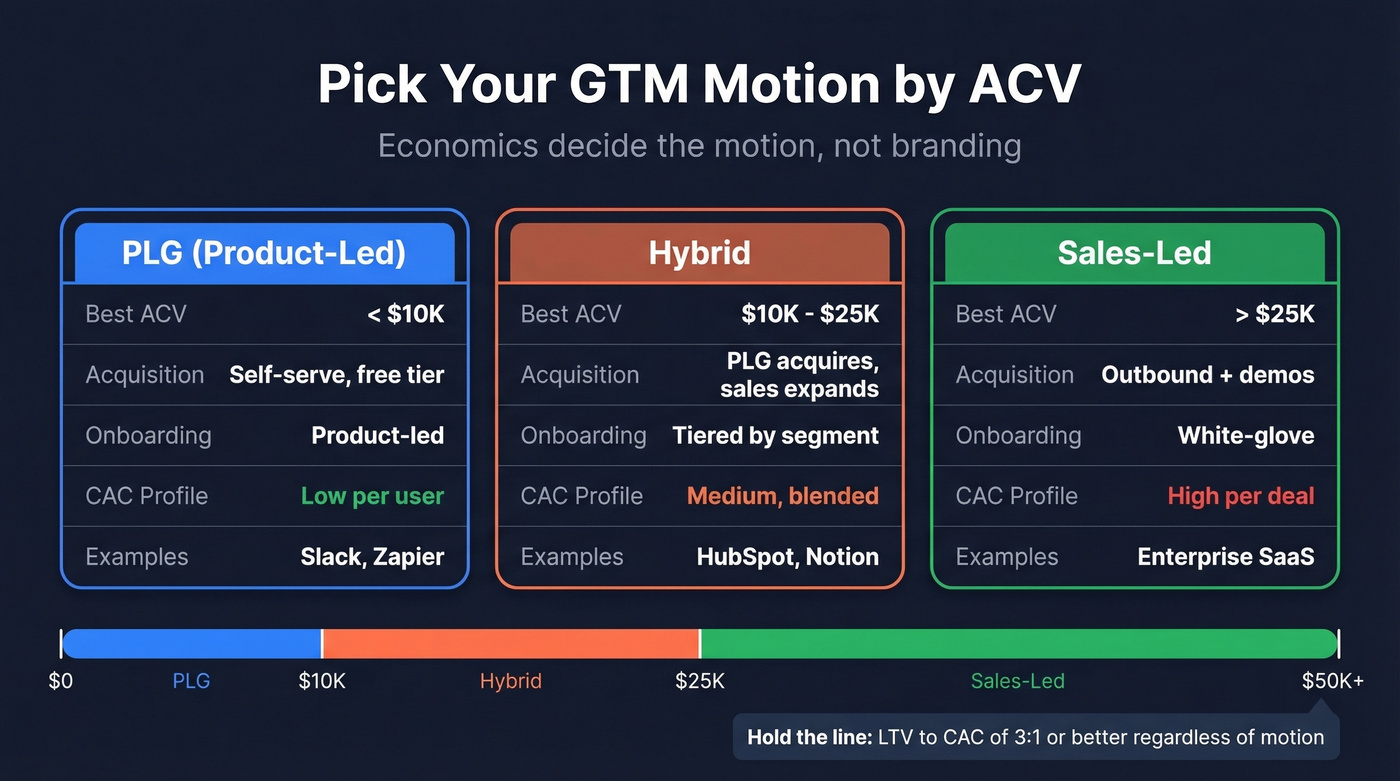
Your motion is an economics decision, not a branding decision. Under $10K ACV favors PLG, over $25K favors sales-led, and the middle is hybrid. Whatever you pick, hold the line on LTV:CAC of 3:1 or better.
93% of GTM teams now use AI somewhere in their workflow, but only 22% have adopted an integrated leadership model across product, marketing, and sales. Those teams are 3x more likely to report that growth is "easy." The tool isn't the bottleneck - the org chart is.
If you're building this as a PM, align the motion to your go-to-market strategy inputs (pricing, onboarding, and distribution), not just acquisition.
| Factor | PLG | Sales-Led | Hybrid |
|---|---|---|---|
| Best for ACV | < $10K | > $25K | $10K-$25K |
| Acquisition | Self-serve / free tier | Outbound + demos | PLG acquires, sales expands |
| Onboarding | Product-led | White-glove | Tiered |
| Example | Slack, Zapier | Enterprise SaaS | HubSpot, Notion |
4 GTM Mistakes That Kill Launches
Treating GTM like a marketing campaign. GTM is the whole system - product, pricing, sales motion, onboarding, and measurement. Marketing is one piece.
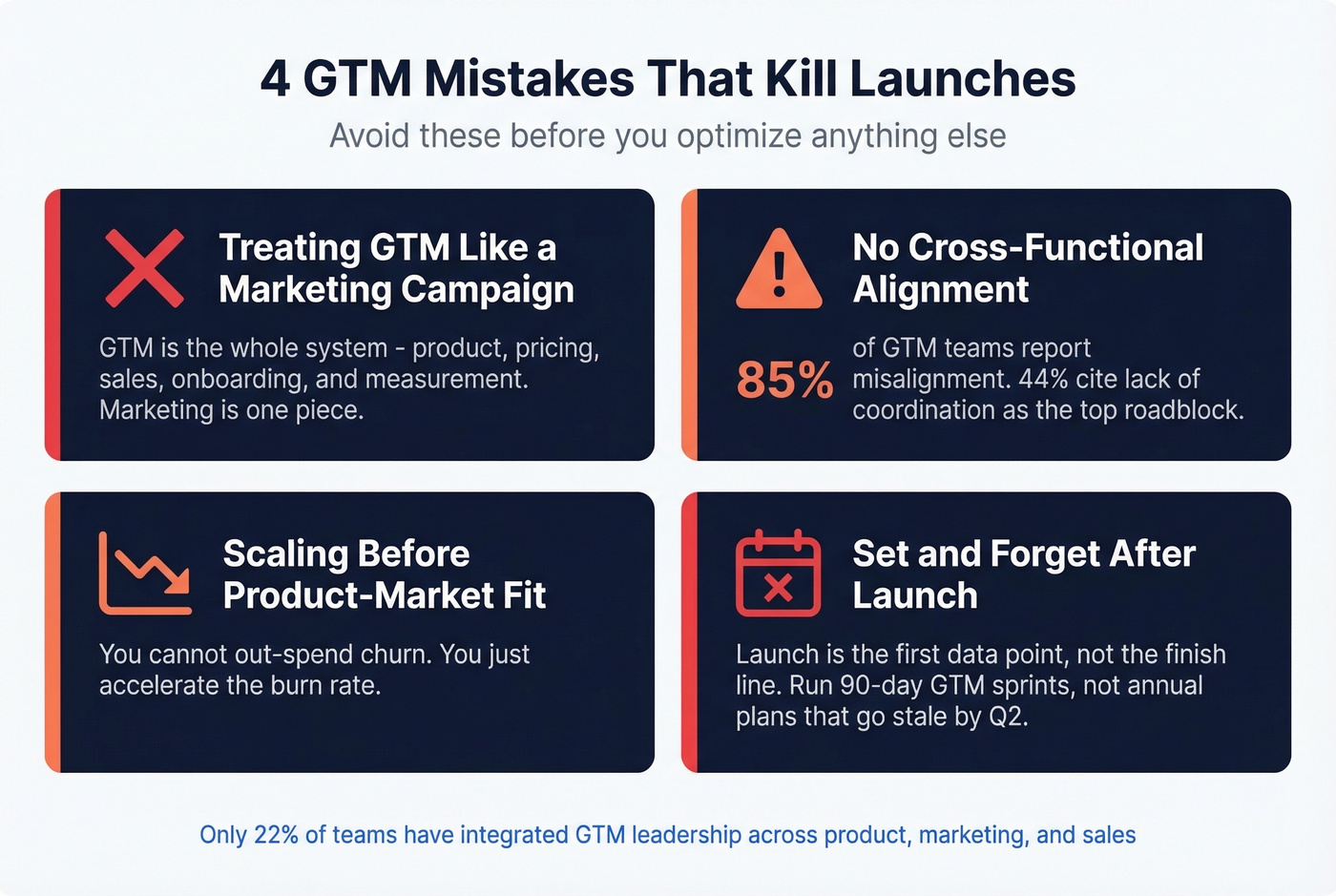
No cross-functional alignment. 85% of GTM teams report misalignment, and 44% cite lack of coordination as the top internal roadblock. Founders on r/SaaS echo this endlessly: they build, then scramble to sell.
Scaling before product-market fit. You can't out-spend churn. You just accelerate the burn.
Set-and-forget. Launch isn't the finish line. It's the first data point. The best teams run 90-day GTM sprints, not annual plans that go stale by Q2.
If you're struggling to operationalize the plan, focus on sales execution before adding more channels.
Your Data Is a GTM Component
Your go-to-market strategy is only as good as the data feeding it. Stale lists mean bounced sequences, wrecked domain reputation, and a "channel strategy" that's really a deliverability incident. We've seen this pattern dozens of times - a team builds a solid GTM framework, then undermines it with contact data that's six weeks old by the time sequences fire.
Meritt is a good example of what fixing this looks like: pipeline went from $100K to $300K/week while bounce rate dropped from 35% to under 4% after switching to verified data with a weekly refresh cycle.
If you're diagnosing bounces, start with email bounce rate benchmarks and then fix the root cause.

ICP triggers like new VP hires, funding rounds, and headcount growth only matter if you can act on them with verified contact data. Prospeo's 30+ search filters - including buyer intent, job changes, and technographics - turn your ICP definition into a targetable list at $0.01 per email.
Turn your ICP from a slide into a pipeline in minutes.
FAQ
What's the difference between a GTM strategy and a marketing plan?
A GTM strategy is the full cross-functional system - product, pricing, channels, sales, and measurement. A marketing plan is one component focused on demand creation and audience engagement. Marketing alone can't carry the weight of a launch without the other seven elements working together.
How long does it take to build a GTM strategy?
Most B2B teams build a working framework in 2-4 weeks, then validate it in a 90-day sprint. Nail the three core pieces first - ICP, positioning, and one repeatable channel - before layering in competitive analysis, pricing, and enablement.
Which GTM metrics matter most?
Pipeline velocity, CAC payback period, and win rate. Together they show how fast revenue moves, whether growth is sustainable, and whether your targeting is landing. Aim for 3-5x pipeline coverage and MQL-to-SQL conversion above 25%.
How do I pick between PLG and sales-led?
It's mostly an ACV question. Under $10K, self-serve usually wins because the economics don't support a sales team touching every deal. Over $25K, you need reps to navigate buying committees and procurement. The $10K-$25K range is where hybrid models shine - PLG acquires, sales expands.