

The Go to Market Playbook That Actually Works
It's Q1. Pipeline is down 30%. The CEO is asking why - despite hiring two more SDRs last quarter and tripling the content budget. The VP of Sales pulls up the "GTM playbook." It's a 25-slide deck from last year's offsite. Slide 7 is a TAM circle diagram. Slide 14 says "leverage multi-channel outreach." Nobody can point to a single play that's running right now, what triggers it, or how it's measured.
This is the norm, not the exception. 95% of new products fail. The 70% five-year failure rate for SaaS companies isn't driven by bad products - it's driven by teams that never translated strategy into an operational system. 42% of those failures trace back to a single root cause: no market need. Not "bad marketing." Not "weak sales." The market didn't want what they were selling, and nobody validated that before burning cash.
Teams with integrated GTM approaches report 73% better sales-marketing alignment and 125% increases in net dollar retention. The gap between companies that treat GTM as a living system and those running off a slide deck is widening every quarter.
A go to market playbook isn't a strategy deck. It's a tactical system that tells your team exactly who to target, what to say, which channels to use, what triggers each play, and how to know if it's working - updated every 90 days, not every fiscal year. Here's how to build one that actually functions.
The Framework in Five Bullets
If you're short on time:
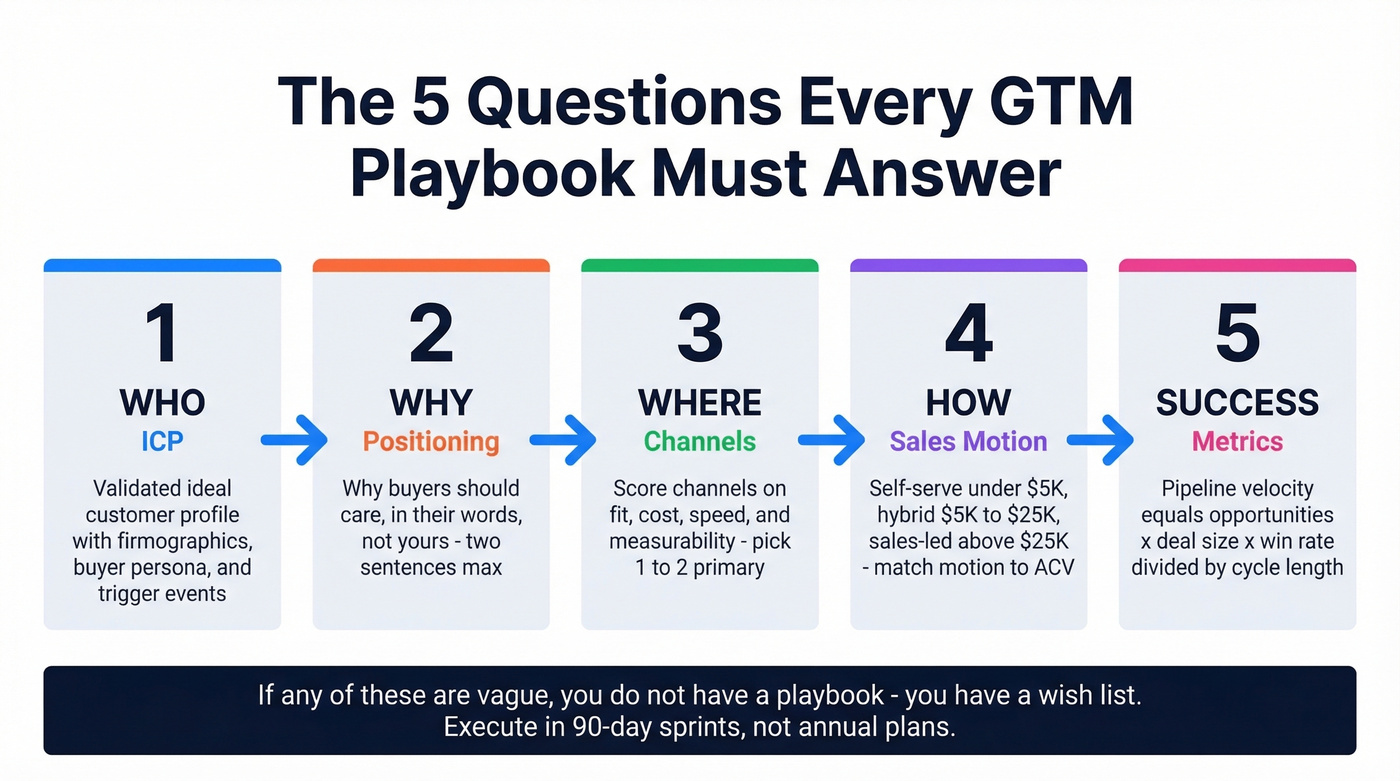
- Your playbook answers 5 questions: Who (ICP), Why (positioning), Where (channels), How (sales motion), and Success (metrics). If any of these are vague, you don't have a playbook - you have a wish list.
- Match your GTM motion to your ACV. Self-serve under $5K, hybrid $5K-$25K, sales-led above $25K. Mismatching motion to deal size is the fastest way to blow unit economics.
- Execute in 90-day sprints, not annual plans. Markets move too fast for 12-month roadmaps. If you need a rep-ready sprint structure, use a 30-60-90-day plan format.
- Measure pipeline velocity, not vanity metrics. MQLs don't pay rent. Track opportunities x deal size x win rate / cycle length.
- Your plays are only as good as your data. If 35% of your emails bounce, the play isn't broken - the data is. (More on email bounce rate benchmarks and fixes.)
What a GTM Playbook Actually Is
A go to market playbook is an operational system - a living document that contains repeatable "plays" your team runs to generate pipeline and close revenue. It's not a Notion page with your mission statement. It's not a slide deck with a Venn diagram of your TAM. If you need a clean way to define TAM/SAM/SOM before you build plays, start with addressable market.
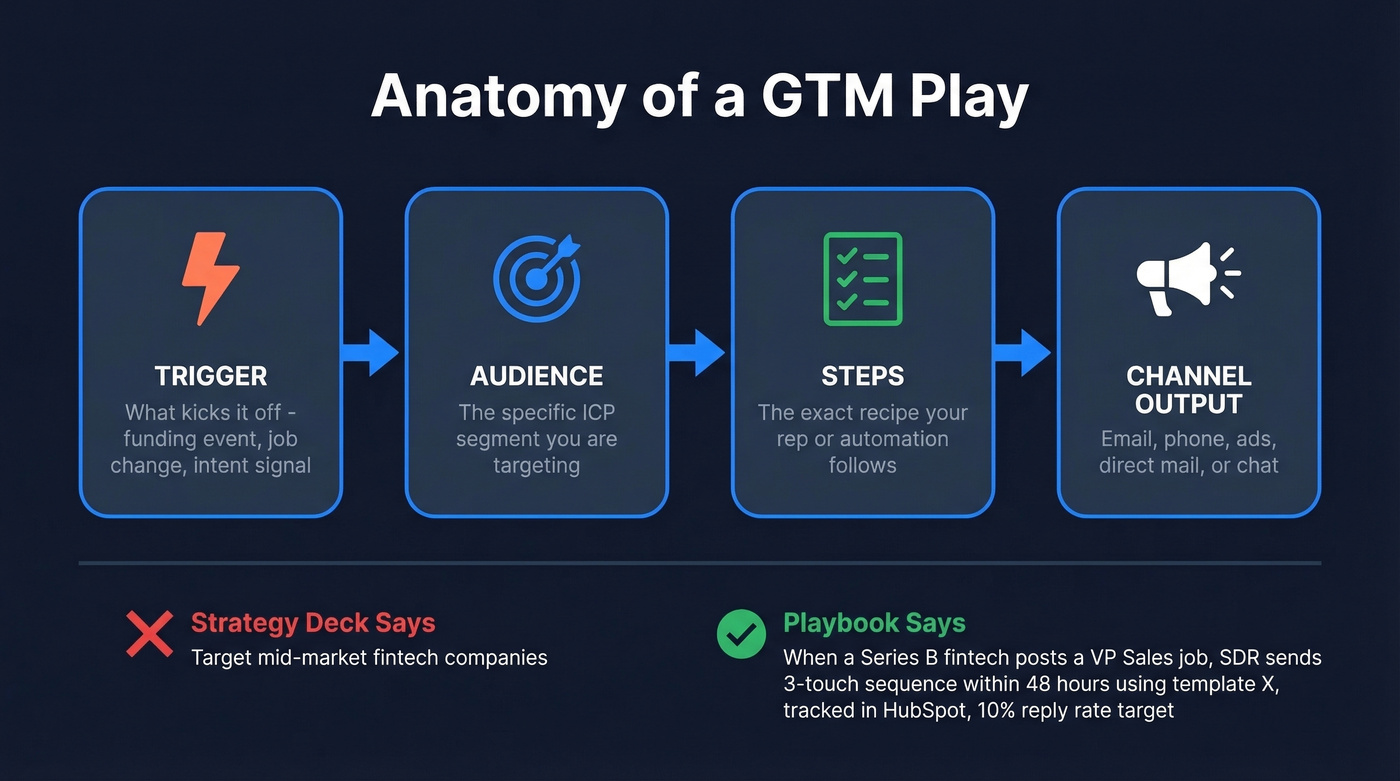
A "play" has four components: a trigger (what kicks it off - a funding event, a job change, an intent signal), an audience (the specific ICP segment), steps (the recipe your rep or automation follows), and channel output (email, phone, ads, direct mail, chat). This framework comes from ZoomInfo's playbook architecture, and it's the clearest definition we've found. If you want a deeper system for operationalizing triggers, see how to track sales triggers.
Here's the contrast that matters. A strategy deck says "target mid-market fintech companies." A playbook says "when a Series B fintech company posts a VP of Sales job, the assigned SDR sends a 3-touch sequence within 48 hours using this messaging template, tracked in HubSpot, with a 10% reply rate target." One is aspiration. The other is execution.
Nearly 70% of enterprise data goes unused. Buyers spend just 17% of their time with suppliers. Your playbook has to make every touchpoint count because you're competing for a sliver of attention against dozens of other vendors.
Why Most GTM Playbooks Fail
The consensus on r/sales is blunt: most "GTM strategies" are process theater - more frameworks, more acronyms, no real strategy beyond "sell harder." That frustration is earned. Here are the six failure modes we see repeatedly.
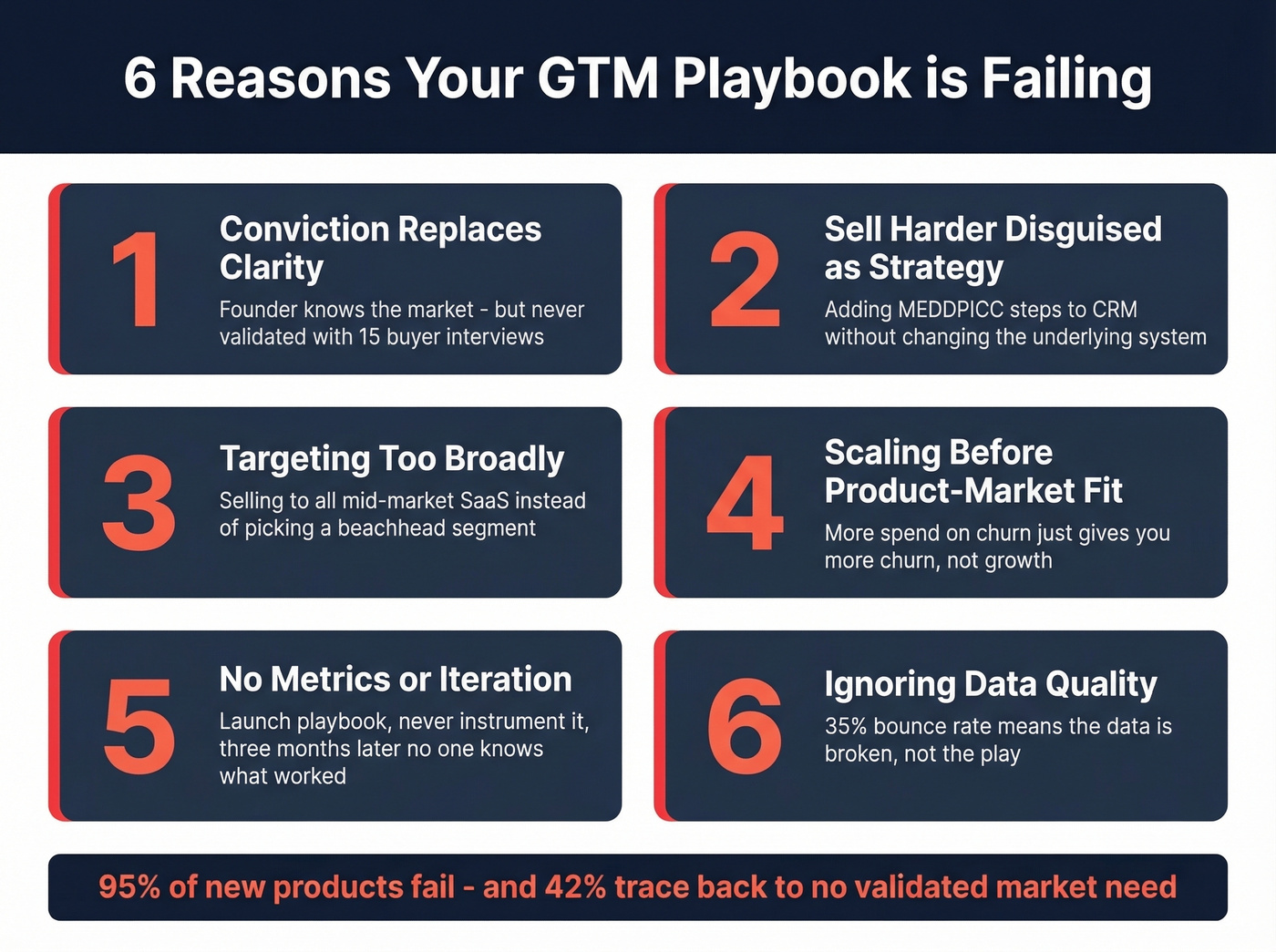
1. Conviction replaces clarity. Teams skip ICP validation because the founder "knows the market." They don't. Internal confidence isn't the same as validated external truth. If you haven't talked to 15 potential buyers and heard 8+ describe the same pain, you're guessing. Use an ideal customer profile template to make this concrete.
2. "Sell harder" disguised as strategy. Adding MEDDPICC steps to your CRM doesn't change your GTM. It adds process artifacts without changing the underlying system. If your reps can't articulate why a buyer should care in two sentences, no framework saves you. (If you're standardizing qualification, start with MEDDIC sales qualification.)
3. Targeting too broadly. You need a beachhead market - a specific segment you can dominate before expanding. Trying to sell to "all mid-market SaaS companies" is how you end up with a 2% win rate and no reference customers.
4. Scaling before product-market fit. Spend amplifies whatever you already have. If you have churn, more spend gives you more churn. If you have PMF, more spend gives you growth. Most teams can't tell the difference until it's too late. If you're diagnosing retention, run a proper churn analysis.
5. Neglecting metrics and iteration. No feedback loop means no learning. Teams launch a playbook, don't instrument it, and three months later can't tell you whether outbound or inbound drove more pipeline. The playbook becomes shelfware. A simple pipeline health scorecard prevents this.
6. Ignoring data quality. Your outbound team sends 500 emails a day at a 2% reply rate. You check - 35% are bouncing. The play isn't broken. The data is. Bad emails tank your domain reputation, kill deliverability on the emails that are valid, and make every downstream metric look worse than it should.

You just read it: 35% bounce rates don't mean the play is broken - the data is. Prospeo's 5-step verification delivers 98% email accuracy, 125M+ verified mobiles, and a 7-day refresh cycle so your GTM plays actually connect with real buyers.
Stop debugging plays when the real problem is bad data.
How to Build Your Playbook in 5 Steps
This is the operational core. Each step produces a concrete deliverable - not a discussion topic for your next offsite.
Step 1 - Define and Validate Your ICP
Don't skip this. Don't shortcut it.
Run 15 interviews: 5 with existing customers, 5 with competitors' customers, and 5 with prospects in your target market. If 8 out of 15 describe the same pain, you have signal. Fewer than that, and you're still searching.
Your ICP card should capture these fields - copy this into your Notion or Google Doc and fill it in:
| Field | What to Capture | Example |
|---|---|---|
| Company | Industry, employee count, ARR range, tech stack, geography | B2B SaaS, 50-200 employees, $5M-$20M ARR, uses HubSpot, North America |
| Buyer | Title, department, reporting line, budget authority | VP of Sales, reports to CRO, owns $500K+ budget |
| Trigger | Event that makes them start looking | New VP of Sales hired, missed quota 2 quarters running |
| Pain | Specific problem in their words | "Our reps spend 4 hours a day on research instead of selling" |
| Dream | What success looks like to them | Case study: similar company cut research time 60%, pipeline up 140% |
This maps directly to the five questions your playbook answers. Who are they? Why do they care? Where do they spend attention? How do they buy? What does success look like?
We've seen teams burn six months of outbound because they built plays for a buyer persona that didn't match their actual closed-won customers. Run a competitive analysis against your top 3 competitors' positioning to make sure your ICP isn't just "everyone they're also targeting." Founders who shared their GTM playbooks on r/SaaS consistently named ICP validation as the step they wished they'd done first.
Step 2 - Choose Your GTM Motion
Your ACV dictates your motion. This isn't a suggestion - it's unit economics.
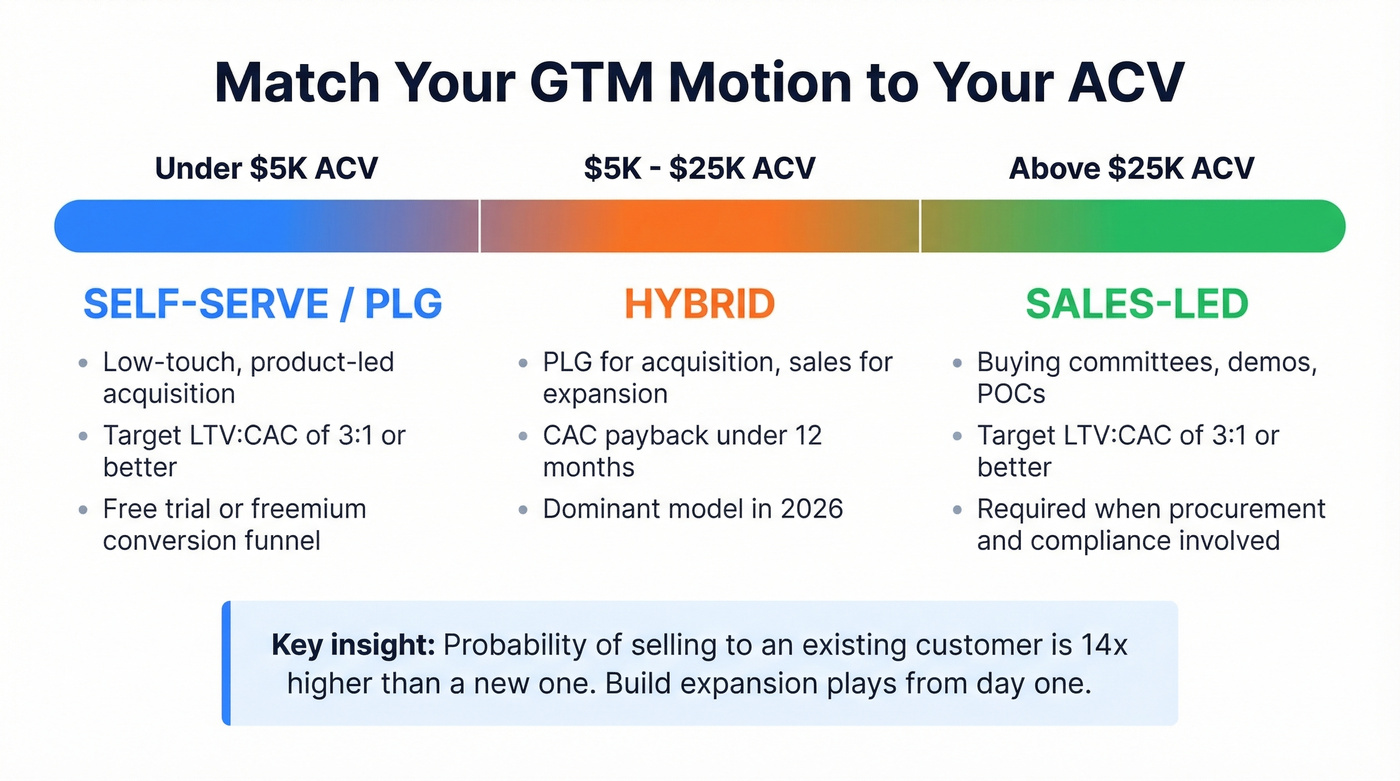
| ACV Range | Motion | Key Characteristics | Unit Economics Target |
|---|---|---|---|
| Under $5K | Self-serve / PLG | Low-touch, product-led | LTV:CAC >= 3:1 |
| $5K-$25K | Hybrid | PLG acquisition + sales expansion | CAC payback < 12 mo |
| Above $25K | Sales-led | Buying committees, demos, POCs | LTV:CAC >= 3:1 |
The hybrid model is dominant in 2026. PLG handles acquisition and activation; sales handles expansion and enterprise deals. If your product requires procurement and compliance reviews, you need a sales-led motion regardless of ACV - the buying process demands it.
The math favors expansion: the probability of selling to an existing customer is 14x higher than selling to a new one. Your hybrid motion should include expansion plays from day one - not as an afterthought bolted on at $10M ARR.
One useful filter: the Ansoff Growth Matrix. It maps four quadrants - market penetration, market development, product development, and diversification. If you're in the penetration quadrant, you probably don't need a full playbook rebuild. You need better execution. New product in a new market? That's where the full build earns its keep.
Here's the thing: if your average deal is under $10K, you probably don't need ZoomInfo-level tooling or a 12-person GTM team. A founder, two SDRs, a PLG motion, and verified data will outperform a bloated org running a 47-slide "strategy" every time. Complexity is the enemy of early-stage GTM.
Emerging motions worth watching: community-led growth and ecosystem marketing. These aren't replacements for outbound or inbound - they're amplifiers that build trust before the first sales touch.
Step 3 - Build Your Channel Strategy
Don't try to be everywhere. Pick 1-2 primary channels, reserve 10-20% of budget for experiments, and score each channel on four dimensions:
| Channel | Fit (1-4) | Cost (1-4) | Speed (1-4) | Measurability (1-4) | Total |
|---|---|---|---|---|---|
| Cold email | 3 | 4 | 3 | 4 | 14 |
| Paid search | |||||
| Content/SEO | |||||
| Events | |||||
| Partnerships |
Score 4 = best. Fill this out for your specific ICP and motion. The average company runs 10.5 GTM efforts - 5 core channels plus 5.5 experimental initiatives. That's too many for most teams under $10M ARR. Ruthless prioritization beats broad coverage.
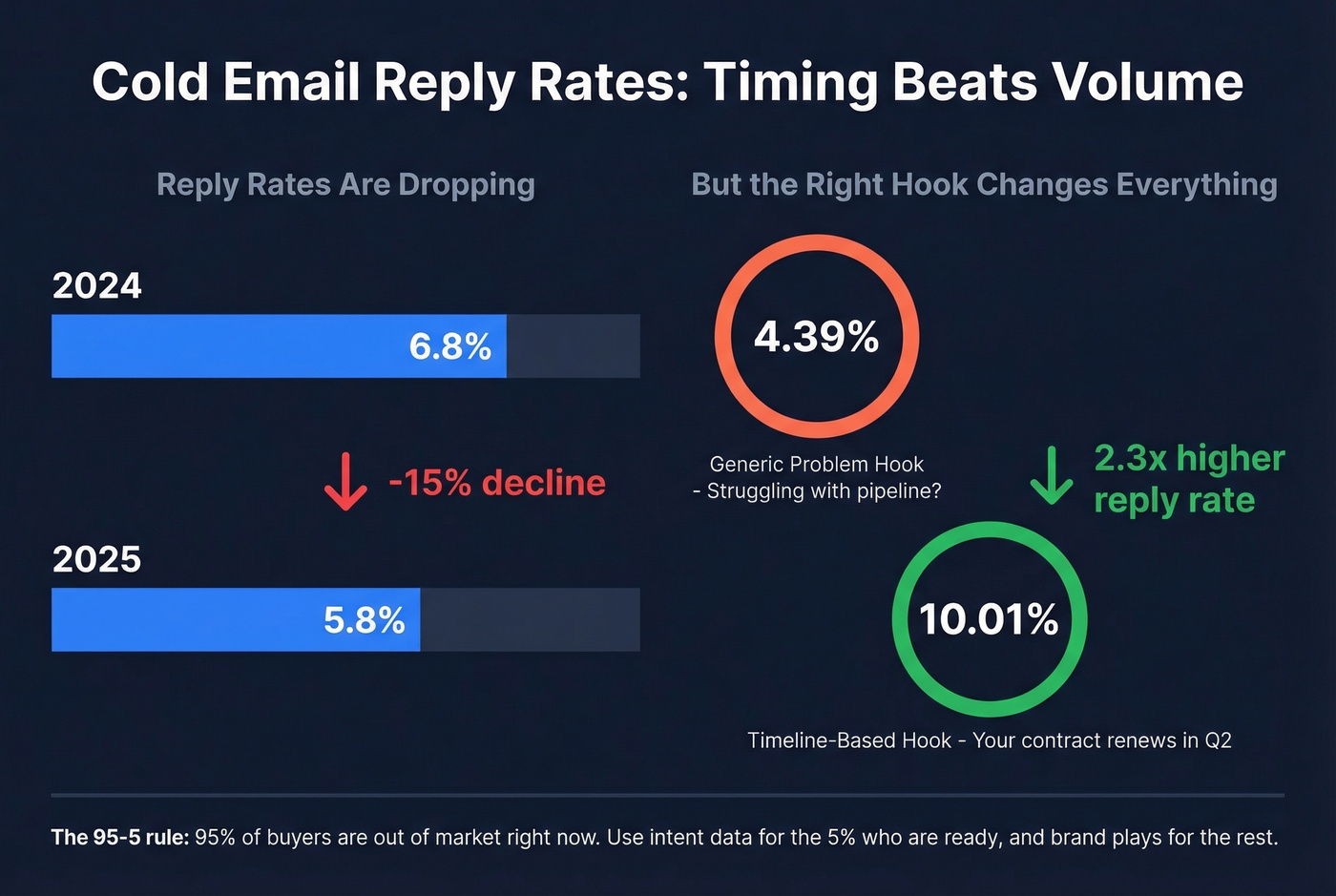
The B2B Institute's 95-5 rule says 95% of your buyers are out of market at any given time. Only 5% are actively looking. Your channel strategy needs plays for both - intent data to catch the 5% who are in-market right now, and brand/content plays to stay top of mind with the 95% who'll buy later.
For outbound specifically, the benchmarks are sobering. Cold email reply rates dropped from 6.8% in 2024 to 5.8% in 2025. But here's the gap most teams miss: timeline-based hooks pull a 10.01% reply rate versus 4.39% for generic problem hooks. That's a 2.3x difference driven entirely by relevance and timing, not volume. A hook like "your contract renews in Q2" crushes "struggling with pipeline?" every time. If you need a starting point for outreach mechanics, build a B2B cold email sequence.

Step 4 - Execute in 90-Day Sprints
Annual GTM plans are fiction. Markets shift, messaging gets stale, and the competitive picture changes faster than any 12-month roadmap can accommodate. Use a 90-day sprint framework instead.
Days 1-30: Foundation. Validate your ICP using the 15-interview method. Lock positioning and messaging. Select your first 2 plays - no more. Define success metrics for each play before you launch anything. Build your sales enablement materials: battle cards, objection handlers, and competitive positioning docs. (If you need a template, use sales battle cards.)
Days 31-60: Architecture. Build the narrative and align SDRs and AEs on handoff criteria. Set up measurement infrastructure - if you can't track pipeline velocity by channel, you're flying blind. Define routes to market and SLAs.
Days 61-90: Activation. Launch your 2 plays. Instrument the scorecard. Optimize weekly - not monthly, not quarterly. Weekly. If a play isn't hitting its reply rate or meeting rate target by week 3, diagnose and adjust. Don't wait until the end of the quarter to discover it's broken.
Each phase ends with a go/no-go gate. Did 8+ of 15 interviews validate the pain? Go. Did the first play hit 50% of its meeting target in week 2? Go. Did outbound bounce rates exceed 10%? No-go - fix the data before scaling. These gates prevent the most expensive GTM mistake: scaling something that isn't working.
We saw a 15-person sales team at an $8M ARR company cut their sales cycle from 45 to 28 days by switching from annual GTM planning to 90-day sprints with weekly optimization. The difference wasn't a new tool or a new hire. It was faster feedback loops.
Focus on outcomes, not activities. The job-to-be-done isn't "send 10,000 emails." It's "generate 40 qualified opportunities this quarter."
Step 5 - Measure and Iterate
Pipeline velocity is your north star metric:
(Number of Opportunities x Average Deal Size x Win Rate) / Sales Cycle (days)
Worked example: 100 opportunities x $25,000 x 20% win rate / 90 days = $5,556 in pipeline velocity per day. If you want to increase revenue, you have four levers - more opportunities, bigger deals, higher win rates, or shorter cycles. Every play in your playbook should move at least one.
Here are the conversion benchmarks to target:
| Metric | Target |
|---|---|
| MQL to SQL | 25-35% |
| SQL to Opportunity | 50%+ |
| Win rate | 20%+ |
| Pipeline coverage | 3-5x quota |
| Inbound response SLA | Under 15 min |
| Follow-up cadence | 5-7 touches / 10 days |
Set SLAs that are specific and measurable. Inbound demo requests get contacted within 15 minutes during business hours. Outbound replies get a response within 1 business day. Follow-up runs 5-7 times over 10 days. These aren't aspirational - they're the minimum for a functioning GTM operation. If you want plug-and-play messaging, use these sales follow-up templates.
Don't stop at pipeline. Beyond $50M ARR, 60% of new ARR comes from existing customers. Your playbook needs expansion plays - not just acquisition plays. Track net revenue retention alongside new logo metrics, and build plays specifically for upsell triggers like usage milestones, team growth, and contract renewal windows.
Your operating cadence should look like this:
- Weekly: 30-minute revenue standup covering pipeline and play performance
- Monthly: GTM QBR with deep dives on channel economics and conversion rates
- Quarterly: Next sprint's plays, budget allocation, ICP refinement
For PLG motions, track activation rate - top performers hit >=65% activation versus a 33% average. That gap is where revenue hides.
AI in Your GTM Playbook
The hype is loud. The results are mixed. 53% of GTM leaders report little to no impact from AI adoption. 47% have zero AI agents in production. 91% are using general-purpose LLMs like ChatGPT and Claude - not purpose-built GTM tools.
The economics look compelling on paper:
| Metric | Human SDR | AI SDR |
|---|---|---|
| Annual cost | ~$139K (fully loaded) | $12K-$60K |
| Daily throughput | 50-80 contacts | 1,000+ contacts |
| Cost per lead | ~$262 | ~$39 |
| Annual churn rate | ~30% | 50-70% |
That last row is the problem. AI SDR tools have 50-70% annual churn because the outputs aren't good enough to sustain. The tools that work are augmentation plays, not replacement plays.
Let's be honest about where AI actually helps right now: research (turning call transcripts into content ideas, summarizing competitor moves), personalization (dynamic first lines based on trigger events), and content repurposing (one webinar becomes 10 social posts). AI-personalized first lines can lift reply rates from 9% to 21% - that's where the ROI is real. Skip AI as a substitute for GTM strategy. A bad play executed at 1,000 contacts per day is just a faster way to burn your domain.
One bright spot: AI-search leads convert 40% better than traditional search leads, so optimizing for AI discovery channels is worth the investment.
Your Minimum GTM Stack
You don't need 15 tools. You need four, maybe five. Everything else is optional until you're past $5M ARR.
| Category | Recommended | Price Range | Why |
|---|---|---|---|
| CRM | HubSpot (free tier) or Salesforce | $0-$300/user/mo | Pipeline tracking, SLAs |
| Outbound sequencer | Instantly or Lemlist | $30-$159/mo | Automated multi-touch sequences |
| Intent signals | Bombora or standalone | $500+/mo | Catch the 5% in-market |
| Enrichment / workflows | Clay | $149-$800/mo | Multi-source enrichment |
ZoomInfo ($15K-$40K+/year) is the enterprise option if you need the full platform - database, intent, chat, workflow automation. For teams under 50 reps, it's usually overkill. The stack above covers 90% of what you need at a fraction of the cost, with native integrations between Prospeo and HubSpot, Salesforce, Instantly, Lemlist, and Clay so data flows without manual exports. If you're comparing providers, start with B2B company data and data enrichment services.
Your playbook needs triggers - funding events, job changes, intent signals. Prospeo tracks 15,000 intent topics, flags job changes in real time, and lets you filter by 30+ criteria so every play fires on the right audience.
Turn your ICP card into a live target list in minutes.
2026 GTM Benchmarks
Pin this table somewhere your team can see it.
| Metric | Target / Benchmark | Context |
|---|---|---|
| MQL to SQL | 25-35% | Mid-market baseline |
| SQL to Opportunity | 50%+ | Below 40% = qualification issue |
| Win rate | 20%+ | Varies by ACV and cycle |
| Pipeline coverage | 3-5x quota | Higher for longer cycles |
| Cold email reply rate | 5.8% avg | Down from 6.8% in 2024 |
| Timeline hook reply rate | 10.01% | vs 4.39% for problem hooks |
| PLG activation (top 10%) | >=65% | Average is 33% |
| LTV:CAC | >=3:1 | Below 3:1 = unsustainable |
| CAC payback | Under 12 months | 18+ months = red flag |
| Deal slip > 2 months | Win rate cuts in half+ | Speed kills - slowly |
The 95-5 rule deserves special attention. If 95% of your market is out of cycle at any given time, your playbook needs two types of plays: capture plays for the 5% in-market now, and creation plays for the 95% you want to remember you later. Most teams over-index on capture and wonder why pipeline is lumpy.
Your go to market playbook is a living system. If it hasn't been updated in the last 90 days, it's already stale. Pick one play, validate it this week, and build from there.
FAQ
What is a go to market playbook?
A GTM playbook is an operational system containing repeatable "plays" - each with a trigger, audience, steps, and channel output - that your team runs to generate pipeline and close revenue. Unlike a strategy deck, it runs on 90-day sprints with go/no-go gates and weekly optimization cycles. Think of it as the operating manual for how your company turns ICP targeting into closed deals.
What should a GTM playbook include?
Five core sections: ICP definition with validation from 15+ buyer interviews, positioning and messaging frameworks, a channel prioritization scorecard, sales motion matched to your ACV range ($5K self-serve, $5K-$25K hybrid, $25K+ sales-led), and a measurement framework tracking pipeline velocity, conversion benchmarks, and response SLAs.
How long does it take to build one?
A validated, operational playbook takes about 90 days. Days 1-30 cover ICP validation through 15 interviews and selecting your first 2 plays. Days 31-60 handle channel alignment and measurement setup. Days 61-90 are activation - launch plays, instrument your scorecard, and optimize weekly. Most teams see pipeline impact by week 8.
How do go-to-market programs differ from GTM strategy?
Programs are the specific, coordinated initiatives - outbound sequences, product launches, expansion campaigns - that execute against your broader strategy. Strategy defines direction; programs are the vehicles. Your playbook catalogs each active program with its owner, trigger conditions, and success metrics so nothing runs on autopilot without accountability.