

Go-to-Market Strategy for an App: Real Numbers, Not Generic Advice
You launched Tuesday. By Friday, you've got 47 downloads, 3 reviews (one from your mom), and a Slack thread where your co-founder asks if you should "try TikTok." Sound familiar?
Here's the reality: roughly 46,700 apps hit the Apple App Store in a single month in 2025. Only about 0.5% of mobile apps succeed, and 67.8% never crack 1,000 downloads. Most "app GTM" guides just recycle SaaS advice with the word "app" swapped in. This one doesn't. We're using real CPI numbers, retention benchmarks by category, and a phased timeline that actually maps to how successful apps get built and sold.
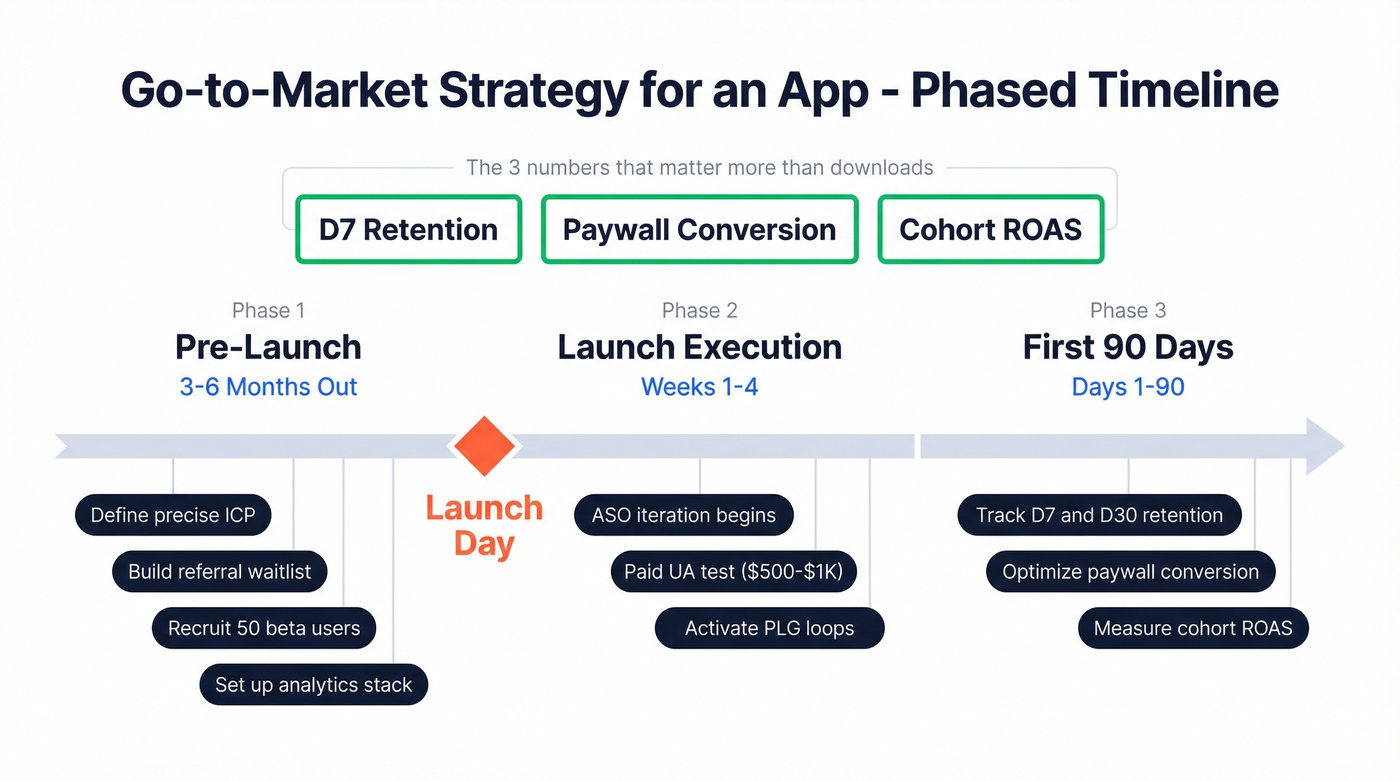
The short version: your go-to-market strategy for an app has three phases - pre-launch, launch, post-launch - and three numbers that matter more than downloads: D7 retention, paywall conversion, and cohort ROAS. Start building your audience 3-6 months before launch.
Why Most App Launch Strategies Fail
Before the framework, let's talk failure modes. If any of these sound like your last launch, the phases below are the fix.
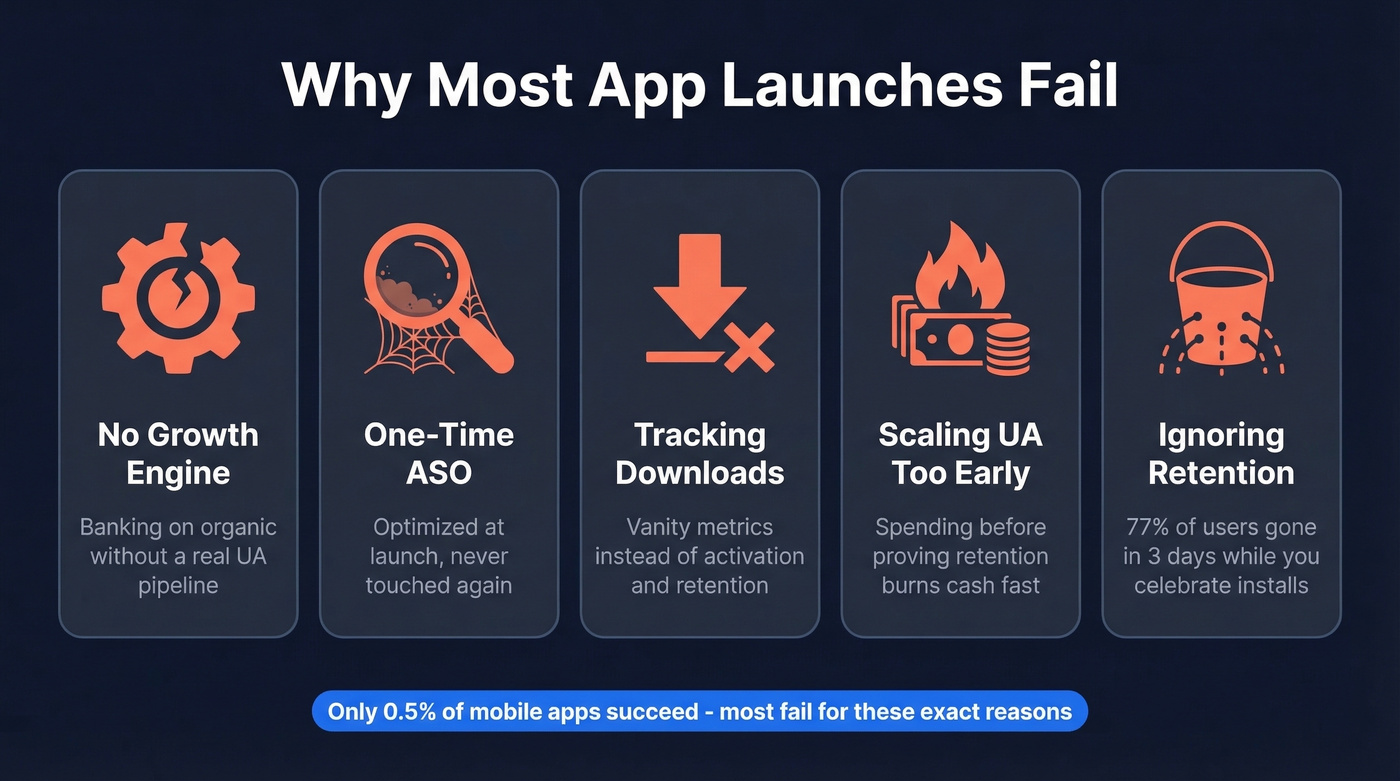
No real growth engine. You're banking on "organic" without a UGC pipeline, multi-channel UA, or cohort modeling. That's not a strategy - it's a hope.
Treating ASO as a one-time task. You optimized your listing at launch and haven't touched it since. Meanwhile, competitors are iterating weekly.
Tracking downloads instead of activation. Downloads tell you nothing about whether users stick or pay. They're a vanity metric dressed up as a KPI.
Scaling paid UA too early. Pouring money into acquisition before proving retention is burning cash. We've seen teams blow $20K in a month with nothing to show for it because their D7 retention was 4%.
Ignoring retention entirely. The average app loses 77% of daily active users within three days. Celebrating install spikes while your bucket leaks is a recipe for a very expensive failure.
Phase 1 - Pre-Launch (3-6 Months Out)
The pre-launch window determines most of your GTM outcome. The trap is always the same: months of building, days of marketing. Flip that ratio.
Define Your ICP With Precision
"Millennials who like fitness" isn't an ICP. For a consumer app, define the specific behavior trigger - the moment someone would search for your solution. A project management app for construction foremen at 50-200 person firms? That's an ICP. "Small businesses" is a demographic, not a target.
For B2B apps, get even more specific. What's the job title? What tool are they currently using? What's the pain that makes them open to switching? The consensus on r/startups is that most founders define their ICP too broadly and end up marketing to everyone, which means marketing to no one.
If you want a tighter way to document this, use an ICP scoring rubric.
Build a Waitlist With Referral Mechanics
Tools like Viral Loops let you create referral-driven waitlists where each signup gets a unique link and a reward - early access, premium features, priority onboarding. 500 genuinely engaged people are worth more than 10,000 passive email addresses. Don't just collect emails. Give people a reason to recruit their friends.
Recruit Beta Users (B2B: Go Outbound)
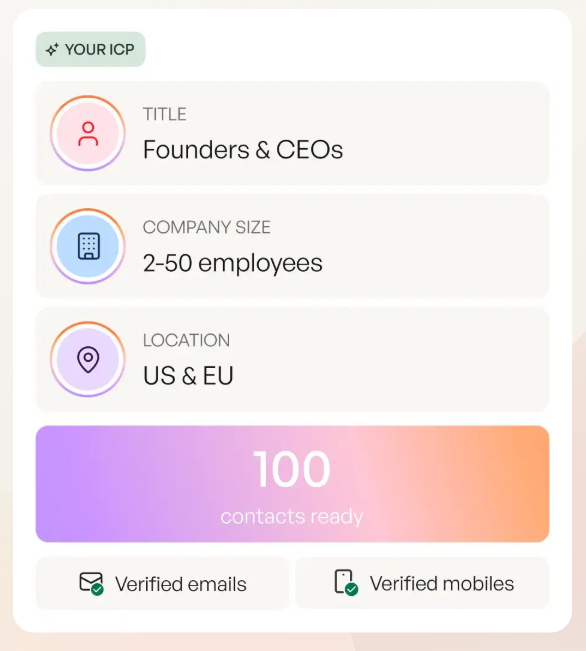
For consumer apps, beta users come from communities - Reddit, Discord, niche forums. For B2B apps, your first 50 users come from founder-led outreach. Period. You need verified contact data for decision-makers at target companies, and you need it before you have a product to demo.
Prospeo's free tier gives you 75 verified emails per month with 98% accuracy - enough to run your first outbound sprint without spending a dollar on data. We've watched founders close design partners weeks before their app hits the store using nothing more than a Loom video and a well-targeted email list.
If you're building the outreach motion from scratch, start with proven sales prospecting techniques and a simple B2B cold email sequence.
Set Up Analytics Before Anything Else
Install Mixpanel or Amplitude for product analytics and AppsFlyer or Adjust for attribution. This is non-negotiable pre-launch infrastructure. If you can't measure activation, retention, and attribution from day one, you're flying blind and every decision you make post-launch will be a guess.
To keep your metrics clean, define your funnel metrics before you ship.
Phase 2 - Launch Execution
Most guides start here. That's the problem.
ASO Is an Ongoing Process
Separate keyword changes from creative changes and allow 3-4 weeks between updates so you can measure impact cleanly. Mallzee A/B tested their icon, title, subtitle, and screenshots - lifting conversion rate by 10%. Vinted used systematic keyword research to rank in the top 10 for 210 new keywords across six European markets within six months.
Skip ASO tools if your budget is under $50/month. But if you're spending real money on UA, something like AppTweak pays for itself when it moves your conversion rate even a couple percentage points.
Paid UA: Start Small, Measure Fast
Customer acquisition costs have climbed 222% over the last decade. Efficiency matters more than ever.
If you’re pressure-testing spend, map UA back to cost to acquire customer math early.
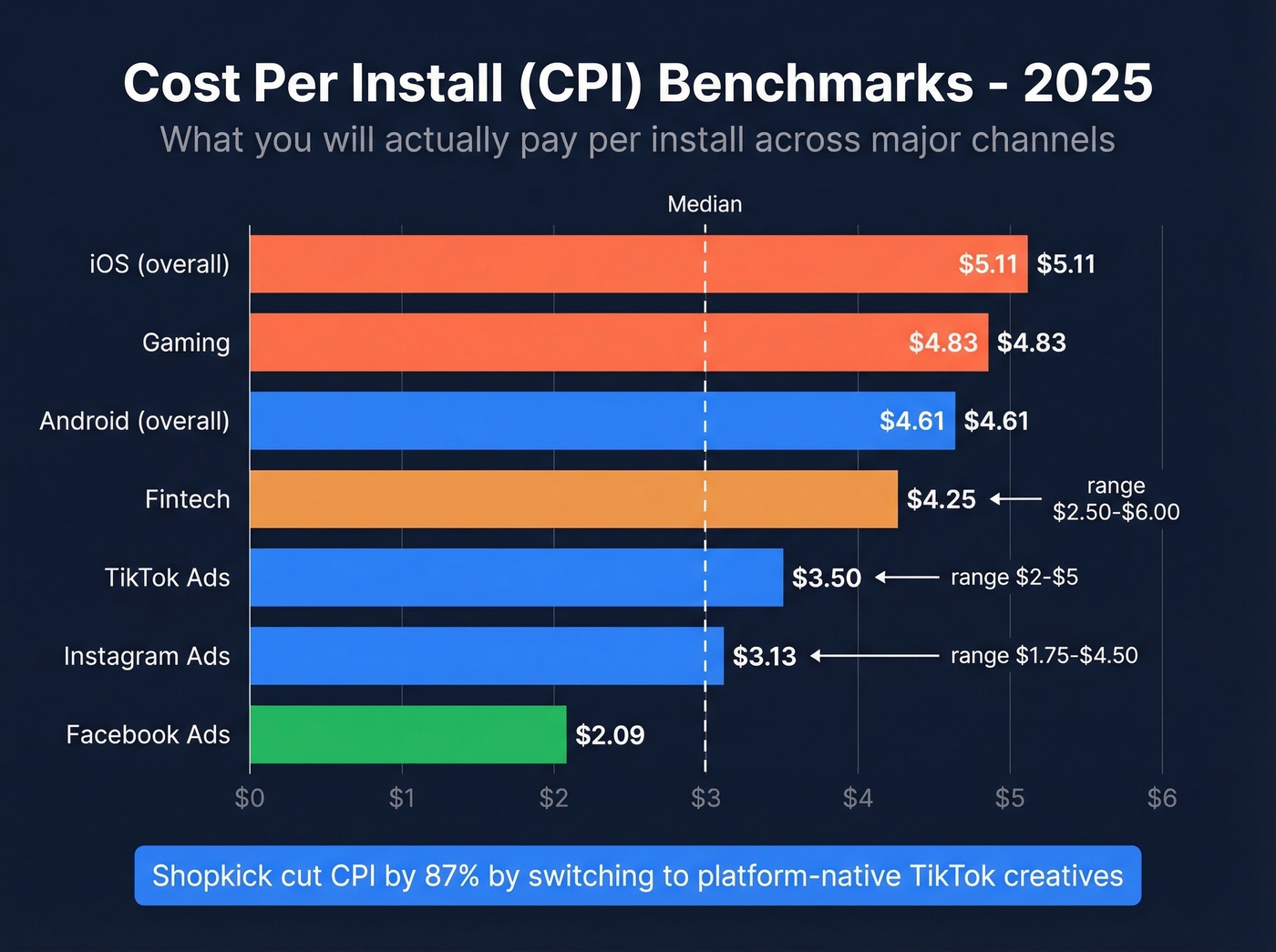
Start with Apple Search Ads for high-intent installs, then test Meta and TikTok for discovery. Budget $500-$1,000 for your first creative test cycle. Add fraud monitoring to your attribution stack from day one - bad installs will poison your cohort data and make every downstream decision wrong.
| Channel / Platform | CPI Range |
|---|---|
| iOS (overall) | ~$5.11 |
| Android (overall) | ~$4.61 |
| Facebook Ads | ~$2.09 |
| Instagram Ads | $1.75-$4.50 |
| TikTok Ads | $2-$5 |
| Gaming (cross-platform) | ~$4.83 |
| Fintech | $2.50-$6.00 |
Shopkick's TikTok campaign is the case study worth studying here. Their first attempt flopped. After tuning creatives to match TikTok's native style, they reduced CPI by 87% and CPA by 86% within two months. Platform-native creative isn't optional.
Product-Led Growth for Consumer Apps
Freemium works for consumer apps because mobile has a structural advantage: users can experience value in the first session. Nail three things:
- Immediate value in the first session (not a feature tour - actual value)
- Onboarding optimized for retention, not education
- Referral loops with social sharing baked into the core experience
Dropbox proved this model with a 60% permanent lift in signups from referrals. Build the referral loop before you build the paid acquisition engine.
If you’re building a repeatable motion, treat it like sales execution: tight loops, fast iteration, and ruthless measurement.

Your app GTM lives or dies on those first 50 design partners. Prospeo gives you 98% accurate emails for the exact decision-makers at your target companies - filtered by job title, company size, tech stack, and more. No guessing, no bounces, no wasted outbound sprints.
Find your first 50 beta users before your app hits the store.
Phase 3 - The First 90 Days
Your co-founder Slacks you: "We're at 2.1% Day 30 retention. Is that good?"
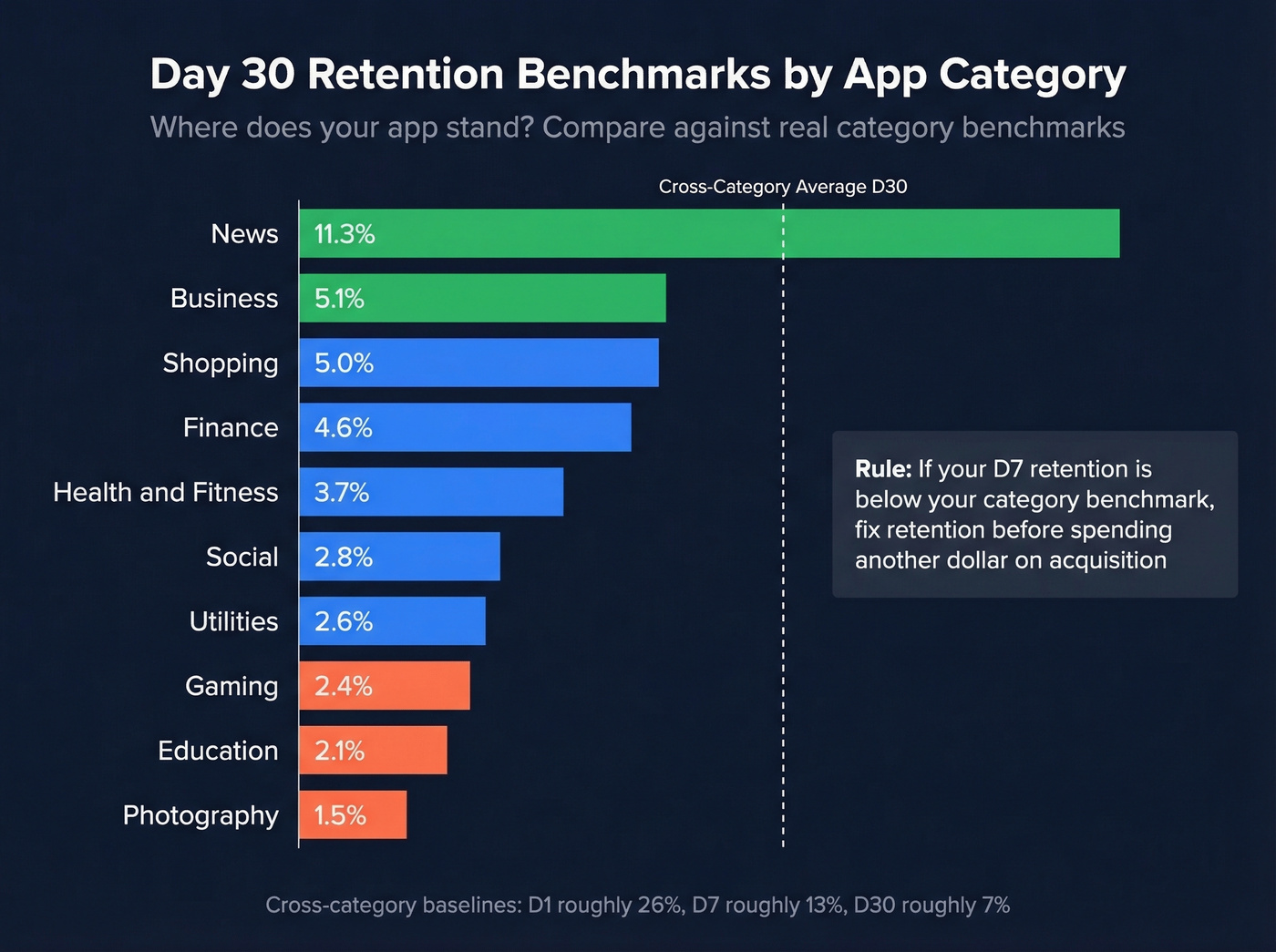
Here's how to answer that. The cross-category baseline runs roughly 26% Day 1, 13% Day 7, and 7% Day 30. But "cross-category" hides massive variation:
| Category | Day 30 Retention |
|---|---|
| News | 11.3% |
| Business | 5.1% |
| Shopping | 5.0% |
| Finance | 4.6% |
| Health & Fitness | 3.7% |
| Social | 2.8% |
| Utilities | 2.6% |
| Gaming | 2.4% |
| Education | 2.1% |
| Photography | 1.5% |
An education app at 2.1% D30 is right at the benchmark. A news app at 2.1% is in trouble. If your D7 retention is below your category benchmark, fix retention before you spend another dollar on acquisition. This is the single most important rule in app GTM, and most teams break it because acquisition feels more productive than retention work.
If you need a structured way to diagnose drop-off, run a proper churn analysis.
Monetization - The Numbers Nobody Shares
RevenueCat's dataset - 75,000 subscription apps and $10B+ in tracked revenue - tells a brutal story. The top 5% of newly launched apps earn $8,880 in their first year. The bottom 25% earn $19 or less.
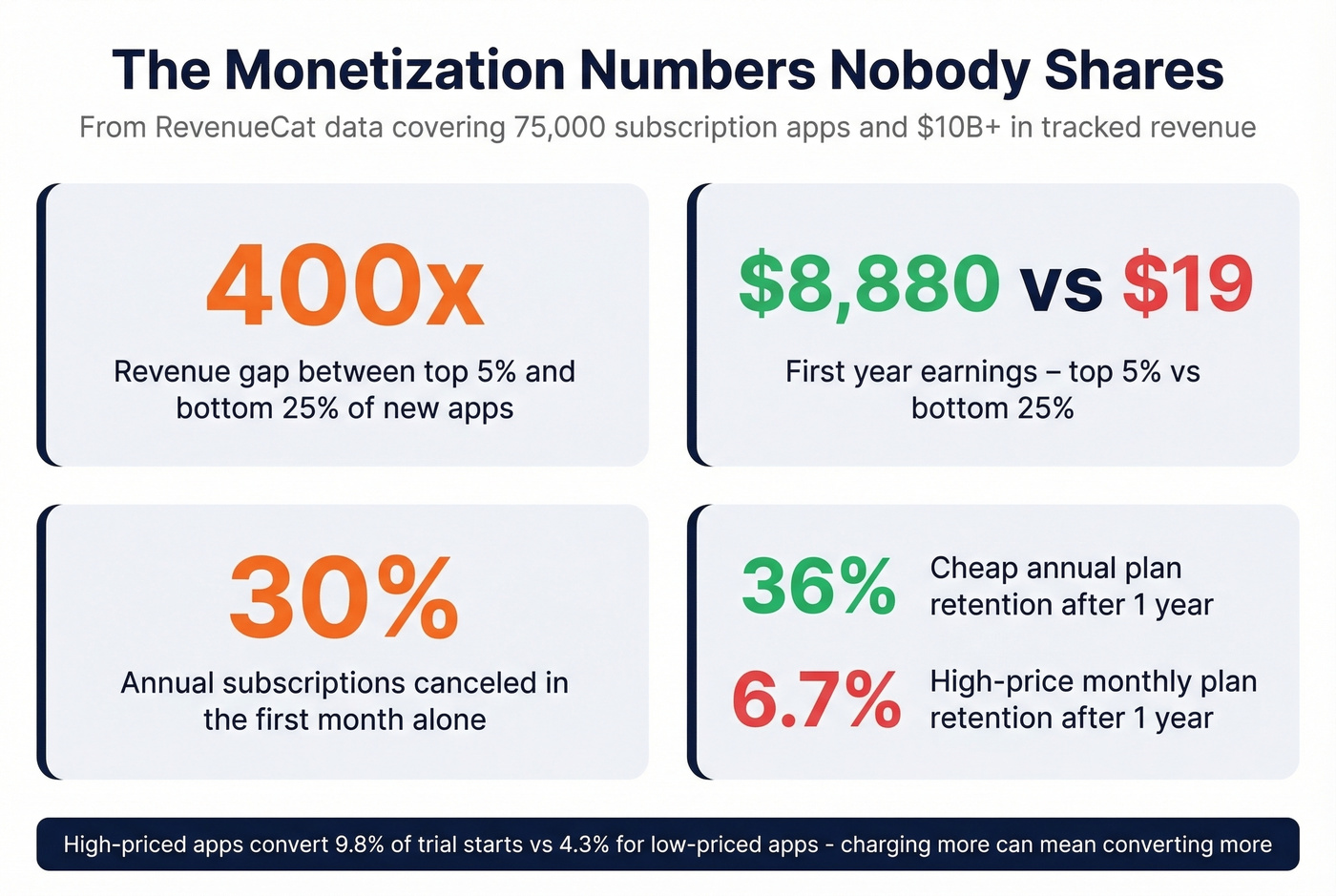
That's a 400x gap.
About 30% of annual subscriptions get canceled in the first month. High-priced monthly plans retain just 6.7% of subscribers after a year, while cheap annual plans retain up to 36%. The pricing architecture you choose isn't a minor detail - it's a retention lever that compounds over twelve months. And here's a number most founders miss: high-priced apps actually convert 9.8% of trial starts into subscribers, compared to 4.3% for low-priced apps. Charging more can mean converting more, not less, because price signals value and filters for serious users.
Let's be honest - most founders treat monetization as something they'll "figure out later." The 400x revenue gap says that's a losing strategy.
Stop Building, Start Selling
Here's the hot take most app founders don't want to hear: if your deal size is under $15K, you probably don't need a six-month build cycle before talking to customers. In our experience, founders who start outbound 3 months pre-launch close design partners before the app hits the store.
Most of your GTM success gets determined before you ship a single line of code to production. Most founders spend 6-12 months building and two weeks on their go-to-market strategy for an app that deserves better.
Build your audience while you build your product. Your app launch should be the middle of your GTM timeline, not the beginning.
If you’re doing founder-led sales, keep a set of sales follow-up templates ready before you start outreach.
You just learned that scaling paid UA before proving retention is burning cash. The same logic applies to your data: bad contact info poisons outbound the way bad installs poison cohort data. Prospeo's 5-step verification and 7-day refresh cycle mean every email you send actually lands.
Stop burning outreach budget on bounced emails. Start at $0.01 per verified lead.
FAQ
How much does it cost to launch an app?
Plan $500-$1,000 for initial paid UA testing alone. Your marketing budget should be a meaningful share of your total app budget - underfunding marketing relative to engineering is one of the most common GTM mistakes we see.
What's a good Day 7 retention rate?
The cross-category average is roughly 13%. Above that for your specific category means onboarding works. Below it, pause acquisition spending and fix retention first.
Should I launch on iOS or Android first?
iOS for most teams. Launch on one platform, prove retention and revenue metrics, then expand to Android. Splitting resources across both platforms before you've found product-market fit slows learning and doubles your bug surface.
How do I find beta users for a B2B app?
Founder-led outbound works best. Identify 50-100 target companies, find decision-maker emails with a tool like Prospeo, and send personalized outreach. Your first 50 users almost never come from inbound.
When should I start marketing my app?
Three to six months before launch. Build a waitlist, recruit beta users, set up analytics, and start ASO research. Teams that treat launch day as "day one" of marketing are already behind.