

The Ecommerce Go-to-Market Strategy Guide (With Real Numbers)
DTC ecommerce hit $213B in 2024 and it's still climbing. That means the bar for launching is higher than ever - "launch and hope" isn't a go-to-market strategy for ecommerce, it's an expensive way to learn what you should've planned. Here's a framework with real benchmarks, a 60-day timeline, and the unit economics that determine whether your launch works or bleeds cash.
What You Need (Quick Version)
- Who's buying? Build a persona around purchase triggers, device preference (73% of ecommerce traffic is mobile), and price sensitivity - not demographics alone. (If you need a structure, start with customer profiling.)
- Where will you sell? Start on Amazon for acquisition, your own store for retention. Don't spend on paid until your landing page converts at 2%+. The global average is just 1.9%.
- What's the price? Charm pricing ($29.99 vs $30) lifts sales roughly 24%. Set your price to pay back CAC on the first order (use a CAC payback period lens).
- Which channels first? Content, then influencer seeding, then paid amplification, then PR, then email/SMS. Not the other way around.
- When do you launch? Give yourself 60 days of pre-launch runway. Anything less and you're improvising.
DTC vs Marketplace vs Hybrid
Over 60% of product searches start on Amazon. That's built-in demand you can't ignore. But Amazon keeps the customer list, which means you're renting traffic instead of building an asset.
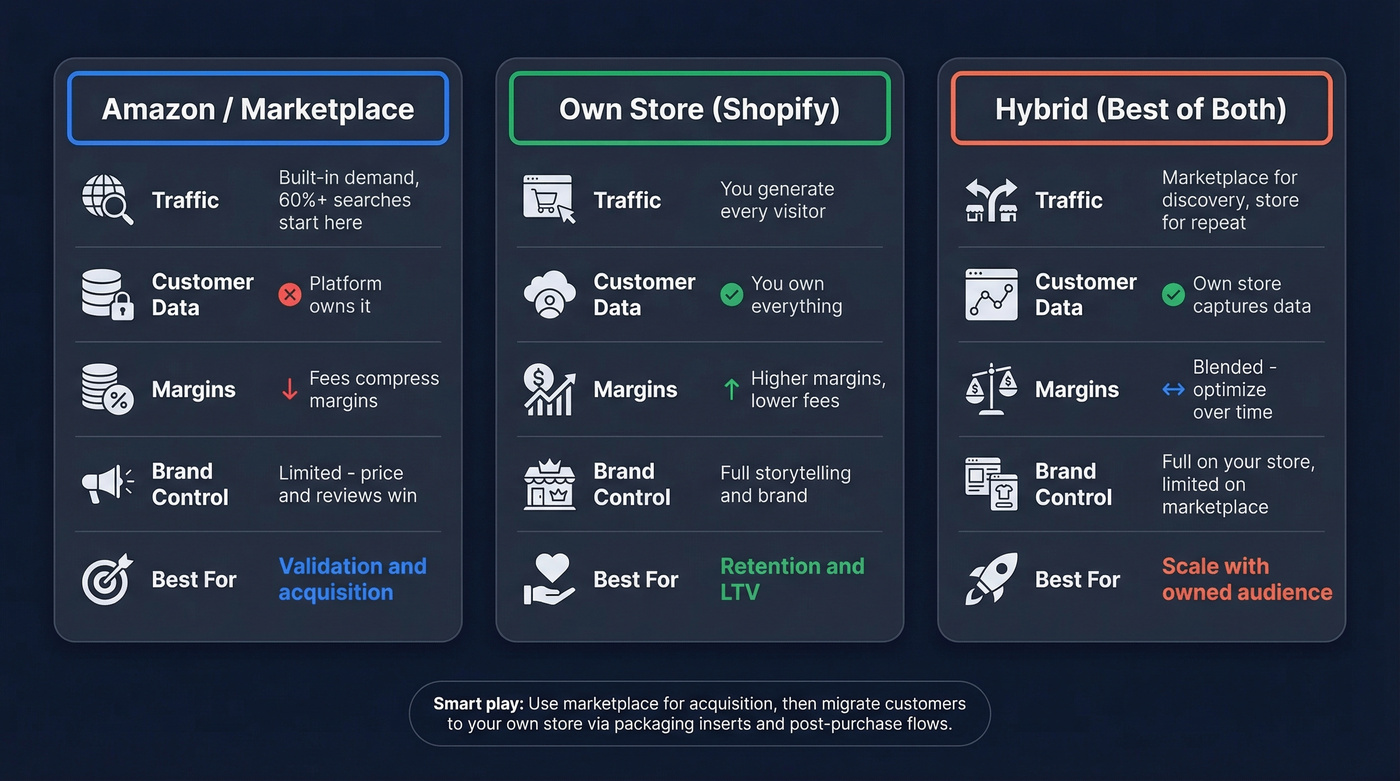
| Factor | Amazon/Marketplace | Own Store (Shopify) |
|---|---|---|
| Traffic | Built-in | You generate it |
| Customer data | Platform owns it | You own it |
| Margins | Marketplace fees + fulfillment costs compress margins | Payment processing + shipping/3PL costs |
| Brand control | Limited | Full |
| Best for | Acquisition / validation | Retention / LTV |
The smartest play for most brands: use Amazon for acquisition, then migrate customers to your own store through packaging inserts and post-purchase flows. Your own store is usually a rounding error compared to marketplace fees eating your margins on every unit. Beyond Amazon, consider TikTok Shop for built-in social proof, Walmart Marketplace for lower fees, or Etsy if you're in the handmade/niche space.
Here's the thing - most ecommerce founders agonize over platform choice when the real decision is simpler. If your product needs storytelling to sell, skip the marketplace entirely. Amazon rewards price and reviews, not brand narrative.
Define Your Target Customer
Ecommerce personas aren't B2B buyer profiles, but they share one thing: specificity matters more than breadth. Don't target "women 25-45 who care about wellness." Target the person who buys $70 supplements on mobile at 10pm after seeing an Instagram Reel, and who'll reorder if you nail the post-purchase email. Size your addressable market before launch - TAM/SAM/SOM framing keeps your channel budget grounded in reality instead of aspiration. (If you want the deeper breakdown, use our addressable markets guide.)
Map purchase triggers (seasonal? problem-aware? impulse?) and device preference. Mobile is 73% of traffic but converts at roughly half the desktop rate. That's a gap most founders underestimate until they see their analytics.
For B2B ecommerce brands selling to retailers and distributors, outbound prospecting is part of the GTM. Tools like Prospeo let you filter by industry, job title, and company size to build verified contact lists, so your outreach to procurement teams and wholesale buyers actually lands instead of bouncing. (If you're building lists, start with lead generation techniques and then tighten targeting with an ideal client profile.)
Pricing and Unit Economics
Pricing isn't a gut decision. It's a unit economics decision.
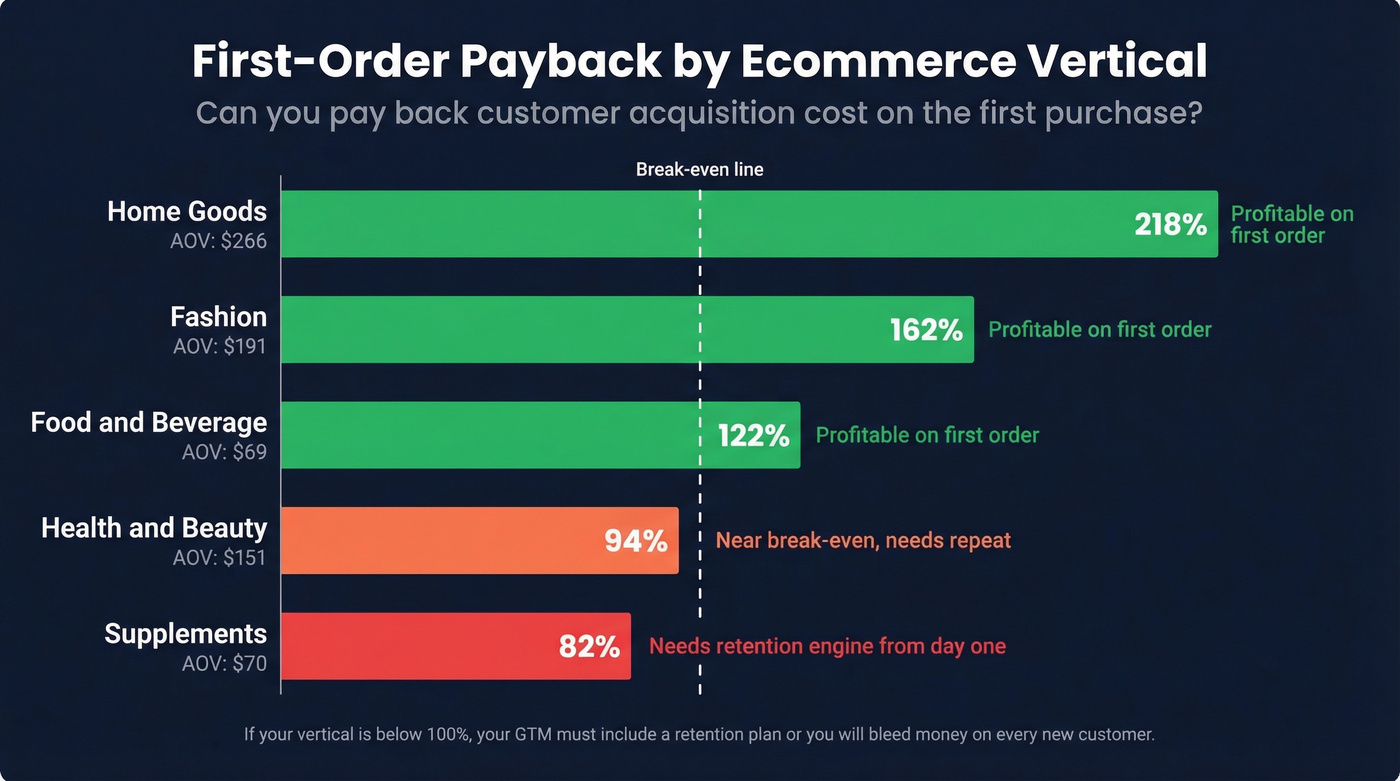
| Vertical | AOV | 1st-Order Payback | Implication |
|---|---|---|---|
| Home Goods | $266 | 218% | Profitable on first order |
| Fashion | $191 | 162% | Profitable on first order |
| Food & Beverage | $69 | 122% | Profitable on first order |
| Health & Beauty | $151 | 94% | Near break-even; needs repeat |
| Supplements | $70 | 82% | Needs repeat purchases to profit |
If you're in supplements or health & beauty, your ecommerce GTM must include a retention engine from day one. You can't treat repeat purchases as optional when your first order doesn't cover acquisition costs. We've watched multiple supplement brands burn through six figures in ad spend before realizing this - don't be one of them.
Two pricing frameworks worth knowing: penetration pricing (launch low, build volume, raise later) works for consumables with high repeat rates. Price skimming (launch high, drop over time) works for novel products with early-adopter demand. Charm pricing - ending in .99 or .97 - is a no-brainer regardless. Tools like Prisync can automate competitive price monitoring once you're live. (To pressure-test your economics, sanity-check your CAC for ecommerce and your LTV CAC ratio.)

If your ecommerce GTM includes wholesale, retail partnerships, or B2B distribution, outbound prospecting is non-negotiable. Prospeo gives you 30+ filters - industry, job title, company size, headcount growth - to build verified contact lists of procurement teams and wholesale buyers. 98% email accuracy means your outreach lands, not bounces.
Stop guessing who to pitch. Start with verified buyer data.
Channel Mix and Budget
Channel sequencing matters more than channel selection. If you're spending on paid ads before your landing page converts at 2%+, you're lighting cash on fire.
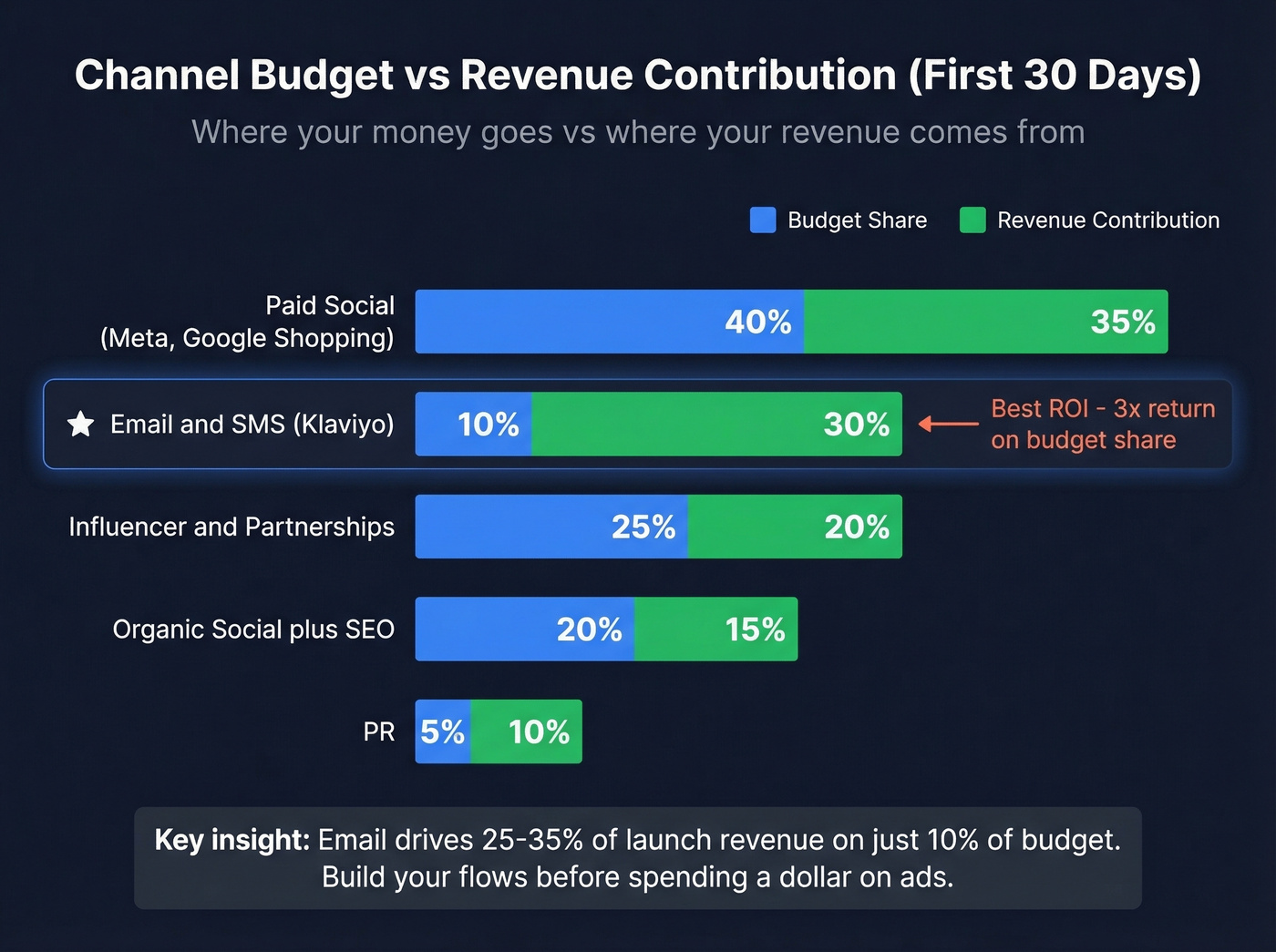
| Channel | Revenue Contribution (First 30 Days) | Budget Share |
|---|---|---|
| Paid social (Meta, Google Shopping) | 30-40% | 40% |
| Email / SMS (Klaviyo) | 25-35% | 10% |
| Influencer / partnerships | 15-25% | 25% |
| Organic social + SEO | 10-20% | 20% |
| PR | 5-15% | 5% |
Look at that second row. Email drives 25-35% of launch revenue on just 10% of budget - it's one of the best ROI channels in ecommerce, and most founders under-invest in it. Klaviyo has a free tier, and paid plans typically start around $20-$30/month depending on list size. There's no excuse to launch without flows built.
Meta Ads CPMs typically run $15-$50 depending on vertical and targeting. Test 3-5 new creative variations weekly and kill underperformers fast. Video testimonials in your ads can drive 1.5-2x lower CAC than static creative - we've seen this consistently across DTC launches we've been involved with.
The consensus across DTC founder communities on Reddit reinforces this: brands that skip email flows before launch underperform, and the ones that nail pre-launch email capture and build sequences before spending on ads start stronger and scale faster. (If you're building a full plan, align this with the 7 elements of go-to-market strategy.)
Your 60-Day Launch Timeline
Days 60-45: Build your content engine and start growing an email list. Landing page, lead magnet, pre-launch waitlist. No ads yet.
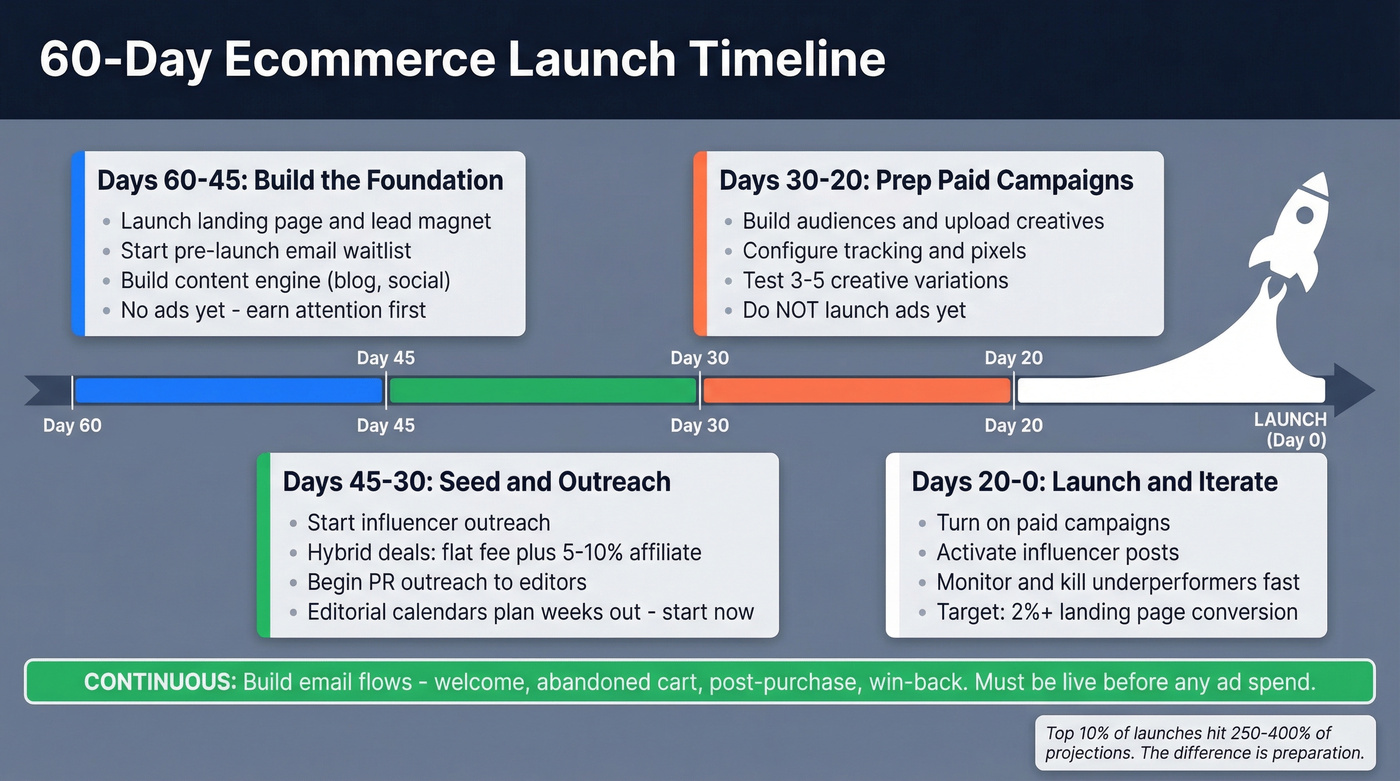
Days 45-30: Start influencer outreach. Hybrid deals - flat fee plus 5-10% affiliate commission - are standard and align incentives.
Days 30-20: Set up paid campaigns but don't launch them. Build audiences, upload creatives, configure tracking. Test 3-5 creative variations so you're ready to iterate from day one. In parallel, start PR outreach to editors and publications - most editorial calendars plan weeks out, so this window matters.
All 60 days (continuous): Build your email sequence - welcome, abandoned cart, post-purchase, win-back. These must be live before a single ad dollar is spent.
Launch performance benchmarks from 150+ DTC launches: top 10% hit 250-400% of projections, average lands at 80-120%, bottom 25% hits 40-70%. The difference is almost always pre-launch preparation, not launch-day execution.
One pattern we've seen repeatedly: brands that run Amazon and DTC simultaneously from day one without unified inventory management end up overselling on one channel and killing their reviews on the other. Start with one. Add the second once fulfillment is airtight.
Retention From Day One
Retention isn't a post-launch afterthought - it's a GTM decision. Cart abandonment runs 70.22% on average, spiking to 73-75% on mobile. Abandoned cart recovery flows typically recapture 10-15% of those lost sales per Klaviyo's benchmarks. That's revenue you're forfeiting without automation, and 48% of abandonments happen because of unexpected costs at checkout - a fixable problem.
Email frequency sweet spot: 2-3 per week. Mobile commerce accounts for 63% of total retail ecommerce, so if your checkout isn't flawless on a phone, you're losing the majority of your revenue. Desktop converts at 3.9% vs mobile's 1.8%. Optimize mobile first, always.
GTM Mistakes That Kill Launches
No mobile optimization. 63% of sales happen on mobile. If your product pages load slow or your checkout is clunky on a phone, nothing else matters.
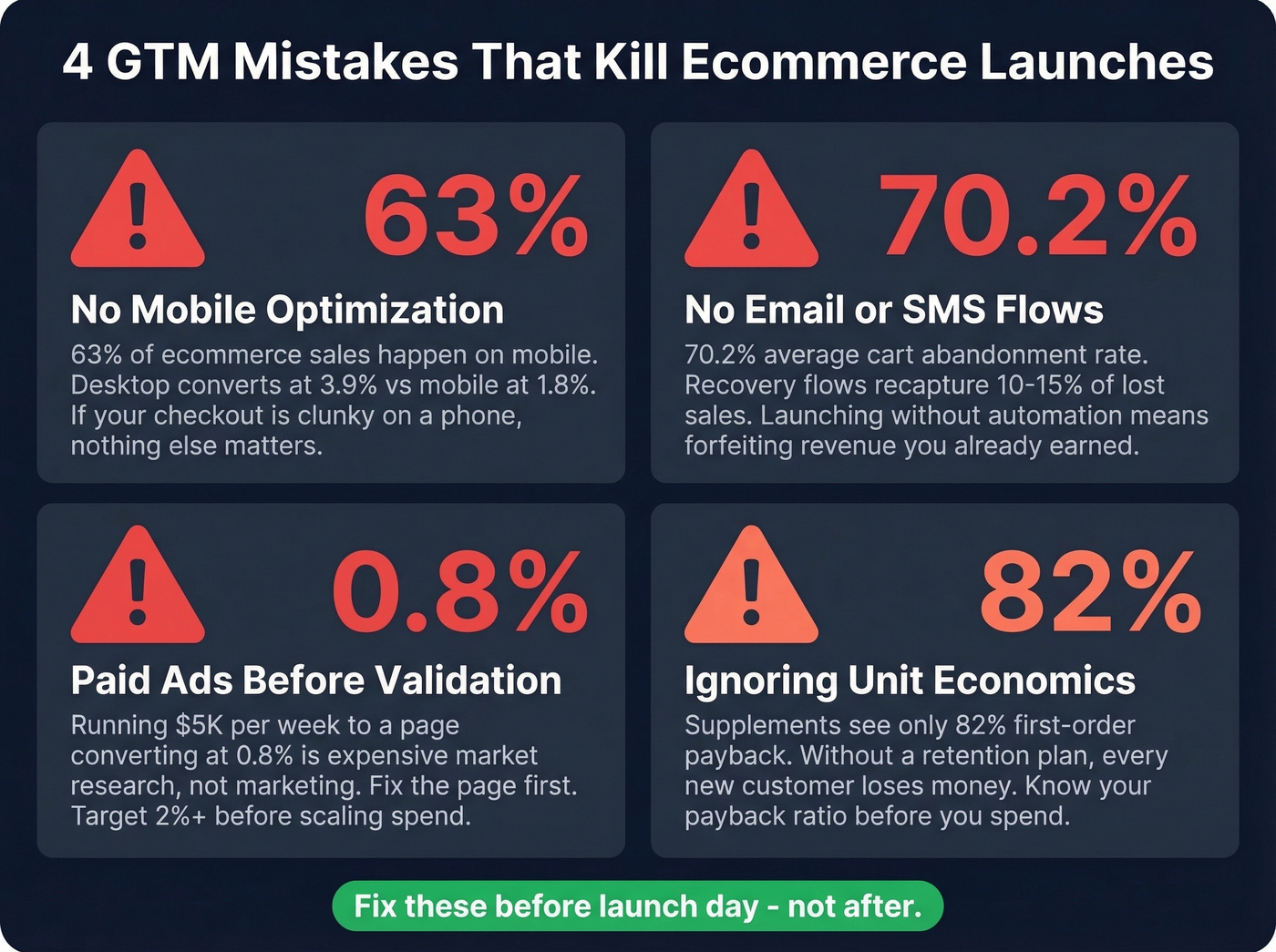
No email/SMS flows before launch. You're paying to acquire customers and then letting them disappear. Build welcome, cart recovery, and post-purchase sequences before day one.
Over-investing in paid before validation. Running $5K/week in Meta Ads to a page that converts at 0.8% is just expensive market research. Fix the page first.
Ignoring unit economics. If you're in supplements with 82% first-order payback, your go-to-market strategy for ecommerce must include a retention plan or you'll bleed money on every new customer. Low CLTV combined with high return rates will eat your margins regardless of how good your acquisition is. Skip this if you're in home goods or fashion with 150%+ first-order payback - you've got more room to experiment before retention becomes urgent.
Your 60-day launch timeline includes influencer outreach, PR pitches, and partnership deals. Every one of those requires finding the right contact and reaching them directly. Prospeo's Chrome extension - used by 40,000+ prospectors - pulls verified emails and phones from any website or LinkedIn profile in one click, so your pre-launch outreach actually connects.
Find every editor, influencer, and buyer contact before launch day.
FAQ
GTM Strategy vs Marketing Plan?
A go-to-market strategy covers the full launch - pricing, channels, positioning, distribution, and timing. A marketing plan is one component focused on demand generation. Think of GTM as the architecture; marketing is one room in the building.
How Much Should I Budget for an Ecommerce Launch?
For a DTC launch, $10K-$50K covers a credible first 30 days. Lower budgets mean tighter channel focus - start with email and one paid channel, then expand once you have conversion data proving at least 2% landing page conversion. Shopify's launch cost guide breaks down the line items if you want a more granular view.
How Do I Find Wholesale Buyers for B2B Ecommerce?
B2B ecommerce GTM includes outbound prospecting alongside your storefront. A B2B leads database with filters for industry, job title, and company size lets you build targeted lists of retailers, distributors, or procurement teams - then verify their emails before outreach so your messages reach real inboxes instead of bouncing.