

Lead Generation Techniques: What Actually Works, What It Costs, and What to Expect
79% of marketing leads never convert into sales. That's not a technique problem - it's a targeting and data quality problem dressed up as a volume issue. The lead generation software market sits at $7.4B and is projected to hit $16.2B by 2034, yet the lead generation techniques most teams rely on still aren't working. Practitioners on r/b2bmarketing post about cold emails pulling 2% reply rates and connection requests getting ignored. More tools haven't fixed the fundamentals.
What You Need (Quick Version)
The 95:5 rule frames everything: 95% of your ideal customers aren't buying right now. Only 5% are in-market. Most lead gen fails because teams blast the 95% with the same message they'd use on the 5%.
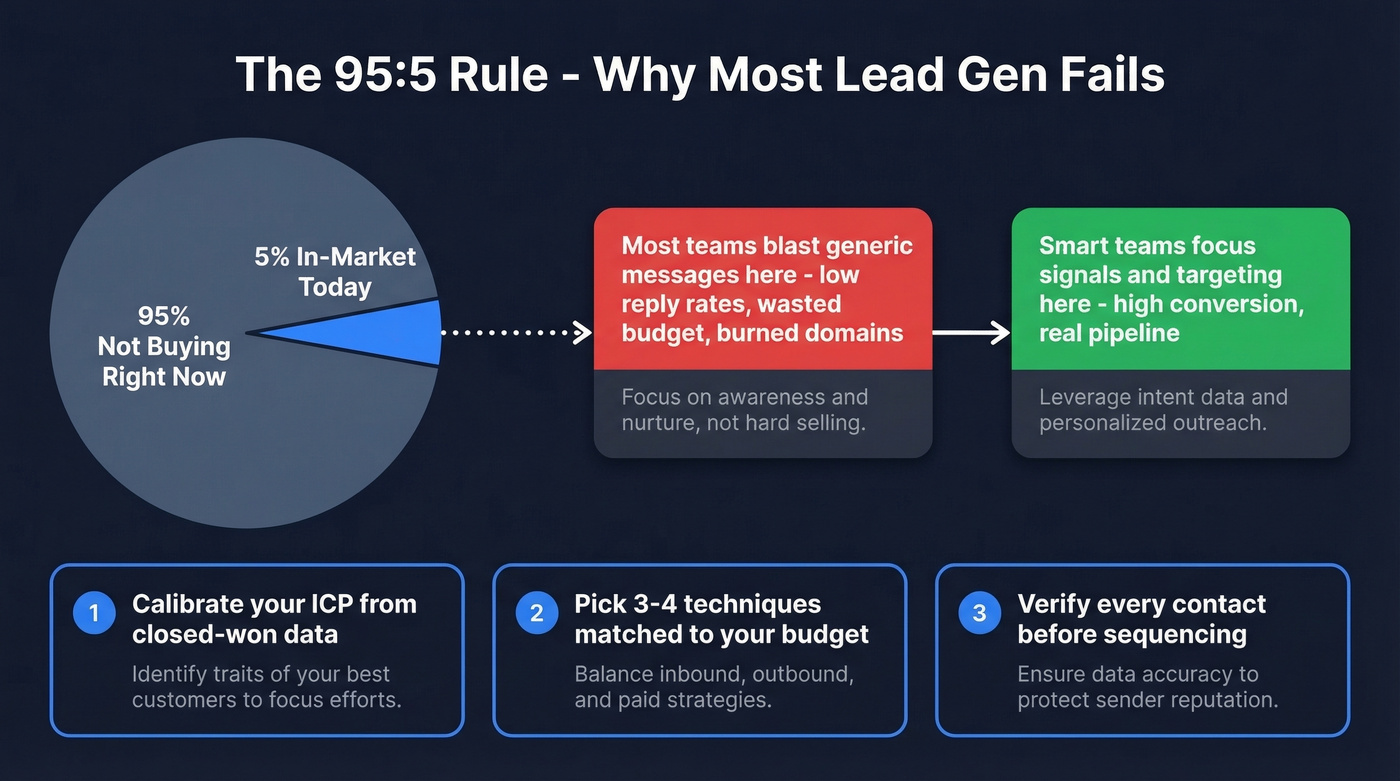
Three steps, in order:
- Calibrate your ICP. Not "we sell to mid-market SaaS" - actual buying committee roles, company triggers, and deal patterns from your last 6-12 months of closed-won data. (If you need a structure, use an ICP template.)
- Pick 3-4 techniques from the list below. Match them to your CPL budget and sales cycle. Fewer channels executed well beats twelve channels with thin effort.
- Verify every contact before sequencing. That single step separates teams booking meetings from teams burning sender domains. (See email verification options if you’re comparing tools.)
Strategy Before Tactics
Three calibration lenses shape which lead generation methods make sense for your business: your product/industry (do you deliver value upfront or over time?), your ACV and sales cycle (enterprise whales vs. SMB velocity deals), and your market position (established brand vs. disruptor needing to earn trust).
Modern B2B buyers engage across 10 channels before purchasing - up from 5 in 2016. Earning trust now requires 70+ touchpoints across six channels. That sounds exhausting, and it is. The fix isn't doing everything. It's doing the right things for your specific buyer persona.
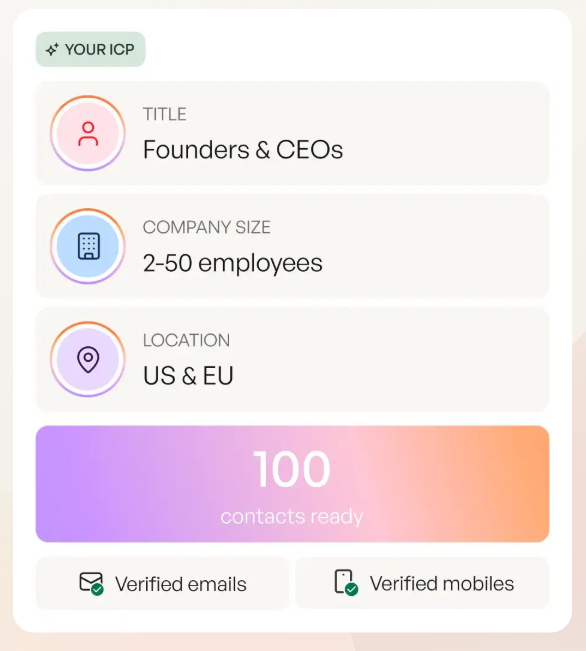
Start with competency mapping. Break your ICP into the buying committee - max five key players. Map each one's role in the decision, their pain points, and where they consume information. A VP of Engineering doesn't respond to the same channel or message as a CFO, and if you're treating them identically, your technique selection doesn't matter because the targeting is already broken. (More on this in account-based selling.)
15 Lead Generation Techniques That Work in 2026
Each technique below gets a CPL benchmark sourced from Sopro's channel data, a demand-capture vs. demand-creation label, and an honest assessment of when to use it.
1. Sales Intelligence & B2B Data Platforms
Demand capture. CPL: $50-200/lead when you factor in subscription cost divided by leads generated.
This is the foundation everything else sits on. A verified prospect list is the prerequisite for cold email, cold calling, and ABM. The quality of that list determines whether your outreach builds pipeline or burns your domain. (If you’re evaluating vendors, start with sales prospecting databases.)
Prospeo covers 300M+ professional profiles with 98% email accuracy, 143M+ verified emails, and 125M+ verified mobile numbers, all refreshed on a 7-day cycle. The industry average refresh is six weeks, which means most databases serve you stale job titles and dead email addresses. With 30+ search filters including buyer intent powered by Bombora (15,000 intent topics), technographics, and job change signals, you're building lists based on real buying triggers rather than firmographic guesses. (If you want the framework behind this, see firmographic and technographic data.)

The difference between a verified-first platform and a user-populated database is stark. Meritt tripled their pipeline from $100K to $300K/week after switching to Prospeo, with bounce rates dropping from 35% to under 4%.
2. Cold Email Outreach
Demand capture. CPL: $225.
An analysis of 44M+ emails by Snov.io puts the average cold email response rate at 5.1% and the average open rate at 27.7%. Top performers hit 8-12% response rates. The average bounce rate across those campaigns is 7.5% - anything above 5% signals a data quality problem, not a copy problem. (Benchmarks and fixes: email bounce rate.)
Here's the thing: turning off open tracking more than doubled reply rates in that same dataset - 2.36% vs. 1.08%. Open and click tracking inject pixels that email providers flag as spammy. The consensus on r/sales is blunt: don't use open or click trackers, and don't trust your platform's deliverability metrics. (Deep dive: email tracking pixels.)
A 2-email sequence (one follow-up) yields the highest response rate at 6.9%. Keep it tight. Warm-up engines help build sender reputation but aren't magic - those warm-up emails count toward your daily send limit. (If you need copy, use these cold email follow-up templates.)
3. Cold Calling
Demand capture. CPL: $300.
Still works, but the mechanics have shifted. Don't exceed 7 calls per contact - after that, you're wasting dials and annoying prospects. Wednesday and Thursday consistently outperform other days, based on Gong's analysis of millions of sales calls.
The bigger issue is VoIP spam flagging. Practitioners on r/sales warn that Twilio VoIP numbers get flagged by carriers before the phone even rings. If your connect rates are tanking, check whether your dialer's numbers are getting flagged before blaming your list. (If you’re rebuilding your motion, start with a cold calling system.)
4. Omnichannel Sequencing
Demand capture + demand creation. CPL: blended across channels.
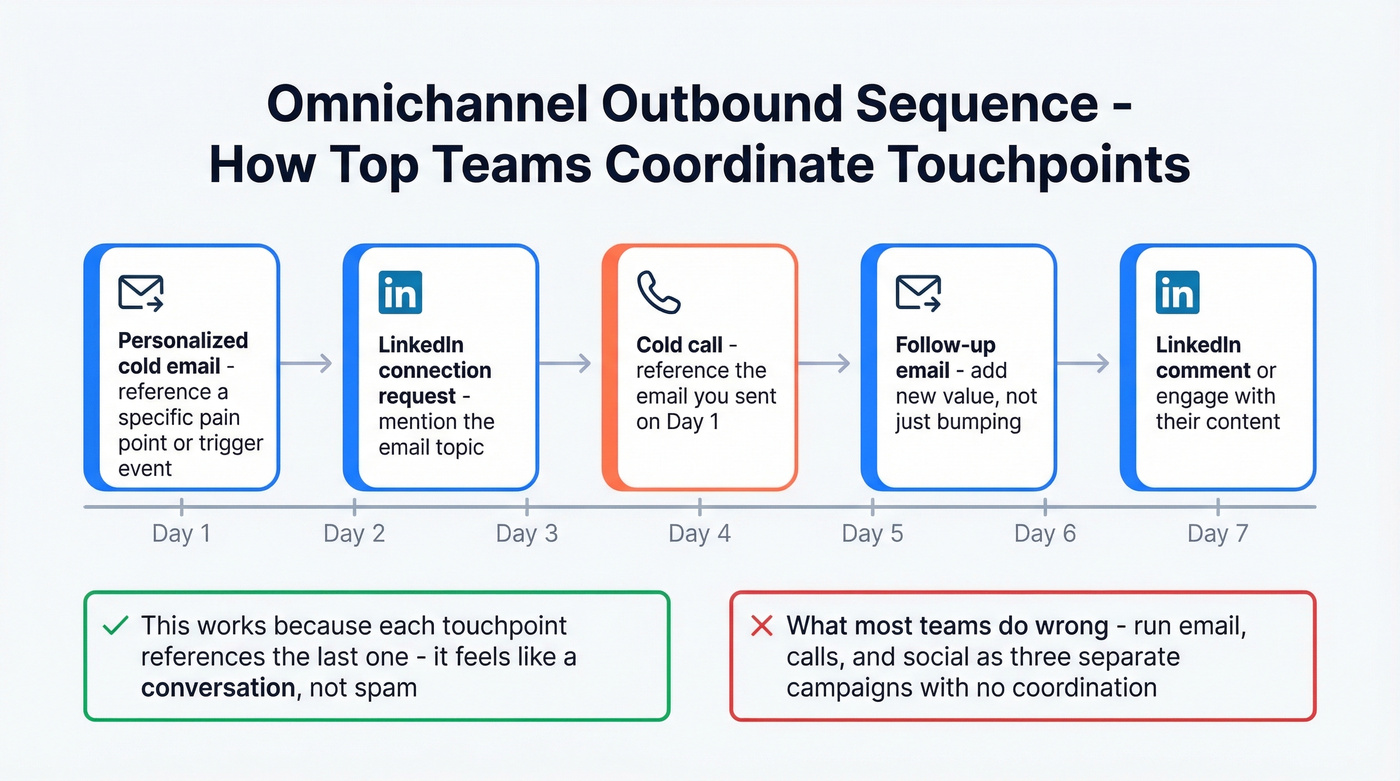
Email + calls + social touchpoints as a coordinated cadence, not three separate campaigns running in parallel. A call that references a specific email you sent yesterday converts differently than a cold dial. This is the baseline for 2026 outbound. (Operationally, this is sequence management.)
5. Content Marketing & SEO
Demand creation. CPL: $206.
HubSpot ranks website/blog/SEO as the top ROI channel for B2B. It's also the most patient channel - expect 6-12 months before content compounds into consistent lead flow. The wrinkle in 2026: 30% of marketers report decreased search traffic as buyers shift to AI tools for research. Generative engine optimization is emerging alongside traditional SEO, and about 24% of marketers are updating their SEO strategies for generative AI in search. (Related: what is B2B content marketing.)
6. PPC / Paid Search
Demand capture. CPL: $463.
Paid search captures existing intent - someone searching "CRM for construction companies" is already in-market. The CPL is more than double SEO's, but the leads arrive immediately rather than in six months. Use it to validate messaging and ICP hypotheses fast, then shift budget to organic as content matures.
7. Social Media (Organic + Paid)
Demand creation + demand capture. LinkedIn ads CPL: $408. Facebook ads CPL: $142.
LinkedIn is where B2B buyers live, and the CPL reflects that premium. Facebook is cheaper but the audience quality for B2B is unreliable. Use paid social for targeted campaigns against specific ICPs; use organic to build the trust that makes outbound warmer.
8. Webinars & Virtual Events
Demand creation. CPL: $267.
Webinars work best as mid-funnel accelerators rather than top-of-funnel lead magnets. A webinar attendee who watches 45 minutes of your content is a fundamentally different lead than someone who downloaded a PDF and never opened it. Skip this if your product has a short sales cycle and low ACV - the effort-to-return ratio won't make sense.
9. Landing Page Optimization & CRO
Demand capture. CPL: n/a (multiplier on existing channels).
CRO is the 2nd-most-used optimization technique among marketers, with 50% actively using it. A 20% improvement in landing page conversion rate cuts your CPL by 20% across every channel feeding that page if spend and traffic stay the same. This isn't a lead source - it's a force multiplier.
10. Referral Programs
Demand capture. CPL: $25 - the lowest of any channel.
Nothing converts like a warm introduction. If you don't have a structured referral program, you're leaving the cheapest leads on the table. Even a simple "who else should we talk to?" at the end of every successful engagement generates pipeline.
11. Retargeting & Remarketing
Demand capture. CPL varies by platform and audience size.
Retargeting keeps you visible to prospects who've already shown interest - website visitors, content downloaders, webinar attendees. Layer it on top of your inbound channels to recapture the 95%+ of visitors who leave without converting.
12. Account-Based Marketing (ABM)
Demand capture + demand creation. CPL: higher per account, lower per deal.
ABM flips the funnel. Instead of generating leads and qualifying down, you start with target accounts and multi-thread into the buying committee. Map the 3-5 decision-makers per account, coordinate outreach across them, and measure pipeline per account rather than leads per campaign. For teams selling deals above $50K ACV, this is where the math starts making serious sense.
13. AI-Powered Lead Generation
Both. CPL: depends on implementation.
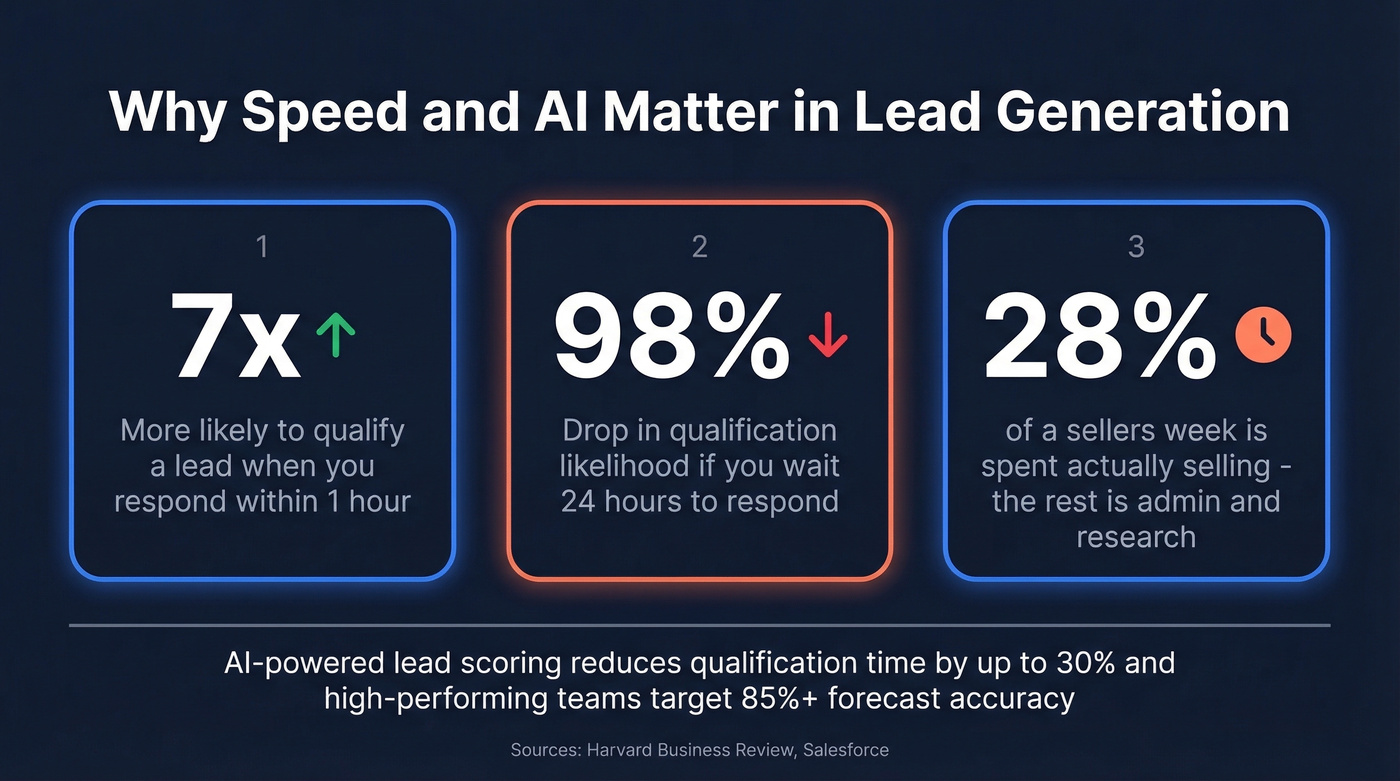
Predictive lead scoring reduces time spent on qualification by up to 30%. High-performing orgs target 85%+ forecast accuracy with AI scoring. But the biggest AI win is speed-to-lead: HBR data shows contacting a lead within 1 hour makes you 7x more likely to qualify them. Wait 24 hours and that likelihood drops by 98%.
Sellers spend only 28% of their time actually selling - the rest is admin and research. AI-driven lead nurturing compounds across every rep on your team. (If you’re building this out, see lead scoring.)
14. Signal-Based Prospecting
Demand capture. CPL: varies by signal source.
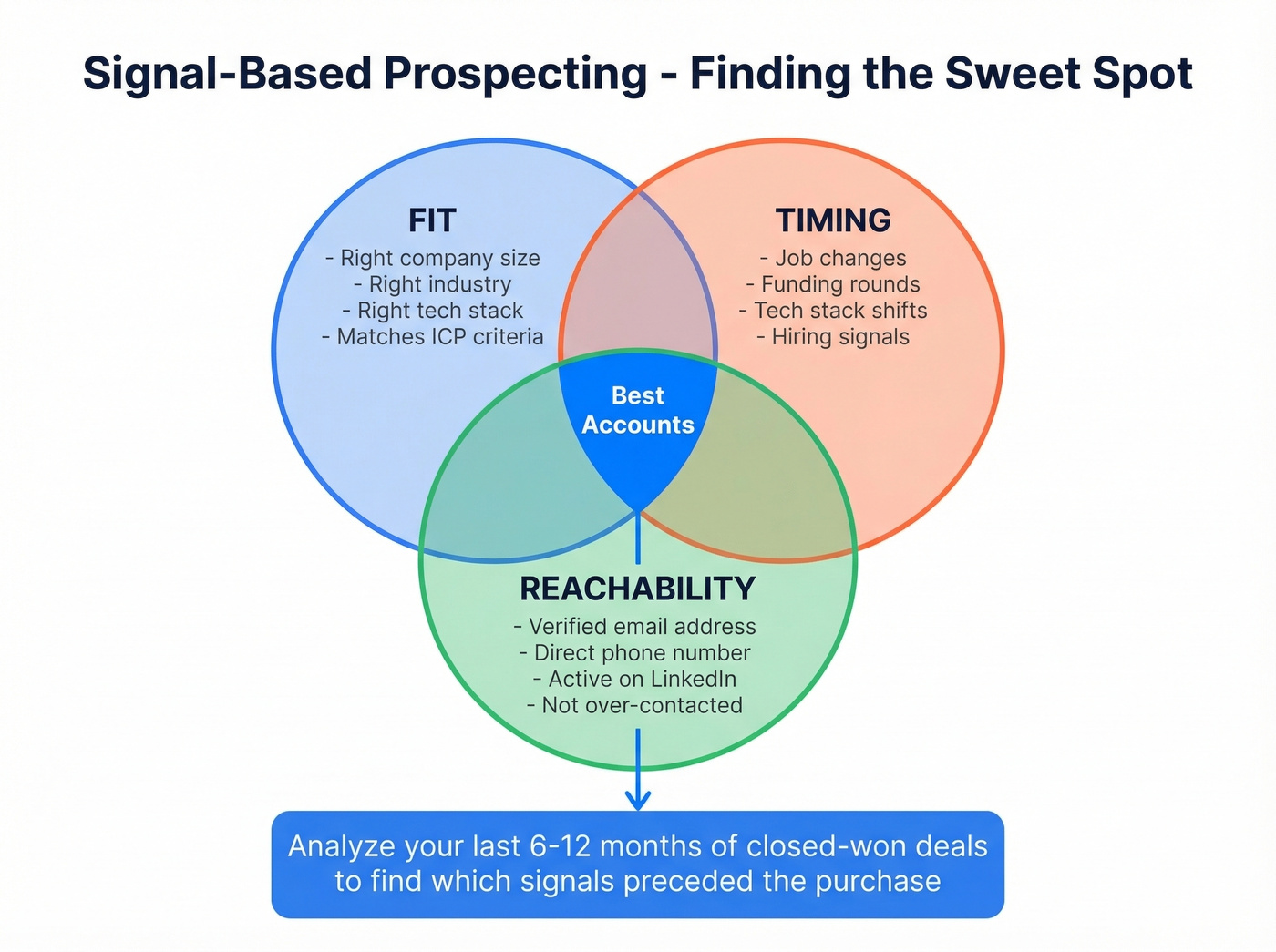
The best accounts sit at the intersection of fit + timing + reachability. Trigger events - job changes, funding rounds, tech stack shifts - often outperform generic intent spikes because they indicate a specific moment of need. Analyze your closed-won deals from the last 6-12 months to identify which signals preceded the purchase, then build your prospecting around those patterns. (How to operationalize: identifying buying signals.)
15. Affiliate Marketing
Demand creation. CPL: $73.
Low-cost, performance-based channel. You pay for results, not impressions. Works best for products with clear value propositions and self-serve onboarding.

Every technique on this list depends on one thing: reaching real people at verified addresses. Prospeo's 300M+ profiles, 98% email accuracy, and 7-day data refresh mean your cold emails land, your calls connect, and your CPL drops. Meritt cut bounce rates from 35% to under 4% and tripled pipeline.
Stop burning your sender domain on stale data. Start with verified contacts.
Cost Per Lead by Channel
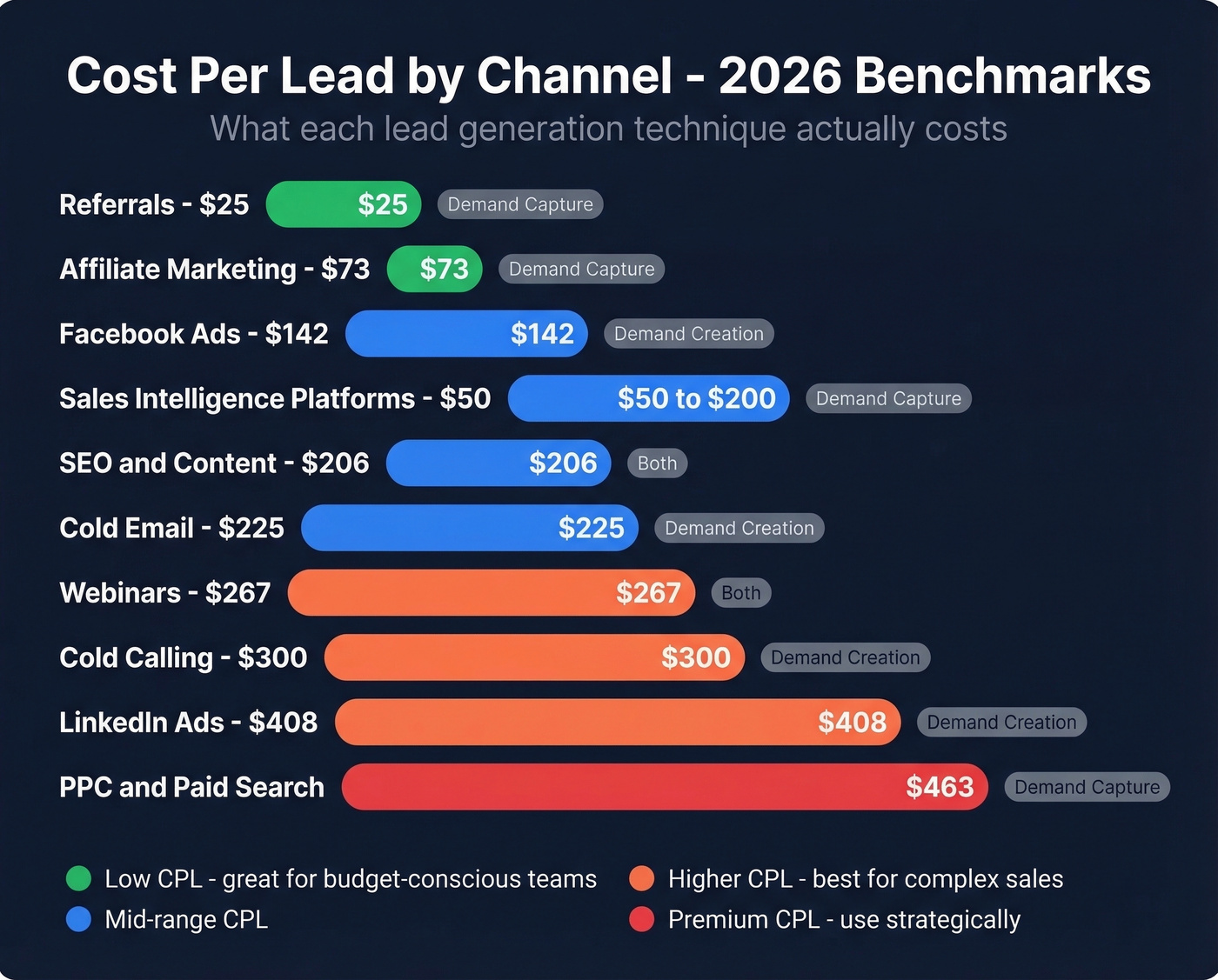
Here are the CPL benchmarks side by side:
| Channel | Avg CPL | Best For |
|---|---|---|
| Referrals | $25 | Teams with an existing customer base |
| Affiliate marketing | $73 | Self-serve products with clear value props |
| Paid Facebook ads | $142 | B2C-adjacent B2B, broad awareness |
| SEO / content | $206 | Long-term pipeline building |
| Cold email | $225 | Outbound teams with verified data |
| Webinars | $267 | Mid-funnel acceleration, complex products |
| Cold calling | $300 | High-ACV deals, direct decision-maker access |
| LinkedIn ads | $408 | Targeted ABM campaigns, niche ICPs |
| PPC / paid search | $463 | Capturing existing in-market intent |
| Trade shows | $840 | Enterprise relationship-building |
How to calculate your own CPL: If you spend $2,250/month on cold email and generate 10 qualified leads, your CPL is $225. Divide total channel spend (including tool subscriptions) by leads generated to get your real number.
Now here's the paid vs. organic split by industry, from FirstPageSage's data:
| Industry | Paid CPL | Organic CPL | Blended |
|---|---|---|---|
| B2B SaaS | $310 | $164 | $237 |
| Cybersecurity | $411 | $404 | $406 |
| Financial Services | $761 | $555 | $653 |
| Manufacturing | $691 | $415 | $553 |
| Legal Services | $784 | $516 | $649 |
| Higher Education | $1,261 | $705 | $982 |
Organic leads cost 30-50% less than paid across most industries. The exception is cybersecurity, where organic and paid CPLs are nearly identical - the buyer journey is heavily research-driven regardless of channel.
Funnel Math - What Good Looks Like
CPL means nothing without conversion rates. Here are stage-by-stage benchmarks from FirstPageSage:
| Industry | Lead to MQL | MQL to SQL | SQL to Opp | SQL to Closed |
|---|---|---|---|---|
| B2B SaaS | 39% | 38% | 42% | 37% |
| Manufacturing | 26% | 41% | 46% | 51% |
| Cybersecurity | 24% | 40% | 43% | 46% |
The diagnostic is straightforward. If your MQL-to-SQL rate is below 30%, fix your scoring model, not your lead volume. Pouring more leads into a broken funnel just creates more work for sales reps who'll disqualify them anyway. Manufacturing's high SQL-to-Closed rate (51%) reflects longer but more deliberate sales cycles - fewer junk leads make it through, so the ones that do are genuinely qualified.
On average, only 13% of MQLs convert to SQLs. Top-performing teams hit 25-35%. The gap is almost entirely explained by lead scoring discipline and sales-marketing alignment on what "qualified" actually means. (More benchmarks: average B2B lead conversion rate.)
Let's be honest: if your deal sizes are under $10K, you probably don't need 15 different tactics. You need three good ones with clean data. We've seen teams triple their reply rates just by verifying contacts before sequencing - no new channels, no new copy, just better data.
How to Build a Lead Scoring Model
A scoring model turns gut feel into a repeatable system. Given that sellers spend only 28% of their time actually selling, automating qualification decisions is one of the highest-impact investments you can make. Combine explicit signals (firmographic fit) with implicit signals (behavioral engagement). Here's a sample matrix:
| Action | Points |
|---|---|
| Demo request | +30 |
| Contact form submit | +25 |
| Pricing page visit | +15 |
| Case study download | +10 |
| Blog post read | +5 |
| Social ad click | +3 |
Thresholds: 50 points = MQL, 100+ points = SQL.
Weight high-intent actions heavily. A pricing page visit is worth three blog reads because it signals buying intent, not just curiosity. Then layer in firmographic scoring - right industry, right company size, right title - so you're not handing sales a marketing manager at a 5-person company who read three blog posts.
Use BANT (Budget, Authority, Need, Timeline) or CHAMP (Challenges, Authority, Money, Prioritization) as your qualification framework at the MQL-to-SQL handoff. Effective scoring models increase close rates by up to 30%. In our experience, the scoring model matters more than the lead source - a mediocre channel with great scoring outperforms a great channel with no scoring every time.
Mistakes That Kill Your Pipeline
These are the patterns we see repeatedly in teams that can't figure out why their lead gen isn't working:
Open and click tracking on cold email. The 44M-email study showed reply rates more than doubled with tracking off. Those tracking pixels are deliverability poison.
Purchased or unverified lists. Buying a list of 50,000 "contacts" and loading them into your sequencer is the fastest way to destroy your sender reputation. The average cold email bounce rate is 7.5% - anything above 5% is a data quality problem, not a copy problem. I've watched teams burn through three domains in a quarter because they skipped verification. It's maddening.
No follow-up strategy. One email isn't a campaign. A 2-email sequence pulls a 6.9% response rate vs. lower for single sends. Most teams give up too early.
Weak lead magnets. A generic "Ultimate Guide to X" PDF doesn't earn an email address anymore. Specificity wins - calculators, benchmarks, templates that solve an immediate problem.
Ignoring qualification. More leads don't equal more revenue. If your MQL-to-SQL rate is below 13%, you're generating noise, not pipeline.
VoIP spam flags. If your cold calling connect rates have cratered, your dialer's numbers are probably getting flagged before the phone rings. Check with your carrier before overhauling your script.
Warm-up false confidence. Warm-up tools build sender reputation, but they don't fix bad data or bad targeting. A warmed-up domain sending to unverified emails still bounces. (If you’re troubleshooting, start with improve sender reputation.)
Run every list through verification before sequencing. Snyk's team of 50 AEs saw bounce rates drop from 35-40% to under 5% after switching to verified-first data, generating 200+ new opportunities per month. That's the difference clean data makes.
The 95:5 rule means you need to find the 5% who are actually buying. Prospeo layers Bombora intent data across 15,000 topics with job change signals, technographics, and 30+ filters so you're targeting real buying triggers - not firmographic guesses. All for roughly $0.01 per email.
Target in-market buyers instead of blasting the other 95%.
FAQ
What's the most cost-effective lead generation technique?
Referrals at $25 CPL are the cheapest channel, followed by affiliate marketing at $73 and organic SEO at $206. Referrals need the least infrastructure - just a structured ask after successful engagements. SEO takes 6-12 months to compound but scales without proportional cost increases.
How many channels should I use at once?
Three to four lead generation techniques executed well with verified data outperform twelve channels running on unverified lists. Start narrow, measure funnel conversion rates against the benchmarks above, and expand only when your current channels are optimized.
What's a good cold email response rate?
The average across 44M emails analyzed is 5.1%, and top performers hit 8-12%. Turn off open tracking, verify contact data before sending, and keep sequences to 2-3 touches. Below 3%, check your data quality before rewriting copy - bounce rates under 5% are the threshold where deliverability stays healthy.
How do I know if my funnel is broken?
Compare your stage-by-stage conversion rates to industry benchmarks: 39% Lead-to-MQL and 38% MQL-to-SQL for B2B SaaS. If your MQL-to-SQL rate is below 30%, the problem is usually your scoring model or sales-marketing alignment - not lead volume.
What tools do I need for B2B lead generation?
At minimum: a verified data source for contact data and email verification, a sequencing tool like Instantly or Smartlead at $30-100/mo, and a CRM such as HubSpot's free tier or Salesforce starting around $25/user/mo. Add intent data and enrichment as you scale.