

Go-to-Market Strategy for Services: The 2026 Guide That Isn't Written for SaaS
Every GTM guide on the internet cites Slack's freemium model or HubSpot's inbound flywheel. Neither helps you sell a $15K consulting engagement. If you need a go-to-market strategy for services, you need a fundamentally different playbook - one built around trust, capacity constraints, and relationships instead of product-led growth loops.
In a Bain survey of 2,300 global companies, only 9% averaged 5.5%+ annual revenue and profit growth over a decade. The ones that did built GTM as a system, not a one-time launch plan.
On r/consulting, operators ask for "tactics that actually won clients" - not vanity metrics or recycled SaaS playbooks. This is the services-specific framework those operators are looking for.
What Makes a Services GTM Different
Most GTM guides assume you're launching a product. Services don't work that way.
You're selling something intangible. Buyers purchase your expertise and judgment. Trust is the entire sale - there's no dashboard demo or free trial to fall back on. Proof comes from case studies, referrals, and thought leadership.
Capacity is a hard ceiling. You can't onboard 1,000 users tomorrow. Every new client consumes delivery hours, and over-selling kills quality faster than under-selling kills growth.
Relationships drive revenue. The buying process involves multiple decision-makers and is often referral-initiated, which means your GTM has to account for longer sales cycles and higher-touch engagement than any product launch playbook will tell you about.
The 6-Step Framework for Launching Services
Six steps, in order. Skip one and the rest fall apart.
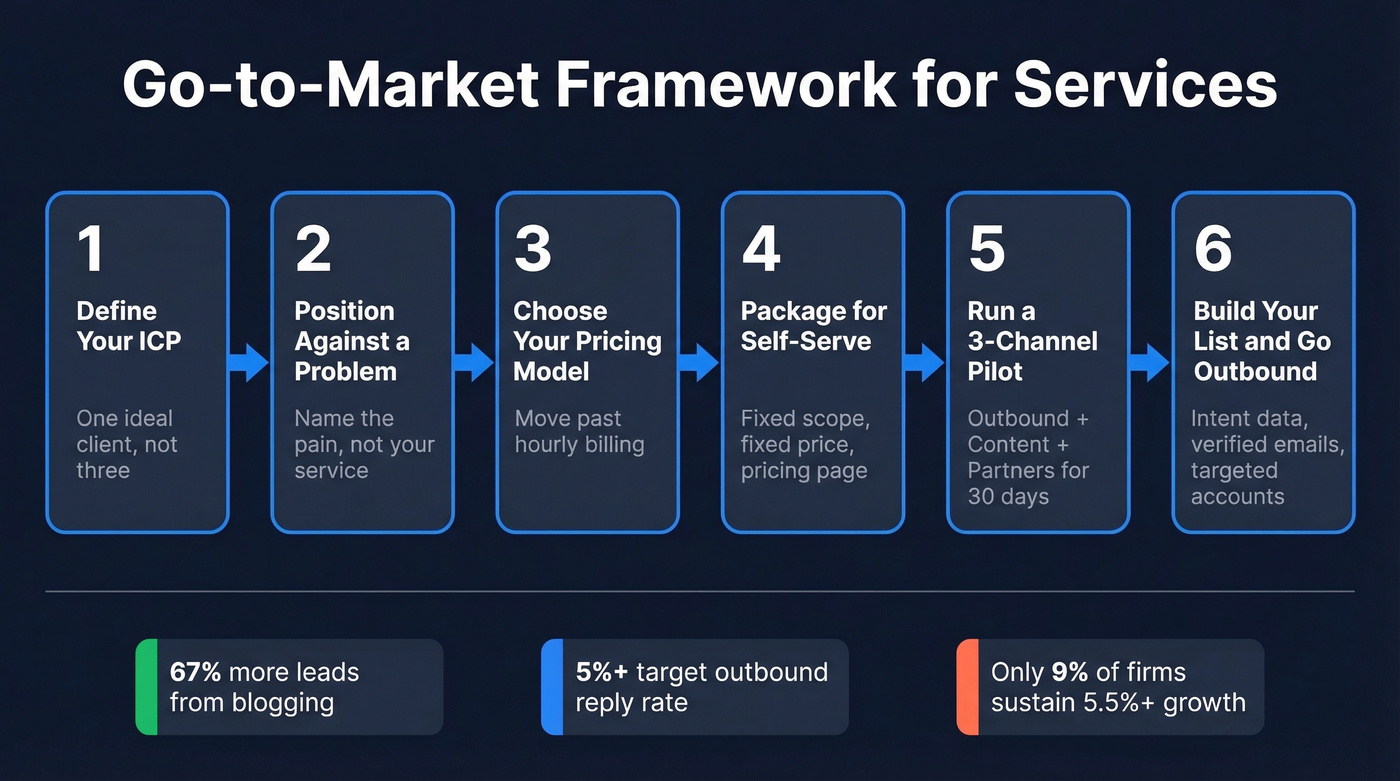
1. Define Your ICP
One ideal client profile , not three. The biggest mistake services firms make is targeting "anyone who'll pay." Segment by problem, not industry. A fractional CFO serving "Series A SaaS companies burning cash faster than they're growing" has a sharper GTM than one serving "startups." That specificity isn't limiting - it's what makes every downstream decision easier.
2. Position Against a Problem
"We help [ICP] solve [specific problem]" - not "we offer consulting services." If your positioning could apply to any competitor, it's not positioning. It's a tagline. If you need a tighter narrative, borrow from proven B2B brand positioning frameworks.
3. Choose Your Pricing Model
Hourly billing is a trap that caps your revenue and commoditizes your expertise. Move toward fixed scope and outcome-based pricing as fast as you can. We break down the five models below. (If you’re benchmarking your economics, start with cost to acquire customer and work backward.)
4. Package for Self-Serve Buying
Productized services - fixed scope, fixed price, standardized workflow - change the entire GTM motion. Instead of custom proposals and three rounds of negotiation, you send a pricing page link. VideoHusky built a $1.2M/year business on productized video editing.
In our experience, this is where most services firms stall. They resist standardizing because every client feels "different." Get over it. Standardize the core, customize at the edges.
5. Run a 3-Channel Pilot
Pick three channels: outbound, inbound/content, and partners. Run all three for 30 days. Kill what doesn't convert. Companies that blog generate 67% more leads than those that don't - but content alone won't fill a services pipeline. You need outbound to control your own timeline.
Track your pipeline velocity: (Opportunities x Deal Size x Win Rate) / Sales Cycle Length. This single formula tells you whether your GTM is actually working or just generating activity. Target a 5%+ outbound reply rate. For webinars, aim for 30%+ live-to-MQL conversion. To pressure-test your numbers, compare against sales pipeline benchmarks and common sales pipeline challenges.
6. Build Your Prospect List and Start Outbound
With 30+ search filters - including buyer intent powered by Bombora, technographics, and headcount growth - you can zero in on accounts that match your ICP instead of blasting a generic list. If you want more ways to fill the top of funnel, use these sales prospecting techniques.
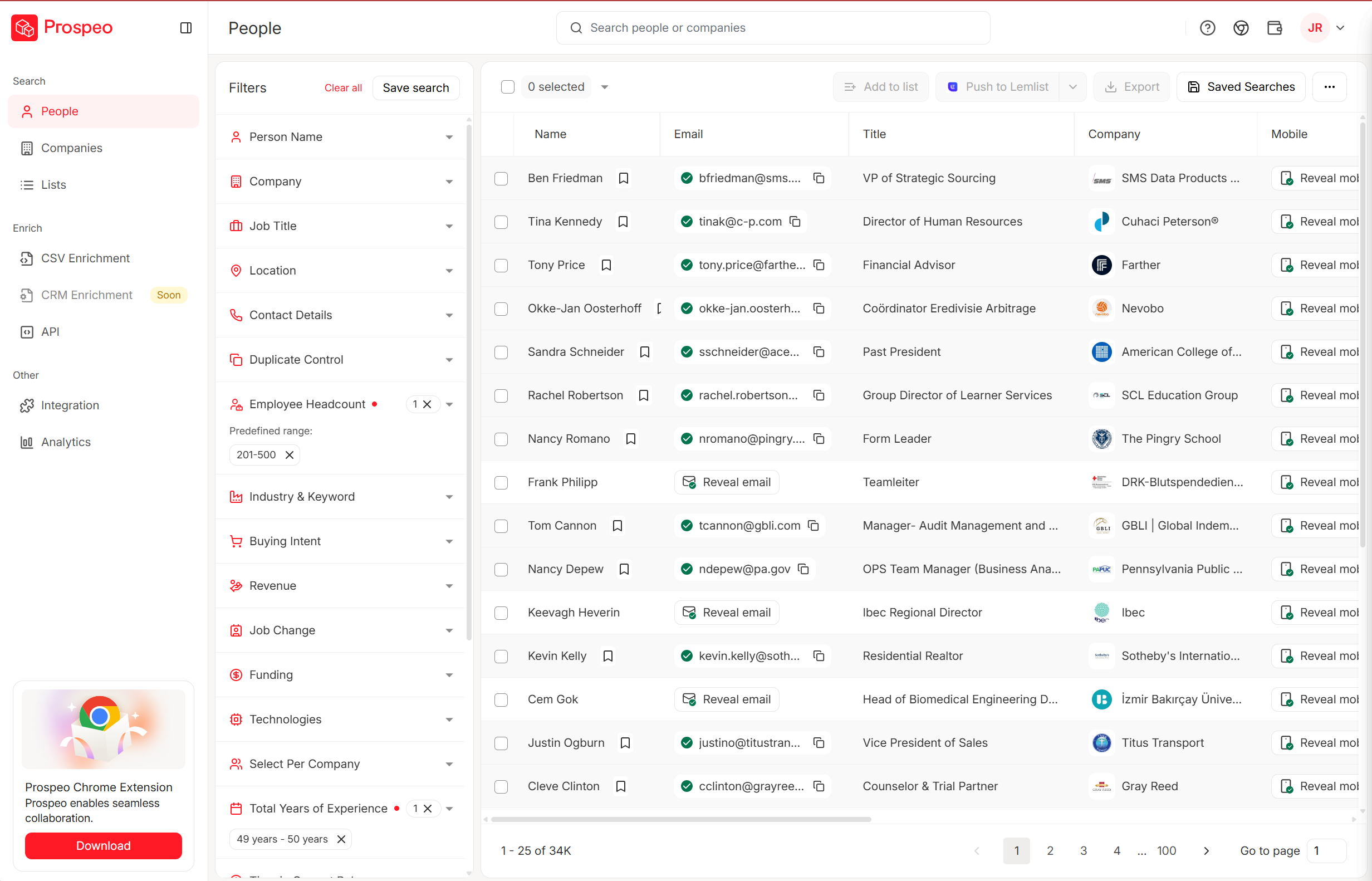

Step 6 is where most services firms stall - building a list that actually matches their ICP. Prospeo's 30+ search filters let you target by buyer intent, technographics, headcount growth, and funding stage so your outbound hits the exact accounts you validated in Step 1. 98% email accuracy means your first impression isn't a bounce.
Stop blasting generic lists. Start reaching the ICP you just defined.
Services Pricing Models Compared
| Model | Typical Range | Best For | Watch Out For |
|---|---|---|---|
| Hourly | $50-$300+/hr | Early freelancers | Revenue cap, scope creep |
| Retainer | $2K-$15K/mo | Ongoing advisory | Scope bleed risk |
| Project | $5K-$100K+ | Defined deliverables | Lumpy cash flow |
| Value-Based | 10-30% of outcome | Proven consultants | Requires trust + track record |
| Productized | $500-$5K/package | Scalable services | Needs standardized delivery |
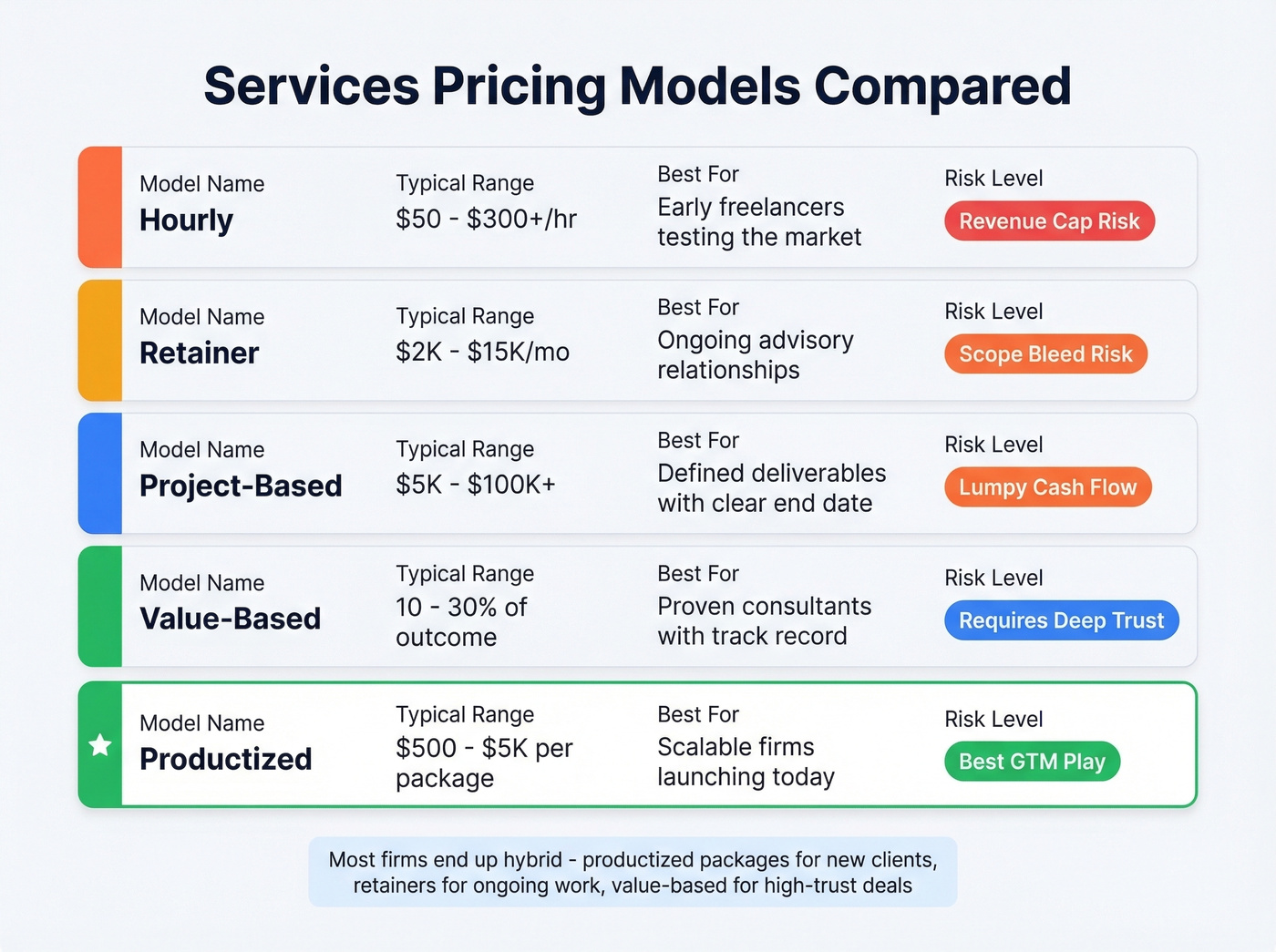
Productized services are the strongest GTM play for most firms launching today. They create a self-serve buying experience, predictable revenue, and standardized delivery - all things that make scaling possible.
Let's be honest: retainers create planning certainty, but projects create lumpy cash. Build a 13-week rolling cash forecast and update it weekly. This one habit prevents the feast-or-famine cycle that kills more services firms than bad marketing ever will. Most firms end up with a hybrid: productized packages for new clients, retainers for ongoing relationships, value-based pricing for high-trust engagements.
Hot take: If your average engagement is under $8K, you almost certainly don't need a complex sales motion. Productize, post a pricing page, and let buyers self-serve. The firms obsessing over "consultative selling" at that price point are just avoiding the hard work of standardizing their delivery.
Your 90-Day Launch Plan
Days 1-14: Validate. Lock your ICP and messaging. Run 5-10 buyer interviews. Don't build anything yet - validate that the problem you're positioning against is real and that people will pay to solve it. If you need a structure, use an ideal customer profile template.
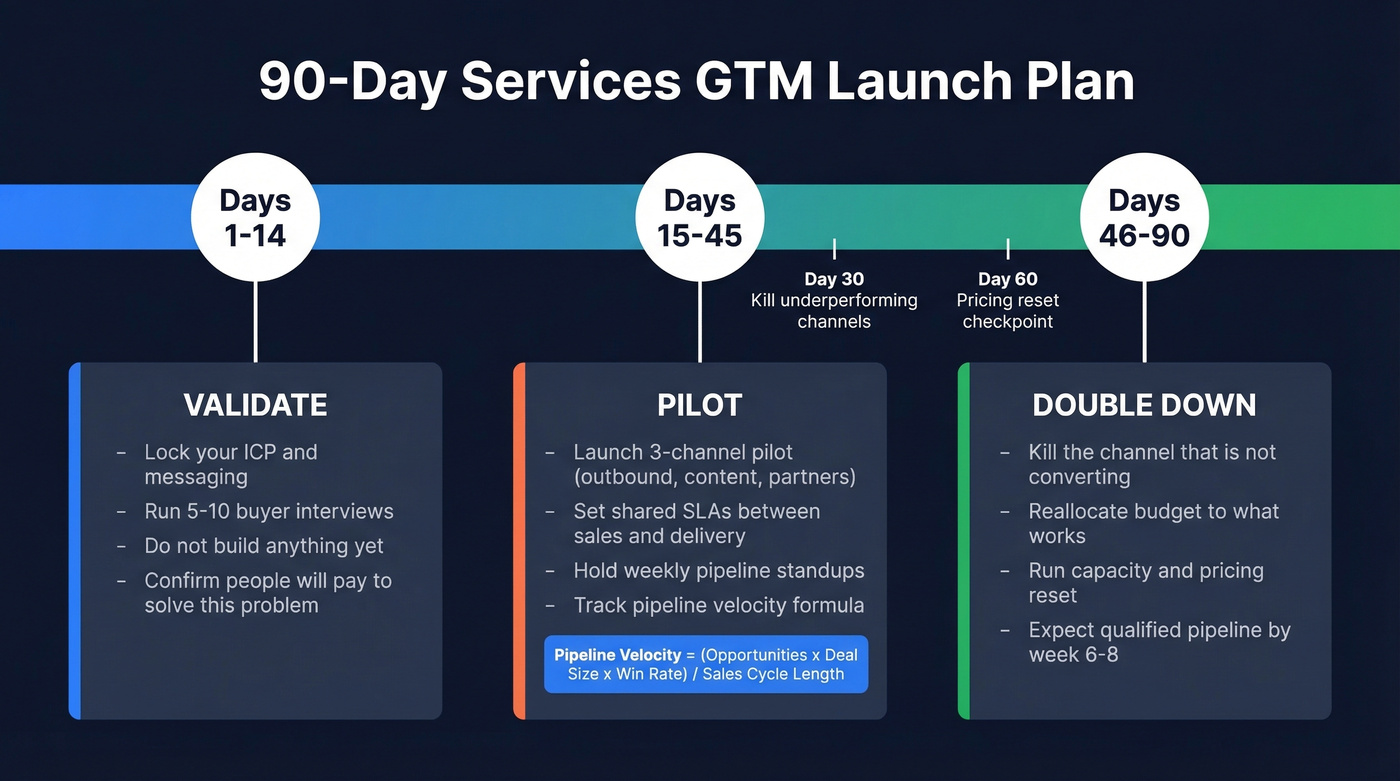
Days 15-45: Pilot. Launch your 3-channel pilot. Set shared SLAs between sales and delivery so you don't sell what you can't fulfill. Hold a weekly pipeline standup - even if your "team" is just you and a contractor. We've seen solo consultants skip this and lose track of their own pipeline within three weeks. If you’re building repeatable outreach, start with cold email follow-up templates.
Days 46-90: Double down. Kill the channel that isn't converting. Reallocate budget and time to what's working. Run a capacity and pricing reset - are you under-priced? Over-committed? Too many firms coast on referrals for years, then panic when the pipeline goes cold. Outbound gives you control before that happens.
Five Mistakes That Kill Momentum
Pricing 70% below competitors. It doesn't signal value - it signals low quality. Services buyers use price as a quality cue, and anchoring too low makes it nearly impossible to raise rates later without losing clients who came for the discount. (If you want a deeper negotiation lens, study anchor in negotiation.)
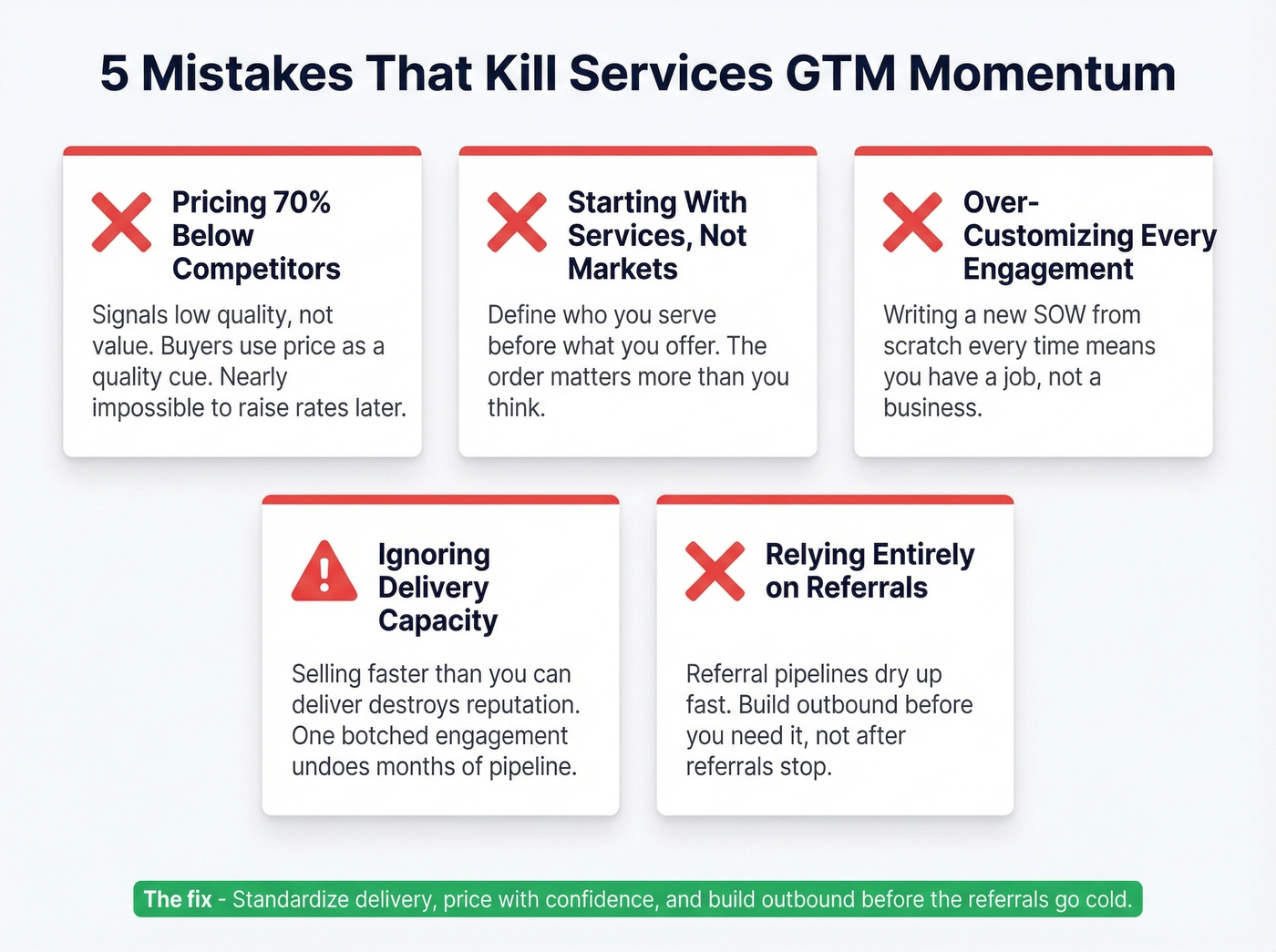
Starting with services instead of markets. Define who you serve before you define what you offer. The order matters.
Over-customizing every engagement. Custom proposals for every prospect don't scale. If you're writing a new SOW from scratch every time, you don't have a business - you have a job.
Ignoring delivery capacity. Selling faster than you can deliver destroys reputation. One botched engagement can undo months of pipeline building.
Relying entirely on referrals. A referral-only pipeline can dry up fast. Build outbound before you need it, not after the referrals stop coming.
Your 90-day launch plan fails if outbound runs on bad data. Prospeo refreshes 300M+ profiles every 7 days - not every 6 weeks - so the contacts you pull on Day 15 are still accurate on Day 90. At $0.01 per verified email, even a solo consultant can afford enterprise-grade prospecting.
Launch your 3-channel pilot with data that won't go stale mid-sprint.
FAQ
How is a services GTM strategy different from a product GTM strategy?
Services GTM replaces product demos with trust-building: case studies, sharp positioning, and proof of expertise drive the sale instead of free trials or freemium loops. Delivery capacity also constrains growth in ways products don't face, so you're always balancing pipeline generation against your ability to fulfill.
What's the best pricing model for a new services firm?
Productized services - fixed scope, fixed price, and a pricing page that lets buyers self-serve. This eliminates proposal ping-pong and creates predictable revenue from day one. As you build trust and a track record, layer in value-based pricing for larger engagements.
How long does a services GTM take to show results?
Plan for 90 days minimum. Validate your ICP in weeks 1-2, pilot three channels through day 45, then double down on what converts through day 90. Most firms see qualified pipeline by week 6-8 if they're running outbound consistently.
What tools help with outbound for a services GTM launch?
For building your prospect list, Prospeo's free tier includes 75 verified emails and 100 Chrome extension credits monthly, with 30+ targeting filters to match your ICP. Pair it with a sequencing tool like Instantly or Smartlead to automate follow-ups and track reply rates across your campaigns.