

Go-to-Market Strategy for Software Services: The 2026 Playbook
Every SaaS GTM guide on the internet assumes you're shipping a product with infinite scale. A go-to-market strategy for software services doesn't work that way. You're selling people, delivery capacity, and expertise - and the biggest constraint isn't demand generation. It's the fact that you'll turn away deals because you can't staff the work. 95% of new products fail to achieve significant market penetration, and for services firms, the failure mode is almost always operational, not marketing.
The Short Version
- Capacity planning is your real constraint. Most services firms capture only 10-20% of potential pipeline due to staffing limitations. Your growth ceiling is your bench, not your ad spend.
- The hybrid model wins. McKinsey's analysis of 107 publicly listed B2B SaaS companies shows a high-performing product-led subset drives outsized ARR growth and higher valuation ratios - and it introduces Product-Led Sales as the hybrid motion that blends product-led mechanics with enterprise sales.
- Clean contact data is non-negotiable. Verify every email before it enters a sequence. Bounced emails wreck domain reputation faster than bad messaging wrecks pipeline.
Why Software Services GTM Is Different
SaaS products scale horizontally. Add servers, ship features, onboard thousands. Software services scale through people - consultants, engineers, delivery managers - and people don't scale like infrastructure.
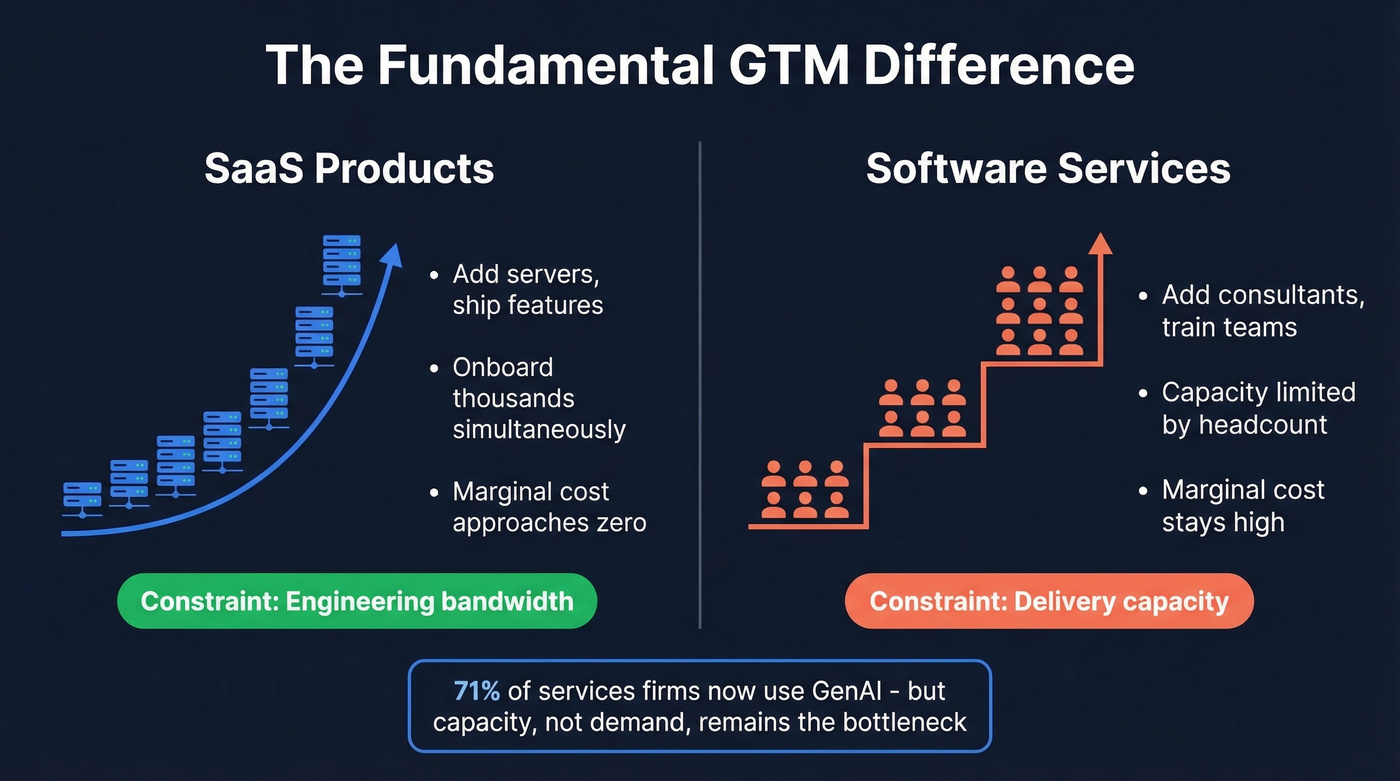
This distinction reshapes every GTM decision. GenAI adoption in professional services jumped from 33% to 71% between 2023 and 2024, and AI consulting is projected to represent 40% of services revenue by 2026. For most services firms, capacity - not demand - becomes the GTM bottleneck. Demand isn't the problem. Delivery is.
The commercial model is shifting too. One-third of professional services firms expect 75%+ of revenue to come from digital services. Clients want outcome-based pricing, subscription engagements, and performance-driven contracts - not billable hours. You're not selling time anymore. You're selling packaged outcomes with capacity constraints baked in.
Choosing Your GTM Motion
McKinsey's 107-company analysis shows that a high-performing product-led subset generates 10 percentage points more ARR growth and achieves valuation ratios around 50% higher than high-performing sales-led peers. But pure PLG doesn't map cleanly to services. You can't "self-serve" a $200K implementation engagement.
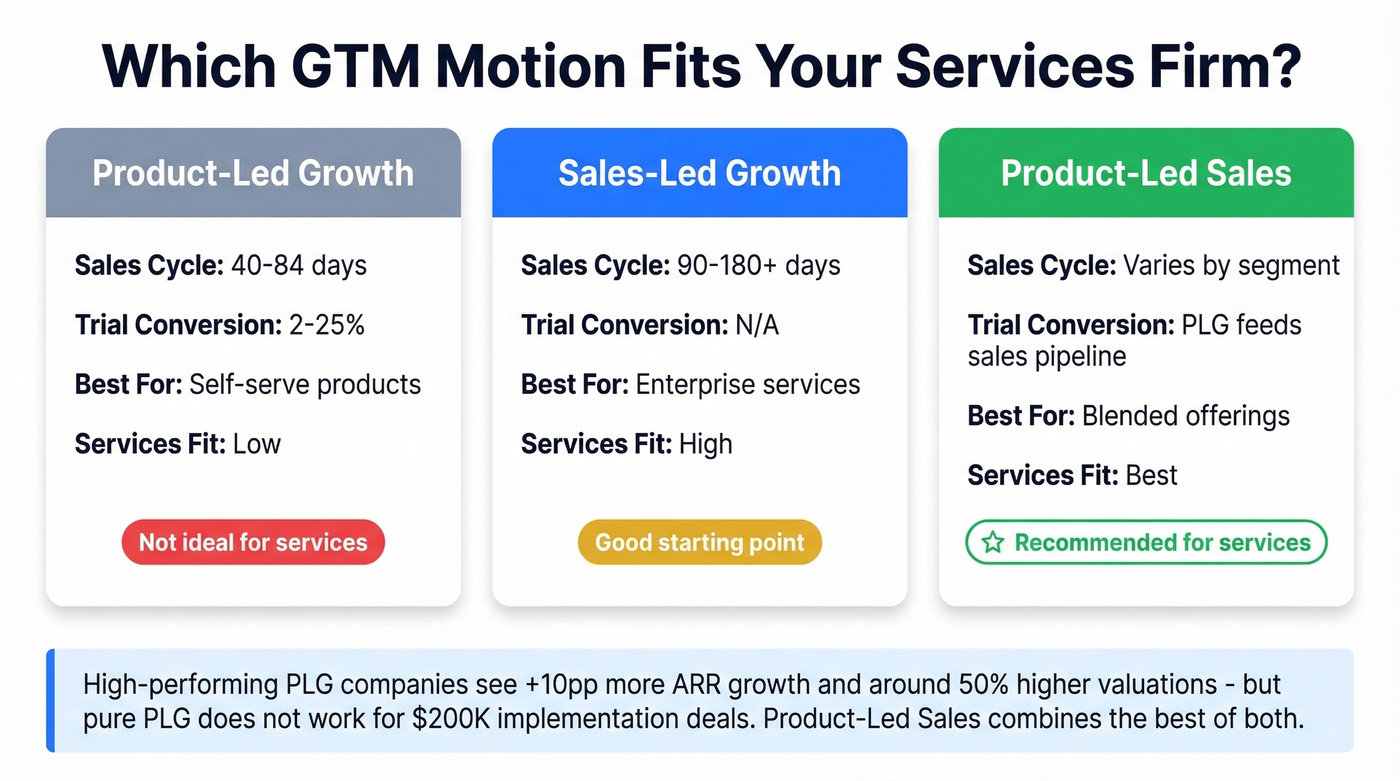
| Dimension | Product-Led Growth | Sales-Led Growth | Product-Led Sales |
|---|---|---|---|
| Sales cycle | 40-84 days | 90-180+ days | Varies by segment |
| Best for | Self-serve products | Enterprise services | Blended offerings |
| Trial conversion | 2-25% | N/A | PLG feeds SLG pipeline |
| ARR growth edge | +10pp (top subset) | Baseline | Combines both |
| Services fit | Low | High | Best |
Product-Led Sales is where services firms should land. Build a productized entry point - an assessment, a diagnostic tool, a starter package - that lets prospects experience value quickly, then layer consultative sales on top for enterprise engagements. If you're below $10M ARR, start sales-led with productized offerings and add self-serve elements as you learn what converts.

Your services GTM motion dies the moment a bounced email tanks your domain reputation. Prospeo's 5-step verification delivers 98% email accuracy with a 7-day refresh cycle - so every outbound sequence hits real inboxes, not spam traps. 30+ filters let you target by buyer intent, tech stack, and headcount growth to nail your ICP from day one.
Clean data is the input that makes every other GTM investment work.
Building the Strategy Step by Step
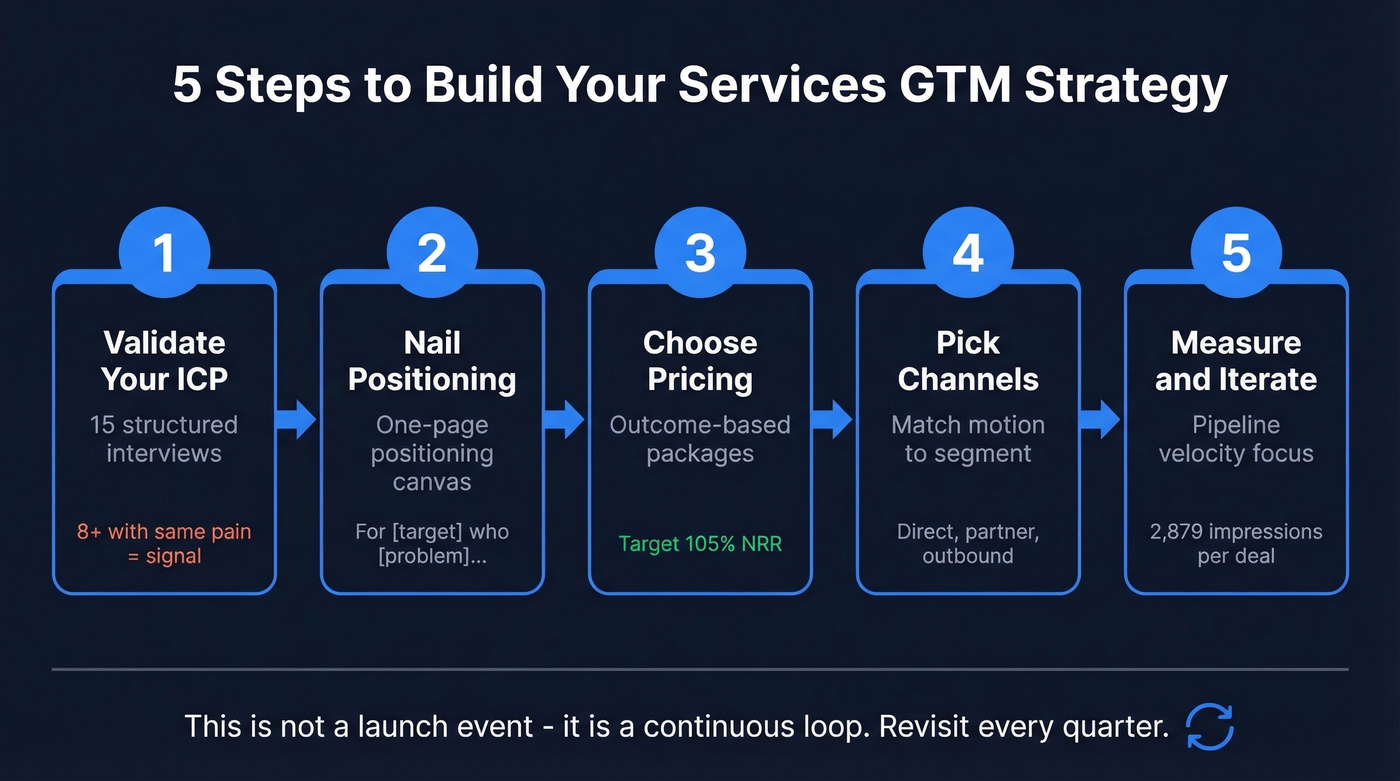
1. Validate your ICP
Run 15 structured interviews with prospects and customers. If 8 or more share the same pain, you've got signal. Fewer than that, and you're guessing. In our experience, the 15-interview method catches ideal customer profile misalignment that surveys consistently miss - we've watched teams burn six figures on outbound targeting the wrong buyer because they skipped this step. Build a one-page ICP card covering company profile, buyer persona, trigger events, core pain, desired outcome, and proof points.
2. Nail your positioning
Use a simple canvas: "For [target] who [problem], [your firm] is a [category] that [benefit]. Unlike [alternative], we [unique mechanism]." This isn't a tagline exercise. It's the foundation for every piece of sales collateral, every outbound sequence, every partner conversation. (If you need a deeper framework, start with B2B brand positioning.)
3. Choose your pricing model
| Do This | Not This |
|---|---|
| Outcome-based packages with clear deliverables | Hourly billing with open-ended scope |
| Subscription/managed services for recurring revenue | One-off projects with no expansion path |
| Hybrid pricing (High Alpha data shows ~105% NRR) | Pure time-and-materials |
Beyond $50M ARR, 60% of new ARR comes from existing customers. Your pricing model should make expansion natural, not require a new sales cycle every time.
4. Pick channels that match your motion
Direct sales for enterprise, partner/referral for mid-market, marketplace and outbound for net-new pipeline. Here's the contrarian data point: 53% of GTM leaders report no or limited impact from AI on their pipeline. AI tools can boost outbound conversion through automated message tailoring based on prospect signals - but only if your contact data is clean and your ICP is validated first. The tool isn't the bottleneck. The inputs are. (For channel tactics, see sales prospecting techniques.)
5. Measure and iterate
GTM isn't a launch event. It's a continuous loop. The average B2B deal requires 2,879 impressions and 266 touchpoints before closing. That means your always-on brand investment is what catches the 95% of your market that's out-of-market at any given time. Measure pipeline velocity, not just lead volume. Use a simple pipeline health scorecard so you can see where deals stall.
Why Most GTM Strategies Fail
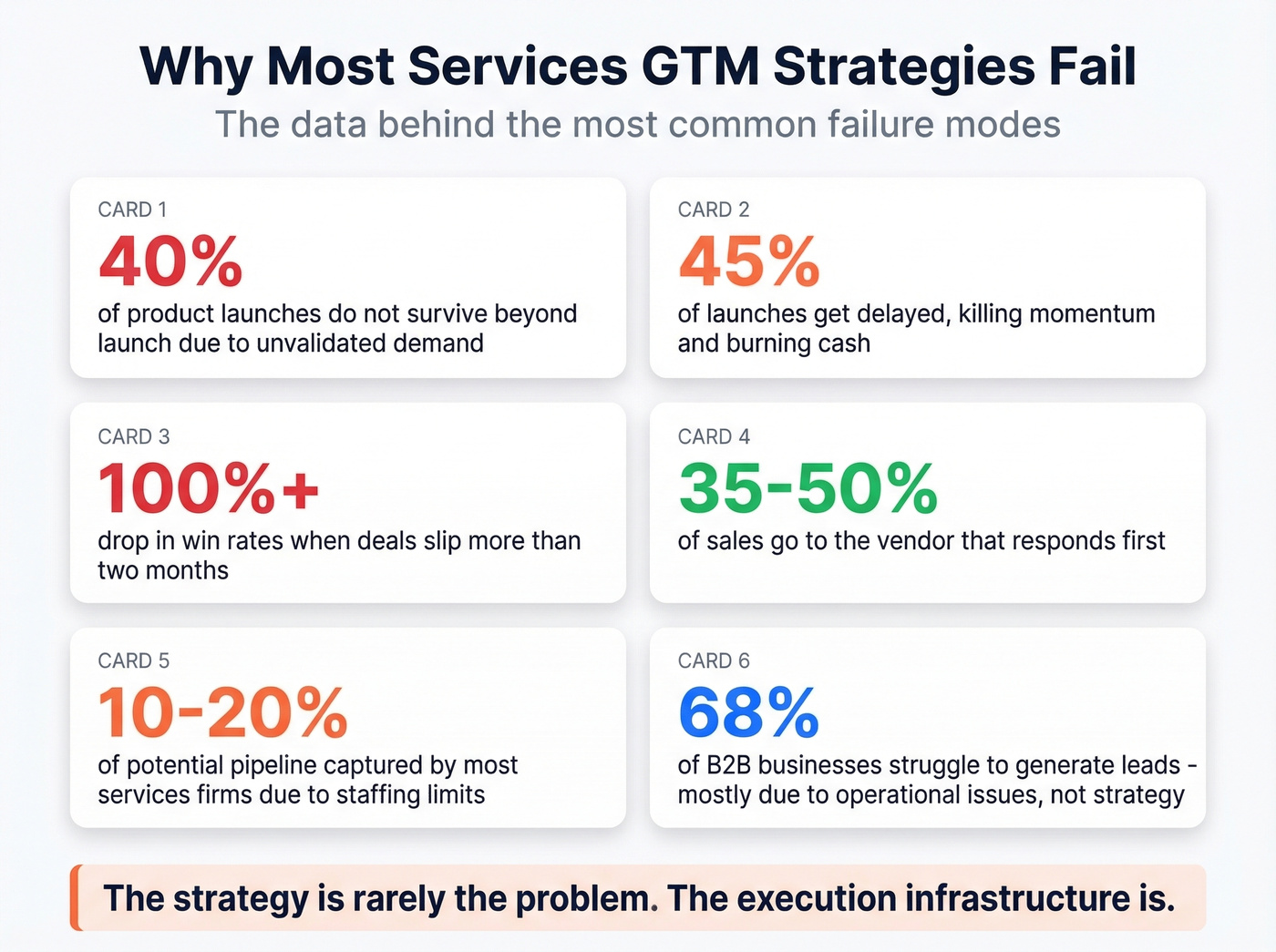
Let's be honest: 40% of product launches don't survive beyond launch due to unvalidated demand. Another 45% get delayed, killing momentum and burning cash. Deals that slip more than two months see win rates drop by over 100%. Speed isn't just nice to have - it's existential.
The failure patterns are consistent:
- Misaligned market understanding. Building for SMBs without validating you can serve them profitably.
- Cross-functional disconnect. Product builds for one persona, marketing targets another, sales pitches a third.
- Feature-first positioning. A cybersecurity services firm talking about "AI-powered threat detection" instead of "we cut breach response time from 72 hours to 4."
- No enablement infrastructure. No playbooks, no objection handling docs, no case studies. Reps wing it. (This is where marketing enablement pays off fast.)
- Neglecting speed. 35-50% of sales go to the vendor that responds first. If your outbound hits a prospect's inbox three weeks after a trigger event, you've already lost.
We saw this play out with a 40-person DevOps consultancy that shifted from hourly billing to outcome-based packages, cut their sales cycle from 6 months to 8 weeks, and doubled pipeline capture from 12% to 28%. The strategy didn't change. The execution infrastructure did.
The Execution Layer Most Guides Skip
Here's the thing: 68% of B2B businesses struggle to generate leads, and most of that struggle isn't strategic. It's operational. Bad contact data kills outbound before it starts. Bounced emails wreck domain reputation. Stale phone numbers waste rep time.
Your go-to-market strategy for software services is only as good as your contact data. Tools like Prospeo cover 300M+ professional profiles with 98% email accuracy and a 7-day data refresh cycle - compared to the 6-week industry average. One customer, Meritt, saw bounce rates drop from 35% to under 4% after switching. The free tier gives you 75 verified emails per month, enough to validate your ICP outreach before committing budget. If you're evaluating vendors, compare options in data enrichment services and sanity-check deliverability with email reputation tools.
Skip the $30K/year data platform if your average deal size is under $25K. Validate that your ICP actually converts first, then scale your data spend alongside your delivery capacity. Most services firms over-invest in tools and under-invest in the interviews and positioning work that makes those tools effective. If you’re running cold outbound, keep an eye on email bounce rate and follow a proper email deliverability guide before you scale volume.

You validated your ICP. You nailed positioning. Now you need verified contact data for the 2,879 impressions and 266 touchpoints it takes to close. Prospeo gives you 300M+ profiles, 125M+ verified mobiles with 30% pickup rates, and intent data across 15,000 topics - so your always-on outbound actually reaches decision-makers.
Stop guessing who's in-market. Layer intent signals on verified contacts.
FAQ
How long does a services GTM strategy take to show results?
Early-stage firms should expect 3-6 months to validate ICP and achieve repeatable pipeline. Growth-stage firms expanding into new markets typically see traction in 2-4 months with an established delivery team and existing case studies to accelerate trust.
What's the biggest GTM mistake services firms make?
Building a go-to-market plan without accounting for delivery capacity. Services firms capture only 10-20% of potential pipeline due to staffing constraints. Your growth ceiling is your bench, not your marketing budget - model headcount before modeling demand.
What budget should a services firm allocate to GTM?
Most services firms spend 8-15% of target revenue on GTM in the first year, weighted toward people and content over tools. Free tiers from self-serve data platforms and similar tools let you run meaningful outbound tests for under $500/month before scaling spend.