

Go-to-Market Strategy for Technology Products: The Guide With Actual Numbers
You just shipped v1 and your co-founder asks, "So how are we getting customers?" You've read five GTM guides already, and they all say "define your ICP" without telling you what anything costs or what good looks like. Building a go-to-market strategy for technology products is harder than it used to be - SaaS growth rates have halved from 47% to 26% since 2024, and CAC is up 60% over five years. You can't afford a framework without numbers anymore.
The quick version:
- Pick your GTM motion based on deal size and buying complexity - self-serve for low-touch, sales-led for enterprise, hybrid for most B2B
- Choose 2-3 channels using the CAC data below - not 10
- Set real KPI targets (LTV:CAC 3:1+, CAC payback under 18 months) and measure from day one
What a GTM Strategy Actually Is
A go-to-market strategy isn't a marketing plan. It's the cross-functional playbook that aligns product, marketing, sales, and enablement around one question: how does this thing reach paying customers? A marketing plan is one slice - demand gen and messaging. A business plan covers the whole company. GTM sits in between, focused on launch and commercialization.
This matters because 72% of SaaS buyers evaluate three or more solutions before buying. Your GTM strategy determines whether you're one of the three they evaluate - or the one they never find.
Pick Your GTM Motion
This is the first real decision, and it shapes everything downstream: team structure, budget allocation, pricing, even your product roadmap.
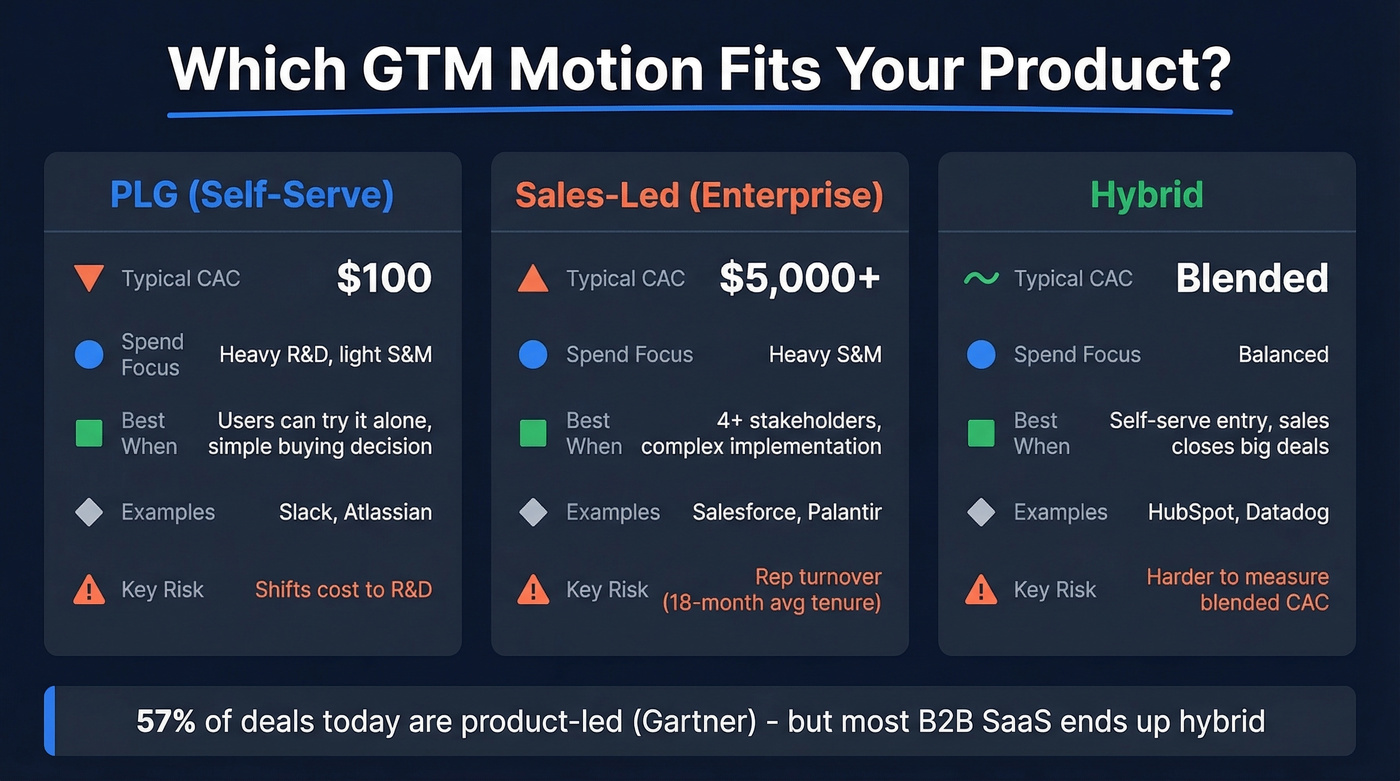
| PLG (Self-Serve) | Sales-Led (Enterprise) | Hybrid | |
|---|---|---|---|
| Typical deal profile | Low-touch, fast time-to-value | Complex, multi-stakeholder | Self-serve entry + sales expansion |
| CAC range | ~$100 | >$5,000 | Blended (depends on mix) |
| Spend split | Heavy R&D, lighter S&M | Often S&M-heavy | Balanced |
| Best for | High-volume, low-touch | Complex, multi-stakeholder | Most B2B SaaS |
| Example | Slack, Atlassian | Salesforce, Palantir | HubSpot, Datadog |
Gartner data shows 57% of deals today are product-led. But PLG isn't free. It shifts cost from sales headcount to R&D. Atlassian spends 47% of revenue on R&D versus just 16% on sales and marketing - the opposite of the traditional 40/20/20 rule where ~40% goes to sales and marketing, ~20% to R&D, and ~20% to G&A.
Slack's PLG motion got them to 8M daily active users and a $27.7B Salesforce acquisition. Even Atlassian eventually built a sales team to close larger accounts. Most companies end up hybrid - the product earns trust, humans close the deal.
How to decide:
- Choose PLG when your product solves a problem users can discover and experience themselves, with minimal hand-holding, and the buying decision is simple.
- Choose sales-led when the buying committee has 4+ stakeholders, the implementation is complex, and your ACV justifies $5,000+ acquisition costs.
- Choose hybrid when your product can self-serve for smaller teams but needs human help to close department-wide or enterprise deals. This is where most B2B SaaS lands.
Sales-led has its own cost problem. Average sales rep tenure is roughly 18 months. By the time a rep is fully ramped, they're halfway to leaving. If your deal size can't absorb that churn cost, you need product doing more of the heavy lifting.
Define Your ICP First
"Everyone" isn't an ICP. Neither is "all high schools" - which is exactly what one edtech company told their GTM team before launch. Their total addressable market was thousands of schools. Their actual ICP, after filtering for sports program success, geography, budget constraints, and tech adoption signals, was roughly 200 target accounts.
That narrowing is uncomfortable. It feels like you're leaving money on the table. In reality, it's the difference between a focused outbound motion that converts and a spray-and-pray campaign that burns budget.
Build your ICP in layers. Start with the decision-maker - the person who signs the contract. Then map the influencer who shapes the shortlist and the end user who'll champion or kill adoption. These are often three different people with three different pain points, and your messaging, channels, and even pricing need to account for all three.
Once you know your ICP, map your positioning against the 2-3 alternatives they'll evaluate. For each buyer pain point, document your solution, the competitor's solution, and the proof point that tips the decision. This value-mapping matrix drives your messaging, battle cards, and sales enablement - and it forces you to be honest about where you actually win.
Pricing: The Most Ignored GTM Lever
Only 24% of B2B SaaS companies have a dedicated pricing team. That should make every founder uncomfortable, because companies that revisit pricing at least annually grow 30% faster than those that don't. Pricing is the highest-leverage GTM decision most teams make once and forget.
Your GTM motion dictates your packaging approach. Self-serve PLG needs simpler packaging with fewer permutations - if a buyer can't understand your pricing page fast, they'll bounce. Enterprise sales-led models can handle more complexity because a human walks the buyer through it.
The systems have to match, too. PLG pricing needs to work inside the product: integrated billing, in-app upgrade flows, usage analytics. Sales-led pricing needs CPQ, deal desk approvals, and CRM integration. If your systems can't support your pricing model, the model fails regardless of how clever the packaging is.
A few principles that hold across both motions:
- Published pricing builds trust and reduces friction for self-serve. Negotiated pricing works for enterprise but kills PLG conversion.
- Modular packaging (base + add-ons) gives buyers control. Tiered "good-better-best" simplifies the decision but risks leaving money on the table.
- Value metrics matter more than features. Price on what the customer gets (seats, contacts, API calls), not what you built.
- The 30% growth advantage comes from at least annual pricing reviews. The best companies go quarterly, tied to usage data and competitive shifts.

The article above shows outbound email CAC at ~$510 - but that number explodes when your data is bad. Prospeo's 98% email accuracy and 7-day refresh cycle keep bounce rates under 4%, so every dollar of your GTM budget actually reaches real buyers. 30+ filters let you target by intent, technographics, funding, and headcount growth - the exact ICP layers this guide recommends.
Stop burning GTM budget on stale data. Start at $0.01 per verified email.
Choose Channels Using CAC Data
Most GTM plans list 8-10 channels and spread budget across all of them. That's a recipe for mediocre results everywhere and great results nowhere.
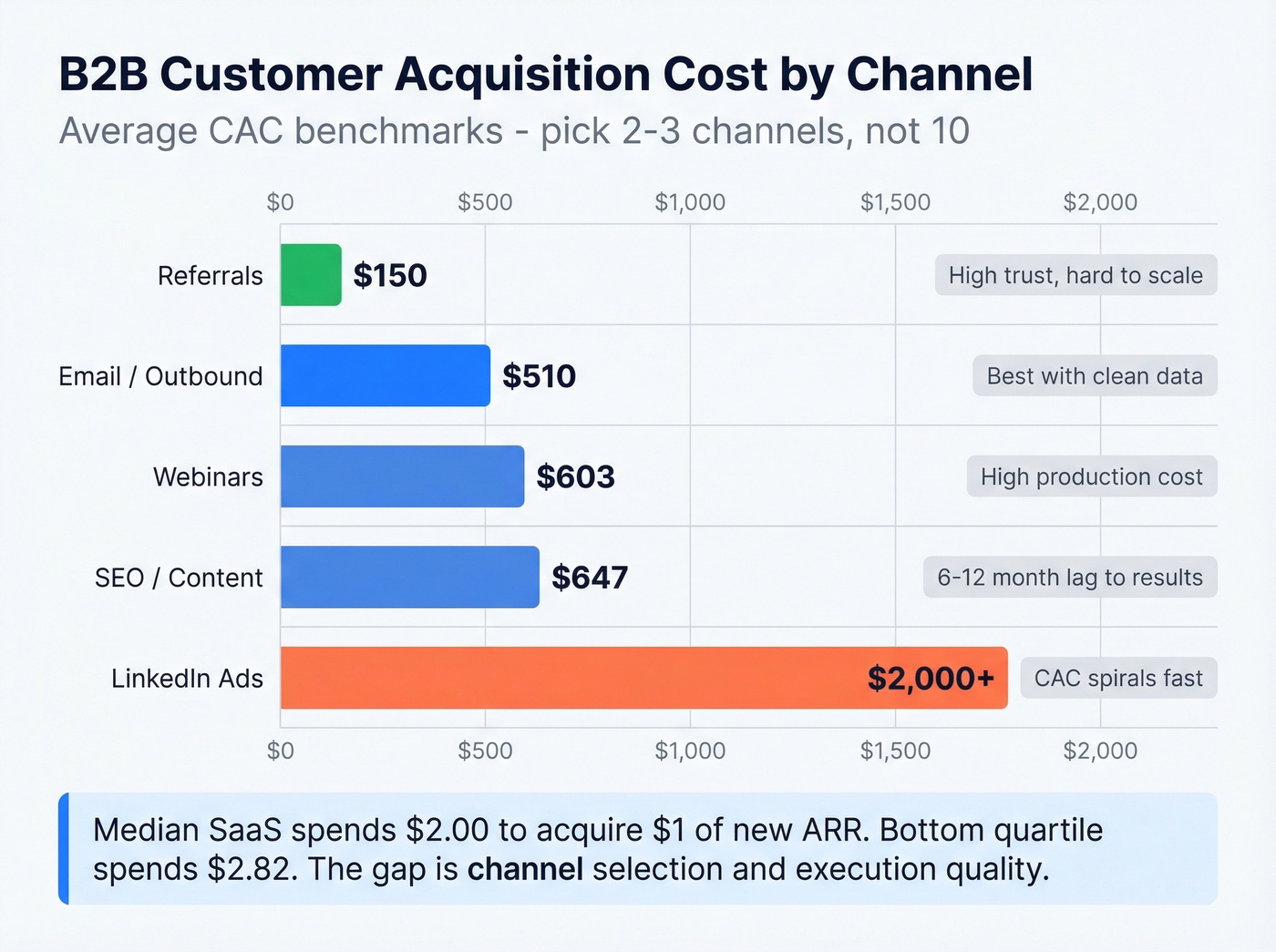
Here's the thing: the founders who succeed almost always start with one or two channels and go deep before expanding. Here's what the numbers actually look like for B2B, per First Page Sage and Phoenix Strategy Group benchmarks:
| Channel | Avg. CAC (B2B) | Best For | Watch Out For |
|---|---|---|---|
| Referrals | ~$150 | High-trust sales | Hard to scale |
| Email/outbound | ~$510 | Targeted ABM | Data quality kills ROI |
| Webinars | ~$603 | Mid-funnel nurture | High production cost |
| SEO/content | ~$647 | Long-term pipeline | 6-12 month lag |
| LinkedIn Ads | $2,000+ | Brand awareness | CAC spirals fast |
Other paid social platforms like Meta can run lower B2B CAC than LinkedIn, but LinkedIn dominates B2B ad spend for a reason - targeting precision. The median SaaS company spends $2.00 to acquire $1 of new ARR. Bottom-quartile companies spend $2.82. That gap is almost entirely explained by channel selection and execution quality.
Outbound email at ~$510 CAC is one of the most efficient B2B channels - but only if your data is clean. We've seen teams run outbound campaigns where 30-40% of emails bounce, torching their domain reputation before the copy even gets read. Meritt, for example, was running a 35% bounce rate before switching to Prospeo - they got it under 4%, and their pipeline tripled from $100K to $300K per week.
Bad contact data isn't a tooling problem. It's a GTM strategy failure. If your outbound channel is built on a database that refreshes every six weeks, you're paying $510 per acquired customer in theory and $1,500+ in practice because half your sends never land.
If you're building this motion, start with proven sales prospecting techniques and a clean list workflow (including lead enrichment) before you scale volume.

Set KPI Targets With Benchmarks
You can't manage a GTM launch without targets. Here are the benchmarks that matter, with ranges so you know where "good" starts and "elite" lives.
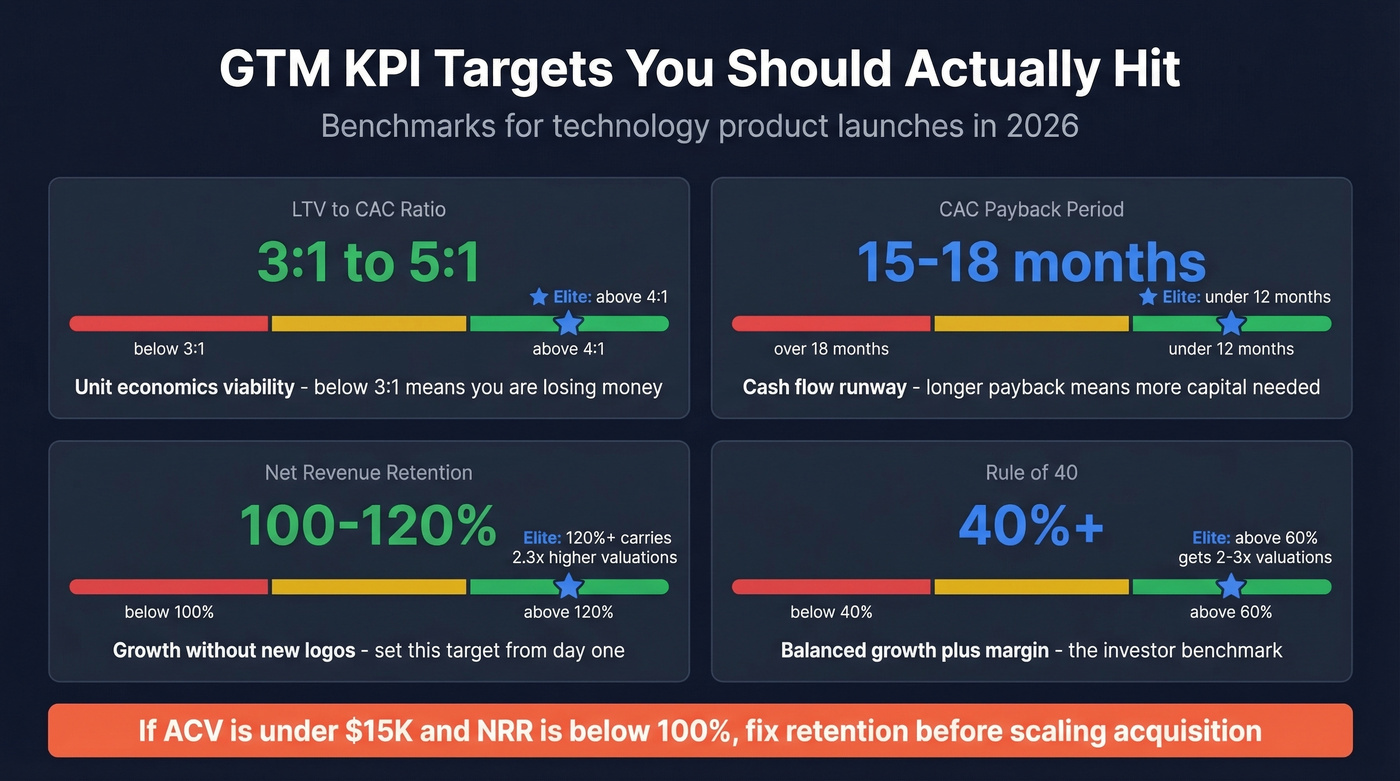
| Metric | Target Range | Elite | Why It Matters |
|---|---|---|---|
| LTV:CAC | 3:1-5:1 | >4:1 | Unit economics viability |
| CAC payback | 15-18 months | <12 months | Cash flow runway |
| NRR | 100-120% | 120%+ (2.3x valuations) | Growth without new logos |
| Rule of 40 | 40%+ | >60% (2-3x valuations) | Balanced growth + margin |
| B2B SaaS CAC (startups) | ~$273 | - | Baseline for early planning |
| B2B SaaS CAC (average) | ~$1,200 | - | Baseline for established SaaS |
The $273 figure reflects early-stage startup benchmarks; established SaaS companies average closer to $1,200. Know which benchmark fits your stage.
NRR deserves special attention. Top performers at 120%+ NRR carry 2.3x higher valuations than median companies. In our experience, the companies that hit Rule of 40 fastest are the ones that set NRR targets from day one - not after churn becomes a board-level problem. Your GTM strategy should include an expansion motion from the start, not just acquisition.
Let's be honest: if your ACV is under $15K and your NRR is below 100%, you don't have a growth problem. You have a product-market fit problem. No amount of GTM sophistication fixes a leaky bucket. Fix retention first, then scale acquisition.
If you need to sanity-check your unit economics, start with a clean definition of cost to acquire customer and then map the rest of your funnel metrics.
Five Mistakes That Kill Tech Launches
Targeting too broad. The most common GTM mistake is going wide before ICP validation. Start with around 50-200 accounts, prove the motion works, then expand. The edtech company that narrowed from "all high schools" to 200 accounts didn't shrink their opportunity - they found it.
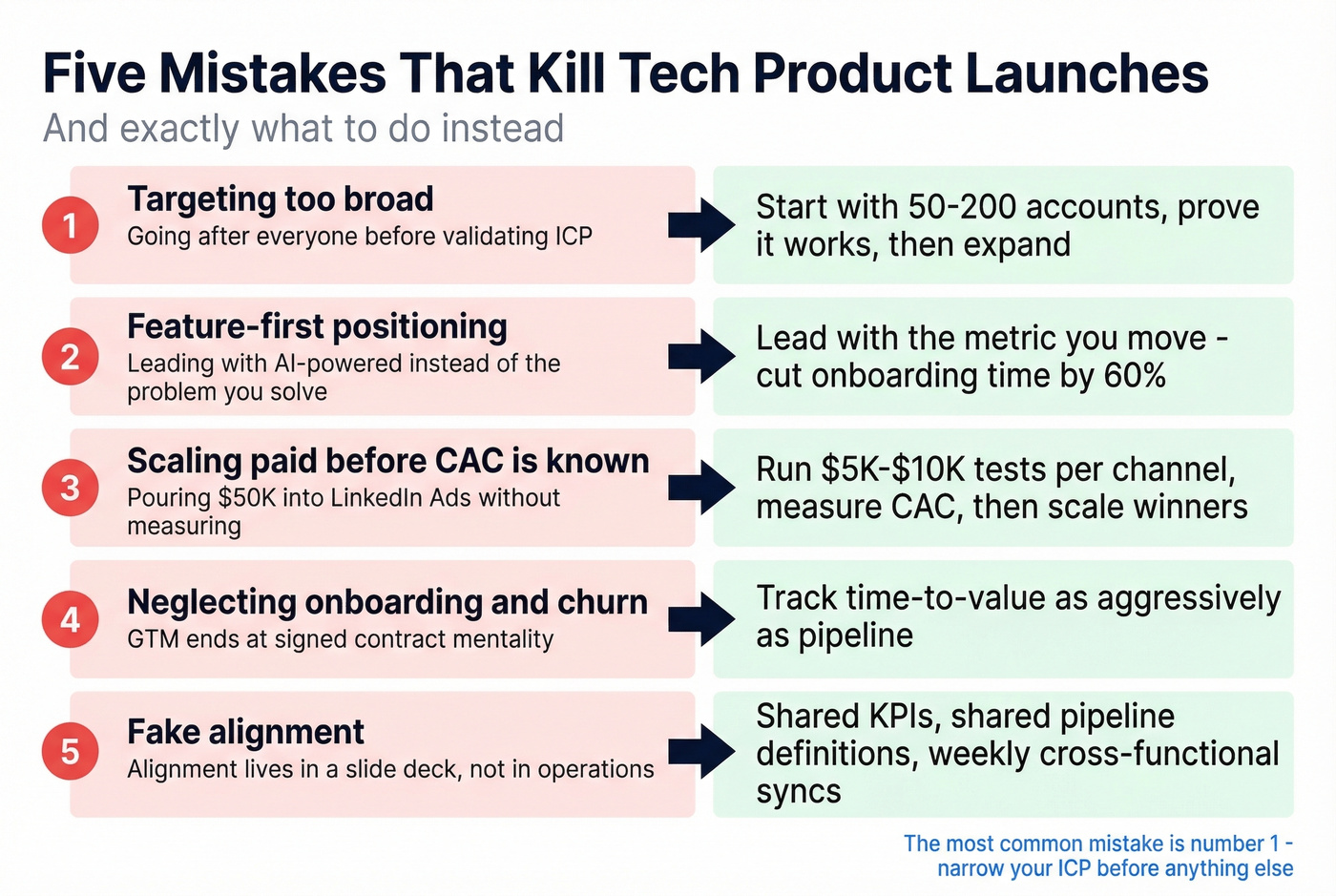
Feature-first positioning. Nobody buys "AI-powered" anything. They buy faster pipeline or lower churn. Lead with the problem you solve and the metric you move. If your homepage says "machine learning" before it says "cut onboarding time by 60%," rewrite it today.
Scaling paid before CAC is known. Run $5K-$10K tests per channel, measure CAC, then scale only what's working. We've watched teams pour $50K into LinkedIn Ads in month one without a single CAC calculation. Don't be that team.
Neglecting onboarding and churn. Your go-to-market strategy for technology products doesn't end at the signed contract. If activation is broken, every dollar you spent acquiring that customer is wasted. Track time-to-value as aggressively as you track pipeline.
Fake alignment. Shared KPIs, shared pipeline definitions, weekly syncs - alignment isn't a slide deck, it's an operating rhythm. If your sales team defines an SQL differently than marketing does, you don't have alignment. You have a shared Google Doc.
If churn is creeping up, do a proper churn analysis before you touch channel mix.
Launch Checklist
Pre-Launch
- ICP validated with real conversations, not assumptions (use an Ideal Customer Profile Template if you need structure)
- Pricing set and tested with at least 10 prospects
- Competitive value-mapping matrix completed for top 2-3 alternatives
- Sales collateral, battle cards, and demo scripts ready
- Cross-functional team aligned on timeline, ownership, and KPIs
Launch Day
- Monitor real-time metrics: signups, activation, support tickets
- Comms cadence running - email sequences, social, partner outreach
- Support team briefed and staffed for volume spikes
Post-Launch
- Feedback loops active: NPS, churn interviews, feature requests
- Week 1 and week 4 metric reviews against pre-set targets
- Iterate pricing, messaging, and channel mix based on actual data
- Plan expansion: new segments, upsell motions, geographic expansion
If outbound is part of your launch, keep a set of sales follow-up templates ready before day one.
Your GTM motion needs direct access to decision-makers - not generic contact lists. Prospeo gives you 300M+ profiles, 125M+ verified mobiles with a 30% pickup rate, and intent data across 15,000 topics so you reach buyers who are actively evaluating solutions like yours. Teams using Prospeo book 26% more meetings than ZoomInfo users, at 90% lower cost.
Reach your ICP's buying committee before your competitors do.
FAQ
What's the difference between a GTM strategy and a marketing plan?
A GTM strategy covers the full cross-functional launch - product, pricing, channels, sales, and enablement working together. A marketing plan is one component focused on demand generation and messaging. Think of GTM as the orchestra; marketing is one section.
How long does it take to build a GTM strategy?
For a new technology product, expect 4-8 weeks of focused work across product, marketing, and sales. For entering a new market with an existing product, 2-4 weeks is realistic if your ICP research is already solid.
What's a good CAC for a B2B SaaS startup?
Early-stage startups average around $273, while established SaaS companies average closer to $1,200. Self-serve models run ~$100 per customer; enterprise sales-led models regularly exceed $5,000. Benchmark against your ACV and stage, not an industry average.
How do I choose between PLG and sales-led?
Start with deal size and buying complexity. Self-serve works best for low-touch products under $5K ACV; enterprise deals with 4+ stakeholders need a sales-led motion. Most B2B SaaS companies land on hybrid - 57% of deals today are product-led, but that doesn't mean sales-free.
What tools do I need for outbound as a GTM channel?
At minimum: a B2B contact database with verified emails, a sending platform like Instantly, Smartlead, or Lemlist, and a CRM. The database matters most - bad data kills deliverability before your copy gets read. Prospeo's free tier includes 75 verified emails per month, which is enough to test data quality before committing budget.