

Go-to-Market Strategy: The Guide With Real Numbers
Leadership wants a GTM deck by Friday. Most GTM docs are recycled frameworks and ancient case studies - clean slides, zero benchmarks, and nothing you can defend when Finance asks, "Is this good?"
Here's the thing: Roger Martin's critique nails the real problem. When "GTM" gets treated as separate from strategy, you create blame loops. Product says Sales can't sell. Sales says the product's unsellable. Everyone's right and nothing gets fixed.
This is the tight, opinionated, benchmarked version. Decision rules and numbers - that's it.
Three Things Before You Touch a Launch Plan
Nail these before anything else:
- ACV - it shapes your motion and payback expectations
- ICP - it determines which channels can even work
- Benchmarks - they tell you whether you're winning or quietly dying
Everything else is execution detail.
What a GTM Strategy Actually Covers
A GTM strategy isn't a marketing plan. Marketing is one lever inside GTM.
A real go-to-market strategy covers positioning, pricing, distribution, sales motion, and timing - the "where to play" and "how to win" choices Roger Martin lays out in Playing to Win. That's why splitting GTM from product strategy is such a reliable way to manufacture internal conflict. If product, sales, and marketing aren't solving the same problem for the same buyer, you don't have a GTM strategy. You have three departments shipping opinions.
If your deal size sits below $10k and your product doesn't require implementation, you don't need a "big GTM strategy." You need one sharp ICP, one channel you can scale, and a pricing page that doesn't confuse people.
The 6-Step GTM Framework
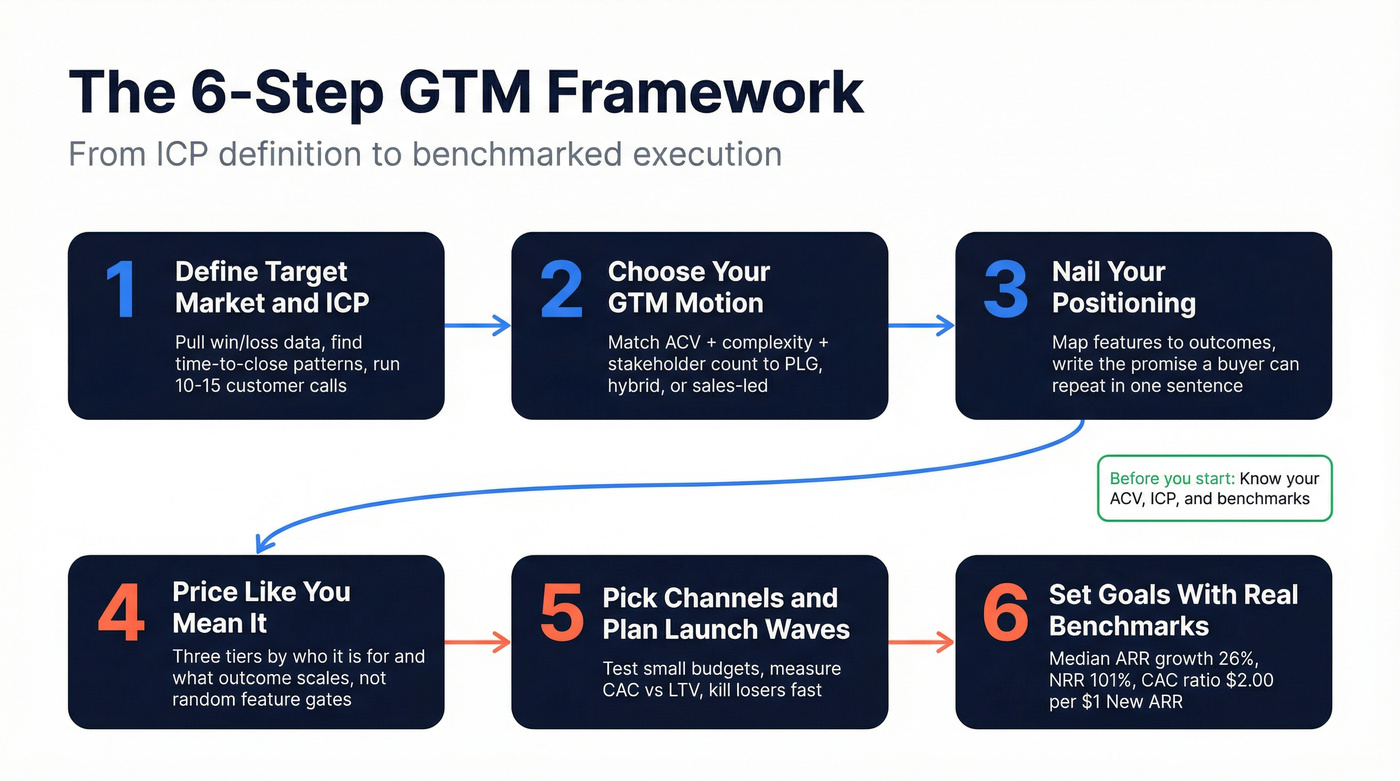
1) Define Your Target Market and ICP
Start with a beachhead segment: one narrow slice you can dominate before you expand. The most common GTM failure is "we sell to everyone," which really means "we don't know who buys." This "too broad" failure mode shows up repeatedly in operator postmortems and founder circles alike.
Do the unsexy validation work:
- Pull win/loss data by industry, company size, and use case.
- Look for time-to-close and time-to-value patterns, not just logo count.
- Run 10-15 customer calls and force yourself to write one sentence: "We win when ___ because ___."
If you can't say why you win, you're not ready to scale anything.
2) Choose Your GTM Motion
ACV is the fastest proxy for motion, but it's not the whole story. Complexity and stakeholder count are the real drivers. If implementation is heavy or procurement is involved, you'll behave sales-led even at lower ACVs. The cleanest rule of thumb we've seen is ACV + complexity + stakeholder count deciding the motion together.
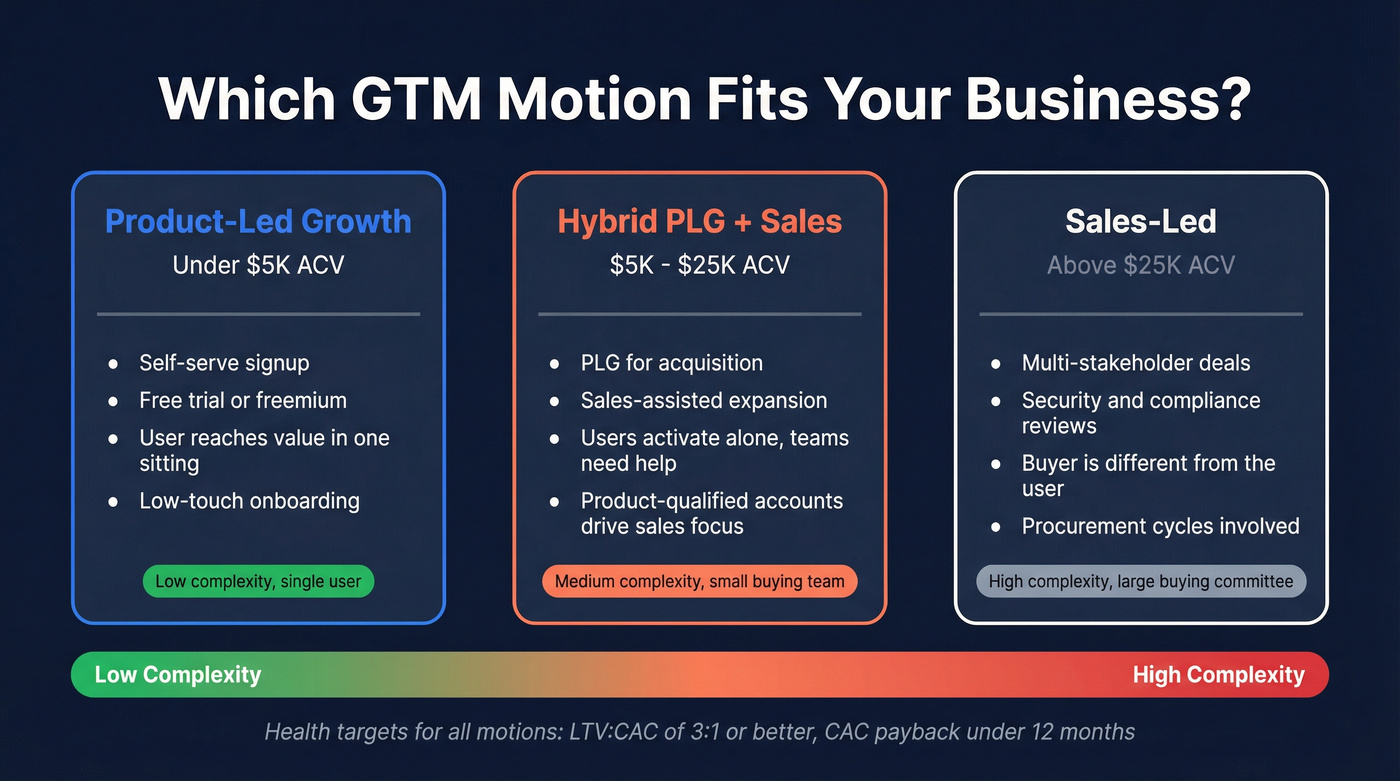
Use these thresholds as defaults:
- Under $5K ACV: Product-led growth. Self-serve signup, free trial or freemium, low-touch onboarding.
- $5K-$25K ACV: Hybrid. PLG for acquisition, sales-assisted for expansion and upsell.
- Above $25K ACV: Sales-led. Multi-stakeholder deals, security reviews, procurement cycles.
Practical "use/skip" cues:
- Go PLG if a user can reach value in one sitting without help.
- Go hybrid if users can activate alone but teams need help to expand.
- Go sales-led if the buyer is different from the user, or if risk and compliance are part of the purchase.
McKinsey analyzed 107 publicly listed B2B SaaS companies and found pure PLG rarely wins alone. The best teams evolve toward product-led sales: they use product-qualified accounts to focus sales effort, and they run cross-functional growth teams of 7-9 people to ship activation experiments. Regardless of motion, keep two health targets on the wall: LTV:CAC of 3:1 or better and CAC payback under 12 months.
3) Nail Your Positioning
Feature-led messaging is the default, and it's almost always wrong. "AI-powered analytics with real-time dashboards" is a brochure, not a reason to buy.
The test is simple: if a buyer can't repeat your outcome in one sentence after a 30-second read, your positioning is feature soup.
Before and after:
- Before: "All-in-one workflow automation with 50+ integrations."
- After: "Cut weekly ops busywork by 5 hours per manager - without changing your existing tools."
Map features to outcomes, then write the outcome like a promise your product can actually keep. Put the feature list in docs, not in the headline.
If you want a tighter way to pressure-test messaging, borrow a few sample elevator pitches and rewrite them for your buyer.
4) Price Like You Mean It
Operator writeups call out a counterintuitive pattern: pricing ~70% below rivals often reduces trust. Buyers don't interpret "cheap" as "great deal." They interpret it as "risk."
Pricing is positioning. If you save a VP of Sales 10 hours a week, charge like it.
A packaging example that works: three tiers differentiated by who it's for (Solo / Team / Enterprise) and what outcome scales (volume, governance, support). Compare that to six tiers differentiated by random feature gates no one understands. If your pricing page needs a sales call to explain it, your market will assume your product is complicated - even if it isn't.
If Finance is pushing back, align on the real cost to acquire customer and what payback you can defend.
5) Pick Channels and Plan Launch Waves
Don't pick channels by habit. Pick them based on where your ICP already pays attention, then test with small budgets and measure CAC against LTV.
A focused distribution bet beats a "we're everywhere" launch. Oatly started in coffee shops before grocery, and US revenue grew 10x between 2017 and 2018 because the channel matched the early buyer context. The lesson isn't "go to coffee shops." It's that channel-market fit matters as much as product-market fit.
For outbound specifically, your channel is only as good as your contact data. If 20% of your emails bounce, you're burning domain reputation and wasting SDR hours. We've tested a lot of data providers for this, and Prospeo's 98% email accuracy with a 7-day refresh cycle has been the cleanest fix - bounce rates drop fast when you're not working with stale records. Worth testing on their free tier before committing.
If you're building the outbound engine from scratch, start with a few proven sales prospecting techniques and a clean lead generation workflow.
6) Set Goals With Real Benchmarks
Most GTM guides tell you to "set KPIs." Useless without a baseline.
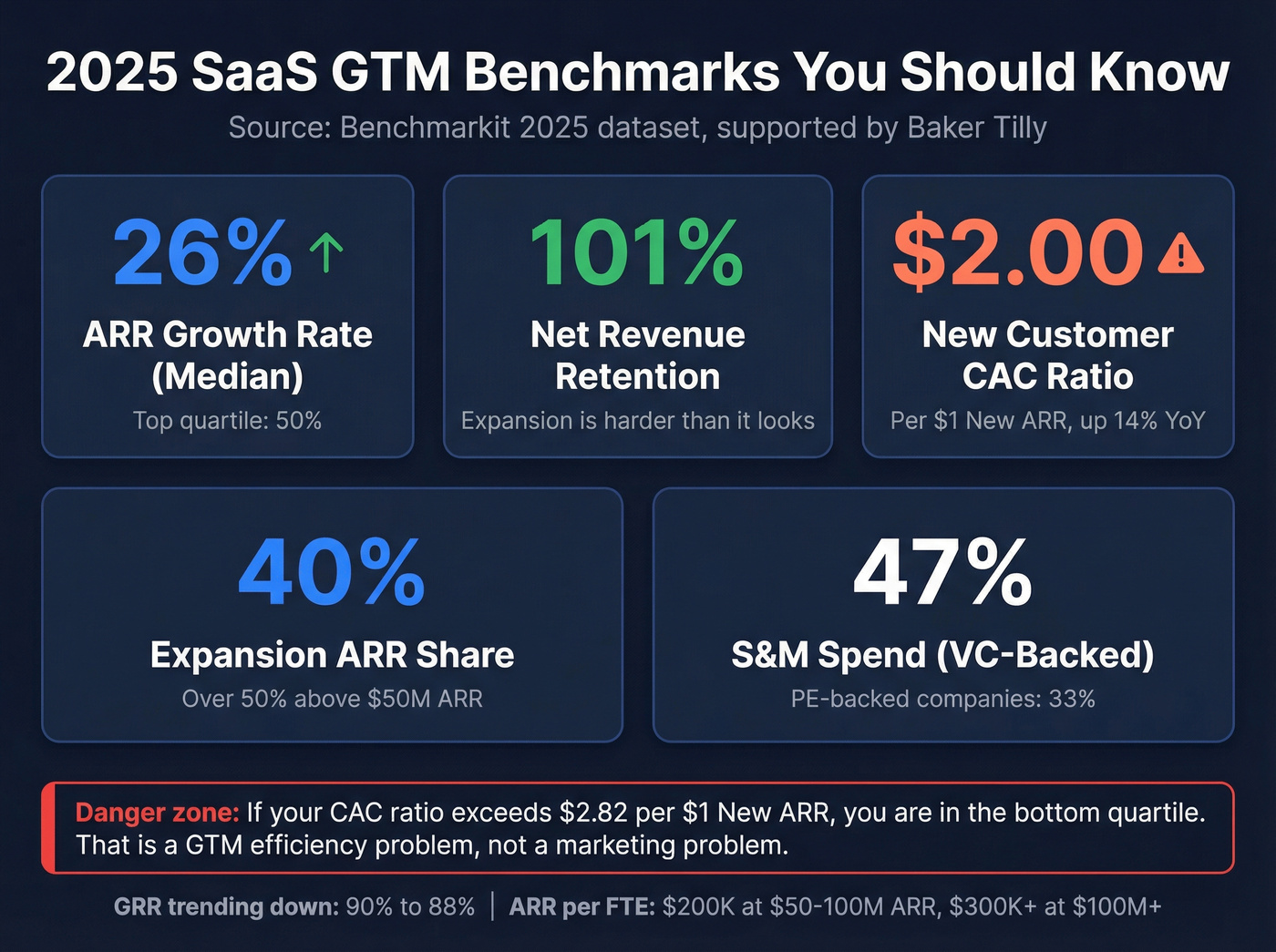
Here are numbers from Benchmarkit's latest published SaaS benchmarks (2025 dataset) - the most recent available as of 2026 - with dataset scale and KPI coverage supported by Baker Tilly:
| Metric | Median | Context |
|---|---|---|
| ARR growth rate | 26% | Top quartile: 50% |
| Net revenue retention | 101% | Expansion is harder than it looks |
| New customer CAC ratio | $2.00 per $1 New ARR | Up 14% year-over-year |
| Expansion ARR share | 40% of total new ARR | >50% above $50M ARR |
| S&M spend (VC-backed) | 47% of revenue | PE-backed: 33% |
If your CAC ratio is above $2.82 per $1 of New ARR, you're in the bottom quartile. That's not a "marketing problem." That's a GTM efficiency problem.
Two more benchmarks we actually use because they predict pain early. First, GRR is slipping: gross revenue retention has trended from ~90% to ~88%. If you're below that, your churn is eating your pipeline. Second, ARR per FTE sits around $200k at $50-$100M ARR and $300k+ at $100M+. If you're far under, you're either overstaffed or under-monetized. Also watch R&D spend: private companies average ~34% of revenue vs ~23% for public - useful context when your board asks why you "spend so much on product."
If you need a sanity check on top-of-funnel math, compare against sales pipeline benchmarks and your pipeline health metrics.

Your GTM benchmarks don't matter if 20% of your outbound emails bounce. Prospeo delivers 98% email accuracy on a 7-day refresh cycle - so your CAC ratio stays healthy and your domain reputation stays intact. 15,000+ companies run their outbound on data they can actually defend to Finance.
Fix your GTM efficiency problem at the data layer.
AI and GTM in 2026
AI isn't a strategy. It's an execution accelerant.
Use it to test more messages faster, qualify inbound with more precision, and personalize outbound without turning your SDR team into a copy factory. But don't outsource the hard calls. AI won't choose your market, define your ICP, or tell you what to charge. Domain expertise still wins; AI just lets the best teams compound faster.
If you're applying AI to outbound, keep it grounded in deliverability and sequencing basics from AI cold email outreach.
GTM Mistakes That Kill Launches
We've watched enough launches go sideways to distill the pattern. These five show up over and over, and the consensus on r/sales and founder communities backs it up:
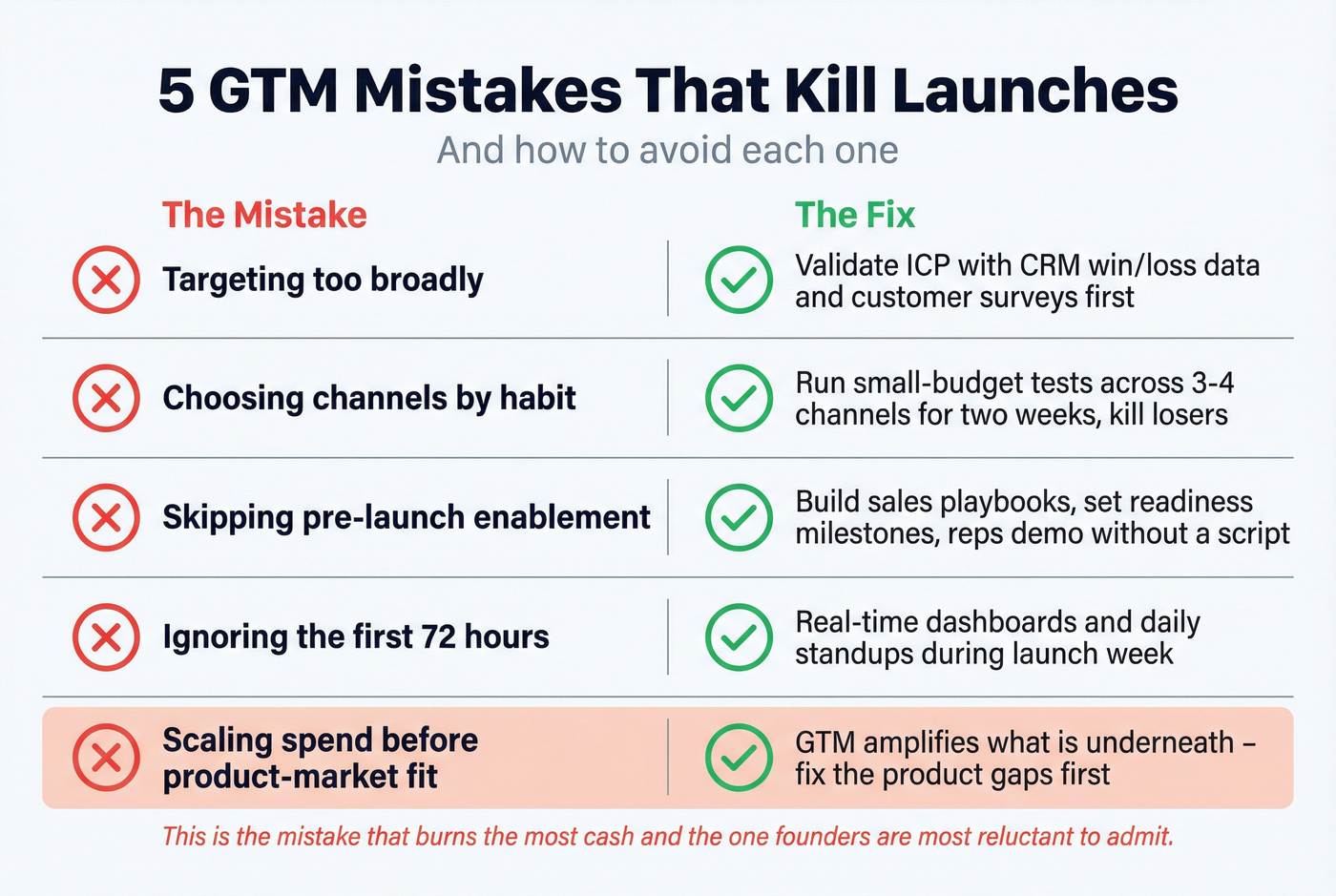
Targeting too broadly. Validate your ICP with CRM win/loss data and customer surveys before you spend a dollar on acquisition. Skip this if you want to learn the lesson the expensive way.
Choosing channels by habit, not data. Run small-budget tests across 3-4 channels for two weeks. Kill the losers. Double down on the winners.
Skipping pre-launch enablement. Build sales playbooks, set readiness milestones, and don't launch until reps can demo without a script. We once saw a team launch with zero enablement materials and then blame "bad leads" for a 2% close rate - the leads were fine, the reps just didn't know the product.
Ignoring the first 72 hours. Set up real-time dashboards and run daily standups during launch week. The signals that predict success or failure show up fast.
Scaling spend before product-market fit. Let's be honest: GTM amplifies whatever's underneath it. If the product has gaps, more ad spend just surfaces those gaps faster and more expensively. This is the mistake that burns the most cash and the one founders are most reluctant to admit.
If you're diagnosing why pipeline isn't converting, start with the most common sales pipeline challenges.
Build Your GTM Strategy With Numbers Behind It
Roger Martin's critique is worth internalizing: a go-to-market strategy isn't a checklist you hand to marketing. It's integrated strategy - product, positioning, pricing, channels, and benchmarks - owned by one accountable leader.
Use the six steps to make the choices. Use the benchmarks to keep yourself honest. Then execute like it matters, because it does.
A sales-led or hybrid GTM motion burns cash fast when reps waste hours on bad contact data. Prospeo gives you 300M+ verified profiles with 30+ filters - buyer intent, technographics, headcount growth - so your pipeline matches your ICP, not a spray-and-pray list.
Build pipeline that hits your 3:1 LTV:CAC target from day one.