

Great Cold Calling Scripts: 12 Templates Backed by Data
It's 10:15 AM on a Tuesday. You've got a fresh list, a double espresso, and 90 minutes before lunch. The rep next to you is on dial number 47 with zero connects. You're about to pick up the phone and say... what, exactly?
That's the part most people get wrong. Great cold calling scripts aren't about memorizing lines - they're about knowing what to say in the first 8 seconds and earning the right to say more.
Quality conversations in outbound have declined from 8 per day in 2014 to 3.6 per day by 2022. The average cold call success rate sits at 4.82% - conversations that actually result in a booked meeting. One rep tracked 11,519 cold calls and booked 335 meetings at a 69% SQL conversion rate, closing $287K from cold outreach alone. The difference wasn't talent. It was avoiding three mistakes: pitching too early, over-relying on word-for-word scripts, and talking more than listening.
You don't need 25 scripts. You need a framework that earns you the first 18 seconds, clean data so you're calling real numbers, and the discipline to call at the right time. Below are 12 templates, the benchmarks behind them, and the objection responses you'll actually need.
Cold Calling by the Numbers
The gap between average reps and top performers isn't talent - it's math. Here's what the same 800 dials produce depending on who's dialing:
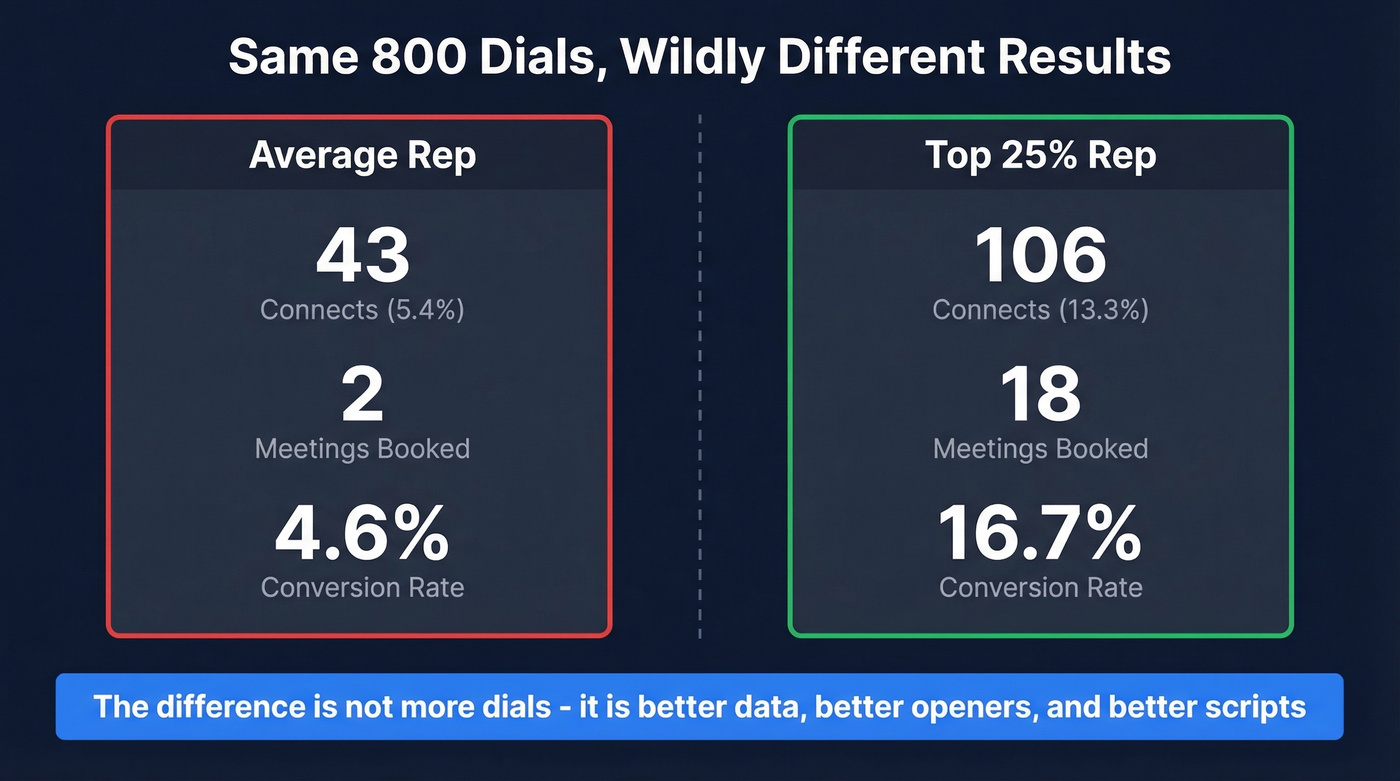
| Metric | Average Rep | Top 25% |
|---|---|---|
| Connects | 43 (5.4%) | 106 (13.3%) |
| Meetings booked | 2 | 18 |
| Conversion rate | 4.6% | 16.7% |
The average cold call lasts 93 seconds. Only 10% make it past 2 minutes. Successful cold calls average 5 minutes 50 seconds; failed ones average 3 minutes 14 seconds. Phone-centric teams generate 1.4x more quality conversations than email-centric ones.
That table isn't about working harder. Top reps aren't making 3x the dials. They're connecting more often (better data), staying on the line longer (better openers), and converting more conversations (better scripts). Let's start with the opener.
Which Opener Actually Works?
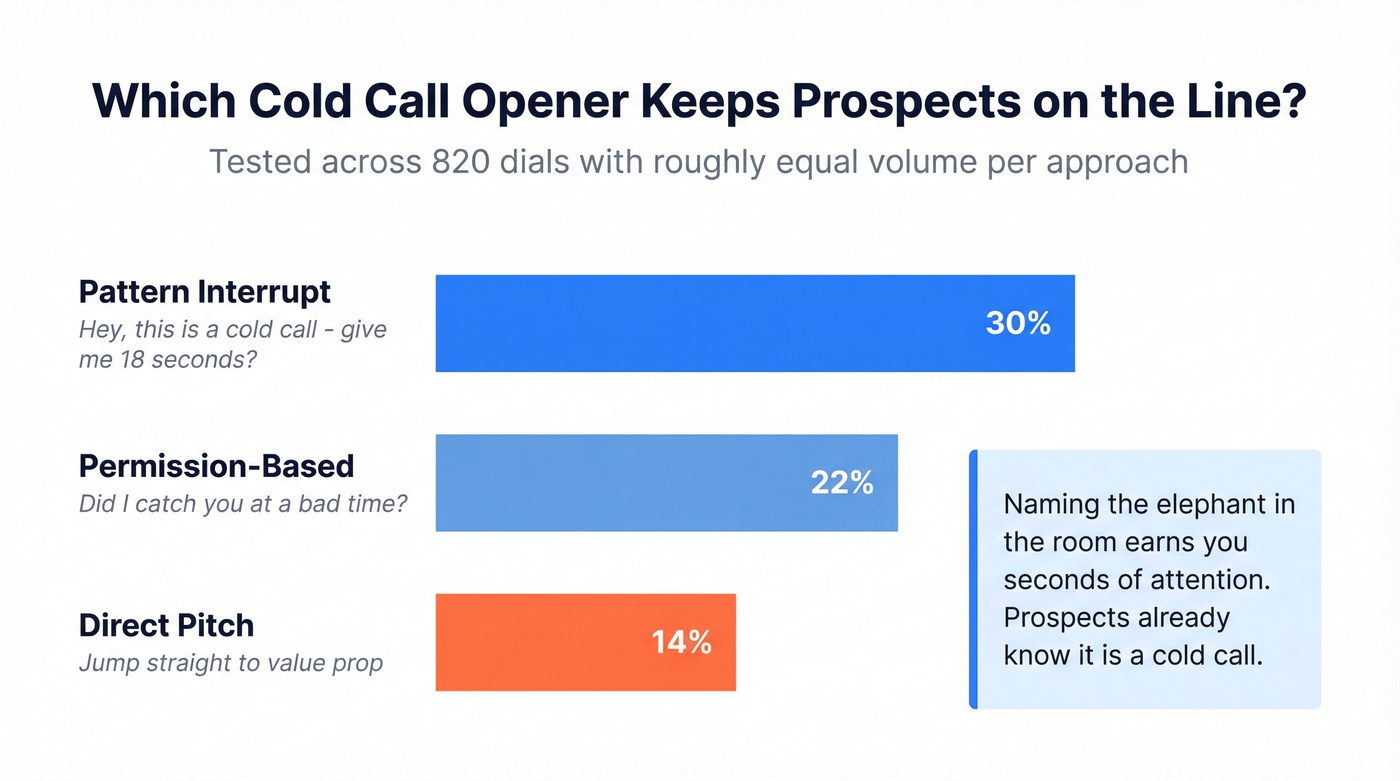
One rep tracked 820 dials across three opener styles with roughly equal volume per approach. The results weren't close:
| Opener Style | Example | Stayed Past 30s |
|---|---|---|
| Pattern interrupt | "Hey, this is a cold call - give me 18 seconds?" | 30% |
| Permission-based | "Did I catch you at a bad time?" | 22% |
| Direct pitch | Jump straight to value prop | 14% |
The pattern interrupt wins because it's honest. Prospects know it's a cold call the moment they hear your voice. Pretending otherwise wastes the 3 seconds of goodwill you have. Naming the elephant in the room earns you a few more seconds of attention. We've seen reps resist this approach because it feels vulnerable - then watch their stay rates double the first week they try it.
In a large benchmark roundup, explaining why you're calling correlates with a 2.1x higher success rate. Meanwhile, "Is this a bad time?" drops your meeting chances by 40%. That phrase signals uncertainty, and prospects mirror it right back to you.
The opener isn't the script. It's the door. You need about 18 seconds of attention to deliver a reason to stay on the line.
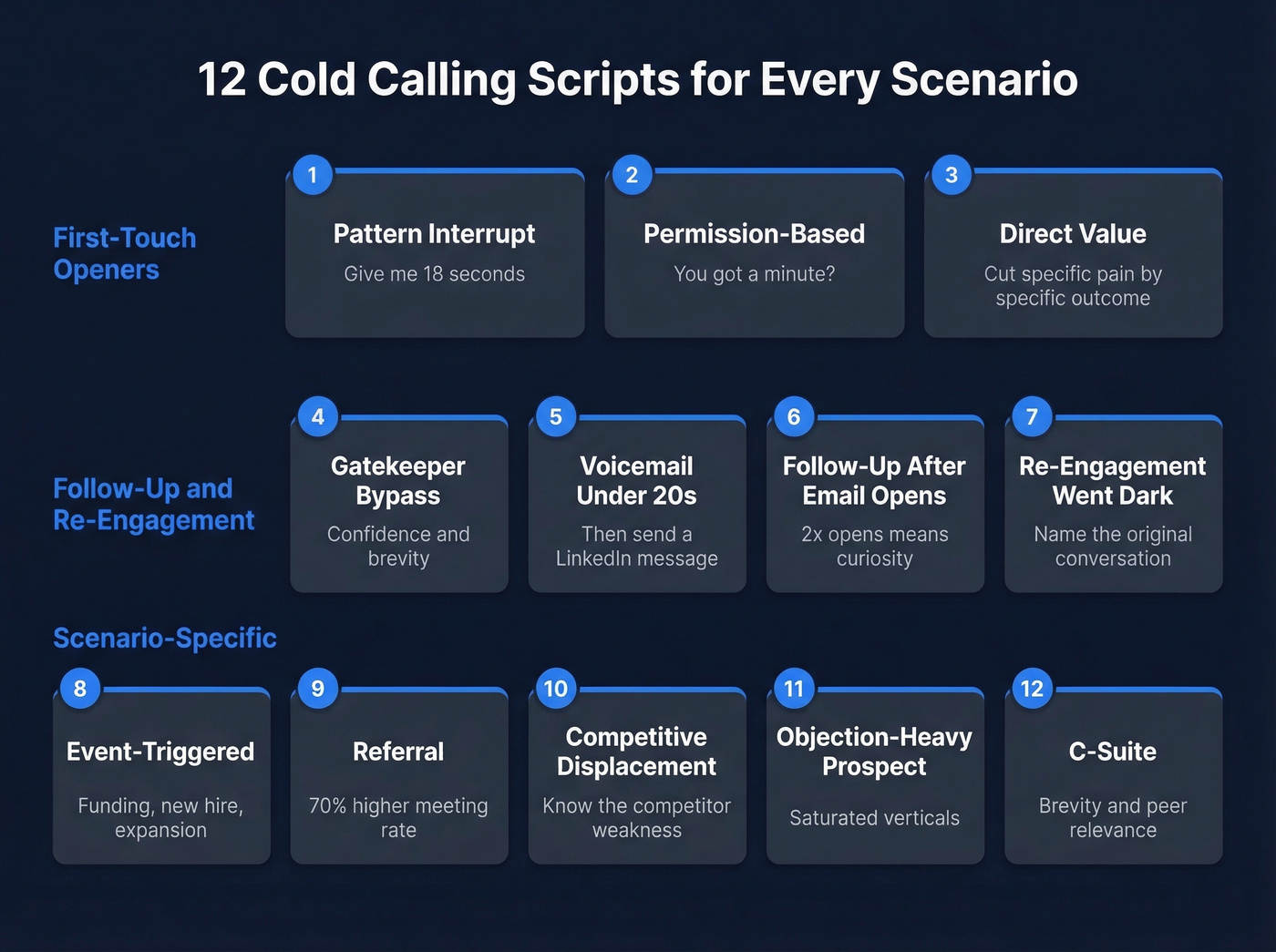
12 Cold Call Scripts for Every Scenario
First-Touch Openers
Pattern Interrupt:
"Hey [Name], this is [Your Name] from [Company]. I'll be honest - this is a cold call. If you give me 18 seconds, I'll tell you why I called, and you can decide if it's worth continuing. Fair?"
This works because it disarms. The "fair?" at the end creates a micro-commitment - most people say yes reflexively. In our experience, the pattern interrupt lands best when you deliver it with a slight smile. Your tone does more work than the words.
Permission-Based:
This script is compact by design. You acknowledge the interruption, deliver value in one sentence, and close in the next. The 2-second pause before asking for the meeting is critical - it lets the prospect process. Here's the script, straight from r/sales:
"[Name], appreciate I caught you out of the blue here - you got a minute? [2-second pause] We do [coolest feature] for companies in your space like [competitor 1] and [competitor 2]. The purpose of my call is to set aside a half hour later this week to show you how. Does [day] at [time] work?"
Direct Value:
"[Name], [Your Name] from [Company]. We help [role/industry] teams cut [specific pain] by [specific outcome]. I've got 30 seconds of context - worth hearing?"
Use this when you have strong intel on the prospect's situation. It skips the warmup and bets on relevance. Skip it if your pre-call research is thin - guessing at the pain point will backfire faster than a generic opener.
Gatekeeper & Voicemail
Gatekeeper Bypass:
"Hi, this is [Your Name]. I'm trying to reach [Prospect Name] about [specific initiative or department]. Can you connect me?"
Don't pitch the gatekeeper. Don't explain your product. Speak like someone who's expected - confidence and brevity get you through. If you need more options, use these gatekeeper tactics.
Voicemail (Under 20 Seconds):
"[Name], [Your Name] from [Company]. Quick reason for the call - we helped [similar company] [specific result]. I'll shoot you a quick note. My number is [number]."
Voicemails have roughly a 1% callback rate. Don't invest 45 seconds in them. The real play is sending a LinkedIn message within 5 minutes - one tracked test showed a 14% response rate for that approach versus 1% for voicemail alone. If you want more templates, start with voicemail scripts.
Follow-Up & Re-Engagement
Follow-Up Call (After Email Opens):
"[Name], [Your Name] from [Company]. I sent you a note about [topic] earlier this week. Wanted to put a voice to the email - did anything in there resonate?"
Prioritize calling people who've opened your emails two or more times. That behavioral signal means they're curious but haven't committed. And here's a stat worth remembering: analysis of 1.8M sales opportunities found closed-won deals involve 2x as many buyer contacts. When you follow up, ask who else should be in the conversation. (More follow-up call options here.)
Re-Engagement (Went Dark):
"[Name], we spoke [timeframe] ago about [topic]. I know things shift - just wanted to check if [original pain point] is still on your radar or if priorities have changed."
No guilt-tripping. No "just following up." Name the original conversation and give them an easy out. Giving them the out is what keeps them talking.
Event-Triggered:
"[Name], saw that [company] just [funding round / new hire / expansion / product launch]. Congrats. We work with teams going through that same phase - usually the [specific challenge] hits around now. Worth a quick conversation?"
Timing is everything here. A trigger event gives you a legitimate reason to call that isn't "I found your name in a database." If you’re building a full system around this, use a cold calling cadence.
Scenario-Specific
Referral / Mutual Connection:
"[Name], [Referrer] suggested I reach out. We helped their team with [result], and they thought you might be dealing with something similar."
Lead with the referrer's name, not your company name. Mention the specific result you delivered, not a generic pitch. And ask about a similar challenge rather than assuming they have the same problem. Mentioning a mutual connection boosts meeting chances by roughly 70%.
Competitive Displacement (Dialogue Format):
Here's how this actually sounds on a live call:
You: "[Name], a lot of teams using [Competitor] have been telling us they're frustrated with [specific issue]. We built [feature] specifically to solve that. Is that something you've run into?"
Prospect: "Yeah, actually - we've been dealing with that for months."
You: "That's exactly what [similar company] told us before they switched. The fix took about two weeks. Want me to walk you through what they did?"
This only works if you genuinely know the competitor's weakness. Guessing will backfire.
Objection-Heavy Prospect:
"[Name], [Your Name] from [Company]. I know you probably get a dozen of these calls a week, so I'll cut straight to it: [one-sentence value prop]. If that's not relevant, tell me and I'll never call again. But if it is - I've got a 2-minute version that might save you a conversation with your team later."
Use this for prospects in saturated verticals - fintech, martech, HR tech - where cold call fatigue is real. The "never call again" promise lowers the stakes enough to earn a listen.
C-Suite:
"[Name], I'll be brief. We work with [peer company CEOs/CROs] on [strategic outcome]. I'd like 15 minutes to show you what we're seeing in [their industry]. Would [day] work?"
Executives respond to brevity, peer relevance, and strategic framing. Don't pitch features - pitch insight. For more, see cold calling executives.
Here's the thing: if your average deal size is under $15K, you probably don't need a C-suite script at all. Director-level calls close faster, require fewer stakeholders, and convert at higher rates for smaller deals. Save the executive outreach for deals that justify the longer cycle.
5 Objections and What to Say
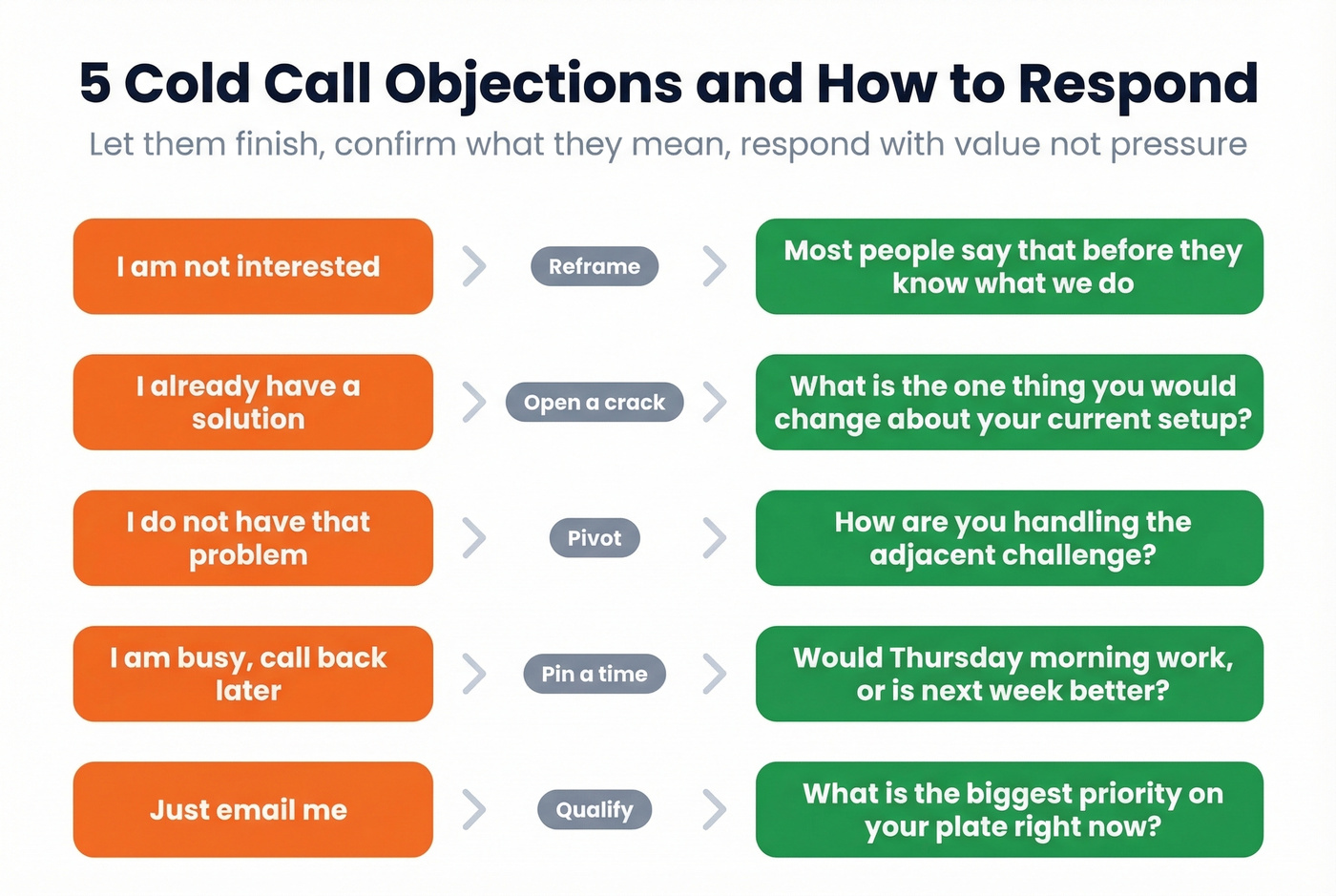
About 60% of cold calls hit "I'm not interested" before you finish your second sentence. The other four aren't much friendlier. Simple framework: let them finish talking, confirm what they actually mean, then respond with value instead of pressure.
"I'm not interested."
"Totally fair - most people say that before they know what we do. If I could show you how [specific benefit] in 90 seconds, would that change anything?" This reframes "not interested" from a conclusion to a starting point.
"I already have a solution."
"Good - that tells me you take this seriously. Out of curiosity, what's the one thing you'd change about your current setup?" You're not attacking their vendor. You're opening a crack.
"I don't have that problem."
"That's great to hear. A lot of [role] leaders tell me the same thing - until [specific trigger event] happens. Mind if I ask how you're handling [adjacent challenge]?"
"I'm busy, call back later."
"Completely understand. When's a better time - would Thursday morning work, or is next week better?" Pin them to a specific time. "Call back later" without a date is a polite no.
"Just email me."
"Happy to. So I send you something relevant - what's the biggest priority on your plate right now around [topic]?" This turns a brush-off into a qualifying question. If they answer, you've got a real conversation.

Top reps don't make 3x the dials - they connect more often because they dial real numbers. Prospeo gives you 125M+ verified mobile numbers with a 30% pickup rate, so your scripts actually reach decision-makers instead of dead lines.
Stop perfecting scripts for numbers that never pick up.
Sound Human, Not Scripted
Reading a script word-for-word sounds like a hostage note. Analysis of 326,000 sales calls found the winning talk-to-listen ratio is 43% talking, 57% listening. The average rep talks 60% of the time. Way too much.
Winners ask 15-16 questions per call. Losers ask around 20 - which sounds counterintuitive until you realize that rapid-fire questions feel like an interrogation, not a conversation. The consensus on r/sales is that the best reps sound like they're having a casual chat about a business problem, not running through a checklist. If you want to build that skill faster, focus on phone sales skills and cold call tonality.
A few delivery habits that actually move the needle:
- Slow down consciously by about 20%, because nerves will speed you up without you noticing.
- Smile before you dial. It changes your vocal tone, sounds ridiculous, and works anyway.
- Pause after asking for the meeting - a full 2 seconds minimum. Some reps go as long as 8 seconds, which feels excruciating but triggers curiosity on the other end.
- Record yourself weekly and listen back to your last 5 calls. You'll catch verbal tics and pacing issues you'd never notice in real time.
The script is a framework, not a teleprompter. Know your key phrases and transitions. Let the rest be natural.
When to Call
Analysis of 1.4 million outbound calls makes the day-of-week breakdown clear:
| Day | Demo Share | Notes |
|---|---|---|
| Tuesday | ~22% | Best overall |
| Wednesday | ~22% | Tied for best |
| Thursday | ~18% | Strong |
| Monday | ~17% | Highest efficiency |
| Friday | ~11% | Worst day |
Now layer in time-of-day data from a 40,000-call analysis:
| Time Block | Connect Rate | Appt Rate |
|---|---|---|
| 10 AM-12 PM | 18.7% | 7.1% |
| 4-5 PM | 21.4% | 8.9% |
| After 5 PM | 6.1% | 1.7% |
The 4-5 PM window is 71% more effective than other time blocks. One exception worth knowing from r/sales: Friday afternoons can work for VP and C-suite calls because gatekeepers leave early. For a deeper breakdown, see best time to cold call.
On attempts, the optimal number is 3. Data shows 93% of total conversations happen by the third attempt. Going to 5 gets you to 98.6%, but beyond that you're burning time for diminishing returns.
Book meetings for the same week whenever possible. Same-day meetings show an 80.79% attendance rate. Same-week drops to 54%. Push it out four or more weeks and you're at 32%.
Your Data Is the Real Problem
Look - before you optimize your opener, verify your list. B2B contact data decays at roughly 22.5% per year. People change jobs, get promoted, switch numbers. Reps lose 27.3% of their selling time to bad contact data, and bad data costs businesses an average of $12.9 million annually.
You can have great cold calling scripts printed on your wall. If 1 in 4 numbers on your list is dead, your connect rate craters before you open your mouth. Start by tracking your cold call connect rate and tightening your BDR contact data workflow.
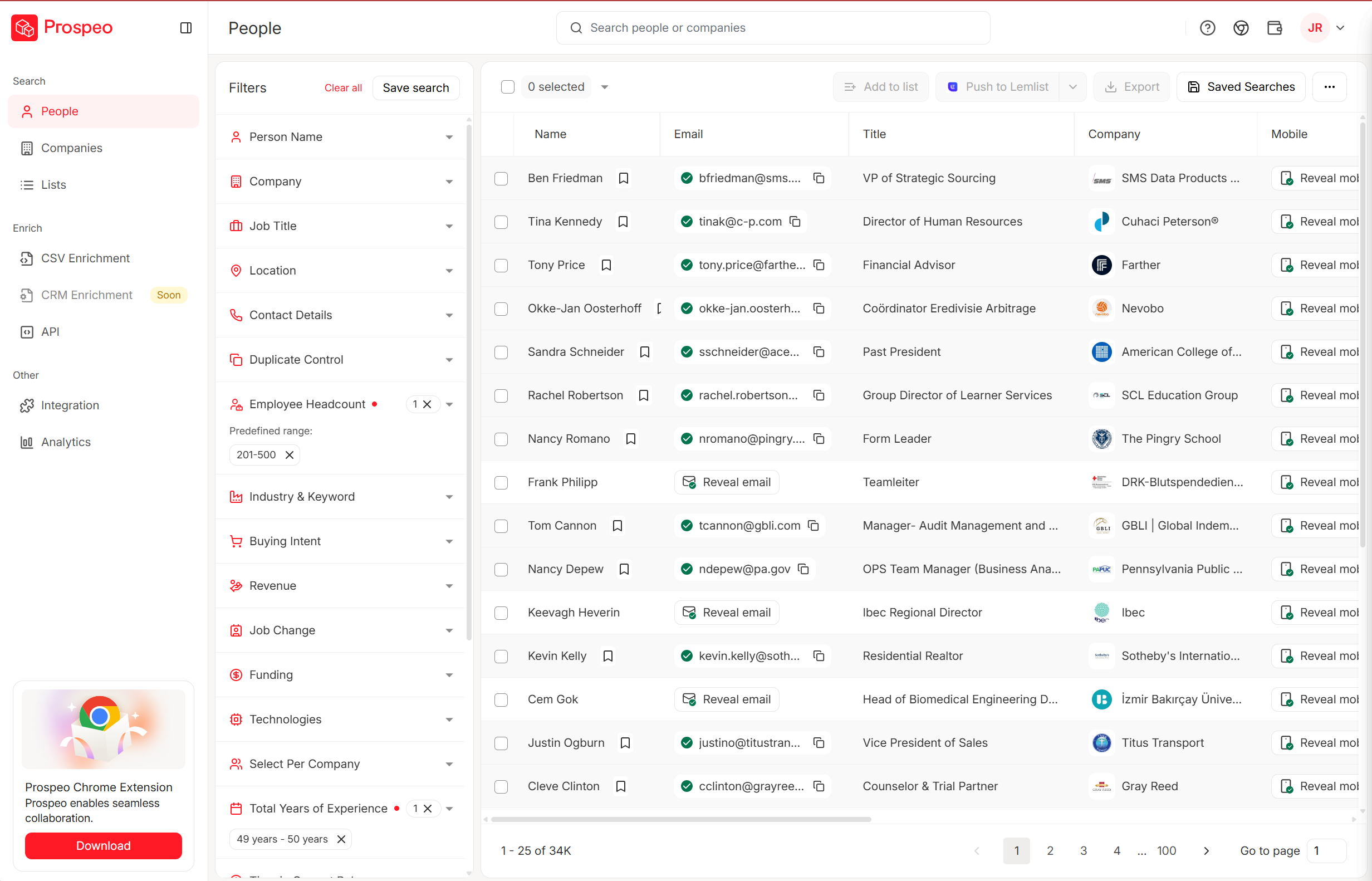
We've seen teams double their connect rates just by switching to weekly-refreshed data. Prospeo's database covers 300M+ professional profiles with 125M+ verified mobile numbers and a 30% pickup rate across all regions, with data refreshing every 7 days versus a 6-week industry average. That's the difference between calling someone at a company they left last month and reaching them at their desk. Teams making that switch typically hit connect rates of 20-25%.
Compliance in 2026
TCPA lawsuits surged roughly 95% year-over-year, with class actions spiking 285% in September alone. The Supreme Court's McLaughlin v. McKesson ruling means district courts no longer defer to FCC interpretations in civil TCPA cases. The rules are getting enforced harder and less predictably.
Your compliance checklist:
- Calling hours: 8 AM-9 PM in the prospect's local time zone. Not yours.
- DNC scrub: Check your lists against the National Do Not Call Registry at least every 31 days.
- AI-generated voice: The FCC ruled that AI voices require prior express written consent. No exceptions for B2B.
- Consent revocation: Consumers can revoke consent by any reasonable means. You have 10 business days to honor it. You get one confirmation text within 5 minutes - no marketing in it.
- TCPA penalties: $500-$1,500 per violation. TSR violations run up to $50,120 each.
- B2B isn't a free pass. DNC provisions don't apply to B2B under the TSR, but the TCPA still applies to mobile autodial and prerecorded messages - even for business contacts.
Don't skip this section. A single compliance misstep can cost more than your entire outbound program generates in a quarter. If you need the full legal breakdown, use this TCPA compliance guide.
Every trigger-based script above depends on accurate, fresh contact data. Prospeo refreshes 300M+ profiles every 7 days - not 6 weeks - so your event-triggered calls land while the news is still warm and the direct dial is still valid.
Stale data kills great scripts. Dial numbers verified this week.
FAQ
What's the average cold call success rate in 2026?
About 4.82% of conversations result in a booked meeting, with the average call lasting 93 seconds. Top-quartile reps convert at 16.7% of connects - roughly 3.5x the average. The gap comes down to openers, timing, and data quality, not raw dial volume.
What's the best day and time to cold call?
Tuesday and Wednesday account for 44% of demos booked across a 1.4 million-call dataset. The 4-5 PM window pulls a 21.4% connect rate and 8.9% appointment rate - 71% more effective than other slots. Avoid Friday unless you're targeting executives whose gatekeepers leave early.
How do I stop sounding robotic on calls?
Use script frameworks - key phrases and structure - not word-for-word scripts. Aim for 43% talking and 57% listening, per analysis of 326,000 calls. Ask 15-16 questions per call, record yourself weekly, and review playback to catch pacing issues you'd never notice live.
How many attempts should I make per prospect?
Three. Data shows 93% of total conversations happen by the third attempt. Going to 5 gets you to 98.6%, but beyond that the returns collapse. Spread attempts across different days and time blocks - don't call the same person three Tuesdays at 10 AM.
How do I fix low connect rates before changing my script?
Low connect rates are almost always a data problem, not a script problem. B2B contact data decays at 22.5% per year. Switch to a provider with verified mobile numbers refreshed weekly - phone-verified numbers hit 87% accuracy, while AI-verified numbers reach 98%. That gap matters when you're dialing 80+ numbers a day.