

Great Email Subject Lines: 80+ Examples Backed by Real Data
Subject lines under nine characters produce the highest open rates. That's not a typo - it's what a study of 2+ billion emails found. Straightforward subject lines pull 60-87% open rates, while the "clever" ones most teams agonize over consistently underperform.
You don't need 47 copywriting frameworks. You need a few rules, a swipe file you can steal from, and clean data underneath it all.
Three Rules You Can Act on Today
Front-load the first 33 characters. That's all Gmail on Android shows. If your hook is buried at character 40, most mobile readers never see it.
Test 2-4 word subject lines. They outperform 6+ word lines in every dataset we reviewed. Shorter isn't lazy - it's strategic.
Clean your list before you optimize your copy. Brilliant subject lines are wasted on bounced emails and spam traps. Fix the data first. We've seen teams spend weeks A/B testing copy when their real problem was a 12% bounce rate torching their sender reputation.
What the Benchmarks Say
Not all email is created equal. Cold outreach, ecommerce campaigns, and automated flows operate in completely different universes.
| Source | Dataset | Open Rate | Click Rate | Context |
|---|---|---|---|---|
| Klaviyo | 183K+ customers | Varies | 1.69% (campaigns) | Ecommerce-focused |
| Higher Logic | 2B+ emails | 33.54% | 2.68% | Associations/nonprofits |
| LevelUpLeads (Smartlead aggregate) | 14.3B sends | 42% | N/A (reply-based) | Cold B2B email |
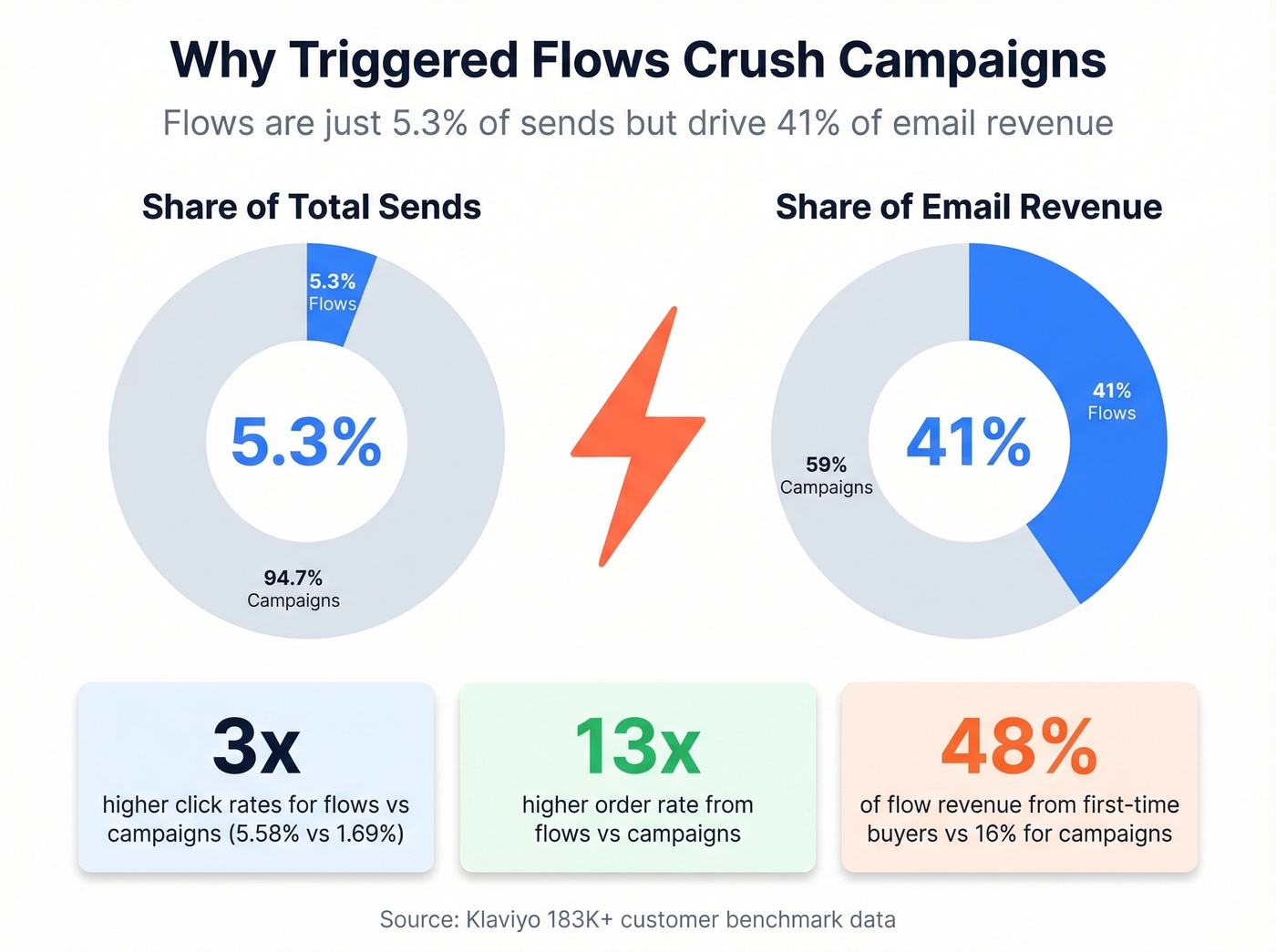
A few things jump out. The ecommerce data reveals that automated flows - abandoned carts, welcome sequences, post-purchase - generate click rates of 5.58%, roughly 3x higher than campaigns. Flows account for just 5.3% of total sends but drive about 41% of email revenue, and 48% of that flow revenue comes from first-time purchasers versus just 16% for campaigns. The subject line matters, but the trigger matters more.
For cold email, the 14.3B-send dataset shows a 42% average open rate, but only ~3% reply and ~1% book meetings. That funnel compression means your subject line's job isn't to be clever - it's to not get deleted.
And 51% of recipients say they receive too many emails. List size matters enormously here: sends to fewer than 500 contacts hit ~48% open rates and 8%+ click-through rates. Smaller, targeted lists crush broadcast blasts every time.
Real Character Limits by Device
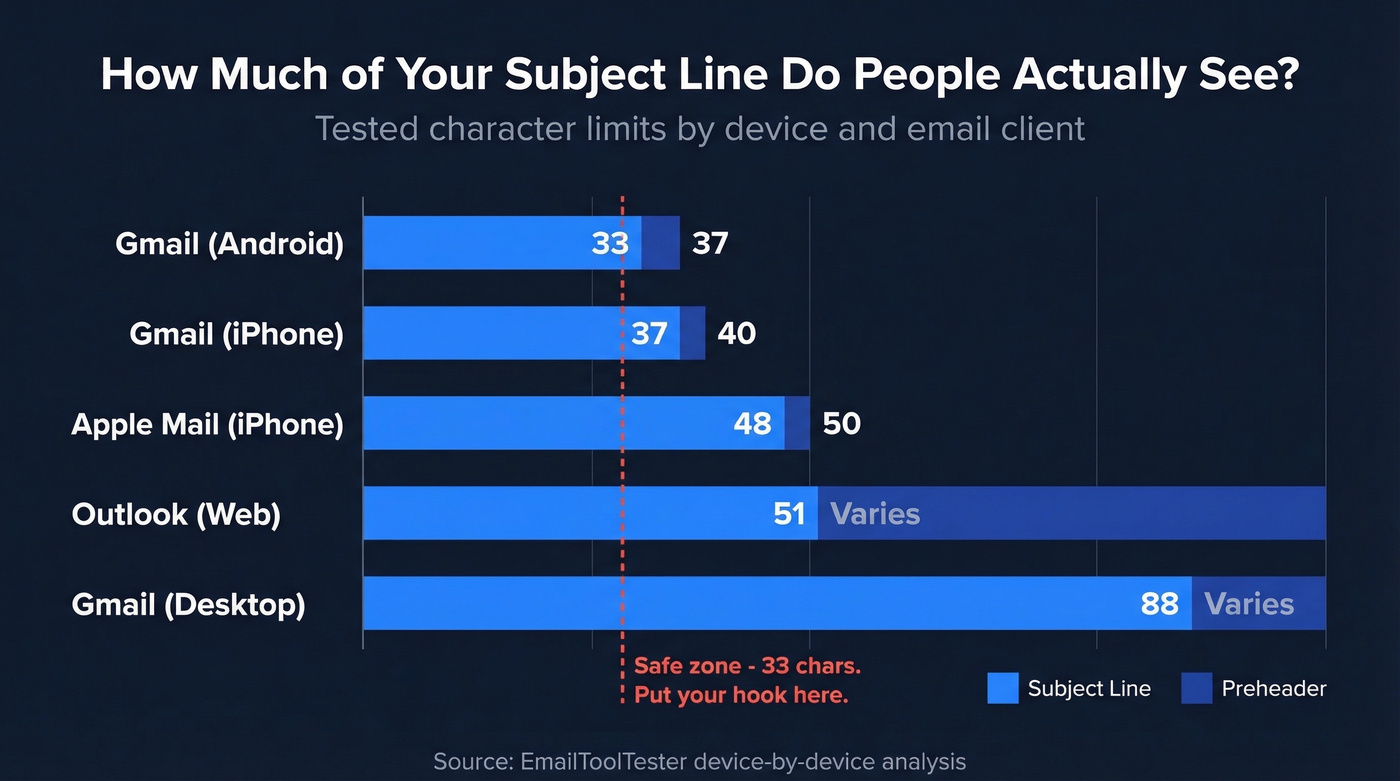
Every "optimal length" article gives you a different number because the answer depends on the device your reader uses. Here are the actual tested limits from EmailToolTester's device-by-device analysis:
| Device / Client | Max Subject Chars | Max Preheader Chars |
|---|---|---|
| Gmail (Android) | 33 | ~37 |
| Gmail (iPhone) | 37 | ~40 |
| Apple Mail (iPhone) | 48 | ~50 |
| Gmail (Desktop) | ~88 | Varies |
| Outlook (Web) | ~51 | Varies |
The practical rule: put your main message in the first 33 characters. That covers the worst-case scenario and ensures every reader sees your hook. Twilio SendGrid's Cyber Week data backs this up - the average subject line was 6 words, but the best performers were 2-4 words.
Write your subject line, then check if the first 33 characters make sense on their own. If they don't, rewrite.
80+ Subject Line Examples by Category
Cold Email / Sales Outreach
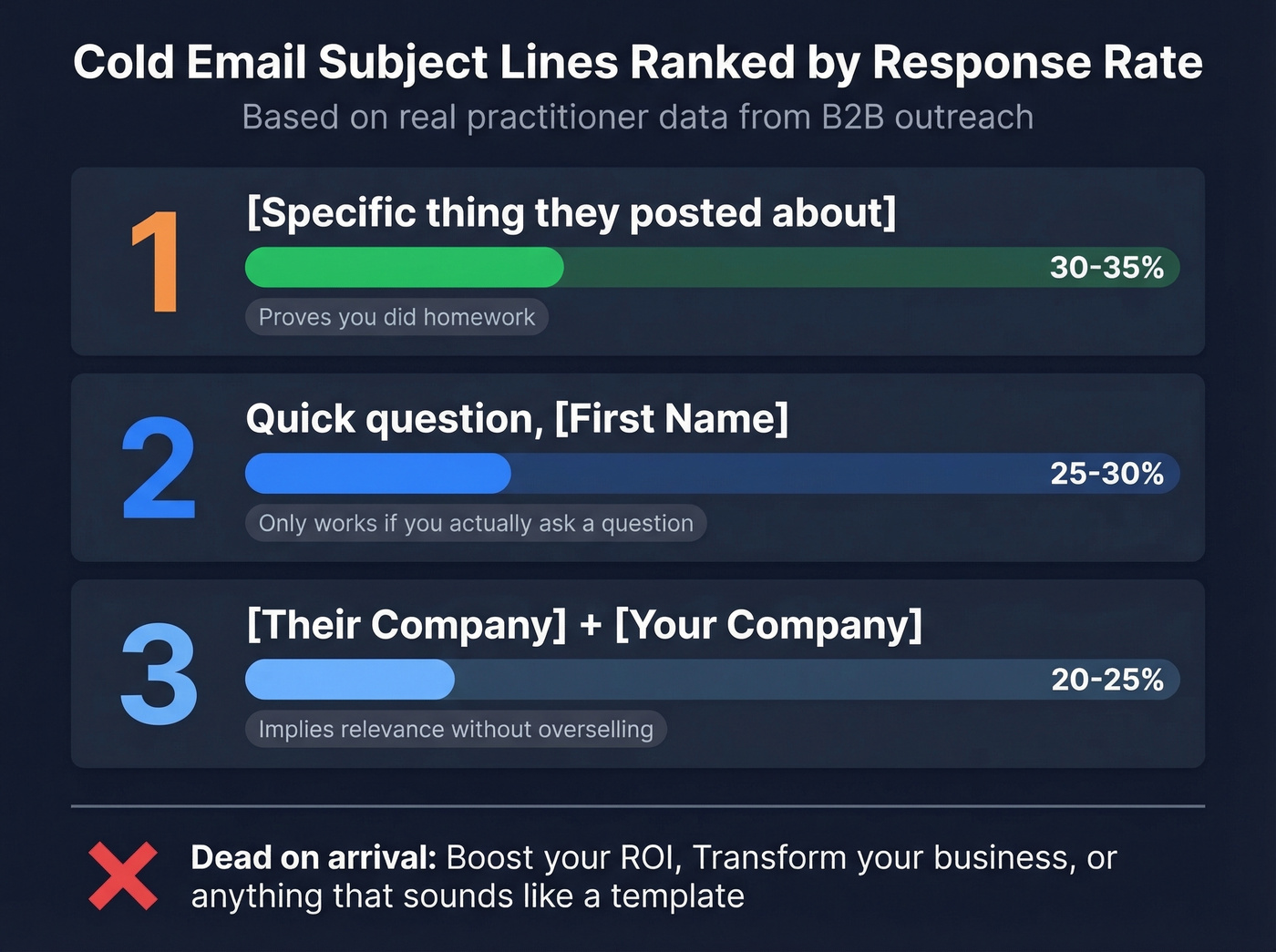
Cold subject lines follow different rules. The recipient didn't opt in, doesn't know you, and will delete anything that smells like marketing. A practitioner on r/b2bmarketing shared response rates that line up with what we've seen in our own testing:
| Subject Line | Response Rate | Why It Works |
|---|---|---|
| "[Specific thing they posted about]" | 30-35% | Proves you did homework. Highest performer. |
| "Quick question, [First Name]" | 25-30% | Works only if the email contains an actual question. |
| "[Their Company] + [Your Company]" | 20-25% | Implies relevance without overselling. |
Beyond the top three, these patterns consistently pull replies:
- "Saw your talk at [Event]" - Feels personal. Works even if you only watched the recording.
- "Idea for [Their Company]'s [specific initiative]" - Specificity signals effort.
- "[Mutual connection] suggested I reach out" - Social proof in six words.
- "Question about [their department]" - Vague enough to open, specific enough to feel relevant.
- "Thoughts on [industry trend]?" - Positions you as a peer, not a seller.
- "Can I send you this?" - Curiosity gap. Works for sharing case studies or reports.
- "Not sure if this is relevant" - Disarming. Low-pressure.
- "[Their Company]'s [metric] vs industry avg" - Data-driven hook that's hard to ignore.
Here's the thing: anything that sounds like it came from a template - "Boost your ROI," "Transform your business" - gets filtered or ignored. The Reddit consensus is clear. Marketing copy in cold subject lines is dead on arrival.
Timing matters too. The same practitioner found Tue-Thu, 9-11am in the recipient's timezone outperformed Monday mornings and Friday afternoons. A winning subject line sent at 4pm Friday dies in the weekend inbox pile.
If you want more cold-specific options, start with cold outreach patterns and then refine with cold email etiquette so your subject lines match the tone.
Ecommerce / Promotional
Ecommerce subject lines can afford more creativity because the recipient opted in. Automated flows generate 13x higher order rates than campaigns, so the trigger context does heavy lifting. Lines worth stealing:
- "You left something behind" - Classic cart abandonment. Still works because it's specific.
- "Your cart misses you 🛒" - Playful variant with emoji.
- "Back in stock: [Product Name]" - Urgency plus specificity.
- "[First Name], your order ships tomorrow" - Post-purchase engagement.
- "Last chance: 40% off ends tonight" - Deadline-driven. Works when the deadline is real.
- "We picked these for you" - AI recommendation framing. AI product recommendations lift click rates to 3.75% on average.
- "New drop 🔥" - Two words. Works for brands with strong identity.
- "Your wishlist is on sale" - Personalized plus urgency.
- "Free shipping today only" - Simple, clear value prop.
- "[First Name], this sold out last time" - Scarcity plus personalization.
- "Don't open this (unless you want 30% off)" - Reverse psychology. Polarizing, so test it.
- "We made a mistake (in your favor)" - Curiosity gap that implies a deal.
Newsletter / Content
Newsletter subject lines compete against dozens of other emails. The "boring" approach - telling readers exactly what's inside - consistently outperforms clever wordplay.
Top 3 we'd test first:
- "The $4M mistake no one talks about" - Specificity plus curiosity gap. Hard to scroll past.
- "Why [contrarian opinion]" - Challenges assumptions. Drives opens from disagreement alone.
- "[Number] + [specific topic]" - "7 cold email templates that got replies" beats "Email tips inside" every time.
More patterns worth rotating:
- "3 things I learned this week" - Simple, personal, repeatable.
- "[Industry] news: [one-line summary]" - Straightforward. Readers know what they're getting.
- "This changed how we [specific action]" - Story-driven.
- "[Famous person] was wrong about [topic]" - Contrarian plus name recognition.
- "The data on [topic] surprised us" - Honest framing that builds trust.
- "Quick read: [topic] in 2 minutes" - Sets time expectation. Reduces friction.
If you’re building a consistent send, pair these with a simple email segmentation strategy so the “what’s inside” subject line stays relevant.
Follow-Up / Re-Engagement
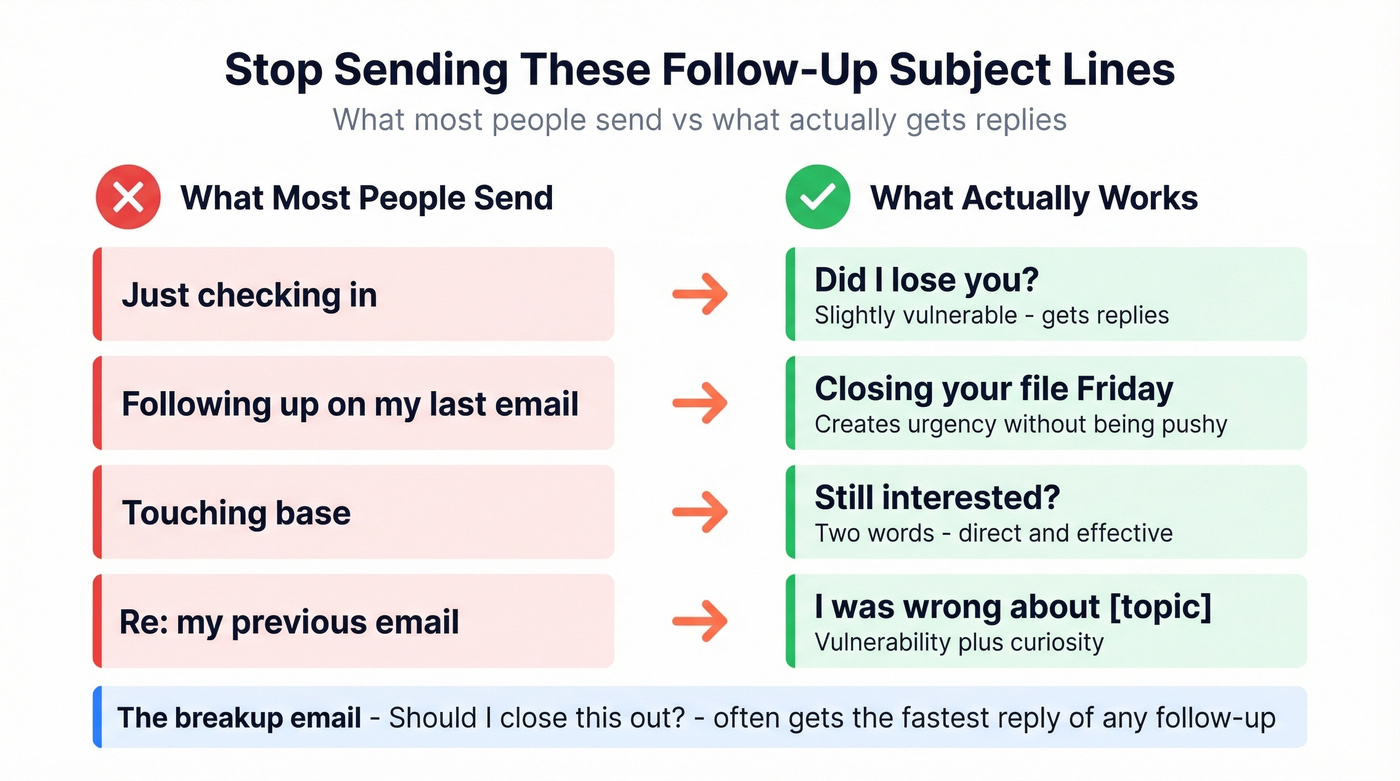
Follow-ups are where most teams get lazy. "Just checking in" is the subject line equivalent of a cold handshake.
| What Most People Send | What Actually Works | Why |
|---|---|---|
| "Just checking in" | "Did I lose you?" | Slightly vulnerable. Gets replies. |
| "Following up on my last email" | "Closing your file Friday" | Creates urgency without being pushy. |
| "Touching base" | "Still interested?" | Two words. Direct. |
| "Re: my previous email" | "I was wrong about [topic]" | Vulnerability plus curiosity. |
More follow-up patterns that pull responses:
- "[First Name], one more thing" - Implies a conversation already happened.
- "Update on [topic from last email]" - Continuity signal.
- "Confirmation: your account status" - This framing boosts opens on unengaged contacts by ~30%.
- "Quick follow-up (no pitch)" - Disarming. Sets expectations.
- "[First Name], should I close this out?" - Breakup email. Often gets the fastest reply.
- "3 months later - worth revisiting?" - Time-stamped follow-up for long sales cycles.
For more options beyond “just checking in,” use these follow-up email templates and the best way to follow up on an email data.
Automated Flows / Triggered Emails
Flow subject lines follow different rules because the timing does most of the persuasion. The recipient just abandoned a cart, just signed up, or just made a purchase. Your subject line needs to match that moment, not sell.
- "Welcome - here's what happens next" - Sets expectations for new subscribers.
- "Your order is confirmed ✓" - Transactional clarity. Highest open rates in any category.
- "[First Name], you forgot something" - Cart abandonment with personalization.
- "How's [Product Name] working out?" - Post-purchase check-in. Drives reviews.
- "Your free trial ends in 3 days" - Deadline-driven. SaaS staple.
- "We saved your cart (but not for long)" - Urgency plus helpfulness.
- "People who bought [X] also loved [Y]" - Cross-sell with social proof.
- "It's been 30 days - how are we doing?" - NPS/feedback trigger.
- "[First Name], you earned a reward" - Loyalty program trigger. Feels like a gift, not a pitch.
Flows drive 41% of email revenue from just 5.3% of sends. The subject line matters less than the trigger - but a bad one still kills performance.
Words That Boost (and Kill) Opens
High-performing keywords: "free," "new," "alert," "update," "invitation," and numbers - especially odd numbers like 3, 5, 7. Brackets work too. "[Video]" or "[Case Study]" in a subject line sets format expectations and lifts click-through rates. The word "you" outperforms "we" in nearly every test. These small word choices are often the difference between great email subject lines and forgettable ones. If you want a bigger blacklist, see words to avoid in email subject lines.
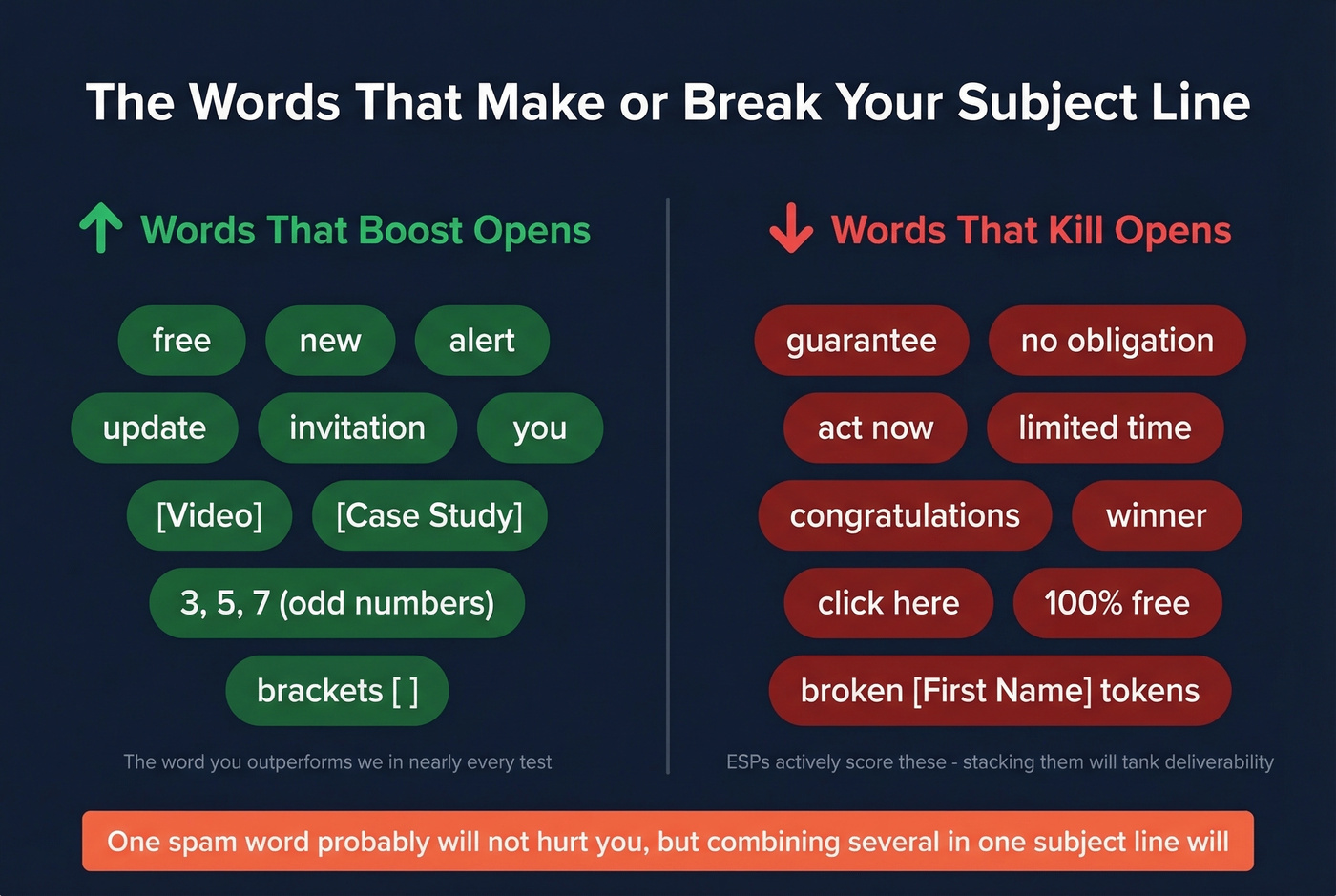
Spam-trigger words to avoid: "guarantee," "no obligation," "act now," "limited time," "congratulations," "winner," "click here," and "100% free." These don't just sound spammy - ESPs actively score them. One or two won't kill you, but stacking them will. Also watch for broken personalization tokens. Nothing destroys trust faster than "[First Name]" appearing literally in someone's inbox because your merge field failed.

You read it above: teams spend weeks A/B testing subject lines when a 12% bounce rate is the real problem. Prospeo's 5-step verification delivers 98% email accuracy, so every great subject line actually lands in a real inbox.
Fix the data first - then your subject lines can do their job.
Should You Use Emojis?
The data is more nuanced than most people think. Moosend analyzed 69,315 subject lines and found 28% included at least one emoji. That's mainstream adoption, not a gimmick.
The most common emojis skew seasonal and promotional: ✨ (4.97%), 🎁 (4.08%), ☀️ (2.26%). Trust-signaling emojis like ✔ (2.89%) and ✅ (1.13%) are underused - and they're the ones that actually reinforce your message rather than decorating it. One fun finding: dog emojis outnumber cat emojis about 5.5:1 in subject lines. Make of that what you will.
CodeCrew's A/B testing shows emojis can lift open rates by up to 10% for promotional emails. But the sentiment on r/marketing is more skeptical - some audiences read emojis as spam signals. Our take: if you're sending B2B cold email, skip them entirely. For ecommerce promos, they're worth testing. For newsletters, one well-placed emoji boosts scannability without feeling cheap. Never use more than one per subject line - stacking emojis is the fastest way to look like a scam. (More nuance here: emojis in email subject lines.)
Psychology Behind High-Performing Opens
Five triggers drive most email opens, and every standout subject line leans on at least one.
Urgency and FOMO are the most obvious - "Last chance: 40% off ends tonight" works because the deadline is real. Fake urgency erodes trust fast, so only use this when the deadline actually exists. Curiosity gaps are the second-most powerful trigger. "The $4M mistake no one talks about" forces the reader to open because they can't resolve the tension otherwise. The key is to avoid giving away the answer in your preheader text.
Specificity separates amateur subject lines from great ones. "[Their Company]'s conversion rate vs industry avg" signals effort and relevance in a way that "Improve your metrics" never will. Numbers, names, and details do the heavy lifting. Loss aversion is the sleeper trigger most teams underuse - "Closing your file Friday" works because people act faster to avoid losing something than to gain something equivalent. That's decades of behavioral economics in six words. Social proof and vanity tap into reciprocity: "Sarah mentioned I should reach out" uses a relationship to bypass the stranger filter entirely.
Most subject lines that flop are missing all five. "Monthly Newsletter - June Edition" triggers nothing. "3 things your competitors changed this quarter" hits curiosity, specificity, and loss aversion in eight words.
Preview Text: The Secret Weapon
Preview text is the most underoptimized element in email marketing. It's the gray text that appears after your subject line in the inbox, and on Gmail Android, you get about 37 characters before it cuts off.
Most senders let their preview text default to "View this email in your browser" or the first line of body copy. That's wasted real estate.
Before: Subject: "Your cart is waiting" / Preview: "View in browser | Unsubscribe"
After: Subject: "Your cart is waiting" / Preview: "Free shipping added - expires at midnight"
The subject line gets the open. The preview text removes the last bit of hesitation. Write them together as a one-two punch - even the best subject lines lose impact if the preheader contradicts or wastes the space you've earned.
Deliverability Mistakes That Kill Opens
You can write the perfect subject line and still land in spam. Average cold email open rates have dropped from 36% to 27.7% over recent years, and these mistakes are a big reason why.
Fake "Re:" and "Fwd:" prefixes. These trick recipients into thinking there's an existing conversation. They also violate CAN-SPAM's prohibition on misleading subject headings. ESPs are catching on, and your domain reputation takes the hit. Never use fake threading - if you want continuity, reference the previous topic naturally.
ALL CAPS and aggressive punctuation. "URGENT!! DON'T MISS THIS!!!" isn't just annoying - VerticalResponse's 2026 analysis found ALL CAPS and excessive punctuation increase spam scores by 40-60%. Use sentence case. Limit yourself to one exclamation point per email, max.
Broken personalization tokens. "[First Name], we have a deal for you" appearing literally in someone's inbox destroys trust instantly and screams "mass blast." Always set fallback values and test merge fields with a seed list before every send.
Ignoring bounce rates. The average cold email bounce rate is ~7.5%. That's catastrophic for sender reputation. ESPs track engagement signals - opens, deletes-without-reading, spam complaints - and a bad bounce rate trains inbox providers to route your entire domain to spam. Verify your list before every campaign. Prospeo's 5-step verification catches invalid addresses, spam traps, and honeypots before you hit send, with 98% email accuracy and catch-all domain handling built in. If you need a deeper walkthrough, use this guide on how to verify email validity.
Never cleaning unengaged contacts. Sending to people who haven't opened in 6+ months tanks your engagement metrics. Some teams have started sending dedicated re-perission emails to unengaged segments - "Do you still want to hear from us?" It feels counterintuitive, but it scrubs dead weight and improves deliverability for everyone who remains. For subject line ideas specifically, see re-engagement email subject lines.
One caveat on open rate tracking: Apple Mail Privacy Protection pre-loads tracking pixels, which inflates open rates across the board. If a large chunk of your list uses Apple Mail, track replies and clicks instead - they're the only reliable engagement signals left. (More on measurement: track email opens.)
Let's be honest about something most guides won't say: if your deal sizes are under five figures and your bounce rate is above 5%, stop tweaking subject lines entirely. Fix the list. A mediocre subject line sent to a clean, targeted list of 200 people will outperform a brilliant subject line sent to a dirty list of 5,000 every single time. The upstream fix matters more than the copy fix.
How to A/B Test Subject Lines
Testing sounds simple. In practice, most teams do it wrong - they test too many variables, use too-small samples, or read results too early.
The framework that works: change one variable per test, send each variant to at least 1,000 recipients, and run the test for 1-2 weeks before calling a winner. Here's what realistic lift ranges look like, based on CodeCrew's testing data:
| Variable Tested | Expected Lift |
|---|---|
| Emojis vs. no emojis | Up to 10% |
| Personalization (name) | 1-5% |
| Send time optimization | Up to 10% |
| Short vs. long subject | Up to 5% |
| Remove brand name | 1-4% |
A couple of surprising findings worth testing: B2B emails sent on weekends show 62% higher click-through rates in some datasets. Thursday outperforms Friday by about 2% for product launches. Neither is universal, but they're worth a test cycle.
One thing we see teams overlook: data freshness matters as much as subject line copy when you're building cold email test lists. Stale data means bounces, and bounces mean your A/B test results are contaminated by deliverability noise, not copy performance.
Cold subject lines like "[Their Company] + [Your Company]" only work when you're reaching the right person. Prospeo gives you 300M+ profiles with 30+ filters - buyer intent, job changes, technographics - so your personalized subject line hits a decision-maker, not a dead end.
Send fewer emails to better prospects. Open rates follow.
FAQ
How long should an email subject line be?
Put your main message in the first 33 characters - that's all Gmail on Android displays. A study of 2+ billion emails found subject lines under 9 characters produced the highest open rates. Twilio SendGrid's data confirms 2-4 word subject lines outperform longer ones. When in doubt, shorter wins.
Do emojis help or hurt open rates?
Across 69,315 subject lines analyzed by Moosend, 28% included emojis. A/B tests show up to 10% open rate lift for promotional audiences and zero change for others. For B2B cold email, skip them. For ecommerce, test one emoji per subject line - never stack multiples.
What's a good open rate in 2026?
Marketing emails average ~33% across 2B+ emails studied. Cold emails average 42% across a 14.3B-send dataset. Automated flows outperform both. Apple Mail Privacy Protection inflates open rates, so track replies and clicks for a more reliable engagement signal.
Why are my emails going to spam?
Aggressive punctuation, ALL CAPS, and misleading "Re:" prefixes increase spam scores 40-60%. But list quality matters more - a 7.5% bounce rate damages sender reputation regardless of copy. Verify addresses before every campaign to keep bounces under 3%.
What makes great email subject lines stand out?
Top-performing subject lines lean on at least one psychological trigger - curiosity, specificity, urgency, loss aversion, or social proof - while staying short enough to display fully on mobile. They sound like a person wrote them, not a template. Cold emails need conversational tone; marketing emails can be more creative since the recipient opted in.