

How to Build Email Outreach Campaigns That Get Replies in 2026
A study analyzing 16.5 million cold emails across 93 business domains found the average reply rate dropped to 5.8% - down 15% from the year before. Most email outreach campaigns are still built on the same playbook that stopped working two years ago: bloated sequences, unverified lists, and "personalization" that amounts to a first-name token in a generic pitch. Cold email isn't dying. Bad cold email is.
The teams still booking meetings from outbound share three things: obsessively clean data, deliverability infrastructure they set up before sending a single email, and short plain-text messages that don't try too hard. Everything else - the fancy templates, the 12-step sequences, the AI-generated opening lines - is noise layered on top of a broken foundation.
The Minimum Viable Checklist
Before you read another word:
- Verified, tightly targeted lists. If 10% of your emails bounce, your domain reputation is already damaged. Clean every list before it touches your sending platform. (If you need bounce benchmarks and what “good” looks like, see bounce rate.)
- Deliverability infrastructure. Separate outreach domains, SPF/DKIM/DMARC authentication, and a proper warmup protocol. Skip this and nothing else matters. (More detail: email deliverability.)
- Short plain-text emails with soft CTAs. Six to eight sentences. No HTML. No images. No "book a call" in the first email. Ask a question instead. (Examples: email call to action.)
That's the foundation. Let's get into the numbers, the setup, and the tools.
Benchmarks That Actually Matter
The 16.5-million-email dataset from Belkins is the most useful independent benchmark we've found - it spans 93 business domains across industries, covering broad outbound performance rather than a single vendor's cherry-picked results. Here's what matters from it.
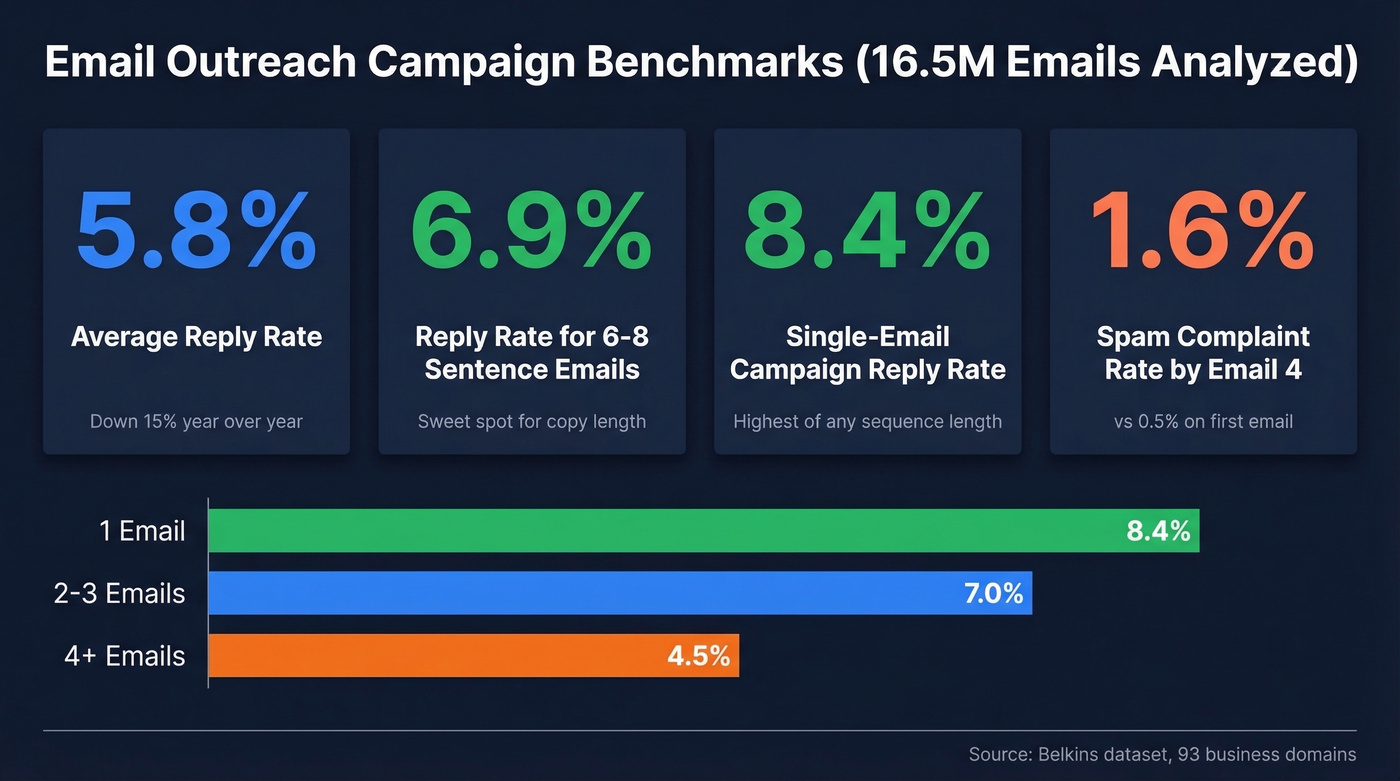
Reply rates averaged 5.8% across all campaigns. Strong, well-targeted campaigns with clean data often reach 8-10%+.
Copy length had a clear sweet spot: 6-8 sentence emails pulled a 6.9% reply rate, and messages under 200 words outperformed longer ones across the board.
Here's a counterintuitive finding: single-email campaigns - no follow-ups at all - pulled an 8.4% reply rate, the highest of any sequence length. More touches drive more total replies, but each additional email dilutes per-email performance. That tension shapes everything about how you design sequences. (If you want a deeper framework for building sequences, see sequence management.)
Follow-ups matter, but with diminishing returns. The first follow-up lifted replies up to 49% in high-performing campaigns. By the 4th round, response rates dropped 55%. The number that should scare you: spam complaints escalated from 0.5% on the first email to 1.6% by the 4th - well past the 0.3% threshold Gmail and Yahoo enforce.
On the ISP side, the enforcement timeline is real. Gmail and Yahoo rolled out authentication requirements for bulk senders in February 2024, and Outlook followed in May 2025 with a 5,000+/day threshold. If your DNS records aren't clean, you're fighting filters before your copy even gets a chance. (Related: bulk email threshold.)
Build Your List - ICP Beats Personalization
Here's the thing: your SDR just sent 2,000 emails and 400 bounced. That's a 20% bounce rate. Your domain reputation just took a hit that'll take weeks to recover from, and every email you send in the meantime lands a little closer to spam. This is the most common way outbound campaigns die - not from bad copy, but from bad data.
The consensus on r/sales and in SaaS communities is clear: narrowing your ICP improves reply rates more than merge-field personalization ever will. Swapping {{first_name}} tokens into a generic pitch doesn't fool anyone. Sending a relevant prospecting email to the right person at the right company does. List quality is the single highest-leverage thing you can control. (If you need a scoring framework, use an ideal customer profile template.)

Before you load a single contact into Instantly or Smartlead, run your list through verification. Prospeo's 5-step verification process handles catch-all domains, spam traps, and honeypot addresses - the three things that silently destroy deliverability. (If you suspect you’ve hit traps, see spam trap removal.) We've seen teams like Stack Optimize build to $1M ARR running client campaigns with 94%+ deliverability, bounce rates under 3%, and zero domain flags. Meritt cut their bounce rate from 35% to under 4%.
You can search by 30+ filters - buyer intent, technographics, job changes, headcount growth, funding stage - and push verified contacts directly into Smartlead, Instantly, Lemlist, or HubSpot. The point isn't just finding emails. It's finding the right emails and knowing they'll land. (If you’re comparing providers, start with data enrichment services.)

Bad data kills outreach campaigns before your copy ever gets a chance. Prospeo's 5-step verification catches catch-all domains, spam traps, and honeypots - the silent deliverability killers this article warns about. Teams using Prospeo run campaigns with bounce rates under 4% and zero domain flags.
Start with 75 free verified emails - no credit card, no contracts.
Deliverability Infrastructure
You can write the perfect email, target the perfect ICP, and still land in spam if your infrastructure is wrong. Deliverability is plumbing. Set it up before you send anything.
Never send cold email from your primary domain. If your outreach domain gets flagged, your company's transactional emails - invoices, password resets, customer comms - go down with it. Buy brand-adjacent domains like acme-team.com or getacme.io and redirect them to your main site for legitimacy.
Then scale across multiple domains and inboxes. The formula that works: 3-5 dedicated outreach domains, 4-6 inboxes per domain, capped at 40-50 emails per inbox per day. This spreads your sending volume so no single inbox looks like a spam cannon. (More on safe sending limits: email velocity.)
Authenticate everything. SPF, DKIM, and DMARC are non-negotiable. Here's what the SPF record looks like if you're using Google Workspace and Instantly:
v=spf1 include:_spf.google.com include:_spf.instantly.ai ~all
Move from ~all to -all once you've confirmed everything's working. Watch the SPF 10-lookup limit - every include: counts toward it, and exceeding it silently breaks authentication. Set DMARC to p=none as a monitoring baseline, then tighten to p=quarantine once you're confident in your setup. (If you want the technical deep dive, see DMARC alignment.)
Start each new inbox at 10-15 sends per day. Ramp over 2-3 weeks to your 40-50/day cap. Jumping straight to full volume is the fastest way to get throttled. There are no shortcuts here.
The article's data is clear: tight ICP targeting beats personalization every time. Prospeo gives you 30+ filters - buyer intent, technographics, job changes, headcount growth, funding - so every email goes to someone who actually fits. At $0.01 per email with 98% accuracy, you protect your domain reputation and your budget.
Build the list that gets 8-10% reply rates, not 5.8%.
Write Emails That Get Replies
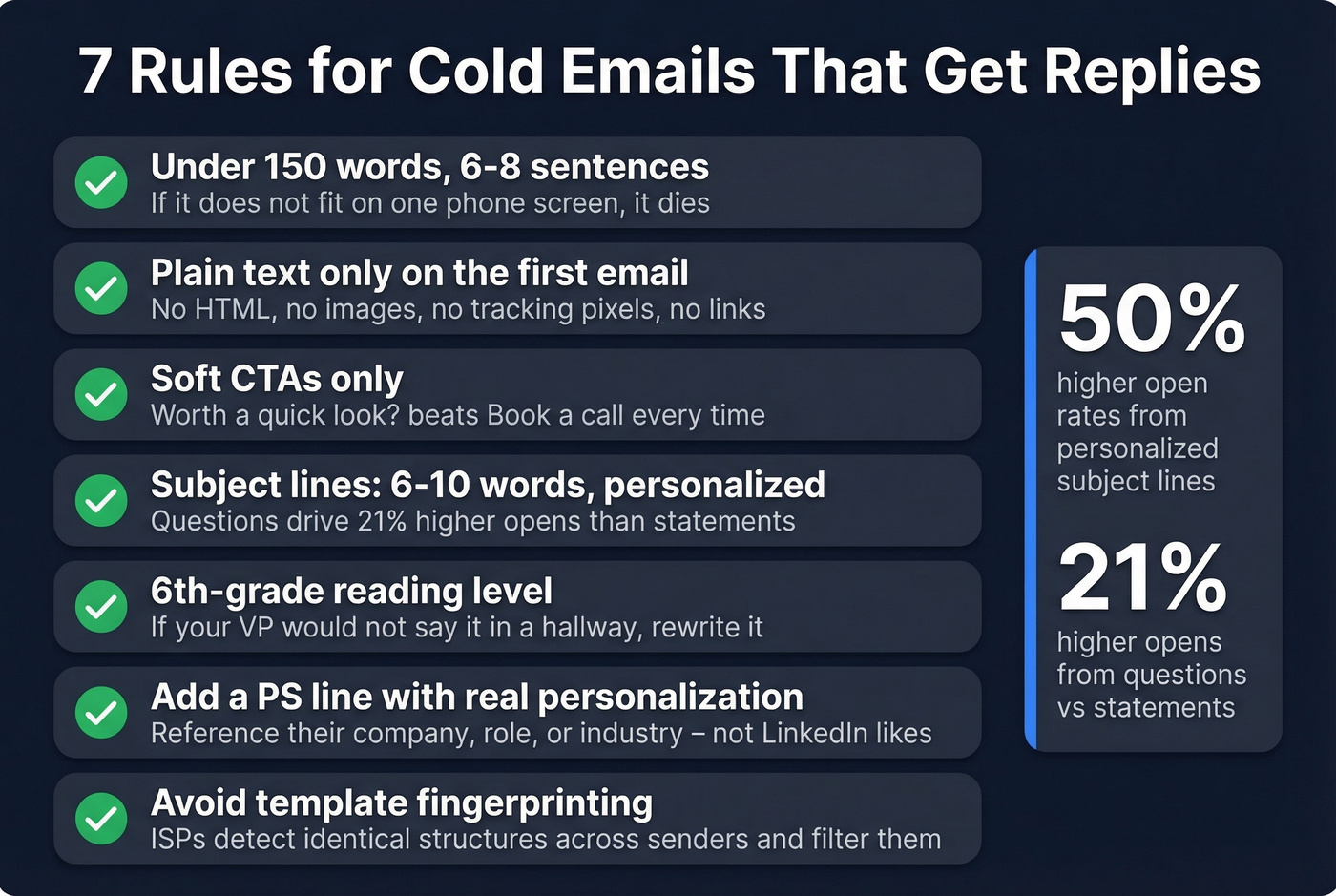
The data points to a clear set of rules. Follow them and you'll outperform most outbound teams by default.
Here's what a good first email actually looks like:
Subject: quick question about {{company}}'s outbound

Hi {{first_name}},

Noticed {{company}} is hiring 3 new AEs   -   usually means
outbound is a priority this quarter.

We help teams like yours cut list-building from 15 hours
to 2-3 hours a week without sacrificing data quality.

Worth a quick look?

  -   [Your name]

PS: Saw your team just closed the Series B. Congrats   -
that's a big milestone for the GTM org.
Six sentences. Plain text. One soft CTA. Specific PS line. That's the template - now here are the principles behind it. (For more frameworks, see email copywriting.)
Keep it under 150 words, 6-8 sentences. That's the sweet spot from the benchmark data. If it doesn't fit on one phone screen, it dies.
Plain text only on the first email. No HTML formatting, no images, no links. Tracking pixels insert invisible code that ESPs detect and route to spam. Save links for follow-ups after your first email lands in the primary inbox - Forbes' deliverability guidance backs this up.
Use soft CTAs. "Worth a quick look?" and "Should I send more details?" outperform hard "Book a call" CTAs. One CTA per email - multiple CTAs perform worse than none at all.
Subject lines: 6-10 words, personalized. Personalized subject lines pull 50% higher open rates. Questions drive 21% higher opens than statements. Keep them under 45 characters for mobile. Skip exclamation marks. (If you need a swipe file, use these cold email subject line examples.)
Write at a 6th-grade reading level. Short sentences, simple words. If your VP of Marketing wouldn't say it out loud in a hallway conversation, rewrite it.
Add a PS line with real personalization. Not "saw you liked a post" - that's creepy. Reference something specific about their company, role, or industry.
Watch for template fingerprinting. If you're using a popular template from a blog post or course, thousands of other senders are too. ISPs detect identical structures across senders and filter accordingly. Write your own copy or meaningfully rewrite any template you borrow.
Design Your Follow-Up Sequence
The practitioner consensus is that 60-70% of replies come after email #3 or #4. But the benchmark data shows a clear tension: follow-ups drive replies and spam complaints. You need to thread the needle.
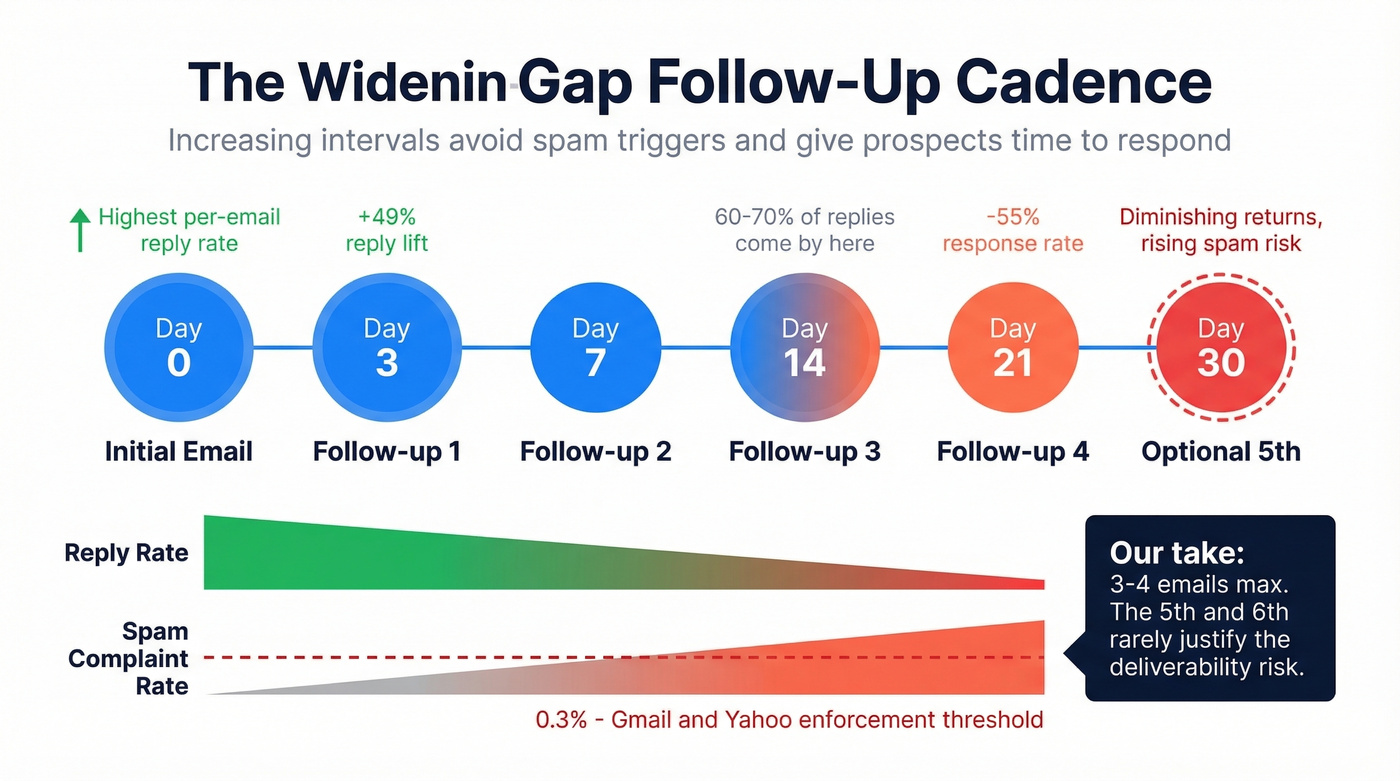
Use a widening-gap cadence: Day 0, Day 3, Day 7, Day 14, Day 21, Day 30. The increasing intervals give prospects time to respond naturally and avoid the predictable velocity patterns that trigger spam filters. Daily follow-ups look robotic to both humans and algorithms.
The diminishing-returns math is straightforward. Follow-up #1 lifts replies up to 49%. By the 4th round, response rates are down 55% from earlier emails. Meanwhile, spam complaints climb from 0.5% to 1.6%. If your complaint rate approaches 0.3% - Gmail and Yahoo's enforcement threshold - stop the sequence immediately.
Our take: most teams send too many follow-ups, not too few. Three to four is the practical maximum. The fifth and sixth emails in a sequence rarely justify the deliverability risk. If someone hasn't replied after four touches, they're either not interested or your targeting was off. More emails won't fix either problem.
Don't Stop at Email
Email-only sequences leave replies on the table. Practitioners see 3X better reply rates when combining email with a social touch and a polite call. A good rule: no more than half your sequence touches should be email. Add a connection request between emails #2 and #3, and task a brief phone call after email #3. Tools like Lemlist and Reply.io make this easier to orchestrate across channels.
Baseline timing: Tuesday through Thursday, 9-11 AM in the recipient's timezone. Cap each inbox at 50 sends per day.
The Tools You Actually Need
You need two tools: one for data, one for sending. That's the minimum viable stack. Everything else is optional until you're sending at scale.
| Tool | Category | Starting Price | G2 Rating | Best For |
|---|---|---|---|---|
| Prospeo | Data & Verification | Free (75 emails/mo); ~$0.01/email paid | 4.2/5 | Verified emails & mobiles |
| Instantly.ai | Sending | $30/mo | 4.9/5 | Scaling with built-in warmup |
| Smartlead | Sending | $39/mo | 4.6/5 | High-volume inbox rotation |
| Lemlist | Multi-channel | $69/mo | 4.4/5 | Email + social sequences |
| Apollo | Database + Sending | Free (100 credits); $59/mo paid | 4.8/5 | Free-tier list building |
| GMass | Gmail-native | $25/mo | 4.7/5 | Gmail power users |
| Reply.io | Multi-channel | $99/mo per user | 4.6/5 | Multi-channel outreach |
| Woodpecker | Sending | $29/mo | 4.5/5 | Deliverability-focused teams |
Most tools listed offer a free plan or trial - test before you commit. Most sending tools support A/B testing on subject lines and copy, and you should use it from day one. (If you’re evaluating platforms, start with these SDR tools.)
The minimum viable stack: A data and verification tool, a sending platform like Instantly.ai or Smartlead, and your existing CRM. That's it. Add multi-channel tools later, but don't overcomplicate your first campaigns.
Scaling Without Killing Deliverability
Track reply rate. It's the only metric that directly correlates with meetings booked. A healthy campaign runs 5-8%; strong ones hit 8-10%+.
Track bounce rate. This is your data quality indicator. Above 3% is a red flag. Above 5% actively damages your domain.
Skip open rate tracking. Tracking pixels trigger spam filters and hurt deliverability. Reply rate is your primary performance signal; bounce rate is your data quality check. The deliverability cost of pixel tracking isn't worth the unreliable data you get back. (If you want the technical why, see email tracking pixels.)
When to kill a campaign: If reply rates sit below 2% after 200+ sends with verified data, the problem is targeting or copy - not volume. Iterate on the message or tighten the ICP. Sending more of the same email to more people won't fix a fundamentals problem. Treat measurement as the backbone of your outreach strategy - every campaign should feed learnings into the next one.
Legal Compliance by Region
| Jurisdiction | Model | Key Requirements | Penalty |
|---|---|---|---|
| US (CAN-SPAM) | Opt-out | Physical address, opt-out link, 30-day honor | $51,744-$53,088/msg |
| EU (GDPR) | Legitimate interest | LIA + 3-part balancing test | Up to 4% revenue |
| Canada (CASL) | Consent-first | Implied/express consent, 10-day unsub | Up to $10M CAD |
| UK (PECR) | Opt-out | Truthful sender, honor opt-outs | Up to £500K |
The biggest compliance mistake isn't missing an unsubscribe link - it's data sourcing. "We didn't collect it ourselves" isn't a defense under GDPR. If you're buying lists from third-party providers, you need to know how that data was sourced and whether consent or legitimate interest applies. (Related: is it illegal to buy email lists.)
Under GDPR, B2B cold email is legal under legitimate interest (Article 6(1)(f)), but you need to document a Legitimate Interest Assessment. The three-part test: is there a legitimate purpose, is email necessary to achieve it, and do the recipient's rights outweigh your interest? For relevant B2B outreach to named professionals, this usually passes.
CASL is the strictest - it's consent-first. Implied consent covers existing business relationships within 24 months and conspicuously published addresses relevant to the recipient's role. Keep opt-out records for at least three years. Manage suppression lists across every tool in your stack - the fastest way to get a complaint is re-adding someone who already unsubscribed because your data provider refreshed the list.
Skip CASL compliance if you don't sell into Canada. But if you do, don't wing it.
FAQ
How many follow-ups should I send?
Three to four maximum. The 16.5M-email study shows replies drop 55% by the 4th round and spam complaints climb from 0.5% to 1.6%. Use a widening-gap cadence - Day 0, 3, 7, 14, 21 - to stay safe while maximizing responses.
Is cold email legal?
Yes, in most jurisdictions with the right compliance framework. CAN-SPAM requires an opt-out mechanism and physical address. GDPR allows B2B outreach under legitimate interest with a documented assessment. CASL requires implied or express consent before sending.
What reply rate should I expect?
The industry average is 5.8% across 16.5 million emails. Well-targeted campaigns with verified data and concise copy regularly reach 8-10%+. Below 4% after 200+ sends, revisit your ICP or messaging before scaling volume.
Should I track open rates?
No. Tracking pixels trigger spam filters and hurt deliverability. Reply rate is the only reliable performance signal, and bounce rate is your data quality check. The deliverability cost of pixel tracking isn't worth the unreliable data you get back.
What's the best free tool for verifying email lists?
Prospeo offers 75 free verified emails per month with its 5-step verification process, including catch-all handling and spam-trap removal. For teams running real campaigns, that free tier covers enough ground to test your first sequences without sacrificing accuracy.