

Cold Email Etiquette: The Rules That Actually Get Replies
A RevOps lead on r/Entrepreneur watched their reply rate drop from 8% to 3% over 18 months. Same copy, same offer, same ICP. The problem wasn't the writing - it was everything underneath it. Cold email etiquette isn't about being polite. It's three layers deep: technical, legal, and human. Most teams only think about the third one.
Start With Infrastructure, Not Writing Tips
If your authentication is broken and your list is full of dead addresses, the best email in the world lands in spam. Fix three things first: SPF/DKIM/DMARC, verified contact data, and emails under 80 words. Then worry about tone. Proper etiquette for sales outreach starts well before you write a single word.
Benchmarks You're Competing Against
The average cold email reply rate is 3.43%. Elite campaigns exceed 10%. Average B2B open rate runs about 27.7%. And 58% of all replies come from the first email in a sequence, which means your opener carries most of the weight.
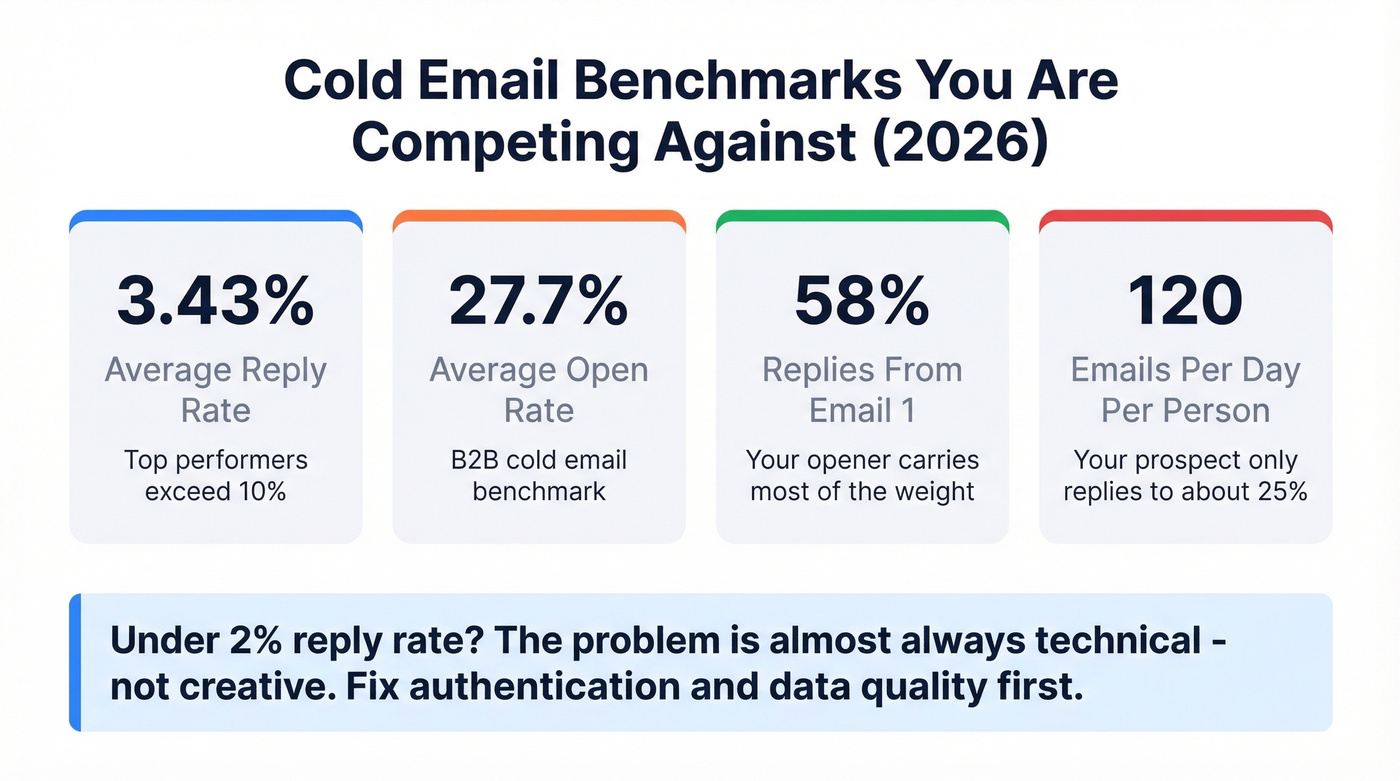
The average professional receives 120 new emails per day and responds to roughly 25% of them - your cold email is competing against all of that.
Under 2% reply rate? The problem is almost always technical, not creative.
Technical Foundations
This is the layer most people skip, and it's the one that matters most.
Authentication Is Non-Negotiable
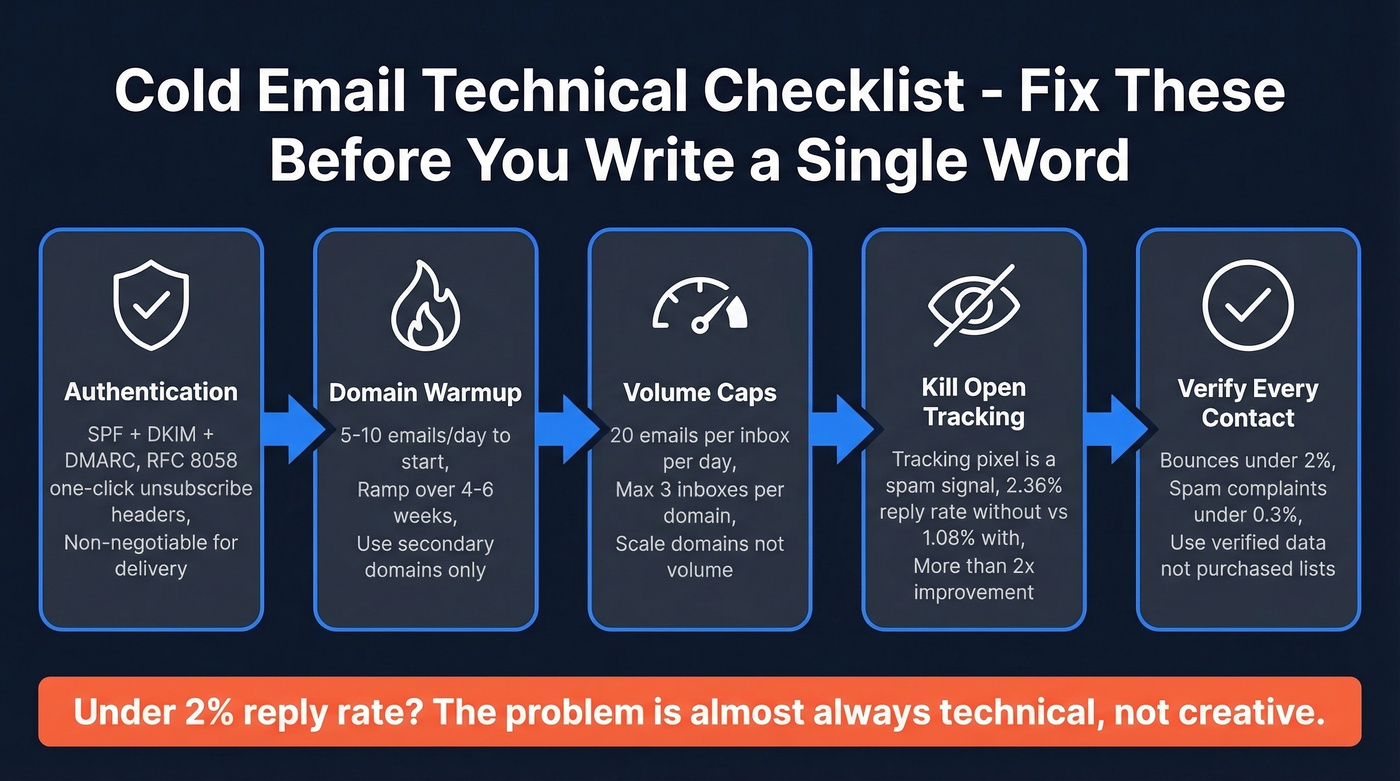
Bulk sender rules now require SPF, DKIM, and DMARC, plus RFC 8058 one-click unsubscribe headers for marketing emails. If you haven't set these up, your emails aren't arriving. Full stop.
Warm Up New Domains Properly
Start at 5-10 emails per day and ramp gradually over 4-6 weeks. Send from secondary domains - never your primary - and strip images and excess HTML, which trigger spam filters. Jumping straight to production volume is the fastest way to torch a domain.
Respect Volume Caps
Keep sends to 20 emails per inbox per day, max 3 inboxes per domain. That r/Entrepreneur operator scaled from 3 to 7 sending domains, each capped at 26 emails/day. Their full stack cost $420/month and produced 16 qualified leads - proof that infrastructure investment pays off. (If you're unsure where your safe limits are, start with email velocity.)
Turn Open Tracking Off
A study of 44 million emails found that campaigns without open tracking more than doubled reply rates - 2.36% vs 1.08%. The tracking pixel is a spam signal now. If you want the technical why, see email tracking pixels.
Keep bounces under 2% and spam complaints under 0.3%. These are enforced thresholds. That same operator went from 3% to 6% reply rate, and the single biggest fix was dropping bounce rate from 11% to under 2% by switching from purchased lists to verified contacts.

Here's the thing: bad data is the #1 campaign killer. You can nail every other rule on this list, but if 10% of your emails bounce, mailbox providers flag you as a spammer. We've seen teams rebuild their entire outbound strategy only to discover the list was the problem all along. Prospeo's database covers 300M+ profiles with 98% email accuracy on a 7-day refresh cycle, which catches job changes that stale databases miss. Verify before you send, every time. (For bounce benchmarks and root causes, use this email bounce rate guide.)
Legal Requirements by Region
Cold email is legal in most jurisdictions. But "legal" comes with specific requirements.
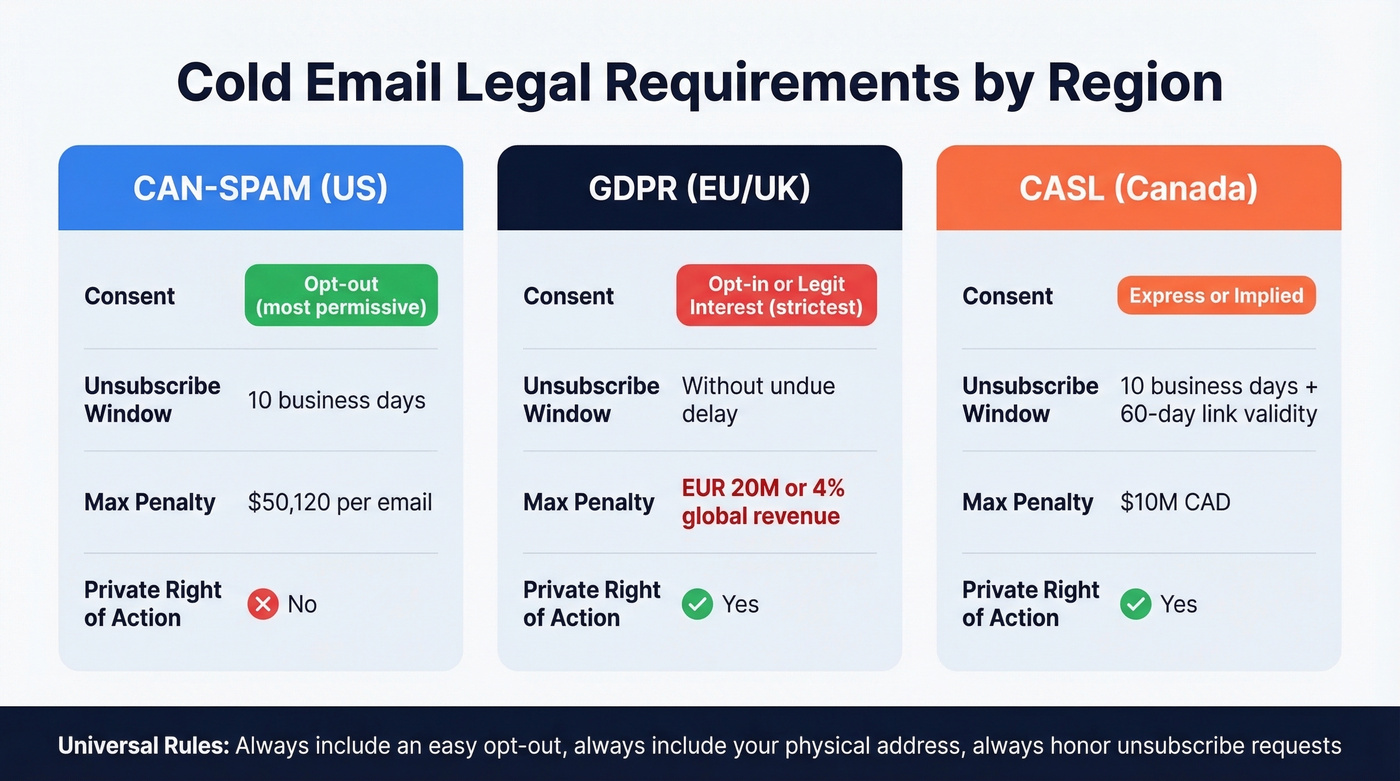
| CAN-SPAM (US) | GDPR (EU/UK) | CASL (Canada) | |
|---|---|---|---|
| Consent | Opt-out | Opt-in / legit interest | Express or implied |
| Unsubscribe | 10 business days | Without undue delay | 10 business days |
| Penalties | $50,120/email | EUR 20M or 4% revenue | $10M CAD |
| Private action | No | Yes | Yes |
CAN-SPAM is the most permissive - you can email without prior consent as long as you include a physical address, an unsubscribe mechanism, and honor opt-outs within 10 business days. GDPR is the strictest, requiring either explicit consent or documented legitimate interest. CASL sits in between, accepting implied consent from existing business relationships, and it also requires your unsubscribe mechanism to remain functional for 60 days.
In practice: always include an easy opt-out, always include your physical address, and if you're emailing into the EU, make sure your legitimate interest documentation is airtight. (If you're building a policy around this, start with ethics in sales.)

You just read that dropping bounce rates from 11% to under 2% was the single biggest fix for doubling reply rates. Prospeo's 98% email accuracy and 7-day refresh cycle keep your list clean automatically - catching job changes, dead addresses, and catch-all traps before they torch your domain.
Fix your data first. The etiquette takes care of itself.
Writing Emails That Earn Replies
Subject Lines
Casual, lowercase, curiosity-driven. The operator who doubled their reply rate tested this directly: "Quick question" pulled 39% opens, company-name subjects hit 33%, and "Partnership opportunity" landed under 19%.
Anything that sounds salesy gets auto-deleted. Your subject line should read like it came from a colleague, not a marketing team. (If you need options, pull from these cold email subject line examples.)
Length and Structure
Under 80 words performs best according to Instantly's benchmark data. Practitioners on r/copywriting push even harder - 40-60 words. We've tested this across dozens of campaigns, and shorter always wins. For a deeper framework, see email copywriting.
That same case study cut emails from 141 words to 56 words and watched reply rates climb. The structure that works: a context signal showing why you're reaching out to them specifically, what you do in one sentence, a proof point, and a soft ask. Never send a naked email - no context, no relevance, no reason to reply. Every message needs a clear "why you, why now" signal. (If you're building sequences, use a B2B cold email sequence structure.)
From Name, Preheader, and CTA
Use "Sarah from Acme," not "Acme Sales Team." A person's name in the from field is the difference between getting opened and getting ignored.
The preheader - that preview text after the subject line - is the second thing recipients see. Treat it like a second subject line, not a throwaway. (If you want to test it properly, use email preview text A/B testing.)
One CTA only. "Worth a conversation?" beats "Book 30 minutes on my calendar" every time. Soft asks reduce friction. Hard closes feel pushy, and the consensus among practitioners is that they tank reply rates. Feature-dumping, aggressive calendar links, no personalization - that's the fastest way to get flagged and ignored. (More CTA patterns here: email call to action.)
Follow-Up Dos and Don'ts
The sweet spot is 4-7 touchpoints, spaced 3-4 days apart. Under 4 gives up too early. Beyond 7, returns diminish sharply unless each touch adds genuinely new value. Send Tuesday through Thursday, 8-11 AM in the recipient's timezone.
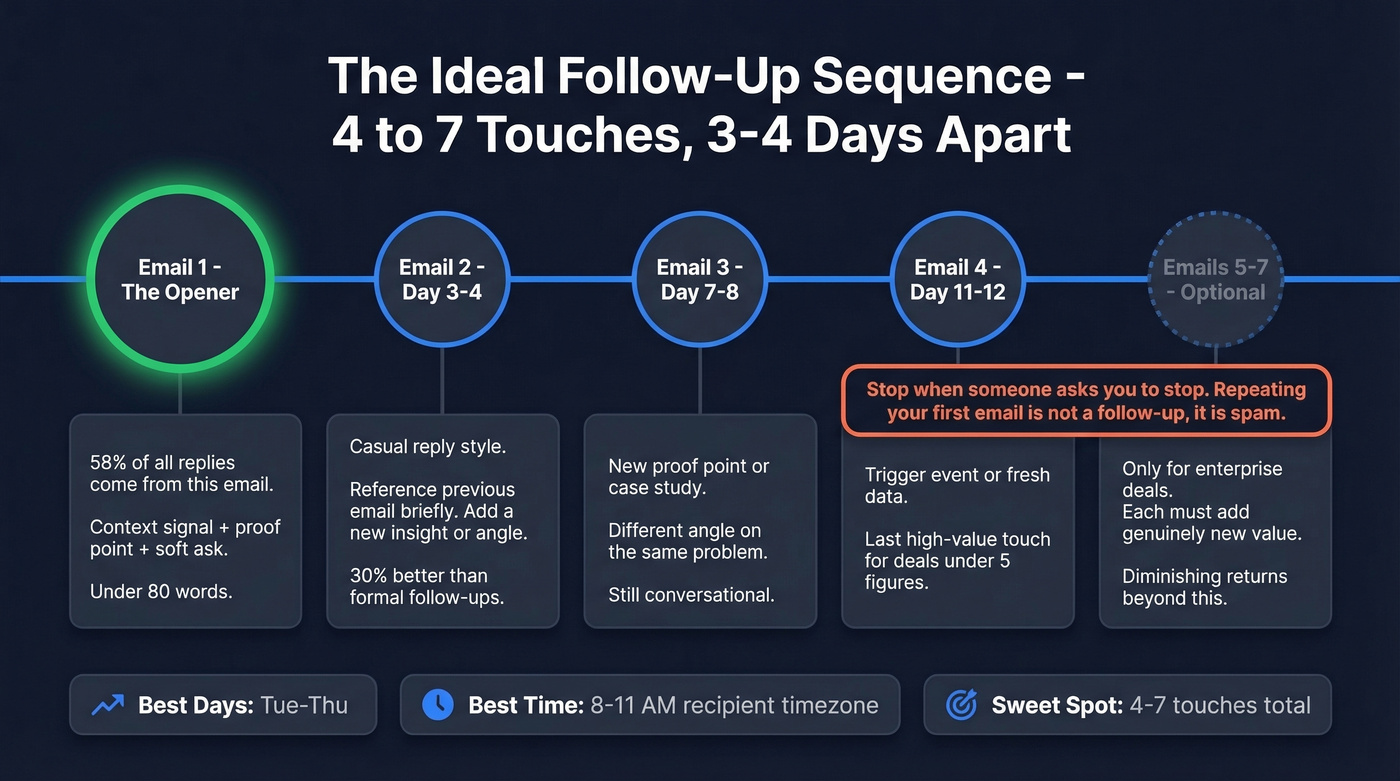
Step-2 emails that feel like casual replies outperform formal follow-ups by roughly 30%. Good follow-up etiquette means referencing your previous message briefly, adding a new insight or proof point, and keeping the tone conversational rather than accusatory. The most important rule: stop when someone asks you to stop. Repeating your first email word-for-word isn't a follow-up - it's spam. (If you need copy you can paste, use these cold email follow-up templates.)
Let's be honest: if your deal size is under five figures, you don't need a 7-step sequence. Three touches with genuine value will outperform seven touches of recycled copy every single time.
Good vs. Bad - Side by Side
The bad version: 140 words, "Exciting Partnership Opportunity" subject line, generic "hope you're doing well" opener, feature-dumping about an "award-winning platform," and a hard calendar push. It screams mass email.
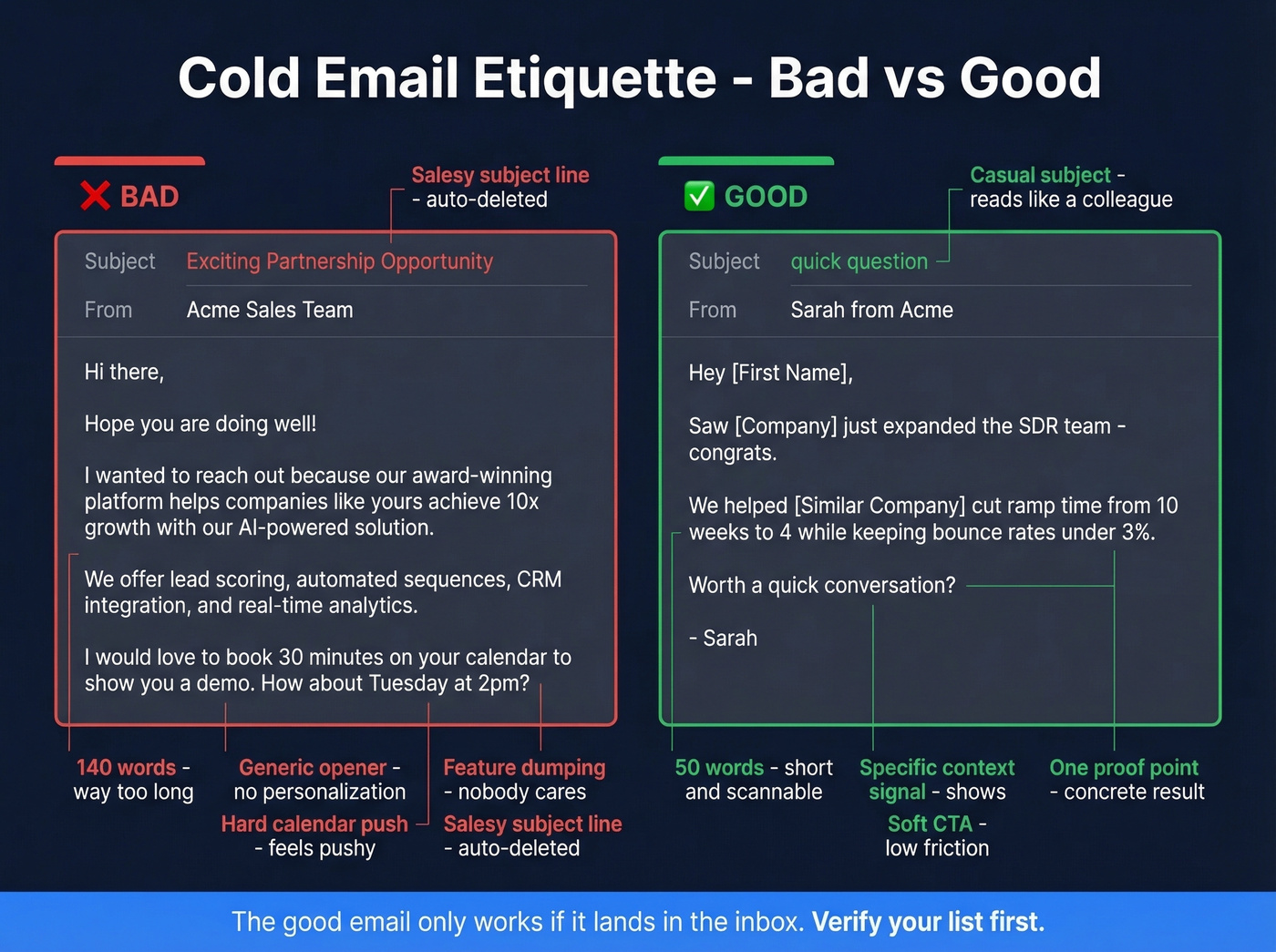
The good version:
Subject: quick question
Hey [First Name],
Saw [Company] just expanded the SDR team - congrats. We helped [Similar Company] cut ramp time from 10 weeks to 4 while keeping bounce rates under 3%.
Worth a quick conversation?
- Sarah
Look at what changed. The subject line dropped from salesy to casual. The opener swapped a generic greeting for a specific context signal. The body went from 140 words of feature-dumping to 50 words with one proof point. And the CTA softened from a calendar push to a simple question.
That good email only works if it lands in the inbox. Build your list from verified sources rather than buying bulk lists that'll wreck your domain reputation.
Every etiquette rule in this article falls apart if your emails never arrive. Prospeo verifies 300M+ contacts through a 5-step process with spam-trap removal and honeypot filtering - so you stay under the 2% bounce threshold and 0.3% complaint rate that mailbox providers enforce.
Stop guessing which emails are real. Verify at $0.01 each.
Cold Email Etiquette FAQ
Is cold email legal?
Yes, in most jurisdictions. CAN-SPAM allows unsolicited email with a physical address, unsubscribe link, and opt-out compliance within 10 business days. GDPR requires documented legitimate interest or explicit consent. CASL requires express or implied consent from an existing business relationship.
How many follow-ups is too many?
Four to seven touchpoints is the proven sweet spot. Beyond seven, returns diminish sharply and you risk spam complaints. Each follow-up must add new value - a fresh case study, a different angle, or a relevant trigger event.
What's a good cold email reply rate?
The average is 3.43%, while top performers exceed 10%. Under 2% usually signals a technical problem - broken authentication, high bounce rates, or stale data - not a copywriting problem.
How do I keep bounce rates low enough to protect my domain?
Keep bounces under 2% by verifying every address before sending. A 5-step verification process with catch-all handling and spam-trap removal catches the edge cases that basic verification misses. Pair verified data with proper SPF/DKIM/DMARC and you'll stay well within safe thresholds.
What separates professional from unprofessional outreach?
Preparation. Verified data, proper authentication, personalized context, and a respectful follow-up cadence form the baseline. Skipping any of these - blasting unverified lists, using misleading subject lines, or ignoring opt-outs - damages your brand and your domain reputation simultaneously.