

GTM Consulting: What It Costs & How to Choose in 2026
Most GTM consulting firms don't publish pricing. You're expected to book a call, sit through a deck, and wait for a proposal before learning whether this costs $5,000 or $250,000. That ends here.
What Go-to-Market Consulting Actually Is
Go-to-market consulting isn't a marketing agency, and it isn't sales training. It's the layer above both - aligning positioning, segmentation, channels, sales motion, and ops infrastructure into a system that generates pipeline.
The demand is real. Roughly 76% of organizations have significantly reinvented their go-to-market approach in the past three years. That's not incremental tuning. It's wholesale rebuilding. And 81% of B2B buyers pick vendors before talking to sales, which means your GTM engine needs to do the selling long before a rep gets involved.
Here's the thing: most companies don't need a consultant. They need a GTM operating system. If the consultant leaves and everything breaks, you didn't get go-to-market consulting - you got an expensive temp. The best engagements build playbooks, dashboards, and processes that outlast the retainer.
What a GTM Consultant Does
The best engagements follow three phases: Diagnose, Design, Execute.
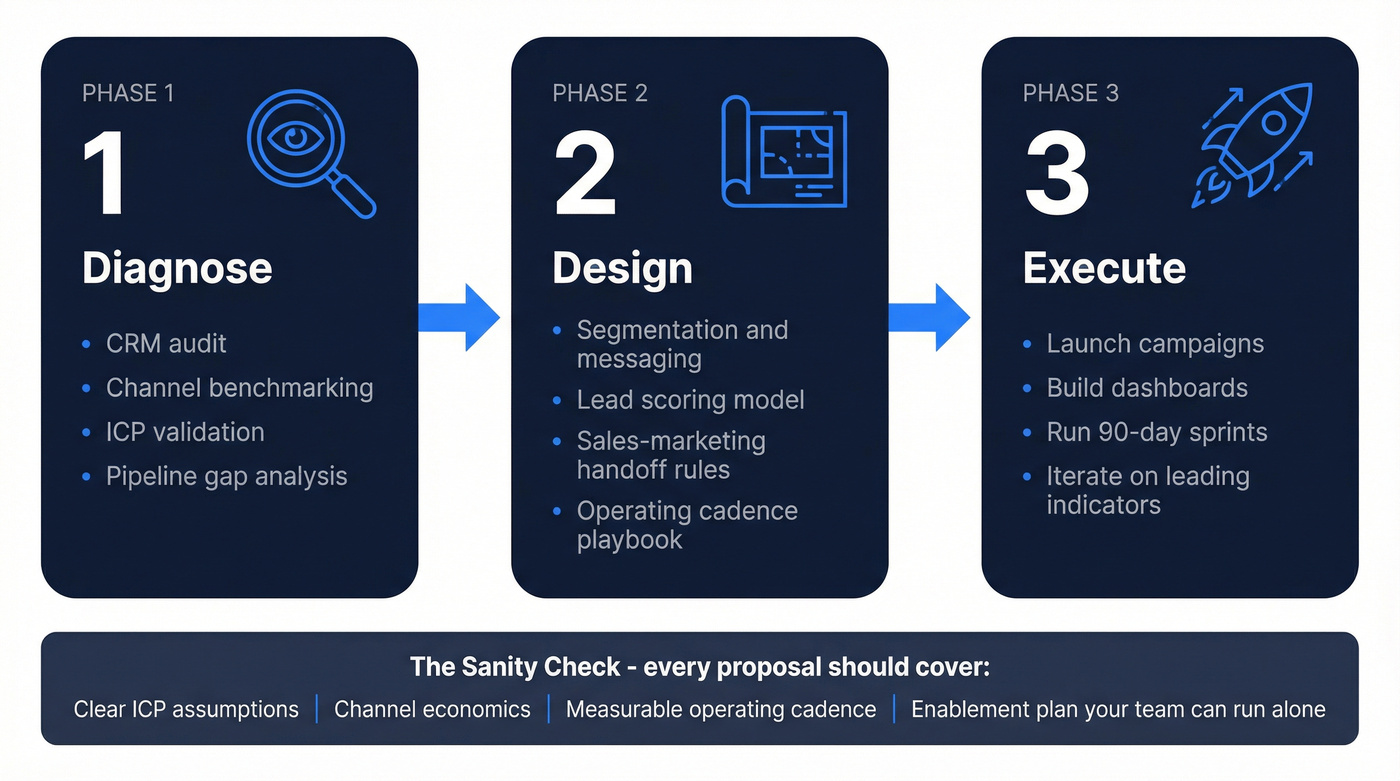
Diagnosis means a CRM audit, channel benchmarking, and ICP validation. Design is the playbook - segmentation, messaging, lead scoring, handoff definitions, and the operating cadence tying sales and marketing together. Execution is where engagements prove their value or fall apart: launching campaigns, building dashboards, running 90-day sprints, iterating on leading indicators.
If you want a simple go-to-market strategy framework to sanity-check a proposal, look for clear ICP assumptions, channel economics, a measurable operating cadence, and an enablement plan your team can run without the consultant. That's it. If the proposal doesn't address all four, push back.
Gartner projects that by 2026, 75% of the highest-growth B2B companies will run a formalized GTM or RevOps model. The rest will keep guessing.
Signs You Need Help
Your board just asked why pipeline is down 30% and nobody could explain it beyond "the market's tough." That's the moment. Organizations with fragmented go-to-market models achieve only 60% of their revenue growth potential, so the cost of not fixing this is concrete and measurable.
Here's the diagnostic checklist:
- AE quota attainment is cratering. The ICONIQ benchmark puts median AE attainment at 58%. If yours is well below that, something structural is broken.
- You're targeting too broadly. No beachhead market, no clear ICP, just "mid-market SaaS companies" as a segment.
- Your sales motion doesn't match your product. Enterprise plays for a self-serve product, or vice versa.
- You scaled before validating product-market fit. You hired reps before the founder could close consistently.
- CAC is climbing with no explanation. CAC creep without corresponding LTV growth is a GTM architecture problem, not a media buying problem. (If you need a clean definition and benchmarks, start with CAC.)
- 30%+ of outbound emails bounce. When that happens, the problem isn't messaging - it's data quality. Verified contacts need to enter sequences before reps burn domain reputation on dead addresses. (If you want the benchmarks and fixes, see email bounce rate.)
Early-stage founders run into the same failure mode over and over: spending on paid acquisition before ICP, positioning, and the funnel are validated. When the fundamentals are wrong, ads don't "create demand." They just amplify waste.

The article above flags 30%+ bounce rates as a sign your GTM is broken. That's not a messaging problem - it's a data problem. Prospeo delivers 98% email accuracy with a 7-day refresh cycle, so every sequence your GTM consultant builds runs on contacts that actually exist. At $0.01 per email, fixing your enrichment layer costs less than one hour of consulting.
Stop paying consultants to optimize campaigns built on dead data.
GTM Consulting Pricing
We've pulled together real ranges so you don't walk into a call blind.
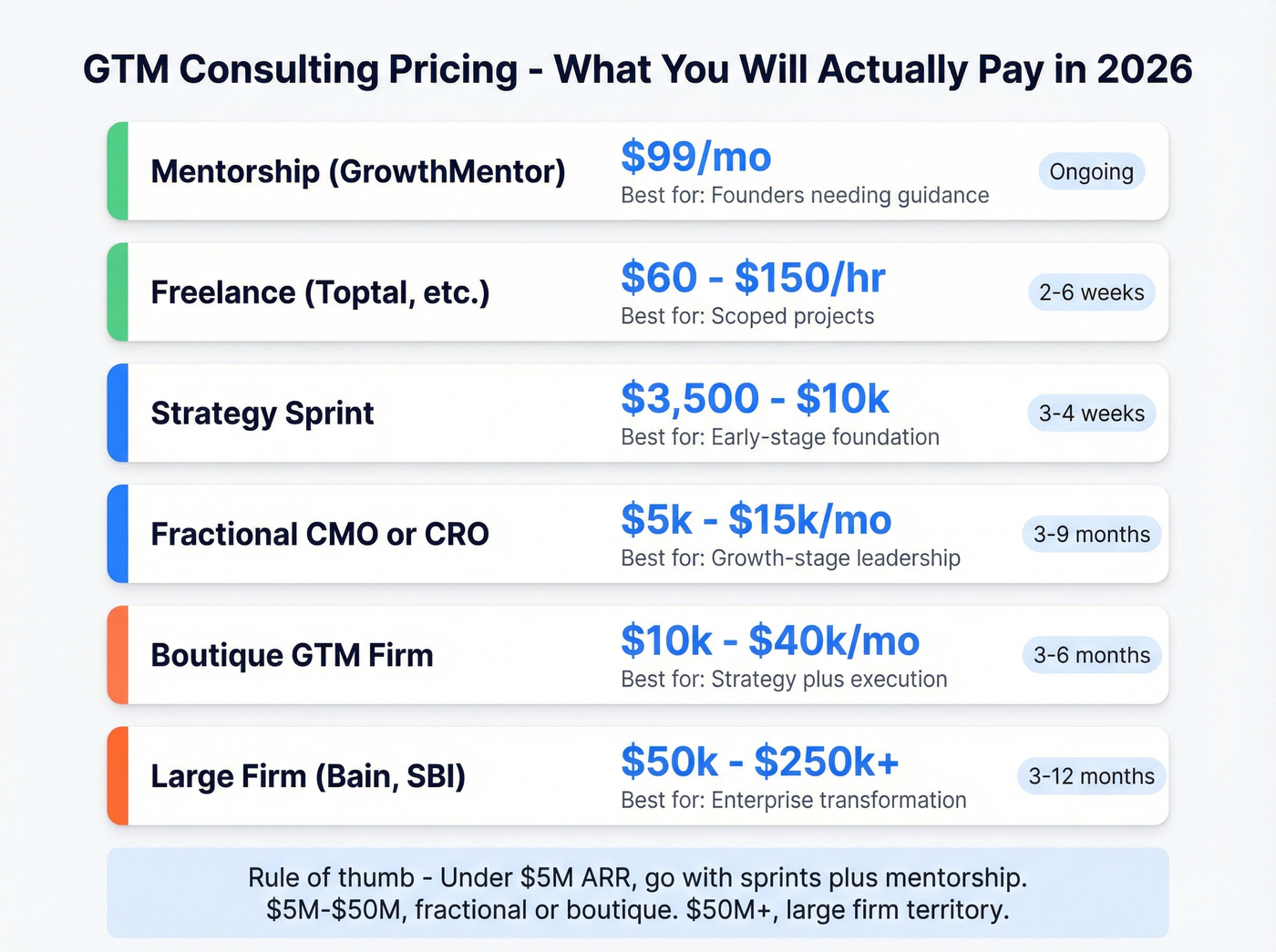
| Engagement Type | Typical Cost | Best For | Timeline |
|---|---|---|---|
| Mentorship (GrowthMentor) | $99/mo | Founders needing guidance | Ongoing |
| Freelance (Toptal, etc.) | $60-$150/hr | Scoped projects | 2-6 weeks |
| Strategy sprint | $3,500-$10k | Early-stage foundation | 3-4 weeks |
| Fractional CMO/CRO | $5k-$15k/mo | Growth-stage leadership | 3-9 months |
| Boutique GTM firm | $10k-$40k/mo | Strategy + execution | 3-6 months |
| Large firm (Bain, SBI) | $50k-$250k+ | Enterprise transformation | 3-12 months |
BCG research shows companies with mature go-to-market strategies outperform laggards by roughly 4% in revenue growth and 6% in profit growth. While that data comes from consumer markets, we've seen the same pattern hold in B2B SaaS - the investment pays back if you pick the right engagement type for your stage.
Rules of thumb by company stage: Sub-$5M ARR? A strategy sprint plus mentorship will get you further than a $30k/mo retainer. Between $5M and $50M? A fractional CRO or boutique firm like Beacon GTM, Directive, or Gravity Global gives you senior strategic support without a full-time salary. North of $50M? That's when firms like Alexander Group, SBI Growth, or Winning by Design earn their fees.
Fractional vs. Consultant vs. Full-Time
If results need to land in under 90 days, hire an interim leader - they'll stabilize the situation and buy you time to recruit. For work that's narrow and stageable over 3-9 months (rebuilding outbound, launching into a new segment), a fractional leader is the sweet spot. Broad and ongoing mandate? You need a full-time hire.
The TCO math is straightforward. Calculate your vacancy cost per month, multiply by the 4-6 months it takes to hire a senior GTM leader, and compare that to 3-6 months of fractional fees. We've run this math with dozens of teams. The fractional route is cheaper and faster to value nearly every time.
How to Evaluate an Engagement
Five questions before signing anything:
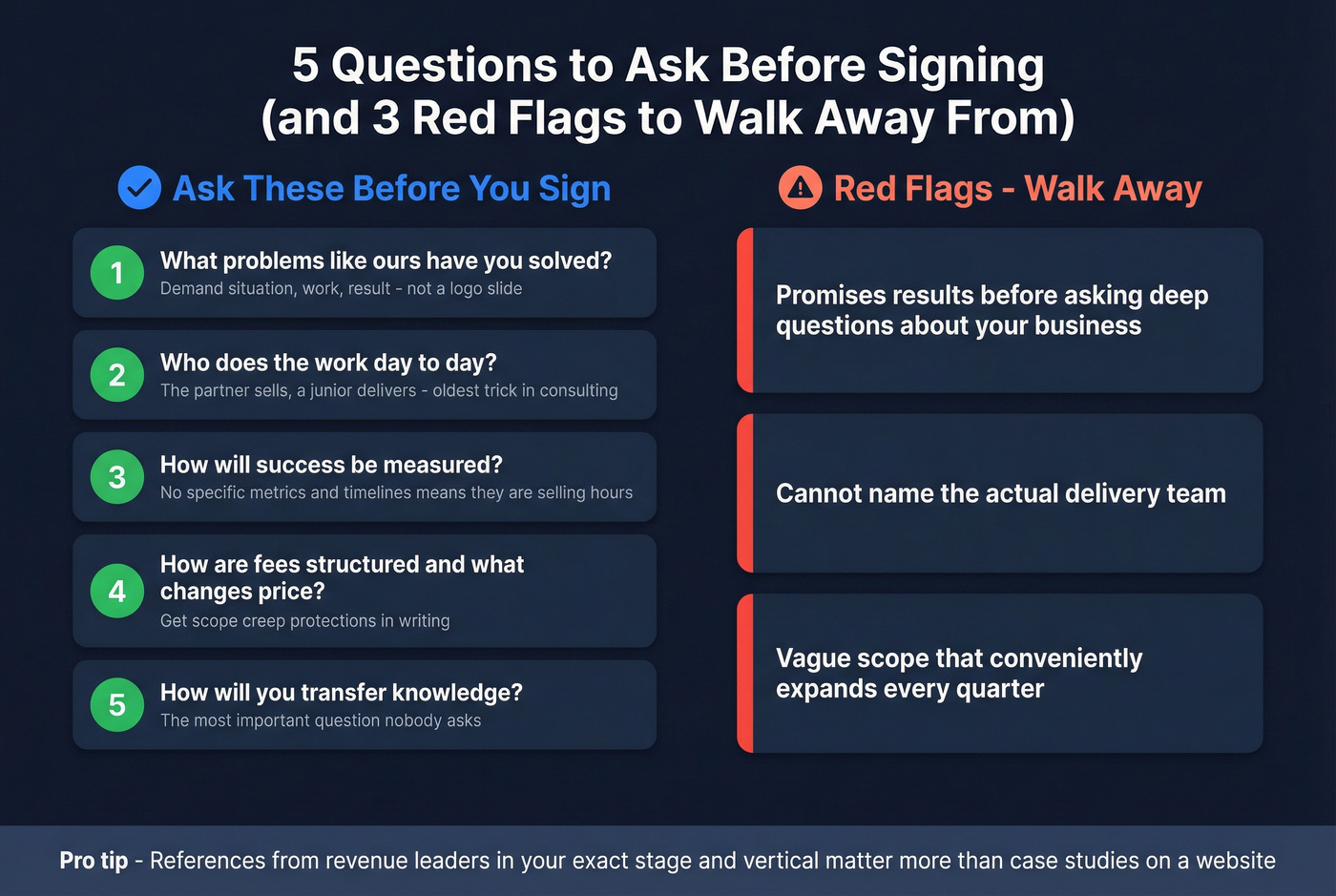
- "What problems like ours have you solved?" Situation, work, result. Not a logo slide.
- "Who does the work day-to-day?" The bait-and-switch where a partner sells and a junior delivers is the oldest trick in consulting. It's also the most common red flag we see.
- "How will success be measured?" No specific metrics and timelines? They're selling hours, not outcomes. (If you want a practical set of KPIs, use funnel metrics.)
- "How are fees structured and what changes price?" Scope creep kills budgets. Get this in writing.
- "How will you transfer knowledge?" The most important question nobody asks.
When you're comparing a solo go-to-market consultant against a strategy agency, ask for recommendations from revenue leaders in your space and then verify them with specific, recent outcomes. The consensus on r/sales and r/startups is consistent: references from people in your exact stage and vertical matter more than case studies on a website.
Red flags: Promising results before asking deep questions about your business. Can't name the delivery team. Vague scope that conveniently expands every quarter. Skip any firm that checks all three.
The GTM Tool Stack
The average software company runs 10.5 simultaneous go-to-market initiatives. The tool stack either makes that manageable or makes it worse.
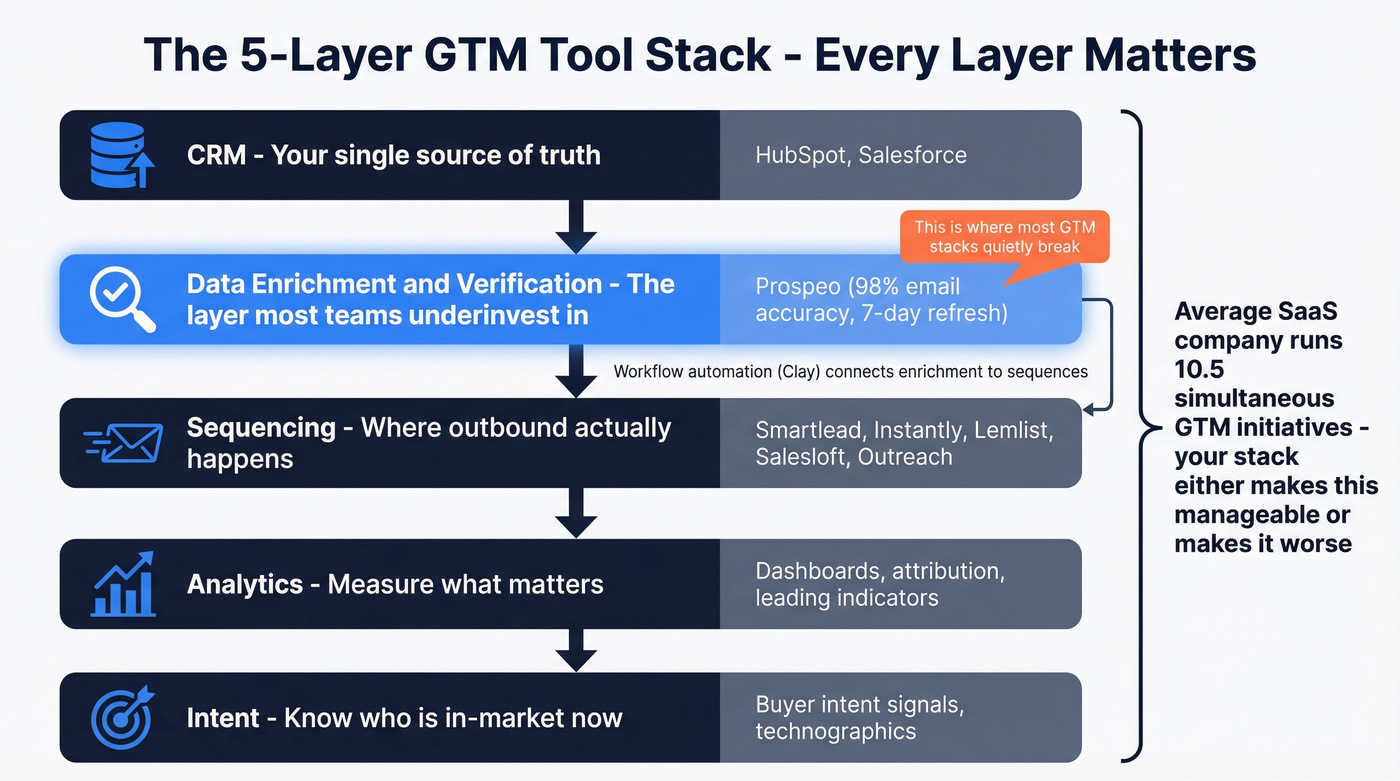
Every stack needs five layers: CRM (HubSpot or Salesforce), data enrichment, sequencing, analytics, and intent. The enrichment layer is where most teams underinvest - and it quietly sabotages everything else. Cold email reply rates have dropped from 6.8% to 5.8% year over year, and timeline-based hooks outperform generic problem hooks by more than 2x (10.01% vs. 4.39% reply rate). When margins are that thin, sending to unverified contacts actively damages your domain. (If you're rebuilding outbound, start with a modern B2B cold email sequence.)
Let's be honest about what we've seen in practice: teams will spend $40k/mo on a GTM consultant and then feed their outbound sequences with garbage data. It's like hiring a Michelin-star chef and giving them expired ingredients. Prospeo handles enrichment and verification with 98% email accuracy and a 7-day data refresh cycle, integrating natively with HubSpot, Salesforce, Clay, Smartlead, Instantly, Lemlist, Salesloft, and Outreach. Free tier available, no contracts.
For workflow automation, Clay connects data sources to sequencers. Pair it with a strong enrichment layer and you've got a pipeline that feeds itself. (If you want the cost/workflow breakdown, see Clay list building.)

Every GTM engagement needs a data enrichment layer that doesn't quietly sabotage the rest of the stack. Prospeo gives your team 300M+ profiles, 30+ search filters including buyer intent and technographics, and a 92% API match rate - so the ICP your consultant defines actually turns into a targetable list. No contracts, no sales calls, no six-figure platform fees.
Build the enrichment layer your GTM strategy actually deserves.
FAQ
How long does a typical engagement last?
Strategy sprints run 3-4 weeks. Full build-and-launch engagements take 3-6 months. Enterprise transformations - new market entry, full RevOps overhaul - run 6-12 months. Scope and company stage are the biggest variables.
Can a startup afford GTM consulting?
Yes. Mentorship platforms cost $99/mo, and strategy sprints start around $3,500. Don't spend on a large firm before validating product-market fit - a sprint plus clean outbound data will stretch further at pre-seed and seed stages than any retainer.
What's the first thing a consultant should fix?
Your ICP. Everything downstream - messaging, channels, data, outbound sequences - depends on knowing exactly who you're selling to. Without a validated ICP, even the best tools and tactics underperform.
What tools should a GTM consultant recommend for outbound data?
Look for a platform combining enrichment, verification, and intent signals. You want 95%+ email accuracy at minimum, a fast data refresh cycle, and native integrations with your CRM and sequencer so reps aren't doing manual data entry.