

GTM Programs: Motions, Tools, and Courses That Work in 2026
A VP of Sales tells the board they're "launching an outbound GTM program." The CMO hears a channel strategy. The CRO hears a software rollout. The CEO hears a training initiative. Nobody's wrong - and that's the problem.
GTM programs mean at least three different things: a strategic motion (outbound, ABM, PLG), a software platform that powers it, or an educational program that teaches your team how to run it. Most companies never clarify which one they're talking about, then wonder why they're running 10.5 simultaneous efforts with nothing to show for it.
Here's the thing: if your average deal size is under $25K, you don't need a sophisticated go-to-market "platform." You need clean data, a CRM, and the discipline to run two motions well.
Why Most GTM Programs Fail
54% of companies didn't create enough pipeline to hit revenue targets last cycle. Win rates dropped 18%. Deal values fell 21% in mid-market B2B. And per Brent Adamson's research, 60% of qualified deals end in no decision at all - not a competitor win, just inertia.
The root cause isn't strategy. It's that most go-to-market "strategy" devolves into process theater - fancy decks that boil down to "sell harder." The average software company runs five core channels plus 5.5 experimental initiatives. That's not a portfolio; it's chaos. Meanwhile, orgs with genuine cross-functional alignment see 19% faster revenue growth and 15% higher profitability.
Even well-designed programs collapse when the foundation is rotten. When bounce rates hit ~35%, your outbound motion isn't broken - your data is. We've watched teams blame messaging, sequences, and SDR effort when the real culprit was a contact database that hadn't been refreshed in over a month.

Six Go-to-Market Motion Types
Outbound remains the fastest path to pipeline for most B2B teams. 2026 benchmarks show average cold email reply rates at 5.8%, down from 6.8% the year before. The lever that matters most: timeline-based hooks pull 10.01% reply rates versus 4.39% for problem hooks - a 2.3x gap.
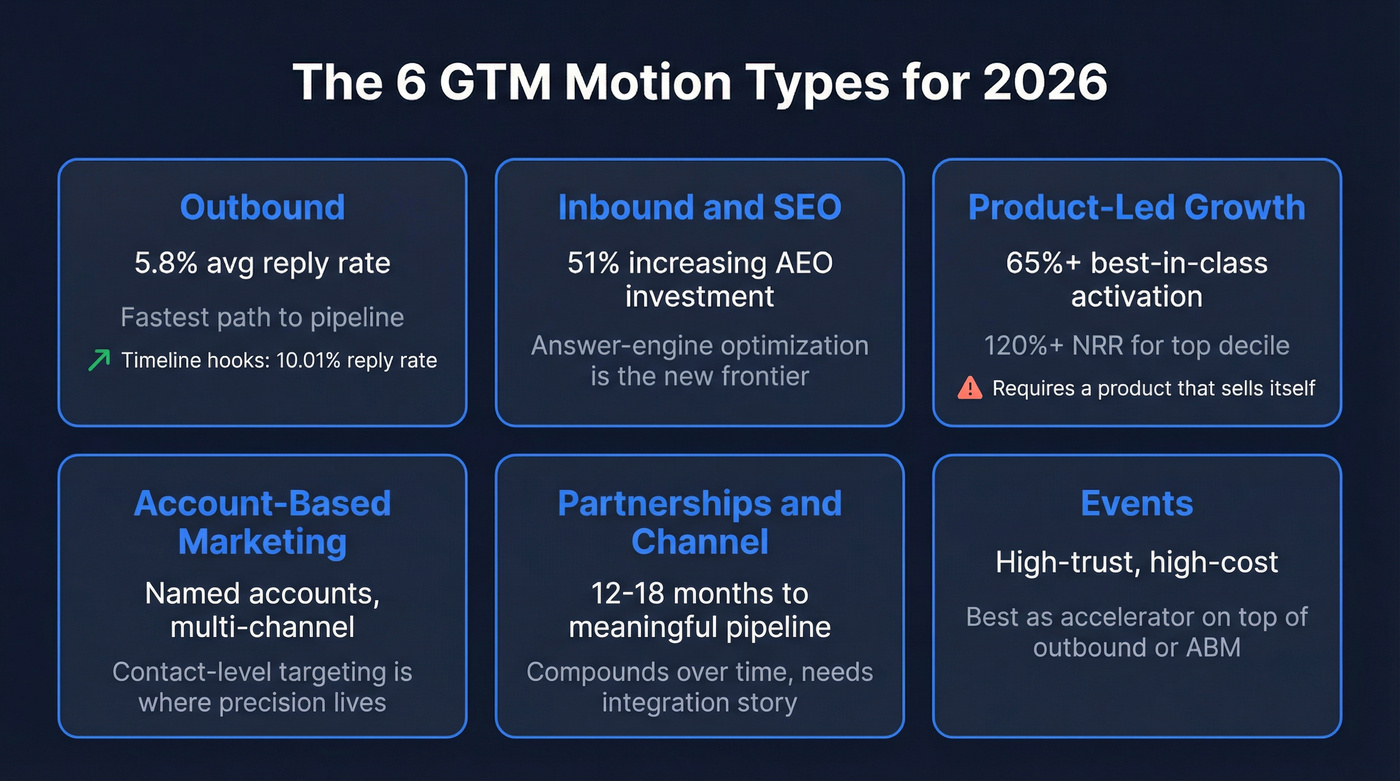
Inbound & SEO is shifting fast. 51% of teams are increasing investment in answer-engine optimization versus just 14% doubling down on traditional SEO. If your content strategy still revolves around keyword-stuffed blog posts, you're already behind.
Product-Led Growth rewards the best and punishes everyone else. Best-in-class activation rates hit 65%+ compared to a 33% average, and top-decile PLG companies maintain net revenue retention above 120%. The catch: PLG requires a product that sells itself, which most enterprise tools don't.
Account-Based Marketing works when you've got a defined ICP, intent signals, and budget for multi-channel plays against named accounts. It fails when it's just outbound with fancier slides. One thing most guides miss: contact-level ABM - targeting specific buyers, not just accounts - is where the real precision lives. And if you're running ABM into EU markets, bake GDPR compliance into your data stack from day one.
Partnerships & Channel compounds over time but takes 12-18 months to generate meaningful pipeline. Best for companies with a clear integration story.
Events remain high-trust, high-cost. They work as an accelerator layered on outbound or ABM - not as a standalone motion.
How to Choose Your Mix
Pick 2-3 motions, resource them properly, measure ruthlessly.
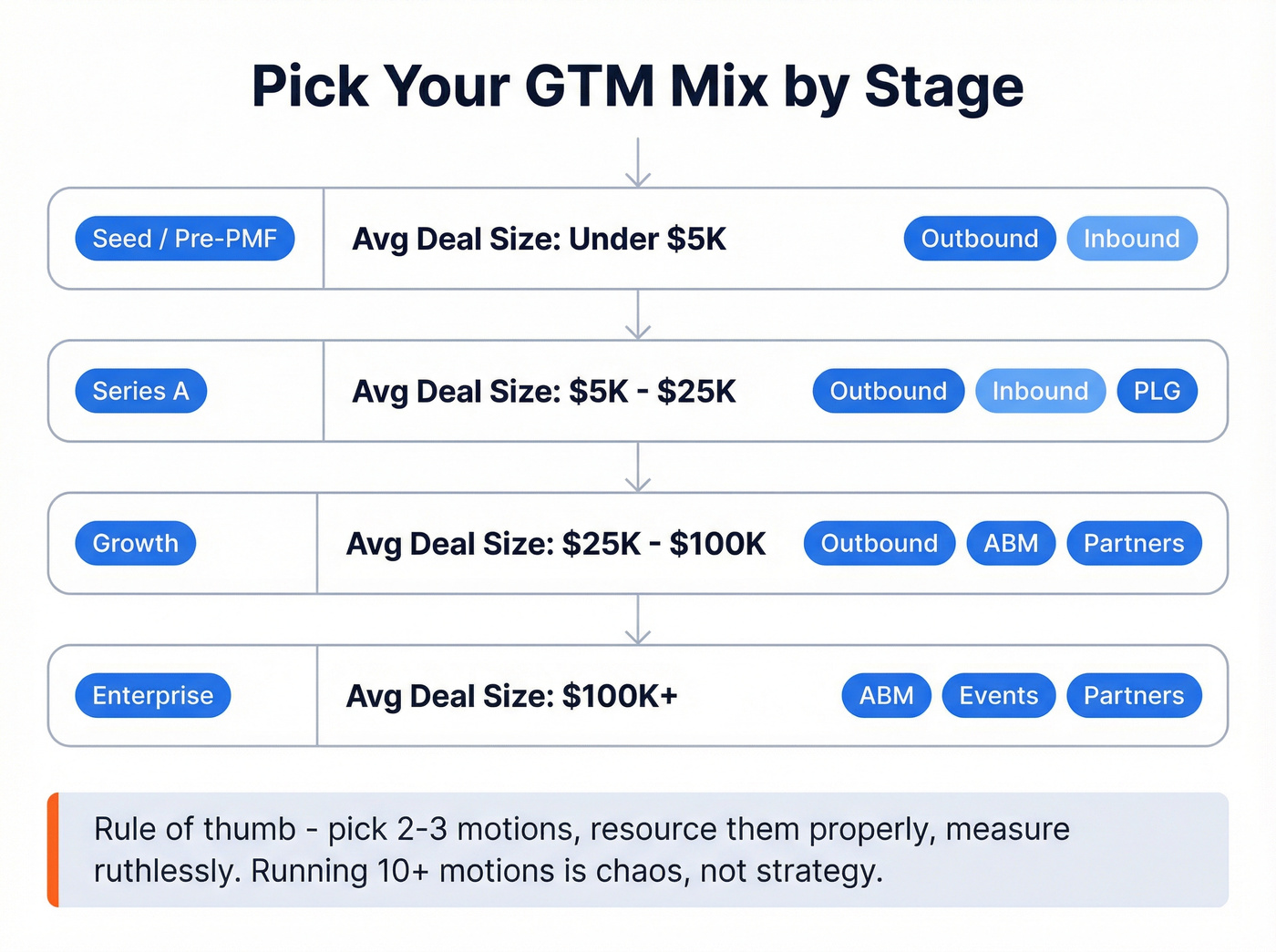
| Stage | Avg Deal Size | Recommended Motions |
|---|---|---|
| Seed / Pre-PMF | <$5K | Outbound + Inbound |
| Series A | $5K-$25K | Outbound + Inbound + PLG |
| Growth | $25K-$100K | Outbound + ABM + Partners |
| Enterprise | $100K+ | ABM + Events + Partners |
One trend worth watching: AI-native systems are collapsing the gap between "motion" and "tool." Platforms that combine synthetic customer testing, automated sequencing, and real-time intent signals are making it possible for a 5-person team to run what used to require 20. The framework above still holds, but the execution layer is getting dramatically cheaper and faster.

54% of companies missed pipeline targets last cycle. The #1 killer? Bad data feeding otherwise solid GTM motions. Prospeo refreshes 300M+ profiles every 7 days with 98% email accuracy - so your outbound, ABM, and PLG plays actually reach real buyers.
Stop blaming your sequences. Fix the data underneath them.
Tools That Power GTM Programs
Prospeo - Data & Prospecting
Every go-to-market motion runs on contact data. Prospeo covers 300M+ professional profiles with 143M+ verified emails and 125M+ verified mobile numbers, all refreshed on a 7-day cycle versus the 6-week industry average. Email accuracy sits at 98%. At $0.01 per email with a free tier included, it's a fraction of what enterprise platforms charge. The 30+ search filters - buyer intent across 15,000 topics powered by Bombora, technographics, job-change signals - let you build targeted lists without bolting on a separate intent tool.
We've seen teams like Snyk cut bounce rates from 35-40% to under 5% and grow AE-sourced pipeline by 180% after switching their data source. That kind of downstream impact is why we always tell people to fix their data before they touch their sequences.

HubSpot - CRM
Free for up to two users and 1,000 contacts, with paid plans starting around ~$20/month per seat. Not the most powerful CRM, but the easiest to adopt - and a CRM nobody uses is worse than a mediocre one everyone does. If you're still evaluating options, start with these examples of a CRM.
Apollo - All-in-One Outbound
Skip this if you care about deliverability above all else. Apollo bundles a contact database with sequencing and a dialer starting at $59/user/mo, and their free plan includes 100 credits/month and 2 email sequences. Good for budget-conscious teams wanting one tool. Data quality doesn't match 98% email accuracy, but the all-in-one convenience is real.
6sense / Demandbase - ABM & Intent
The dominant platforms for account-based programs: intent signals, predictive scoring, advertising orchestration. Typically $30-100K+/year. Overkill for teams under 50 reps. If you're building this motion, use a tighter account-based selling playbook than most ABM guides.
Gong - Revenue Intelligence
Typically ~$100-150/user/mo. Worth it once you've got enough pipeline to analyze patterns - not a day-one purchase.
| Tool | Category | Starting Price | Best For |
|---|---|---|---|
| Prospeo | Data & Prospecting | Free / $0.01/email | Email accuracy, outbound |
| Apollo | All-in-one Outbound | Free / $59/user/mo | Budget outbound teams |
| HubSpot | CRM | Free (2 users) | CRM + marketing hub |
| ZoomInfo | Enterprise Data | $15K-$40K+/yr | Large sales orgs |
| 6sense | ABM & Intent | ~$30K+/yr | Enterprise ABM |
Best GTM Education Programs
Reforge charges $2K/year for access to 20+ programs across growth, product, and marketing. The self-study materials are genuinely excellent - practitioner-built and dense with usable frameworks. The live sessions? Less valuable. With 200-300 people on a Zoom call, meaningful interaction is limited. Reddit sentiment confirms this: buy it for the content library, not the community.
If you're training SDRs specifically, pair any course with a practical set of sales prospecting techniques and a clear 30-60-90 day plan so the learning turns into activity.
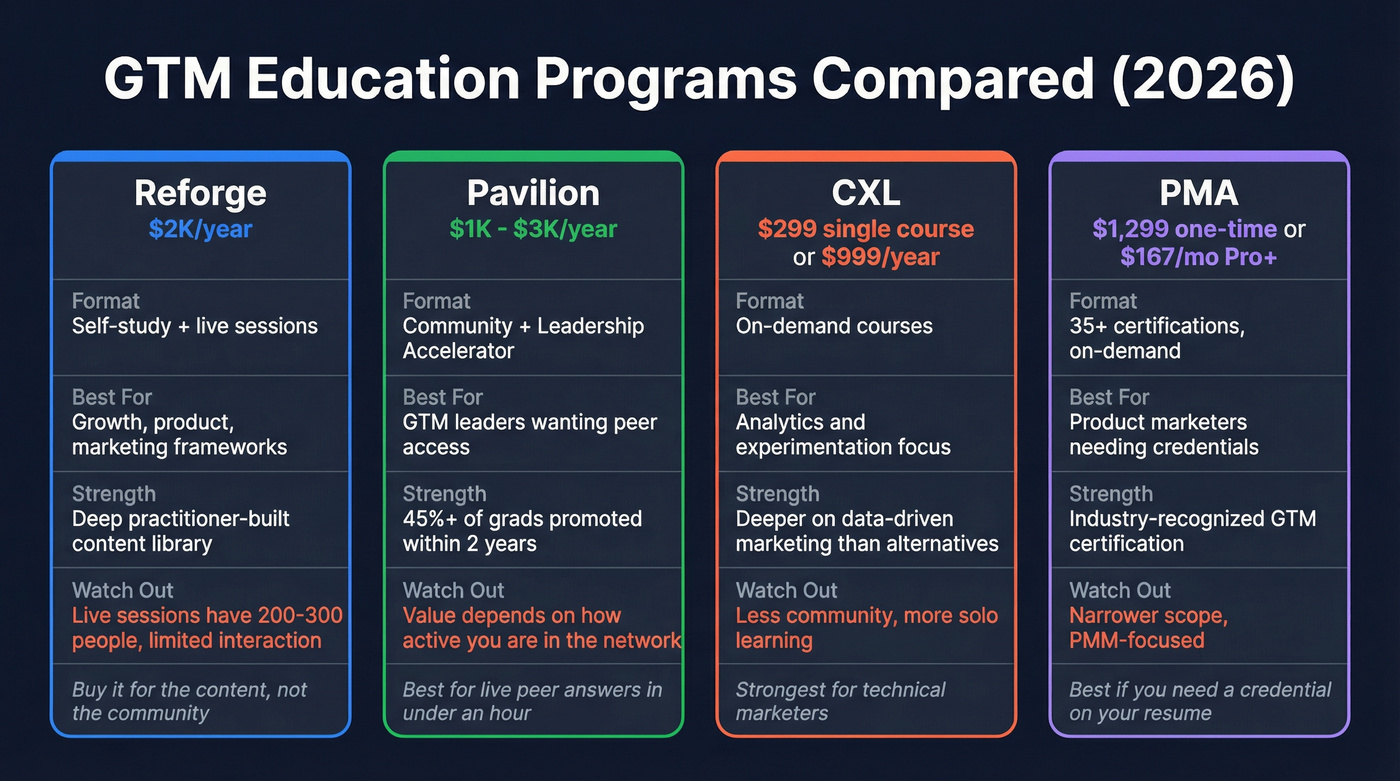
Pavilion is a private community for GTM leaders. Their Leadership Accelerator reports over 45% of graduates get promoted within two years, and membership typically runs ~$1K-3K/year. The real value is peer access - you can get a live answer from another operator in under an hour.
CXL offers single courses at $299 or all-access at $999/year. Stronger on analytics and experimentation than Reforge, less community-oriented than Pavilion.
PMA charges $1,299 for their GTM Certified: Masters program or $167/mo for Pro+ with 35+ certifications. Best for product marketers who need a credential alongside the learning.
If you prefer 1:1 mentorship over courses, platforms like MentorCruise connect you with go-to-market practitioners for $150-300/mo. It's a different model, but in our experience it can accelerate ramp time faster than any self-study program.
Mistakes That Kill Pipeline
Let's be honest - we've made some of these ourselves, and we've watched hundreds of teams repeat them.
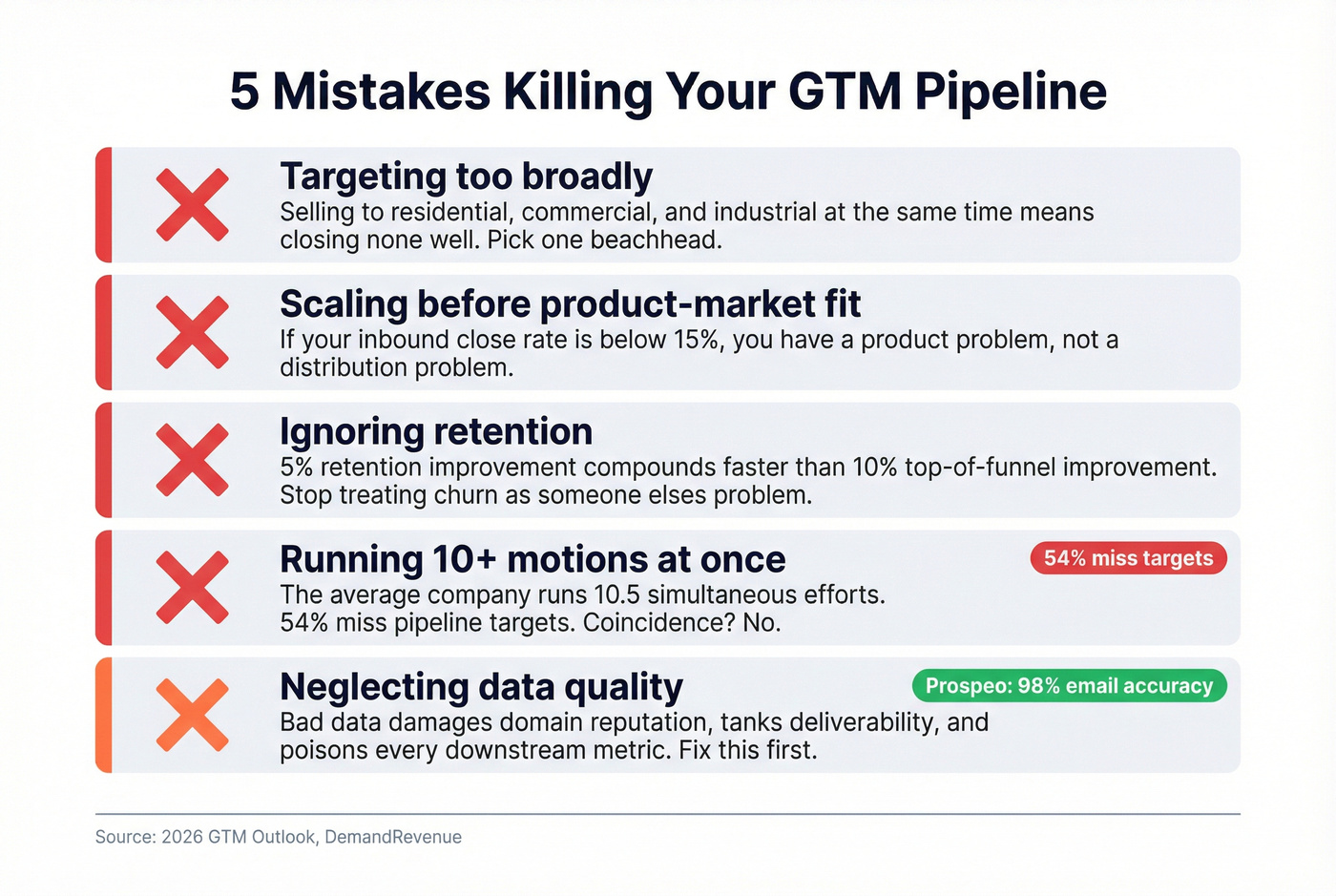
Targeting too broadly. A proptech startup selling to residential, commercial, and industrial segments simultaneously will close none well. Pick one beachhead and dominate it before expanding. A simple ideal customer profile scoring model prevents this mistake.
Scaling before product-market fit. Pouring money into outbound before validating demand is the fastest way to burn cash. If your close rate on inbound leads is below 15%, you don't have a distribution problem - you have a product-market fit problem.
Ignoring retention. A 5% improvement in retention compounds faster than a 10% improvement in top-of-funnel. Yet most GTM programs obsess over acquisition and treat churn as someone else's problem. If you want the math and levers, start with churn analysis.
Running 10+ motions simultaneously. The average company does this. Don't be average.
Neglecting data quality. Bad contact data doesn't just waste SDR time - it damages your domain reputation, tanks deliverability, and poisons every downstream metric. The consensus on r/sales is that data quality is the single most underrated variable in outbound performance, and we'd agree. If you're seeing issues, start with email bounce rate benchmarks and an email deliverability guide before you touch copy.
Snyk cut bounce rates from 35% to under 5% and grew AE-sourced pipeline 180% - just by switching their data source. With 30+ filters including Bombora intent data across 15,000 topics, Prospeo gives your GTM program the targeting precision that ABM decks promise but rarely deliver.
Layer intent signals, technographics, and job changes into every GTM motion for $0.01 per email.
FAQ
What's the difference between a GTM strategy and a GTM program?
A GTM strategy is the overarching plan for reaching your market; a GTM program is a specific motion within that strategy - outbound, ABM, or PLG. Strategy sets direction; programs execute it. Most orgs conflate the two, which leads to misaligned teams and wasted budget.
How many GTM programs should a company run?
Two to three, properly resourced. The average company runs 10.5 simultaneous efforts, and 54% miss pipeline targets. Fewer motions with better execution consistently outperforms a scattered portfolio approach.
What tools do I need to launch a go-to-market program?
Start with a CRM (HubSpot's free tier works), a verified contact data source for high-accuracy emails, and one engagement platform like Outreach or Salesloft. Add intent data and ABM tools once you scale past 20-30 reps.
How do I fix a GTM program that isn't generating pipeline?
Audit your data quality first - if email bounce rates exceed 10%, your sequences and messaging aren't the problem. After data, narrow your ICP and reduce the number of motions you're running. Teams that go from five motions to two almost always see pipeline improve within a quarter.