

The Best GTM Tools for 2026 (And the Only Ones You Actually Need)
A founder on r/b2bmarketing shared a number last year that stuck with us: $56,000 spent on 25 GTM tools. They canceled 20 and kept five - a lead database, an AI research agent, social automation, cold email, and video. The average org runs 305 apps, and companies spend roughly $2 in S&M for every $1 of new ARR. The go-to-market tools market isn't broken because there aren't enough options. It's broken because there are too many, and most teams buy before they think.
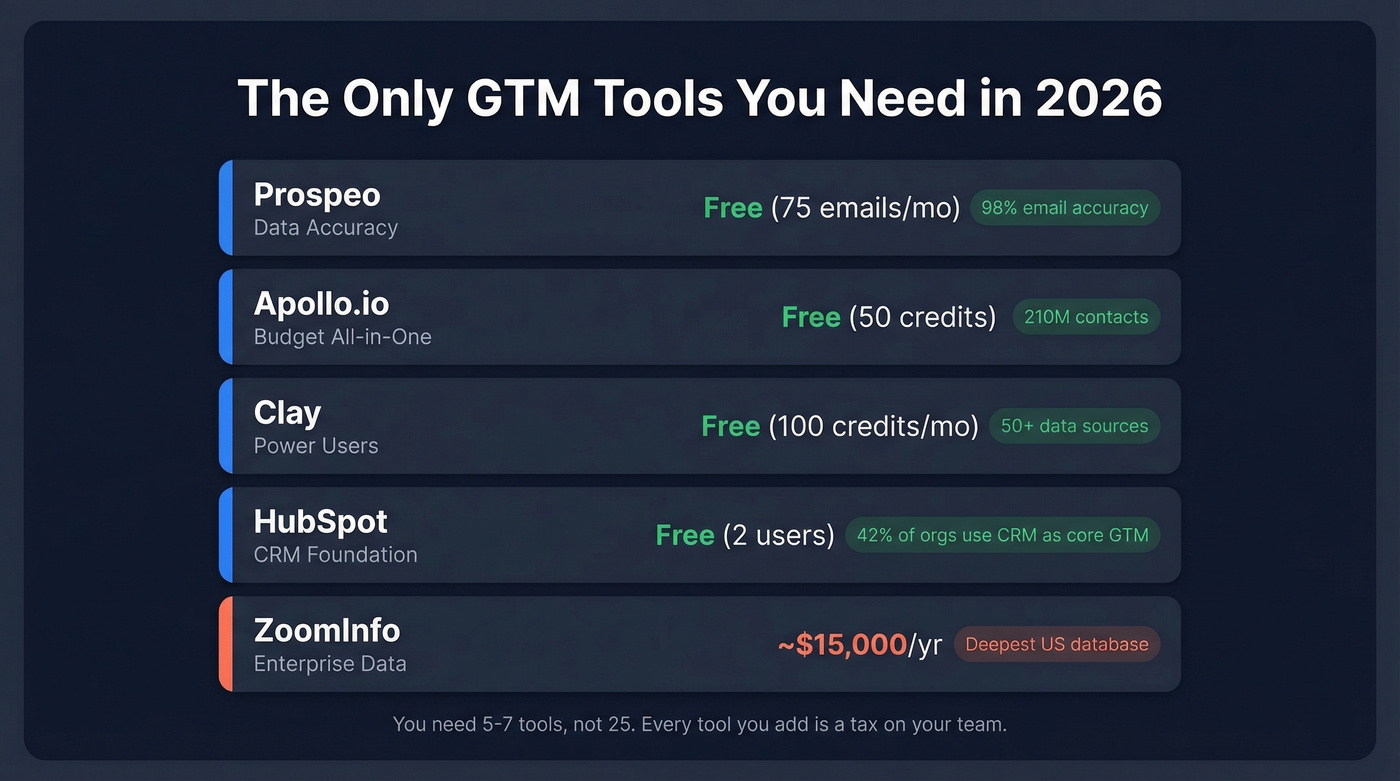
You need 5-7 tools, not 25. Every GTM tool you add is a tax on your team's attention.
Our Picks
| Use Case | Winner | Starting Price |
|---|---|---|
| Data accuracy | Prospeo | Free (75 emails/mo) |
| Budget all-in-one | Apollo.io | Free (50 credits) |
| Power users | Clay | Free (100 credits/mo) |
| CRM foundation | HubSpot | Free (2 users) |
| Enterprise data | ZoomInfo | ~$15,000/yr |
What Is a GTM Tool?
Quick disambiguation: if you're looking for Google Tag Manager, this isn't that article. GTM here means go-to-market.
A go-to-market tool is any software that helps revenue teams find prospects, engage them, close deals, or expand accounts. That covers everything from data providers to CRMs to conversation intelligence platforms. Gartner now formally tracks an "AI GTM Platforms" category, defining it as tools that use AI to streamline GTM processes across marketing, sales, and customer success.
The six core categories worth knowing: Data, CRM, Engagement, Intent/ABM, Conversation Intelligence, and Automation. Every tool in this article falls into one of them. A newer role - GTM engineer - emerged around building and connecting this technology across categories, though that role is already being absorbed back into RevOps.
How to Choose the Right Go-to-Market Tools
Here's the thing: tools don't create use cases. Tools solve problems. The Reddit hype cycle - Clay one week, some AI agent the next - leads teams to buy software they don't need for workflows they haven't mapped.
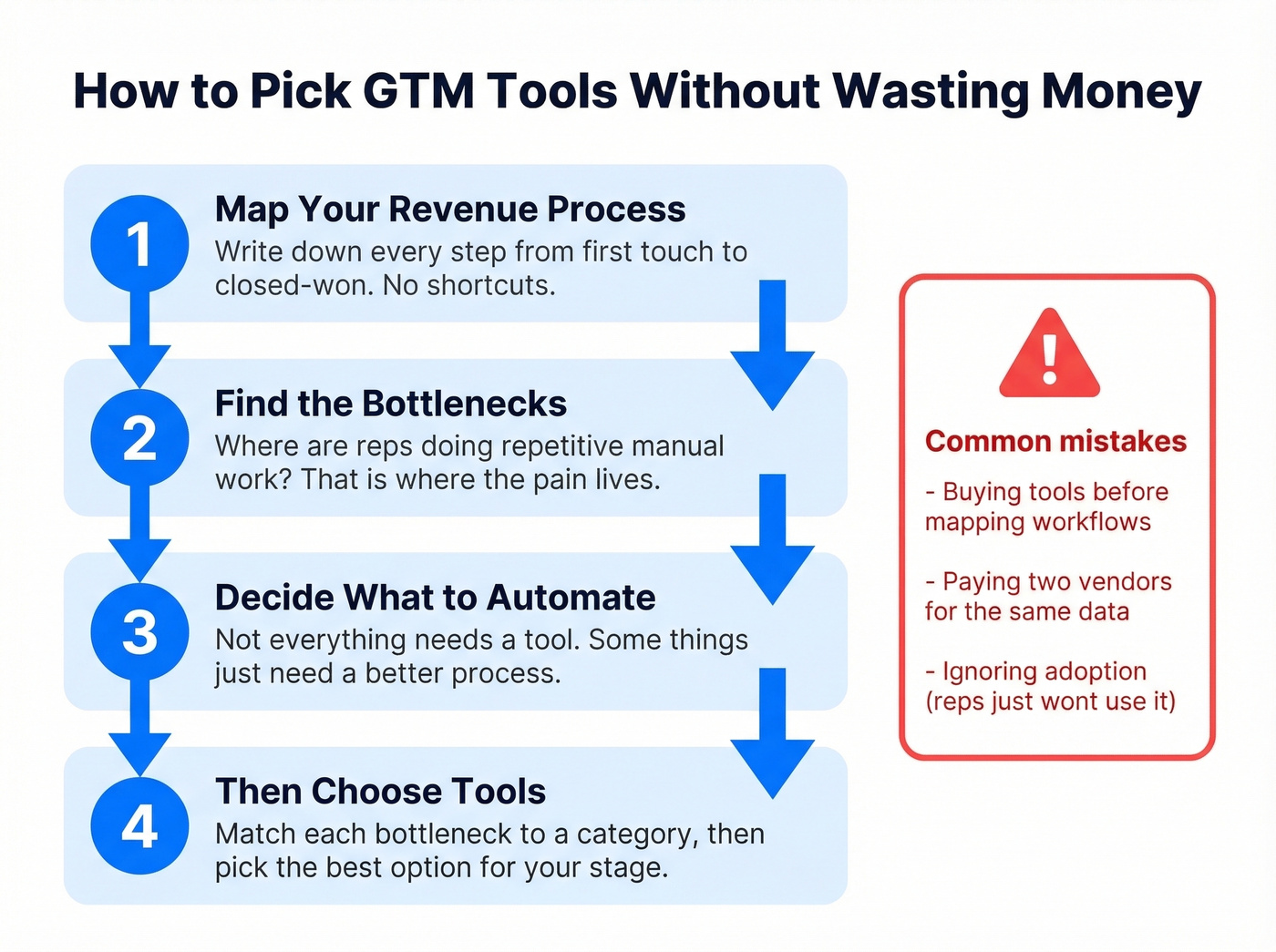
Most stack failures come from three places: tool overlap where you're paying two vendors for the same data, integration gaps where tools don't talk to each other, and low adoption where reps ignore the platform entirely. Your GTM motion matters too. A product-led growth company needs different tools than an enterprise sales-led org running outbound into named accounts.
Before you open a single pricing page, run this process:
- Map your end-to-end revenue process. From first touch to closed-won. Write it down.
- Identify the bottlenecks. Where are reps spending time on repetitive, manual work?
- Decide what to automate. Not everything needs a tool. Some things need a better process.
- Then choose tools. Match each bottleneck to a category, then pick the best option for your stage.
The Best GTM Software for 2026
Prospeo - Best for Data Accuracy
Use this if: You care more about data quality than feature count, you're running outbound and can't afford bounced emails tanking your domain reputation, and you want self-serve pricing without a sales call.
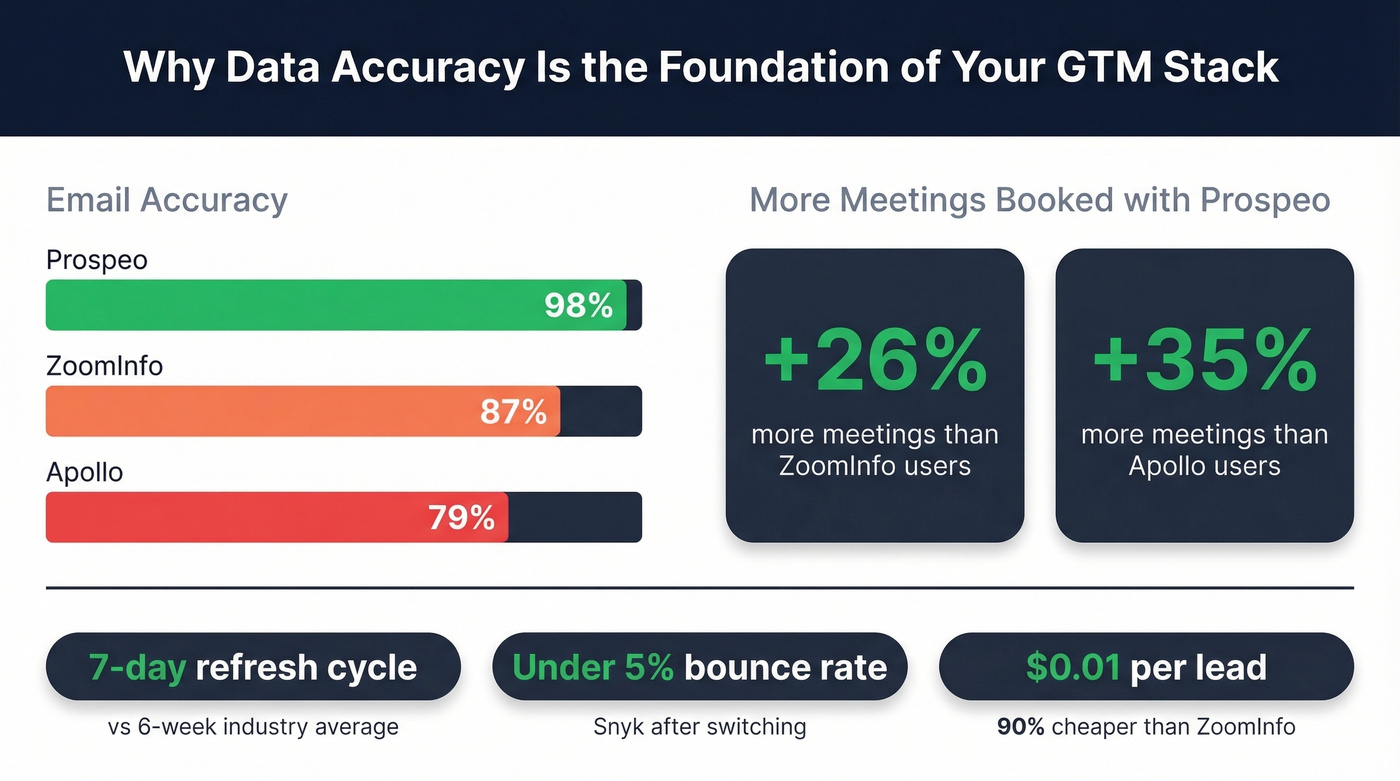
Prospeo's database covers 300M+ professional profiles with 143M+ verified emails and 125M+ verified mobile numbers with a 30% pickup rate. The headline stat is 98% email accuracy - and in head-to-head comparisons, that gap is dramatic: 98% vs. 87% for ZoomInfo and 79% for Apollo. Teams using Prospeo book 26% more meetings than ZoomInfo users and 35% more than Apollo users. Snyk's 50-person AE team saw bounce rates drop from 35-40% to under 5% after switching, with AE-sourced pipeline up 180%. Meritt tripled pipeline from $100K to $300K per week.
What makes the data different is the refresh cycle: every 7 days, compared to the 6-week industry average. That matters when you're prospecting into fast-moving companies where people change roles quarterly.
The platform includes 30+ search filters - buyer intent powered by 15,000 Bombora topics, technographics, job changes, headcount growth, funding signals - so you're building targeted lists, not just pulling names from a directory. The Chrome extension with 40,000+ users lets you pull verified contact data from web sources, and the API returns matches on 92% of queries, which is useful for RevOps teams running enrichment at scale.
Pricing is radically transparent: the free tier gives you 75 verified emails per month, paid plans run about $0.01 per lead - 90% cheaper than ZoomInfo. No contracts, cancel anytime. You only pay for valid emails.


You don't need 25 GTM tools. You need 5-7 that actually work - and the data layer is the foundation. Prospeo gives you 300M+ profiles, 98% verified emails, and a 7-day refresh cycle so your outbound never runs on stale contacts. At ~$0.01/email, it's 90% cheaper than ZoomInfo.
Fix the data layer first. Everything else in your GTM stack depends on it.
Apollo.io - Best Budget All-in-One
Skip this if: You need best-in-class data accuracy or you're selling into EMEA where Apollo's coverage gets thinner.
Apollo's database covers 210M contacts across 30M+ companies. The free plan includes 50 credits and up to 2 sequences - enough to test whether the platform fits your workflow. Paid tiers run $49/mo (Basic), $79/mo (Professional), and $119/mo (Organization, minimum 3 seats).
The all-in-one pitch is real: you get contact search, email sequencing, a built-in dialer, and basic CRM functionality. For a 3-person SDR team at a Series A company, Apollo is the obvious starting point. In our testing, it falls short of ZoomInfo on US database depth for enterprise accounts, and email accuracy runs noticeably lower - we've consistently seen more bounces from Apollo lists. One critical gotcha: credits don't roll over. If you don't use them, you lose them.
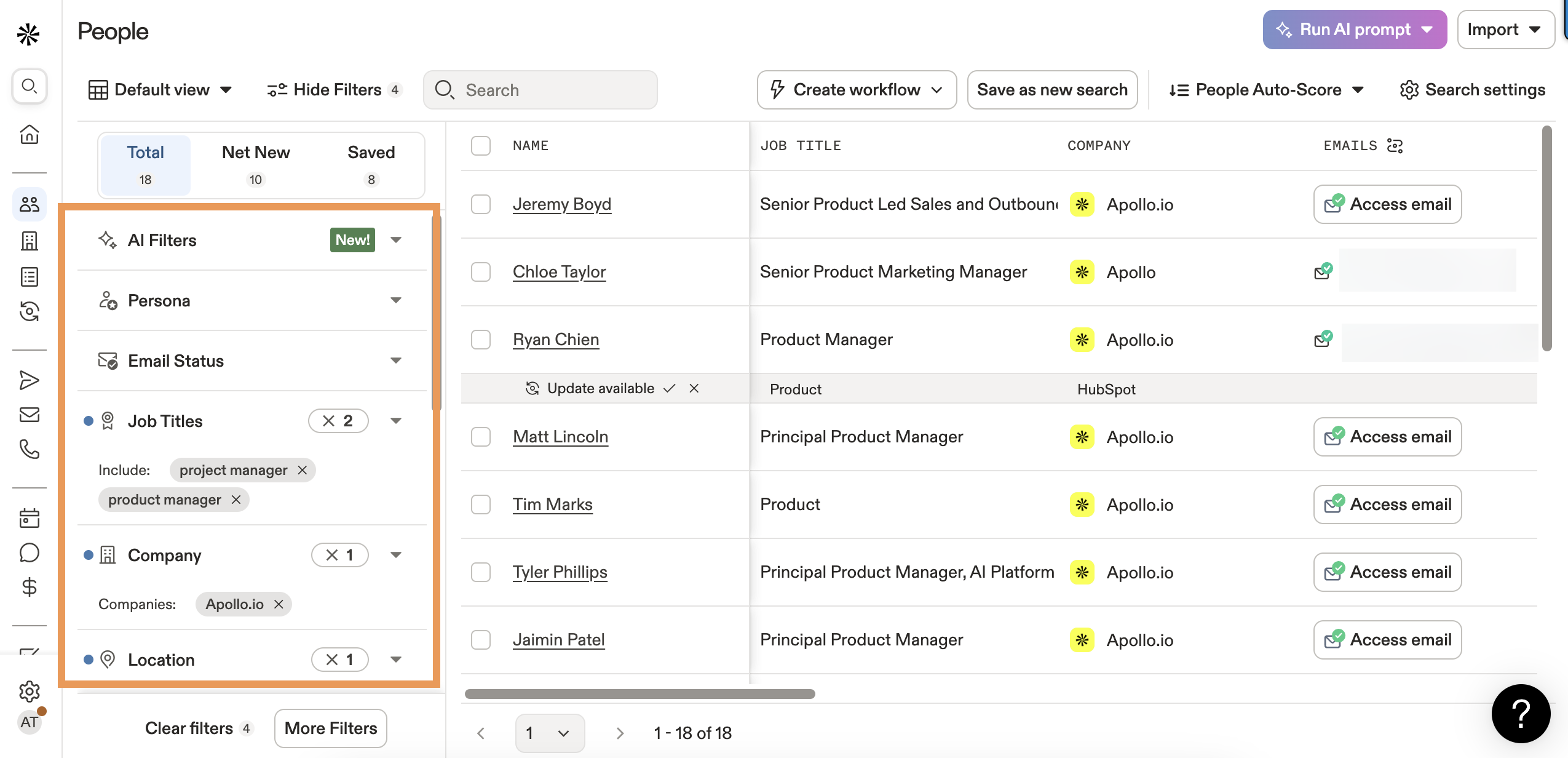
Clay - Best for Power Users
Who it's for: RevOps teams and GTM engineers who want to build custom enrichment workflows. People who think in systems, not search bars.
Who should stay away: Anyone who wants something that works out of the box. Clay has a real learning curve, and the credit burn can surprise you.
Clay's core value is waterfall enrichment - it queries 50+ data sources in sequence, so if one provider doesn't have a contact's email, the next one tries. This produces better coverage than any single database. Their Sculptor feature lets you describe your ICP in plain English and build a workflow in about 20 minutes, which has dramatically lowered the barrier to entry.
Pricing starts with a free plan at 100 credits/month. Paid tiers: Starter at $149/mo, Explorer at $349/mo, Pro at $800/mo. Enterprise deals run a median $30,400/year via Vendr. The warning: power users can exhaust monthly credits in days. Budget 2-3x your expected usage in the first quarter until you understand your burn rate.
HubSpot - Best CRM Foundation
42% of organizations cite CRM as their core GTM platform, and HubSpot is the one most teams can actually afford to start with. The free CRM supports 2 users and 1,000 contacts - enough to validate your sales process before spending anything. Paid plans start at $15/mo per seat (Starter), with Professional from $800/mo and Enterprise at $3,600/mo.
HubSpot's Breeze Intelligence adds AI-powered enrichment and intent signals directly inside the CRM, which reduces the need for separate tools. The ecosystem is massive - nearly every go-to-market tool integrates with HubSpot natively. If you're already locked into Salesforce and your team won't migrate, skip it. Otherwise, HubSpot is the CRM to build around. (If you want more context, see examples of a CRM.)
ZoomInfo - Enterprise Data
Look, ZoomInfo is still the deepest US B2B database. But most teams don't need the deepest US B2B database - they need accurate data at a price that doesn't eat their entire tools budget.
A 10-seat contract with intent and mobile numbers runs $15K-$40K/year. The consensus on Reddit is blunt: "$20K+ annual is wild." Annual contracts are required, there's no self-serve pricing, and you'll negotiate with a sales team incentivized to upsell modules you won't use. For 100+ rep orgs with budget, ZoomInfo's US data depth is the benchmark. For everyone else, there are better options at a fraction of the cost.
If you're comparing providers, start with a shortlist of sales prospecting databases and validate accuracy before you sign anything.
Outreach - Enterprise Sales Engagement
Outreach is the sales engagement platform enterprise teams default to, especially those already on Salesforce. Multi-channel sequencing, AI-powered deal insights, and deep CRM integration make it the workhorse for large SDR and AE teams. Pricing runs ~$100-$150/user/month on annual contracts. It's overkill for a 5-person team, but for 50+ reps running coordinated outbound, it's hard to beat. (Implementation matters more than vendor choice - see implementing a sales engagement platform.)
6sense - ABM & Intent for Enterprise
6sense combines account identification with intent signals to tell you which accounts are actively researching your category. Pricing starts around $50K/year and scales past $100K+ for larger deployments. If you're running account-based motions with 10+ target accounts per rep, 6sense delivers real signal. For SMBs, the ROI math doesn't work until you're closing six-figure deals. If you're building the motion, use an account-based selling playbook first.
Instantly - Budget Cold Email
Instantly has become the default cold email tool for agencies and high-volume outbound teams. Unlimited email accounts on higher tiers, built-in warmup, and a clean UI make it easy to scale sending. Plans start around $30/mo and top out at $97/mo for the growth tier. It does one thing well: getting cold emails delivered. Pair it with a verified data source - bad data will tank your deliverability regardless of how good your warmup is. If you’re tightening the basics, start with an email deliverability guide.
Gong - Conversation Intelligence
Gong records, transcribes, and analyzes sales calls to surface coaching insights and deal risk signals. At ~$100-$150/user/month, it isn't cheap, but for teams focused on improving win rates rather than just generating more top-of-funnel, it pays for itself. The deal intelligence features - tracking which stakeholders are engaged, flagging stalled deals - are where the real value lives beyond basic call recording.
Quick Mentions
| Tool | Category | Starting Price | Best For |
|---|---|---|---|
| Salesloft | Sales Engagement | ~$100-$200/user/mo | Outreach alternative |
| Demandbase | ABM | ~$50K+/yr | Enterprise ABM |
| Warmly | Visitor ID | Free - $10K+/yr | Website deanonymization |
| Attio | CRM | Free - $34/user/mo | Modern CRM for startups |
| n8n / Make / Zapier | Automation | Free - $20-$50/mo | Workflow glue |
Stack Optimize built a $1M agency with zero domain flags. Snyk's 50 AEs cut bounce rates from 40% to under 5%. The difference wasn't more tools - it was accurate data powering fewer, better workflows. Prospeo's 5-step verification and weekly refresh keep your GTM motion clean.
Stop burning credits on bad data. Verify before you send.
Pricing Comparison
Transparent pricing should be table stakes in 2026. If a vendor hides pricing, they're optimizing for their sales team, not yours.
| Tool | Category | Starting Price | Model | Self-Serve? | Best For |
|---|---|---|---|---|---|
| Prospeo | B2B Data | Free (75 emails/mo) | Per credit (~$0.01/lead) | Yes | Accuracy-first outbound |
| Apollo.io | Data + Engagement | Free (50 credits) | Per user + credits | Yes | SMB all-in-one |
| Clay | Enrichment | Free (100 credits/mo) | Per credit ($149-$800/mo) | Yes | Custom workflows |
| HubSpot | CRM | Free (2 users) | Per user ($15-$3,600/mo) | Yes | CRM foundation |
| ZoomInfo | B2B Data | ~$15,000/yr | Annual contract | No | Enterprise US data |
| Outreach | Engagement | ~$100/user/mo | Per user, annual | No | Large SDR teams |
| 6sense | ABM / Intent | ~$50,000/yr | Annual contract | No | Enterprise ABM |
| Instantly | Cold Email | ~$30/mo | Flat rate | Yes | Budget cold email |
| Gong | Conversation Intel | ~$100/user/mo | Per user, annual | No | Win rate optimization |
Credit-Based Pricing Traps
Real talk: credit-based pricing can be a trap if you don't plan for it. Clay power users routinely exhaust monthly credits within the first week, and upgrading mid-cycle isn't always seamless. Apollo's credits don't roll over, so anything unused at the end of your billing cycle vanishes.
We recommend budgeting 2-3x your expected credit usage in the first quarter. You'll burn more credits than you think while learning the platform, building workflows, and iterating on your ICP filters. After that, usage stabilizes and you can right-size your plan. Pay-per-result models sidestep this entirely - paying only for valid addresses with no credits expiring and no surprise overages makes budgeting predictable.
If you’re doing enrichment across multiple sources, compare data enrichment services before you commit.
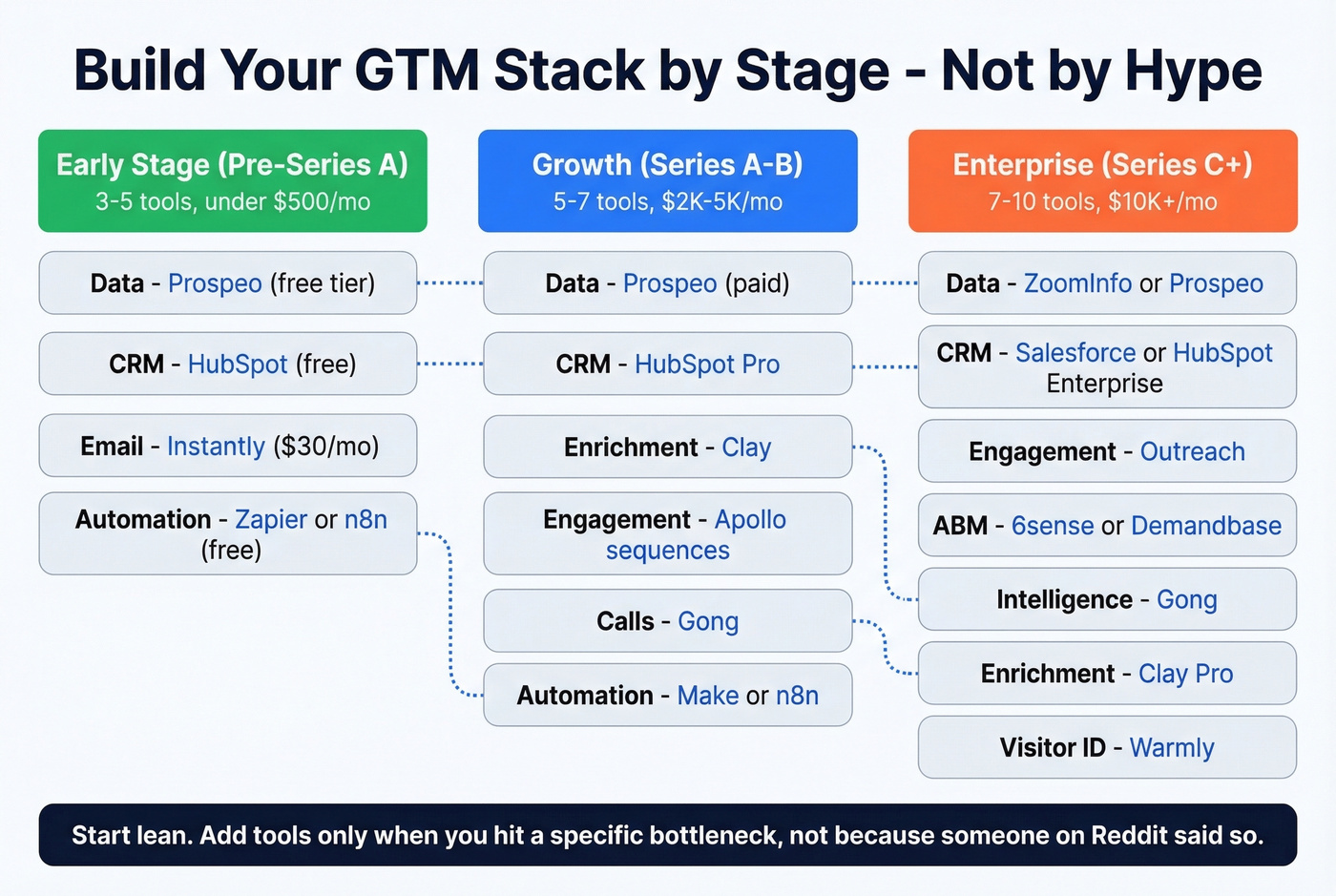
Recommended Stacks by Stage
Starter (under $500/mo):
- Prospeo for data and verification
- HubSpot Free for CRM
- Instantly for cold email
- Zapier for automation glue
Growth ($1K-$3K/mo):
- Your data layer from Starter, plus Clay for enrichment workflows
- HubSpot Pro for CRM and marketing
- Outreach for multi-channel sequences
- n8n for advanced automation
Enterprise ($5K+/mo):
- ZoomInfo or Cognism for data
- Salesforce for CRM
- Outreach for engagement
- 6sense for ABM and intent
- Gong for conversation intelligence
At every stage, the goal is the same: choose go-to-market software that solves a specific bottleneck, not tools that sound impressive on a vendor slide deck.
AI Agents and the Future of GTM Stacks
In 2024, building serious outbound workflows required someone who could wire up Clay tables, connect enrichment providers, and push results to sequencers. Companies were paying $100K-$130K for strong GTM engineers. Clay's Sculptor changed that - an SDR can now describe their ICP in plain English and have a working workflow in 20 minutes.
The GTM engineering role is collapsing back into RevOps. Early data suggests AI-native companies convert trials at nearly double the rate of traditional SaaS, with shorter sales cycles. But most "AI GTM" labels are marketing. The real shift is agentic workflows that eliminate manual steps, not chatbots slapped onto existing platforms. If you’re building outbound with AI, start with AI cold email outreach principles before you buy more tools.
FAQ
What is a GTM tool?
A GTM tool is software that helps revenue teams execute go-to-market strategy - finding prospects, engaging them, closing deals, and expanding accounts. It spans categories from B2B data providers to CRMs to sales engagement platforms. Not to be confused with Google Tag Manager, which shares the acronym.
How much should a GTM stack cost?
Startups can build a functional stack for under $500/month using free tiers and self-serve tools. Mid-market teams typically spend $1K-$5K/month. Enterprise stacks with intent data, ABM platforms, and conversation intelligence run $10K-$50K+ monthly.
What's the minimum viable GTM stack?
Three tools under $200/month: a data provider for verified contacts, a CRM (HubSpot Free works), and a sequencing tool like Instantly. That's enough to find prospects, track deals, and run outbound sequences without overcomplicating your workflow.
Do I need a GTM engineer in 2026?
Probably not. Tools like Clay's Sculptor and no-code automation platforms like n8n and Make have collapsed most GTM engineering work back into RevOps. Unless you're building highly custom data pipelines at enterprise scale, a strong RevOps generalist can handle it.