

Hot Leads: How to Score, Reach & Close Them (2026)
Your SDR flagged a lead as "hot" because they attended a webinar. No scoring model - just a gut feeling and a sticky note that says "seemed interested." That's not a hot lead. That's a warm lead with wishful thinking.
Stop trying to generate more of them. Start by not losing the ones you already have - through slow response, bad data, and one-touch follow-up that kills deals already won.
A prospect ready to buy within 30-90 days who shows stacked intent signals - not just one action - is what separates a genuinely high-intent buyer from noise. Three things determine whether you close them. First, an objective scoring model, not gut feel. Second, speed - responding in 5 minutes makes you 21x more likely to qualify a lead. Third, data accuracy, because a buyer you can't reach is a lost deal.
What Is a Hot Lead?
A hot lead is a qualified prospect actively evaluating solutions and ready to purchase within 30-90 days. The critical distinction isn't just "interested" - it's showing stacked signals. A single pricing page visit doesn't make someone ready to buy. A pricing page visit plus a demo request plus a CFO joining the call? That's a pattern.
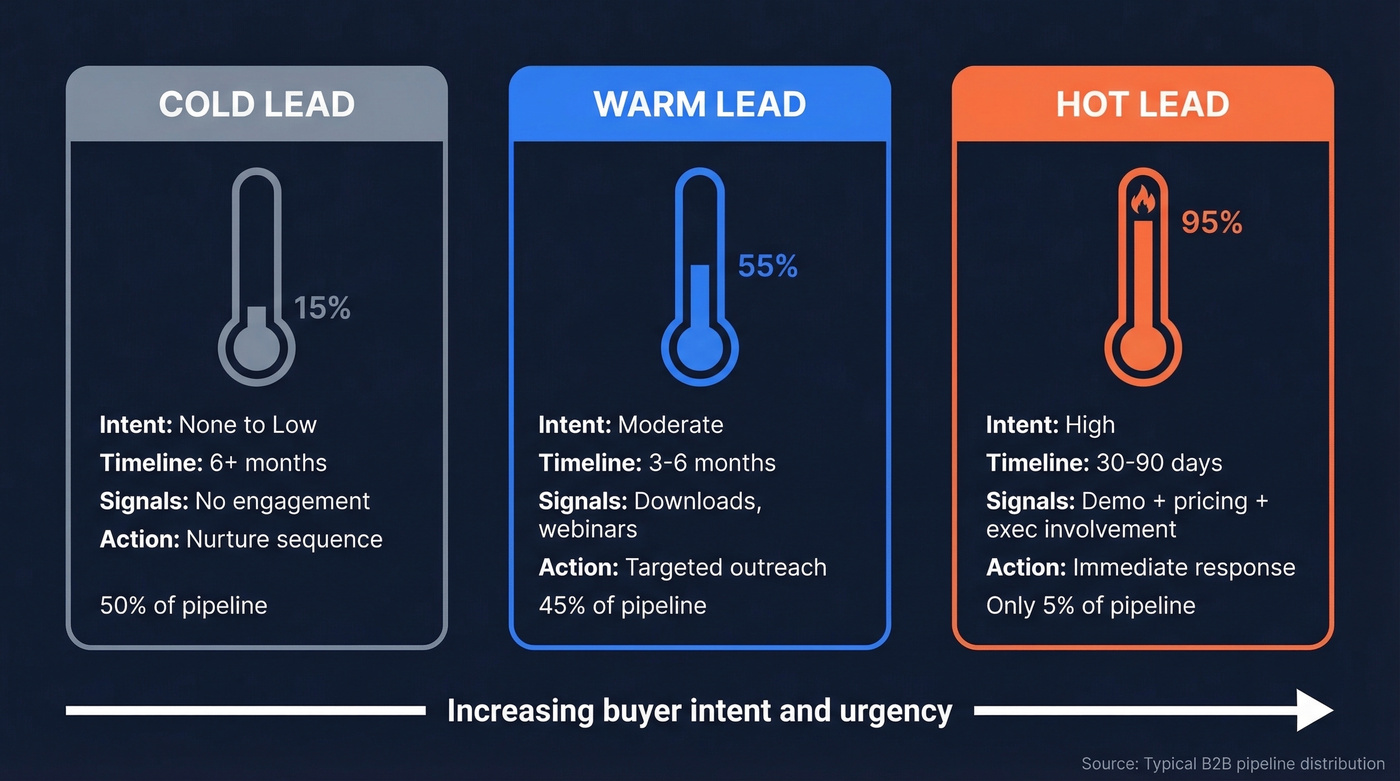
Most teams confuse enthusiasm with intent. Someone downloading a whitepaper is warm at best. The real meaning goes deeper: these prospects demonstrate urgency through multiple, overlapping behaviors that signal they're deep in a buying process, not just browsing.
| Lead Type | Intent Level | Timeline | Signals | Action |
|---|---|---|---|---|
| Cold | None/low | 6+ months | No engagement | Nurture sequence |
| Warm | Moderate | 3-6 months | Downloads, webinar | Targeted outreach |
| Hot | High | 30-90 days | Demo + pricing + exec | Immediate response |
One heuristic from r/Entrepreneur puts the distribution at roughly 5% hot, 45% warm, and 50% cold across a typical pipeline. That feels directionally right - high-intent buyers are rare, which is exactly why losing them to slow follow-up is so painful.
7 Signs a Lead Is Ready to Buy
Not every engaged prospect is genuinely high-intent. These seven signals, especially when they stack, separate buyers from tire-kickers.
Pricing and timeline questions. When a prospect asks "what does this cost?" and "how fast can we implement?" in the same conversation, they're past research. They're building a business case.
Decision-maker involvement. A champion looping in their VP or CFO isn't being polite - they're accelerating an internal process.
Rapid multi-asset consumption. Visiting your pricing page, downloading a case study, and watching a product demo within 48 hours isn't casual browsing. That's someone building a shortlist.
Budget discussions. Any mention of allocated budget, fiscal year timing, or procurement process means they've already decided they need a solution. The question is which one.
Competitor research. If a prospect asks how you compare to a specific competitor, they've narrowed the field and you're on it.
Reference requests. Asking to speak with current customers means they're validating a decision they've already mentally made.
Implementation questions. "How long does onboarding take?" and "Does this integrate with Salesforce?" are questions from someone planning to buy, not someone browsing.
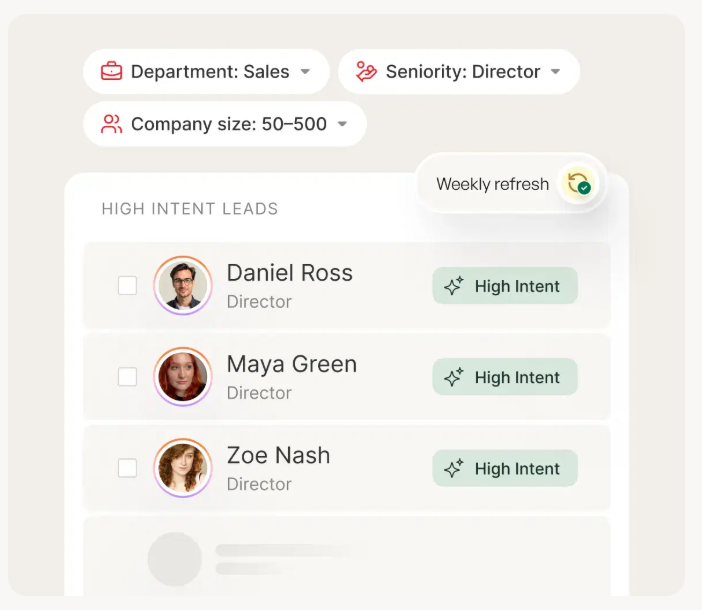
The key is stacking. Any single signal is noise. Three or more within a compressed timeframe? That's what separates a genuinely hot prospect from a casual click.
How to Score Hot Leads
Lead scoring without a model is just vibes. Vibes don't scale. We've found that starting with 5-7 core criteria covers 80%+ of what matters for most teams. Assign positive points for behaviors and demographics that correlate with closed deals, negative points for disqualifiers, and set a threshold that separates high-intent from warm. A 100-point scale works well, with your MQL threshold at the top 20% of leads - typically 50-75 points.
If you want a deeper framework, start with a formal Lead Scoring system and tune it to your funnel.
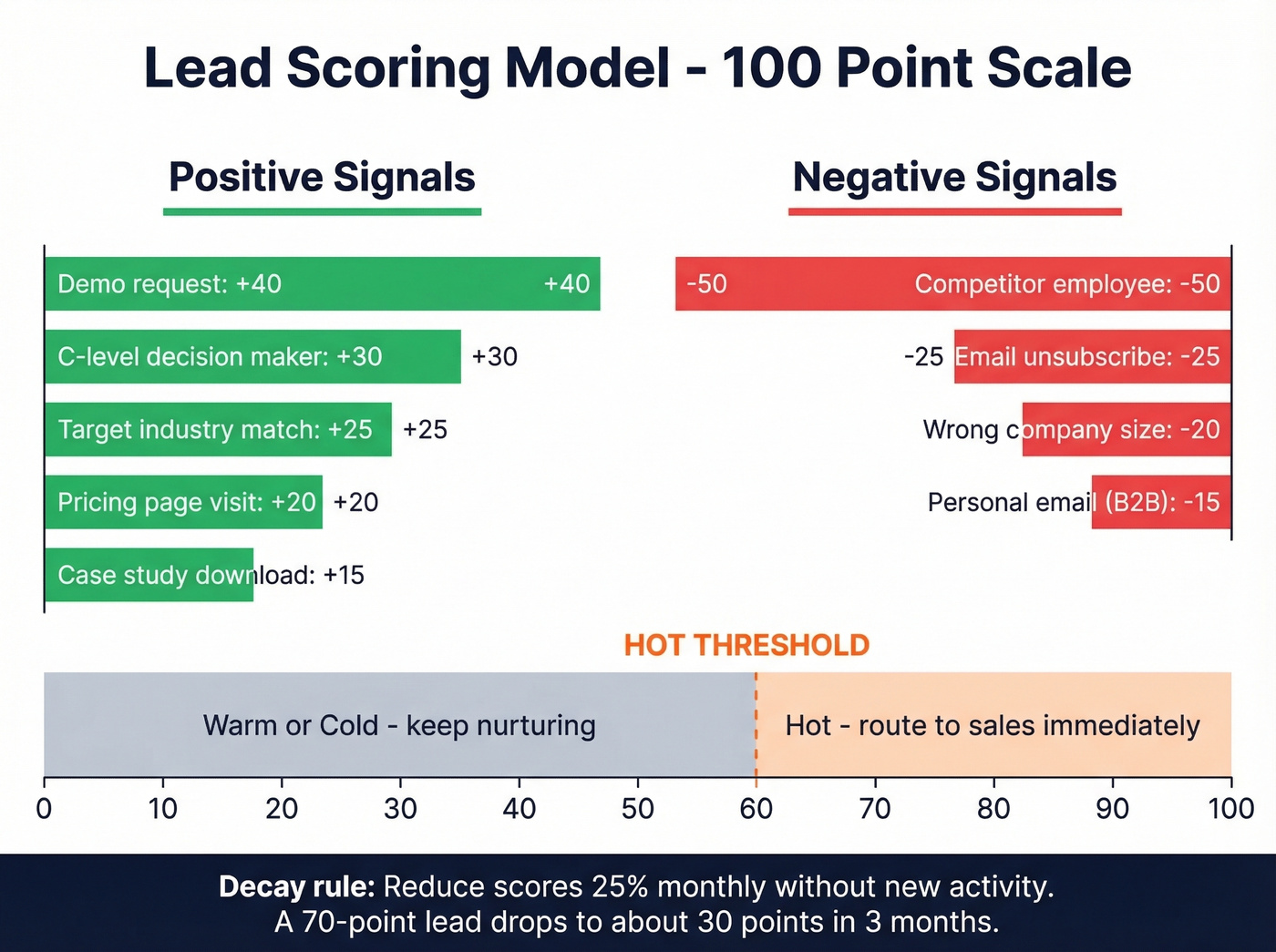
| Criteria | Points | Category |
|---|---|---|
| Demo request | +40 | Behavioral |
| C-level decision maker | +30 | Demographic |
| Target industry match | +25 | Demographic |
| Pricing page visit | +20 | Behavioral |
| Case study download | +15 | Behavioral |
| Competitor employee | -50 | Negative |
| Email unsubscribe | -25 | Negative |
| Wrong company size | -20 | Negative |
| Personal email (B2B) | -15 | Negative |
Here's the thing most scoring guides skip: time decay.
Decay rule: Reduce scores by 25% monthly without new activity. A 70-point lead with no engagement drops to roughly 30 points in three months - warm at best. Without decay, your "hot" list fills up with stale contacts that waste rep time.
Negative signals matter just as much as positives. Lead scoring without disqualifiers is a vanity metric. A competitor employee who downloads every piece of content you publish will score sky-high on behavior alone - and waste your rep's entire afternoon.
How well does intent-based scoring work in practice? One campaign tested it on 552 cold leads. 318 responded with interest - a 58% response rate. That's what happens when you contact the right people at the right time instead of blasting a list.
BANT vs. CHAMP vs. MEDDIC
Scoring tells you who's hot. Qualification tells you if they're real.
If you're building a repeatable process, it helps to standardize your lead status definitions across marketing and sales.
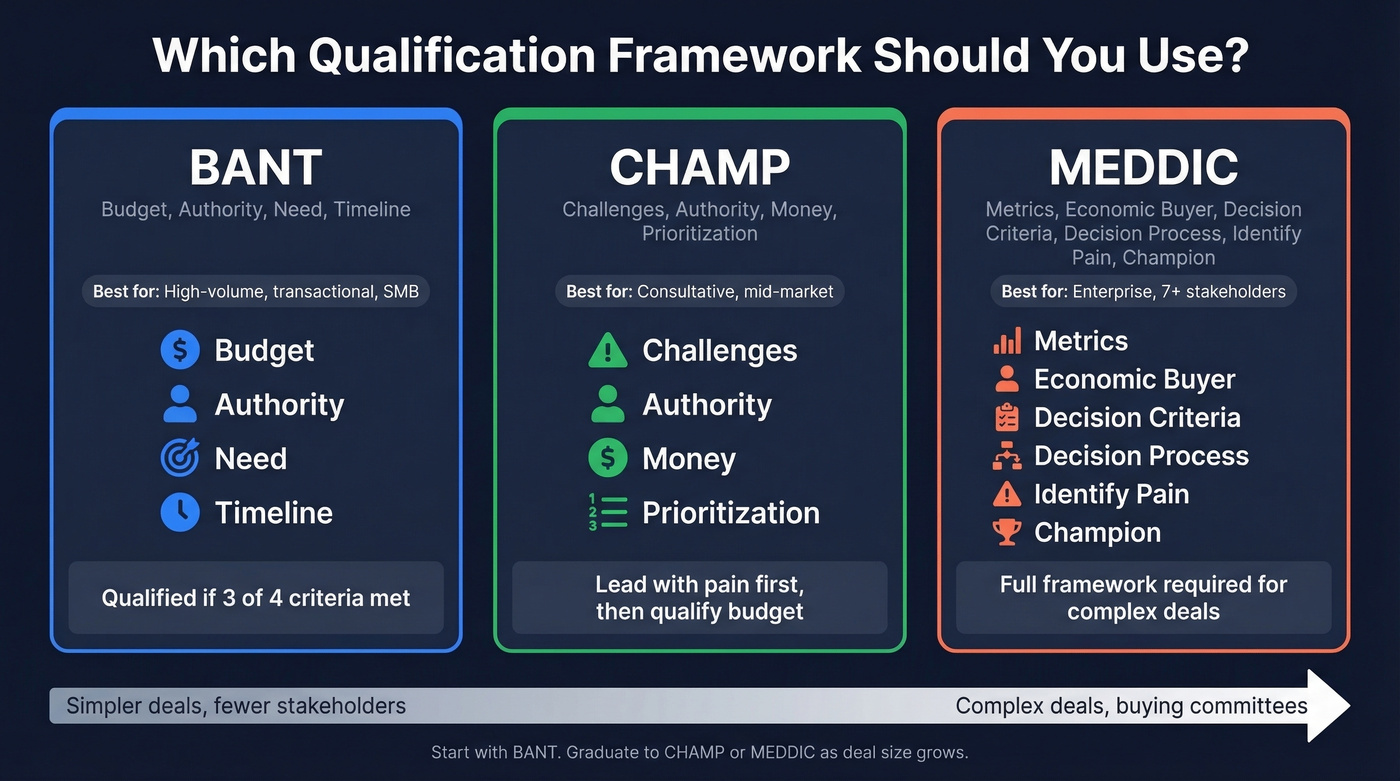
BANT stands for Budget, Authority, Need, Timeline. CHAMP reorders the priorities to Challenges, Authority, Money, Prioritization. MEDDIC covers Metrics, Economic Buyer, Decision Criteria, Decision Process, Identify Pain, and Champion.
| Framework | Best For | Qualification Rule |
|---|---|---|
| BANT | High-volume, transactional | Qualified if 3 of 4 met |
| CHAMP | Consultative, mid-market | Lead with pain first |
| MEDDIC | Enterprise, 7+ stakeholders | Full framework required |
Sales communities on Reddit debate BANT vs. MEDDIC endlessly, but the answer is simpler than the threads suggest. BANT has been around since IBM coined it in the 1950s, and it's still fine for SMB and transactional sales. But modern B2B buying involves roughly 7 stakeholders. If you're selling six-figure enterprise deals and qualifying on BANT alone, you're going to miss the political dynamics that kill deals in committee.
Most teams should start with BANT and graduate to CHAMP or MEDDIC as their average deal size grows. Don't over-engineer qualification for deals that close in two calls.

Your scoring model is only as good as the data behind it. Prospeo layers Bombora intent data across 15,000 topics with 30+ filters - buyer intent, job changes, headcount growth - so you spot stacked signals before your competitors do. 98% email accuracy means every hot lead you identify actually gets your message.
Stop scoring leads you can't reach. Start closing the ones you can.
Identifying Buyers with Intent Data
70% of B2B buyers prefer researching solutions online before engaging sales. Your highest-intent prospects are showing signals you'll never see - unless you're tracking them.
First-party intent comes from your own properties: website visits, email engagement, CRM activity. It's the most reliable but the narrowest view. Second-party intent is shared first-party data from partners. Third-party intent is the big unlock: external web behavior aggregated by providers like Bombora, tracking keyword searches, content consumption, and competitor research across the broader web.
The real power comes from layering all three. A prospect researching your category on third-party sites, visiting your pricing page, and engaging with your emails is showing a pattern that's hard to fake.
If you want to operationalize this, use intent based segmentation so your routing and sequences match the signal.
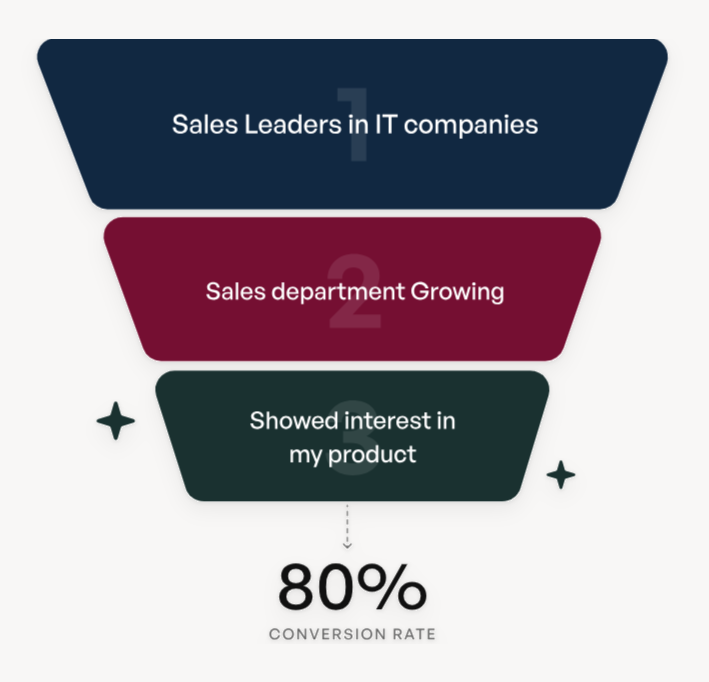
Prospeo tracks 15,000 intent topics via Bombora, letting you layer buyer intent signals with job role, headcount growth, and technographic filters to surface leads actively researching solutions - before they fill out a form.
Why Speed Saves (or Kills) Deals
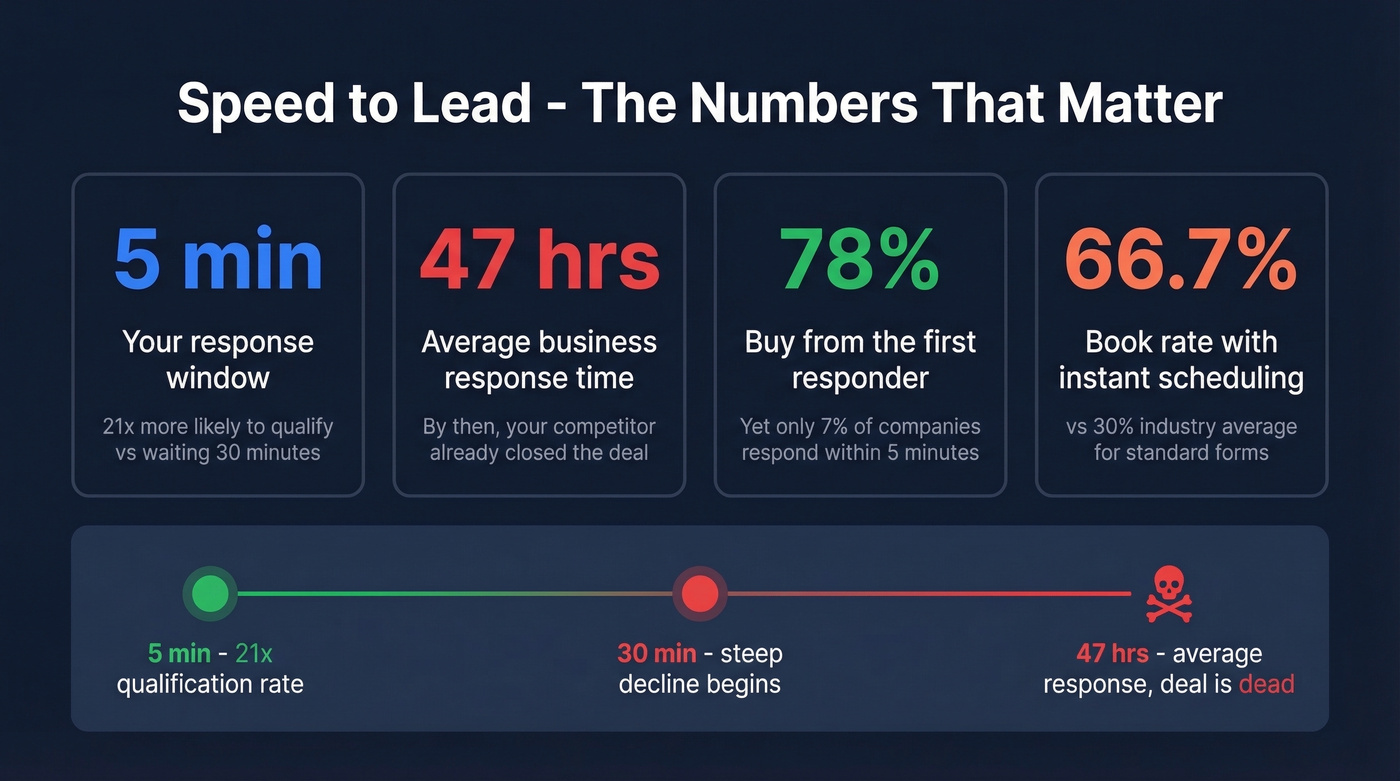
The average business takes 47 hours to respond to a lead.
This is one of the most common sales pipeline challenges we see: leads are there, but the handoff and response system isn't.
Forty-seven hours. Let's put that in context: a prospect requested a demo, asked about pricing, and looped in their CFO - all in the same week. Your rep sent a follow-up three days later. By then, the prospect had signed with a competitor who responded in 12 minutes.
The data is brutal. Responding within 5 minutes makes you 21x more likely to qualify a lead than waiting 30 minutes. 78% of customers buy from the first company that responds. Yet only 7% of companies respond within that 5-minute window.
The number that matters: 5 minutes. That's your window. Everything after that is a steep decline.
Chili Piper's analysis of nearly 4 million form submissions found that 66.7% of qualified submissions booked a meeting when instant scheduling was available - compared to a 30% industry average. Only 8% of top B2B SaaS companies have form scheduling on their website. That's a massive gap between what works and what teams actually do.
Speed matters, but so does accuracy. Dialing a verified mobile beats leaving a voicemail on a switchboard every time. Snyk saw this firsthand - after switching to verified contact data with a 7-day refresh cycle, their 50 AEs cut bounce rates from 35-40% to under 5% and grew AE-sourced pipeline 180%.
If you're seeing high bounces, start with email bounce rate benchmarks and fixes before you scale outreach.
5 Mistakes That Cool Off Hot Sales Leads
We've seen teams with solid pipelines bleed revenue from avoidable errors. Ask any SDR manager and they'll tell you the same - their reps treat every inbound the same, regardless of intent signals.
If your team is stuck in one-touch follow-up, steal a proven cadence from these sales follow-up templates.
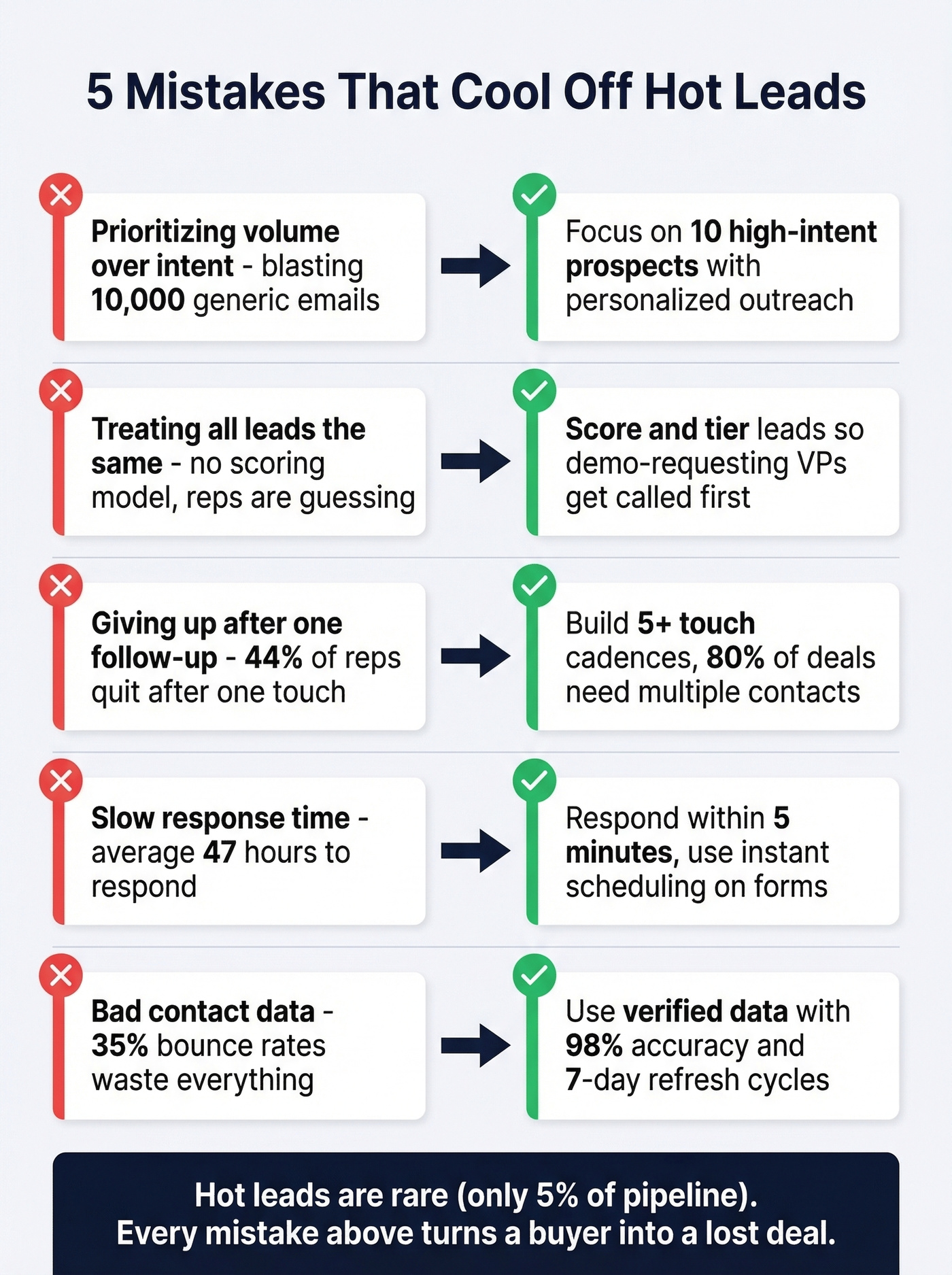
1. Prioritizing volume over intent. Blasting 10,000 contacts with a generic sequence feels productive. It's not. Ten high-intent prospects contacted with personalized, timely outreach will outperform a thousand cold emails every time.
2. Treating all leads the same. Without a scoring model, your reps are guessing which leads to call first. A demo-requesting VP gets the same priority as a blog-reading intern. That's not a pipeline - it's a lottery.
3. Giving up too early. 44% of reps quit after one follow-up, yet 80% of deals require 5+ touches. If your cadence is "call once, send one email, move on," you're abandoning winnable deals.
4. Slow response. Buyers complete up to 80% of their decision-making before talking to sales. A 47-hour response time isn't just slow - it's disqualifying.
5. Bad contact data. This is the silent killer. A high-intent buyer is only as valuable as your ability to reach them. If your database has a 35% bounce rate, your scoring model is grading garbage. Prospeo's 5-step verification delivers 98% email accuracy and refreshes data every 7 days - so when a lead goes hot, the contact info is current.
To fix this at the source, use data enrichment services to keep records current as intent changes.
How to Close High-Intent Buyers
Closing isn't about pressure. It's about removing friction. The prospect has already decided they need a solution. Your job is to make buying from you the easiest path forward.
Picture this: your prospect downloaded a case study Tuesday, attended the webinar Wednesday, and requested pricing Thursday. Here's what your next 48 hours should look like.
Start with their engagement history. They've already consumed your overview content, so don't send another overview deck. Send the pricing breakdown and implementation timeline they actually need. 80% of consumers are more likely to buy from companies that personalize outreach - and personalization means knowing what they've already consumed and giving them the next thing, not the same thing.
Confirm their timeline and align your process to theirs. If their fiscal year ends in Q4 and they need procurement approval, work backward from that date. Send non-redundant collateral: pricing, relevant case studies, trial access, and technical documentation for the stakeholders who need it. Use CRM automation to enforce your follow-up cadence - five-plus touches is the minimum, and each one should add value. A new data point, a relevant customer story, an answer to a question they haven't asked yet.
If you want a tighter close motion, map this to a repeatable 7 steps to close a sale process.
Here's my take: if you're closing deals under $15k, you probably don't need a complex multi-touch closing sequence. Speed and accuracy beat sophistication. Respond fast, send the right collateral, and get out of the way. Over-engineering the close on small deals kills more revenue than it saves.
Conversion Benchmarks for 2026
Let's ground this in data. These are top-of-funnel baselines - hot leads that are properly scored and quickly engaged convert at multiples of these numbers.
| Metric | Rate | Source |
|---|---|---|
| Avg. conversion (14 industries) | 2.9% | Ruler Analytics, 100M+ data points |
| Avg. form conversion | 1.7% | Ruler Analytics |
| Avg. call conversion | 1.2% | Ruler Analytics |
| B2B website visitor conversion | 3.6% | First Page Sage |
| B2B SaaS visitor conversion | 1.7% | First Page Sage |
| Qualified form to booked meeting | 66.7% | Chili Piper, ~4M submissions |
The gap between 2.9% overall and 66.7% for qualified, instantly-routed submissions tells the whole story. The leads aren't the problem. The handling is.
In our experience, properly scored high-intent prospects with sub-5-minute response times convert at 3-5x your sitewide baseline - and in some SMB inbound motions, that number goes even higher. If your hot leads are converting at or below these averages, something is broken in your scoring, speed, or data quality.
If you need to sanity-check your funnel, compare against the average B2B lead conversion rate and adjust your targets by channel.
Speed-to-lead dies when your data is wrong. A 5-minute response means nothing if the email bounces. Prospeo's 7-day data refresh and 5-step verification keep bounce rates under 4% - so hot leads get your outreach, not an error message. At $0.01 per email, bad data is no longer an excuse.
Reach every hot lead before they go cold. Every single one.
FAQ
What is a hot lead?
A hot lead is a prospect showing stacked buying signals - demo request, pricing inquiry, decision-maker involvement - who's ready to purchase within 30-90 days. Unlike warm leads who show casual interest, these buyers demonstrate multiple overlapping intent behaviors that indicate active solution evaluation.
How long does a hot lead stay hot?
Most have a 30-90 day buying window before intent fades. Apply a 25% monthly score decay - a lead that scored 70 three months ago with no new activity is warm at best. The clock starts when intent signals peak, so respond within minutes, not days.
What's the difference between a hot lead and an SQL?
An SQL has been vetted by sales against qualification criteria like BANT or MEDDIC. A hot lead shows high intent signals but hasn't been sales-verified yet. Most become SQLs after a discovery call confirms budget, authority, and timeline fit.
How do you reach high-intent buyers with accurate data?
Use a verified B2B database with a weekly refresh cycle - stale data is the fastest way to waste a buying signal. Prospeo delivers 98% email accuracy with a 7-day refresh and 125M+ verified mobile numbers, so when a lead goes hot, you reach them on the first attempt instead of bouncing.