

How Does Apollo.io Work? The End-to-End Walkthrough
A RevOps lead we ran a bake-off with last quarter picked Apollo for its filtering speed, got burned by data accuracy, and spent two weeks cleaning up a deliverability mess. That's how Apollo works in practice - powerful engine, needs guardrails. Here's exactly what happens under the hood, where it breaks, and what to pair it with.
What Apollo.io Actually Is
Apollo.io is a B2B sales platform combining a 275M+ contact database, sales engagement sequences, a dialer, deal intelligence, and workflow automation. It carries a 4.7/5 on G2 across 9,500+ reviews. The pitch is simple: your database, sequencer, dialer, and CRM enrichment tool in one subscription. It mostly pulls that off, except for data accuracy - which we'll get into.
The Quick Workflow
Define your ICP. Set filters and save as a Persona. Build a list with emails and mobiles, enrich gaps via waterfall, verify exports externally before sending, sequence multi-channel outreach, sync contacts and activities to your CRM, then track opens, replies, bounces, and iterate.
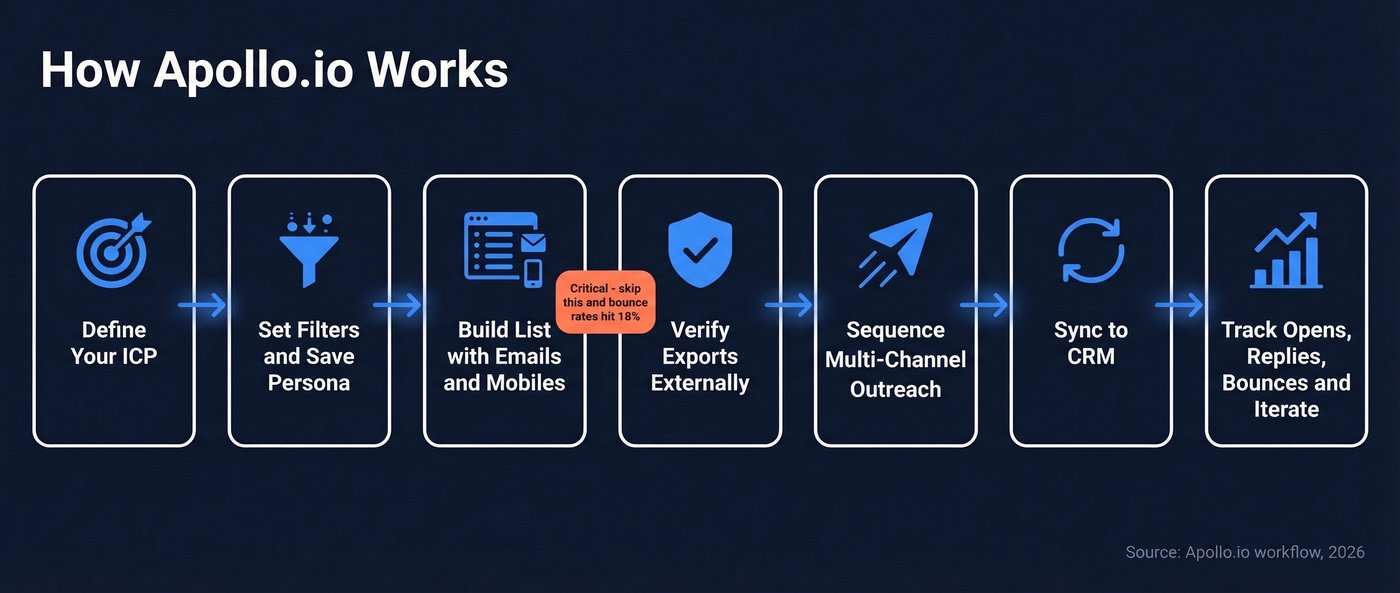
Apollo's filtering is fast and genuinely impressive for the price. The data accuracy and deliverability? That's where external help becomes non-negotiable.
Step-by-Step Breakdown
Search and Filtering
This is where Apollo earns its reputation. The platform offers 65+ filters spanning firmographics, technographics, job titles, seniority, headcount, revenue, and Bombora-powered intent signals to surface companies actively researching topics you care about.
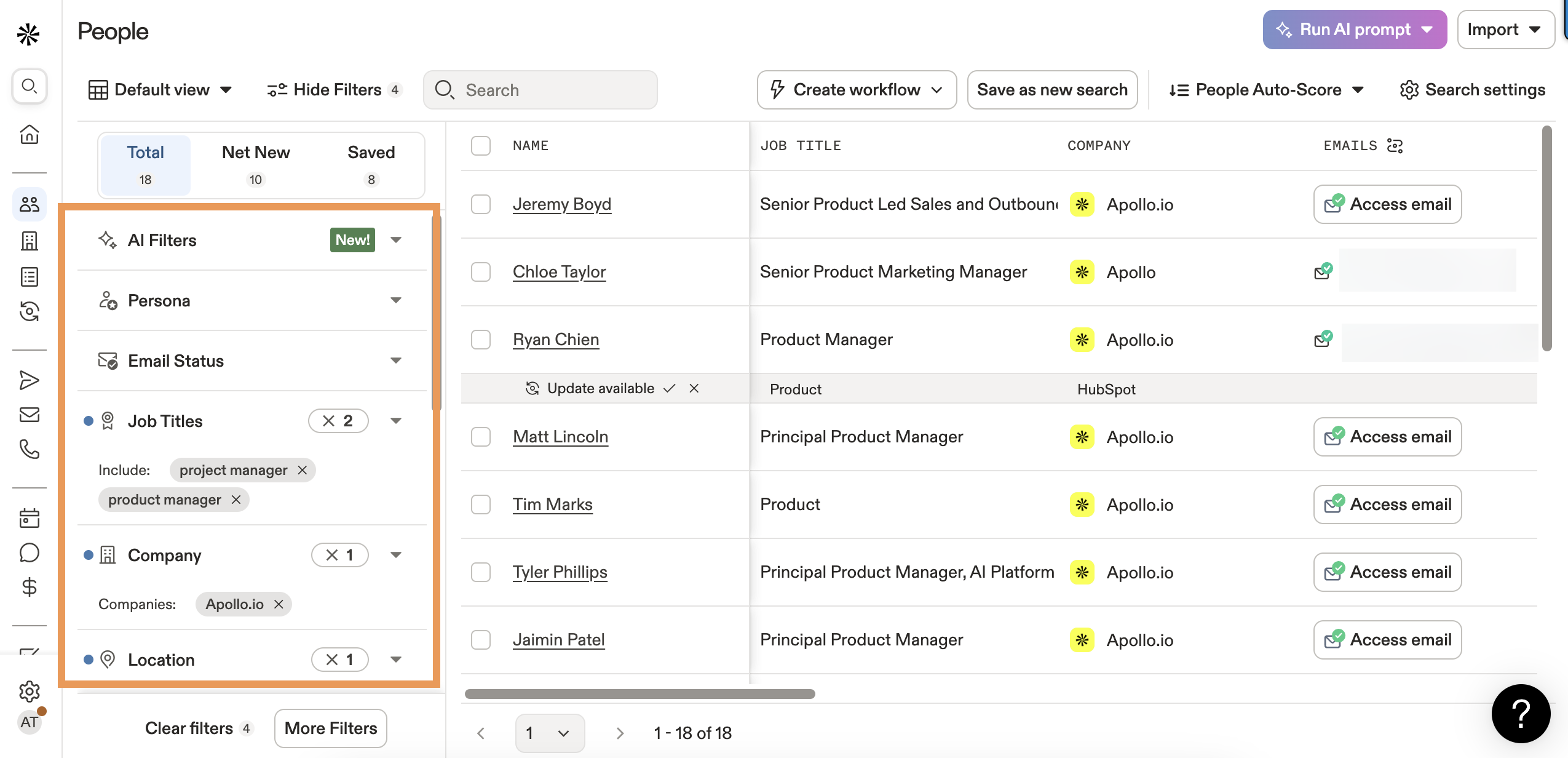
The Persona feature saves filter combinations as reusable templates. Saved searches update dynamically - Apollo emails you when new leads match your criteria. For SDR teams running multiple ICPs, this alone saves hours per week. We've seen teams go from 45 minutes of manual filtering per session down to a quick Persona check and export.
Enrichment
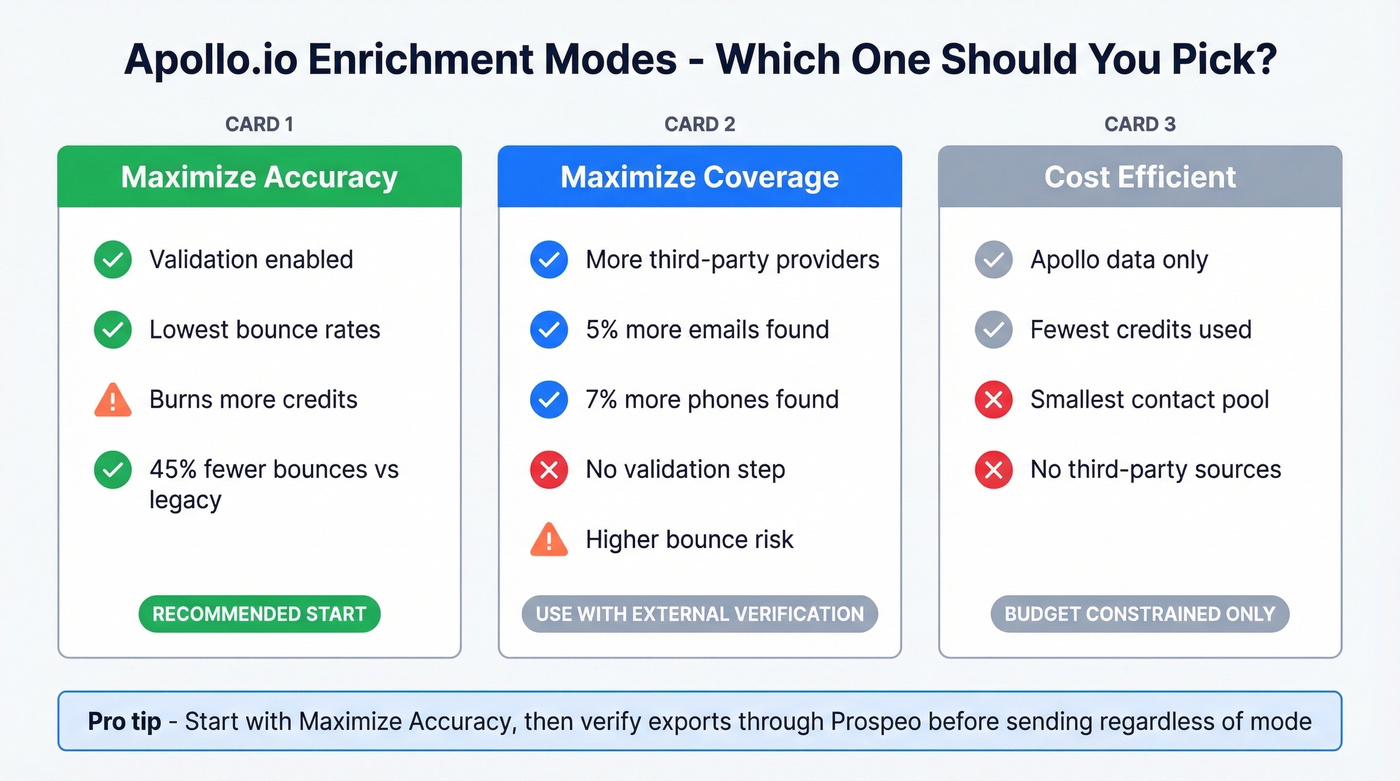
Apollo supports CSV upload, Job Change & Missing Email enrichment, CRM enrichment, waterfall enrichment, and API enrichment. Since late 2025, waterfall enrichment is the default, cascading through Apollo and third-party providers. Apollo reports roughly 5% more emails, 7% more phones, and 45% fewer bounces with waterfall enabled.
Admins get three modes. "Maximize accuracy" enables validation but burns more credits. "Maximize coverage" adds providers without validation. "Cost-efficient" limits sourcing to Apollo only. Start with maximize accuracy and adjust from there.
Sequences and Outreach
Go to Engage, then Sequences, then Create Sequence. Add steps across channels: automated emails, manual emails, call tasks, and manual tasks. Use dynamic fields and set up A/B variants for subject lines and body copy (if you need ideas, pull from these email subject lines). Enroll prospects from a saved search or list, enable mailbox rotation, and activate.
For deliverability, start at around 50 emails per day per mailbox and ramp gradually (use an email velocity cap). Use secondary domains for cold outbound - never your primary. Apollo includes an email warmup tool on select paid plans, but here's the thing: the consensus on r/sales is to avoid Apollo's sending infrastructure for cold outbound entirely. Dedicated senders like Instantly or Smartlead are what most teams actually use for deliverability.
CRM Sync
The sync handles field mapping for HubSpot and Salesforce with both real-time and scheduled enrichment. Three things to watch: only one CRM connects at a time, paid plans have a 6-hour mapping window after setup, and in HubSpot, Apollo activities associate to contacts and companies - not deals - without a workaround. If your reporting needs deal-level activity tracking, you'll need HubSpot workflows to bridge that gap. Skip this platform for CRM sync if deal-level attribution is critical and you don't have someone who can build those workflows (or follow a full connect outreach tool to CRM setup).

Apollo's CRM sync and sequences are solid, but sending to unverified contacts tanks your domain. Prospeo's 5-step verification catches the 18% of Apollo contacts that bounce - at $0.01/email with 98% accuracy and a 7-day refresh cycle. No contracts, no sales calls.
Clean your Apollo exports before they wreck your sender reputation.
The Chrome Extension
Apollo's Chrome extension activates on professional profiles, Gmail, Salesforce, and company websites. It reveals emails and phones in a sidebar, lets you add contacts to sequences, and inside Gmail it enables open tracking and Apollo templates right in compose.
It's often the first thing reps miss when they switch away from Apollo. That sidebar becomes muscle memory fast.
Pricing and Credit Math
| Plan | Monthly (Annual) | Credits |
|---|---|---|
| Free | $0 | 50/mo |
| Basic | $49/seat | 2,400/yr (~200/mo) |
| Professional | $79/seat | 4,800/yr (~400/mo) |
| Organization | $119/seat (min 3) | 6,000/yr/seat |
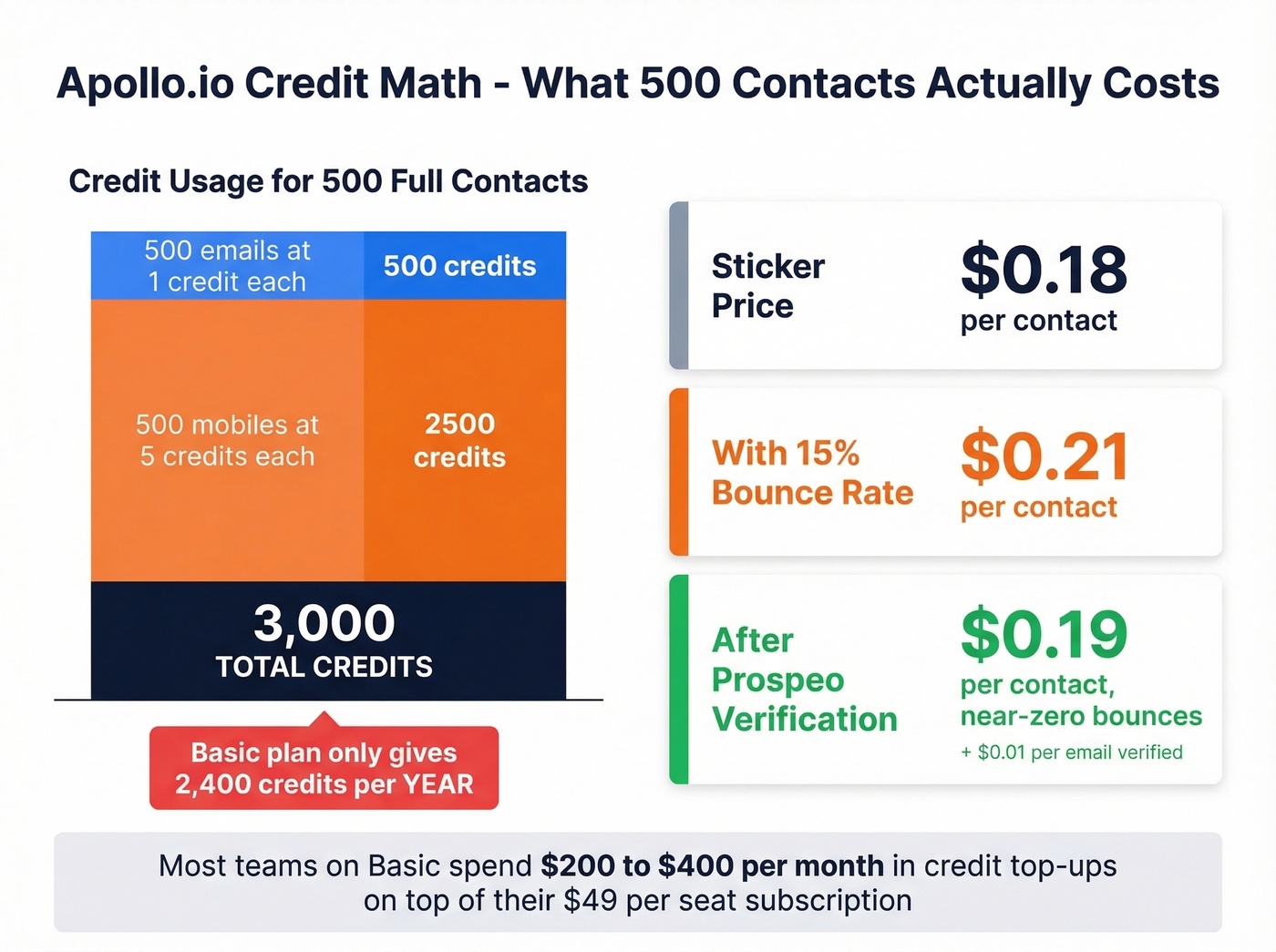
Here's where the math gets uncomfortable. An email costs 1 credit. A mobile costs 5. A full contact runs 6 credits. Need 500 contacts with both? That's 3,000 credits - exceeding the Basic plan's entire annual allotment in a single export.
Most teams buying Apollo Basic will spend more on credit top-ups than on the subscription itself. We've seen $200-$400/mo in additional credit packs at roughly $0.03-$0.05 per credit. Factor in a 15% bounce rate and your effective cost per usable contact jumps from about $0.18 to $0.21. Budget accordingly, because the sticker price on the pricing page tells maybe half the story.
Where Apollo Falls Short
Apollo's data accuracy is the elephant in the room. Waterfall enrichment helped, but practitioners on r/coldemail still report roughly 18% hard-bounce rates on day one with exported "verified" lists. The VoIP dialer uses Twilio numbers that get flagged as spam. And sending from Apollo's infrastructure isn't where you want to stake your domain reputation.
If you're trying to reduce bounces, start with the basics: understand your email bounce rate and run a proper email deliverability checklist before scaling volume.
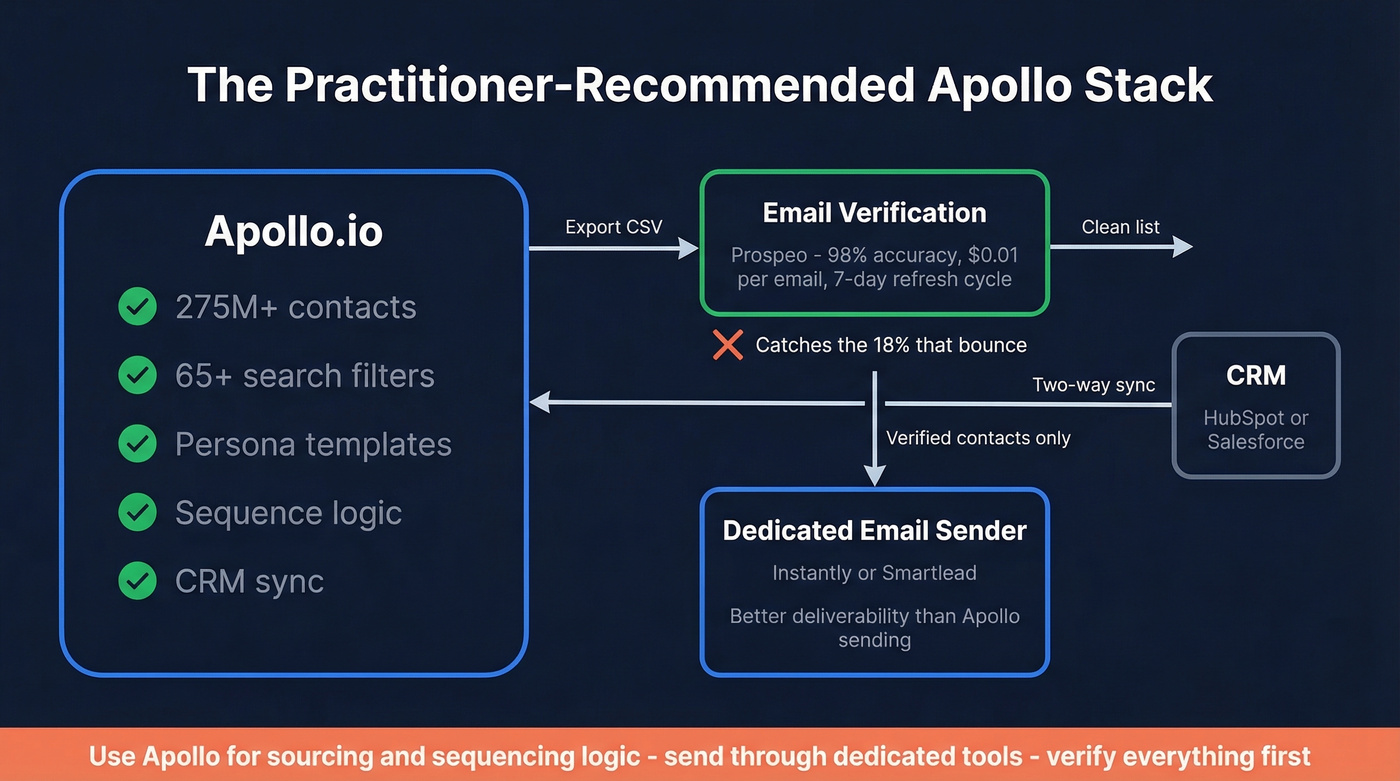
The practitioner consensus: use Apollo for data sourcing and sequencing logic, then send through dedicated tools.
The verification gap is straightforward to fix. Upload your Apollo CSV export to Prospeo's email verification, and send only to confirmed addresses. With 98% email accuracy and a 7-day data refresh cycle, Prospeo catches the stale contacts Apollo misses at roughly $0.01 per email verified. Upload, verify, export the clean list, load into your sequencer - five minutes of work that saves your domain.
Apollo's credit math already hurts - 3,000 credits for 500 full contacts. Adding a 15-18% bounce rate on top means you're paying $0.21/contact for emails that never land. Prospeo gives you 98% verified emails at ~$0.01 each, with 125M+ verified mobiles at a 30% pickup rate. Fill Apollo's accuracy gaps without blowing your budget.
Stop burning credits on contacts that bounce - verify first.
FAQ
Is Apollo.io free?
Yes. The free plan includes 50 credits per month, basic sequences, and limited filters. That's roughly 8 full contacts per month - enough to test data quality for your ICP before upgrading, but not enough to run any real campaign.
How accurate is Apollo's data?
Practitioners report around 18% hard-bounce rates on day one with exported lists, even with waterfall enrichment enabled. Running exports through a dedicated verification tool before sending is the standard recommendation across r/coldemail and r/sales. Prospeo's 98% email accuracy and 7-day refresh cycle make it a natural pairing for this exact problem.
Can Apollo replace my CRM?
No. Apollo syncs with HubSpot and Salesforce for contact, account, and deal data, but it isn't built for pipeline management. Only one CRM connects at a time, and in HubSpot, activity tracking doesn't reach the deal level without workarounds. Treat it as a prospecting layer that feeds your CRM, not a replacement.
What should I pair with Apollo for better results?
Most outbound teams pair Apollo's filtering and sequencing with a dedicated email sender like Instantly or Smartlead and a verification tool to clean exports before sending. This stack keeps Apollo's strengths - search speed and workflow automation - while offsetting its data accuracy gaps before anything hits an inbox.