

How Long to Wait Before Following Up on an Email (2026)
It's Wednesday afternoon. You sent a VP of Sales a carefully crafted email on Monday morning - personalized opening, clear value prop, specific ask. No reply. Your cursor hovers over a follow-up draft. Too soon? Too desperate?
Most advice on follow-up timing is either a one-line forum post with no data or a 3,000-word guide that buries the answer under filler. Neither helps. So here's the answer, backed by research we actually trust, followed by the context that makes it useful.
The Short Answer: 2-3 Business Days
Wait 2-3 business days before your first follow-up. That's the sweet spot for most professional emails - long enough to respect their inbox, short enough that your original message is still fresh.
Here's how that shifts by scenario:
| Scenario | Wait Time |
|---|---|
| Cold sales outreach | 2-3 business days |
| Job application | 5-7 business days |
| Post-meeting / demo | 24-72 hours |
| Networking / conference | 1-2 days |
| Internal / colleague | 1 business day |
Now, a counterintuitive finding worth sitting with: a study of 16.5 million emails found the highest reply rate - 8.4% - came from a single email with no follow-up at all. 42% of all campaign replies come from follow-ups, but the real skill isn't following up more. It's making your first email so good you barely need to.
What 16.5M Emails Tell Us About Timing
A 2025 Belkins study analyzing 16.5 million cold emails sent across 93 business domains challenges the "just keep following up" gospel that dominates sales advice.
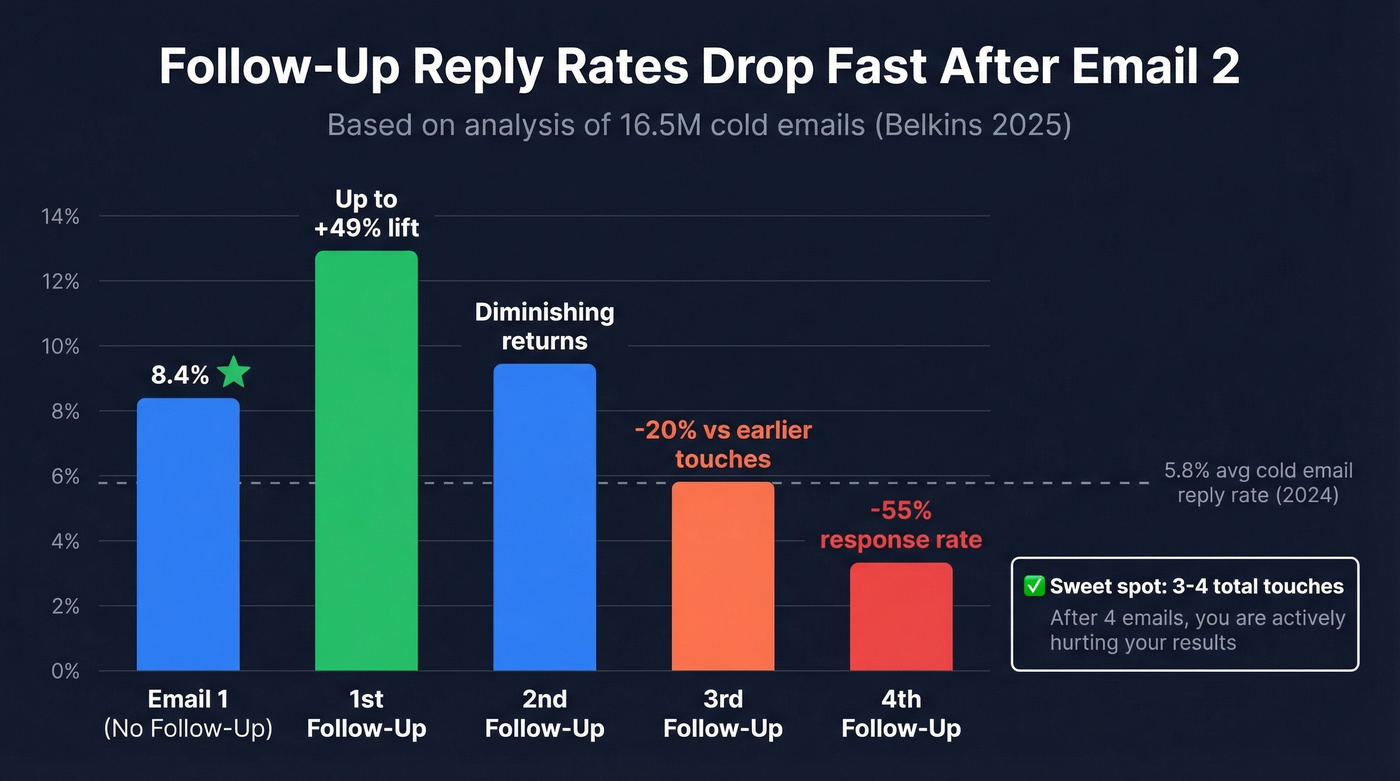
The first follow-up lifts reply rates up to 49% in high-performing campaigns. That's significant. But the returns drop fast - the third email in a sequence brought 20% fewer responses than earlier touches, and by the fourth follow-up, response rates were down 55%.
Average cold email reply rates fell to 5.8% in 2024, down from 6.8% in 2023. A 15% year-over-year decline. Inboxes are more crowded, spam filters are more aggressive, and buyers are pickier about what they engage with.
Here's the thing: most sales teams over-invest in follow-up sequences and under-invest in making email one worth opening. We've seen this pattern repeatedly across the campaigns our users run. Three to four touches is the productive range. After that, you're spending effort that actively works against you.
Ideal Wait Times by Scenario
Different contexts demand different timing. A post-demo follow-up and a cold outreach follow-up aren't the same conversation, and they shouldn't follow the same clock.
| Scenario | First Follow-Up | Why |
|---|---|---|
| Cold sales outreach | 2-3 business days | Gives them time to read without feeling stalked |
| Job application | 5-7 business days | Hiring moves slowly; earlier looks impatient |
| After a meeting/demo | 24-72 hours | Momentum matters; recap while it's fresh |
| Networking/conference | 1-2 days | Strike while the connection is warm |
| Internal/colleague | 1 business day | They're busy, not avoiding you |
| Professor/academic | 3-5 business days | Academics batch-process email; patience wins |
| Vendor/service provider | 3-5 business days | Professional but not passive |
For cold outreach specifically, Thursday is the best send day at a 6.87% reply rate versus 5.29% on Monday. Evenings between 8-11 PM hit a 6.52% reply peak, and mornings from 7-11 AM are also strong - you're either catching them during a quiet evening inbox scan or landing at the top of their morning queue.
If you send an initial email Thursday afternoon, your first follow-up lands Tuesday. Not Saturday. The business-day clock pauses over weekends.
A Follow-Up Cadence You Can Steal
Each step below has a specific purpose - not just "checking in."
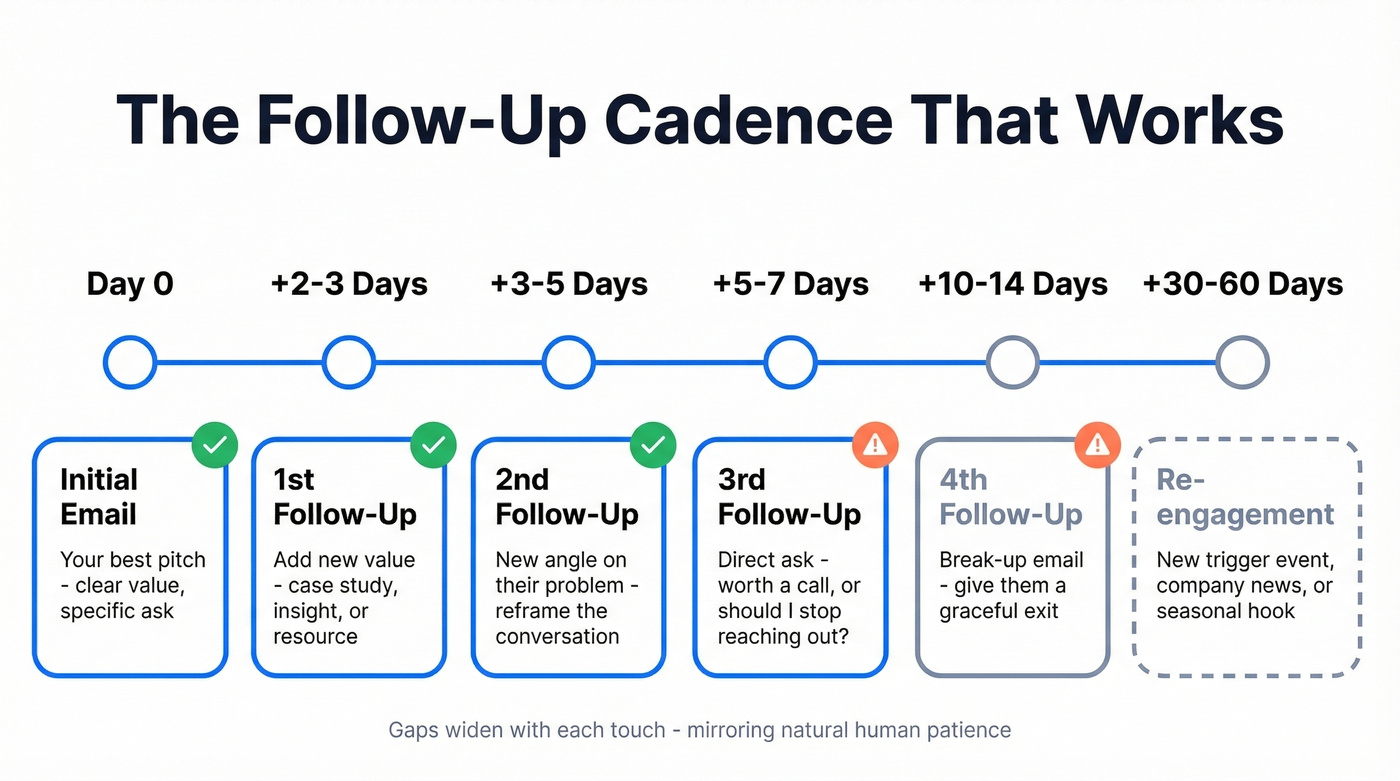
| Timing | Touch | What to Say |
|---|---|---|
| Day 0 | Initial email | Your best pitch. Clear value, specific ask. |
| +2-3 days | 1st follow-up | Add new value: a relevant insight, case study, or resource |
| +3-5 days | 2nd follow-up | New angle on their problem; reframe the conversation |
| +5-7 days | 3rd follow-up | Direct ask: "Worth a 15-minute call, or should I stop reaching out?" |
| +10-14 days | 4th follow-up | Break-up email - give them a graceful exit |
| +30-60 days | Re-engagement | Optional: new trigger event, company news, or seasonal relevance |
Notice how the gaps widen with each touch. You're giving progressively more breathing room as the silence grows. This mirrors how real human patience works: the first nudge is quick, the later ones are gentler.
Each follow-up must earn its existence. If you can't answer "what am I adding that wasn't in the last email?" - don't send it.
If you want plug-and-play copy for each touch, use these sales follow-up templates and adapt them to your offer.

Your follow-up cadence only works if your first email actually lands. With 17% of cold emails never reaching the inbox, bad data kills your sequence before timing even matters. Prospeo's 98% verified emails and 7-day refresh cycle mean your carefully timed follow-ups reach real inboxes - not spam folders or dead addresses.
Stop perfecting your timing on emails that bounce.
Timing Adjustments That Actually Matter
Seniority Changes Everything
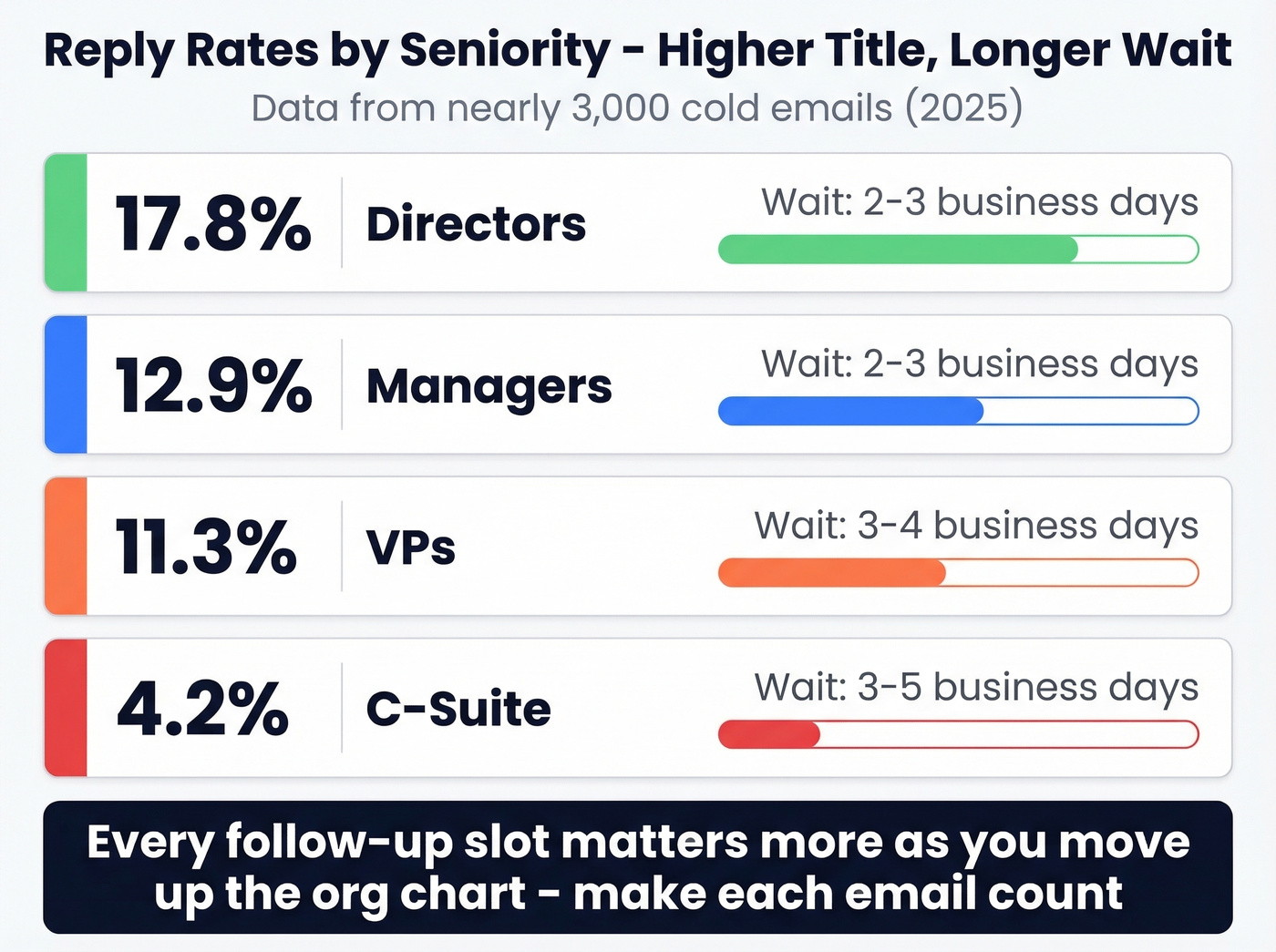
A 2025 study of nearly 3,000 cold emails found dramatic differences by title: Directors responded at 17.8%, VPs at 11.3%, managers at 12.9%, and C-suite at just 4.2%. Higher seniority means longer wait times and more value per touch. A CEO doesn't need three emails in a week - wait 3-5 business days between touches for C-level, and make every email count.
If you're building sequences by persona, a B2B cold email sequence framework helps you vary timing and value by seniority.
Company Size
Small businesses with 2-50 employees are more tolerant of follow-ups. They maintained a 9.2% initial reply rate and stayed engaged through the second follow-up. Enterprises with 1,000+ employees ghost quickly - the Belkins study describes them as "allergic" to persistence.
We've watched teams burn through entire enterprise target lists by running the same five-email sequence they use on SMBs. If you're prospecting into large accounts, front-load your value. Your first email needs to do the heavy lifting because you won't get many shots.
This is also where account-based selling tends to outperform high-volume sequences.
Day and Time
Thursday wins at 6.87% reply rate. Avoid Mondays (inbox triage mode) and Fridays (mentally checked out). Evenings between 8-11 PM peak at 6.52% replies, especially mid-week. You're catching people during a quiet inbox scan when there's less competition for attention.
For a deeper breakdown, see our data on the best send day for cold outreach.
Five Mistakes That Kill Follow-Ups
"Just checking in." This phrase signals you have nothing new to say. It puts the burden on the recipient to re-read your previous email and figure out why they should care. Delete it from your vocabulary.
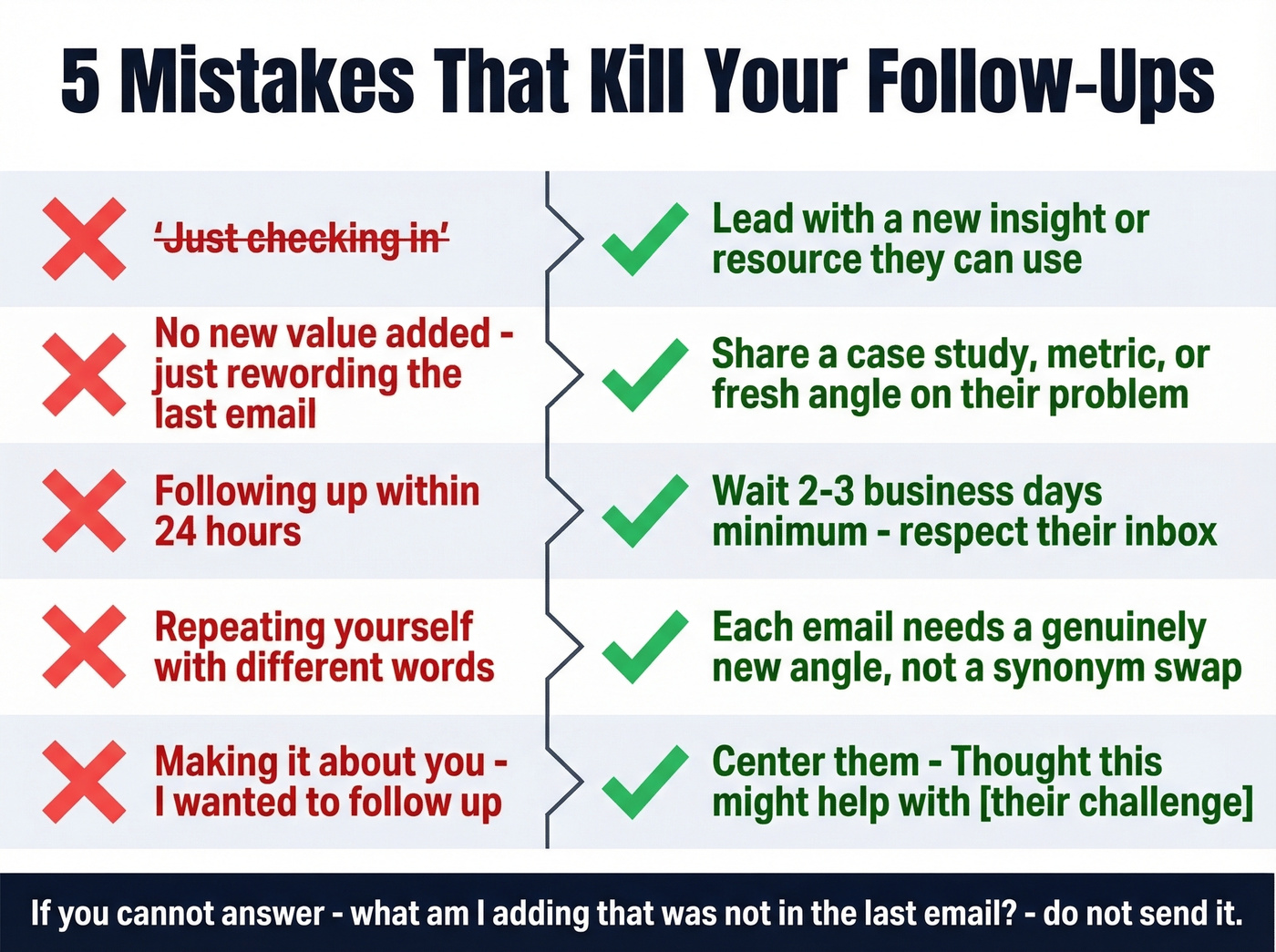
No new value added. A relevant case study, a fresh insight about their industry, a specific metric - something. If you're just rewording the last email, don't send it.
Following up too soon. Anything under 24 hours reads as impatient at best, desperate at worst. Respect the clock.
Repeating yourself with different words. Your recipient will notice. Each follow-up needs a genuinely new angle, not a synonym swap.
Making it about you. "I wanted to follow up" centers you as the protagonist. "Thought this might help with [their specific challenge]" centers them. Small shift, big difference.
If you catch yourself writing "checking in," use these alternatives for how to say just checking in professionally.
Maybe They Never Saw Your Email
Before you agonize over follow-up timing, consider this: roughly 17% of cold emails never reach the inbox. They bounce, hit spam filters, or vanish into the void.
That "no response" you're stressing about? There's nearly a one-in-five chance they never saw your message.
The root causes are predictable: invalid email addresses, poor sender domain reputation, spam-trigger content, or catch-all domains that accept everything but route to nowhere. The single biggest lever for improving reply rates isn't follow-up cadence - it's making sure the email address is real before you hit send. Prospeo's 5-step verification catches bad addresses, spam traps, catch-all domains, and honeypots before you send, with 98% accuracy across 143M+ verified emails. The free tier lets you verify 75 emails a month, enough to clean your next campaign before launch.
In our experience, once your bounce rate creeps past 3-4%, your list quality is usually the bottleneck - not your follow-up timing. And when bounces get high enough, cadence optimization turns into rearranging deck chairs. The r/coldemail community echoes this constantly: fix your data first, then worry about sequence length.
If you want to diagnose the issue properly, start with email bounce rate benchmarks and fixes, then work through an email deliverability guide to address root causes.
Directors reply at 17.8%, VPs at 11.3%, C-suite at 4.2% - every follow-up slot matters more as you move up the org chart. Prospeo gives you verified direct emails for 300M+ professionals with 30+ filters for seniority, intent signals, and company size, so you spend those 3-4 productive touches on the right person.
Reach decision-makers on the first try for $0.01 per email.
When to Stop Following Up
Three follow-ups is the sweet spot. After that, the math turns ugly: sending 4+ emails more than triples spam complaints from 0.5% on the first email to 1.6% by the fourth. Unsubscribe rates jump from 0.1% to 2%. You're not just wasting time; you're actively damaging your sender reputation.
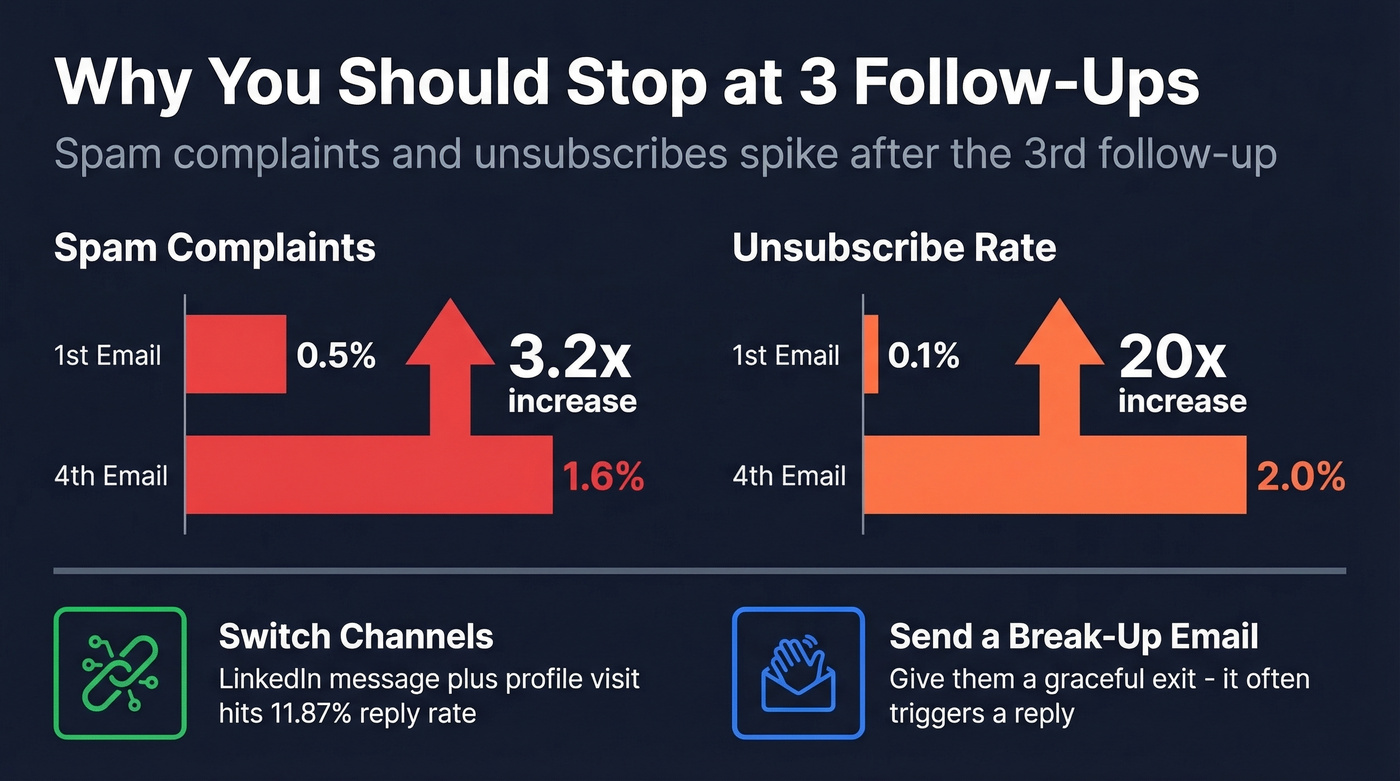
After three follow-ups with no response, you have two good options.
Switch channels. A LinkedIn message paired with a profile visit hit an 11.87% reply rate - higher than most email sequences achieve. Sometimes the channel is the problem, not the message.
Send a break-up email. Give them a graceful exit: "Looks like the timing isn't right. I'll stop reaching out, but if [specific value] becomes relevant, here's where to find me." It's respectful, it closes the loop, and it occasionally triggers a response from people who felt guilty about not replying.
If you're running multi-touch outreach, it helps to track sender reputation as closely as you track replies.
Let's be honest about what the data really says: hyper-personalized emails that reference specific business challenges get 8.7x more responses than generic ones. Two great emails will outperform five mediocre ones every time. Invest in personalization quality, not sequence length.
For more on writing the actual message (not just timing), see our guide to emails that get responses.
Follow-Up Timing FAQ
How many days should I wait to follow up on an email?
Two to three business days works for most professional contexts. Job applications are the exception - wait five to seven business days since hiring timelines move slowly. After a meeting or demo, follow up within 24-72 hours while the conversation's still fresh.
How many follow-up emails is too many?
Three follow-ups (four total emails) is the productive limit. After that, spam complaints triple and unsubscribe rates jump 20x. If three emails don't get a response, switch to a different channel or send a break-up email.
What should I say instead of "just checking in"?
Every follow-up needs to add something the last email didn't - a relevant case study, a fresh industry insight, or a new angle on their specific problem. Lead with the new value in your opening line so they see it immediately.
How do I know if my email was even delivered?
About 17% of cold emails never reach the inbox due to bounces and spam filtering. If your bounce rate's above 3-4%, fix your data before tweaking your cadence. Tools like Prospeo verify addresses before you send, catching bounces and spam traps that would otherwise tank your deliverability.
Should I follow up if I haven't heard back at all?
Yes - 42% of all campaign replies come from follow-ups, not the initial email. Most people aren't ignoring you; they're busy. The line between helpful and annoying is whether you're offering something new each time you reach out.