

How to Apply the AIDA Model: Examples for Email, Landing Pages, and Ads
A poster on r/coldemail restructured their outreach around AIDA and closed $27K in business within two months. The framework dates back to 1898. The reason it still works isn't magic - it's structure. Here's how to apply the AIDA model across the channels that actually matter in 2026.
Quick version:
- AIDA is a writing structure. Use it to organize copy, not to model every real-world journey.
- In sequences, emphasize one AIDA stage per message and let the full arc play out across touchpoints.
- Worked examples for cold emails, landing pages, and ads below - plus the KPIs to measure each stage.
What AIDA Actually Is (And Isn't)
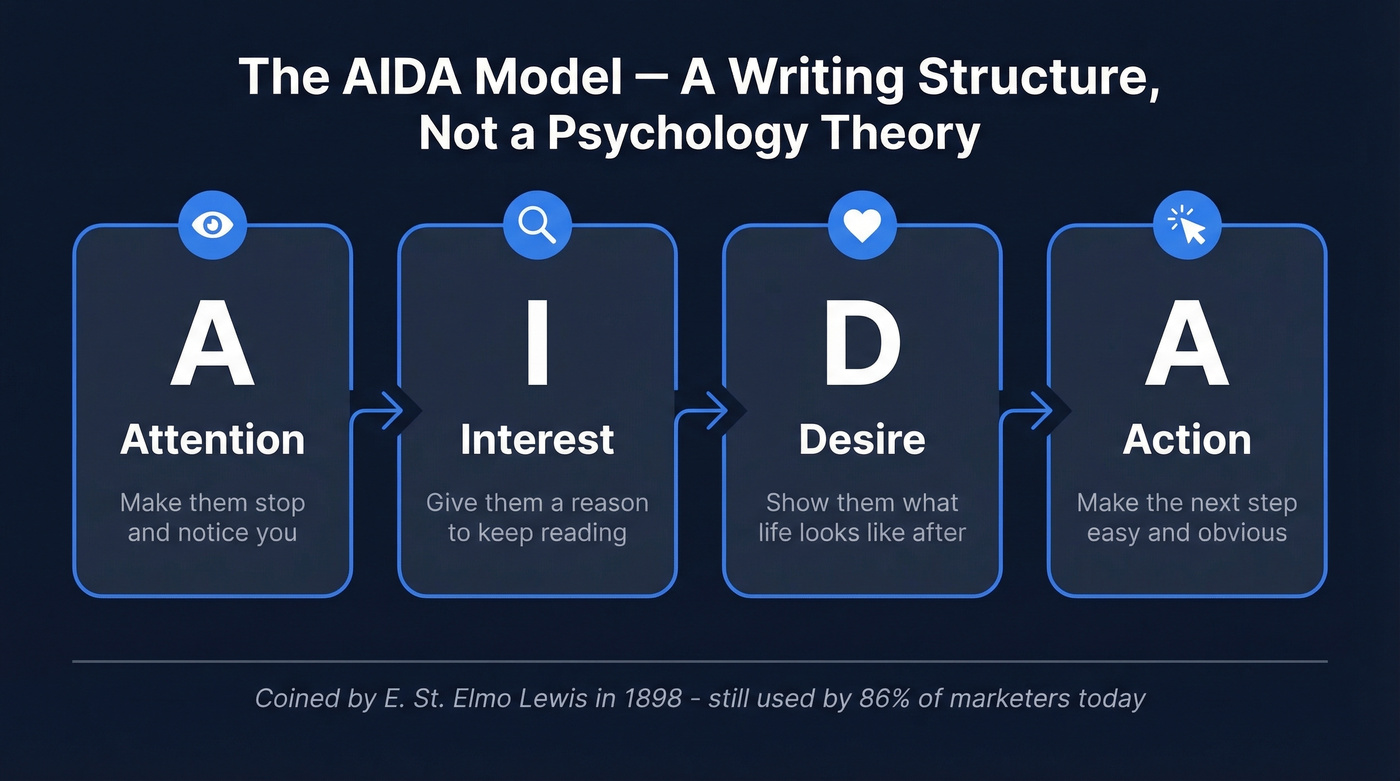
AIDA stands for Attention, Interest, Desire, Action). E. St. Elmo Lewis coined it in 1898) to describe how advertising should move a reader from noticing something to doing something about it. 86% of marketers globally use the AIDA marketing model or AIDA-based frameworks as their core marketing model - not because it's scientifically proven, but because it gives copy a spine. Think of it as a checklist for persuasion within your funnel, not a theory of human psychology.
If you want the deeper version of how AIDA maps to pipeline stages, see the AIDA sales funnel breakdown.
The One Rule That Makes AIDA Convert
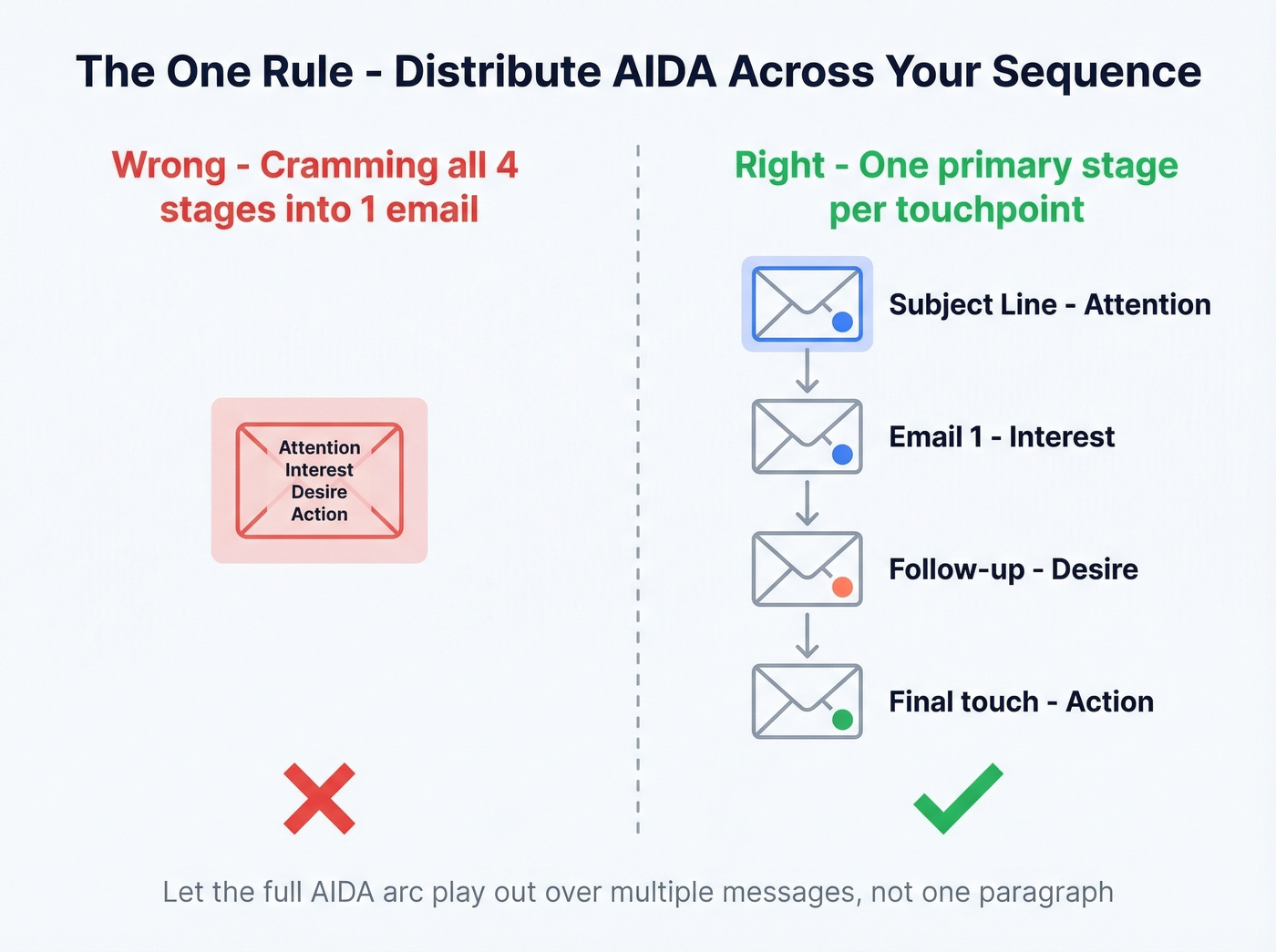
The biggest mistake I see is cramming all four stages into one asset. One email shouldn't try to grab attention, build interest, create desire, and close the deal. Use one primary tactic per message. Let Attention live in your subject line. Let Interest carry your first email. Let Desire build across follow-ups. The full AIDA arc plays out across a sequence, not inside a single paragraph. Once you understand the framework this way - distributing stages across touchpoints - your sequences start converting at a fundamentally different level.
How to Apply AIDA: Three Worked Examples
Cold Email (The $27K Structure)
Here's the AIDA structure from that Reddit case study, broken down stage by stage.
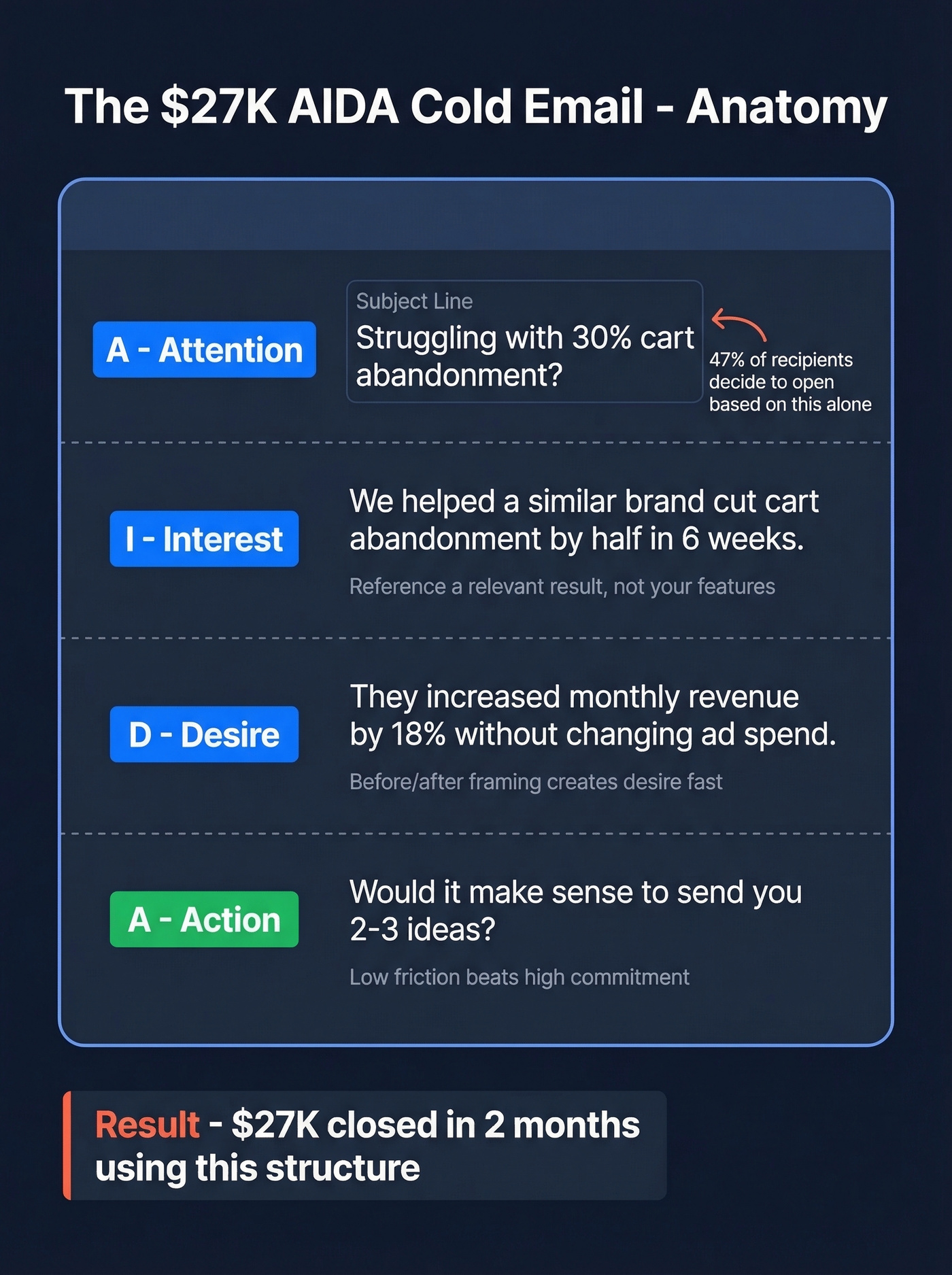
Attention - the subject line. Replace generic openers with hyper-specific pain hooks. The example subject: "Struggling with 30% cart abandonment?" 47% of recipients open emails based on the subject line alone. If your hook doesn't name a real problem, nothing else matters. (Need ideas? Steal from these cold email subject line examples.)
Interest - the opening line. Explain why you're reaching out and reference a relevant result. For example: "We helped a similar brand cut cart abandonment by half in 6 weeks." This isn't about you - it's about proving you understand their world.
Desire - paint the outcome. Don't list features. Show what's possible: "They increased monthly revenue by 18% without changing ad spend." Before/after framing is the fastest way to create desire in a cold context.
Action - low-friction CTA. "Would it make sense to send you 2-3 ideas?" beats "Book a 30-minute call" every time. Add a small incentive if you can - a free audit, a benchmark report, a relevant case study. The goal is a reply, not a commitment. (More patterns in these sales follow-up templates.)
The best AIDA email in the world fails if it bounces. Your Action stage depends entirely on reaching a real inbox. Prospeo runs real-time email verification with 98% accuracy on a 7-day refresh cycle, so your domain reputation stays clean and your sequences actually land. If you're troubleshooting deliverability, start with this email deliverability guide.

Landing Pages
Think of your landing page as a visitor's internal monologue: "Oh, what is this?" → "Let me read on..." → "I want this" → "Let me get it now."
Attention (above the fold). Lead with a bold headline emphasizing a benefit, not a feature. Add visuals - imagery can increase engagement by up to 94%. Use an odd number of bullet points if you're listing benefits; odd numbers tend to convert better than even.
Interest (below the fold). Show how easy it is to get started. A simple "Step 1, Step 2, Step 3" layout removes friction and keeps people scrolling.
Desire (social proof section). Testimonials, ratings, trust seals. Place these high enough that visitors don't leave to research you elsewhere.
Action (CTA). One consistent CTA throughout the page. Don't mix "fill out form" and "add to cart." Reduce doubt with specifics - free shipping, no-credit-card trial, money-back guarantee. A/B test the CTA copy relentlessly.
Digital Ads (Google, Meta, YouTube)
Ads compress AIDA into seconds. On Meta, you've got 3 seconds to grab attention. On YouTube, it's 5 seconds before the skip button appears.
For Attention, lead with question-based headlines, shocking stats, or before/after visuals - high-contrast imagery stops the scroll. Creative disruption works here too: unexpected placements, personalized hooks, or pattern-interrupt visuals that break the feed's monotony. SEO also functions as an Attention-stage channel - ranking for the right keyword means your audience finds you before you find them. (If you're building that system, this guide on SEO sales leads helps.)
Here's my hot take: skip Desire in the ad itself and let the landing page handle it. In practice, Interest and Desire merge in ads because you don't have the real estate. Think of ads as "A-I-A" - Attention, Interest, Action.
Here's what that looks like on Meta:
Headline: "Still paying $50/lead?" Body: "Our clients cut CPL by 40% in 30 days." CTA: "Start Free →"
For Action, combine urgency with a low-risk offer. Use CTAs like "Start free - no credit card" when you can, and keep CTA button copy to 3-4 words.

The Action stage of AIDA falls apart when emails bounce. Prospeo's 5-step verification delivers 98% email accuracy across 300M+ profiles - refreshed every 7 days, not every 6 weeks. Your AIDA sequences deserve inboxes, not spam folders.
Build your AIDA prospect list on data that actually connects.
How to Measure AIDA Performance
Each AIDA stage has its own KPIs. The trap is treating Attention metrics as success metrics - impressions and open rates become vanity metrics fast if they're not tied to downstream business goals.
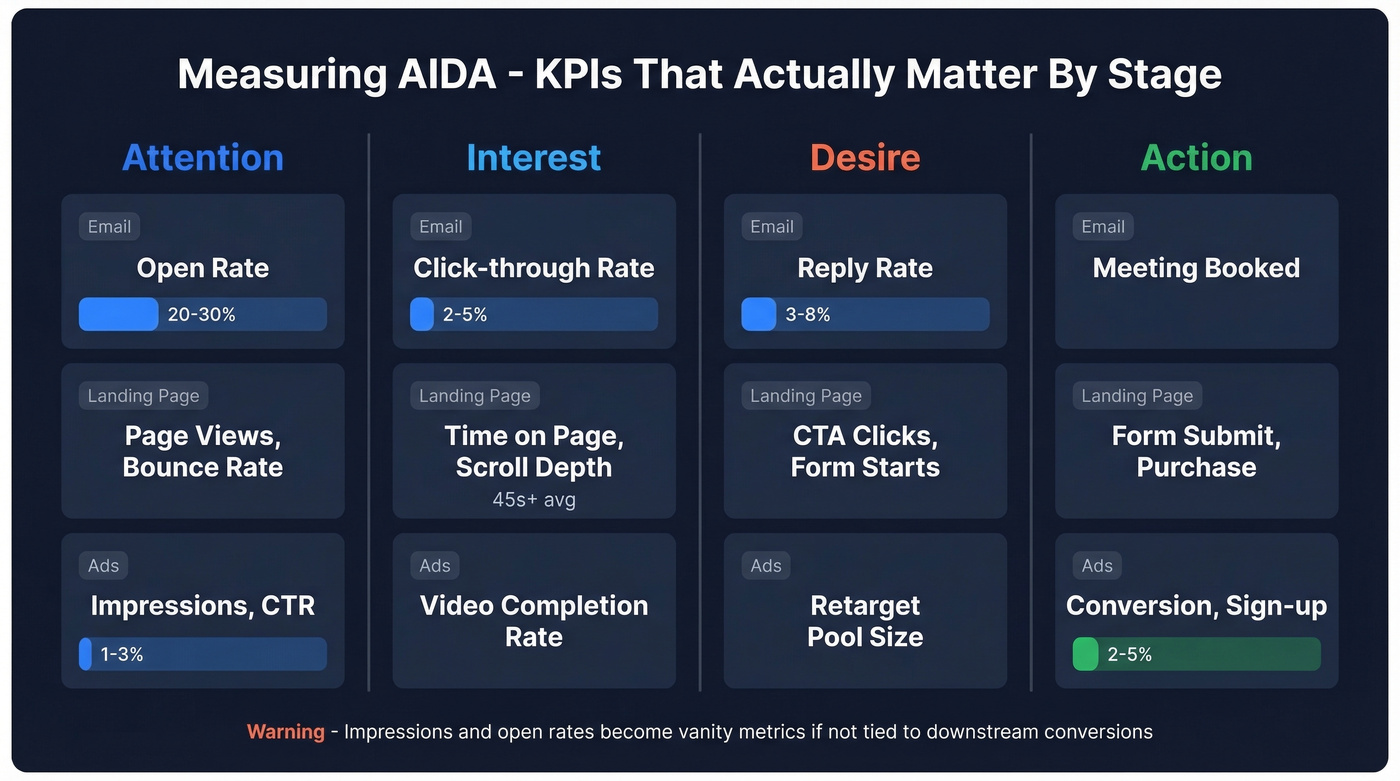
| AIDA Stage | Email KPIs | Landing Page KPIs | Ad KPIs | Benchmarks (typical ranges) |
|---|---|---|---|---|
| Attention | Open rate, deliverability | Page views, bounce rate | Impressions, CTR | Open: 20-30%; Ad CTR: 1-3% |
| Interest | Click-through rate | Time on page, scroll depth | Video completion | Email CTR: 2-5%; Avg time: 45s+ |
| Desire | Reply rate, lead score | CTA clicks, form starts | Retarget pool size | Reply: 3-8% |
| Action | Meeting booked | Form submit, purchase | Conversion, sign-up | Conversion: 2-5% |
Building your prospect list for that email column? Prospeo's email finder pulls verified contacts from 300M+ profiles - start free and pay only for valid addresses. To keep bounce rates under control, use these email bounce rate benchmarks and fixes.
When to Use PAS Instead
AIDA works best when you're introducing something new to a cold audience - building awareness from scratch. PAS (Problem-Agitate-Solution) is better when your audience already knows their problem and you just need to twist the knife.
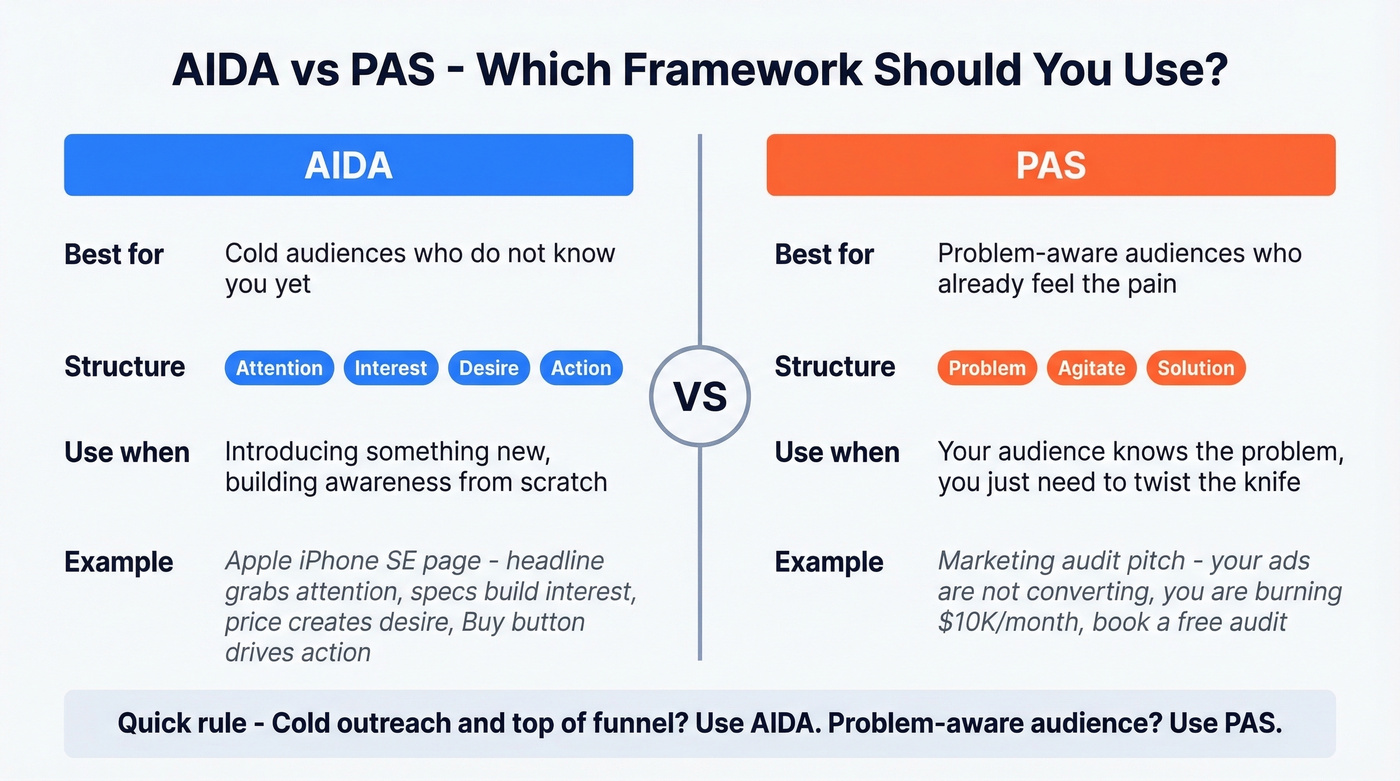
Apple's iPhone SE page is classic AIDA: headline grabs attention, specs build interest, price creates desire, "Buy" button drives action. A marketing audit pitch is classic PAS: name the problem (your ads aren't converting), agitate it (you're burning $10K/month on wasted spend), solve it (book a free audit). BAB exists but rarely beats AIDA or PAS for these use cases.
AIDA's Limitations
AIDA is linear. Real buying behavior isn't. Vakratsas & Ambler's literature review) found limited empirical support for hierarchy-of-effects models - people don't move neatly from awareness to interest to desire to action. A thread on r/advertising asks whether AIDA has any empirical backing; the honest answer is limited. The model also ignores post-purchase behavior entirely - extensions like AIDAS and AIDAR exist, but they're less commonly operationalized.
Use AIDA as a writing structure, not a law of physics. It won't predict what your buyers do. It will make your copy clearer, more persuasive, and easier to measure. That's enough - and knowing how to apply the AIDA model as a structural tool rather than a behavioral theory is the difference between practitioners who get results and those who don't.
If you're building outbound around this, pair it with proven sales prospecting techniques and a clean list workflow like how to generate an email list.
You just learned how to structure Attention, Interest, Desire, and Action across touchpoints. Now you need the contacts to run that sequence. Prospeo gives you verified emails at $0.01 each - pay only for valid addresses, no contracts.
Stop perfecting copy for contacts that don't exist.
FAQ
Does the AIDA model actually work?
No rigorous empirical proof exists that AIDA predicts buyer behavior. But practitioners consistently report it improves copy structure and conversion rates - the $27K cold email case is one example. Treat it as a writing tool, not a behavioral law.
How do I apply the AIDA model to B2B outbound?
Map one primary AIDA stage per email in your sequence rather than cramming everything into one message. The biggest risk isn't your copy - it's bad contact data causing bounces. Verify your list with a tool like Prospeo (98% email accuracy, 7-day refresh) before sending.
What's the difference between AIDA and PAS?
AIDA builds awareness from scratch - ideal for cold audiences who don't know you yet. PAS agitates an existing pain point when the audience already recognizes the problem. Use AIDA for top-of-funnel outreach and PAS for problem-aware audiences.