

How to Convert Leads Into Customers: The System That Actually Works
You generated 200 leads last month. You booked four meetings. Your marketing team is confused, your sales team is frustrated, and your CFO wants to know why the pipeline looks empty despite a healthy top-of-funnel.
Here's the thing: you don't have a lead problem. You have a system problem. Figuring out how to convert leads into customers starts with acknowledging that most failures are structural, not creative. The average B2B company takes 42 hours to respond to a new lead - by which point that prospect has already talked to two competitors and forgotten your name. Reddit threads on r/PPC are full of the same question: "I'm generating leads but they're not converting." The answer is almost always broken systems, not broken leads.
If You Only Do Three Things
Seriously, if you skim this entire article and only act on three points, make it these:
- Respond within 5 minutes. Leads contacted in the first 5 minutes convert at a 21% qualification rate. After an hour, it drops below 0.5%.
- Score leads with a 60/40 rubric - 60% who they are, 40% what they do - and route by threshold so your best reps get the hottest leads automatically.
- Run an 8-email nurture sequence over 30 days, but verify your contact data first so those emails actually reach real people.
What Lead Conversion Actually Means
Lead conversion is straightforward math: Converted Leads / Total Leads x 100. The tricky part is defining "converted." For most B2B teams, a converted lead is one that becomes a qualified opportunity - not necessarily a closed deal.
| Benchmark | Rate | Source |
|---|---|---|
| Avg. across 14 industries | 2.9% | Ruler Analytics, 100M+ data points |
| Median landing page | 6.6% | Unbounce Benchmark Report |
A quick distinction that matters: an MQL meets the demographic and behavioral criteria your marketing team sets. An SQL has been vetted by sales and confirmed as ready for a real conversation. The gap between those two is where most leads die, and it's exactly what a scoring model fixes.
The Speed-to-Lead Rule
This is the single highest-leverage fix in your entire funnel. Nothing else comes close.
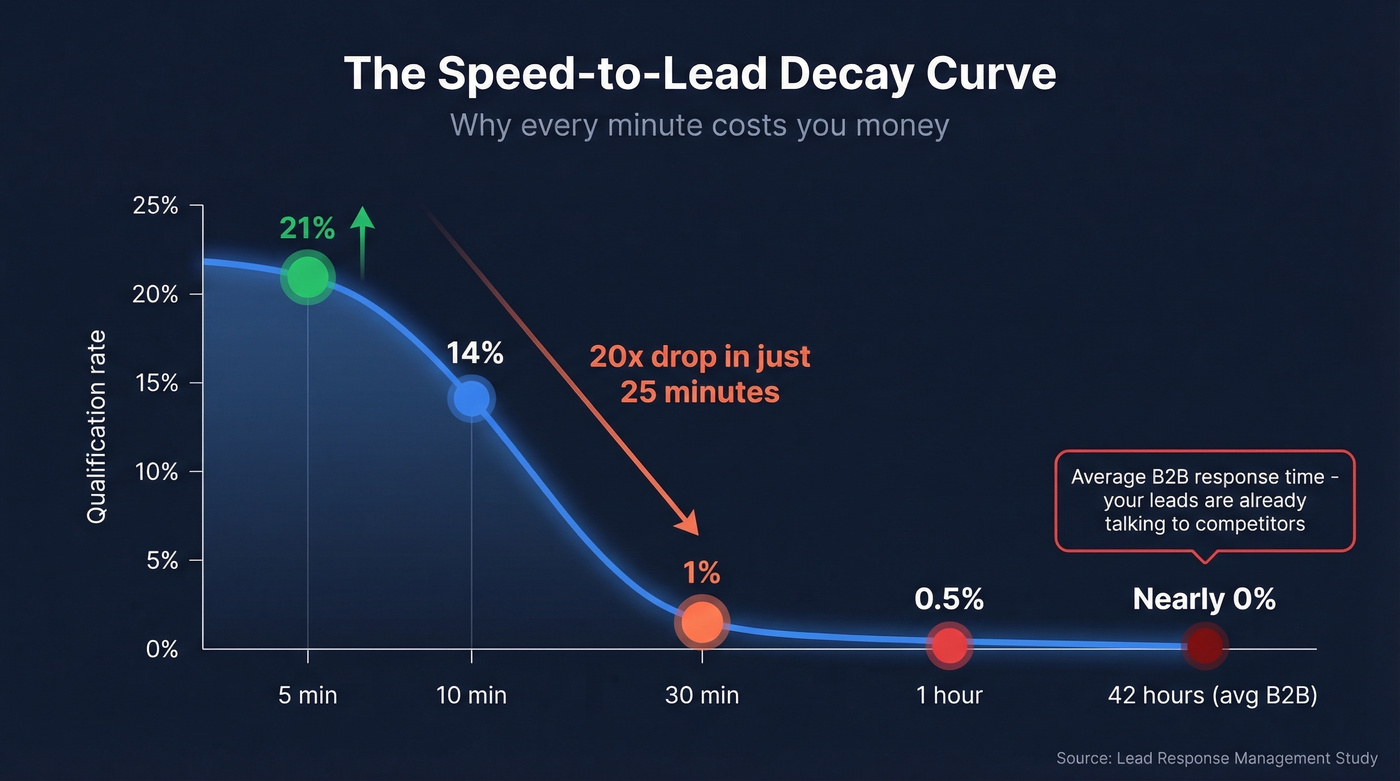
A widely cited lead-response study produced a decay curve that should make every sales leader uncomfortable:
- Within 5 minutes: 21% qualification rate
- After 10 minutes: 14%
- After 30 minutes: 1%
- After 1 hour: less than 0.5%
Read that again. The difference between 5 minutes and 30 minutes is a 20x drop. And the average B2B company takes 42 hours. If your team is doing that, your lead gen budget is a donation to your competitors.
The fix isn't complicated. Set up instant routing in your CRM so inbound leads trigger a Slack alert and get assigned to a rep within seconds. If nobody picks up in 5 minutes, it escalates. Automate this once and it pays dividends forever - it's the fastest way to turn interested prospects into paying customers without changing anything else in your stack.
Build Your Lead Scoring Model
The goal is simple: rank every lead so your team knows who to call first, who to nurture, and who to ignore.
The 60/40 Rubric
Split your scoring into two buckets: who they are (60%) and what they do (40%). In our experience, demographic fit matters more than behavior because a VP at a target account who visited your pricing page once is worth more than an intern who downloaded every whitepaper you've ever published.
If your ICP is still fuzzy, start with an ICP template and tighten it from there.
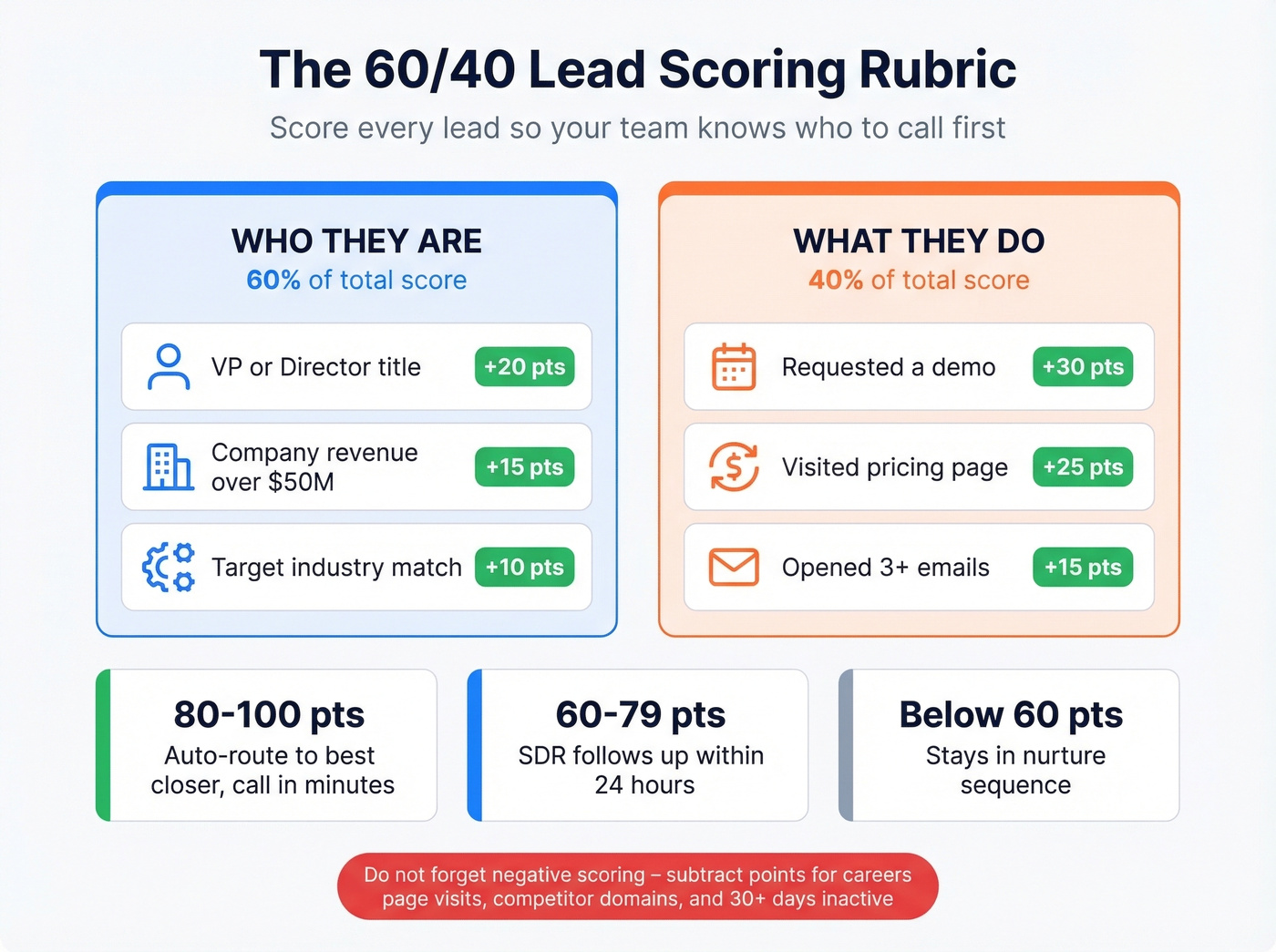
| Signal | Points | Category |
|---|---|---|
| VP/Director title | +20 | Who (60%) |
| Company revenue >$50M | +15 | Who (60%) |
| Target industry | +10 | Who (60%) |
| Requested demo | +30 | What (40%) |
| Visited pricing page | +25 | What (40%) |
| Opened 3+ emails | +15 | What (40%) |
Handoff Thresholds
80-100 points: Auto-route to your best closer. This lead gets a call within minutes. 60-79 points: SDR follows up within 24 hours - warm but not urgent. Below 60: Stays in nurture. Let your sequences do the work.
Don't Skip Negative Scoring
This is the part most teams ignore. Subtract points for visiting your careers page - they're job hunting, not buying. Same goes for competitor domains, unsubscribes, or 30+ days of inactivity. Companies with effective lead scoring see up to 30% higher conversion rates and 25% larger deal sizes, and negative signals are a big part of why.

Your scoring model is only as good as the data behind it. Route a perfect-fit VP to your best closer, but if their email bounces, the score is worthless. Prospeo's 98% email accuracy and 7-day refresh cycle mean your highest-scored leads actually get reached.
Stop scoring leads you can't contact. Verify first.
The Follow-Up Cadence
Here's a scenario we've seen dozens of times. An SDR sends one email to a new lead. No response. They mark it "unresponsive" and move on. That lead wasn't uninterested - they were untouched.
Meetings require roughly 8 touches on average. The sweet spot is 8-12 touchpoints over 17-21 days, starting with touches every 1-2 days, then expanding to 3+ days between later touches. Mix your channels: email, call, email, social, email, call, email, breakup email. The specific order matters less than the discipline of executing all 8+ touches.
If you need copy you can deploy today, use these follow-up templates to keep touches consistent.
McKinsey found that systematic sales engagement processes drive 10-20% pipeline improvements - the cadence itself is the competitive advantage. But your cadence is worthless if half the emails bounce. Verify your list before you start sending so those touches actually land in real inboxes.
Email Nurture That Turns Leads Into Buyers
For leads that aren't ready to buy today, here's a proven 8-email, 30-day SaaS nurture sequence based on Sequenzy's template data:
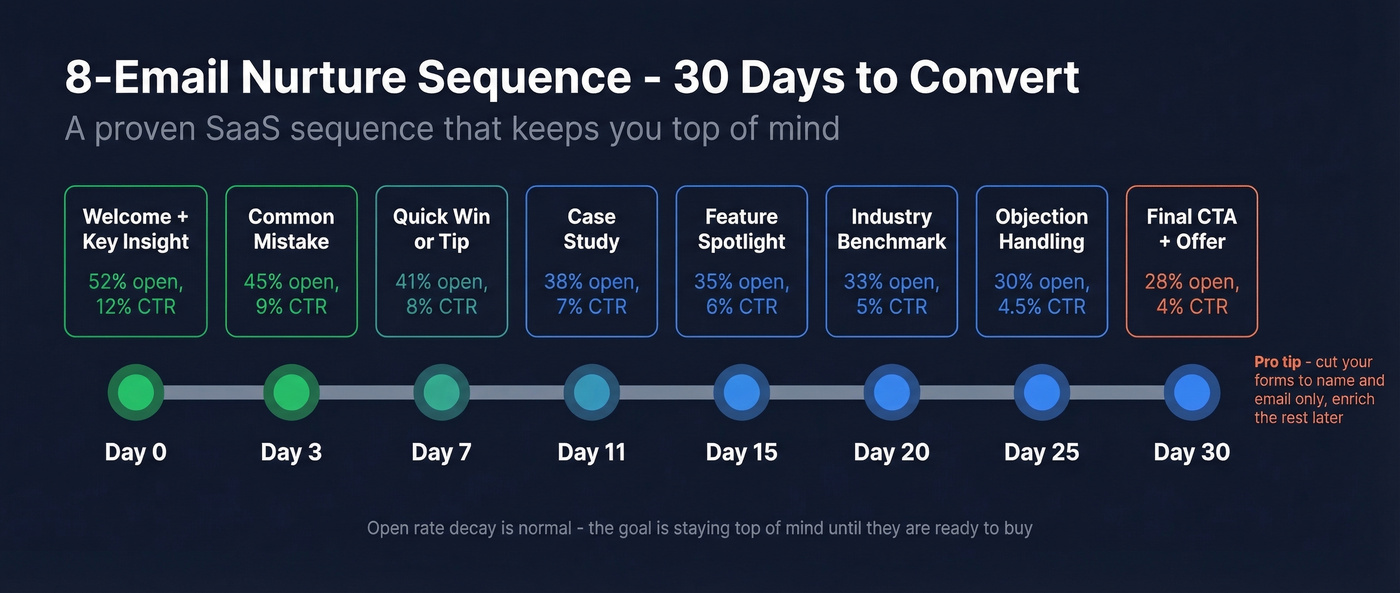
| Day | Subject Line Angle | Open Rate | CTR | |
|---|---|---|---|---|
| 1 | 0 | Welcome + key insight | 52% | 12% |
| 2 | 3 | Common mistake | 45% | 9% |
| 3 | 7 | Quick win / tip | 41% | 8% |
| 4 | 11 | Case study | 38% | 7% |
| 5 | 15 | Feature spotlight | 35% | 6% |
| 6 | 20 | Industry benchmark | 33% | 5% |
| 7 | 25 | Objection handling | 30% | 4.5% |
| 8 | 30 | Final CTA + offer | 28% | 4% |
That decay is normal. The goal is staying top-of-mind so you're the first call when they're ready. For longer B2B sales cycles like consulting or enterprise software, extend to 10 emails over 60 days.
To improve opens and clicks, borrow proven email subject lines and adapt them to your offer.
One tactical note most guides miss: more than 3 form fields reduces conversion 40-60%. If your lead capture form asks for name, email, phone, company, title, and revenue range, you're killing conversion before the nurture even starts. Cut it to name and email. Enrich the rest later.
Optimize Your Conversion Points
Small changes produce outsized results. One test compared "Sign up for free" versus "Trial for free" and saw a 104% increase in premium trial starts from the second version. Same page, same traffic, one word changed.
Let's be honest: most teams spend weeks A/B testing button colors when the real conversion killer is page clutter. We've tested this ourselves - single-CTA pages consistently outperform multi-CTA variants. The moment you add a navigation bar, a sidebar, or three different CTAs, you're splitting attention. One page, one offer, one button. Stop testing fonts and start removing distractions.
If you want a broader view of funnel structure, map this section to an AIDA funnel and spot where attention drops.
What's Worth Testing vs. What Isn't
Test CTA copy, headline framing, form field count, and social proof placement. Skip font changes, hero image swaps, and footer layout - those rarely move the needle enough to justify the effort.
Fix Your Data First
You can build the perfect scoring model, design a flawless 8-touch cadence, and write nurture emails that would make a copywriter weep - and none of it matters if 35% of your emails bounce.
Bad data is the silent killer of lead conversion. We've watched teams spend months optimizing sequences while ignoring that a third of their contact records were outdated or flat-out wrong. If you're serious about turning prospects into revenue, clean data isn't optional - it's the foundation everything else sits on.
If you're seeing bounces, start by tracking your email bounce rate and fixing the root causes before scaling volume.
Prospeo's 5-step verification process with 98% email accuracy and a 7-day data refresh cycle catches invalid addresses, spam traps, and honeypots before they torch your sender reputation. Snyk cut bounce rates from 35-40% to under 5%, grew AE-sourced pipeline 180%, and generated 200+ new opportunities per month. Meritt tripled their pipeline from $100K to $300K per week after switching to verified data. Those aren't marginal improvements - they're the difference between a pipeline that works and one that doesn't.
Mistakes That Kill Conversion
Per HubSpot's State of Marketing report, 61% of marketers say generating traffic and leads is their top challenge, and 49% aren't confident in lead quality. Most of that pain is self-inflicted.
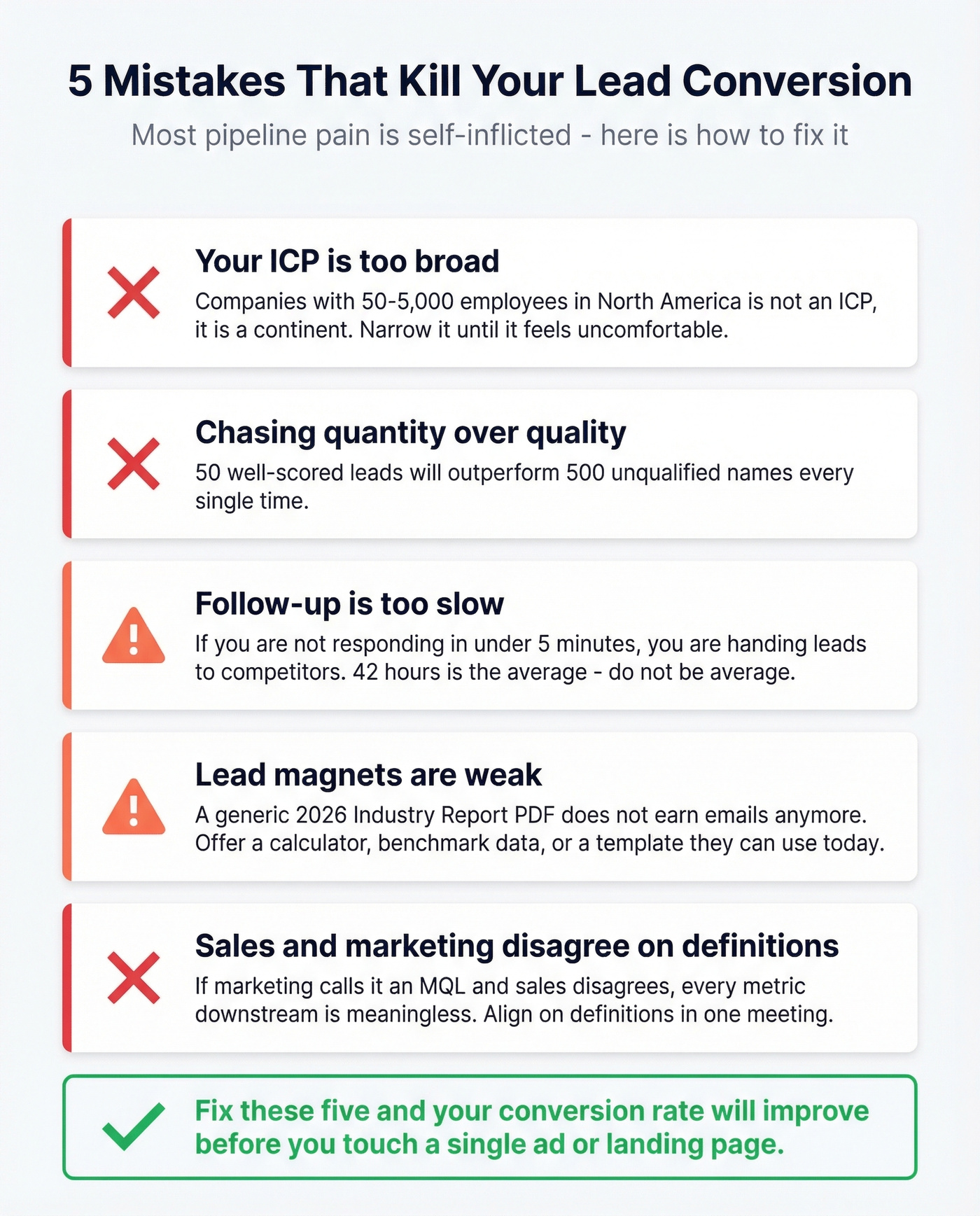
Your ICP is too broad. "Companies with 50-5,000 employees in North America" isn't an ICP. It's a continent. Narrow it until it feels uncomfortable.
You're chasing quantity over quality. 50 well-scored leads will outperform 500 unqualified names every single time. Teams that successfully convert leads into customers focus on fit, not volume.
Your follow-up is too slow. If you aren't responding in under 5 minutes, re-read the speed-to-lead section above.
Your lead magnets are weak. A generic "2026 Industry Report" PDF doesn't earn someone's email anymore. Offer something specific and immediately useful - a calculator, a benchmark dataset, a template they can use today.
Sales and marketing aren't aligned on definitions. If marketing calls something an MQL and sales disagrees, every metric downstream is meaningless. Sit in a room together and hash it out. It'll take an hour and save you months of finger-pointing.
If you're still leaking deals after fixing the basics, audit common sales pipeline challenges and patch the biggest bottleneck first.
You read it above: cut your forms to name and email, then enrich the rest. Prospeo returns 50+ data points per contact - title, company revenue, headcount, tech stack - at a 92% match rate. Your nurture sequences hit real inboxes, and your reps get full context without asking prospects to fill out six fields.
Capture less. Enrich more. Convert faster.
FAQ
What's a good lead-to-customer conversion rate?
The average across 14 industries is 2.9% based on Ruler Analytics' analysis of 100M+ data points. Above 3% is solid; above 5% is strong. The number that matters most is your trend line - are you improving quarter over quarter?
What's the difference between MQL and SQL?
An MQL meets demographic and behavioral criteria set by marketing. An SQL has been vetted by a salesperson and confirmed as ready for a real conversation. The lead scoring model above automates that handoff so nothing slips through the cracks.
How long should a nurture sequence last?
For SaaS and shorter sales cycles, 30 days with 8 emails works well. For complex B2B deals with multiple stakeholders, extend to 60 days with 10 emails. Match sequence length to your average sales cycle - Gong data suggests most mid-market deals close in 30-45 days.
How do I verify lead data before outreach?
Run your contact list through a bulk email verification tool before launching any sequence. Prospeo's 5-step verification catches invalid addresses, spam traps, and honeypots - teams typically see bounce rates drop from 30%+ to under 5%, which protects sender reputation and keeps deliverability high.