

How to Create a Drip Campaign That Doesn't End Up in Spam
The biggest reason drip campaigns fail isn't bad copy - it's bad data. If you're figuring out how to create a drip campaign, start with deliverability, not subject lines. Automated drip emails average a 4.67% click rate versus 1.29% for bulk sends, and they can lift conversion rates by up to 50%. But 10-15% of marketing emails never reach the inbox, and no amount of clever copywriting fixes a wrecked sender reputation.
Quick version: Map your trigger, segment, write 3-5 emails. Authenticate your domain (SPF, DKIM, DMARC) and verify your list before sending anything. Pick a tool - ActiveCampaign for depth, MailerLite for simplicity, Klaviyo for ecommerce.
What Is a Drip Campaign?
A drip campaign is a scheduled series of automated emails triggered by a specific action - someone signs up, abandons a cart, downloads a resource, or goes quiet for 30 days. Unlike nurture flows, which shift based on what the contact does next, drips follow a fixed sequence and timeline.
| Type | Typical Emails | Trigger |
|---|---|---|
| Welcome | 3-5 | Signup/subscribe |
| Onboarding | 4-7 | Account creation |
| Cold outreach | 3-5 | Added to list |
| Re-engagement | 2-3 | Inactivity (30-90 days) |
| Abandoned cart | 2-3 | Cart left open |
| Post-purchase | 2-3 | Order confirmed |
Build Your Drip Campaign Step by Step
Choose Your Trigger and Goal
Every drip starts with a single event and a single outcome. The trigger enrolls someone - a form submission, a purchase, a page visit. The goal is what you want them to do by the end.
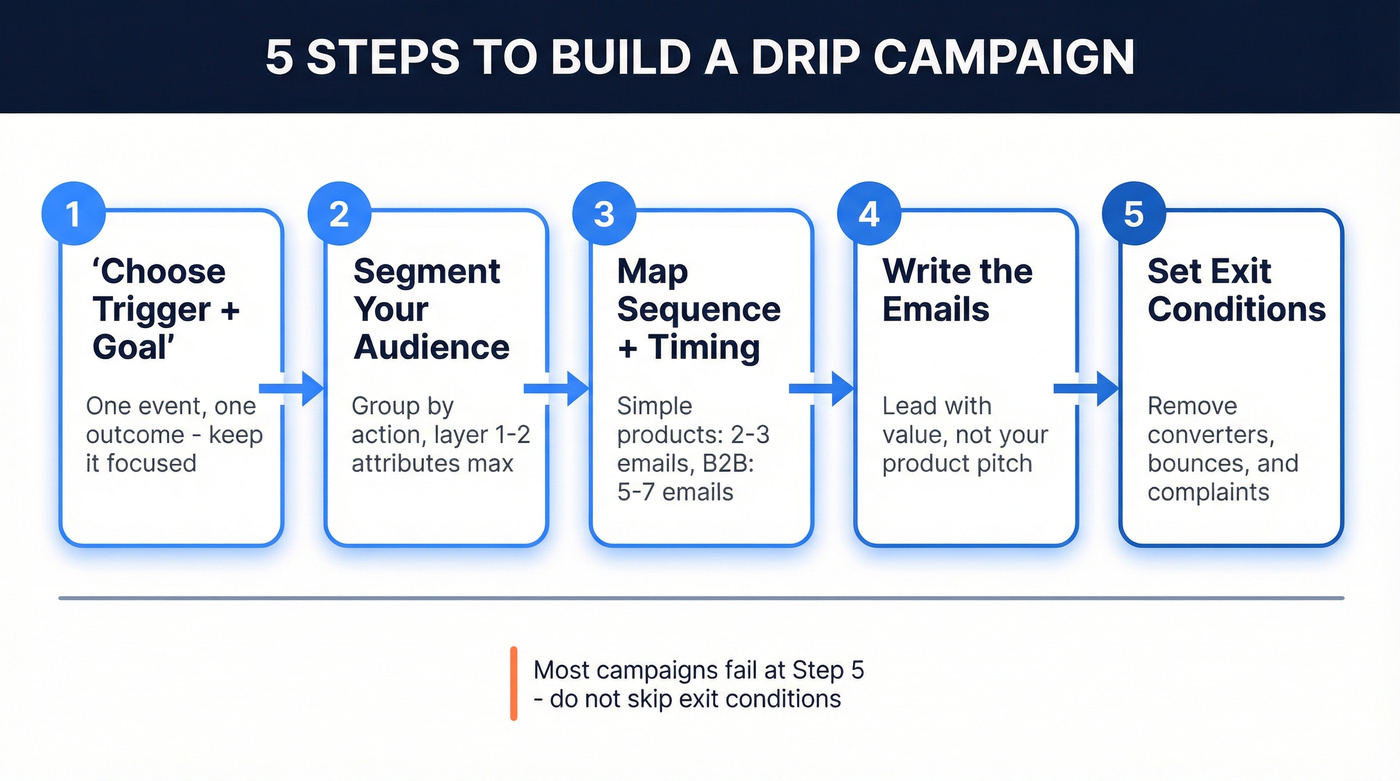
Don't combine goals. A welcome series that also tries to upsell and collect a review will do none of those things well.
Segment Your Audience
Here's what segmentation actually means in practice: group contacts by the action that triggered enrollment, then layer on one or two attributes that change the message.
Someone who downloaded a pricing PDF gets a different sequence than someone who grabbed a blog checklist - they're at different funnel stages. Purchase recency, site visit frequency, loyalty tier, and visits to your premium or pricing page all work as secondary segments. The key is restraint: two segmentation layers are usually enough, and three is the maximum before you're building sequences nobody will ever maintain. (If you want to go deeper, use intent based segmentation to prioritize high-signal behaviors.)
Map Your Sequence and Timing
Simple products need 2-3 emails. Complex B2B products with longer sales cycles need 5-7 spaced further apart. Subscribers spend roughly 2-8 seconds skimming an email, so each one needs a single clear purpose and CTA.
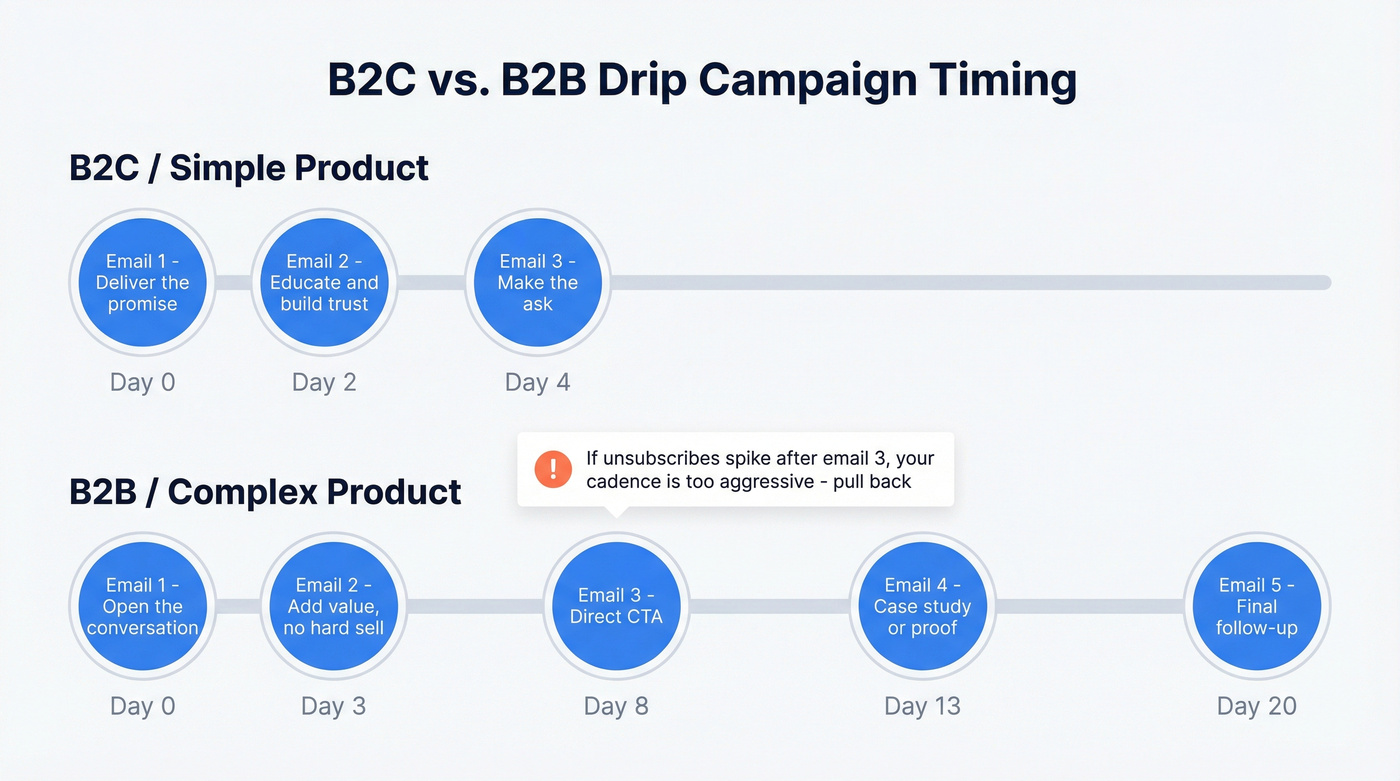
Start with: first email immediately, second at day 2, third at day 4-5. For B2B, stretch to 3-5 day gaps after the first touch. If unsubscribe rates spike after email three, your cadence is too aggressive - pull back before you burn the list.
Write the Emails
Lead with value, not your product. Email one delivers what was promised. Email two educates or builds trust - a case study, a quick tip, social proof. Email three makes the ask.
Keep subject lines specific and honest. Clickbait is the fastest way to train recipients to ignore you, and we've seen it tank open rates within two sends on sequences we've audited for clients. If you need ideas, pull from proven email subject line examples and adapt them to your segment.
Set Exit Conditions
This is the step most guides skip entirely.
Exit conditions prevent someone who already converted from getting three more nudge emails. If a lead books a demo after email two, they leave the drip immediately. Same for unsubscribes, bounces, and spam complaints. Without exit conditions, you're annoying your best prospects - and training inbox providers to deprioritize your domain.
Drip Campaign Templates You Can Steal
Welcome Series (3 emails)
| Email # | Timing | Subject Line | Purpose |
|---|---|---|---|
| 1 | Immediately | Welcome! Here's Your Free SEO Checklist | Deliver the asset |
| 2 | +2 days | Did you know these 3 common SEO mistakes? | Educate + build trust |
| 3 | +4 days | How [Company] increased traffic 140% | Social proof + CTA |
B2B Cold Outreach (3 emails)
| Email # | Timing | Subject Line | Purpose |
|---|---|---|---|
| 1 | Day 0 | Quick question about your pipeline velocity | Open the conversation |
| 2 | +3 days | Re: pipeline - one idea worth testing | Add value, no hard sell |
| 3 | +5 days | Worth a 15-min call this week? | Direct CTA to book |
For cold outreach specifically, the quality of your contact data matters more than the copy. We've watched teams spend weeks perfecting a three-email sequence only to see 8% bounce rates because they pulled addresses from a stale database. If your list isn't verified, the sequence doesn't matter. For more structure, model your outreach after a high-performing B2B cold email sequence.

You just mapped your trigger, segmented your list, and wrote three killer emails. None of it matters if 8% of those addresses bounce. Prospeo verifies emails at 98% accuracy across 143M+ records - so your drip sequence actually reaches real inboxes instead of destroying your sender reputation.
Clean your list before you launch. 75 free verifications, no credit card.
The Deliverability Checklist
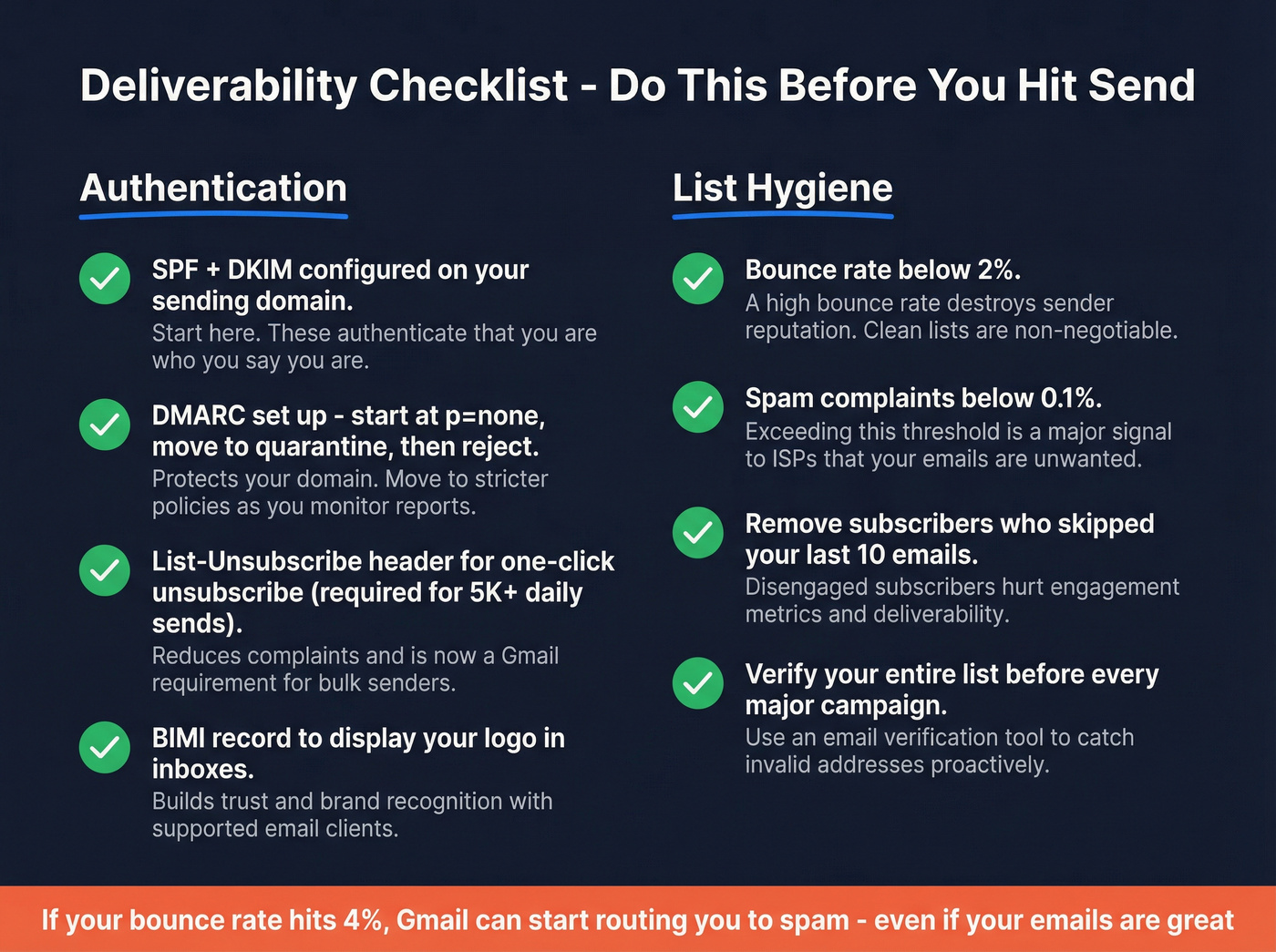
Let's be honest: this is where most drip campaigns quietly die. You spend two weeks writing a five-email welcome sequence, open rates look fine for the first week, then they crater. If your bounce rate hits ~4%, Gmail can start routing you to spam - even if the emails are great - because the list is garbage. (If you're troubleshooting, start with an email deliverability guide and then check your email bounce rate patterns.)
Authentication (non-negotiable)
- SPF and DKIM configured for your sending domain
- DMARC set up - start at
p=none, move toquarantine, thenreject - A 15K-subscriber list running multiple flows can easily cross 5,000 emails/day, which triggers bulk-sender requirements from Google and Yahoo: DMARC plus one-click unsubscribe via a List-Unsubscribe header
- Set up BIMI to display your logo in inboxes - it's a trust signal almost nobody bothers with
List hygiene
- Bounce rate below 2%, spam complaints below 0.1%
- Remove subscribers who haven't opened your last 10 emails
- Verify your list before every major campaign launch
- Warm up new sending domains gradually - no volume spikes (use a dedicated email velocity plan so you don't trip filters)
One thread on r/coldemail put it bluntly: if you're buying lists instead of building permission-based ones, you deserve the spam folder. Verify before you send. Prospeo's email verification catches bad addresses before they tank your sender reputation - 98% accuracy across 143M+ verified emails, keeping your bounce rate under 1%. If you're cleaning up after a bad import, follow a proper spam trap removal process.
Cold outreach drip campaigns live or die on contact data quality. Prospeo's 300M+ professional profiles refresh every 7 days - not every 6 weeks like most providers - so the emails in your sequence connect to real people at their current companies. At $0.01 per email, a stale list is no longer an excuse.
Stop dripping into the void. Start with verified contacts.
Benchmarks Worth Knowing
| Metric | All Campaigns (Median) | Automated Flows (Avg) | Top 10% |
|---|---|---|---|
| Open rate | 43.46% | 48.57% | 65.74% |
| Click rate | 2.09% | 4.67% | 12.22% |
| Unsubscribe | 0.22% | 0.81% | 0.04% |
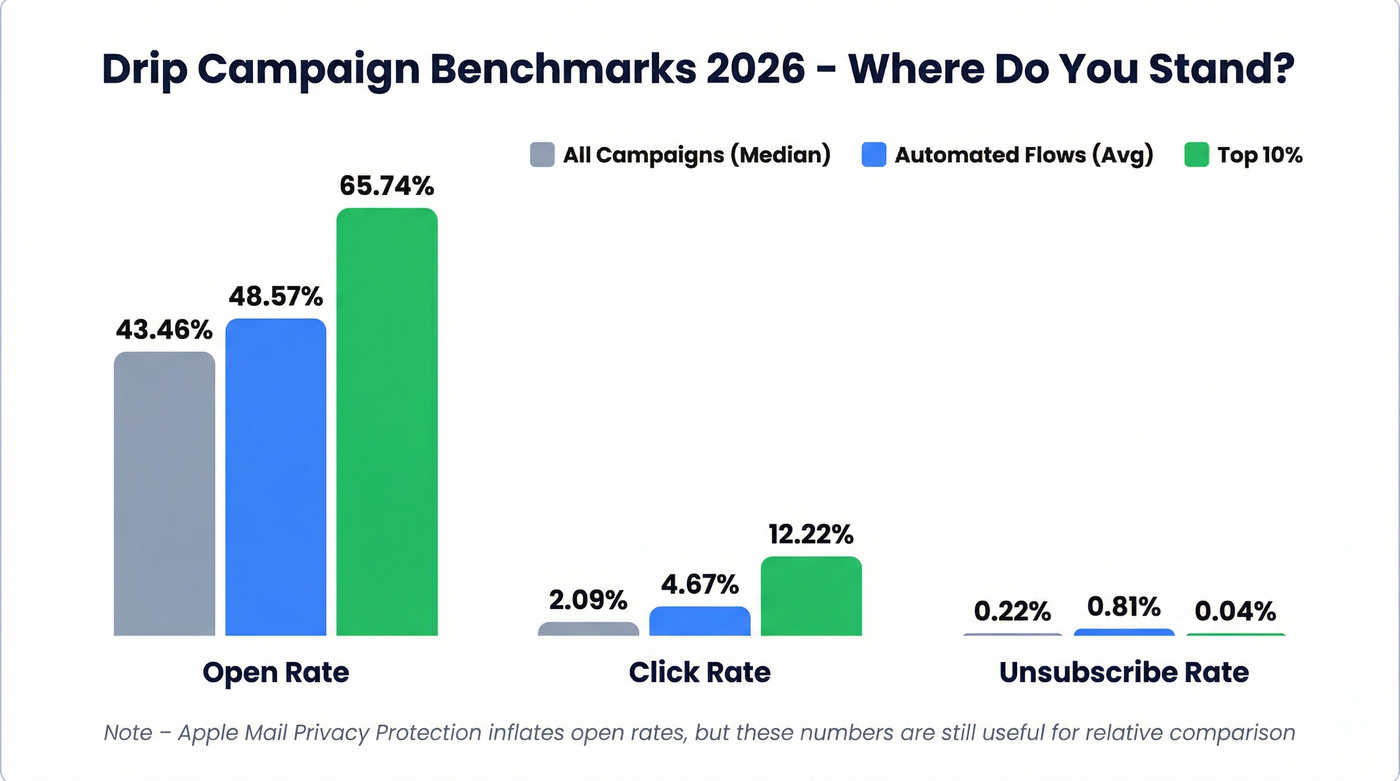
Apple Mail Privacy Protection inflates open rates across the board, but the numbers are still useful for relative comparison. If your automated flows beat the all-campaigns median, you're in good shape. If you're approaching a 12.22% click rate, you're doing something very right - and it probably means your segmentation is tight, not just your subject lines.
Best Drip Campaign Tools in 2026
| Tool | Best For | Starting Price |
|---|---|---|
| ActiveCampaign | Deepest automation builder | Free trial / $15/mo |
| MailerLite | Fastest setup, best value | Free up to 500 / $10/mo |
| Klaviyo | Ecommerce revenue attribution | Free up to 250 / $20/mo |
| Brevo | Budget teams | Free up to 300/day / $9/mo |
| Mailchimp | Beginners | Free up to 500 / $13/mo |
| HubSpot | CRM-native workflows | Free CRM / $20/mo Marketing |
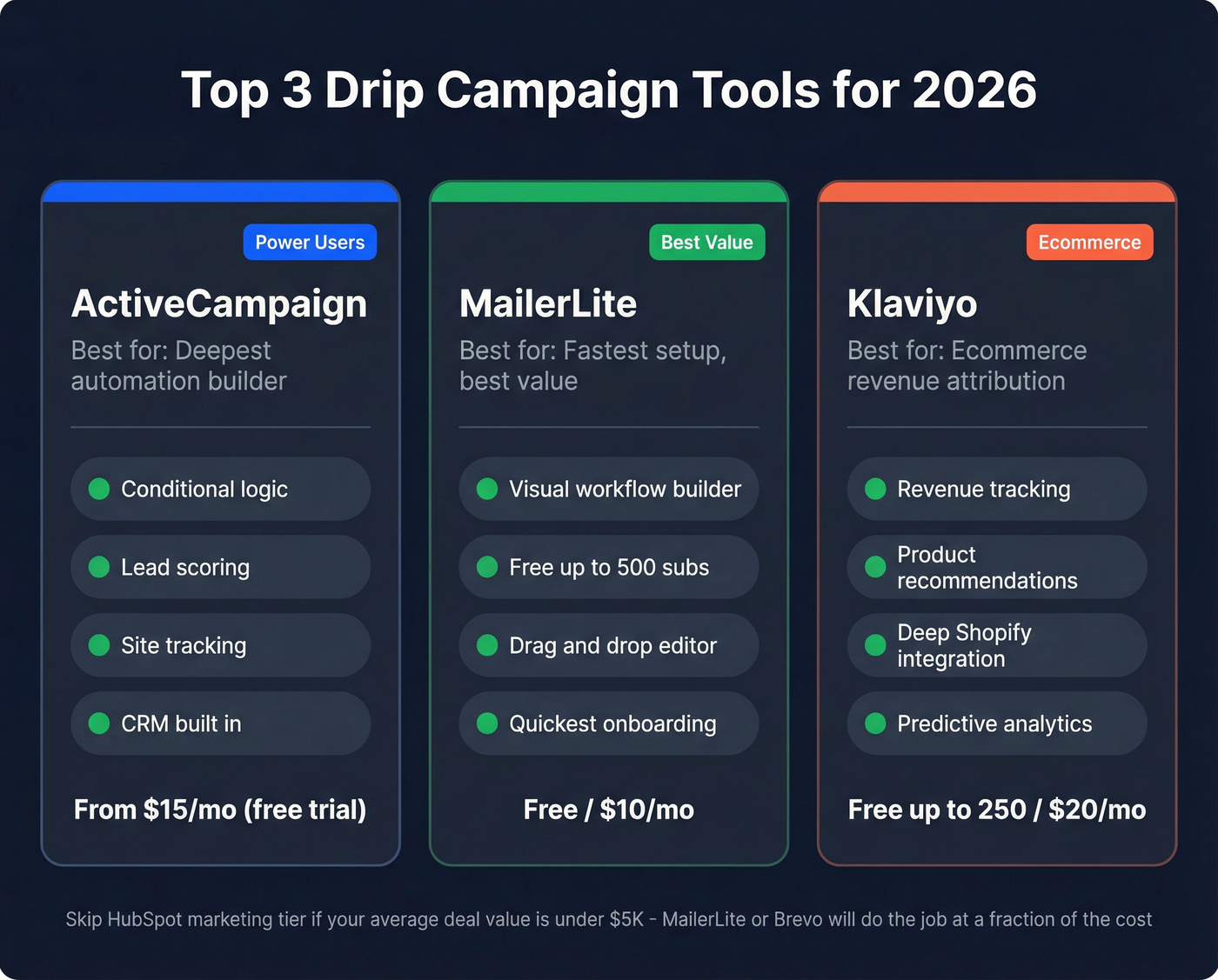
If I had to pick three to trial: ActiveCampaign, MailerLite, Klaviyo. ActiveCampaign has the deepest automation builder - conditional logic, lead scoring, site tracking all baked in. MailerLite is the fastest to set up and cheapest to run, which makes it ideal for teams that just need a working drip without a two-week onboarding process. Klaviyo is unbeatable for ecommerce with revenue attribution baked in.
Skip HubSpot's marketing tier if your average deal value is under $5K. MailerLite or Brevo will do everything you need at a fraction of the cost.
Mistakes That Kill Drip Campaigns
Frequency flooding. One practitioner put it well: "We don't usually send more than one of each a week unless a large holiday." Overlapping drips hitting the same person twice in a day is a fast path to unsubscribes. In our experience, the teams with the worst unsubscribe rates aren't sending bad emails - they're sending too many decent ones.
No exit conditions. Someone who already bought shouldn't get the "still thinking about it?" email. This is the most common automation mistake we see, and it's the easiest to fix.
Skipping authentication. SPF, DKIM, and DMARC aren't optional anymore. Google and Yahoo enforce them.
Sending to unverified lists. If your bounce rate is above 2%, stop building sequences and fix your data first. Everything else is downstream of list quality. If you're scaling outbound, use a safer best way to send bulk email without getting blacklisted approach.
FAQ
How many emails should a drip campaign have?
3-5 emails works for most use cases - welcome series, cart abandonment, and cold outreach all fit this range. Start shorter and add emails only if engagement data like click rates and replies supports extending the sequence.
What's a good open rate for automated drip emails?
Automated drip flows average 48.57% opens based on recent Klaviyo benchmarks, while the top 10% hit 65.74%. Anything above 40% means your subject lines and sender reputation are healthy.
How do I stop drip emails from landing in spam?
Configure SPF, DKIM, and DMARC on your sending domain, keep bounce rates below 2%, and hold spam complaints under 0.1%. Verify every address before launching - tools like Prospeo catch invalid emails in bulk so bad data never touches your sender score.
What's the best free tool for setting up a drip sequence?
MailerLite offers the strongest free tier for drip automation - up to 500 subscribers with a visual workflow builder included. Brevo's free plan at 300 emails/day is another solid option for teams just getting started.