

How to Create an Email Nurture Campaign That Actually Converts
You built a 2,000-contact list, wrote five emails, hit send on a blast, and watched open rates crater below 15%. The list wasn't bad. The content wasn't terrible. The problem was treating nurture like a newsletter with a fancier name.
Automated nurture flows get 3.3x the click rate of one-off campaigns - but only when you build them right. That gap between "sent a sequence" and "built a real nurture engine" is where most teams lose deals they should've closed.
What You Actually Need
Three things make a nurture campaign work. First, a verified list - bounces destroy sender reputation faster than bad copy ever will. Second, behavioral segmentation, because a VP evaluating your product and an intern who downloaded a whitepaper shouldn't get the same sequence. Third, automation with exit criteria so leads don't loop through your emails forever while your sales team wonders why nobody's converting.
The rest of this guide gives you the exact sequence, timing, copy rules, and workflow logic to launch this week.
Why Nurture Sequences Outperform Blasts
The numbers aren't close. Across 183,000+ brands in Klaviyo's 2026 dataset, automated flows hit a 5.58% click rate versus 1.69% for one-off campaigns. The placed-order rate gap is even wider: 2.11% for flows versus 0.16% for campaigns - about a 13.2x difference.
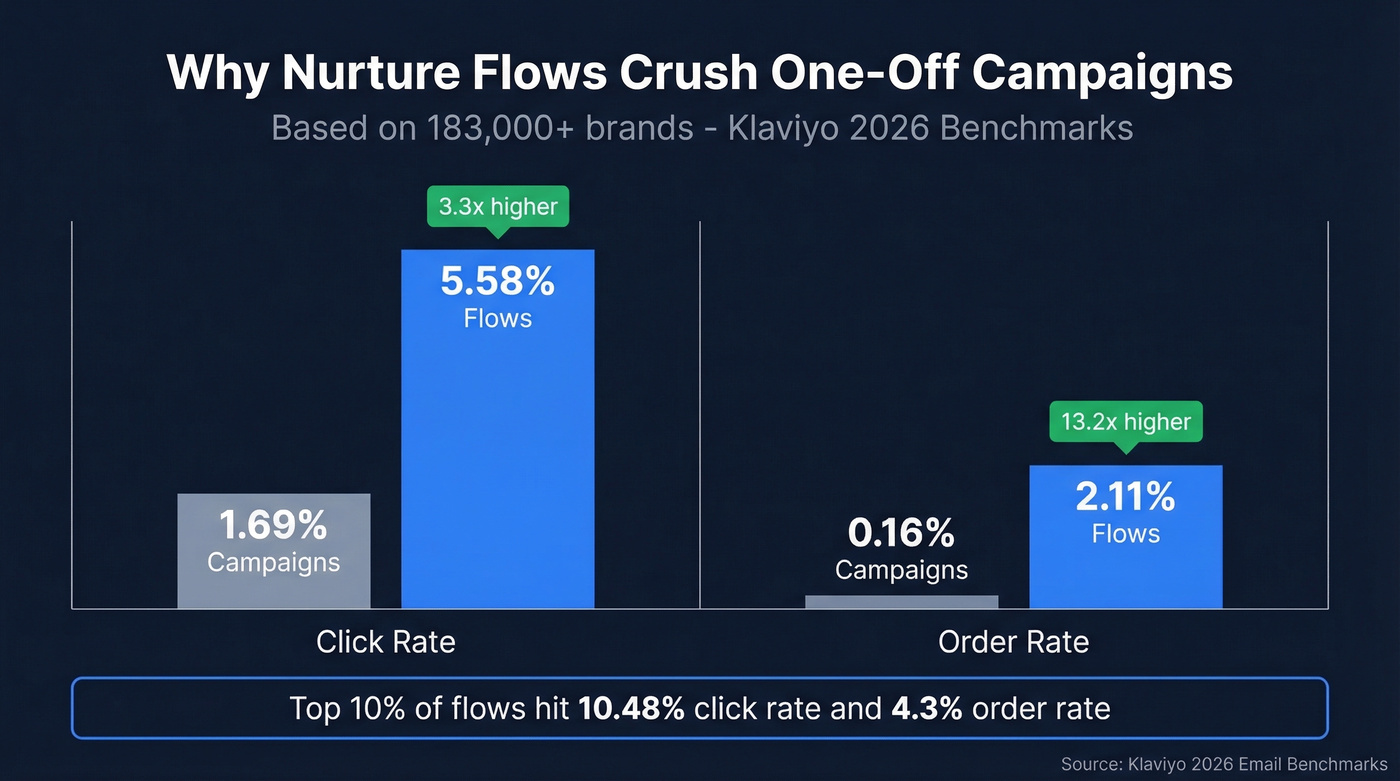
It compounds over touches. In one B2B test, one-touch leads converted at roughly 0.30%. By the fourth engagement, that climbed to 6.3%. Nurture isn't about sending more email - it's about sending the right email at the right moment in the buying cycle, then getting out of the way when the lead is ready for sales.
Apple Mail Privacy Protection has made open rates unreliable as a primary metric. Treat them as directional. Click-through rate is your real signal now.
Here's the thing: if your average deal size is under $5k, you probably don't need a 12-email nurture masterpiece. Five tight emails with clean data will outperform a bloated sequence every time.

Bounces kill nurture campaigns before your copy even gets a chance. Prospeo's 5-step email verification delivers 98% accuracy - so your carefully crafted sequences actually reach inboxes instead of destroying your sender reputation.
Start your nurture campaign on a list you can trust.
Building Your Nurture Campaign: Step by Step
Define Your Segments
The biggest mistake we see teams make is running one sequence for everyone. As one practitioner in r/b2bmarketing put it, nurture is too often "reduced to a drip of emails" when it should be a system connecting sales and marketing around buyer behavior.
A cold lead who's never heard of you needs education. A warm lead who attended your webinar needs proof. A hot lead who visited your pricing page needs a meeting link, not another blog post.
| Segment | Definition | Goal |
|---|---|---|
| Cold | No engagement yet | Build awareness |
| Warm | Some engagement (50+ points) | Deepen trust |
| Hot | Buying signals (100+ points) | Hand off to sales |
Lead scoring makes this dynamic. Page visits, email clicks, content downloads, and webinar attendance should all feed the score. The VP who opened three emails and visited pricing isn't the same lead as the intern who downloaded one PDF - and your nurture should reflect that. If you need a scoring model that doesn't fall apart in week two, start with a simple lead scoring framework.
Map Content to Buyer Journey
Each segment needs content matched to where they are in the funnel. Sending a case study to someone who doesn't understand the problem yet is a waste. Sending a blog post to someone ready to buy is a missed opportunity.
| Stage | Content Types | Email Goal |
|---|---|---|
| TOFU | Guides, insights, videos | Educate on the problem |
| MOFU | Case studies, webinars, comparisons | Build preference |
| BOFU | Demos, pricing, offers | Drive action |
Your welcome sequence is TOFU. Your "here's how Company X solved this" email is MOFU. Your "book a 15-minute call" email is BOFU. Don't skip stages - leads who feel pushed too fast disengage.
Build Your Sequence and Timing
The most effective framework spans 30-60-90 days: an active sequence, an education phase, and a long-term nurture tail. (If you want a sales-side version of this cadence, the 30-60-90 day plan is a useful companion.)
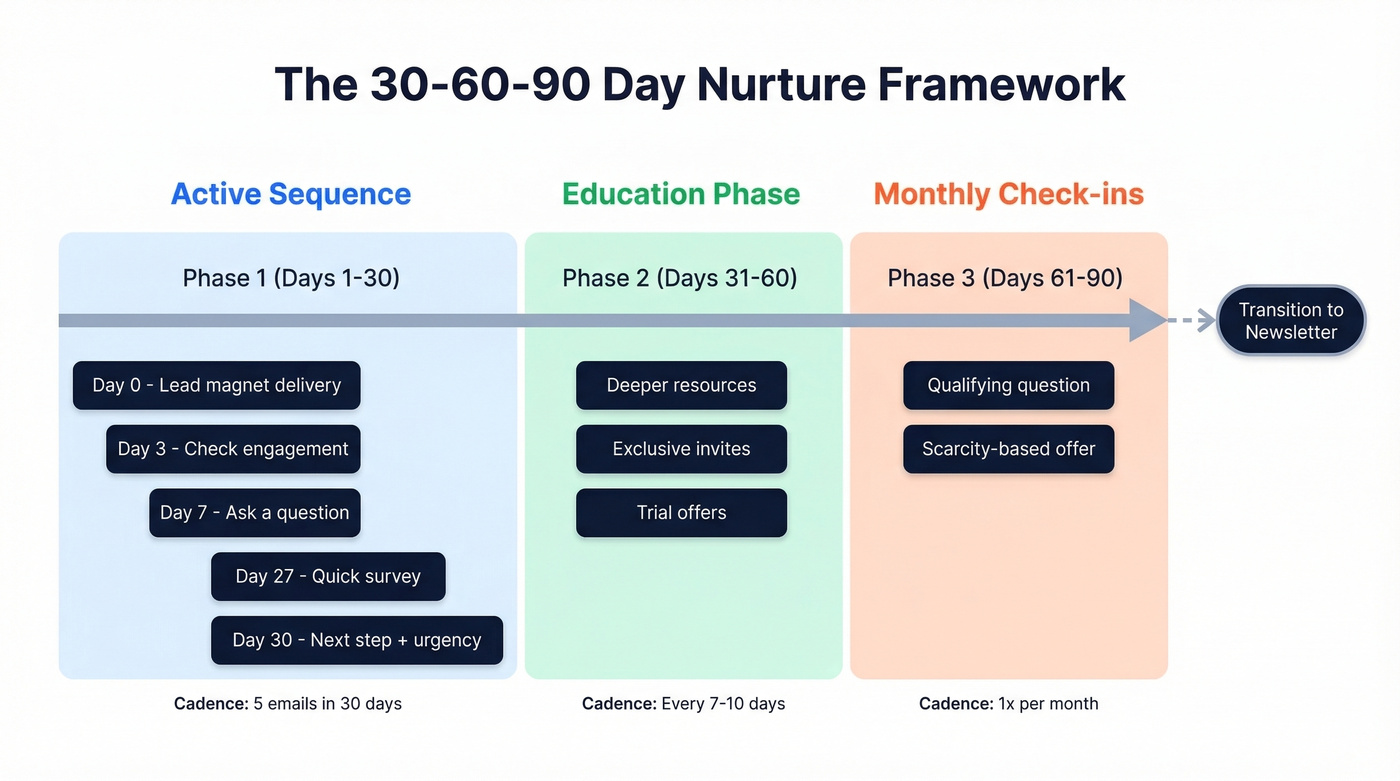
Days 1-30: Active sequence. Five emails with this timing:
| Timing | Purpose | |
|---|---|---|
| 1 | Instant | Deliver lead magnet |
| 2 | Day 3-12 | Check engagement |
| 3 | Day 7-14 | Ask a question |
| 4 | Day 27 | Quick survey (1-5) |
| 5 | Day 30 | Next step + urgency |
For shorter sales cycles, the 5-day quick-start variant works well: Welcome, Big Problem, Quick Win, Proof, Next Step. One email per day, tight and focused.
Days 31-60: Education phase. Shift to deeper resources - exclusive invites, trial offers, and content that builds preference. Email every 7-10 days for leads still engaged.
Days 61-90: Monthly check-ins. One email per month with a single qualifying question or a scarcity-based offer. After 90 days, transition to a newsletter. Don't leave leads in a dead sequence - the GoSquared approach of active sequence then newsletter is a solid default.
Real SaaS performance data. We've seen 8-email sequences over 30 days perform well. Here's actual per-email data from a SaaS educational nurture:
| Email # | Day | Purpose | Open Rate | CTR |
|---|---|---|---|---|
| 1 | 0 | Welcome + lead magnet | 52% | 12% |
| 2 | 3 | Problem education | 38% | 7.5% |
| 3 | 7 | Quick win / tip | 33% | 6.1% |
| 4 | 10 | Social proof | 30% | 5.4% |
| 5 | 14 | Case study | 28% | 4.8% |
| 6 | 18 | Feature deep-dive | 26% | 4.2% |
| 7 | 24 | Objection handling | 24% | 3.9% |
| 8 | 30 | CTA + urgency | 23% | 5.1% |
Notice how Email 8's CTR spikes despite lower opens - urgency works on engaged survivors. That natural engagement decline is expected and healthy; it's the people who stick around that matter.
Write Emails That Convert
Here's a concrete example. Email 1 (lead magnet delivery) might look like this:
Subject: Your [resource name] is ready
Hey [First Name], here's the guide you requested: [link]. The section on [specific topic] is where most teams find the biggest quick win. Reply and tell me what you're working on - I read every response.
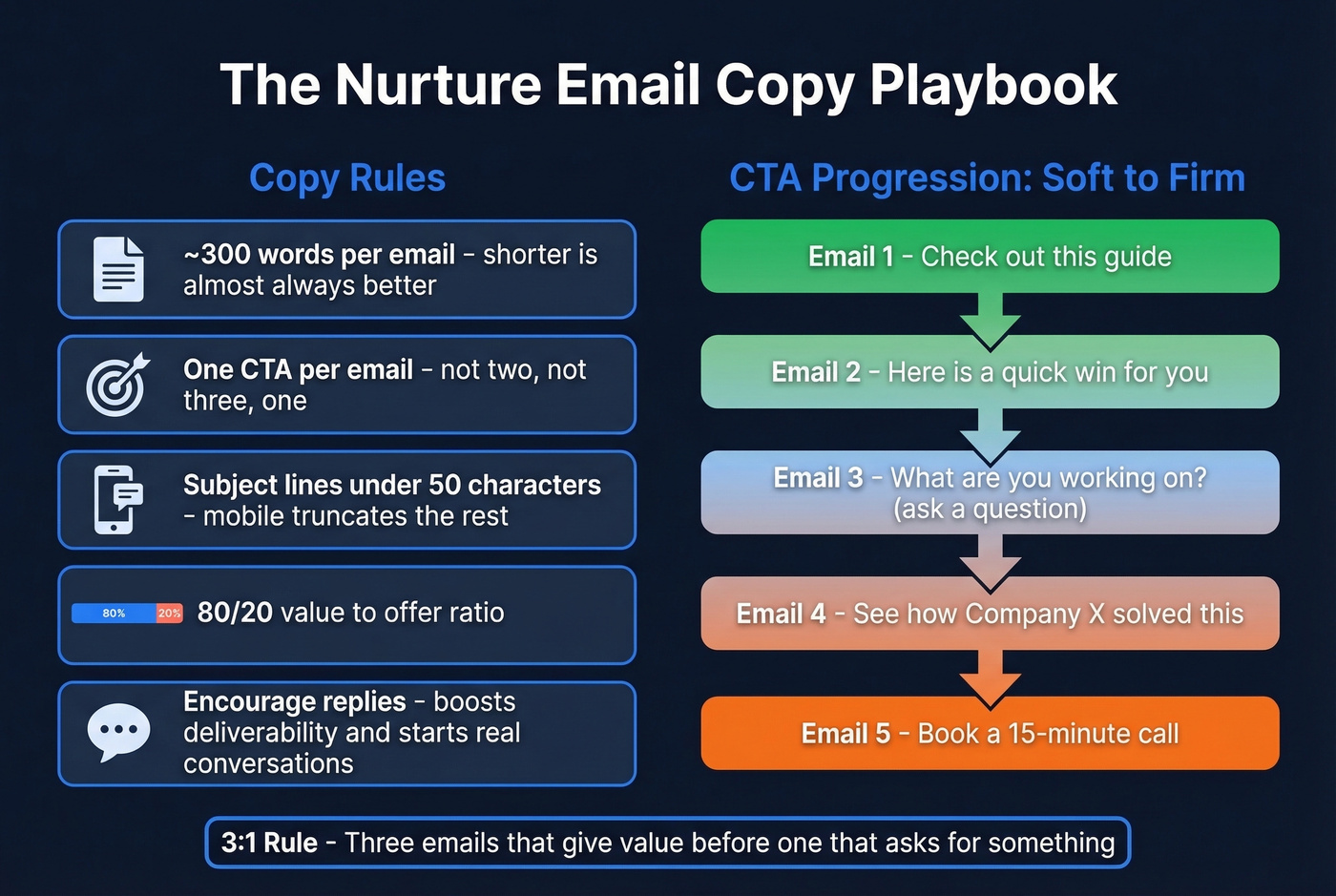
Follow these copy rules for every email in the sequence:
- ~300 words per email. Shorter is almost always better.
- One CTA per email. Not two. Not three. One.
- Subject lines under 50 characters. Longer ones get truncated on mobile. If you need ideas, pull from these email subject lines.
- 80/20 value-to-offer ratio. Roughly 80% useful content, 20% product or ask.
- CTA progression from soft to firm. Email 1: "check out this guide." Email 5: "book a call."
- Encourage replies. Email 3 is a great place to ask a genuine question. Replies boost deliverability and start real conversations.
The 3:1 give-to-get ratio is a useful mental model. Three emails that deliver value before one that asks for something. Leads who feel like they're getting something are far more likely to give something back.
Set Up Automation and Branching
A nurture campaign without branching logic is just a drip. That distinction matters: drips send the same emails on a fixed schedule, while true nurture responds to behavior in real time.
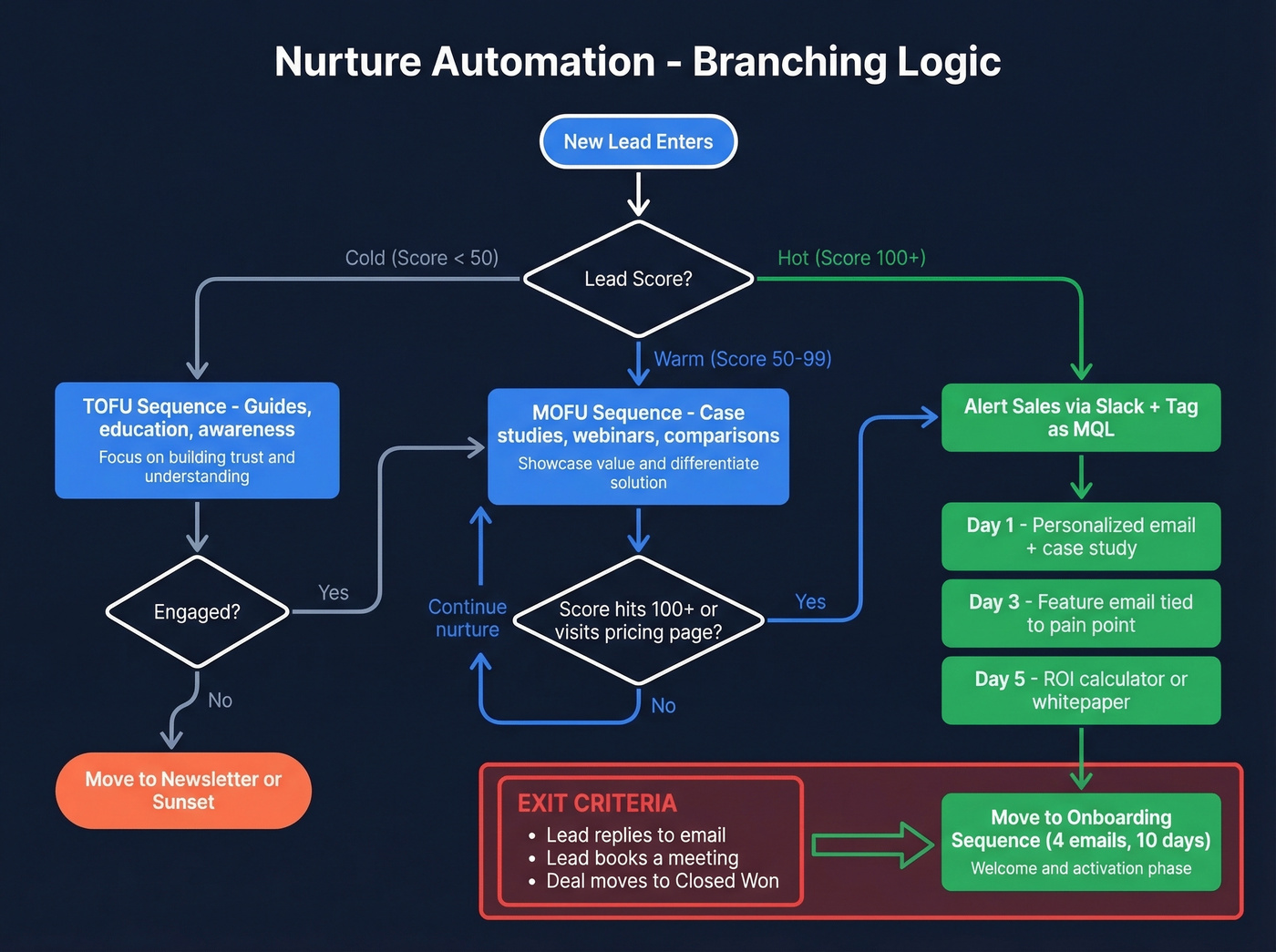
Start with a high-intent workflow. When a lead's score crosses 100 points - or they visit your pricing page or request-demo page - the system should immediately tag them as an MQL in your CRM and fire a Slack alert to the assigned rep.
Then launch a tight 3-email sequence over 5 days:
- Day 1: Personalized email from the rep referencing what triggered the alert, plus a case study.
- Day 3: Feature-focused email tied to their pain point.
- Day 5: Value email with an ROI calculator or whitepaper.
Exit criteria matter just as much as entry triggers. If the lead replies, books a meeting, or gets manually claimed by a rep, pull them out immediately. For customers, when a deal moves to Closed Won, remove them from lead nurture and shift to an onboarding sequence - typically 4 emails over 10 days.
Fix Deliverability Before You Send
Deliverability isn't the same as delivery. Delivery means the server accepted your email. Deliverability means it landed in the inbox, not promotions, not spam. If you want the full technical breakdown, use this email deliverability guide as your reference.
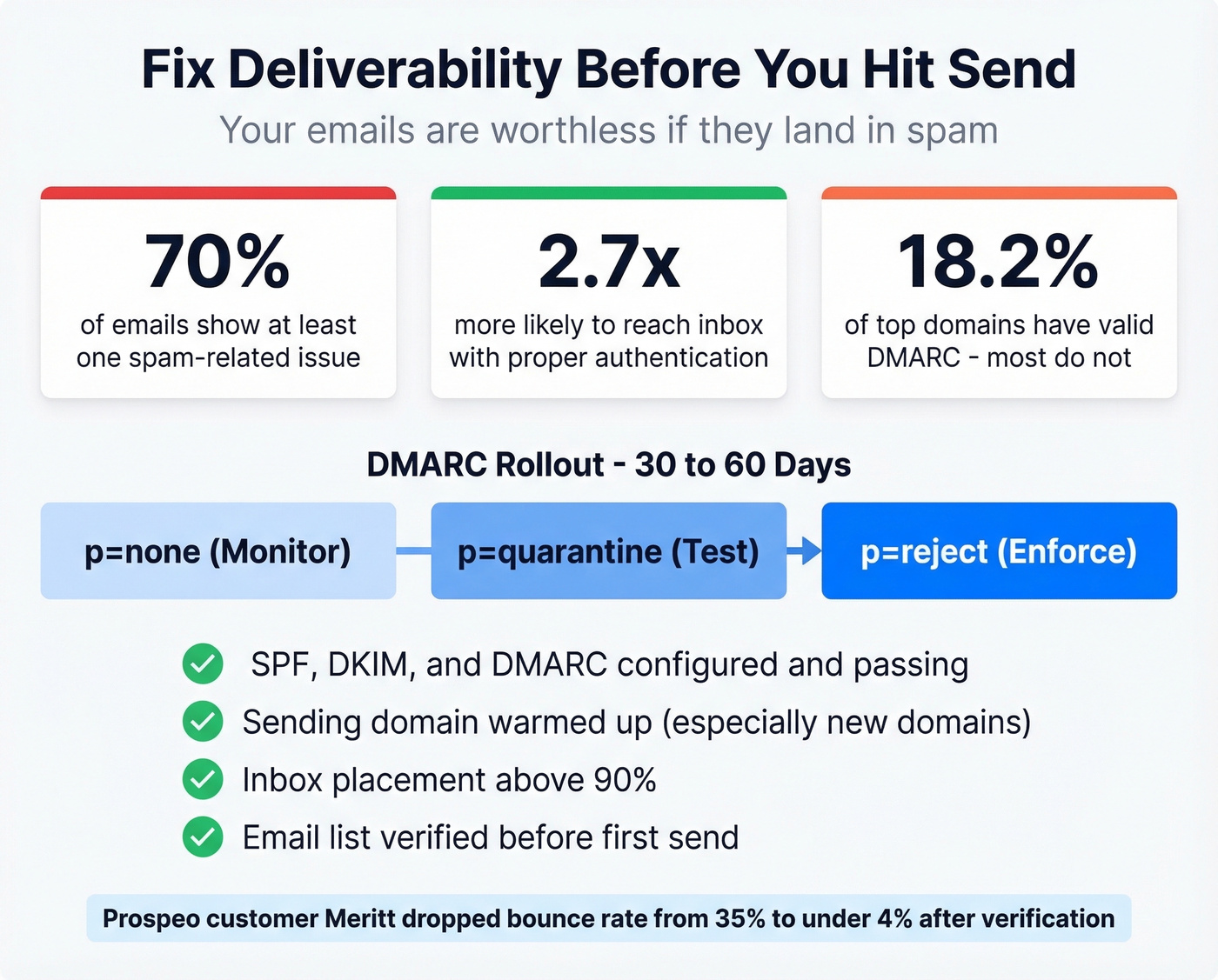
Start with authentication. Google and Yahoo's bulk-sender rules require SPF, DKIM, and DMARC for anyone sending 5,000+ emails per day. Only 18.2% of the top 10M domains have valid DMARC, and just 36.7% have valid SPF. Authenticated senders are 2.7x more likely to reach the inbox. Roll out DMARC in phases - start with p=none, move to p=quarantine, then p=reject over 30-60 days. (If you're stuck on setup details, see SPF record examples and how to verify DKIM is working.)
Also: make unsubscribing obvious, and include a physical mailing address in every email.
Your pre-send checklist:
- SPF, DKIM, and DMARC configured and passing
- Sending domain warmed up (especially new domains)
- Inbox placement above 90%
- List verified before the first send
That last point is the other half of deliverability most guides skip. Your authentication can be perfect, but a 35% bounce rate from aging or purchased lists undoes all that work. Prospeo's 5-step verification catches catch-all domains, spam traps, and honeypots that basic verification tools miss. One customer, Meritt, dropped their bounce rate from 35% to under 4% after switching to Prospeo-verified contacts. If you're troubleshooting bounce spikes, this email bounce rate guide will help you pinpoint the cause.
Litmus found that 70% of emails show at least one spam-related issue. Don't let your nurture campaign be one of them.
Measure and Optimize
What "good" looks like, based on Klaviyo's 2026 benchmarks:
| Metric | Campaigns (avg) | Flows (avg) | Top 10% flows |
|---|---|---|---|
| Click rate | 1.69% | 5.58% | 10.48% |
| Order rate | 0.16% | 2.11% | 4.3% |
Open rates aren't included here because open rates unreliable for flow-level comparison. Track these metrics in order of importance: click-through rate (primary signal), reply rate, conversion rate, and unsubscribe rate. (If you want to standardize reporting, use a consistent click rate formula.)
For A/B testing, prioritize subject lines first - they have the highest impact on whether anyone sees your content. Then test send timing. Then CTA placement. Isolate one variable per test and run it for at least 500 sends before drawing conclusions.
Practices That Protect Your Pipeline
Missing the golden window. Leads contacted within 5 minutes of opting in are 100x more likely to qualify. Your first email must fire instantly. Not "within 24 hours." Instantly. If your automation tool can't do this, switch tools.
One sequence for everyone. We've watched teams send the same 7-email drip to every lead regardless of behavior, role, or intent level. Segmented campaigns drive a 760% revenue increase over non-segmented ones. Build at least three segments and branch accordingly.
Email-only nurture. Email is the backbone, but the best-performing nurture programs layer in retargeting ads, SMS with consent, and sales call triggers when engagement scores cross a threshold. One tactic gaining traction among B2B practitioners: embedding 30-60 second personalized video snippets in nurture emails to re-engage dormant deals. Think surround sound, not solo instrument.
Too much friction, too fast. Asking for a demo in email two is the nurture equivalent of proposing on a first date. Stick to the 3:1 give-to-get ratio - three value-driven touches before any ask.
Dirty data. None of the above matters if 20% of your list bounces. Verify before you send. Prospeo refreshes data every 7 days - compared to the 6-week industry average - so even contacts that were valid last month get re-checked.
Best Tools for Email Nurture
You don't need an $800/month marketing platform to run effective nurture. Let's be honest - HubSpot Marketing Hub Professional is overkill for most teams starting out.
| Tool | Best For | Starting Price |
|---|---|---|
| ActiveCampaign | Automation depth (best overall) | ~$19/mo |
| HubSpot Starter | CRM ecosystem | $15/mo/seat |
| Brevo | Free starting point | Free (300/day) |
| Mailchimp | Simple sequences | ~$13/mo |
| Kit | Creator/content | Free to 10K |
| Klaviyo | Ecommerce nurture | Free to 250 |
ActiveCampaign gives you the best automation builder for the price - conditional logic, lead scoring, and CRM in one tool. HubSpot Starter makes sense if you're already in their ecosystem, but don't let them upsell you to Professional until you've outgrown Starter's workflows. Skip Mailchimp if you need anything beyond basic sequences; its automation builder hasn't kept pace. If you're evaluating platforms for outbound + nurture together, compare options in our SDR tools roundup.
Brevo is the best free option for teams just getting started - 300 emails per day with no credit card.
Behavioral segmentation only works when you have real data behind it. Prospeo gives you 50+ data points per contact - job title, seniority, intent signals, tech stack - so you can build segments that actually match your buyer journey.
Segment smarter with enriched contact data at $0.01 per email.
FAQ
How many emails should a nurture campaign have?
Five to eight for most B2B sequences. Quick-start frameworks use five emails over five days; longer sales cycles stretch to ten over 60 days. After the active sequence, transition leads to a monthly newsletter rather than letting them sit in a dead flow.
What's the difference between drip and nurture campaigns?
A drip is time-based - everyone gets the same emails on the same schedule. A nurture campaign uses behavioral triggers and branching logic so leads receive different content based on their actions. Most teams start with a simple drip, then layer in behavioral rules as they learn what resonates.
What's a good click rate for nurture emails?
Automated flows average a 5.58% click rate across 183,000+ brands. Top 10% performers hit 10.48%. If you're below 3%, revisit your segmentation and CTA relevance before touching copy.
How do I keep my nurture list clean?
Verify every contact before the first send, then re-verify quarterly. Remove hard bounces immediately and suppress contacts with zero engagement after 90 days. Tools like Prospeo handle catch-all domain verification and spam-trap removal, which basic verifiers miss entirely.