

How to Find the Owner of a Business (2026 Guide)
You need a name. Maybe it's for a sales pitch, a partnership, a legal dispute, or due diligence on a company you're about to do business with. Finding the owner of a business sounds straightforward - until you type the company name into your state's Secretary of State website and the result shows a registered agent in Delaware you've never heard of.
That's the first trap most people hit. Anonymous LLC states - Delaware, Nevada, Wyoming, and New Mexico - are designed to keep owner names out of public records. Even in states that do disclose, the name on the filing is often an organizer or attorney, not the actual owner.
What You Need (Quick Version)
Just need a name? Start with your state's Secretary of State business entity search. It's usually free, though some states charge small fees for certain searches.
Need to verify ownership for compliance or due diligence? Combine state filings with UCC records and court records.
Need to contact the owner for sales or partnerships? Use a B2B data platform like Prospeo to get verified emails and direct phone numbers in minutes instead of spending hours on manual research.
Quick Terminology
State filings use terms that trip people up:
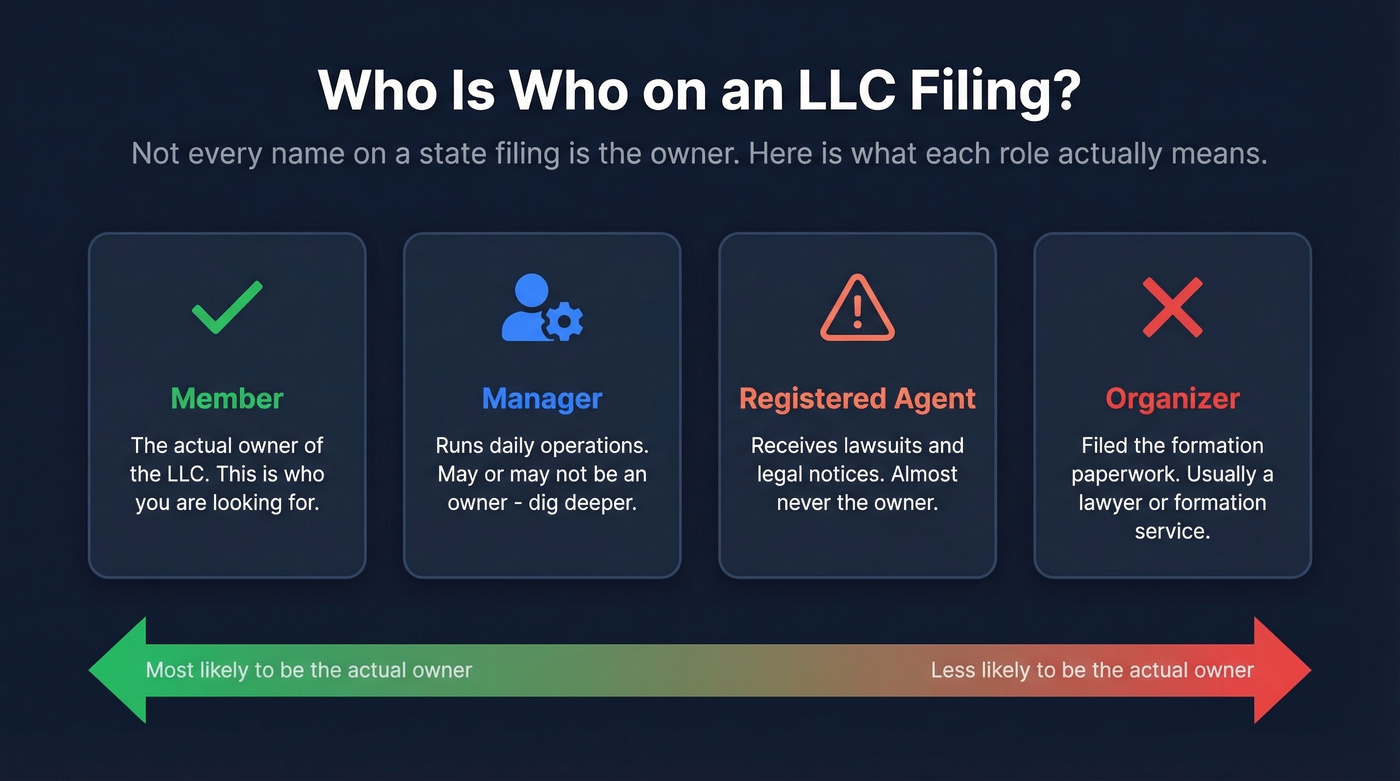
- Member - an actual owner of an LLC. This is who you're looking for.
- Manager - runs the LLC's day-to-day operations. May or may not be an owner.
- Registered agent - a legal contact designated to receive lawsuits and official notices. Almost never the owner.
- Organizer - the person who filed the formation documents. Often a lawyer or formation service.
If a state filing shows an organizer or registered agent, you haven't found the owner. Keep digging. And if you're doing sales outreach, don't limit your search to the title "Owner" - many decision-makers go by Managing Member, Principal, Founder, or Director of Operations.
10 Methods to Find Who Owns a Business
1. Search State Business Databases
Use this if the business is registered in a state that discloses member names in public filings. Arizona, California, Florida, Illinois, New Jersey, Oregon, Tennessee, Texas, and Utah are among them - and so are states like Connecticut, DC, Hawaii, Idaho, Indiana, Massachusetts, Maine, Montana, Nebraska, Nevada, North Carolina, and Vermont.
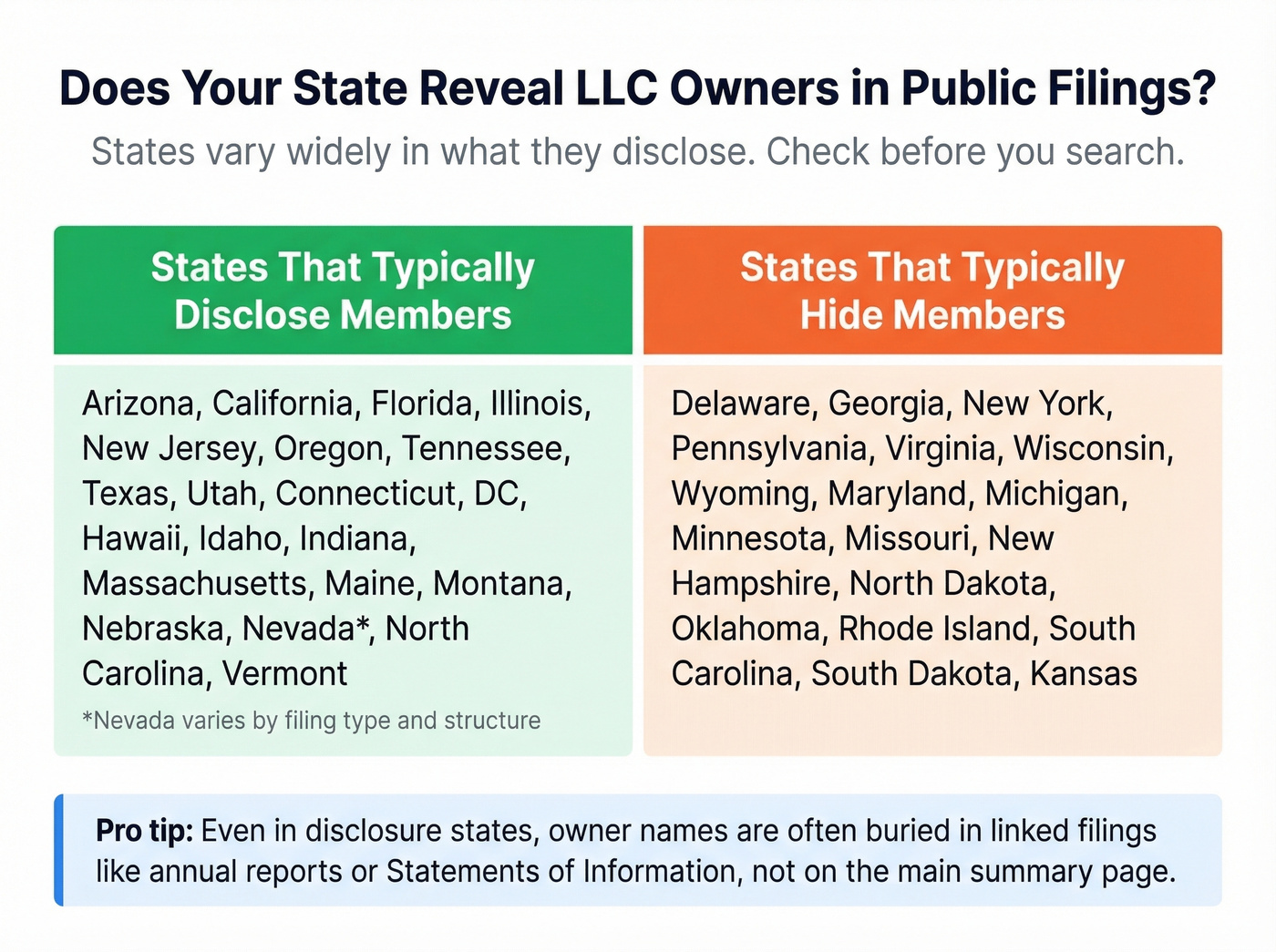
Skip this if the LLC is formed in a state that typically doesn't list members in formation documents and instead shows an organizer or authorized representative plus a registered agent. Delaware, Georgia, New York, Pennsylvania, Virginia, Wisconsin, and Wyoming fall into this bucket - along with Maryland, Michigan, Minnesota, Missouri, New Hampshire, North Dakota, Oklahoma, Rhode Island, South Carolina, South Dakota, and Kansas.
A note on Nevada: it's widely used for privacy, and what you can see publicly depends on the specific filing and structure. Don't assume a Nevada filing will give you what you need.
Owner names rarely appear on the main summary page. Open linked filings - articles of organization, annual reports, or Statements of Information - to find member names. California is a good example: the Articles of Organization won't list members, but the Statement of Information filed within 90 days does.
The National Association of Secretaries of State maintains a directory linking to every state's UCC filing portal. Bookmark it.
2. Check the Company Website and Professional Profiles
The About, Leadership, or Team page is the fastest free method for mid-size companies. Founders and C-suite executives are usually listed with names and titles. This works less reliably for sole proprietors and small LLCs - many don't have websites at all.
Don't stop at the company site. Search the business name on professional networks to find people who list themselves as Owner or Founder.
3. Search Business Directories
The BBB, Google Business Profile, Yelp, and Manta all list business contacts. Worth a quick check, but the person listed is often a general manager or marketing contact, not the owner. Cross-reference any name against state filings before treating it as confirmed.
If you're doing this for outreach, pair directory results with sales prospecting techniques so you don't waste cycles on the wrong contact.
4. Check UCC Filings
Here's the method experienced investigators rely on - and most guides skip it entirely.
When a business takes out a loan or uses assets as collateral, the lender files a UCC (Uniform Commercial Code) lien as public notice. That filing can include the debtor's name and address, the secured party, and the filing date. Many states offer online UCC searches through their Secretary of State website, but fees and access rules vary. Texas, for instance, charges a small per-search fee.
If the business has ever financed equipment, taken a line of credit, or used inventory as collateral, there's likely a UCC filing that helps identify the real person behind an LLC. We've found UCC filings to be more reliable than state formation documents for identifying the actual human behind an LLC, especially in privacy states where the articles of organization are deliberately sparse.
5. Review Property Records
If the business owns commercial real estate, county assessor and recorder websites are goldmines. Deeds and property tax records list the legal owner - and when that owner is an LLC, the deed often names the individual who signed on behalf of the entity. Free and surprisingly effective for businesses with physical locations.
6. Search Court Records
Lawsuits, liens, and judgments frequently name the individual behind an LLC. The federal PACER system covers federal cases (free to $0.10/page), while state and county court portals handle local litigation. Court filings often pierce the LLC veil in ways that formation documents don't.
7. Submit a Public Records Request
FOIA-style requests at the state or local level can surface business licensing applications and permit filings that list individual owners. Typical cost runs $3-$5 per request, though fees vary by jurisdiction and request type. Expect days to weeks for turnaround. This is a last-resort method, not a starting point.
8. Search SEC EDGAR (Public Companies)
For publicly traded companies, the SEC's EDGAR database is definitive. Schedule 13D and 13G filings reveal anyone holding 5% or more of a company's shares. DEF 14A proxy statements list directors and officers. This only applies to public companies - but when it does, it's the most authoritative source available.
9. Use a B2B Data Platform
Public records give you names. They don't give you a way to reach the person.
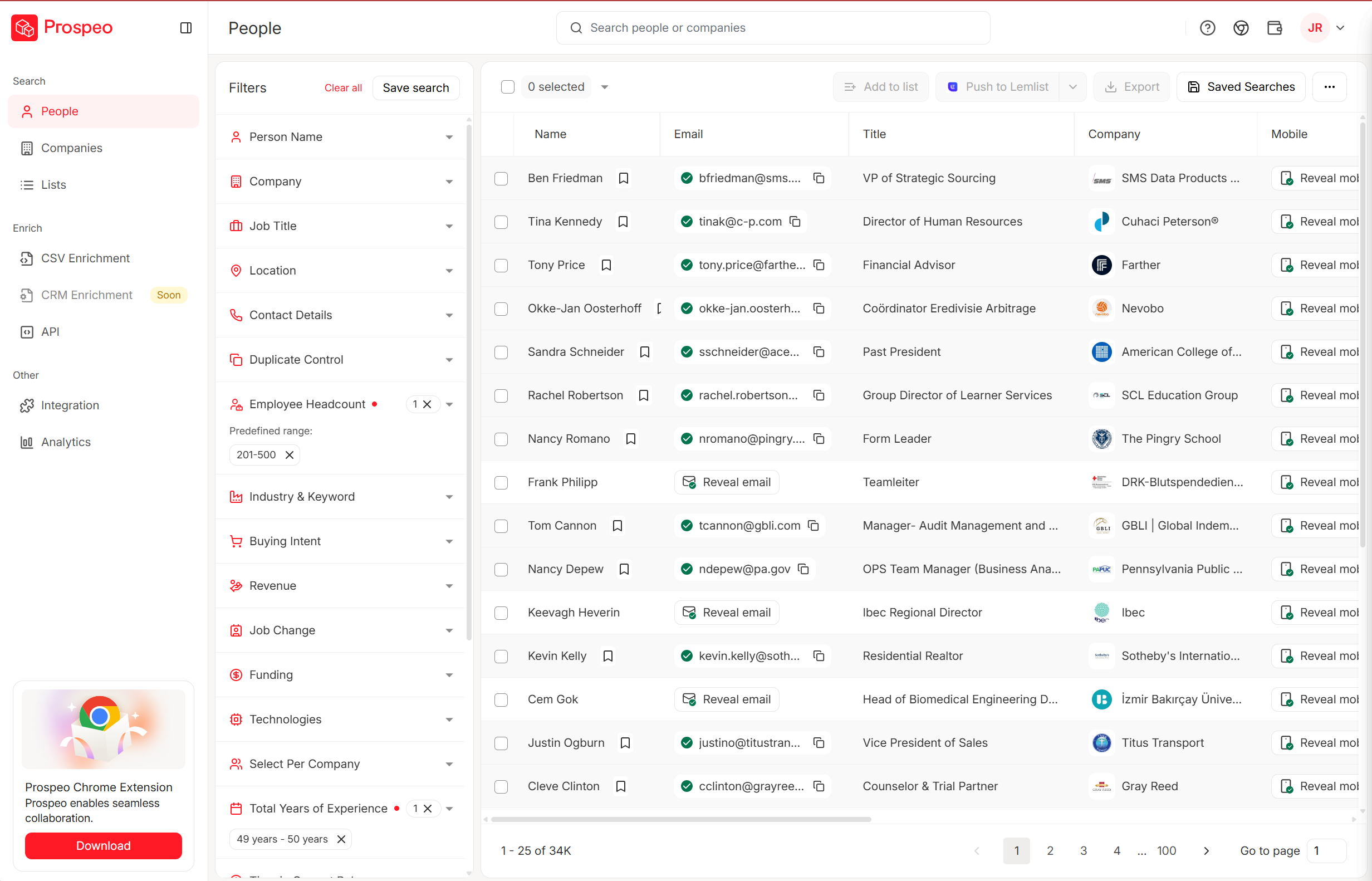
If your goal is to actually contact a business owner - for sales, partnerships, or vendor outreach - you need verified contact data. Prospeo covers 300M+ professional profiles with 143M+ verified emails and 125M+ verified mobile numbers. Search by company name, filter by job title (Owner, Founder, CEO, Managing Member) using 30+ search filters, and get verified email addresses with 98% accuracy and direct phone numbers. Not generic info@ addresses. The free tier gives you 75 emails per month, and paid plans run about $0.01 per email. Data refreshes every 7 days, compared to the 6-week industry average.
If you're building lists at scale, combine this with a lead generation workflow and data enrichment services to keep records clean.
For context, Apollo.io starts at $49/user/month and Lusha at $29/user/month. Both are solid platforms, but in our testing Prospeo's email accuracy and data freshness consistently outperform - which matters when a bounced email means a burned domain.
10. Call or Email the Business Directly
Sometimes the simplest approach works. Call the main business line and ask to speak with the owner. This works best for local businesses where the owner is actively involved in daily operations. Least scalable method on this list, but for a single lookup, it costs nothing.
If you do reach them, use a tight opener from these sample elevator pitches and follow up with proven sales follow-up templates.

State databases give you names - sometimes. Prospeo gives you the owner's verified email and direct phone number. Search 300M+ profiles by company name, filter by title like Owner, Founder, or CEO, and get 98% accurate emails at $0.01 each. Data refreshes every 7 days so you're never reaching out to someone who left 6 months ago.
Skip the Secretary of State rabbit hole. Get the owner's contact info now.
Method Comparison
| Method | Cost | Time | What You Get | Best For |
|---|---|---|---|---|
| State databases | Free (sometimes small fees) | Minutes | Name (sometimes) | First step for any lookup |
| Company website + profiles | Free | Minutes | Name + title | Mid-size companies |
| Business directories | Free | Minutes | Name (maybe) | Local businesses |
| UCC filings | Free-small fees | Minutes-hours | Name + address | LLCs in privacy states |
| Property records | Free | Minutes-hours | Name + address | Businesses with real estate |
| Court records | Free-$0.10/pg | Hours | Name + details | Disputed or litigious entities |
| Public records request | $3-$5 | Days-weeks | Varies | Last resort |
| SEC EDGAR | Free | Minutes | Officers + holders | Public companies only |
| Prospeo | ~$0.01/email | Minutes | Name + email + phone | Sales outreach and partnerships |
| Direct contact | Free | Minutes | Varies | One-off local lookups |
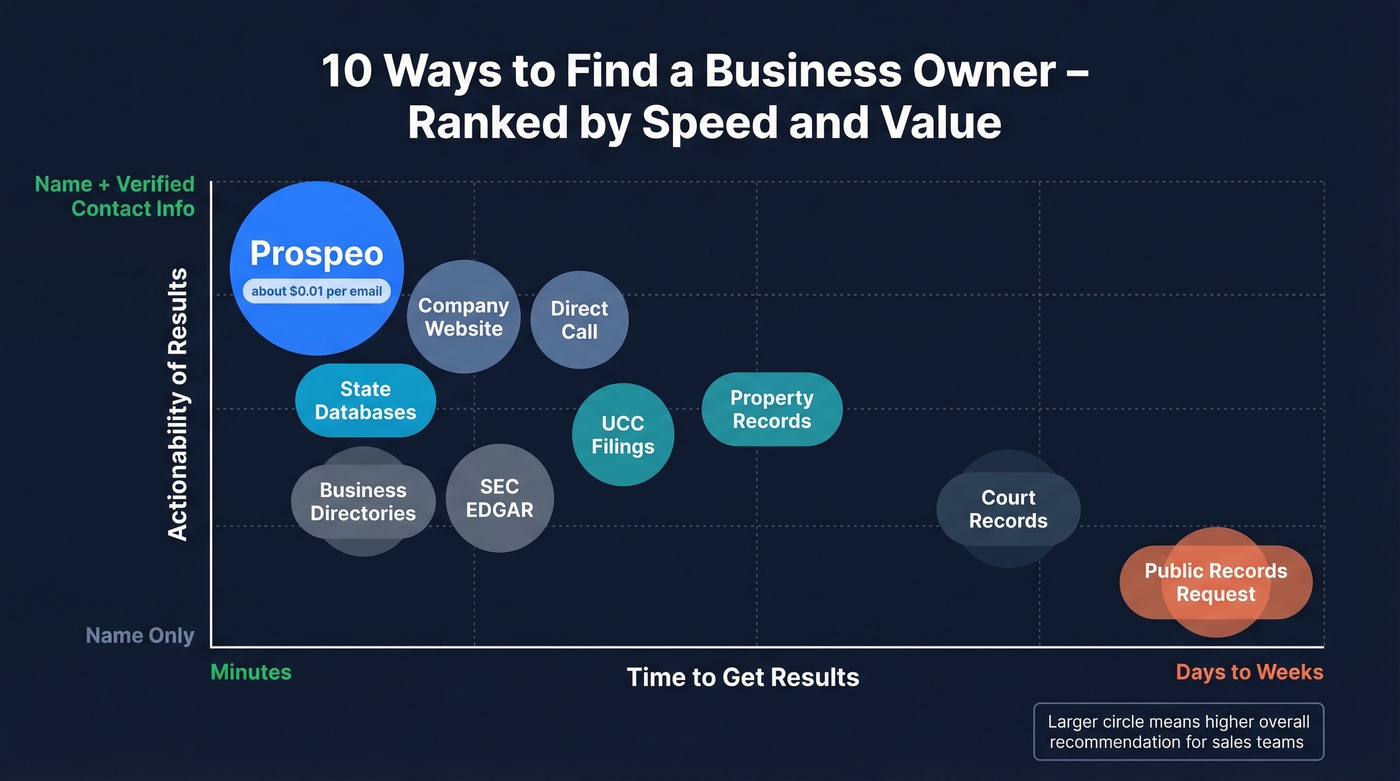
Let's be honest: if your goal is to contact the owner rather than just identify them, the free methods are a time sink. Most sales teams burn hours on public records research when a 30-second search would give them a verified email and direct dial. The free methods are great for due diligence and legal work - they're terrible for pipeline building.
If you're doing outbound, make sure your stack includes best contact management software so owner data doesn't get lost in spreadsheets.
What Changed in 2026
Two developments have reshaped ownership research. Both make certain methods less useful than older guides suggest.

FinCEN's BOI Database Isn't Public
The Corporate Transparency Act created a Beneficial Ownership Information (BOI) registry at FinCEN, and plenty of articles still suggest it's a way to find LLC owners. It isn't.
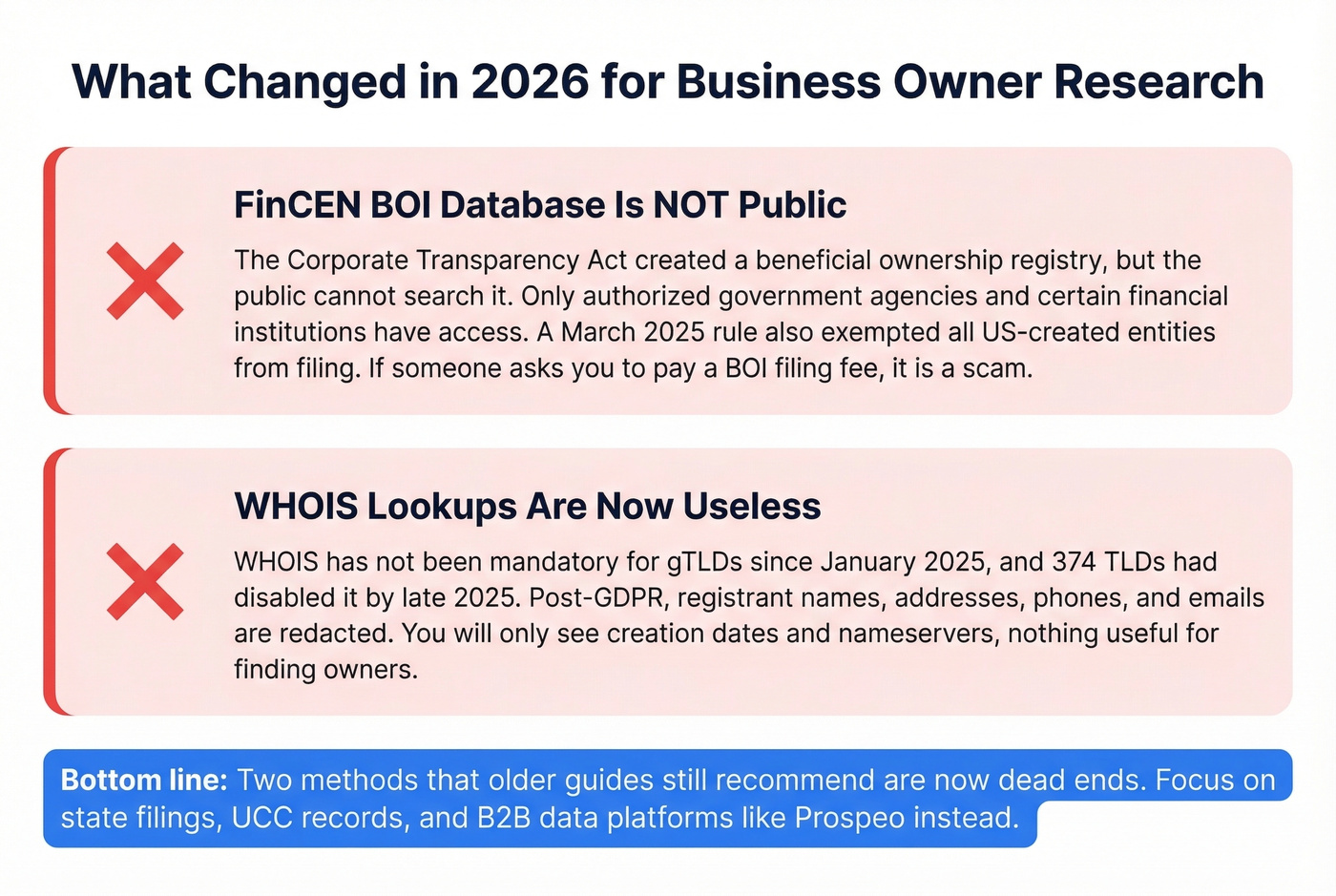
BOI reports are restricted to authorized government officials and, in limited cases, financial institutions with the reporting company's consent. The public can't search the database. A March 2025 interim final rule also exempted all U.S.-created entities from filing requirements entirely - only foreign companies registered in a U.S. state must file. If someone contacts you claiming you owe a BOI filing fee, it's a scam. FinCEN charges nothing to file directly.
WHOIS Lookups Are Obsolete
If you've seen guides recommending WHOIS lookups to find who registered a business's domain, that advice is outdated. WHOIS hasn't been mandatory for gTLDs since January 2025, and 374 TLDs had disabled WHOIS as of late 2025. Post-GDPR, registrant name, address, phone, and email are redacted on most domains. You'll see creation dates and nameservers - nothing useful for identifying a business owner.
Why You Might Hit a Dead End
Some owners are deliberately unfindable through public records - and that's by design, not a failure on your part.
Anonymous LLC states allow articles of organization to be filed by a third-party organizer, so member names never appear in public records. Multi-layered entity structures - an LLC owned by a trust owned by another LLC - add further opacity. We've seen cases where tracing through three layers of entities still leads to a registered agent office in Wilmington, Delaware. Domain privacy services add another layer: even if you find the company's website, the domain registration won't reveal who's behind it.
If you've exhausted state filings, UCC records, court records, and property records without finding a name, the owner has structured their privacy intentionally. At that point, a B2B data platform or a professional investigator is your best remaining option.
FAQ
Can I find the owner of an LLC for free?
Yes, in most states. Start with your state's Secretary of State business entity search - states like California, Florida, and Texas disclose member names in annual filings. If the LLC is in a privacy state like Delaware or Wyoming, try UCC filings and county property records instead.
What if the state filing only shows a registered agent?
A registered agent isn't the owner - they're a legal mail recipient. Open linked documents like annual reports or Statements of Information for member names. If those don't help, UCC filings and court records frequently name the individual behind the LLC when formation documents don't.
Is FinCEN's beneficial ownership database public?
No. BOI reports are restricted to government officials and certain financial institutions. U.S.-created entities are also exempt from filing as of March 2025, so the database won't contain most domestic companies. Don't pay anyone who claims you need to file - FinCEN's portal is free.
How do I find a business owner's email for outreach?
Public records give you names, not contact details. A B2B data platform lets you search by company name and filter by title to get verified emails and direct phone numbers. Prospeo's free tier includes 75 emails per month - enough to test before committing to a paid plan.
You found the owner's name in a UCC filing or county deed. Now what? Prospeo turns that name into a verified email and direct dial in one click. 143M+ verified emails, 125M+ verified mobiles, and 30+ filters to confirm you've got the right person at the right company. The free tier gives you 75 emails per month - no contract, no sales call.
Turn a name into a conversation. Get verified owner contact data in seconds.