

How to Formally Introduce Yourself via Email - and Actually Get a Reply
You're staring at a blank compose window, rewriting your opening line for the fourth time. That anxiety about sounding too stiff or too casual? It's the actual problem - it produces stilted emails nobody wants to read. The answer isn't more polish. It's a tighter framework backed by data from 16.5 million emails.
The quick version: 6-8 sentences hits a 6.9% reply rate and a 42.67% open rate. Send on Thursday (6.87% vs. 5.29% on Monday). And one great email beats a sequence - single sends pull an 8.4% reply rate, while a third follow-up drops replies by up to 20%.
The Data Behind Great Introductions
A 2024 analysis of 16.5 million cold emails across 93 business domains found the average reply rate was 5.8%. Inboxes have only gotten more crowded since then, which means your intro email needs to work harder in fewer words.
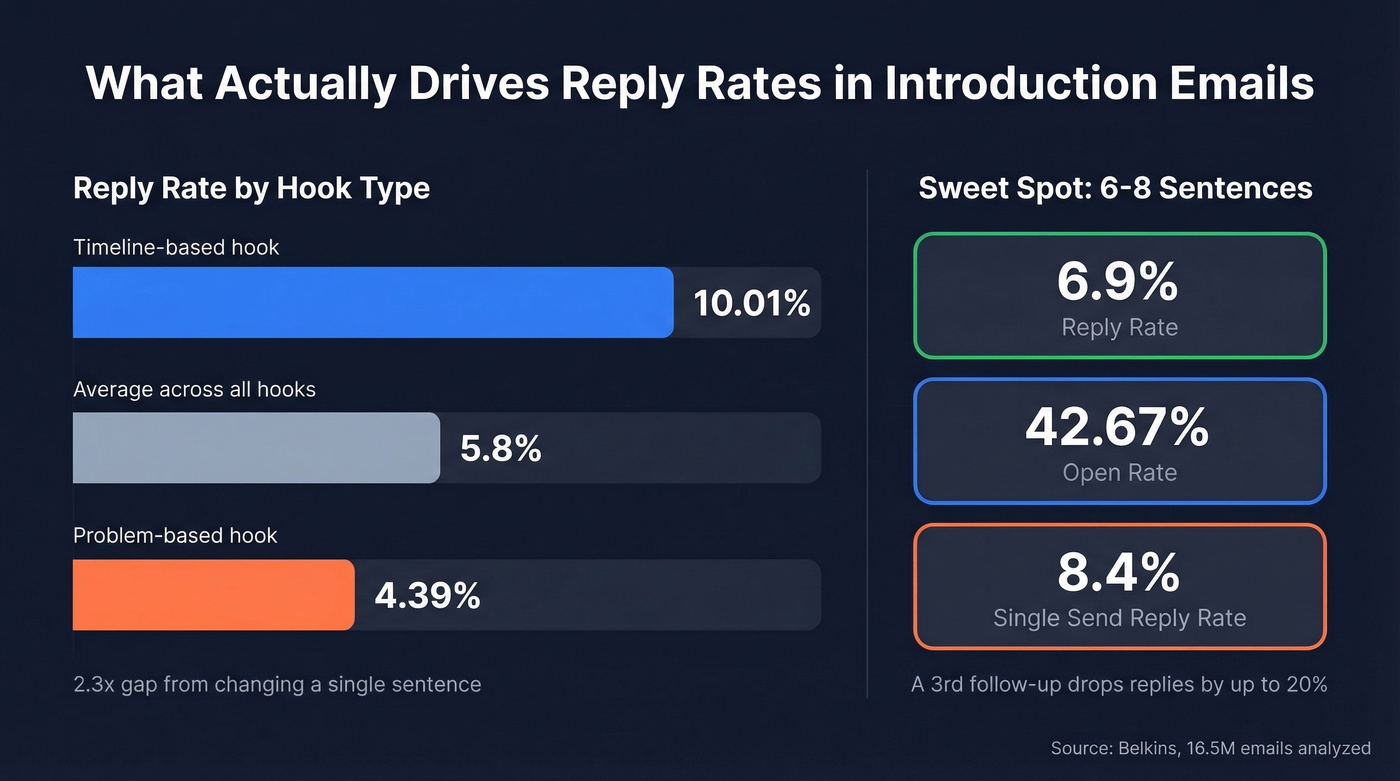
The biggest lever is your hook type. Timeline-based hooks - referencing a recent event, announcement, or deadline - average a 10.01% reply rate. Problem-based hooks ("Are you struggling with X?") land at just 4.39%. That's a 2.3x gap from changing a single sentence.
If you're building a repeatable outbound motion, it also helps to understand sales prospecting techniques that support personalization at scale.
The 6-Step Framework
1. Write a specific subject line. "Hi" gets deleted. "Quick question" gets ignored. Name your purpose in plain language - "Undergraduate Research Opportunity in Your Lab" works because it's specific and honest. For business outreach, use a timeline hook: "Saw your Series B announcement - quick thought on scaling outbound" outperforms vague alternatives every time. If you need ideas, borrow from proven email subject line examples and adapt them to your context.
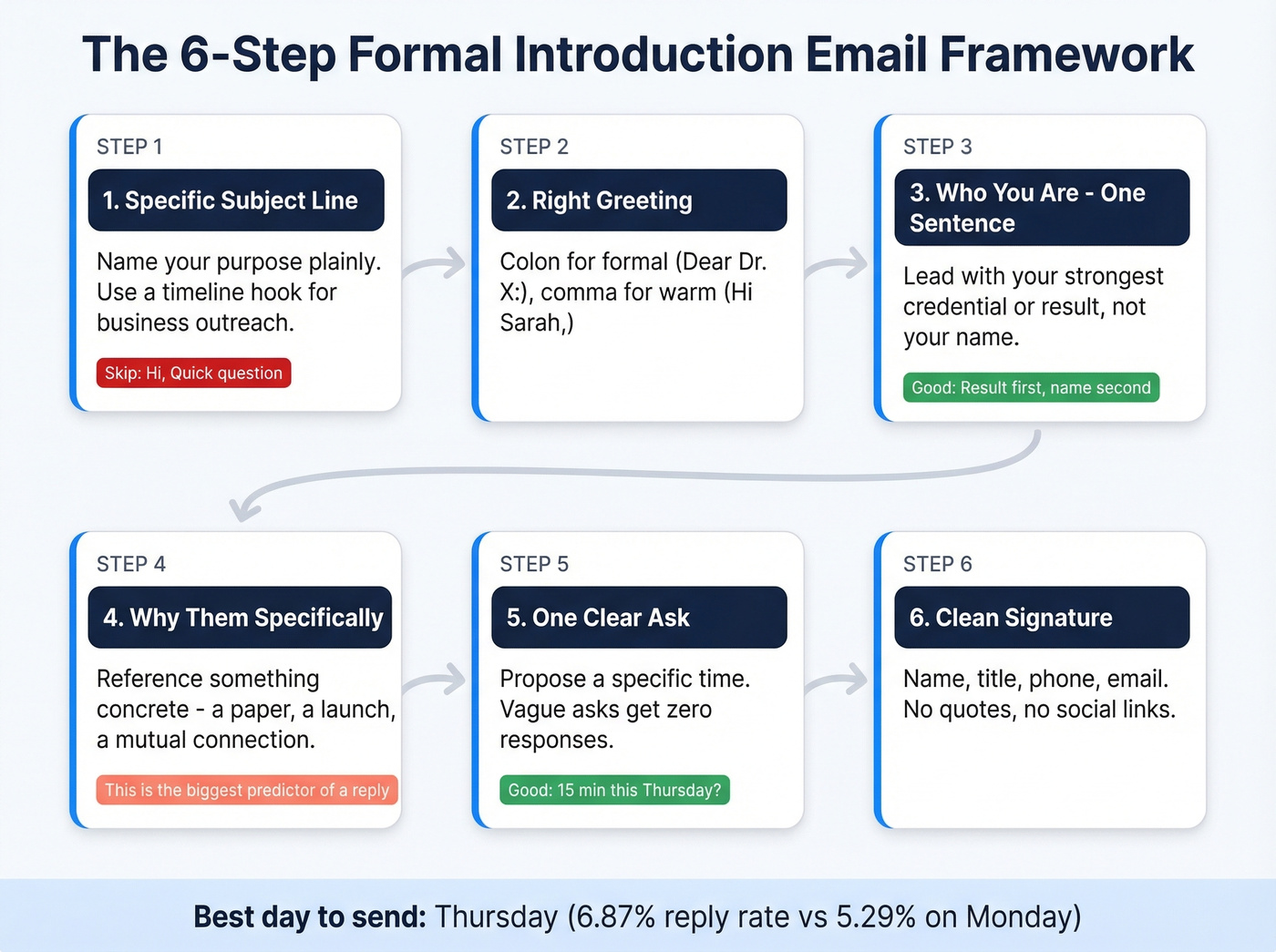
2. Choose the right greeting. "Dear Dr. Martinez:" - the colon signals formality. "Hi Sarah," - the comma signals warmth. Match the relationship. For professors, hiring managers you've never met, or international contacts, default to the formal version. One detail most people get wrong: capitalize only the first word of your closing. It's "Best regards," not "Best Regards."
3. Say who you are in one sentence. Don't lead with your life story. "I'm a third-year mechanical engineering student at Georgia Tech focused on computational fluid dynamics" - done. Many guides suggest opening with "by way of introduction, my name is..." followed by your role, but that wastes words. For job applications, lead with value tied to the role. "I've scaled outbound programs from 0 to $2M pipeline at two SaaS startups" beats "My name is Alex and I'm interested in your opening." (If you struggle to summarize yourself, start from a few sample elevator pitches and tighten from there.)
4. Explain why them, specifically. This is where most formal email introductions fall apart. Generic flattery ("I admire your company's mission") signals you sent this to 50 people. Reference something concrete - a paper they published, a product launch, a mutual connection. "I read your team's recent paper on polymer degradation rates and had a question about the methodology in Section 3" shows you did the work. We've reviewed hundreds of outreach emails across our team, and the single biggest predictor of a reply is specificity in this section. For more ways to do this without sounding creepy, see our guide to personalized outreach.
5. Make one clear ask. "Would you have 15 minutes this Thursday or Friday?" beats "Let me know if you'd be open to chatting sometime." Vague asks get vague responses - which usually means no response at all. If you want more phrasing options, use these email wording to schedule a meeting patterns.
6. Close with a clean signature. Full name, title, phone number, email. No inspirational quotes, no five social media links.
Templates That Work
Business Cold Outreach (Annotated)
Subject: Saw Acme's Q1 expansion - thought on your outbound stack -- Timeline hook: 10% avg. reply rate
Dear Ms. Chen: -- Colon = formal. Match their seniority.
I wanted to reach out and introduce myself - I'm Jordan Park, Head of Partnerships at Relay. I noticed Acme just opened offices in Austin and Denver - congrats on the expansion. -- Specific. Proves you researched them.
We help scaling sales teams cut list-building time by 60% while keeping bounce rates under 3%. -- One value prop, quantified.
Would you have 15 minutes this Thursday to see if there's a fit? -- Concrete ask with a deadline.
Best regards, Jordan Park | jordan@relay.io | (512) 555-0147
If you're sending a sequence instead of a single email, use these cold email follow-up templates to keep the nudge short and specific.
Job Application - Before vs. After
Before:
Dear Mr. Okoro, My name is Alex Reeves and I'm writing to express my interest in the Senior Marketing Manager position. I believe my skills and experience make me a strong candidate...
After:
Subject: Application: Senior Marketing Manager, Alex Reeves
Dear Mr. Okoro:
Your posting mentions building a demand gen engine from scratch - I've done that twice. At my last company, I built a content-to-pipeline program generating $1.4M in influenced revenue in 9 months and reduced CAC by 31%. I've attached my resume and would welcome the chance to discuss your Q3 pipeline targets.
Best regards, Alex Reeves | alex.reeves@email.com | (415) 555-0193
The "before" version wastes 30 words saying nothing. The "after" leads with proof. If you want to introduce yourself in a professional email, skip the preamble and open with your strongest result.
Student to Professor
Subject: Undergraduate Research Opportunity in Your Lab
Dear Dr. Nakamura:
I'm a second-year biology major at UNC focused on microbial ecology. Your recent paper on soil microbiome resilience after wildfire events was fascinating - particularly the methodology for tracking community reassembly over time.
I've completed coursework in biostatistics and spent last summer doing field sampling with Dr. Torres's hydrology lab. Would you be open to a brief meeting to discuss whether there might be a fit in your lab this fall?
Respectfully, Maya Lin | Biology, Class of 2028 | mlin@unc.edu
New Team Member Introduction
Skip this if you're on a very small team - it's almost always faster to introduce yourself in person or on Slack. For larger orgs where you won't meet everyone in week one:
Subject: New on the RevOps team - looking forward to working together
Hi team, I'm Sam Delgado, joining as the new RevOps Analyst on Monday. I'll be focused on pipeline reporting and CRM hygiene, so expect questions about your workflows. Before this, I spent three years at a Series B fintech working in HubSpot and Looker. I'll send 15-minute intro invites shortly.
Best, Sam

You just spent 20 minutes crafting the perfect introduction email. Don't waste it on a bounced address. Prospeo's 98% verified emails and 7-day refresh cycle mean your carefully written intro actually reaches the inbox - not a dead end.
Great copy deserves a real inbox. Verify before you send.
Opening Lines - What Works and What Doesn't
People obsess over the perfect opener. Let's be honest: none of these phrases will make or break your email, but some are clearly stronger than others.
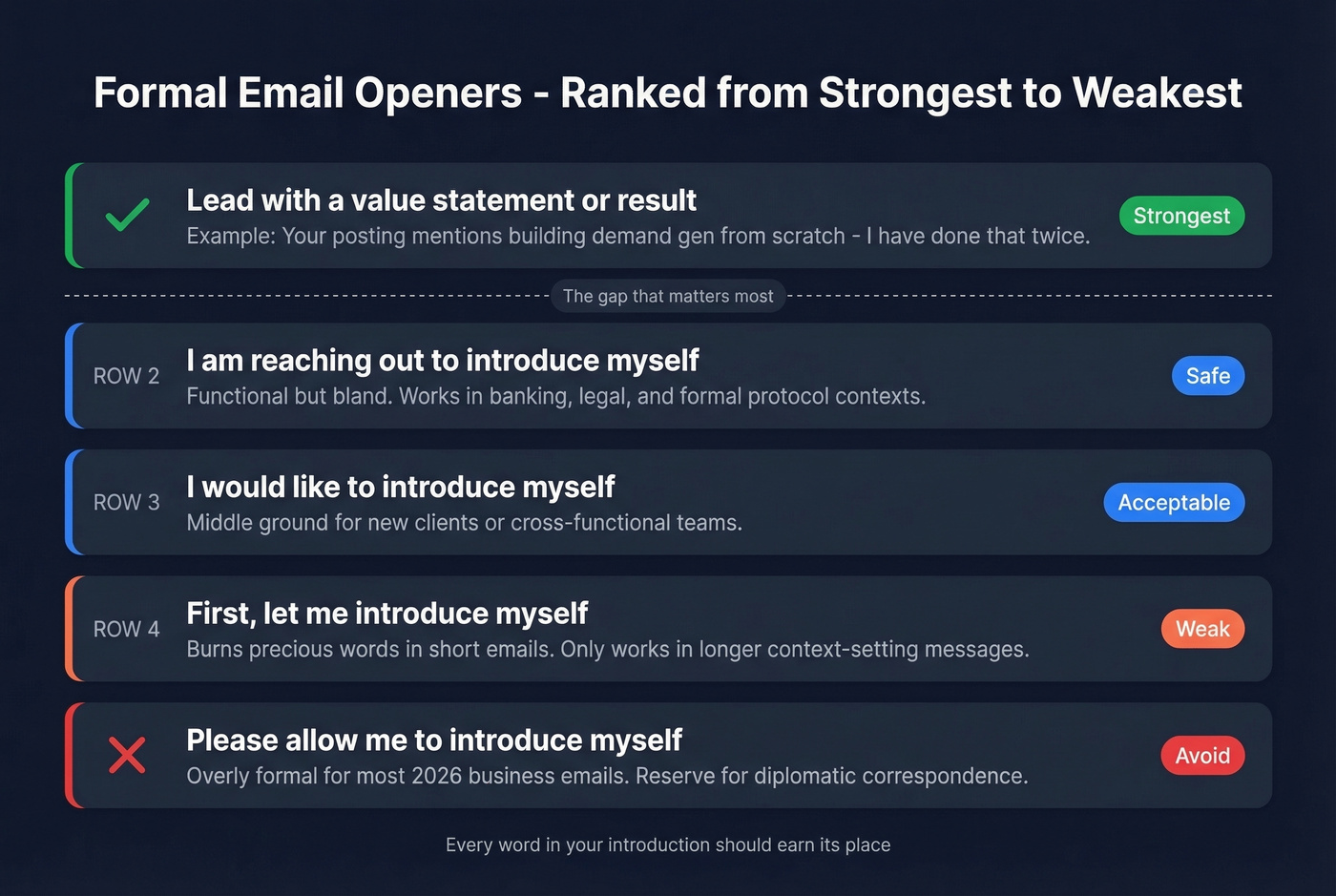
- "I am reaching out to introduce myself" - Functional but bland. It works in formal contexts like banking or legal, where personality takes a back seat to protocol.
- "Please allow me to introduce myself" - Overly formal for most business emails in 2026. Reserve it for diplomatic or executive-level correspondence.
- "I would like to introduce myself" - A safe middle ground for new clients or cross-functional teams, though leading with a value statement is almost always stronger.
- "First, let me introduce myself" - Acceptable in longer emails where context-setting is necessary, like a new vendor relationship. In a short cold email, it burns precious words.
The pattern is clear: these openers aren't wrong, but they're never the strongest option. Every word in your introduction should earn its place, and a generic "let me introduce myself" phrase rarely does. For more data-backed structure, see emails that get responses.
What Recipients Actually Hate
Here's the thing: "Hope this email finds you well" from a stranger is an instant signal you're sending a template. The consensus on r/sales and r/professors is blunt - fake pleasantries from someone you've never met feel performative, not polite. Skip it entirely.
Vague subject lines get deleted by professors and hiring managers alike. And if you're emailing a professor, don't frame their lab as a stepping stone to med school. UNC's own guidance calls this out specifically - it signals you care about the credential, not the research. We've seen otherwise strong emails torpedoed by a single throwaway line about "preparing for medical school applications."
If your email is longer than 200 words, you've already lost. Most people agonize over word choice when they should be cutting words. The best intro email you'll ever write is the one where you deleted half your first draft. If you're troubleshooting performance, start with email copywriting fundamentals before you tweak tiny phrasing.
Sending Internationally
When emailing someone in a different country, default to higher formality until they signal otherwise. Use titles and honorifics. Avoid idioms, slang, and humor - they rarely translate well. In practice, Germany and Japan tend to expect more formal conventions, while many Latin American business contexts lean warmer and more relationship-forward.
One rule covers everything: when in doubt, be more formal.
Follow Up Without Being Annoying
Wait about a week for business contacts, two weeks for academics. Forward the original email rather than rewriting from scratch - it gives them context without making them search their inbox.
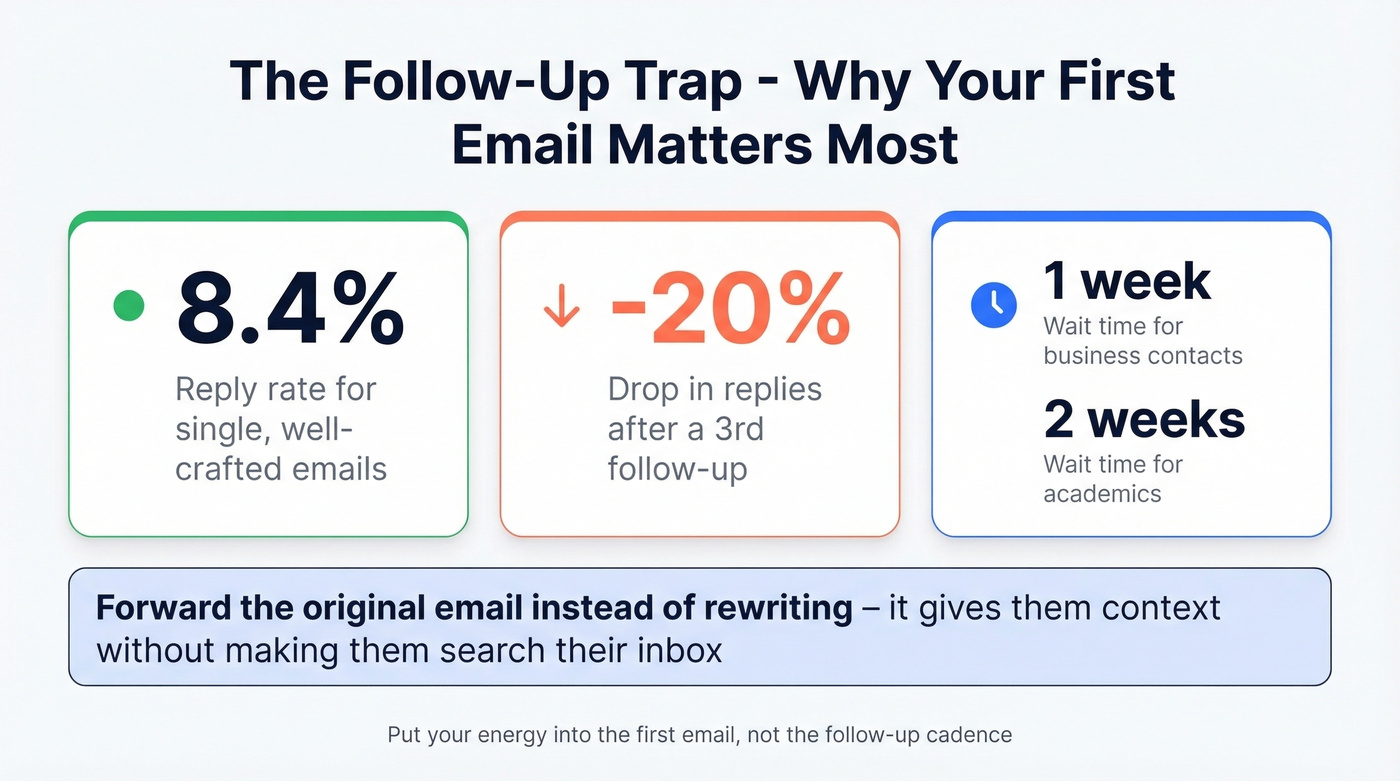
One follow-up is enough. Single emails had an 8.4% reply rate. Adding a third drops replies by up to 20%, and you start risking spam complaints. Put your energy into the first email, not the follow-up cadence. The answer to getting a response from a formal introduction is almost always a better first message - not more messages. If you need a simple system, use these sales follow-up templates and keep the thread tight.
FAQ
How long should a formal introduction email be?
Aim for 6-8 sentences, roughly 80-130 words. Data from 16.5 million emails shows this length hits a 6.9% reply rate and a 42.67% open rate. Anything over 200 words sees diminishing returns - cut ruthlessly.
What's the best day to send an introduction email?
Thursday consistently outperforms other weekdays, averaging a 6.87% reply rate compared to 5.29% on Monday. Tuesday and Wednesday fall in between. Avoid weekends for professional outreach entirely.
Should I use "Dear" or "Hi" in a formal email?
Use "Dear [Title] [Last Name]:" with a colon for professors, executives, or anyone you've never met. Use "Hi [First Name]," with a comma for peers or contacts in casual industries. When you're unsure, "Dear" is always the safer choice.
How do I find the right email address before introducing myself?
Use a verified email finder rather than guessing formats. Prospeo covers 300M+ professional profiles with 98% email accuracy and offers 75 free lookups per month - enough to verify contacts before any important introduction.
The framework above works - but only if you're emailing the right person at the right address. Prospeo gives you 300M+ professional profiles with 30+ filters so you can find the exact decision-maker, grab their verified email, and send that intro with confidence.
Stop guessing email addresses. Start getting replies.