

How to Generate Leads: The Data-Backed Playbook for 2026
Your SDR just burned through 500 emails and got 8 replies. Three bounced. Two were out-of-office. One said "wrong person." That's not a lead generation problem - it's a data problem. And it's the reason most advice on how to generate leads falls flat: it focuses on tactics while ignoring the numbers underneath them.
Here's the reality. The lead generation software market was valued at $7.4B in 2025 and is growing at 9.1% CAGR. 85% of B2B marketers call lead generation their number one challenge, B2B buyers now use roughly 10 channels before making a purchase decision, and yet the average conversion rate across industries is just 2.9%. That gap between spending and converting is where most teams bleed out.
The Framework (Quick Version)
Short on time? Four pillars, one anchor metric:
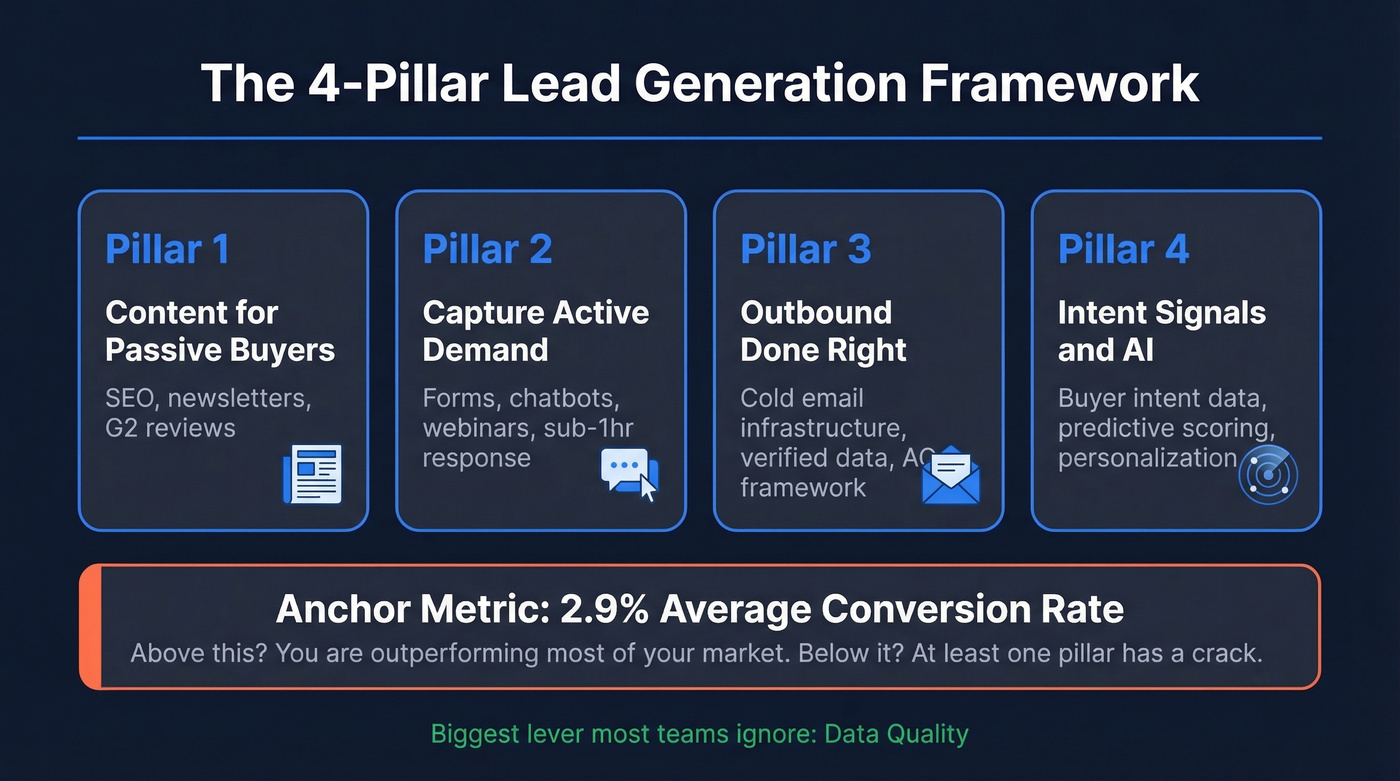
- Pillar 1 - Content for passive buyers. Build trust before they're ready to buy. SEO, newsletters, reviews on G2 and Capterra.
- Pillar 2 - Capture active demand. When someone raises their hand, respond in under an hour. Forms, chatbots, webinars.
- Pillar 3 - Outbound done right. Cold email isn't dead - 97% of people ignore cold calls. Email is still one of the most scalable outbound channels, but your infrastructure and data quality determine whether it works.
- Pillar 4 - Intent signals and AI. Stop guessing who's in-market. Use data to find them before your competitors do.
The benchmark that anchors everything: 2.9% average conversion rate across 100M+ data points. Above that, you're outperforming most of your market. Below it, at least one of these pillars has a crack.
The single biggest lever most teams ignore? Data quality. Bad contact data doesn't just waste rep time - it burns sender domains, tanks deliverability, and poisons every channel it touches.
Benchmarks Before You Optimize
Before you optimize anything, you need to know what "good" actually means. Too many teams chase leads without knowing whether their CPL is healthy or their funnel conversion rates are competitive.
Channel Performance
| Channel | Avg Conversion Rate | Avg CPL | Best For |
|---|---|---|---|
| 6.5% | $30-$45 | Lowest CPL, highest volume | |
| SEO / Content | 1.8% | $30-$60 | Compounding ROI over time |
| Google Search Ads | 4.5% | $90-$150 | Capturing active intent |
| LinkedIn Ads | 3.2% | $120-$200 | Precise B2B targeting |
| Webinars | 11.2% | $60-$80 | Highest conversion rate |
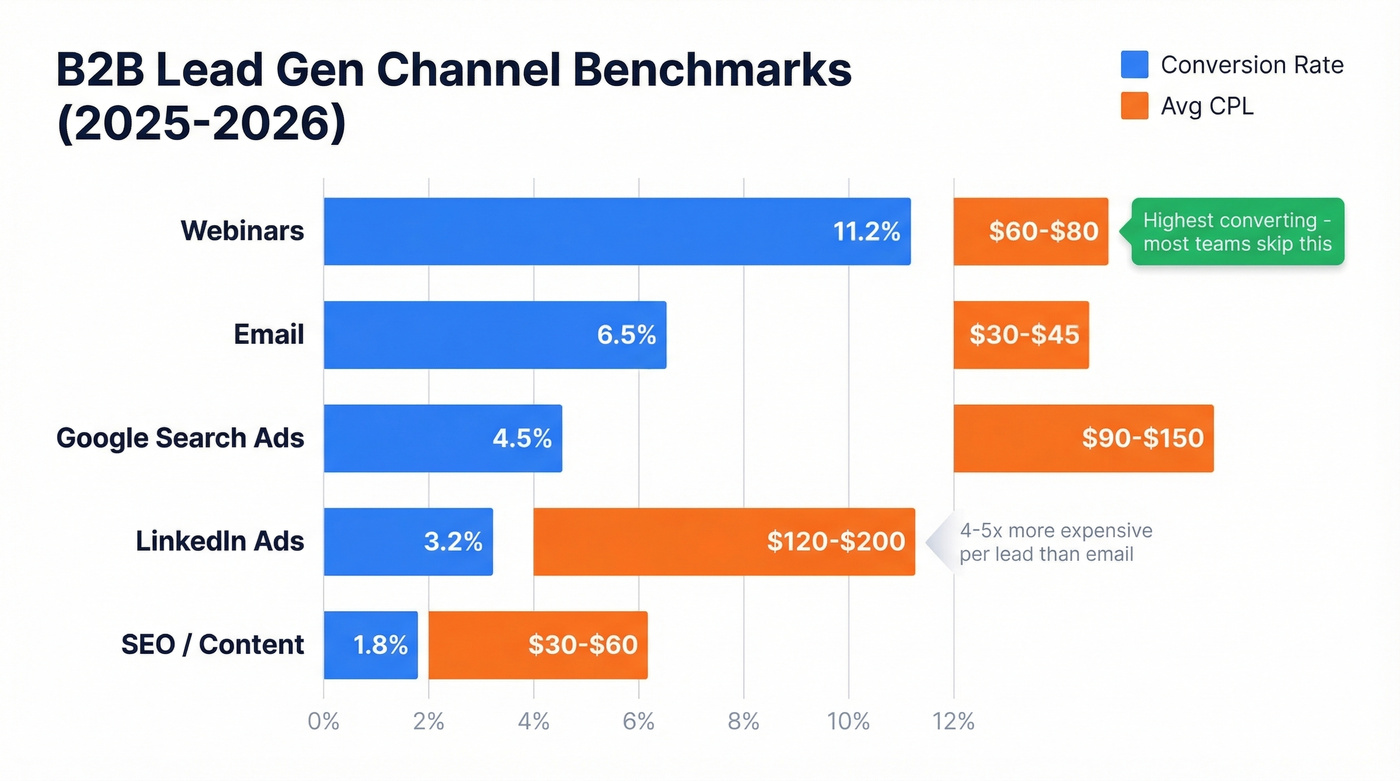
Data from LeadCrafters' 2025 benchmarks.
The standout? Webinars at 11.2% conversion - and most teams aren't running them. LinkedIn ads cost 4-5x more per lead than email with a lower conversion rate. That doesn't mean LinkedIn is bad. It means you need to understand what you're paying for and whether the audience precision justifies the premium.
Funnel-Stage Targets
| Funnel Stage | Great | Average | Needs Work |
|---|---|---|---|
| Visitor to Lead | >5% | 2-5% | <2% |
| MQL to SQL | >60% | 40-60% | <40% |
| Lead to Customer | >20% | 10-20% | <10% |
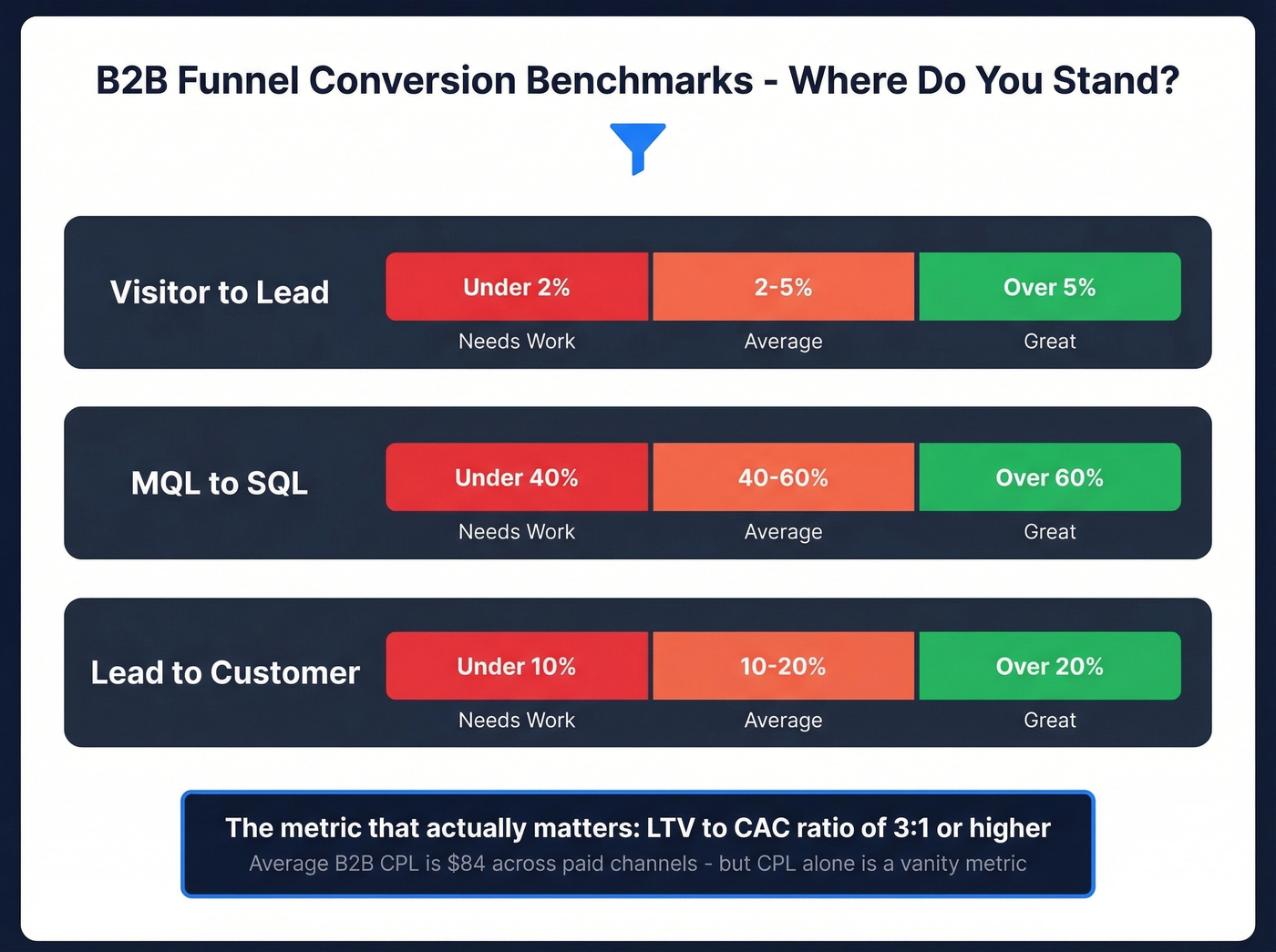
The average B2B CPL across paid channels is $84, while the mean across all industries is $198.44 - so B2B teams actually start in a better position than most. But CPL alone is a vanity metric. The sustainability benchmark that actually matters is LTV:CAC of 3:1 or higher. If you're spending $84 per lead but your average customer lifetime value is $200, the math doesn't work regardless of how many leads you pull in.
The 4-Pillar Lead Generation Framework
Pillar 1: Content for Passive Buyers
Most of your market isn't ready to buy right now. McKinsey's data shows B2B buyers use roughly 10 channels before making a purchase decision. If you're only showing up when they're actively searching, you're missing the majority of the buying journey.
Content marketing converts at just 1.8% on average, which looks unimpressive next to email's 6.5%. But that number misses the point entirely. SEO and content compound - a blog post that ranks today keeps pulling in prospects for months or years after you publish it, while paid channels stop the moment you stop paying.
The playbook isn't complicated. Publish consistently on topics your ICP actually searches for. Build a newsletter that delivers genuine insight, not product updates disguised as thought leadership. Create content that answers the questions your sales team hears on every discovery call. And don't ignore review platforms - 87% of B2B decision makers look for honest reviews online before purchasing. A strong presence on G2 or Capterra builds trust you can't buy with ad spend.
One emerging channel worth watching: AI-powered search. Buyers increasingly discover vendors through ChatGPT, Perplexity, and other generative engines. Optimizing your content for these platforms - sometimes called Generative Engine Optimization - is becoming a real competitive edge. The teams doing it now will own the channel before it gets crowded.
We've seen teams triple their inbound pipeline by shifting from "content about our product" to "content about our buyer's problems." That shift sounds obvious. Almost nobody actually makes it.
Pillar 2: Capturing Active Demand Fast
When someone fills out a form, requests a demo, or starts a chat, the clock starts. It ticks fast.
Respond within one hour. An HBR study found that contacting a lead within 60 minutes makes you roughly 7x more likely to qualify them. Wait 24 hours and the likelihood of qualifying drops over 98%. Speed-to-lead is the cheapest conversion lever you have, and most teams are terrible at it.
Cut your forms to 3 fields. Three-field forms convert 27% better than five-field forms. Name, email, company. That's it. Enrich the rest later with your data tools.
Run webinars. At 11.2% conversion, they're the highest-converting B2B channel and most teams underinvest in them. A monthly webinar with a genuine expert beats a quarterly one with a polished slide deck every time.
Deploy chatbots on high-intent pages. 42% of customers prefer live chat for support questions. Put a conversational bot on your pricing page and demo request page. Route hot leads to a human immediately.
Here's the thing: we see this pattern constantly. Teams invest heavily in driving traffic, then lose half their leads because the response time is measured in days instead of minutes. Fix the back end before you spend more on the front end - especially your lead routing.
Pillar 3: Outbound Done Right
Cold email isn't dead. The consensus on r/b2bmarketing is that most teams get around a 2% reply rate - and then conclude the channel is broken. It's not broken. Their infrastructure is.
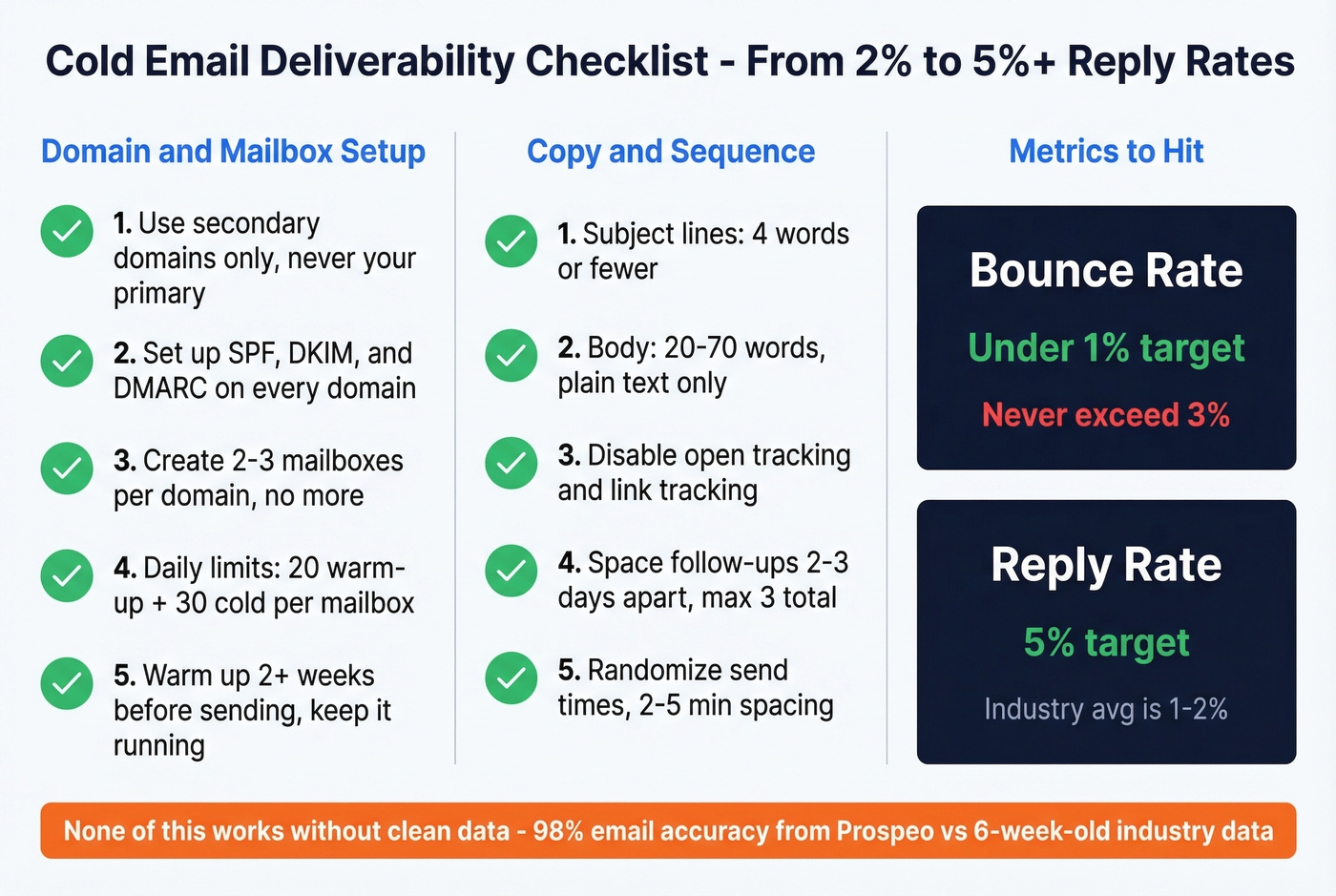
Here's the cold email deliverability checklist that separates 2% reply rates from 5%+:
Domain and mailbox setup:
- Use secondary domains for cold email. Never send cold outreach from your primary domain.
- Set up SPF, DKIM, and DMARC on every sending domain.
- Create 2-3 mailboxes per domain. No more.
- Daily limits per mailbox: ~20 warm-up emails + ~30 cold emails.
- Warm up every mailbox for at least 2 weeks before sending a single cold email. Keep warm-up running continuously.
Copy and sequence design:
- Subject lines: 4 words or fewer. Body: 20-70 words. Plain text only.
- Disable open tracking and link tracking. Tracking pixels hurt deliverability.
- Space follow-ups 2-3 days apart. Limit to 2-3 follow-ups total.
- Randomize sending times. Space sends 2-5 minutes apart.
Metrics to watch:
- Bounce rate under 1%. Never exceed 3%.
- Reply rate target: ~5%. Industry average is 1-2%.
None of this matters if your contact data is bad. A 3% bounce rate sounds manageable until you realize it's enough to trigger spam filters and tank your domain reputation across every mailbox. Prospeo's 5-step verification process delivers 98% email accuracy with a 7-day data refresh cycle, compared to the 6-week industry average. One customer, Meritt, saw their bounce rate drop from 35% to under 4% after switching, with pipeline tripling from $100K to $300K per week.
If you want the full infrastructure-first approach, follow the outbound cold email playbook.
Quality-gate your meetings with AQO. Activity alone doesn't matter - a booked meeting only counts if it actually holds, passes your quality checklist (right company, right person, right timing), and ends with a concrete next step scheduled within a week. Track Activity, Quality, and Outcomes separately. Most teams only measure the first one, which is why their pipeline looks full but nothing closes.
Pillar 4: Intent Signals and AI
The final pillar is knowing who to reach out to before they tell you. Buyer intent data tracks signals - content consumption, research behavior, technology adoption - that indicate a company is actively evaluating solutions in your category.
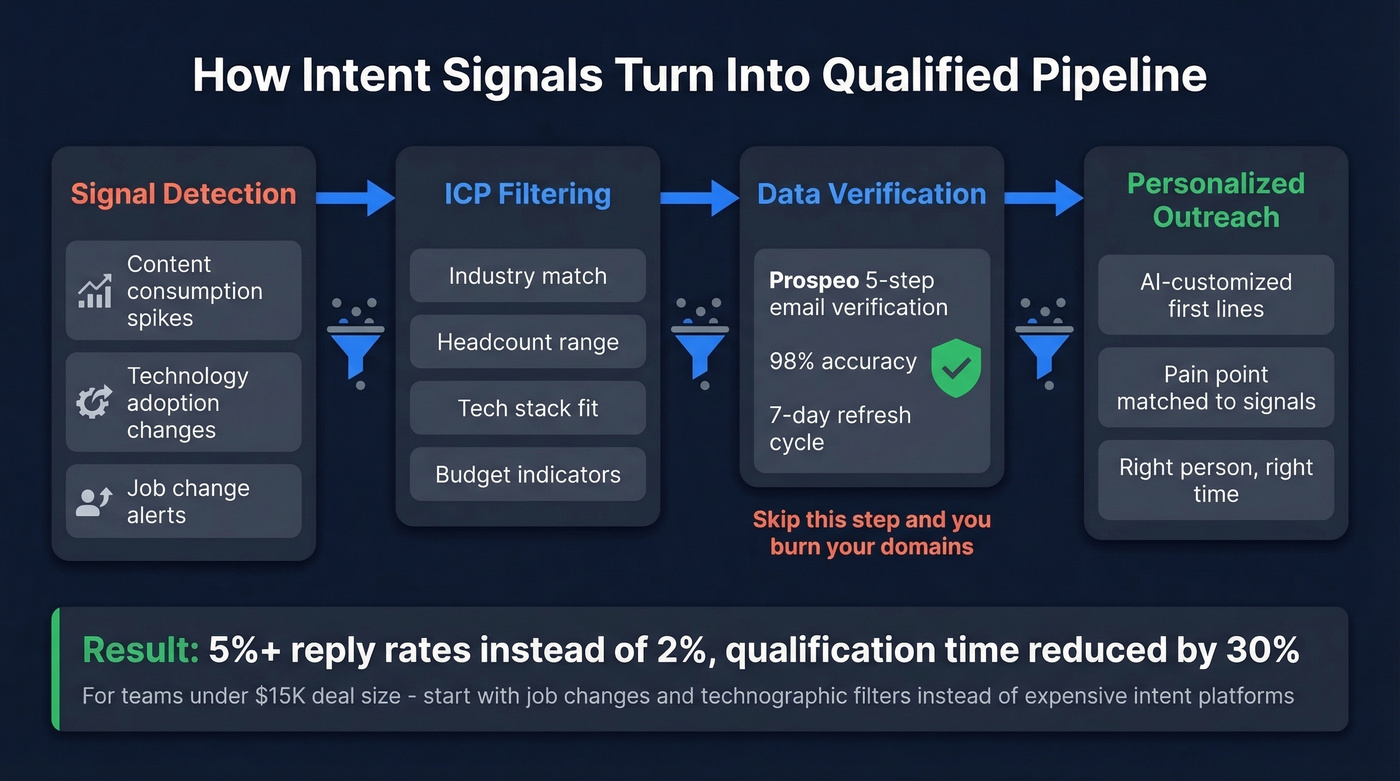
Tools like Bombora aggregate intent signals across thousands of B2B publishers. When a company's research activity on topics relevant to your product spikes above their baseline, that's a buying signal. Layering intent data with firmographic filters like industry, headcount, and tech stack lets you build lists of companies that are both a good fit and actively in-market.
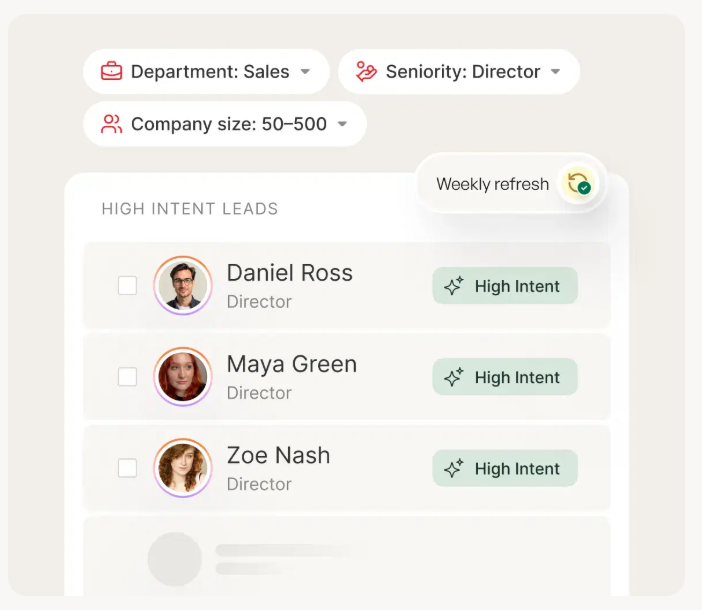
This is where AI earns its hype. Predictive lead scoring models can reduce qualification time by up to 30% according to Gartner. Conversational AI chatbots qualify inbound leads 24/7 without burning SDR hours. And personalized outreach at scale - using AI to customize the first line, the pain point, and the CTA based on a prospect's signals - is what turns a 2% reply rate into a 5%+ one.
If you're evaluating vendors, start with a shortlist of AI lead generation tools that actually fit your workflow.
Intent data isn't magic. It tells you who's researching, not who's buying. But combined with a tight ICP and verified contact data, it dramatically improves your odds of reaching the right person at the right time.
For teams without a massive budget, intent signals paired with clean data are the highest-leverage starting point. If your average deal size is under $15K, you probably don't need a $30K/year intent data platform. Start with job change alerts and technographic filters - they're cheaper signals that correlate just as strongly with buying intent for mid-market deals.

The article says it clearly: bad data burns domains, tanks deliverability, and poisons every channel. Prospeo's 5-step verification delivers 98% email accuracy on 300M+ profiles - refreshed every 7 days, not 6 weeks. That's how teams like Snyk cut bounce rates from 35% to under 5% and grew AE-sourced pipeline 180%.
Stop bleeding leads to bad data. Start generating pipeline that converts.
A 90-Day Example in Practice
Let's make this concrete. A 12-person SaaS company selling project management software to mid-market construction firms implemented this framework over 90 days:
Month 1 - Foundation. They narrowed their ICP from "construction companies" to "commercial general contractors with 50-200 employees using Procore." They set up HubSpot free, configured secondary domains for outbound, and started warming mailboxes. They published two blog posts targeting questions their sales team heard on every call.
Month 2 - Activation. They launched a biweekly webinar featuring a customer walking through their workflow. Conversion rate on webinar attendees: 14%. They started outbound sequences to ICP-matched contacts, keeping bounce rates under 2% with verified data. They cut their demo request form from seven fields to three and saw a 31% increase in submissions.
Month 3 - Compounding. Blog posts from month one started ranking. Inbound leads grew 40%. They layered intent signals to prioritize outbound - companies researching "construction project management software" got contacted first. Pipeline grew from $180K to $420K per month. No new hires, no new tools beyond the starter stack.
No single channel carried the load. The compounding effect of content, fast response, clean outbound, and intent-driven prioritization did. If you want more real-world breakdowns, see these lead generation case studies.
Mistakes That Kill Your Pipeline
Most lead gen failures aren't strategy failures. They're operational ones.
Too-broad ICP. Targeting "SaaS companies" instead of "Series B SaaS companies with 50-200 employees struggling with attribution" is the difference between a 10% and a 55% lead-to-opportunity rate. One study found a 45% increase in lead-to-opportunity conversion after narrowing the ICP definition.
Broken MQL/SQL definitions. If your Sales Acceptance Rate is below 75%, your MQL definition is wrong. Marketing is passing leads that sales doesn't want. Fix the definition before you fix the volume - your lead generation funnel math will show you where it breaks.
Over-reliance on one channel. You don't need 10 channels. But you need at least 2-3. Algorithm changes, policy updates, or a single platform outage shouldn't be able to zero out your pipeline overnight. Use a simple multi-channel lead nurturing plan to keep deals moving.
Ignoring data quality. Bad emails don't just bounce - they trigger spam traps, damage domain reputation, and make every subsequent campaign perform worse. Verify emails before you send, catching bad addresses and catch-all domains before they torch your sender reputation. If you need options, compare email address validation checkers.
Slow speed-to-lead. Waiting 24 hours to respond to an inbound lead drops your qualification probability by over 98%. If you don't have a system that routes and responds within an hour, build one before you spend another dollar on traffic.
Form friction. Every field you add costs you conversions. Three fields convert 27% better than five. Capture the minimum, enrich the rest afterward - ideally with a repeatable B2B lead enrichment workflow.
The Lead Gen Tool Stack
You don't need 15 tools. You need the right five or six, connected properly.
| Category | Tool | Starting Price | Key Strength |
|---|---|---|---|
| CRM | HubSpot | Free to $15/mo | Best free tier for SMBs |
| CRM | Salesforce | $25/user/mo | Enterprise customization |
| Enrichment | Prospeo | Free to ~$0.01/email | 98% accuracy, 7-day refresh |
| Prospecting | Apollo | ~$49/mo | Large database + sequences |
| Sequencing | Instantly | ~$30/mo | Cold email at scale |
| Sequencing | Lemlist | ~$39/mo | Personalization features |
| Automation | Clay | ~$149/mo | Workflow orchestration |
| Automation | Zapier | $19.99/mo | Connect everything |
Skip the enterprise platforms if your team is under 20 people. They'll eat your budget and half the features will sit unused.
The starter stack for teams under $200/month: HubSpot free + a verified data provider for enrichment + one sequencing tool like Instantly or Lemlist. That covers CRM, verified data, and outbound execution. Scale from there only when you've maxed out what these tools can do - then evaluate broader lead generation software options.
You read it above: 3-field forms convert 27% better because you enrich the rest later. Prospeo's enrichment engine returns 50+ data points per contact at a 92% match rate - job title, direct dial, intent signals, all of it. Capture the lead fast, then let your data platform fill in the gaps.
Enrich every lead with 50+ data points for $0.01 each.
FAQ
What's a good cost per lead in B2B?
The average B2B CPL across paid channels is $84, while the mean across all industries is $198.44. But the number that actually matters is your LTV:CAC ratio - if it's at or above 3:1, your CPL is sustainable regardless of the absolute dollar figure.
How many leads should a company generate per month?
HubSpot reports an average of 1,877 leads per month across companies, but that number is meaningless without context. Two hundred high-intent leads from your exact ICP will outperform 2,000 unqualified names every time. Optimize for lead-to-opportunity conversion rate, not raw volume.
How can you generate leads without a big budget?
Start with email outreach at $30-$45 CPL and SEO content that compounds over time. Use a free CRM like HubSpot, verify contacts with a free-tier tool, and run a monthly webinar. Teams spending under $200/month can build serious pipeline - the difference is data quality and execution, not budget.
What's the best B2B lead generation channel?
Webinars convert highest at 11.2%, email delivers the lowest CPL at $30-$45, and SEO compounds over time with minimal ongoing spend. The best approach is running 2-3 channels well and connecting them with verified contact data so outbound actually reaches real people.