

The B2B Lead Generation Funnel Guide (With Real Benchmarks)
Your VP of Sales just told you marketing leads are garbage. Five hundred MQLs last quarter, twelve opportunities. That's a 2.4% conversion rate - but is it actually bad? You don't know, because nobody gave you benchmarks.
Most B2B lead generation funnel guides define stages without telling you what "good" looks like. This one does.
What Is a Lead Generation Funnel in B2B?
A lead generation funnel is a measurement framework that tracks how prospects move from first awareness to closed deal, with defined stages, conversion criteria, and owners at each step. It's not how buyers actually behave - real buying is a pinball machine of parallel evaluations, internal politics, and dark-funnel research you'll never see in your CRM. But the funnel gives you a way to measure where things break.
There's a distinction worth making early:
| Demand Generation | Lead Generation | |
|---|---|---|
| Goal | Create awareness and interest | Capture interest into contacts and pipeline |
| Tactics | Ungated content, brand building, education | Forms, demos, outbound sequences |
| Metric | Share of voice, engagement | MQLs, pipeline value |
81% of buyers research independently before talking to a vendor, which means demand gen feeds the top. But 91% of marketers still rank lead generation as their top priority, because pipeline doesn't fill itself.
The decision framework is simple. If your market doesn't know you exist, invest in demand gen. If your audience is already aware and you need pipeline this quarter, lean into lead gen. Most teams need both running simultaneously - and a well-structured funnel ties the two together so nothing falls through the cracks.
The 6 Funnel Stages (With Benchmarks)
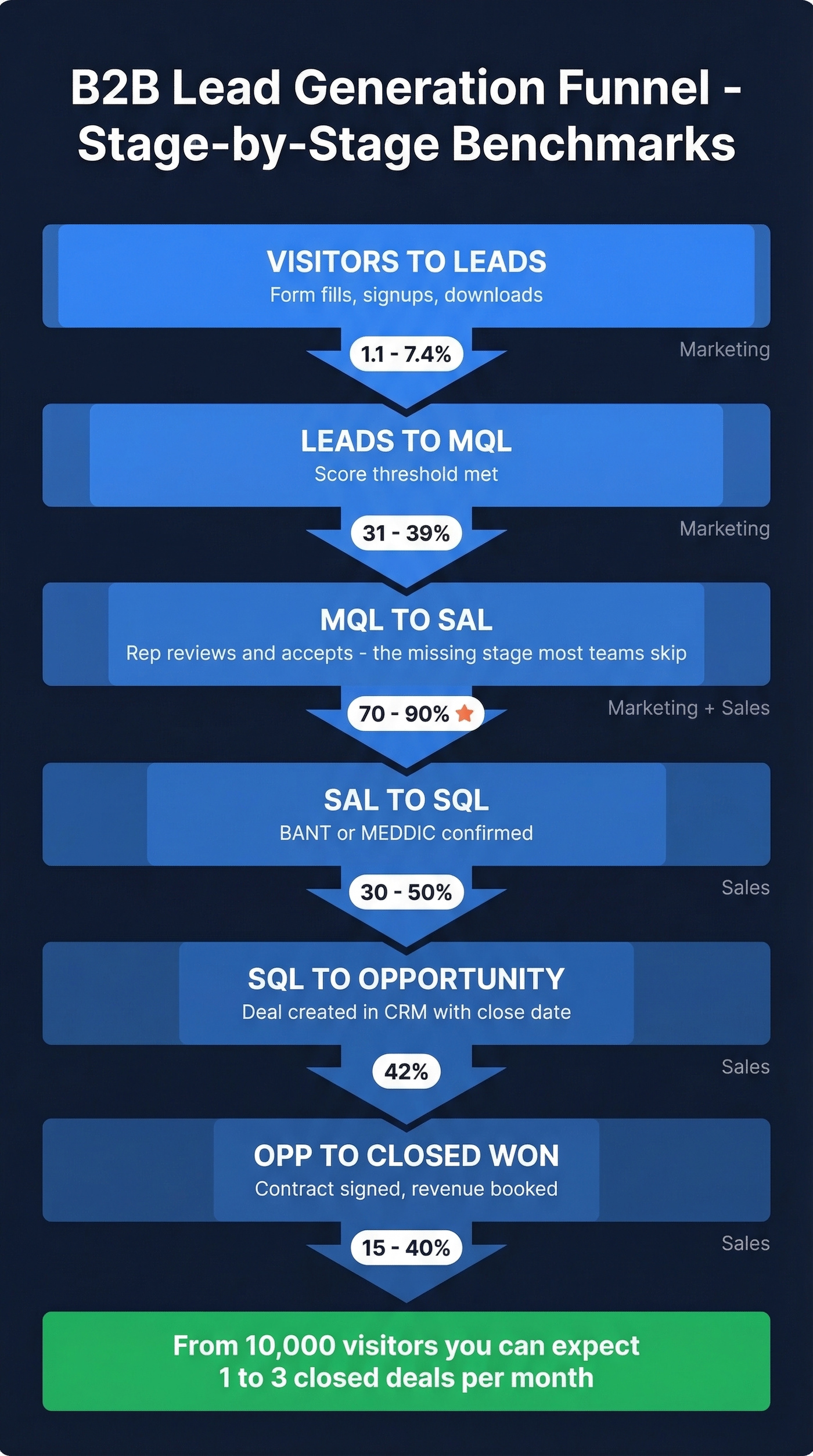
Most funnel guides were written by content marketers who've never stared at a pipeline report. Here are the six stages with real numbers - including the one most guides skip entirely.
Awareness (Visitor to Lead)
This is where anonymous traffic becomes a known contact through a form fill, trial signup, or content download. Conversion rates vary wildly by industry: B2B SaaS averages 1.1%, legal services hit 7.4%, and manufacturing lands around 2.2%. If you're in SaaS and converting above 2%, you're outperforming most of the market.
The lever here is offer quality. A generic "subscribe to our newsletter" converts at a fraction of what a specific tool, calculator, or benchmark report delivers. Your top-of-funnel efforts - SEO content, social campaigns, paid ads - determine how many visitors arrive, but the offer determines how many convert.
Lead to MQL
Marketing Qualified Leads are contacts that match your firmographic and engagement criteria: right company size, right title, visited the pricing page twice, downloaded the ROI calculator. Scoring is automated. B2B SaaS benchmarks sit around 39% for Lead-to-MQL. Don't confuse this with MQL-to-SQL, which benchmarks at 38% - the numbers are close enough to cause spreadsheet chaos if you're not careful.
Loose scoring inflates MQL counts and tanks downstream conversion. Tight scoring does the opposite. There's no universal right answer, but here's our rule of thumb: if more than 50% of your leads become MQLs, your scoring is too loose. (If you need a practical setup, start with a simple lead scoring model and iterate.)
MQL to SAL (The Missing Stage)
Here's the thing: if your SAL stage doesn't exist, everything downstream is fiction.
A Sales Accepted Lead is an MQL that a sales rep has reviewed and formally agreed to work. It's the handoff control point. Without it, marketing throws leads over the wall and sales ignores a big chunk of them - then both teams blame each other at the quarterly review. We've seen this play out at dozens of companies, and it's always the same story.
Benchmark: 70-90% of MQLs should become SALs. Below 70%? Either your scoring model is broken or your sales team doesn't trust marketing's judgment. Adding the SAL stage alone reduces lead waste and forces alignment between the two teams.
SAL to SQL
By this point, you've already lost half your leads if the upstream stages aren't working. Sales Qualified Leads have been engaged by a rep and confirmed as a legitimate opportunity with need, budget, authority, and timeline. This is where frameworks like BANT, CHAMP, or MEDDIC earn their keep (use a tighter MEDDIC sales qualification checklist if your deals are complex).
Benchmark: 30-50%. The gap between SAL and SQL usually comes down to timing - the prospect is real but not ready. That's a nurture problem, not a disqualification.
SQL to Opportunity
An SQL becomes an opportunity when there's a defined deal with a projected close date and value in your CRM. For B2B SaaS, SQL-to-Opportunity averages 42%. The drop-off is often competitive - the prospect is evaluating multiple vendors and you didn't make the shortlist, or internal priorities shifted mid-cycle.
Opportunity to Closed Won
SaaS deals close at 15-40% depending on deal size, sales cycle length, and competitive density. One of the biggest predictors of close rate is whether you have an internal champion who can sell when you're not in the room. Skip this if you're selling sub-$5K deals - at that price point, a single decision-maker usually owns the call.
| Stage | Definition | Entry Criteria | Benchmark Rate | Key Tactic |
|---|---|---|---|---|
| Visitor to Lead | Anonymous to known | Form fill or signup | 1.1-7.4% | High-value offers |
| Lead to MQL | Known to qualified | Score threshold met | 31-39% | Behavioral scoring |
| MQL to SAL | Qualified to accepted | Rep reviews and accepts | 70-90% | SLA + handoff rules |
| SAL to SQL | Accepted to confirmed | BANT/MEDDIC passed | 30-50% | Discovery calls |
| SQL to Opp | Confirmed to deal | CRM opportunity created | 42% | Multi-threading |
| Opp to Close | Deal to revenue | Contract signed | 15-40% | Champion enablement |
Pipeline Math - Model Your Funnel Backward
Every guide says "track metrics." None show the actual math. Let's take 10,000 monthly visitors and run them through the benchmarks above using B2B SaaS rates, then see what happens when you improve just one stage. (If you want a broader KPI list, track funnel metrics alongside stage conversion.)
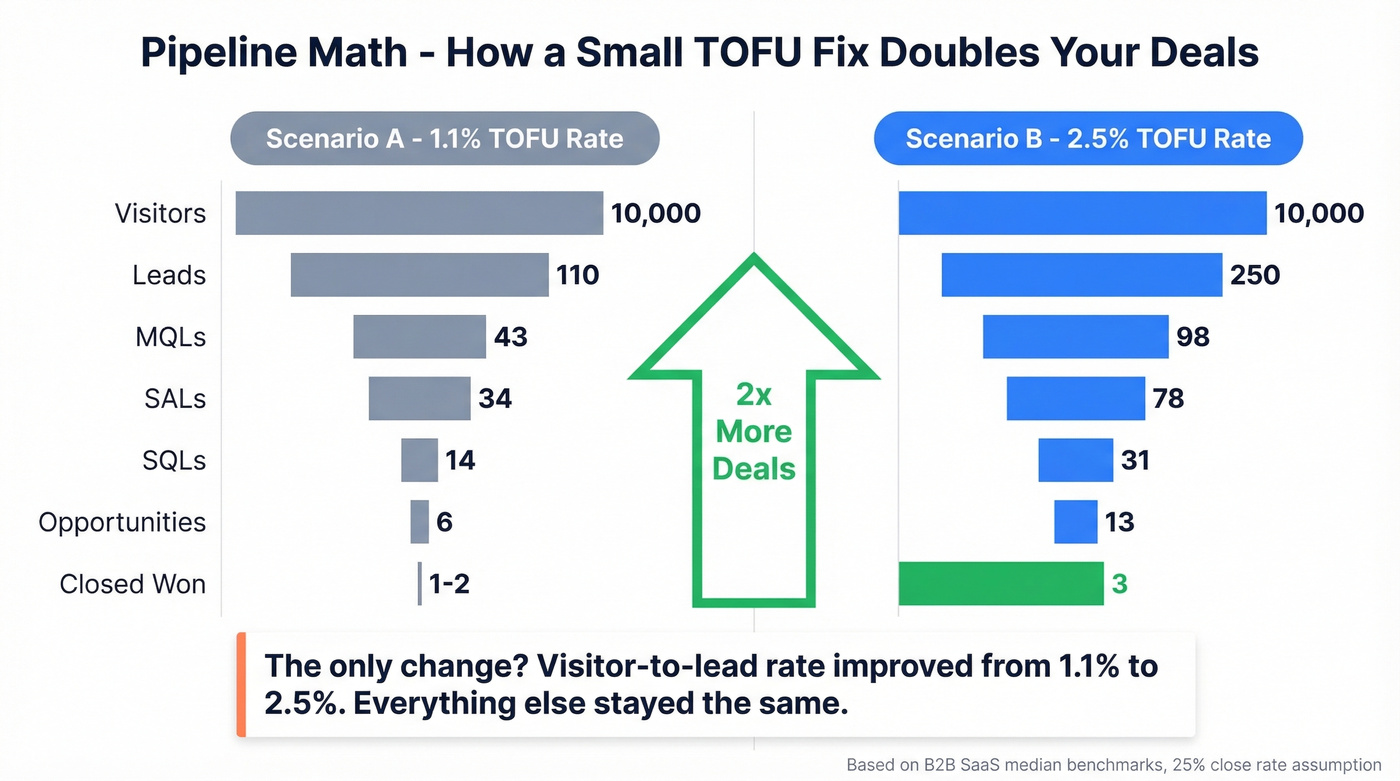
The close rate below uses a 25% assumption, which falls within the 15-40% benchmark range.
| Stage | Rate | Scenario A (1.1% TOFU) | Scenario B (2.5% TOFU) |
|---|---|---|---|
| Visitors | - | 10,000 | 10,000 |
| Leads | 1.1% / 2.5% | 110 | 250 |
| MQLs | 39% | 43 | 98 |
| SALs | 80% | 34 | 78 |
| SQLs | 40% | 14 | 31 |
| Opportunities | 42% | 6 | 13 |
| Closed Won | 25% | ~1-2 deals | ~3 deals |
Scenario A gives you roughly 1-2 closed deals per month from 10,000 visitors. Scenario B - where you've improved visitor-to-lead from 1.1% to 2.5% - more than doubles your output without changing anything else in the funnel. That's the power of TOFU optimization.
Now remember that VP who said your 500 MQLs produced only 12 opportunities? That's a 2.4% MQL-to-Opp rate. The benchmark path through MQL-to-SAL-to-SQL-to-Opp works out to around 9-19%, typically closer to 13%. Now you know where to look: the SAL stage probably doesn't exist, and a lot of those MQLs were never reviewed by a rep. This kind of pipeline breakdown is exactly what funnel math is designed to diagnose.
Your Funnel Has a Buying Committee Problem
Your funnel tracks individual leads, but B2B purchases are made by committees. About 13 people are involved in a typical B2B buying decision, and Forrester's 2021 B2B Buying Study found that 95% of purchases involve 3+ people across 2+ departments. More than 80% qualify as complex buying scenarios.
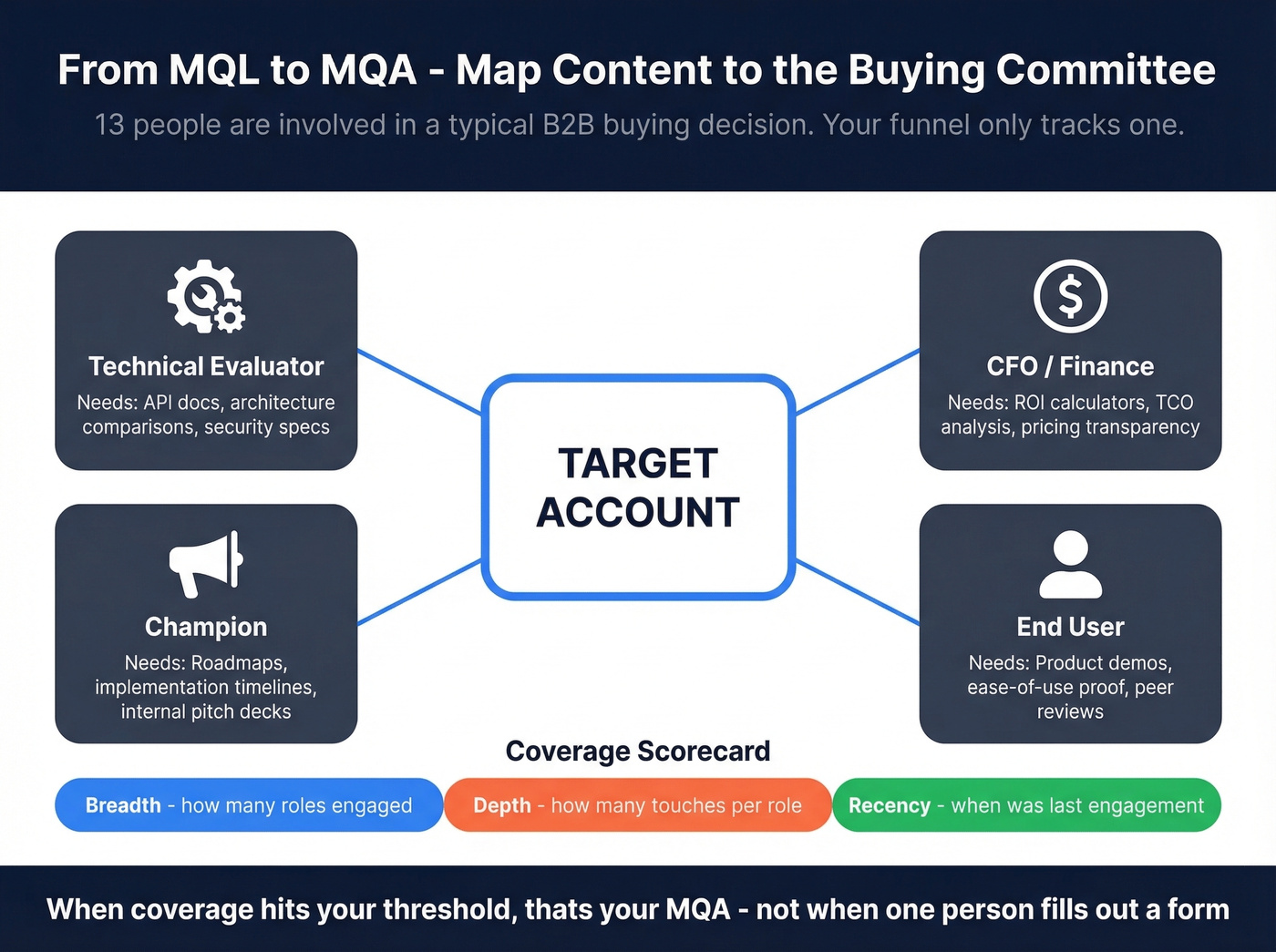
This creates a structural problem. Your funnel measures one lead per account, but the deal requires consensus from a technical evaluator, a CFO, an end user, and a champion. Buyers spend about 17% of their total buying time with suppliers - and if they're evaluating three vendors, each gets roughly 5-6% of the committee's attention. Meanwhile, 61% of B2B buyers prefer a rep-free experience, and 73% actively avoid vendors that blast irrelevant outreach.
If your deal size is under $25K, you probably don't need a 6-stage funnel. You need a 3-stage funnel with airtight data and fast follow-up. The complexity of your funnel should match the complexity of your deal.
A common debate: should you multi-touch the same person across channels, or spread touches across the buying committee? Both - but prioritize breadth first. Getting 5 people in an account to engage once beats getting 1 person to engage 5 times. A multi-threaded content strategy increases account penetration velocity by 30-40% compared to single-persona funnels (this is where account-based selling best practices help).
The fix is shifting from MQL to MQA - Marketing Qualified Accounts. Instead of asking "is this lead qualified?" ask "how many roles in this account are engaged?" Map content to buying committee roles: technical evaluators need API docs and architecture comparisons, CFOs need ROI calculators and TCO analyses, champions need roadmaps and implementation timelines. Build a coverage scorecard tracking breadth, depth, and recency. When coverage hits your threshold, that's your MQA.

Your TOFU-to-MQL conversion rate means nothing if 35% of those leads bounce. Prospeo's 98% verified email accuracy and 7-day data refresh cycle ensure every lead entering your funnel is reachable - so your pipeline math actually holds up.
Stop modeling pipeline on bad data. Start with contacts that convert.
Funnel Performance by Channel
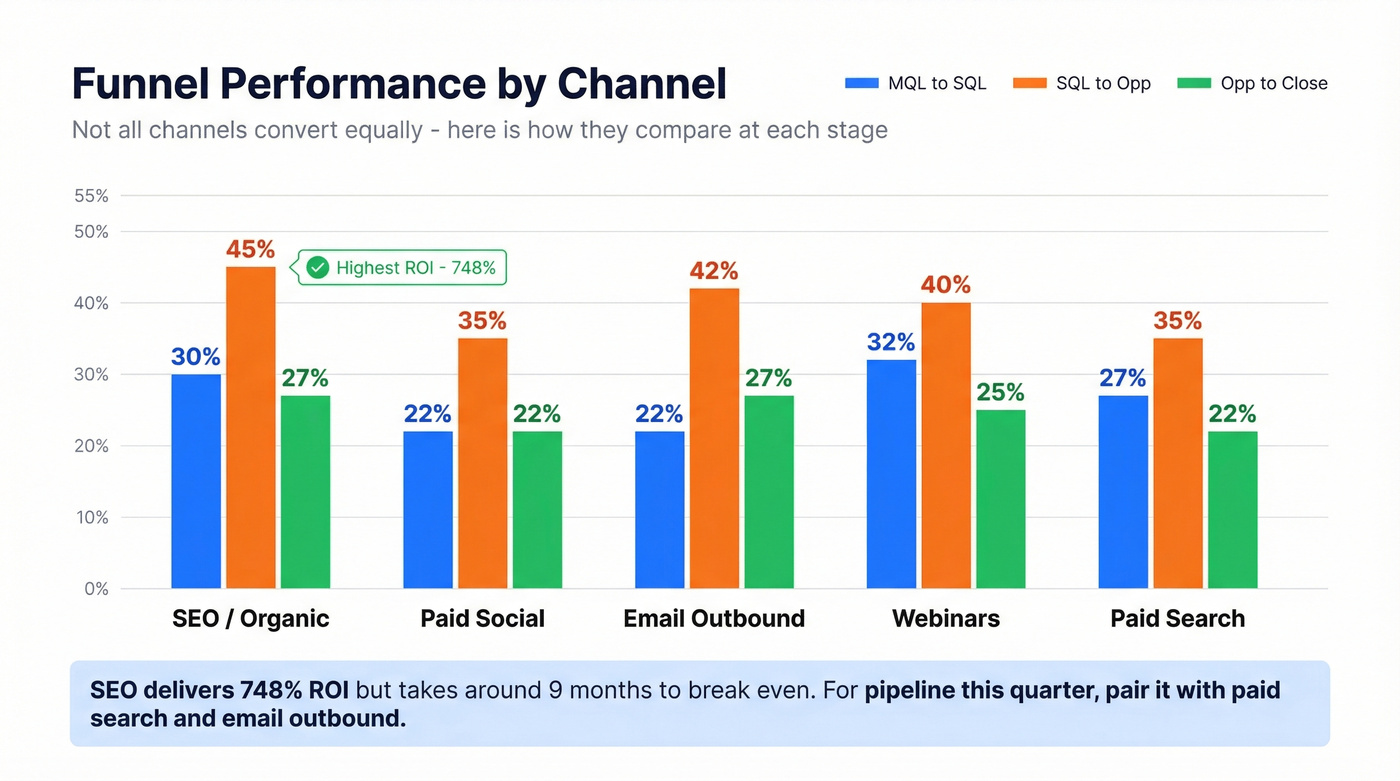
Not all channels convert equally. Here's how performance typically differs across stages.
| Channel | MQL to SQL | SQL to Opp | Opp to Close | Notes |
|---|---|---|---|---|
| SEO/Organic | 25-35% | 35-55% | 20-35% | Highest ROI, slow ramp |
| Paid Social | 15-30% | 25-45% | 15-30% | Strong targeting, expensive |
| Email Outbound | 15-30% | 30-55% | 15-40% | Fast, needs clean data |
| Webinars | 25-40% | 30-50% | 15-35% | High intent, low volume |
| Paid Search | 20-35% | 25-45% | 15-30% | Fast pipeline, high CPL |
SEO delivers the highest ROI at 748% - but it takes around 9 months to break even. If you need pipeline this quarter, pair SEO with paid search and email outbound. Webinars produce high-intent MQLs but don't scale well. The right answer is almost always a mix of three channels, not all-in on one.
For email outbound specifically, the channel lives or dies on data quality. High bounce rates don't just waste sends - they tank your sender reputation and make every subsequent campaign perform worse. We've watched teams burn through three domains in a quarter because they were working off a stale contact list. Investing in verified data with a short refresh cycle pays for itself many times over (and if you're diagnosing issues, start with email bounce rate and how to improve sender reputation).
How to Build Your B2B Lead Generation Funnel
Step 1: Define Your Minimum Viable ICP
Every guide says "define your ICP" as if it's a 10-minute exercise. It's not - but you also don't need a 40-page document. Start with three things: industry, company size range, and the job title of your primary buyer. That's your minimum viable ICP. Refine it after 50 conversations, not before. (If you want a starting point, use an ideal customer profile template.)
Step 2: Map Content to Stages and Roles
Each funnel stage needs content, and each buying committee role needs different content at each stage. Early stage: educational blog posts and benchmark reports for awareness. Mid stage: case studies and ROI calculators for evaluation. Late stage: implementation guides and security documentation for decision. Don't create content without knowing which stage and which role it serves - otherwise you're just publishing into the void.
Step 3: Build Capture Mechanisms
You need three types of capture:
- Inbound: forms, gated content, free tools
- Signal-based: intent data and website visitor identification to surface accounts already researching your category
- Outbound: targeted prospecting into accounts showing buying signals (use a consistent set of sales prospecting techniques so reps don’t freestyle)
Most teams over-invest in inbound and under-invest in signal-based capture. That's a mistake, because signal-based capture helps you prioritize the right accounts at the right time instead of waiting for them to raise their hand.
Step 4: Set Up Nurturing Automation
A practitioner on r/smallbusiness shared an automation checklist that maps well to funnel stages: scheduled social posts for awareness, triggered remarketing for interest, automated email sequences for consideration, value-based workflows for decision, and automated onboarding for post-sale. The key is that every automation has a trigger condition and an exit condition - not just a time delay.
Step 5: Define Handoff SLAs
Every stage transition needs three things: entry criteria defining what qualifies a lead to enter, an owner who's responsible, and a time SLA dictating how long before the owner must act. The MQL-to-SAL handoff is the most critical. We've seen teams where reps had 72 hours to accept or reject an MQL, and that single SLA dramatically reduced lead waste compared to the "whenever I get around to it" approach.
7 Funnel Mistakes That Kill Pipeline
1. No SAL stage. If your sales team ignores a big chunk of MQLs, you don't have a funnel - you have a spreadsheet. Add a formal acceptance step with a 24-48 hour SLA.
2. Feeding bad data. High bounce rates tank your sender reputation and make every metric downstream unreliable. Use a data platform with real-time verification and a refresh cycle measured in days, not weeks. When your email accuracy is 98%, your funnel metrics actually reflect your strategy - not data rot.
3. Measuring volume instead of velocity. How fast leads move through stages matters more than how many enter. A funnel that converts 50 leads in 30 days beats one that converts 200 leads in 120 days.
4. Single-persona targeting. Your deal involves 13 people and you're sending one person a drip sequence. Multi-thread or lose to the competitor who does.
5. Giving up too early. 80% of B2B deals require 5+ follow-ups, and 44% of reps quit after the first. Build follow-up sequences that run at least 7-8 touches across multiple channels (you can pull from these sales follow-up templates to standardize).
6. Over-reliance on one channel. If 80% of your pipeline comes from one source, you're one algorithm change away from a crisis quarter. Diversify across at least three channels.
7. Treating all leads the same. A VP who visited your pricing page three times isn't the same as an intern who downloaded a whitepaper. Without lead scoring, your reps waste time on contacts that'll never close.
Funnel Tech Stack (With Costs)
The lead generation software market hit $7.4B and is projected to reach $16.2B by 2034. That's a lot of tools competing for your budget. Here's what you actually need, organized by funnel stage.
| Funnel Stage | Category | Example Tool | Starting Price |
|---|---|---|---|
| All stages | CRM | HubSpot / Salesforce | Free tier / ~$25/user/mo |
| Awareness | SEO & Content | Ahrefs / Semrush | ~$99/mo |
| Capture | Data & Enrichment | Prospeo | Free (75 emails/mo) |
| Qualification | Prospecting | Apollo | ~$49/user/mo |
| Nurture | Automation | Zapier | From $19.99/mo |
| Conversion | Scheduling | Calendly | ~$10/user/mo |
If I had to build a funnel tech stack from scratch on an SMB budget, it'd be HubSpot's free CRM, Prospeo for data and enrichment, and Zapier for automation glue. Everything else is a nice-to-have until you're past $1M ARR. Total cost: $100-300/mo. Enterprise stacks with Salesforce, intent platforms, and ABM tools run $50-100K+/year - and half the time, teams aren't using 60% of what they're paying for. (If you’re comparing vendors, start with data enrichment services and a shortlist of SDR tools.)

For the data layer specifically, freshness matters more than most teams realize. A 7-day refresh cycle catches job changes, company moves, and email updates that a 6-week cycle misses entirely. Stale data compounds errors across every downstream stage - your MQL counts look fine, but half those contacts bounced and your reps are chasing ghosts. Let's be honest: most pipeline problems that get blamed on "bad leads" are actually bad data problems in disguise.
The SAL-to-SQL gap shrinks when reps reach real decision-makers on the first attempt. Prospeo gives your team 125M+ verified mobile numbers with a 30% pickup rate and 30+ filters to target by intent, job change, and tech stack.
Give your reps direct dials that actually pick up - at $0.01 per lead.
FAQ
What's a good MQL-to-SQL conversion rate?
B2B SaaS averages around 38%, while other industries range from 15-35%. If you're consistently below 15%, your ICP definition or lead scoring model needs work. Tighten scoring criteria before blaming the sales team.
How is a B2B funnel different from B2C?
B2B funnels run 4-6+ stages with sales cycles measured in weeks or months and multiple decision-makers per deal. B2C is typically 1-2 steps. The biggest structural difference is the buying committee - B2B deals require consensus across departments, so your funnel needs to track account-level engagement, not just individual leads.
Is the MQL dead?
No. The concept is sound, but most implementations are broken. Teams skip the SAL stage and never define acceptance criteria, so MQLs pile up unworked and everyone declares the metric useless. Add a formal acceptance step with a 24-48 hour SLA and the MQL becomes actionable again.
What tools do you need to run a lead generation funnel?
The minimum viable stack is a CRM, a verified data platform for contacts and enrichment, and an automation tool like Zapier or Make. Add intent data and ABM platforms as you scale past $1M ARR. Three solid tools beat eight mediocre ones every time.