

How to Build a Multi-Channel Lead Nurturing Program That Actually Converts
You built the funnel. Leads pour in from paid search, webinars, content downloads. They hit the CRM, enter a drip sequence, and then... nothing. 80% of new leads never convert into sales. The ones that don't convert don't disappear - they sit in your automation tool, receiving emails nobody reads, inflating your contact count while your pipeline stays flat.
This is what happens when multi-channel lead nurturing is just email drips with a fancy name. On Reddit, practitioners call it the lead graveyard. Let's build something that actually works.
What You Need (Quick Version)
- Clean your data first. A high bounce rate will sabotage every channel you add. Verification isn't optional - it's the foundation. (If you’re diagnosing issues, start with bounce rate benchmarks and fixes.)
- Use 3-5 channels orchestrated around behavioral triggers, not timed email drips. Timing matters more than volume. (If you need a framework, use a lead scoring model to drive triggers.)
- Build exit conditions into every workflow. Leads that never leave your nurture aren't being nurtured - they're being spammed. (This is a common sales pipeline challenges root cause.)
Multichannel vs. Omnichannel
These terms get used interchangeably, but they're different. Multichannel nurturing means you're present across multiple channels - email, ads, phone, social. Omnichannel means those channels share context and hand off without friction, so a lead's experience feels unified regardless of where they engage.
B2B buyers now use [ten or more channels](https://www.mckinsey.com/capabilities/growth-marketing-and-sales/our-insights/b2b-sales-omnichannel-everywhere-every-time) to interact with suppliers. Most teams should aim for multichannel first and evolve toward omnichannel as their data and tooling mature.
Why This Matters in 2026
The data is unambiguous. HubSpot's 2026 State of Marketing found that 94% of marketers diversified their channel mix last year - only 6% still rely on one or two channels. Meanwhile, 45% now allocate 10-20% of their budgets specifically to testing new channels. If you're running email-only nurture, you're in a shrinking minority. The lead generation software market is projected to grow from $7.4B in 2025 to $16.2B by 2034, and that money is flowing toward multi-channel orchestration, not single-channel blasts. (If you’re planning budget, track lead generation metrics beyond opens and clicks.)
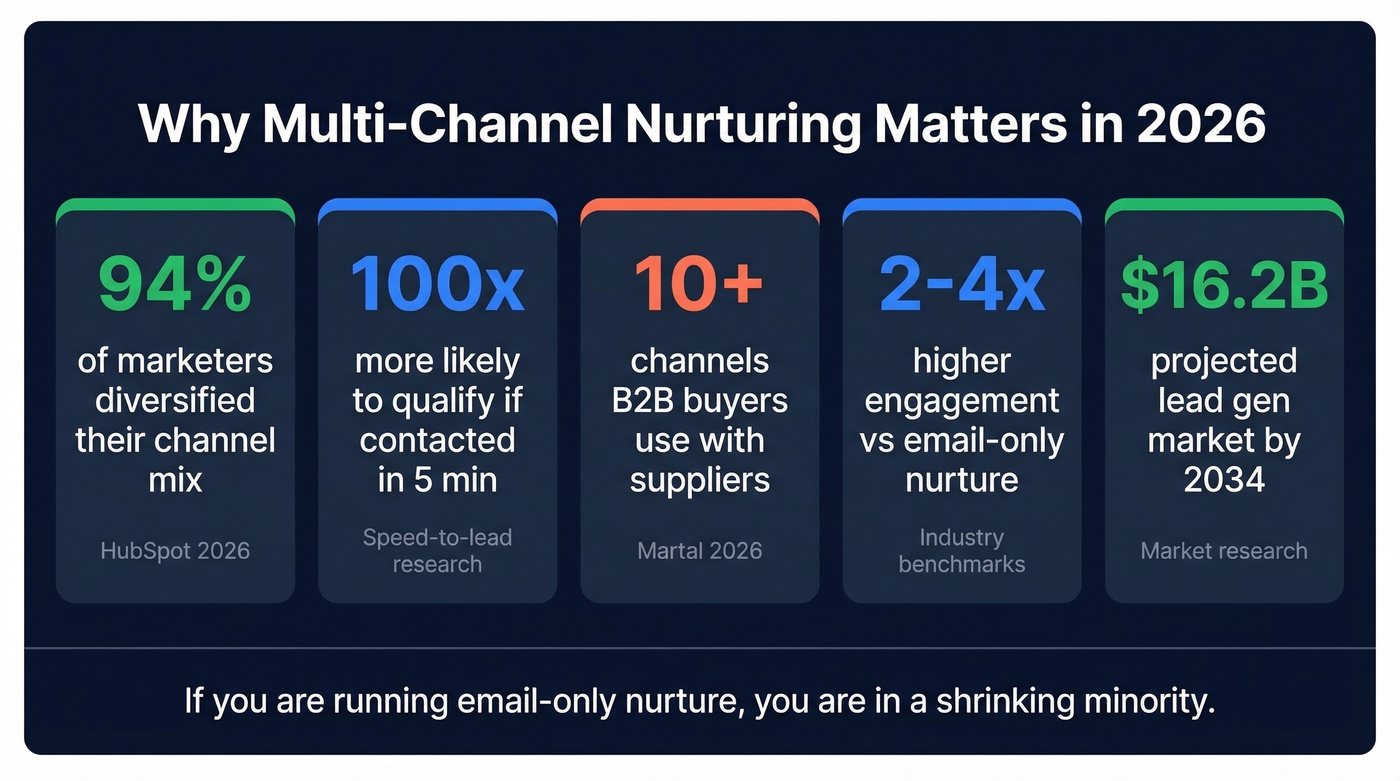
There's also a timing dimension most teams underestimate. Leads contacted within five minutes are 100x more likely to qualify, and the first 48 hours after entry are a golden window. After that, attention drops fast. A Demand Gen Report benchmark survey found 72% of B2B buyers expect personalized engagement tailored to where they are in the buying process. Generic sequences don't cut it. (This is where personalized outreach beats “one-size-fits-all” drips.)
Here's the thing: most teams don't have a lead quality problem - they have a channel diversity problem. Multichannel programs drive 2-4x higher engagement than email-only nurture because you're meeting buyers where they already are, not forcing them into the one channel you happen to be good at. (If you’re rebuilding the top of funnel, start with a tighter lead generation workflow.)

Your 30-day nurture sequence is only as good as the data underneath it. Bad emails kill deliverability, poison lead scores, and turn every channel into a dead end. Prospeo's 98% email accuracy and 7-day refresh cycle mean your nurture hits real inboxes from Day 1 through Day 30.
Stop nurturing bounced emails. Start with verified contacts at $0.01 each.
A 30-Day Nurture Sequence You Can Steal
Here's a concrete sequence we've used and refined. The entry trigger is a form fill or content download. The principle throughout: maintain a 3:1 give-to-get ratio - deliver value three times before making any ask. This sequence delivers 9 touches across 5 channels, within the 8-12 touches many mid-market B2B teams use. (If you need copy, pull from proven sales follow-up templates.)
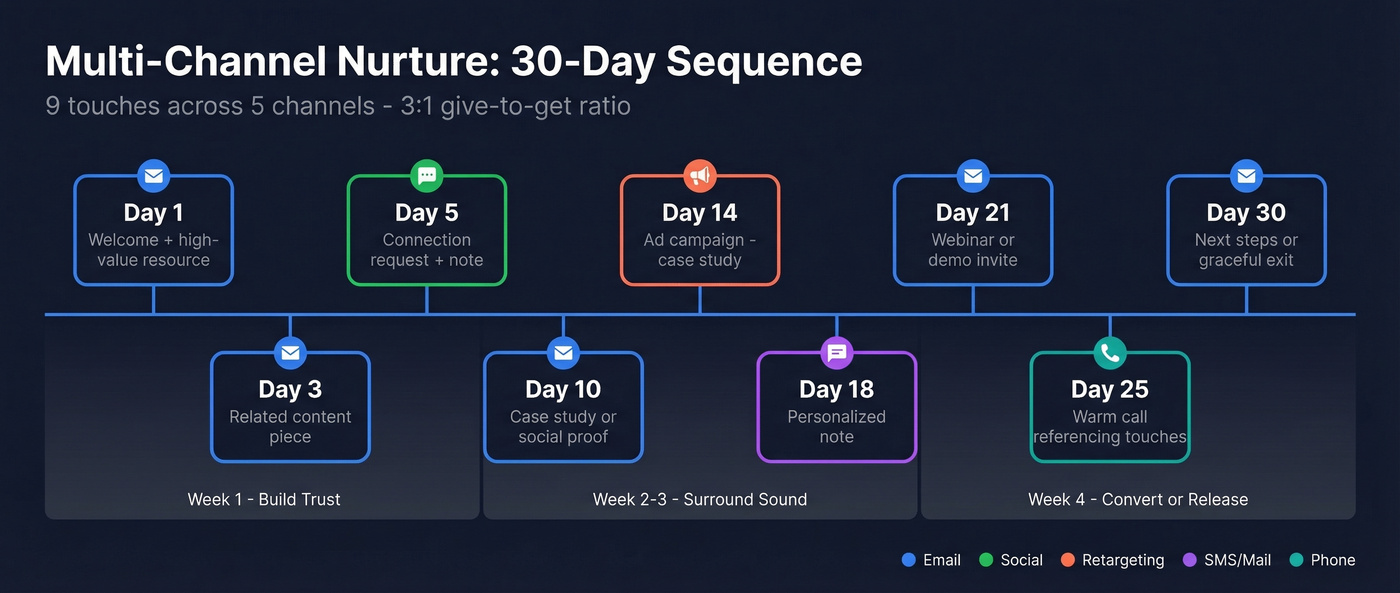
| Day | Channel | Action | Purpose |
|---|---|---|---|
| 1 | Welcome + high-value resource | Deliver immediate value | |
| 3 | Related content piece | Deepen engagement | |
| 5 | Social | Connection request + note | Open a second channel |
| 10 | Case study or social proof | Build credibility | |
| 14 | Retargeting | Ad campaign (case study) | Surround-sound effect |
| 18 | SMS or mail | Personalized note | Pattern interrupt |
| 21 | Webinar or demo invite | Conversion offer | |
| 25 | Phone | Warm call referencing touches | Human connection |
| 30 | Next steps or graceful exit | Close or release |
The first week is email-heavy because that's where you have permission and attention. Social and retargeting layer in during week two to create the surround-sound effect - the lead starts seeing you everywhere without feeling bombarded. The connection request on Day 5 warms the relationship so subsequent emails feel familiar rather than intrusive. The phone call on Day 25 isn't cold; the rep references specific content the lead engaged with. (For the call motion, use a warm calling approach.)
Exit conditions matter as much as the sequence itself. A lead exits when they reply, book a meeting, hit a lead score threshold of 80+, or get manually removed. If none of those happen by Day 30, move them to a low-frequency re-engagement track or let them go. In our experience, teams that skip exit conditions end up with a huge chunk of their database in zombie status - dead weight dragging down deliverability and metrics. (To keep revenue visibility, monitor pipeline health alongside engagement.)
Lead Scoring and Handoff
Without scoring, you're guessing when a lead is ready for sales. Here's a model that works for most B2B teams:
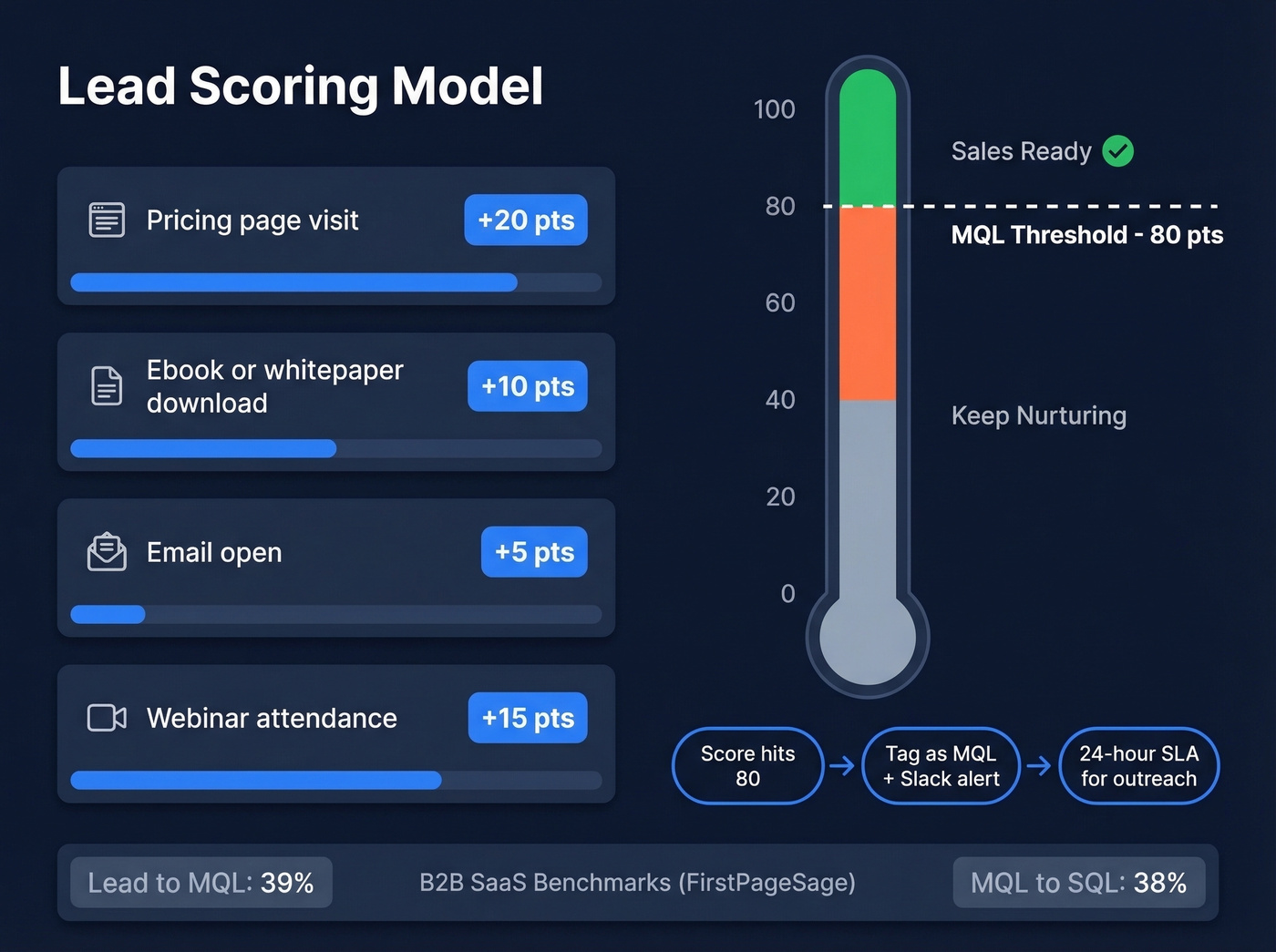
- Pricing page visit: +20 points
- Ebook or whitepaper download: +10 points
- Email open: +5 points
- Webinar attendance: +15 points
Set your MQL threshold at 80 points. When a lead crosses it, tag them as MQL, fire a Slack notification to the assigned rep, and enforce a 24-hour SLA for first outreach. (If you’re formalizing the process, define lead status stages so marketing and sales stay aligned.)
FirstPageSage benchmarks for B2B SaaS show Lead-to-MQL conversion at 39% and MQL-to-SQL at 38%. If your numbers are significantly below those, the problem is usually scoring calibration or handoff speed - not lead quality. Mature teams should also track pipeline velocity and stage progression, not just lead scores. Those revenue-level metrics tell you whether nurture is actually working or just generating activity.
Five Mistakes That Kill Your Nurture Program
1. Single-channel disguised as multi-channel. Sending five emails from different templates isn't multichannel. Layer in retargeting and one social channel from Day 5.
2. No exit conditions. Leads enter your nurture and never leave, tanking engagement rates and training inbox providers to ignore you. Set a 30-day hard stop with a re-engagement branch or full exit.
3. Ignoring data quality. A high bounce rate doesn't just waste sends - it damages your sender reputation and poisons your scoring model. Verify your list before you build on top of it. Prospeo runs 98% email accuracy with a 7-day refresh cycle, so your nurture starts on a clean foundation instead of a crumbling one. (If you’re troubleshooting deliverability, start with an email deliverability guide.)

4. Generic sequences with no behavioral branching. If a lead downloads a pricing PDF and gets the same "intro to our product" email as someone who read a blog post, you've wasted the signal. Branch workflows based on content consumed and pages visited.
5. No attribution model. If you can't tell which channel influenced conversion, you can't optimize. Implement multi-touch attribution - even a simple linear model beats nothing.
The Tool Stack You Actually Need
You need three layers. Not eight tools. A CRM with automation handles orchestration. A data quality layer ensures your contacts are reachable. And a retargeting platform creates the surround-sound effect. (If you’re evaluating options, compare examples of a CRM before you commit.)
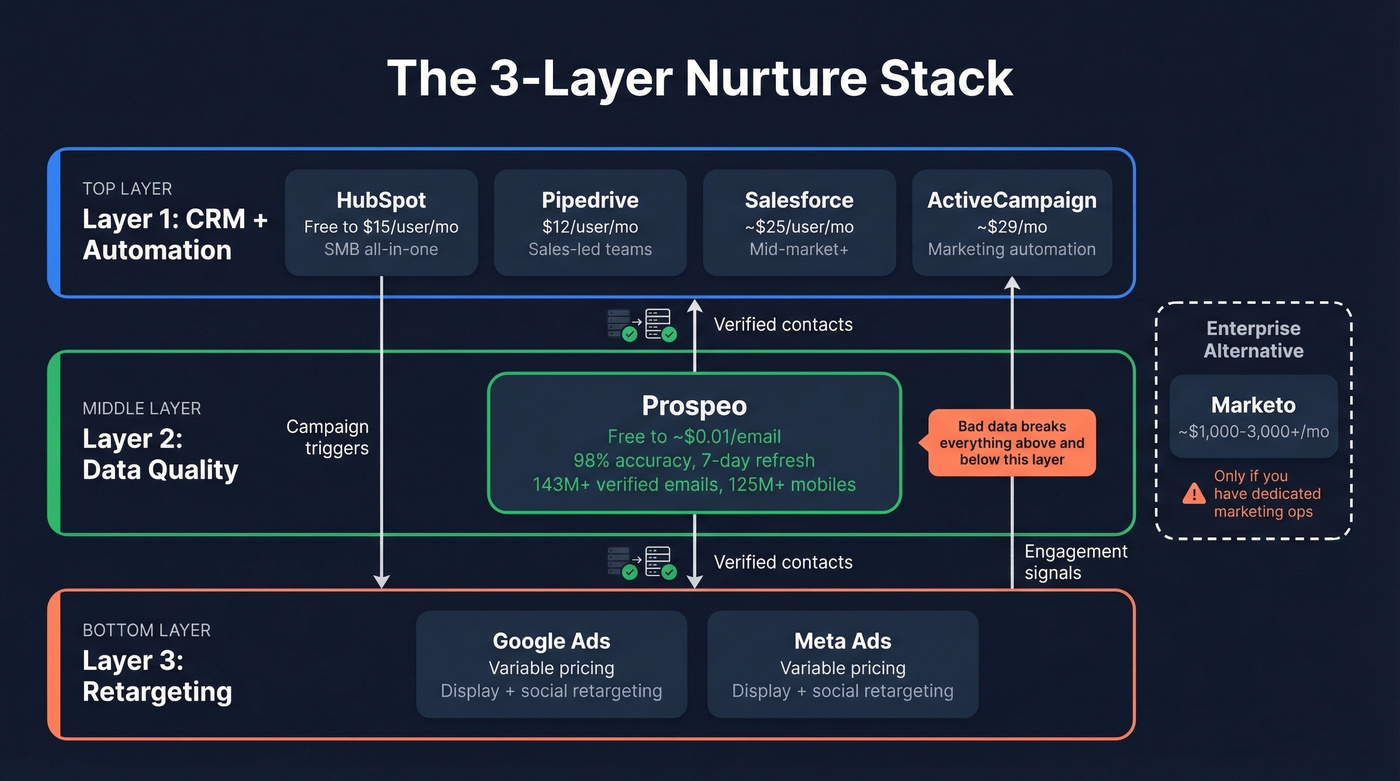
We've seen teams stitch together Zapier + Notion + five point solutions and spend more time maintaining the stack than running campaigns. On r/MarketingAutomation, this debate comes up constantly - all-in-one CRM vs. stitched-together stack. The answer depends on team size, but the principle holds: three layers, not eight tools.
| Layer | Tool | Starting Price | Best For |
|---|---|---|---|
| CRM + Automation | HubSpot | Free (up to 5 users); $15/user/mo | SMB all-in-one |
| CRM + Automation | Pipedrive | $12/user/mo | Sales-led teams |
| CRM + Automation | Salesforce | ~$25/user/mo | Mid-market+ |
| CRM + Automation | ActiveCampaign | ~$29/mo | Marketing automation |
| Data Quality | Prospeo | Free (75 emails/mo); ~$0.01/email | Verification + enrichment |
| Retargeting | Google/Meta Ads | Variable | Display + social |
| Enterprise | Marketo | ~$1,000-3,000+/mo | Enterprise nurture |
Skip Marketo unless you have a dedicated marketing ops person. It's powerful but complex, and we've watched lean teams burn months on implementation that a HubSpot + Prospeo combo would've handled in a week.
Multi-channel nurturing needs emails, phones, and social profiles that actually connect. Prospeo gives you 143M+ verified emails and 125M+ verified mobiles with 30% pickup rates - so your Day 25 warm call actually reaches someone, and your Day 1 email actually lands.
Every channel in your sequence deserves data that converts.
FAQ
How many channels should a B2B nurture program use?
Three to five integrated channels is the sweet spot. HubSpot's 2026 data shows 94% of marketers have diversified beyond two channels. Start with email plus retargeting plus one social channel, then add phone and direct mail as capacity allows.
How long should a lead nurture sequence run?
Thirty days for an initial sequence, then reassess. If a lead hasn't engaged after 30 days, move them to a low-frequency re-engagement track or exit them entirely. Keeping unresponsive leads in active nurture hurts deliverability and inflates costs.
What's the biggest reason multi-channel nurture programs fail?
Bad contact data. If 15%+ of your emails bounce, your sender reputation drops, your scoring model breaks, and every channel built on top of that data underperforms. Verify lists before sequences launch so your nurture reaches contacts that actually exist.
How does digital lead nurturing differ from traditional outbound?
Traditional outbound pushes the same message to a broad list regardless of interest signals. Digital lead nurturing uses behavioral data - page visits, content downloads, ad clicks - to trigger the right message on the right channel at the right time. The result is nurture that feels responsive rather than interruptive, which is why nurtured leads produce 20% more sales opportunities than non-nurtured contacts.