

How to Generate MQLs That Sales Won't Reject
Your VP set a target: 1,500 MQLs on a $150K budget. That's $100 per MQL - reasonable until you realize half will bounce, ghost, or get rejected before a single meeting is booked. The problem isn't your budget. It's that most teams trying to figure out how to generate MQLs optimize for volume when they should optimize for conversion.
The 3-Part Fix
Every MQL program that actually works has three things: a scoring model with real point values tied to sales capacity, a handoff SLA with response-time commitments and rejection codes, and verified contact data so reps aren't burning dials on dead numbers. Miss any one of those and you're just generating noise.
What Qualifies as an MQL
An MQL is a lead marketing has vetted as ready for sales outreach based on ICP fit and engagement signals. Not someone who downloaded a PDF - someone whose behavior and profile suggest they're worth a phone call.
An SAL means sales reviewed the MQL, confirmed it meets criteria, and committed to follow up. An SQL means sales engaged the prospect and confirmed real need, budget, authority, and intent.
Here's what conversion benchmarks look like stage by stage:
| Stage | Conversion Rate |
|---|---|
| Lead → MQL | 20-40% |
| MQL → SAL | 70-90% |
| SAL → SQL | 30-50% |
| SQL → Customer | 20-30% |
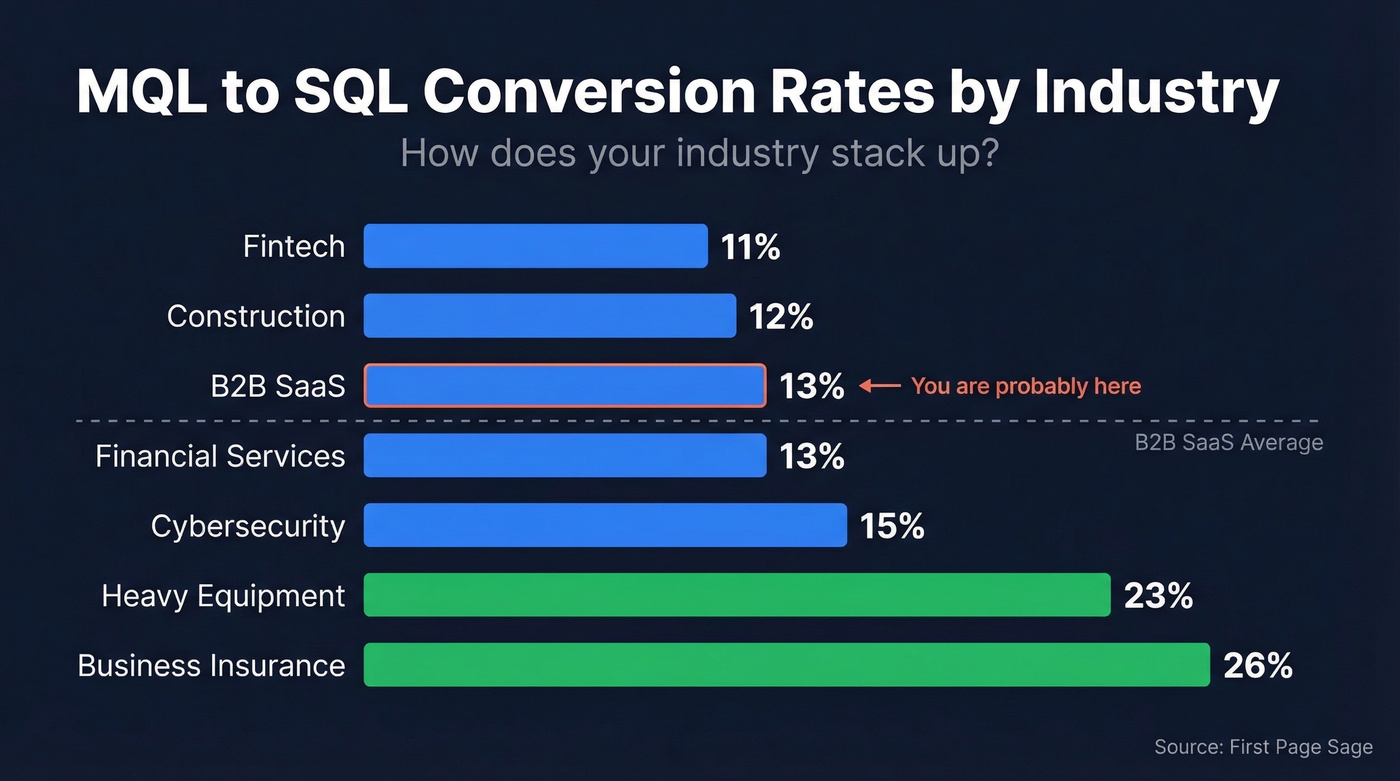
The lead-to-MQL conversion rate is your first filter - get it wrong and every downstream metric suffers. MQL-to-SQL rates vary wildly by industry, though. Here's what First Page Sage found analyzing client data:
| Industry | MQL → SQL |
|---|---|
| Fintech | 11% |
| Construction | 12% |
| B2B SaaS | 13% |
| Financial Services | 13% |
| Cybersecurity | 15% |
| Heavy Equipment | 23% |
| Business Insurance | 26% |
If you're in B2B SaaS and converting 13% of MQLs to SQLs, you're average. That's exactly why this article exists.
Is the MQL Dead?
Forrester's 2023 Global B2B Buyers' Journey Survey found that 93% of B2B buyers participate in buying groups of 2+ people, and 71% in groups of 4+. Inbound leads are 57-70% through the buying journey before they ever talk to sales. The linear waterfall doesn't reflect how people actually buy.
Here's the thing: MQLs aren't dead. They're misused. The fix isn't removing them from your dashboard - it's demoting them to an internal leading indicator. Nobody on the board cares about your MQL count. They care about pipeline and revenue.

Half your MQLs fail because the contact data is wrong - bounced emails tank your domain and kill downstream conversion. Prospeo's 300M+ profiles with 98% email accuracy and 7-day refresh cycle mean every MQL you hand to sales has a working inbox behind it. At $0.01 per verified email, it costs less than a single wasted rep dial.
Fix MQL quality at the source - start with data sales can actually use.
Five Tactics to Generate MQLs Worth Pursuing
B2B buyers average 36 interactions before purchase. A single tactic won't get you there. Here's how to get marketing qualified leads worth your sales team's time.
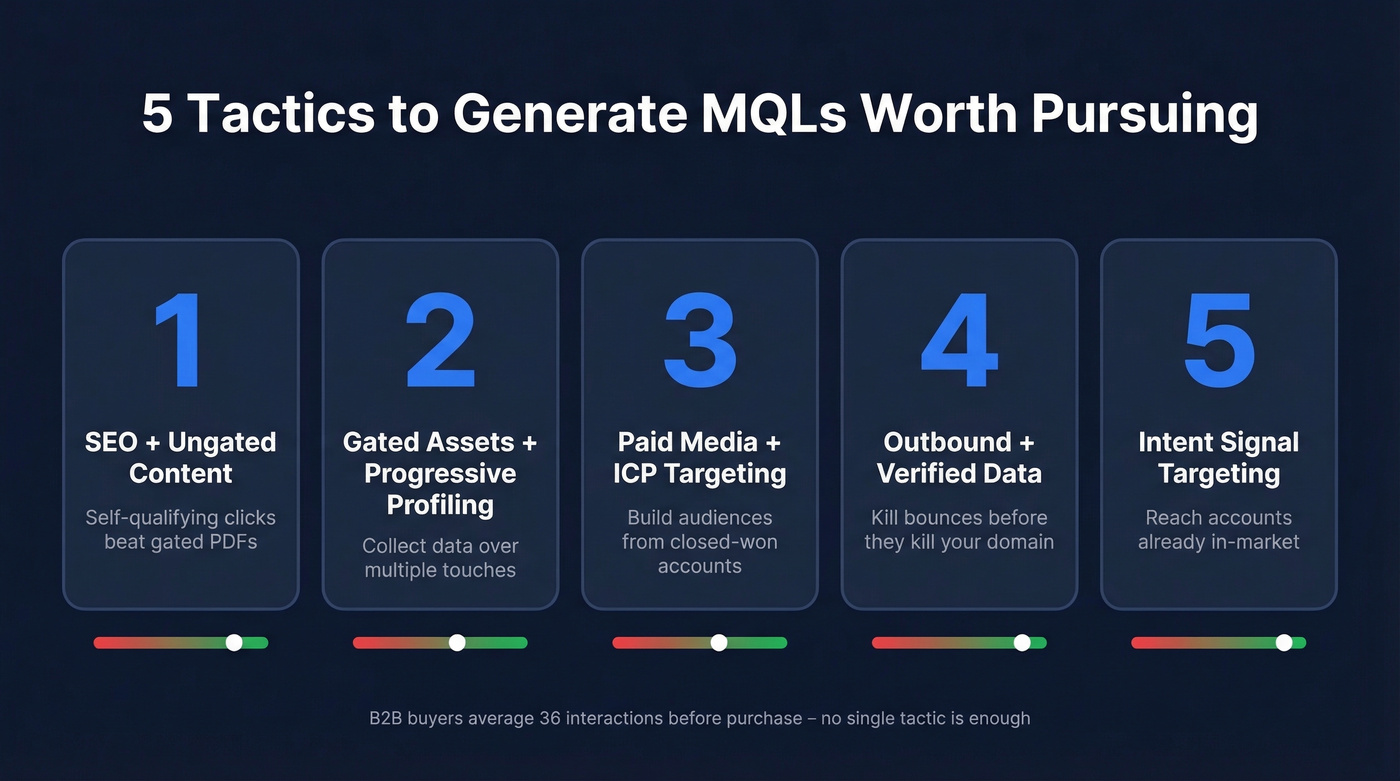
1. SEO + Ungated Content With In-Line CTAs
Stop gating everything. Publish your best content openly, then embed contextual CTAs - demo requests, ROI calculators - inside the content itself. The people who click those are self-qualifying. In our experience, they're worth 5x a gated PDF download because they've already consumed enough to know what they want.
2. Gated Assets With Progressive Profiling
Gating still works for high-value content like benchmarks and original research, but don't ask for 12 form fields on the first touch. Collect email and company on download one, job title and team size on download two. Each interaction adds lead scoring data without killing conversion rates. By the third touchpoint, you've got a rich profile without ever making the prospect feel interrogated.
3. Paid Media With ICP-Targeted Audiences
One thread on r/b2bmarketing captured this perfectly: a marketer described being handed a $150K budget for 1,500 MQLs selling $140K logistics equipment. The math only works if conversion rates hold - and they won't if you're targeting too broadly.
Build audiences from your CRM's closed-won accounts, layer firmographic filters, and run conversion campaigns. If your paid MQLs aren't converting, the targeting is wrong before the ad copy is.
4. Outbound With Verified Contact Data
This is where most teams leak pipeline. You build a prospect list, load it into your Sequence Management, and 30% of emails bounce on the first send. Your domain reputation tanks, and suddenly even good leads aren't seeing your messages.
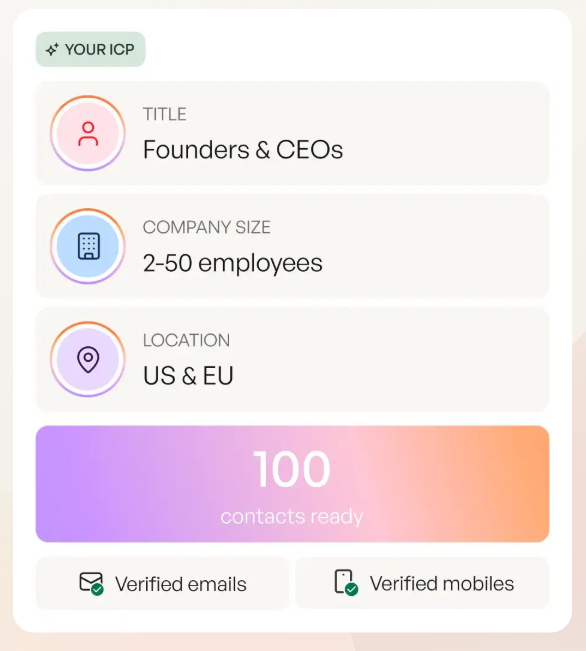
We've watched this play out dozens of times. Prospeo catches the problem at the source - 300M+ professional profiles with 98% verified email accuracy and 30+ ICP filters including buyer intent and technographics, all on a 7-day refresh cycle. At roughly $0.01 per verified email, it's a fraction of what enterprise intent platforms like 6sense charge ($60K-$300K/year).
5. Intent-Signal-Based Targeting
Tools like Bombora and 6sense track which accounts are actively researching topics related to your product. Layer intent signals on top of your ICP criteria and you're reaching companies already in-market. The catch: enterprise intent platforms are expensive. For teams that can't justify $60K+/year, intent data layered into your existing prospecting workflow gets you 80% of the value.
Build a Scoring Model for MQL Generation
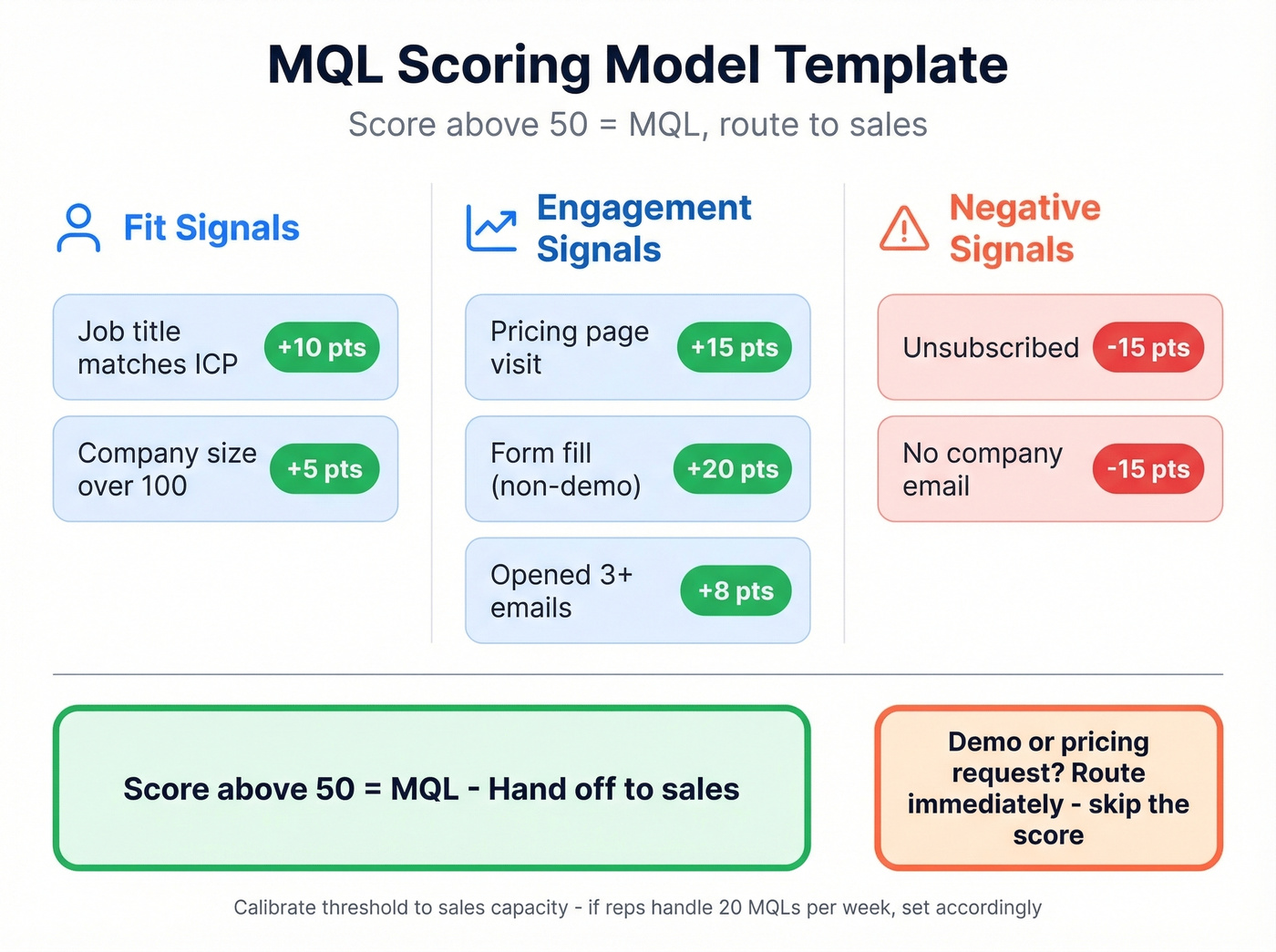
A scoring model without concrete point values is a wish list. Here's a working template for any MAP:
| Signal | Points | Type |
|---|---|---|
| Job title matches ICP | +10 | Fit |
| Company size >100 | +5 | Fit |
| Pricing page visit | +15 | Engagement |
| Form fill (non-demo) | +20 | Engagement |
| Demo request | Route immediately | - |
| Opened 3+ emails | +8 | Engagement |
| Unsubscribed | -15 | Negative |
| No company email | -15 | Negative |
Threshold: score >50 = MQL. That's the trigger for sales handoff.
Two design principles matter here.
Separate Fit from Engagement. HubSpot introduced its new lead scoring feature in early 2025, and legacy score properties stopped updating Aug 31, 2025. If you're still on the old model, your scores are stale. Rebuild with the Fit/Engagement framework now - HubSpot Professional runs $890/month for 3 seats and includes the new scoring natively.
Calibrate your threshold to sales capacity. If reps can handle 20 new MQLs per week, set the threshold so roughly 20 leads per rep cross it. A threshold that floods sales with 80 leads per week is worse than no threshold at all. We've seen teams cut their MQL volume by 60% and double their SQL output just by raising the bar.
If someone requests a demo, pricing, or a trial, route them to sales immediately regardless of score. Don't let a formula block a buyer raising their hand.
The Handoff SLA That Prevents Waste
Without a written SLA, MQLs die in the gap between marketing and sales. Even the best lead generation strategy falls apart if the handoff is broken.
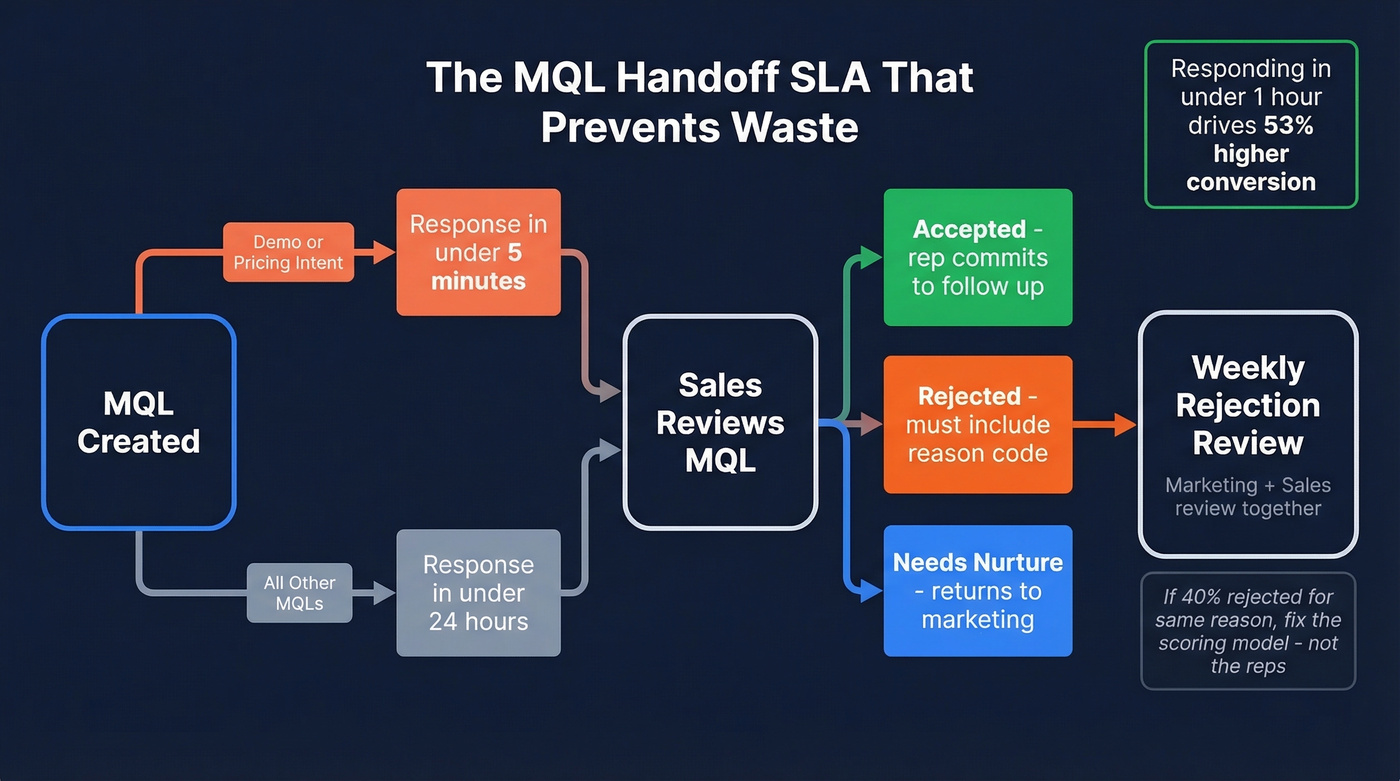
Response time: Under 5 minutes for demo/pricing intent. Under 24 hours for all other MQLs. Follow-up within the first hour drives up to 53% higher conversion versus waiting even a few hours.
Required disposition codes: Accepted, Rejected with reason, Needs Nurture. No limbo. Every MQL gets a status within the SLA window or it escalates.
Weekly rejection review: Marketing and sales review rejected MQLs together. If 40% are rejected for the same reason, that's a scoring model problem - not a sales laziness problem.
Five Mistakes That Kill MQL Programs
Unclear ICP. If your ICP is "companies with 50+ employees in North America," you don't have an ICP. You have a continent. Define the accounts where you've actually won before.
If you need a starting point, use an Ideal Customer Profile Template to document fit criteria and exclusions.
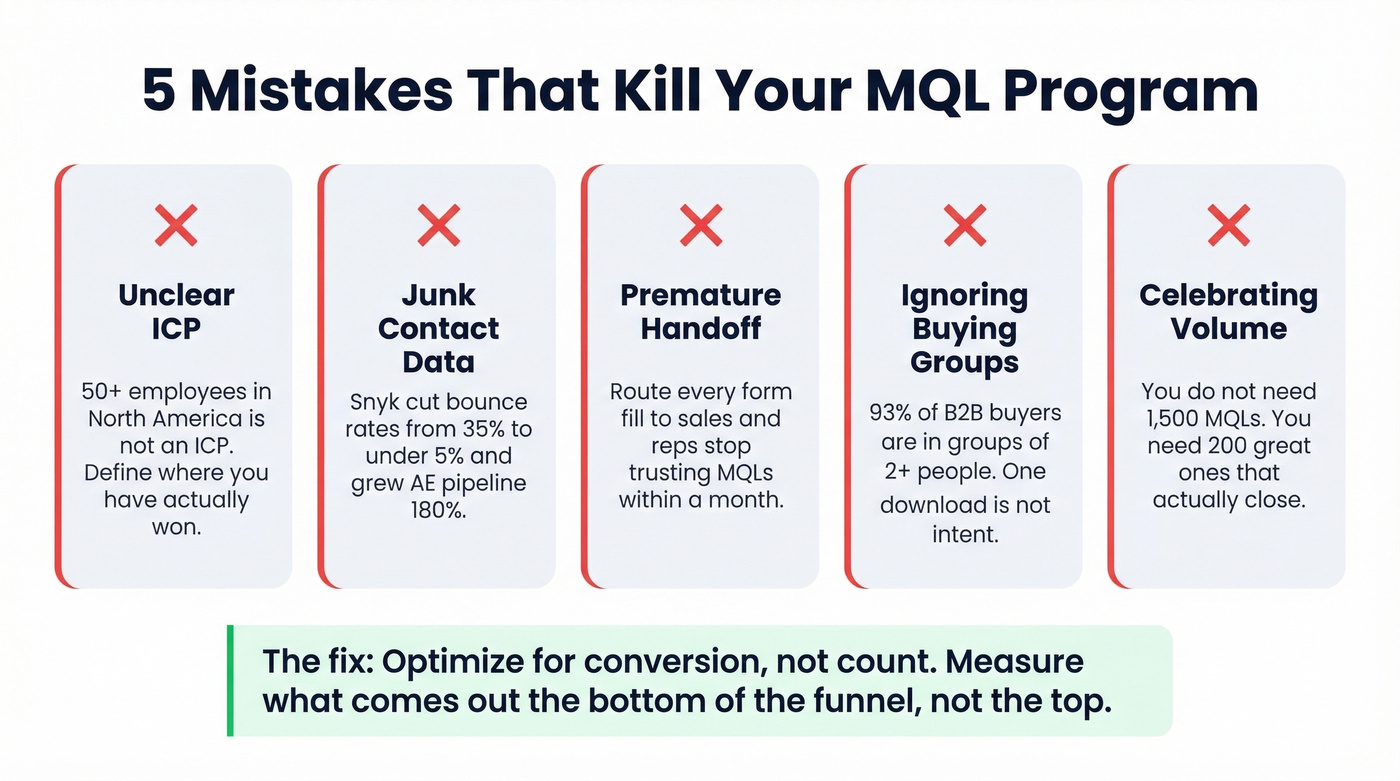
Junk contact data. A lead that scores as an MQL but has a dead email wastes rep time and erodes trust between sales and marketing. Snyk's 50-person AE team dropped their bounce rate from 35-40% to under 5% using real-time email verification, and AE-sourced pipeline grew 180%. We've seen this pattern at a dozen companies: teams invest in scoring and content, then feed the whole system with unverified data.
If you're seeing bounces, start by tracking your email bounce rate and fixing deliverability upstream.
Premature handoff. If marketing routes every form fill to sales, reps stop trusting MQLs within a month. The scoring model exists for a reason - use it.
Ignoring buying groups. One person downloading an eBook isn't business intent. Track account-level engagement - multiple stakeholders from the same company engaging within 30 days is a far stronger signal than any single contact's score.
Celebrating volume over conversion. Let's be honest: if your average deal size is under $15K, you probably don't need 1,500 MQLs. You need 200 great ones. At a 13% MQL-to-SQL rate and 25% close rate, 1,500 MQLs produce roughly 49 customers. The math only works if the MQLs are real. Stop optimizing for the top of the funnel and start measuring what comes out the bottom.
If you want a cleaner view of what’s working, align your reporting to funnel metrics instead of vanity counts.
Your scoring model is only as good as the data feeding it. Layer Prospeo's 30+ ICP filters - buyer intent, technographics, headcount growth, funding - directly into your MQL generation workflow. Teams using Prospeo book 26% more meetings than ZoomInfo users because every lead matches fit AND has verified contact info.
Generate fewer MQLs. Convert more of them. That's the entire playbook.
FAQ
What's a good MQL-to-SQL conversion rate?
B2B SaaS averages 13%, cybersecurity hits 15%, and heavy equipment reaches 23%. If you're below your industry benchmark, tighten your scoring model and verify contact data before generating more volume.
How many touchpoints before an MQL converts?
B2B buyers average 36 interactions before purchase. Plan for 6-8 touchpoints minimum - email sequences, retargeting, content offers, and outbound calls - not a single form fill and a prayer.
How do I generate more MQLs without sacrificing quality?
Separate Fit from Engagement in your scoring model and add negative scoring for poor-fit signals like personal emails. Then verify contact data before it enters your CRM - bad data inflates counts with leads that never convert. A 7-day data refresh cycle keeps junk out at the source, so volume gains translate to real pipeline instead of vanity metrics.