

How to Actually Get Customers for Your IT Business
The average IT services company pays $454 to acquire a single customer - $325 through organic channels, $840 through paid. B2B acquisition costs broadly have climbed 40-60% since 2023. If you're running a 10-seat shop trying to figure out how to get customers for an IT business without bleeding cash, that math demands a sharper approach than "try everything and hope."
Most IT business owners spread effort across six channels and get traction on none. The playbook that works in 2026 is narrower than you'd expect, and it starts with a decision most people avoid.
The Short Version
If we had to start an IT services company from scratch tomorrow:
- Pick a vertical. Healthcare, financial services, legal - something with compliance pressure and recurring pain. This alone changes your close rate.
- Launch cold email with verified data. Fastest path to pipeline that doesn't depend on inbound traffic or brand awareness.
- Activate 3-5 referral partners. CPAs, business consultants, commercial real estate brokers - people who already talk to your buyers.
Everything else - SEO, content marketing, paid ads - comes after you have revenue. Expect a 3-6 month sales cycle from first touch to signed contract. That's normal for IT services, not a sign something's broken.
Pick a Vertical First
The single highest-leverage decision isn't which channel to use. It's which industry to serve. Vertical-focused IT businesses see 2-3x higher win rates, 30-50% premium pricing, and 40-60% shorter sales cycles.
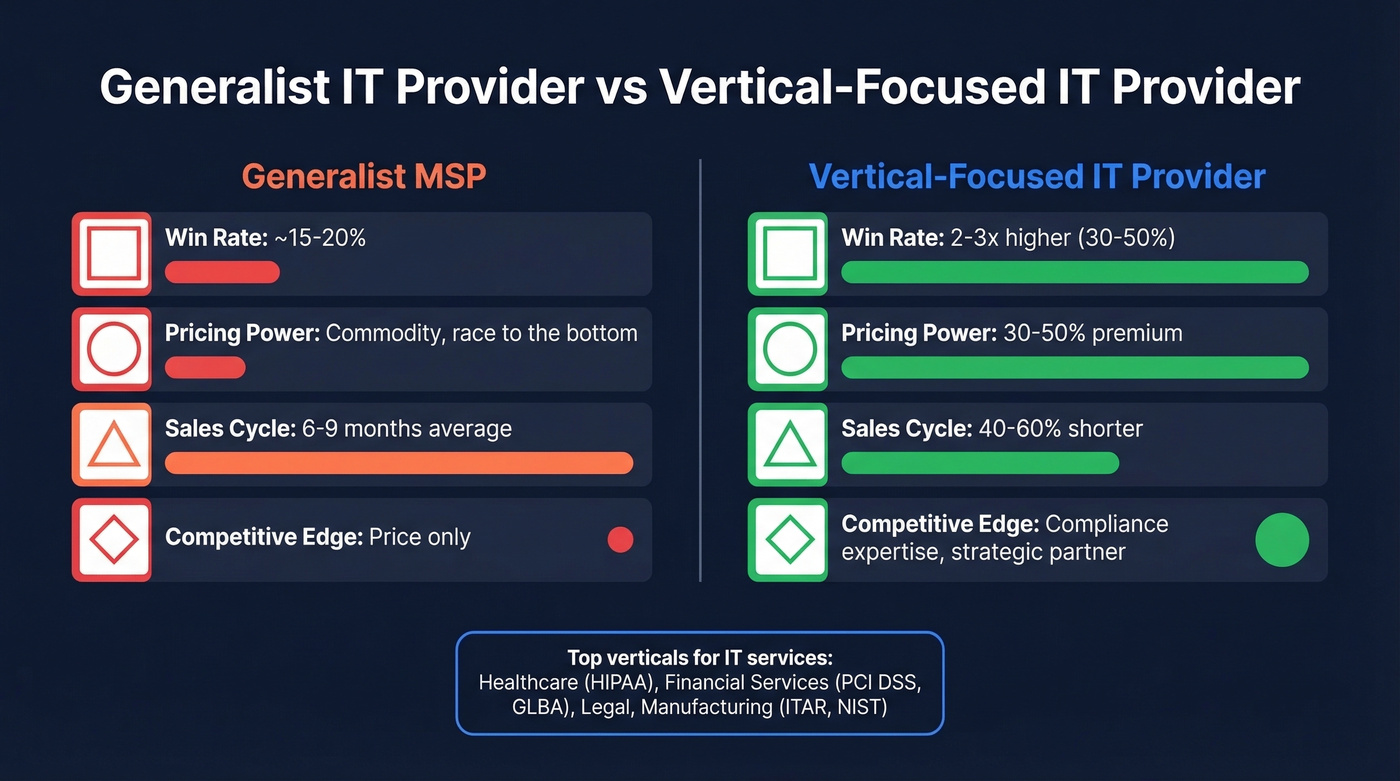
A generalist MSP competes on price. A healthcare IT provider who understands HIPAA, ePHI handling, and medical software integrations competes on expertise - and that's a completely different conversation with a prospect. Financial services firms need someone who speaks PCI DSS and GLBA fluently. Manufacturing companies care about ITAR and NIST compliance. When you know the compliance frameworks cold, you stop being a vendor and start being a strategic partner.
The anchor client strategy works well here. Find one client in your target vertical - treat them as a design partner, not just a customer. Over-deliver, learn their workflows inside out, and build your first case study from the engagement. We've seen IT firms ride a single anchor client into a full book of business within 18 months. If you already have break-fix clients, converting 20-30% to managed services contracts is often faster than acquiring net-new prospects.
Here's the thing: if your average contract value is under $5K/year, you probably can't afford to stay a generalist. Specialization isn't optional at that margin - it's survival.
Channel Comparison for IT Lead Generation
Not every channel deserves your time right now:
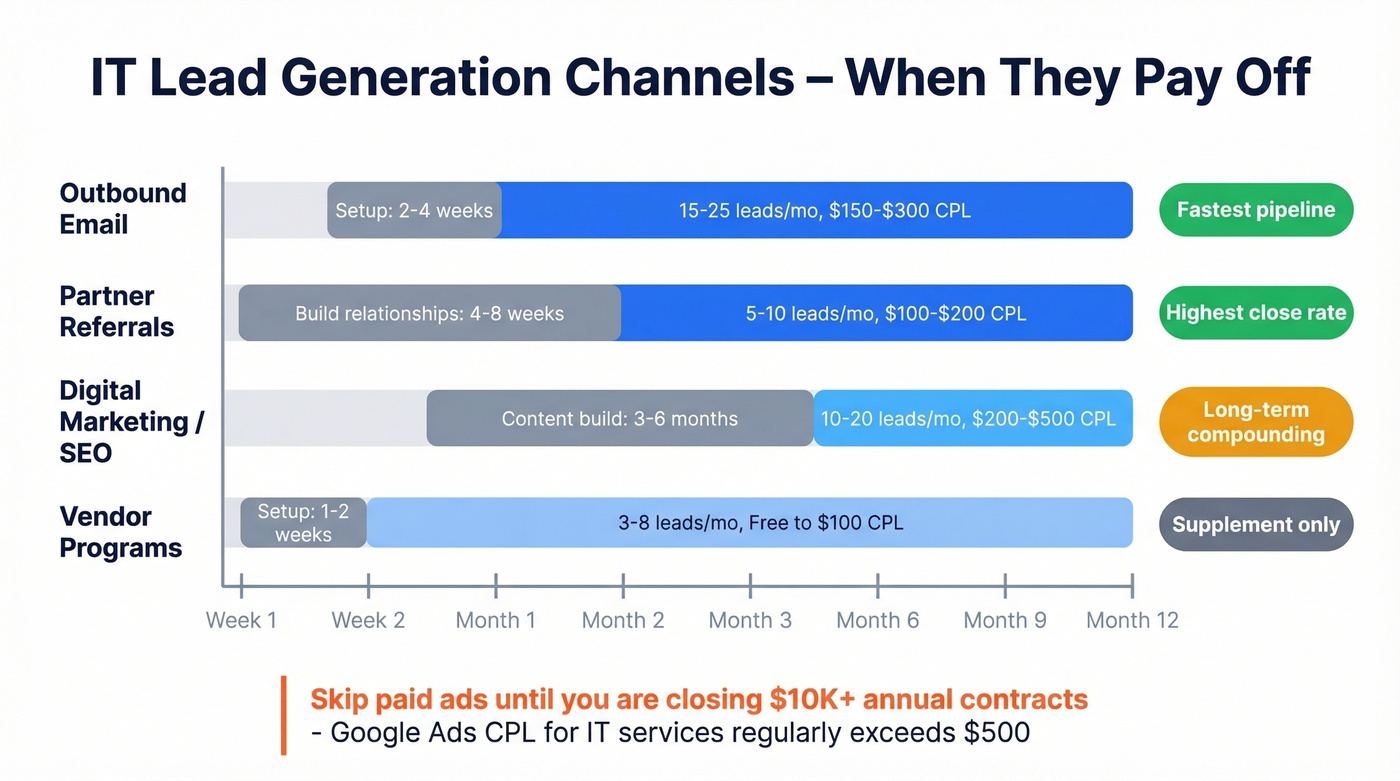
| Channel | Setup Time | Leads/Mo | CPL | Best For |
|---|---|---|---|---|
| Outbound email | 2-4 weeks | 15-25 | $150-$300 | Fastest pipeline |
| Partner referrals | 4-8 weeks | 5-10 | $100-$200 | Highest close rate |
| Digital marketing | 3-6 months | 10-20 | $200-$500 | Long-term compounding |
| Vendor programs | 1-2 weeks | 3-8 | Free-$100 | Low-effort supplement |
Outbound and partner referrals are the only channels that produce meaningful pipeline within 90 days. Digital marketing is a 3-6 month build at minimum. Vendor programs through Microsoft Partner Network, Ingram Micro, or TD SYNNEX are supplements, not primary engines.
Skip paid ads entirely until you're closing $10K+ annual contracts. The CPL for IT services on Google Ads regularly exceeds $500, and the conversion rates don't justify it at lower deal sizes.

Your cold email campaign dies at a 15% bounce rate. Prospeo's 98% email accuracy and 7-day data refresh keep your secondary domains clean and your pipeline moving. Target IT buyers by vertical, headcount, and tech stack with 30+ filters - exactly how vertical-focused MSPs build prospect lists that convert.
Stop torching domains with stale data. Start sending emails that land.
Cold Email Infrastructure
Cold email is still the primary growth channel for IT services in 2026, but the infrastructure requirements have gotten steeper. Reply rates are about half of what they were at the start of 2025 as inbox placement gets harder, which means infrastructure and data quality matter more than clever copy.
If you need a tighter system for outreach, start with these sales prospecting techniques and a simple B2B cold email sequence you can run consistently.
An IT staff augmentation owner on Reddit shared exact numbers: 100 mailboxes, 10,000 leads per month, 30,000 emails per month at three emails per lead, 1-2% reply rate, roughly one closed deal per quarter at five-figure profit. That's reaching EUR 280K ARR after almost five years. Not glamorous, but real.
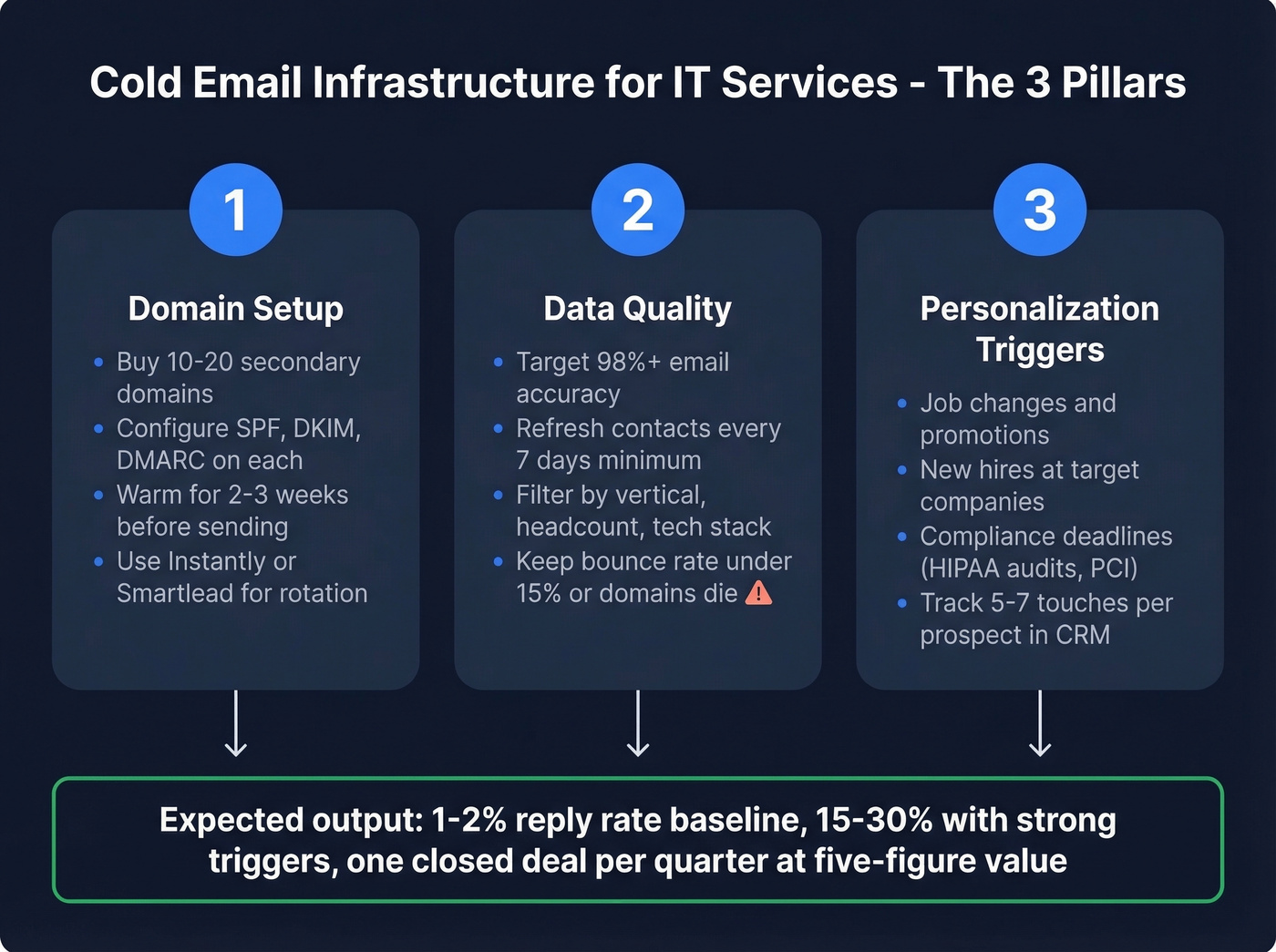
Before you send a single email, you need three things locked down:
Domain setup. Buy 10-20 secondary domains. Configure SPF, DKIM, and DMARC on every one. Warm each domain for 2-3 weeks before sending at volume. Tools like Instantly or Smartlead handle mailbox rotation and warmup. If you want to go deeper on the technical side, use these SPF Record Examples and this guide to DMARC Alignment.
Data quality. This is where most IT outbound campaigns die. A 15% bounce rate doesn't just waste sends - it torches your domain reputation and tanks deliverability for months. We've tested several data providers for this exact use case, and Prospeo's 98% email accuracy and 7-day refresh cycle keep you off stale contacts. The 30+ search filters let you target IT buyers by industry, headcount, and tech stack, so if you've picked healthcare as your vertical, you can pull a list of 50-200 seat medical practices in your metro in minutes. If you're troubleshooting deliverability, start with Email Bounce Rate benchmarks and fixes.

Personalization triggers. Basic name/company tokens don't cut it anymore. The triggers that get replies: job changes, promotions, new hires, and compliance deadlines like HIPAA audits or PCI assessments. Practitioners who nail these triggers report reply rates of 15-30%, compared to the 1-2% baseline for generic outreach. Track every touchpoint in a CRM - even a spreadsheet works - because the 5-7 touches needed to book a meeting are easy to lose track of manually. For a repeatable process, borrow these cold email follow-up templates and a few sales follow-up templates for later-stage nudges.
One contrarian insight from that same Reddit thread worth highlighting: posting content on social platforms produces "literally zero leads." Pipeline comes from direct messages after connecting. Don't confuse visibility with demand generation.
Partner and Referral Programs
Referral partners are the highest-quality lead source for IT services, and they're wildly underused. Your target list: CPAs and bookkeepers, business consultants, commercial real estate brokers, and HR consultancies. These people already sit in meetings with your ideal buyers and hear "we need better IT support" regularly.
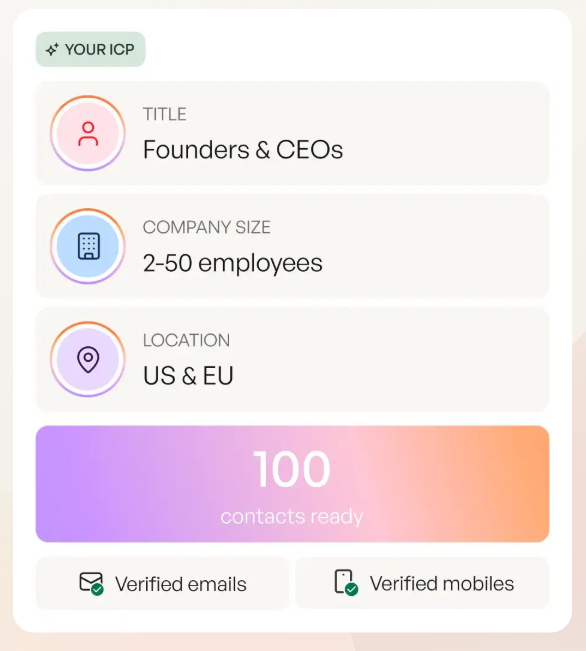
If you want to formalize who you’re targeting (and make partner intros convert faster), build a simple Ideal Customer Profile before you start outreach.
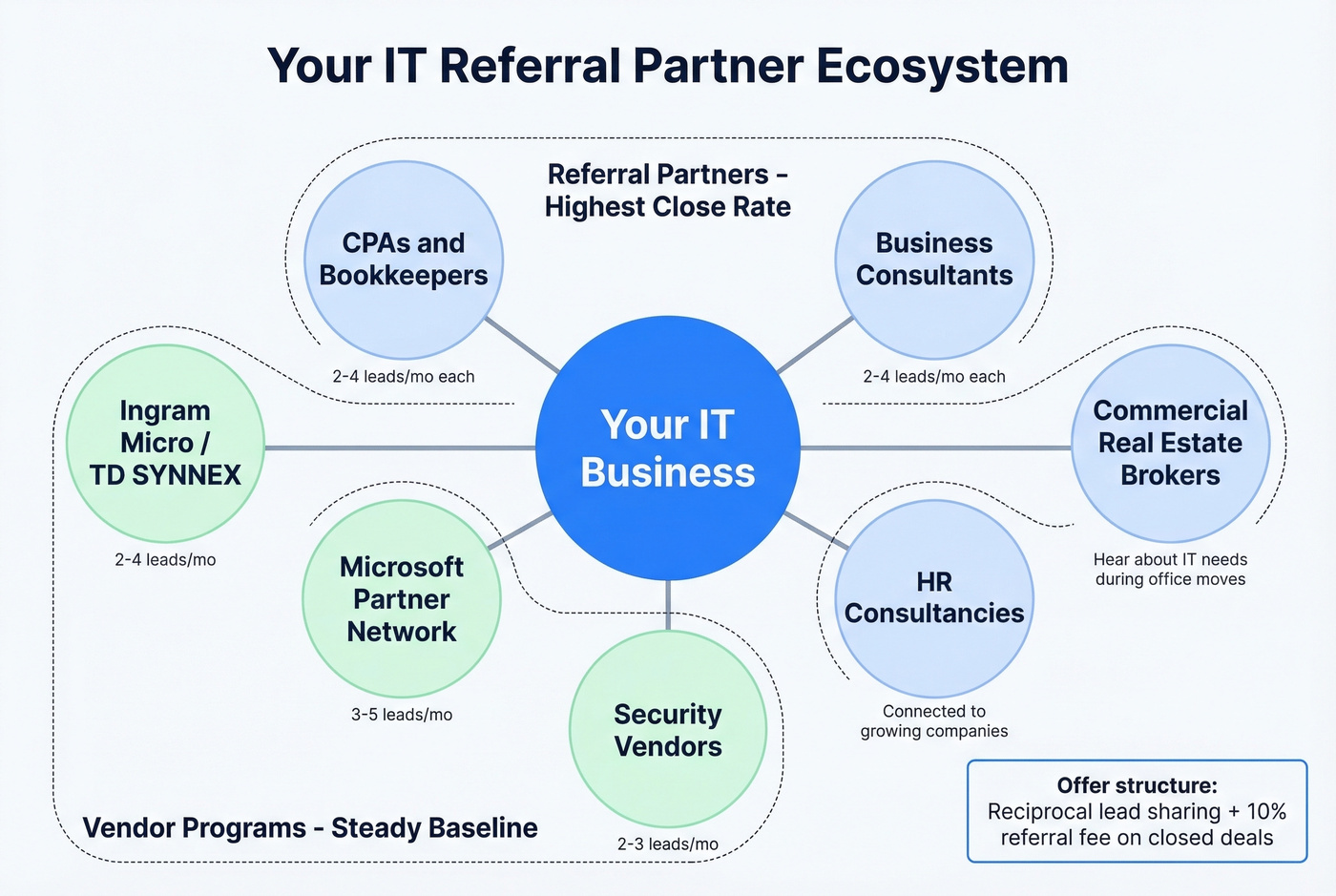
The offer structure that works is simple. Reciprocal lead sharing plus a 10% referral fee on closed deals. One active partner typically produces 2-4 qualified leads per month, and these leads close at significantly higher rates than cold outbound because they come with built-in trust. Industry associations like CompTIA chapters or local tech meetups can also produce warm introductions, though the volume is lower.
Vendor programs add steady baseline volume. Microsoft Partner Network can feed you 3-5 leads per month. Distributors like Ingram Micro and TD SYNNEX contribute 2-4. Security vendors add another 2-3. None of these move the needle alone, but stacked together they create a reliable floor beneath your outbound efforts.
Local SEO for IT Services
Your Google Business Profile is the highest-ROI local asset you own. For "IT support [city]" searches, GBP listings dominate the results - and most IT companies barely maintain theirs.
Post weekly updates to your GBP. Case studies, service announcements, local event mentions. Upload photos and short videos of your team or project work. Google rewards active profiles with better placement.
Chase detailed reviews, not star ratings. A review that says "they migrated our entire office to Microsoft 365 in two days with zero downtime" is worth more than a generic five-star rating. Prompt clients with specific questions to get that kind of detail.
Build hyperlocal pages. If you serve three metros, create a dedicated page for each one with unique content about that market. These rank for long-tail local queries that generalist pages miss entirely.
Site speed under 2 seconds. Faster sites rank higher and convert better in local results. If your site takes four seconds to load on mobile, you're losing prospects before they even see your services page.
Local SEO is a 6-12 month play, but once it compounds, the leads are essentially free. If you want a clearer view of what “compounding” looks like in practice, map it to a simple lead generation workflow.
Realistic Timelines
Let's be honest about what "working" looks like:
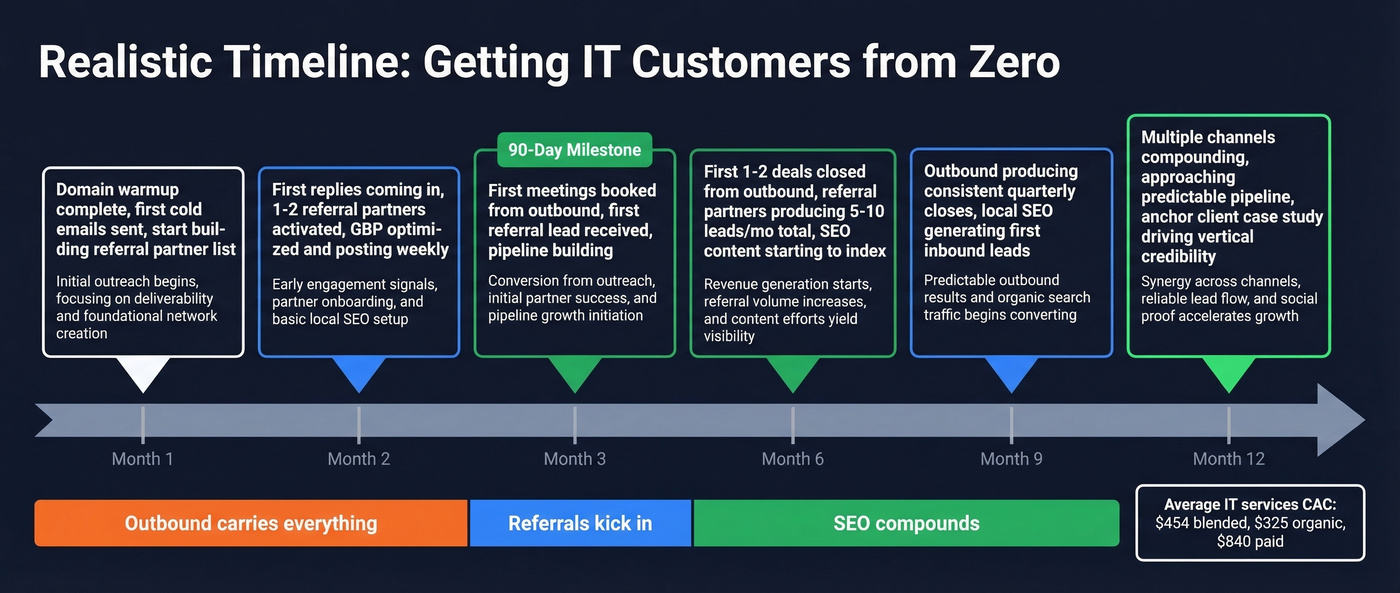
The IT services sales cycle runs 3-6 months from first touch to signed contract. One closed deal per quarter from outbound is normal, not failure - especially when those deals are five-figure annual contracts. SEO takes 6-12 months to produce consistent inbound leads. One Reddit practitioner published 100 articles in two months and got a single solid lead from it. Outbound email and partner referrals are the only realistic 90-day options for new pipeline.
Building an IT services business to EUR 280K ARR took one practitioner almost five years. The compounding is real, but it's slow. Set your expectations accordingly, and don't abandon a channel after 60 days because it hasn't produced a whale.
At $454 per customer acquired, every wasted email costs you real money. Prospeo gives you verified contacts at ~$0.01 per email - 90% cheaper than legacy providers - so a 10-seat IT shop can run enterprise-grade outbound without the enterprise budget. Filter by healthcare, financial services, or any vertical you've chosen.
Get enterprise data at startup pricing. No contracts, no sales calls.
FAQ
How long until cold email lands my first IT client?
Expect 3-6 months from first outreach to signed contract. At scale, one closed deal per quarter is realistic for five-figure annual contracts. Most prospects need 5-7 touches before booking a meeting, so consistent follow-up matters more than volume.
What does it cost to acquire an IT services customer?
The blended average CAC for IT and managed services is $454 - $325 organic, $840 paid. Referrals and outbound with verified data are the lowest-cost channels at $100-$300 per lead.
Should I niche down or serve all industries?
Niche. Vertical-focused IT businesses see 2-3x higher win rates and 30-50% premium pricing. Pick an industry with compliance pressure - healthcare, finance, or legal - and build deep expertise before expanding to adjacent verticals.