

How to Get Leads Online: The Data-Backed Playbook for 2026
85% of B2B marketers say lead generation is their number-one challenge - and yet most advice on the topic reads like it was written in 2019 and repackaged with a new date. Here's the thing: if you're figuring out how to get leads online without burning through budget, the real problem isn't a shortage of tactics. It's that nobody tells you which ones actually produce pipeline at a cost that makes sense.
Let's fix that with actual numbers, actual playbooks, and a tool stack that doesn't require a $40k annual contract.
Why Most Lead Gen Advice Falls Flat
97% of buyers research vendors online before engaging, but only 9% trust what they read on vendor websites. Your prospects are doing homework - they just don't believe your marketing site. Every lead gen strategy needs to account for skepticism, not just visibility.
Most guides hand you a list of 32 tactics and wish you luck. That's not a strategy. It's a menu at a restaurant with no prices. You don't need 32 tactics. You need to know what channels return real money, what they cost, and how to execute three of them well - with clean data feeding the whole machine.
What You Need (Quick Version)
Your timeline determines your playbook:
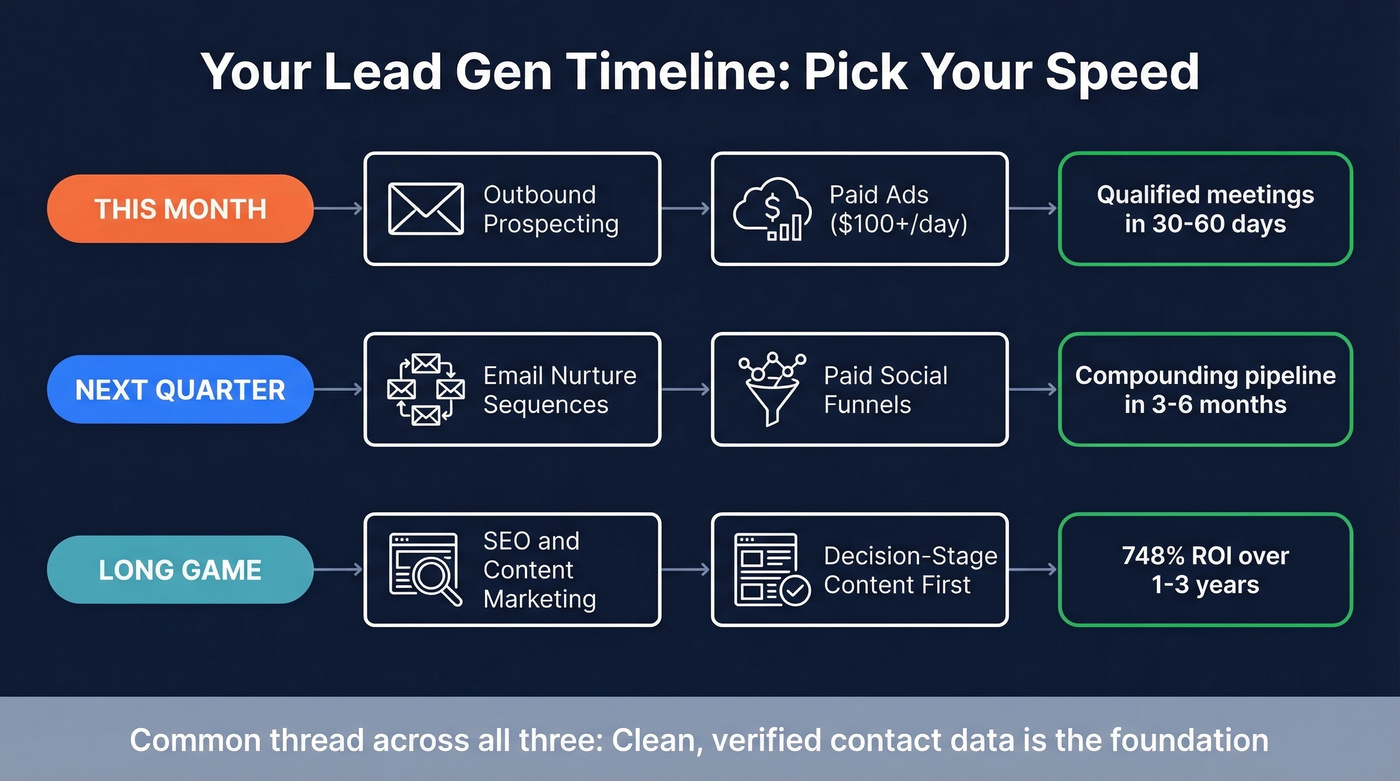
- Need leads this month? Outbound prospecting with verified contact data, plus paid ads at a minimum $100/day budget. Expect qualified meetings within 30-60 days.
- Building for next quarter? Email marketing combined with paid social funnels. This is where nurture sequences and retargeting start compounding.
- Playing the long game? SEO and content marketing, built bottom-up from decision-stage content to awareness pieces.
The common thread across all three: data quality. Bad emails, wrong numbers, and stale contacts will sabotage every channel. Get the data right first, then pick your path.
Real Costs of Online Lead Generation
Let's ground this in real numbers. The average B2B cost per lead is $84 across channels, but that average hides massive variation.
| Channel | Avg CPL | Notes |
|---|---|---|
| Google Ads | $70.11 | Intent-driven, higher quality |
| LinkedIn Ads | $110+ | 57% pricier than Google |
| Facebook Ads | $40-80 | Better for B2C, varies wildly |
| SEO (organic) | $0 marginal | High upfront investment |
| Email outbound | $10-30 | Depends on data + tooling |
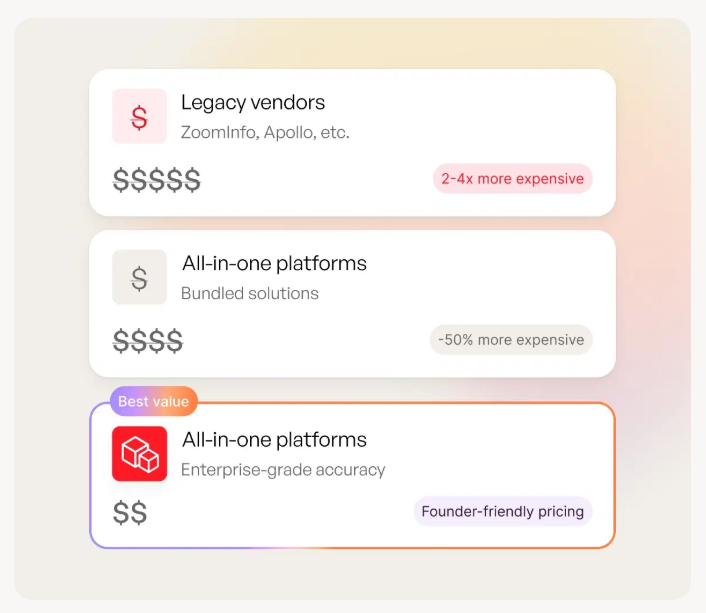
CPL only tells half the story. Customer acquisition cost varies dramatically by industry, per HubSpot's benchmarks:
| Industry | Avg CAC |
|---|---|
| B2B SaaS | $239 |
| Ecommerce | $86 |
| Financial Services | $784 |
| Legal Services | $749 |
The rule of thumb: your LTV-to-CAC ratio should be at least 3:1. If you're spending $784 to acquire a financial services client worth $2,000, that math doesn't work. If that client's worth $10,000, you're in great shape.
For conversion expectations, Ruler Analytics found an average qualified lead conversion rate of 2.9% across 100M+ data points - 1.7% from forms, 1.2% from calls. Plan your funnel math accordingly.
Which Channels to Prioritize
Channel selection comes down to two variables: how fast you need results and how much you can spend monthly. Here's the ROI data from FirstPageSage across a 2.7-year average campaign length across a 2.7-year average campaign length:
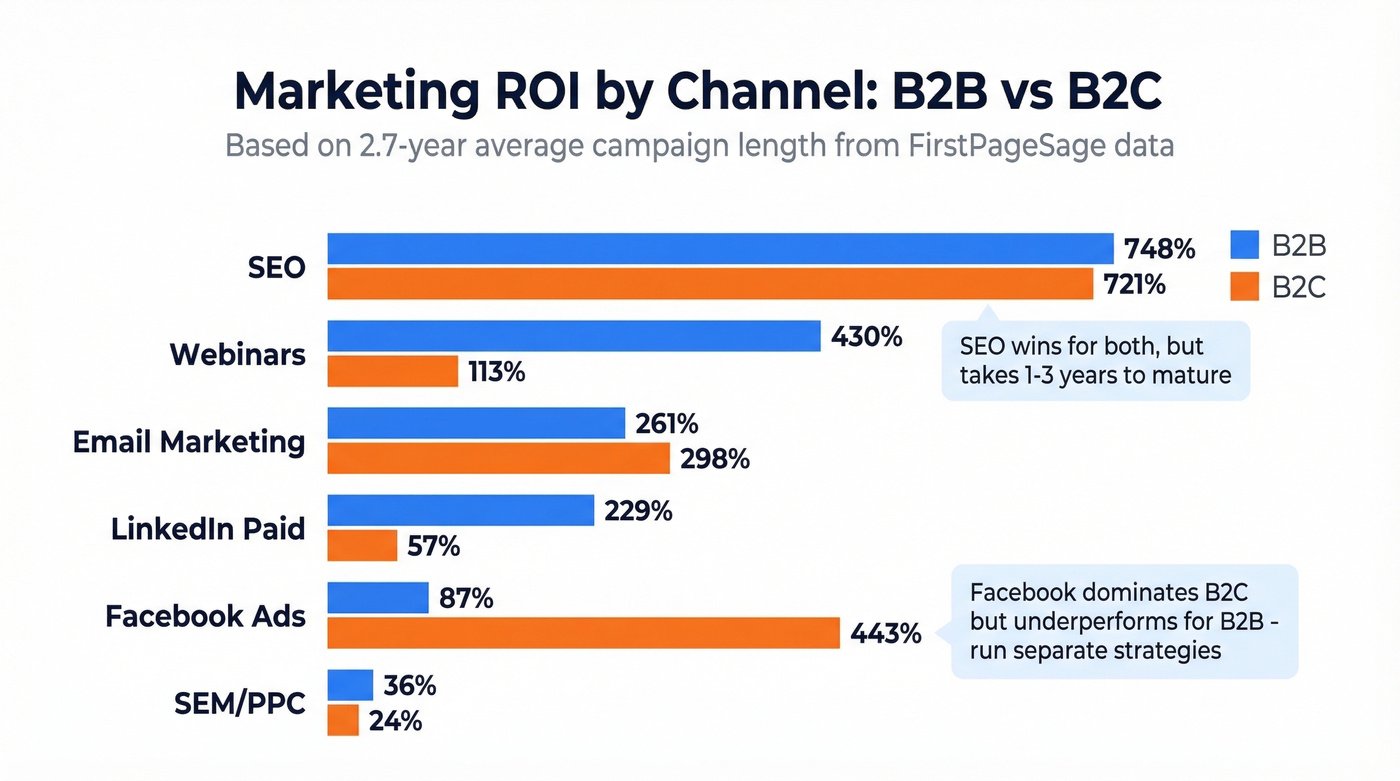
| Channel | B2B ROI | B2C ROI | Monthly Cost | Time to Return |
|---|---|---|---|---|
| SEO | 748% | 721% | $2k-$15k | 1-3 years |
| Email Marketing | 261% | 298% | $500-$5k | 3-6 months |
| LinkedIn Paid | 229% | 57% | $5k-$20k | 3-9 months |
| Webinars | 430% | 113% | $1k-$5k | 3-6 months |
| SEM/PPC | 36% | 24% | $3k-$30k | 2-5 weeks |
| Facebook Ads | 87% | 443% | $1k-$10k | 1-3 months |
The B2C column tells a completely different story than B2B. Facebook Ads are mediocre for B2B but dominant for B2C. LinkedIn is the opposite. If you're running both motions, you need separate channel strategies - not a blended approach.
The pattern on the B2B side is clear: SEO and email marketing deliver the highest long-term ROI, but PPC gets you leads fastest. Most teams need a blend - outbound and paid for immediate pipeline, inbound and content for compounding returns. Inbound takes 6-18 months to mature. Outbound can produce qualified meetings in 30-60 days.
If your average deal size is under $5k, skip LinkedIn Ads entirely. The $110+ CPL will eat your margins alive. Put that budget into outbound email at $10-30 per lead and pocket the difference.
Inbound Strategies That Generate Leads
SEO and Generative Engine Optimization
Prospects don't just search Google anymore - they search ChatGPT, Perplexity, and Gemini. SEO now includes GEO, which means your content needs to be structured so AI models can cite it. Clear answers to specific questions, structured data, and authoritative sourcing are table stakes. The 748% ROI from SEO only materializes if you're creating content that ranks in both traditional search and AI-generated answers.
GEO is the channel most teams are ignoring right now. As more buyers use AI assistants to research vendors, showing up in generative search results becomes as important as ranking on page one. Structure your content with direct, quotable answers to specific questions - that's what AI models pull from. This is one of the most effective ways to find leads online without paying for every click.
Content Marketing: Build Bottom-Up
Most content strategies overproduce awareness-stage blog posts. The funnel feels full, but pipeline doesn't move.
The fix is building your editorial calendar bottom-up. Start with decision-stage content - comparison pages, ROI calculators, case studies - then create awareness content that feeds into those assets. Enterprise deals now involve 10-11 stakeholders on average, so your content needs to address multiple personas, not just the primary contact. The CFO cares about ROI. The end user cares about workflow. The IT lead cares about integrations. One blog post can't serve all three.
Map every piece to a persona, a funnel stage, and a next step. A blog post without a clear path to a case study or demo is just traffic that never converts.
Email Marketing and Newsletters
Email marketing's 261% ROI makes it the most efficient owned channel for B2B. The key is segmentation and consistency. A monthly newsletter to your full list is fine for awareness, but the real pipeline comes from triggered sequences - someone downloads a guide, they get a 5-email nurture series tailored to their industry and pain point. Someone visits your pricing page twice, they get direct outreach from an AE. The trigger matters more than the template.
Social Proof, Reviews, and Live Chat
87% of B2B buyers check online reviews before purchasing, and 67% of customers prefer self-service over speaking to a representative. If you aren't actively managing your G2, Capterra, and Google Business profiles, you're leaking leads at the decision stage.
42% of customers prefer live chat for initial questions. Adding a chat widget to high-intent pages like pricing and demo request can capture leads that would otherwise bounce. Don't put it on every page - that's annoying. Put it where buying intent is highest.

The article shows email outbound costs $10-30 per lead - the lowest CPL of any channel. That math only works with clean data. Prospeo delivers 98% email accuracy at $0.01 per lead, with a 7-day refresh cycle so you're never emailing stale contacts.
Stop guessing which emails are real. Start with 75 free verified contacts.
Outbound Prospecting Playbook
Defining a Tight ICP
Generic lists produce generic results. A tight ICP definition goes beyond "VP of Marketing at SaaS companies." You need four layers: firmographics like industry, headcount, and revenue; technographics covering their current tool stack; behavioral signals such as hiring patterns, leadership changes, and content engagement; and pain indicators including competitor switches, layoffs, and negative reviews.
Start small. Filter down to roughly 1,000 contacts that match your ICP perfectly before scaling. We've seen teams blast 10,000 generic contacts and get worse results than teams who carefully targeted 500.
Build Your Multi-Touch Sequence
Single-channel outreach is dead. Here's the cadence we've tested that consistently outperforms single-channel alternatives:
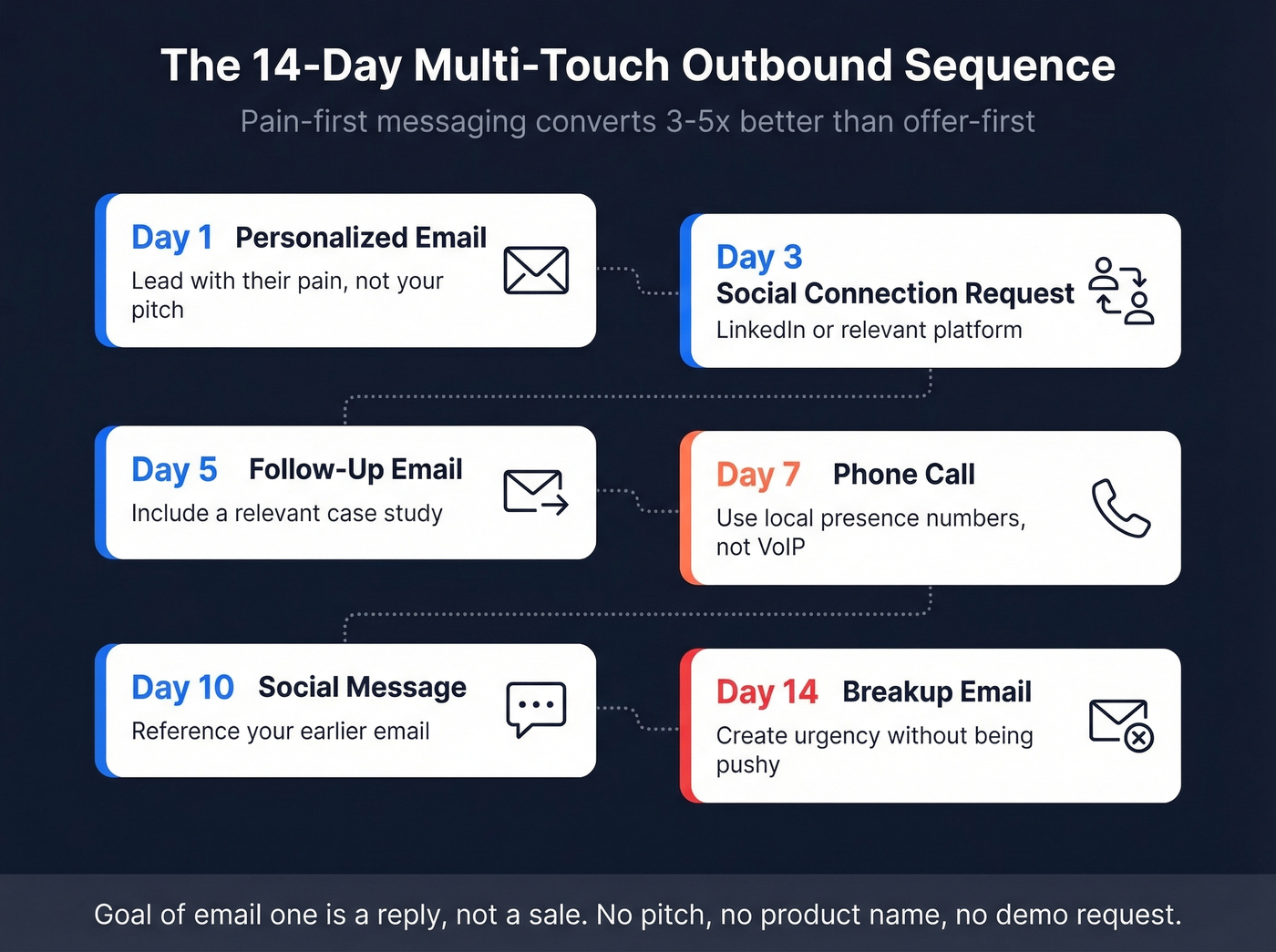
- Day 1: Personalized email (pain-first, not pitch-first)
- Day 3: Connection request on social
- Day 5: Follow-up email with a relevant case study
- Day 7: Phone call
- Day 10: Social message referencing the email
- Day 14: Breakup email
Pain-first messaging converts at 3-5x the rate of offer-first messaging. Lead with the problem you solve, not the product you sell. Here's what a pain-first opener looks like:
"[Name], I noticed [Company] is hiring 3 SDRs this quarter. Most teams scaling outbound that fast run into deliverability problems within 60 days - bounce rates spike, reply rates crater. Is that something you're thinking about?"
No pitch, no product name, no "I'd love to show you a demo." The goal of email one is a reply, not a sale.
Verify Data Before You Send
This is where most outbound programs silently die. You export 5,000 contacts from a database, launch your sequence, and within a week your bounce rate hits 35%. Your domain reputation tanks. Emails start landing in spam. Now you've got a deliverability problem that takes weeks to fix.
Apollo's contact data is populated by other users, which means accuracy varies wildly. The practitioner guidance is to verify exported data with at least two tools before sending a single email. Prospeo's email finder catches this problem before it starts - 98% email accuracy with a 5-step verification process that includes catch-all handling, spam-trap removal, and honeypot filtering.
If you want a deeper breakdown of what to monitor and fix, use an email deliverability checklist before scaling volume.
Deliverability: What Kills Campaigns
Three things destroy cold email campaigns:
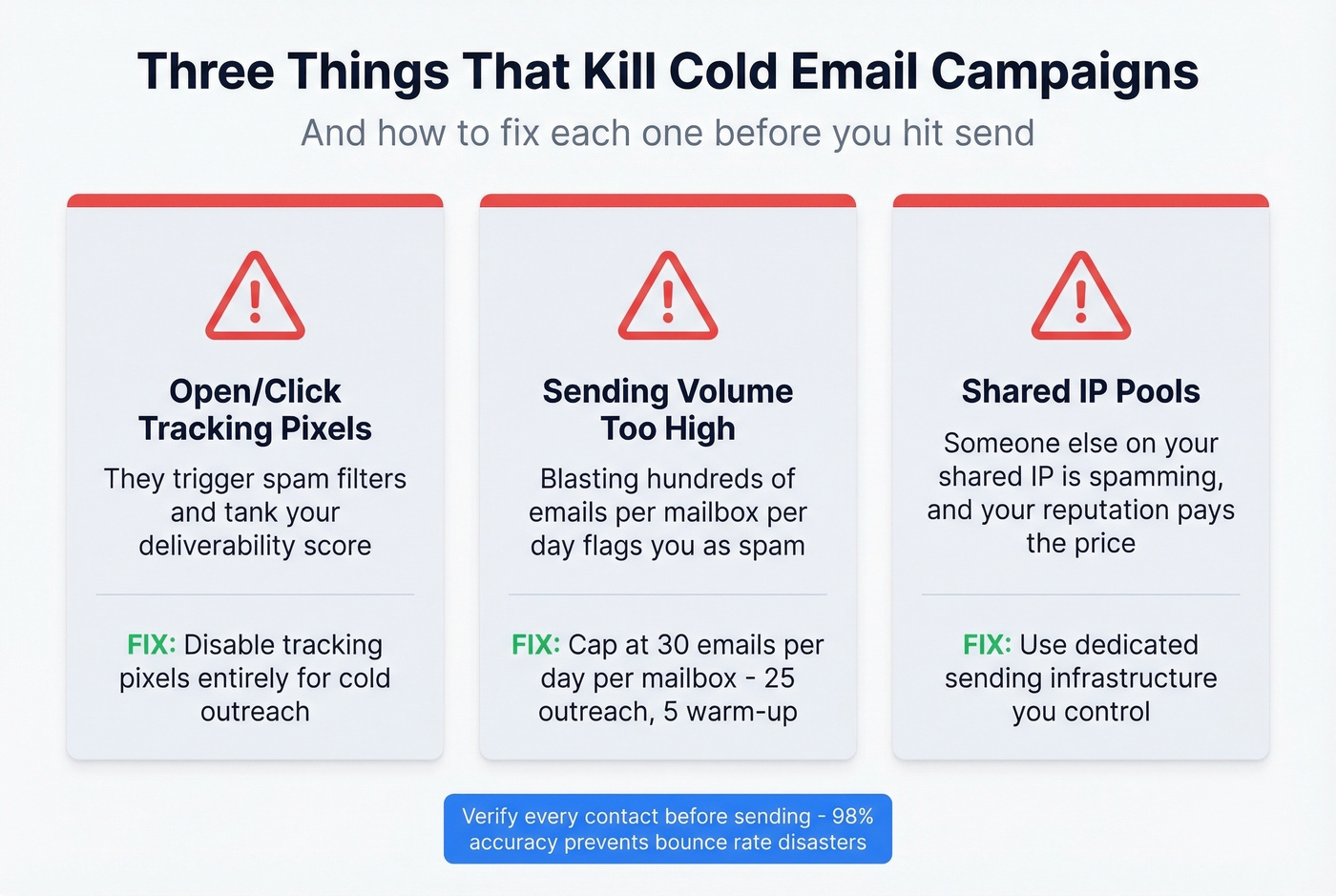
- Open/click tracking pixels - they trigger spam filters. (More detail: email tracking pixels.)
- Sending volume that's too high. Cap at 30 emails per day per mailbox, with 25 outreach and 5 warm-up. (See email velocity.)
- Shared IP pools. If you're on shared sending infrastructure, your reputation is tied to everyone else on that IP.
Phone outreach has its own pitfalls. Apollo's calling feature uses Twilio VoIP numbers that get flagged as spam by carrier-level filters. If phone is a key part of your sequence, invest in a dedicated dialer with local presence numbers - it makes a measurable difference in connect rates.
Control your sending infrastructure or accept that someone else's spam is dragging your deliverability down.
Bad data doesn't just waste budget - it tanks your domain reputation and kills every channel downstream. Prospeo's 5-step verification, spam-trap removal, and 143M+ verified emails mean your outbound actually lands in inboxes, not bounce folders.
Teams using Prospeo book 35% more meetings than Apollo users. See why.
Paid Lead Generation
PPC is the fastest path to leads, but the ROI ceiling is lower than organic channels. Google Ads averages $70.11 per lead; LinkedIn runs $110+. The math works when your deal sizes justify the spend.
One example we keep coming back to: a bathroom remodeling company with a $15k average ticket spent $4,500 on Facebook ads in month one and generated $62k in revenue. The setup was simple - one campaign, two static image creatives, one ad copy variation, $100/day budget. The landing page was a 3,000-4,000 word sales letter, not a short-form squeeze page, with an opt-in near the bottom.
The real differentiator wasn't the ad creative. It was the follow-up. They called every lead within 10 minutes. Reminders went out at 2 days, 1 day, 4 hours, and 1 hour before any scheduled appointment. That operational discipline - not the ad spend - drove the conversion rate. They scaled from $150/day to $400/day once the unit economics proved out. As practitioners on r/DigitalMarketing consistently point out, the ad is the easy part; speed-to-lead and follow-up cadence determine whether paid traffic becomes revenue.
For B2B, the same principle applies. In our experience, teams that respond to inbound leads within 5 minutes close at 3x the rate of teams that wait an hour. Paid ads buy you attention. What you do in the next 300 seconds determines whether that attention becomes pipeline.
If you need plug-and-play messaging, keep sales follow-up templates handy for fast response.
AI and Automation in Lead Gen
Speed-to-lead isn't a nice-to-have. It's a revenue multiplier.
Companies that respond within one hour are 7x more likely to qualify a lead. Wait 24+ hours and the likelihood drops by 98%. AI makes this operationally possible by automating routing, scoring, and initial outreach.
AI lead scoring reduces qualification time by up to 30%. That means your reps spend less time sorting and more time selling. But the bigger shift is signal-based outreach: instead of blasting a static list, you're triggering sequences when a decision-maker visits your site, evaluates a competitor, changes jobs, or shows buying intent on specific topics. Signal-based tools now track thousands of intent topics, so you can trigger outreach when a prospect starts researching your category - not after they've already shortlisted your competitor. (See lead scoring and identifying buying signals.)
Why Most Lead Gen Programs Fail
The channels aren't usually the problem. The breakdown happens after you capture the lead.
Misaligned handoffs. Marketing and sales don't share a definition of "qualified." Leads get tossed over the wall with no context, and sales ignores them.
Low-quality placements. Cheap lead sources inflate volume metrics but collapse downstream. You look busy but nothing closes.
Fragmented attribution. Your CRM, marketing automation, and intent tools don't talk to each other. Nobody knows which channel actually drove the deal.
Slow activation. Manual lead routing means your competitor engages the prospect before your rep even sees the notification. We can't stress this enough - treat speed-to-lead as a revenue KPI. Measure it. Report on it. The teams that respond fastest win disproportionately, and it isn't even close.
No real nurture. Generic drip sequences don't count. If your follow-up isn't tailored to the prospect's behavior and intent signals, it's just noise. Remember - enterprise deals involve 10-11 stakeholders. A single drip sequence aimed at one persona won't move a buying committee.
Recommended Tool Stack
You don't need a $50k/year tech stack to generate leads online. Here's what actually works:
| Category | Tool | Price | Why It's Here |
|---|---|---|---|
| Data & Prospecting | Prospeo | Free tier; ~$0.01/email | 98% accuracy, 7-day refresh |
| Data & Prospecting | Apollo.io | From ~$49/user/mo | Huge database, good for lists |
| Data & Prospecting | ZoomInfo | $15k-$40k/yr | Enterprise standard |
| Outreach | Instantly | From ~$30/mo | Affordable cold email at scale |
| Outreach | Lemlist | From ~$59/mo | Strong personalization features |
| CRM | HubSpot | Free CRM tier | Best free CRM for startups |
| Enrichment | Clay | From ~$149/mo | Powerful waterfall enrichment |
| Automation | Zapier | From $19.99/mo | Connects everything |
Apollo.io has one of the largest B2B databases and works well for initial list building. The interface is intuitive and the free tier is generous. The trade-off is data accuracy - since the database is community-populated, you'll want to verify exports through a dedicated verification tool before sending. Think of Apollo as your starting point, not your source of truth.
ZoomInfo is the enterprise standard for a reason: deep data, strong intent signals, and integrations with every major CRM and sales engagement platform. The catch is price. At $15k-$40k per year with annual contracts, it's built for teams with budget to match. If your average contract value is under $20k and your team is under 10 reps, skip it - you'll get better ROI elsewhere.

When Meritt switched to Prospeo, their pipeline tripled from $100K to $300K per week and their bounce rate dropped from 35% to under 4%. That's not a marginal improvement - it's the difference between a working outbound program and a broken one.
The budget stack: Prospeo's free tier + Instantly at ~$30/mo + HubSpot CRM's free plan = a complete online lead generation system for under $50/month. That's enough to run outbound sequences with verified data and track your pipeline. Scale up from there as revenue justifies it.
If you want more options, compare free lead generation tools and outbound lead generation tools.
FAQ
How much does it cost to get leads online?
The average B2B cost per lead is $84 across paid channels, with Google Ads at $70.11 and LinkedIn at $110+. Organic channels like SEO cost more upfront but deliver 748% ROI over multi-year campaigns. Outbound email runs $10-30 per lead with verified data and proper tooling.
What's the fastest way to find leads online?
Outbound prospecting with verified contact data produces qualified meetings in 30-60 days, while paid ads can generate inbound leads within 2-5 weeks. Combine both for the fastest ramp - paid for volume, outbound for precision targeting of your ideal accounts.
How do I generate leads online for free?
Use tools with generous free tiers: Prospeo offers 75 verified emails per month at no cost, HubSpot's CRM is free, and organic social prospecting costs nothing. Pair these with SEO-driven blog posts and community engagement for a viable pipeline without paid ads.
How do I improve lead quality?
Define your ICP beyond firmographics to include technographics and behavioral signals like hiring patterns and competitor switches. Verify all contact data before outreach - bounce rates above 5% damage domain reputation. Implement lead scoring based on engagement behavior, not just job title.
What's a good conversion rate for online leads?
The average qualified lead conversion rate across industries is 2.9%, based on 100M+ data points - 1.7% from forms and 1.2% from phone calls. B2B SaaS teams typically see higher form conversion rates, while service businesses convert more through calls.