

How to Identify Quality Leads (With a 100-Point Scoring Model You Can Steal)
Your SDR manager just told you half the meetings booked last month were no-shows or bad fits. The pipeline looks full, but nothing's closing. You don't have a pipeline problem - you have a lead quality problem, and knowing how to identify quality leads starts with a scoring model that reflects buying behavior, not just firmographics.
What You Need (Quick Version)
- Build a 100-point scoring model based on timing, pain, and accessibility.
- Pick one qualification framework - BANT, CHAMP, or MEDDIC - and commit.
- Verify your contact data before outreach. A lead scoring 90 with a dead email is worth zero.
Why Lead Quality Beats Volume
Companies that focus on lead quality report up to a 40% closing ratio versus 11% with unqualified leads. That's not a marginal improvement. It's a fundamentally different business. Meanwhile, 67% of sales opportunities are lost due to poorly qualified leads.
We've watched teams spend entire quarters building top-of-funnel volume when the real problem was that their scoring criteria let garbage through. Spotting high-quality leads early in the funnel changes everything downstream: shorter sales cycles, better forecasting, happier reps. What follows is the scoring model we keep coming back to - with real point values, negative scoring, and benchmarks so you know what good looks like.
Characteristics of High-Quality Leads
Companies with a well-defined ICP see 68% higher win rates and 45% larger deal sizes. Before you score anything, make sure your leads check these five boxes:
- ICP fit - Industry, headcount, revenue, and tech stack match your best customers.
- Expressed interest - They've engaged with your content, visited your site, or responded to outreach.
- Confirmed need - A real pain point exists, not a hypothetical one.
- Near-term timeline - They're buying this quarter, not "exploring for next year."
- Budget and authority - Qualified decision-makers are involved, and money's allocated.
These traits apply whether you're selling $5K tools or six-figure enterprise contracts. The weight you assign each one shifts, but the traits themselves stay constant.
The 100-Point Scoring Model
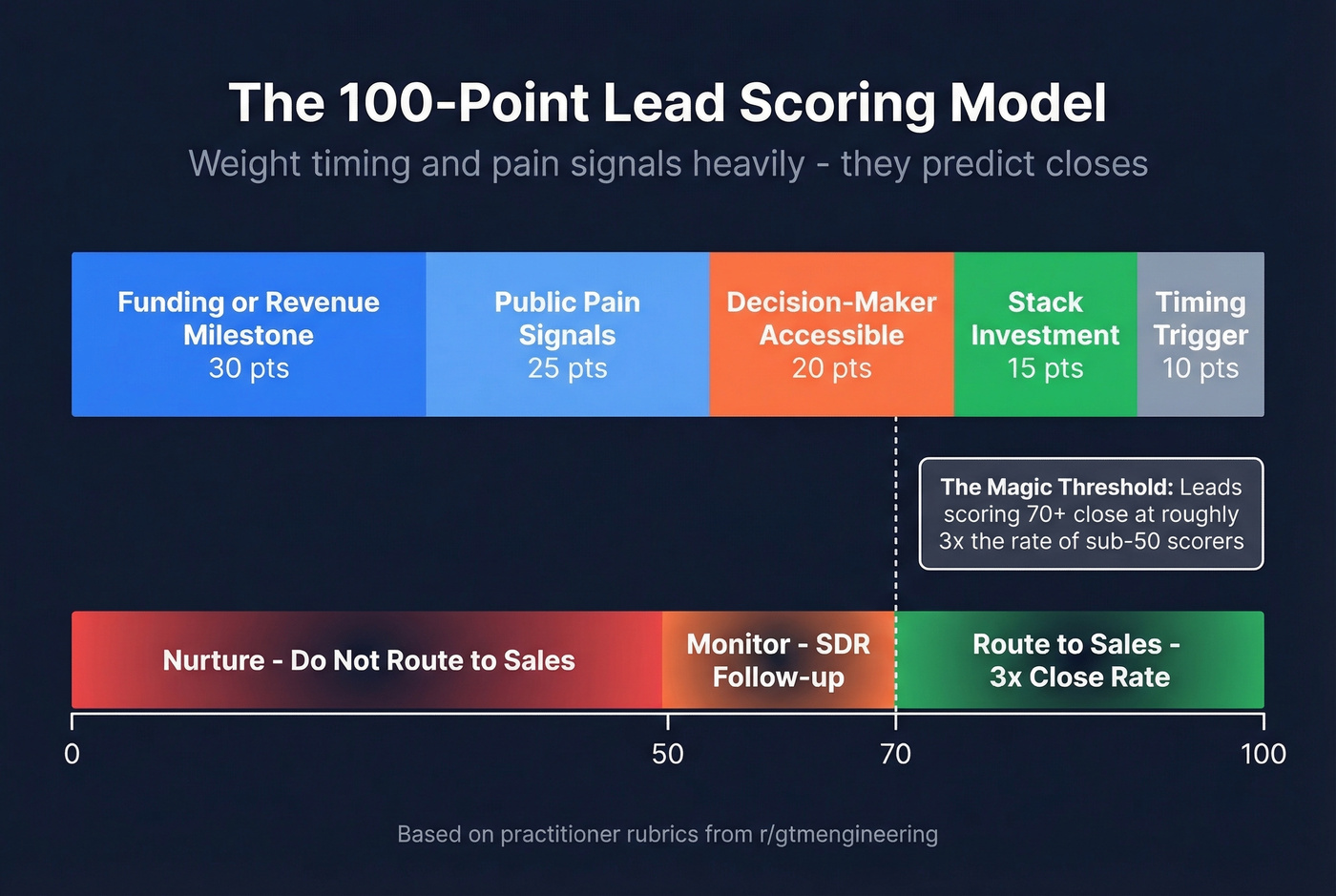
Most scoring models over-index on firmographics. A company can match your ICP perfectly and have zero intent to buy. This model, based on a practitioner rubric shared on r/gtmengineering, weights timing and pain signals heavily because those predict closes.
If you want a deeper breakdown of scoring mechanics, start with our lead scoring guide.
Fit + Intent Layer
| Signal | Points | Why It Matters |
|---|---|---|
| Funding or revenue milestone | 30 | Money's moving; budgets open |
| Public pain signals | 25 | Founder posting about scaling challenges? Gold. |
| Decision-maker accessible | 20 | Can you reach the VP in 2 touches? |
| Stack investment | 15 | Already paying for similar tools |
| Timing trigger | 10 | New VP hire, planning cycle, product launch |
In our experience, leads scoring 70+ close at roughly 3x the rate of sub-50 scorers. That's the threshold where you route to sales and stop wasting SDR time on maybes.
Behavioral Engagement Signals
Layer engagement scoring on top. These are HubSpot-style examples:
- Viewed pricing page: +15
- Filled out contact form: +20
- Clicked email link: +10
- Opened 3+ marketing emails: +8
- Job title matches decision-maker: +10
A lead who visits your pricing page and fills out a form is behaving like a buyer, not a researcher. That distinction matters more than company size.
Negative Scoring
Here's where most teams get lazy. Negative scores keep your pipeline honest:
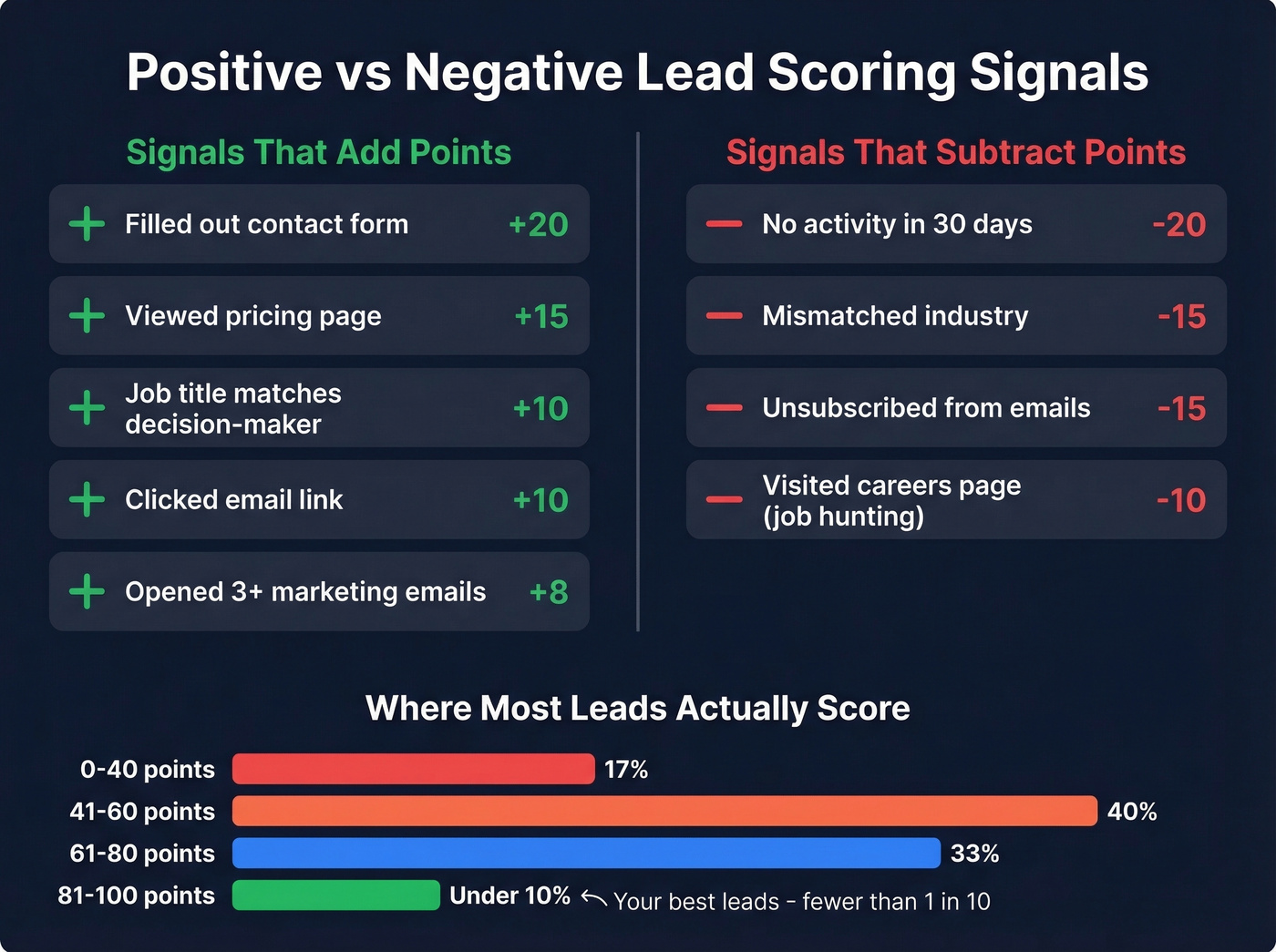
- Visited careers page (they're job hunting, not buying): -10
- Mismatched industry: -15
- Unsubscribed from emails: -15
- No activity in 30 days: -20
A Databox distribution analysis found 40% of leads score between 41-60, about a third land in 61-80, and fewer than 10% hit 81-100. If your MQL threshold is 70, you're filtering aggressively - and that's the point.
Implementations Worth Studying
Heap started with employee count plus industry scoring in Salesforce - simple firmographic gates before anything behavioral. Proposify layers Marketo behavioral scoring with firmographic enrichment via Clearbit, combining page visits and email engagement with company-level data. Both approaches work because they start with hard ICP criteria and add behavioral signals on top, not the other way around. If you flip that order, you end up chasing engaged leads who'll never buy because they don't fit your ICP in the first place.
Picking the Right Framework
| BANT | CHAMP | MEDDIC | |
|---|---|---|---|
| Best for | High-velocity inbound | Consultative sales | Enterprise, 7+ stakeholders |
| Speed | Fast triage | Moderate | Slow, thorough |
| Weakness | Misses complexity | Requires skill | Heavy training |
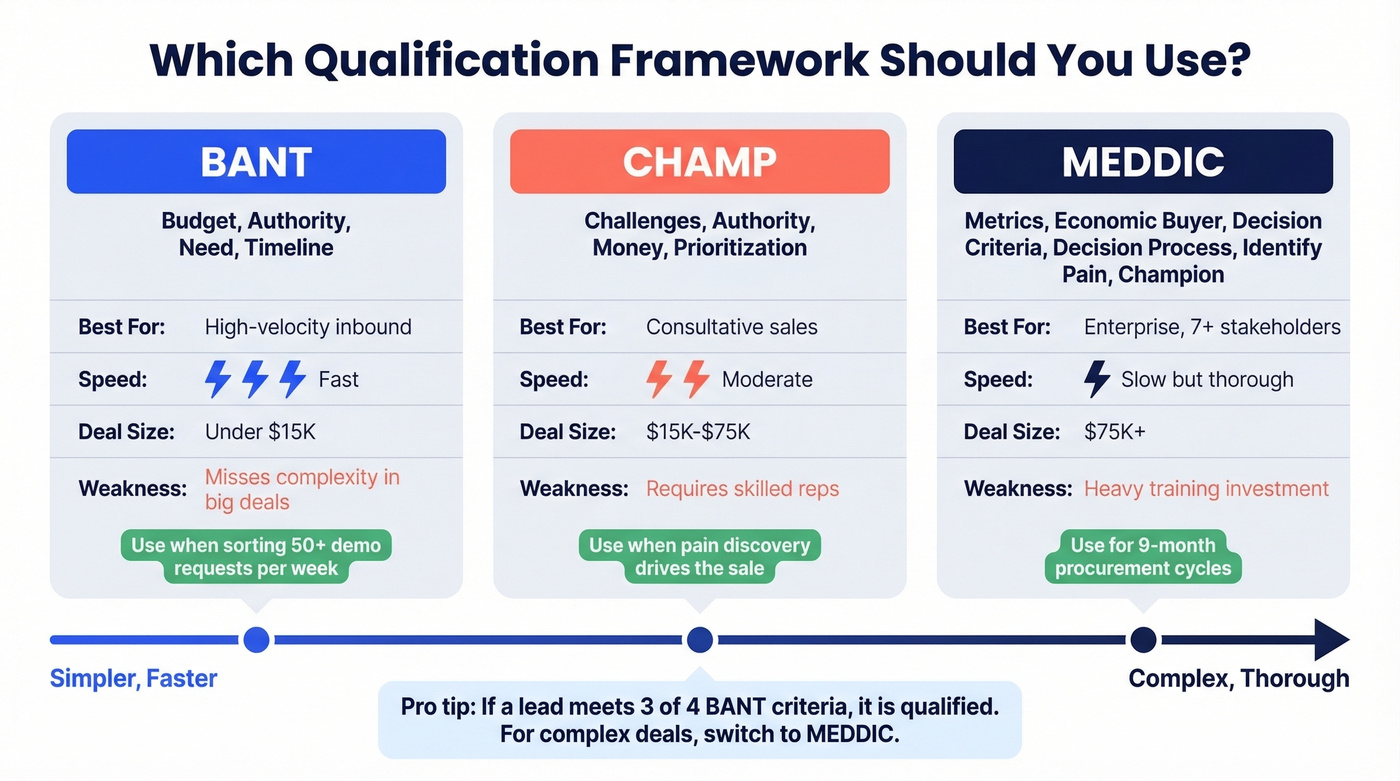
BANT isn't dead - it's misapplied. For high-velocity inbound triage where you're sorting 50 demo requests a week, BANT is perfect. It falls apart when you try to use it as a full methodology for enterprise deals with seven stakeholders and a nine-month procurement cycle. A practical heuristic: if a lead meets 3 of 4 BANT criteria, it's qualified. For complex deals, switch to MEDDIC and don't look back.
If you're running enterprise cycles, pair this with a tighter MEDDIC sales qualification process.

A lead scoring 90 with a dead email is worth zero. Prospeo's 98% email accuracy and 7-day data refresh mean your highest-scored leads actually get reached - not bounced. Layer 30+ filters including buyer intent, funding signals, and headcount growth to pre-qualify before you even score.
Stop scoring leads you can't reach. Start with verified data.
Intent Signals Worth Tracking
First-party intent is what happens on your turf - website visits, email clicks, form submissions. Third-party intent is activity happening elsewhere: research on review sites, competitor content engagement, keyword searches across publisher networks.
The signals we weight heavily: competitor brand engagement on social, hiring for sales roles (a classic expansion signal), pricing page visits, branded keyword searches, and social interactions with competitor content. 65% of marketers say intent signals improved their pipeline forecasting accuracy. The consensus on r/gtmengineering and r/GrowthHacking is that platforms like Bombora and 6sense deliver real value but some signals go stale quickly, so you need to act fast on them.
Let's be honest: if your average deal size is under $15K, you probably don't need a dedicated intent data platform. Track first-party signals in your CRM and save the budget for when deal sizes justify the spend.
To operationalize this, use an intent based segmentation approach and a repeatable system for identifying buying signals.
Prioritizing High-Value Accounts
Not all accounts deserve equal attention. Once you've scored individual leads, roll those scores up to the account level to find the accounts worth your team's best effort.
Look for accounts where multiple contacts are engaging simultaneously - a VP visiting your pricing page while a director downloads a case study is a far stronger signal than either action alone. High-value attributes at the account level include recent funding rounds, executive turnover in your buyer persona's department, and active tech stack changes that create integration opportunities. When three or more of these attributes converge, move the account to the top of your outreach queue immediately.
This is also where account-based selling becomes the natural next step.
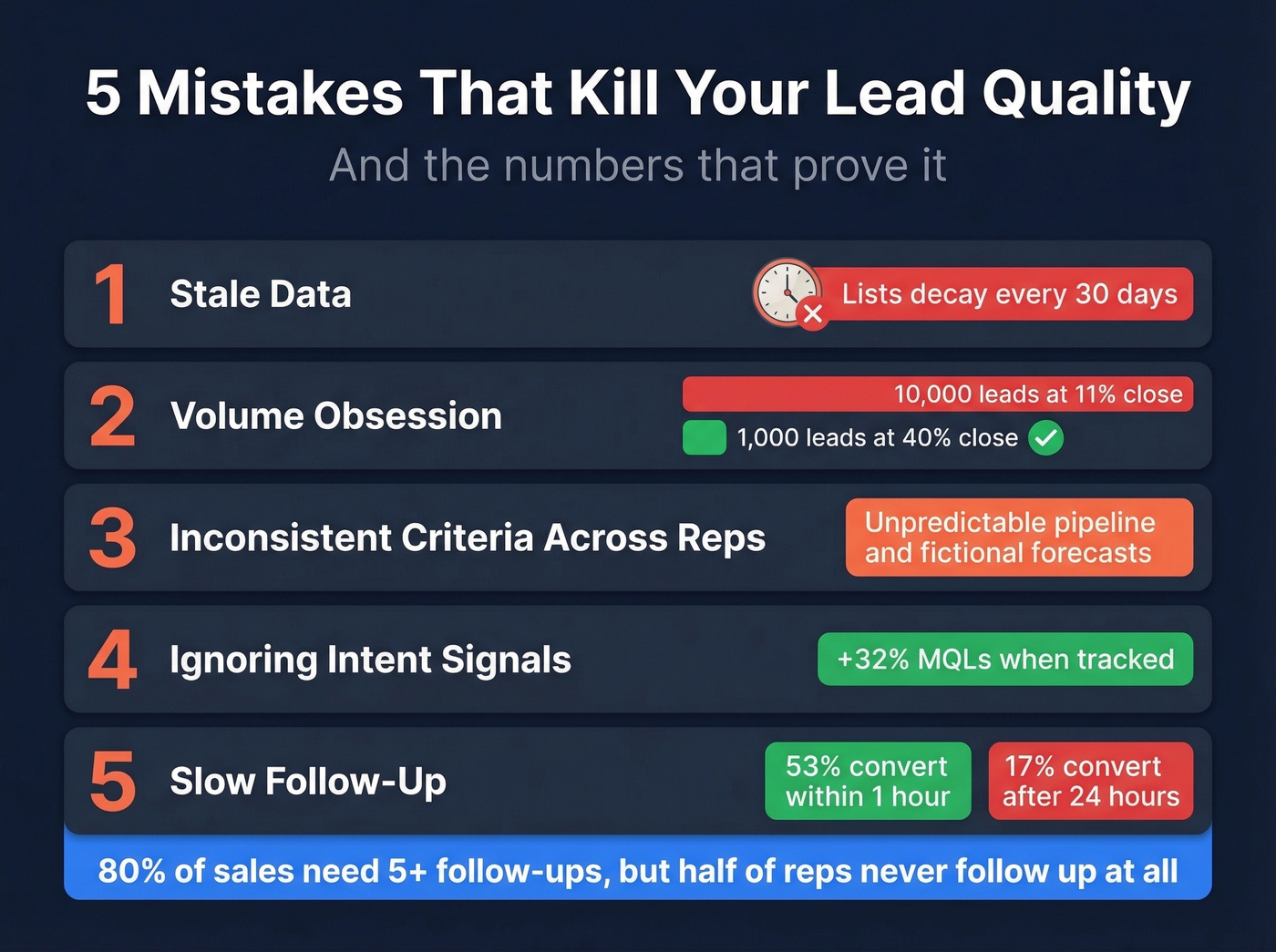
Five Mistakes That Kill Lead Quality
- Stale data. Your "verified" list decays every month. If you haven't refreshed in 90 days, you're emailing ghosts.
- Volume obsession. Chasing 10,000 leads with an 11% close rate loses to 1,000 leads closing at 40%. Every single time.
- Inconsistent criteria across reps. If your SDRs can't agree on what "qualified" means, your pipeline is unpredictable and your forecasts are fiction.
- Ignoring intent signals. Teams that track and act on intent see a 32% increase in MQLs.
- Slow follow-up. Following up within one hour converts at 53%; wait 24 hours and it drops to 17%. And 80% of sales require at least 5 follow-ups, yet half of reps don't follow up at all.
If your team needs a system for speed, keep a set of sales follow-up templates ready to go.
The Data Quality Gap
We've seen teams waste months refining scoring sophistication when their underlying data was garbage. Pull 500 leads from your database, run a sequence, and watch the bounces pile up. That means your highest-scoring leads never even see your message.
Skip this section if your bounce rate is already under 5%. But if it's not - and for most teams it's not - data freshness is the bottleneck, not scoring logic. When Snyk rolled out Prospeo across 50 AEs, their bounce rate dropped from 35-40% to under 5%, and AE-sourced pipeline jumped 180% with 200+ new opportunities per month. That's what a 7-day data refresh cycle looks like in practice compared to the 6-week industry average.
If you're troubleshooting bounces, start with email bounce rate benchmarks and fixes.
Tracking intent signals like competitor engagement and hiring patterns? Prospeo combines Bombora-powered intent data across 15,000 topics with verified contact data for decision-makers - so you act on buying signals while they're still fresh, not six weeks later.
Turn intent signals into booked meetings at $0.01 per verified email.
Benchmarks - What Good Looks Like
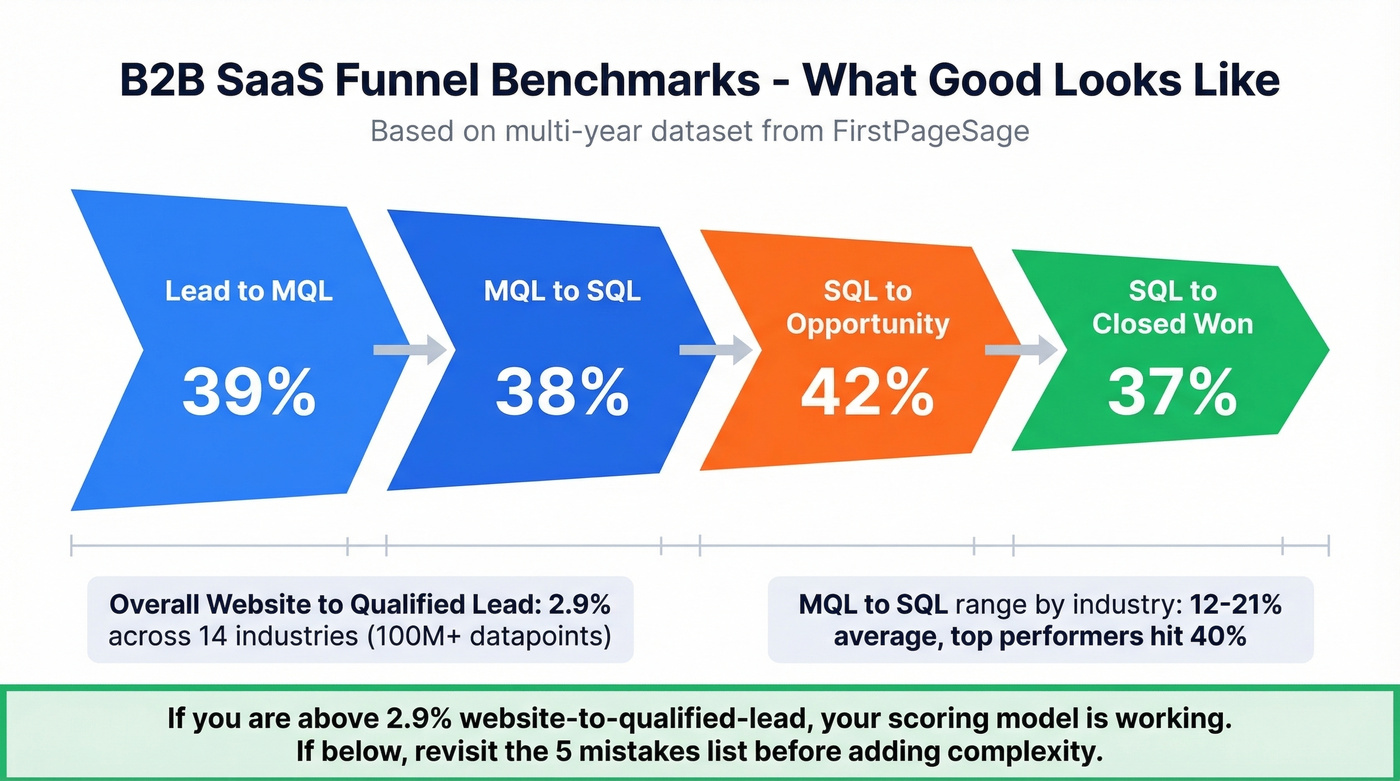
B2B SaaS funnel benchmarks from a multi-year dataset:
| Stage | Conversion Rate |
|---|---|
| Lead to MQL | 39% |
| MQL to SQL | 38% |
| SQL to Opportunity | 42% |
| SQL to Closed Won | 37% |
MQL-to-SQL averages range 12-21% by industry, with top performers hitting 40%. The overall website-to-qualified-lead conversion rate across 14 industries sits at 2.9% based on 100M+ datapoints. If you're above that, your scoring model is doing its job. If you're below it, start with the five mistakes list above before adding more complexity.
For more context, compare against the average B2B lead conversion rate and track the right funnel metrics.
FAQ
What's the difference between MQL and SQL?
An MQL meets engagement thresholds - downloads, page visits, email clicks. An SQL has been vetted by sales for budget, authority, need, and timeline. The handoff typically happens when a lead crosses a scoring threshold, like the 70-point mark in the model above.
How many leads should convert to customers?
In B2B SaaS, roughly 37% of SQLs close. The full funnel narrows fast: only 39% of raw leads become MQLs, and 38% of those become SQLs. If your SQL-to-Close rate is below 25%, your qualification criteria need tightening - not your top-of-funnel volume.
What's the fastest way to find high-quality leads?
Define your ICP with hard criteria - industry, headcount, revenue, tech stack - and verify your contact data before outreach. Combining firmographic filters with behavioral scoring is the most reliable approach at scale, and tools like Prospeo let you layer 30+ filters including buyer intent and technographics to narrow your list before a single email goes out.
Is BANT still relevant in 2026?
Yes, for high-velocity inbound triage where you're sorting a large volume of demo requests quickly. It fails for enterprise deals with 7+ stakeholders. Match the framework to your sales motion: BANT for speed, MEDDIC for complexity.