

How to Improve Email Click-Through Rate (When Nothing Else Has Worked)
Your open rate looks fine. Maybe even good. But nobody's clicking - and a 2% CTR on your last three campaigns has you questioning everything from your button color to your entire email strategy. Most advice on how to improve email click-through rate treats symptoms. The fixes that actually move the needle are upstream.
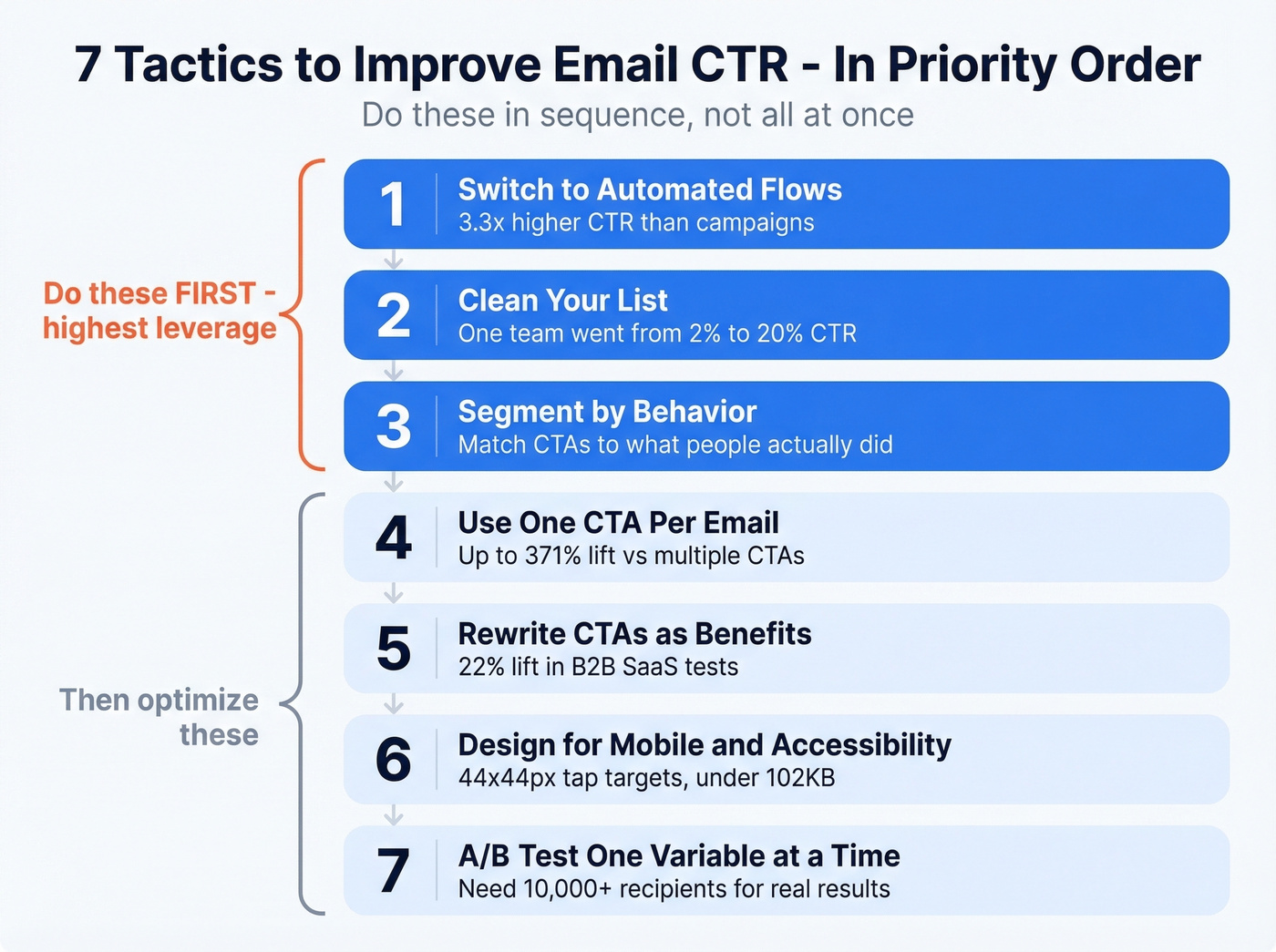
If your CTR is stuck at 2%, do these three things in this order:
- Clean your list - remove unengaged subscribers first.
- Set up at least one automated flow (welcome, abandoned cart, re-engagement).
- Then optimize your CTA copy and design.
That sequence matters more than any button-color test ever will.
Quick diagnostic: Under 1% is low. 1-2% is baseline. 2-4% is good. Above 4% is strong.
Why Your CTR Is Stuck at 2%
The "good opens, dead clicks" pattern is a common complaint on r/Emailmarketing. Marketers watch open rates hold steady while click rates decay - then start tweaking everything inside the email, when the real lever is often upstream.
Most CTR problems aren't content problems. They're list problems. One practitioner on Reddit removed unengaged contacts and watched CTR jump from 2% to 20%. That's not a typo. When you stop emailing people who'll never click, the math changes dramatically - shrinking the denominator is sometimes the fastest path to better engagement.
2026 Email CTR Benchmarks
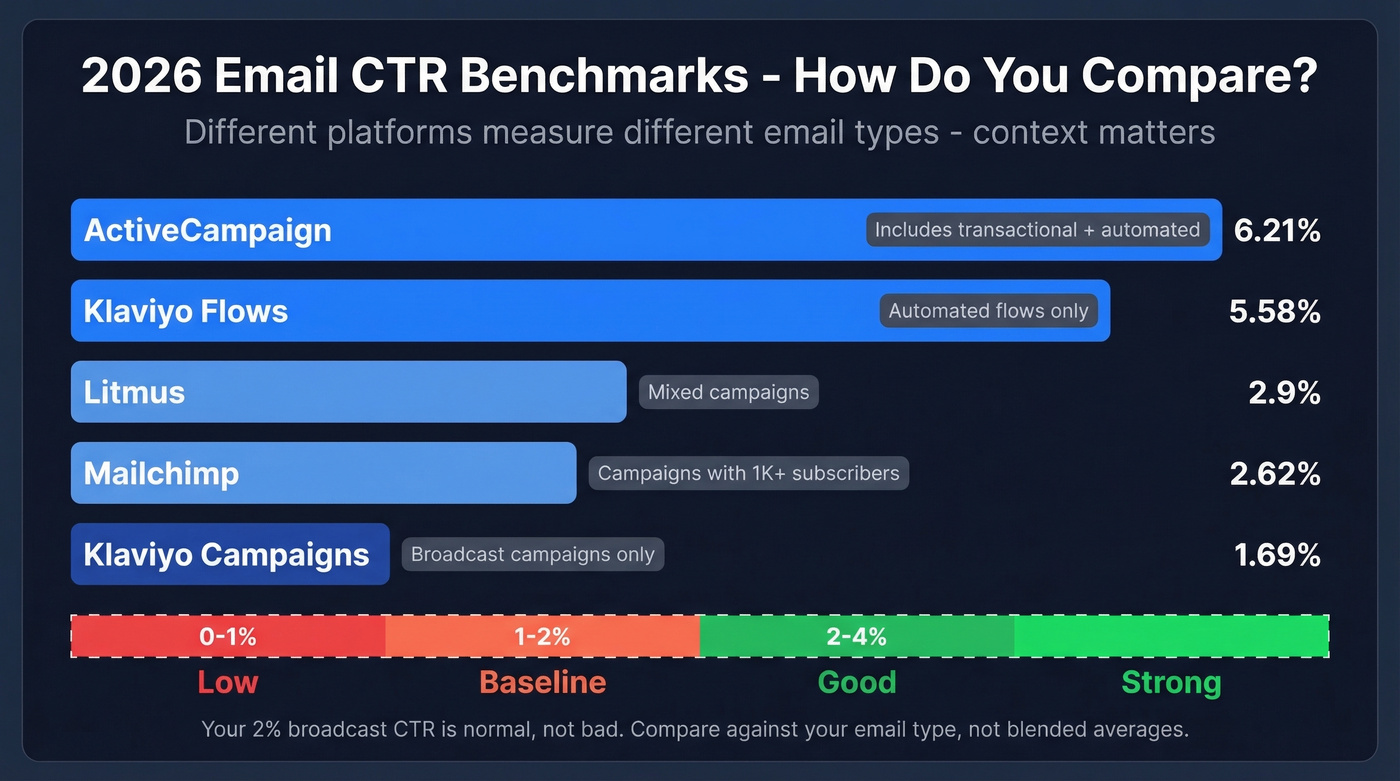
Before you panic, you need context. Different platforms measure different email types, which is why benchmarks seem all over the map.
| Source | CTR | Email Types | Data Period |
|---|---|---|---|
| ActiveCampaign | 6.21% | Mixed (incl. transactional + automated) | Jan-Dec 2025 |
| Klaviyo (flows) | 5.58% | Automated flows only | Not specified |
| Litmus | 2.9% | Mixed campaigns | Not specified |
| Mailchimp | 2.62% | Campaigns (1K+ subscribers) | Updated Dec 2023 |
| Klaviyo (campaigns) | 1.69% | Broadcast campaigns only | Not specified |
ActiveCampaign's 6.21% looks impressive until you realize it includes transactional and automated emails, which naturally get higher engagement. Mailchimp's 2.62% is based on tracked campaigns sent to lists over 1,000 subscribers - a much harder benchmark to hit. A 2% CTR on broadcast campaigns is normal, not bad.
Industry matters too. ActiveCampaign's data shows Software averaging 6.67% and E-Commerce/Retail at 5.07%. If you're in retail comparing yourself to SaaS benchmarks, you're measuring against the wrong yardstick.

Your CTR won't improve if 17% of your emails never reach an inbox. Prospeo's 5-step email verification delivers 98% accuracy across 143M+ verified addresses - catching bounces, spam traps, and honeypots before they torch your sender reputation. Stack Optimize kept bounce rates under 3% across every client.
Fix your list first. Everything else is downstream.
Seven Tactics to Increase Email Click Rate
1. Switch to Automated Flows
This is the single highest-leverage change you can make. Klaviyo's data across 183,000+ customers shows flows get 3.3x higher CTR than campaigns - 5.58% vs 1.69%. Flows generate roughly 41% of total email revenue from just 5.3% of sends, which is a staggering return on a relatively small volume of messages. Set up a welcome series, abandoned cart sequence, post-purchase follow-up, and re-engagement flow. These aren't optional anymore.
2. Clean Your List First
56% of subscribers unsubscribe when content stops being relevant. The ones who don't unsubscribe just stop clicking - dragging your metrics down silently.
Set a rule: no engagement in 90 days means suppression or a re-engagement flow. That Reddit practitioner who went from 2% to 20%? List hygiene was the first thing they did. Before touching anything else, purge the dead weight.
If you're doing this at scale, it helps to standardize your email deliverability checks alongside suppression rules.
3. Segment by Behavior, Not Demographics
Segment by what people clicked, bought, or browsed - not just job title or location. Dynamic segments that auto-update based on recent behavior outperform static lists every time. When your CTA matches what someone did last week, clicks follow. We've seen teams double their CTR just by splitting "opened in last 30 days" from "opened in last 90 days" and sending different content to each group. Behavioral segmentation is the most reliable way to sustain higher engagement over time.
If you want a more structured approach, build segments around intent and engagement signals.
4. Use One CTA Per Email
A single CTA can increase CTR by up to 371% compared to multiple asks. Every additional link dilutes attention. One email, one ask, one button. We've audited campaigns with six different links competing for attention in a single send - it's chaos. Pick the one thing you want the reader to do.
If you need examples and rules, use this email call to action guide as a checklist.
5. Rewrite Your CTA as a Benefit
"See It in Action" outperformed "Request a Demo" by 22% in a B2B SaaS test. Frame the click as what the reader gets, not what they do. The consensus on r/AskMarketing echoes this: benefit-framed CTAs consistently beat generic "click here" language. This single change can lift clicks across every campaign type.
This is also where tighter email copywriting pays off fast.
6. Design for Mobile and Accessibility
Minimum 44x44px tap targets for buttons. 4.5:1 contrast ratio for button text. Keep your email under 102KB to avoid Gmail clipping. Most scroll drop-off happens at the 50-60% mark - place your primary CTA before that point. These details are the difference between a click and a frustrated thumb-tap on the wrong link.
If you're seeing strong opens but weak clicks, it can be worth checking whether your tracking pixel setup is skewing engagement reporting.
7. A/B Test One Variable at a Time
Litmus recommends at least 10,000 recipients for meaningful results. Test CTA copy before design - copy changes move the needle faster. We've seen teams run dozens of tests and learn nothing because they changed three variables at once. Isolate the variable, run the test, read the data. Then move on.
For more test ideas upstream of the CTA, pull from these email subject line examples and pair them with a single-offer body.
Cold Email CTR: Different Rules
Cold email plays by a completely different rulebook. Average CTR sits around 3-4%, and 17% of cold emails never reach the inbox. Your CTA optimization doesn't matter if your messages land in spam.
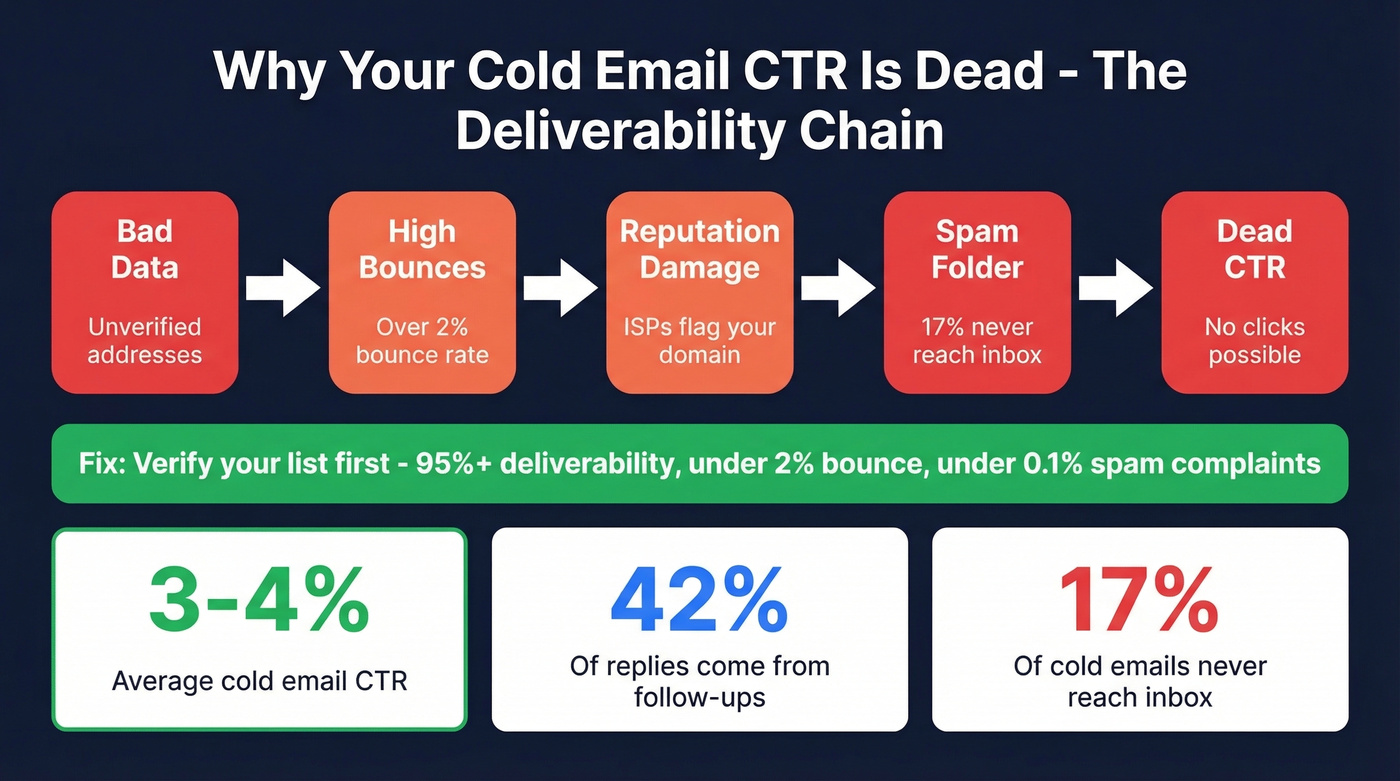
Here's the thing: the logic chain is brutal. Bad data leads to bounces, bounces damage your sender reputation, reputation damage kills inbox placement, and dead inbox placement tanks CTR. If your bounce rate exceeds 2%, no CTA optimization will save you. Verify your list before you optimize anything else. Prospeo's email verification catches bad addresses before they do damage - 98% accuracy across 143M+ verified emails. Stack Optimize built their agency to $1M ARR using that data, maintaining 94%+ deliverability and under 3% bounce across all clients.
If you're troubleshooting bounces specifically, start with these email bounce rate benchmarks and fixes.
Most teams obsess over CTA wording in cold emails when their real problem is that 17% of messages never reach an inbox. Fix deliverability first, and a mediocre CTA will outperform a brilliant one sent to a dirty list.
Your guardrails: 95%+ deliverability, under 2% bounce rate, under 0.1% spam complaints. And 42% of cold email replies come from follow-up sequences, so your deliverability needs to hold across multiple sends.
If you're building sequences, this B2B cold email sequence framework helps keep clicks and replies compounding.
How to Measure CTR Properly
Before you benchmark, make sure you're measuring the right thing.
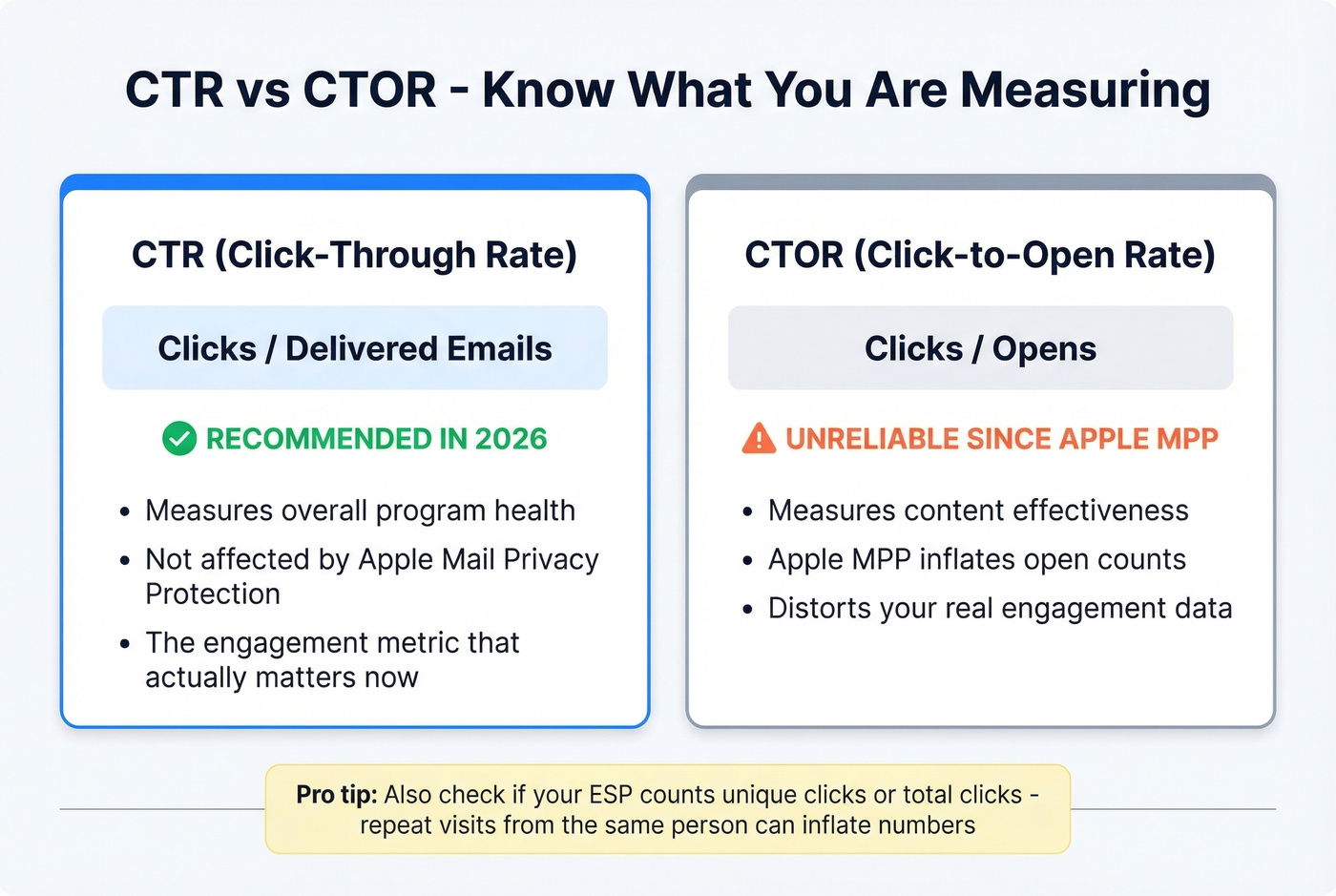
CTR vs CTOR: CTR equals clicks divided by delivered emails - it measures program health. CTOR equals clicks divided by opens - it measures content effectiveness. Know which you're tracking, because they tell very different stories.
If you want to standardize reporting across teams, use a consistent click rate formula definition.
Unique vs total clicks: Some ESPs count repeat visits from the same person. Check your platform's formula before comparing to benchmarks.
Apple MPP inflation: Apple Mail Privacy Protection inflates open rates, making CTOR unreliable. CTR is the engagement metric that actually matters in 2026. If you're still reporting CTOR as your primary engagement number, you're working with distorted data.
Behavioral segmentation only works when you're reaching real people at real addresses. Prospeo's database gives you 300M+ profiles with 30+ filters - buyer intent, job changes, technographics - so every segment you build starts with verified, fresh data refreshed every 7 days.
Better segments start with better data. At $0.01 per email, there's no excuse.
FAQ
What's a good email click-through rate in 2026?
For broadcast campaigns, 2-3% is average. For automated flows, 5-6% is typical. Benchmark against your own email type - blended averages that mix transactional, automated, and broadcast sends are misleading.
Why is my open rate high but CTR low?
Your subject line works but your content isn't compelling action. Cut to a single CTA and test benefit-driven copy first. If your primary CTA sits below the 50-60% scroll mark, move it higher - most readers never reach the bottom.
How do I improve CTR on cold emails?
Verify every address before sending. If your bounce rate exceeds 2%, your sender reputation is already damaged and inbox placement drops. After that, focus on a single clear CTA and follow-up sequences - 42% of cold email replies come from follow-ups, not the first touch.
Can I increase email clicks without a full redesign?
Yes. The highest-impact changes are operational: clean your list, segment by recent behavior, and reduce to one CTA per send. These three moves alone typically outperform any template overhaul - and they take hours, not weeks.