

How to Incentivize Your Sales Team in 2026 (With Math)
Only 21% of the global workforce is engaged. That disengagement cost $438 billion in lost productivity last year, and 70% of team engagement traces directly back to the manager - which means figuring out how to incentivize your sales team is a management decision, not an HR one.
It's Q3. Your team is sitting at 47% of annual target, and your VP wants you to "run a contest or something." We've been there. The problem isn't motivation - it's that most incentive programs fail at operations, not design. Here's how to build one that actually moves numbers.
Three Things That Drive Sales Performance
You need exactly three things:
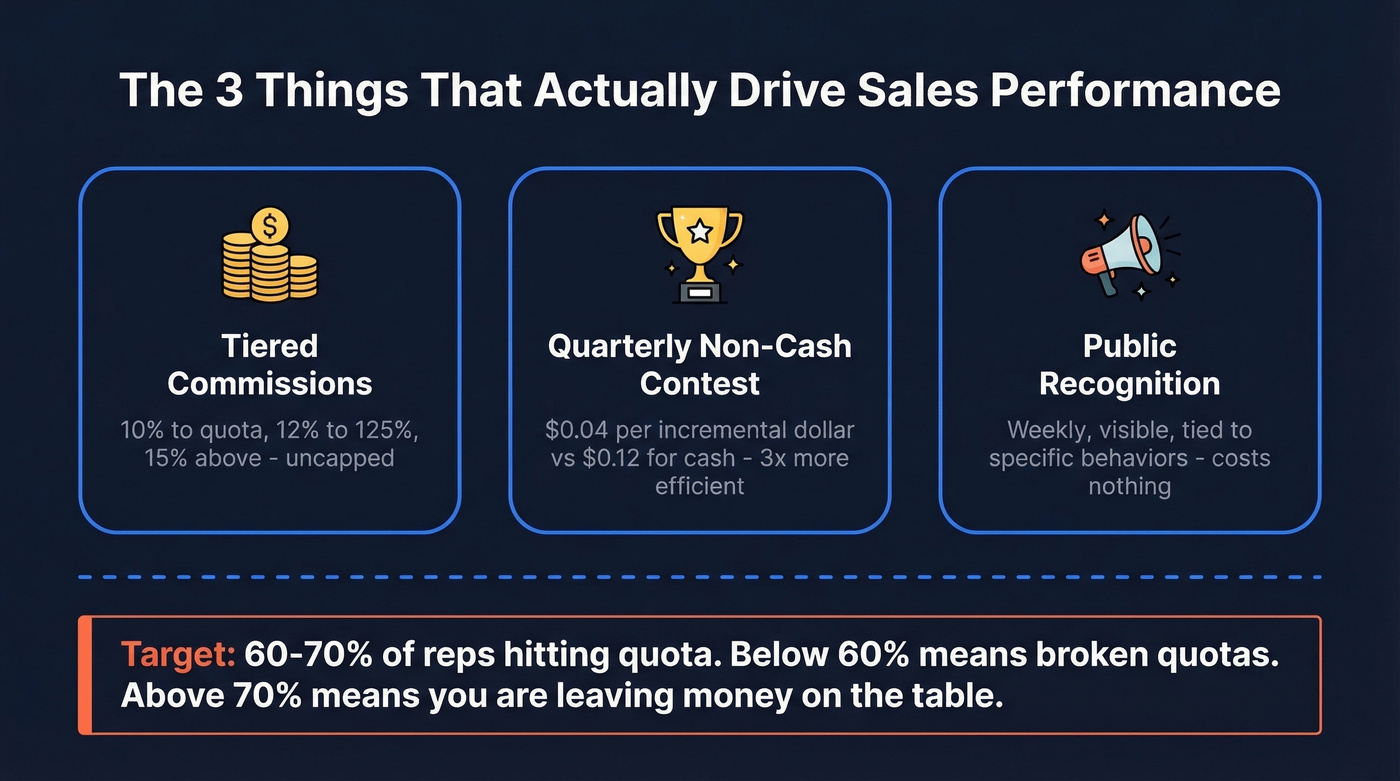
- A tiered commission plan - 10% up to quota, 12% to 125%, 15% above that
- One quarterly non-cash contest - non-cash incentives are roughly 3x more cost-efficient than cash ($0.04 vs. $0.12 cost per incremental dollar)
- Consistent public recognition - weekly, visible, tied to specific behaviors
Design for 60-70% quota attainment across your team. If fewer than 60% of reps are hitting quota, your quotas are broken. Above 70%, you're leaving money on the table. Three incentives, not thirty.
How to Structure Your Plan
Start with OTE: base salary plus variable pay at 100% quota. A mid-market AE might look like $70k base + $50k variable = $120k OTE. A 50/50 pay-mix signals a performance-heavy hunter role; 70/30 fits blended roles or new hires still ramping (see a 30-60-90 day plan for ramp expectations).
Now layer in tiers. Here's a structure we've seen work well, built around a $100k quarterly quota:
| Quota Attainment | Commission Rate | On $120k in Sales |
|---|---|---|
| First $100k (up to 100%) | 10% | $10,000 |
| Next $20k (100%-120%) | 12% | $2,400 on $20k overage |
| Above 125% | 15% | Uncapped |
Let's walk through the math. A rep closes $120k against a $100k quota. First $100k earns $10,000 at 10%. The next $20k earns $2,400 at 12%. Total: $12,400. Clear enough to calculate on a napkin - and that's the point.
Add accelerators above 125% to reward top performers disproportionately. Add clawbacks for churned or cancelled deals so reps don't sandbag bad-fit customers. And simulate every plan change against historical data before you launch it (this is basic sales operations hygiene). I've watched reps build shadow spreadsheets within a week of a poorly communicated mid-quarter change. Don't be the leader who causes that.
Cash vs. Non-Cash Rewards
Here's where most sales leaders get it wrong. They default to cash bonuses because reps say they want cash. The research disagrees.
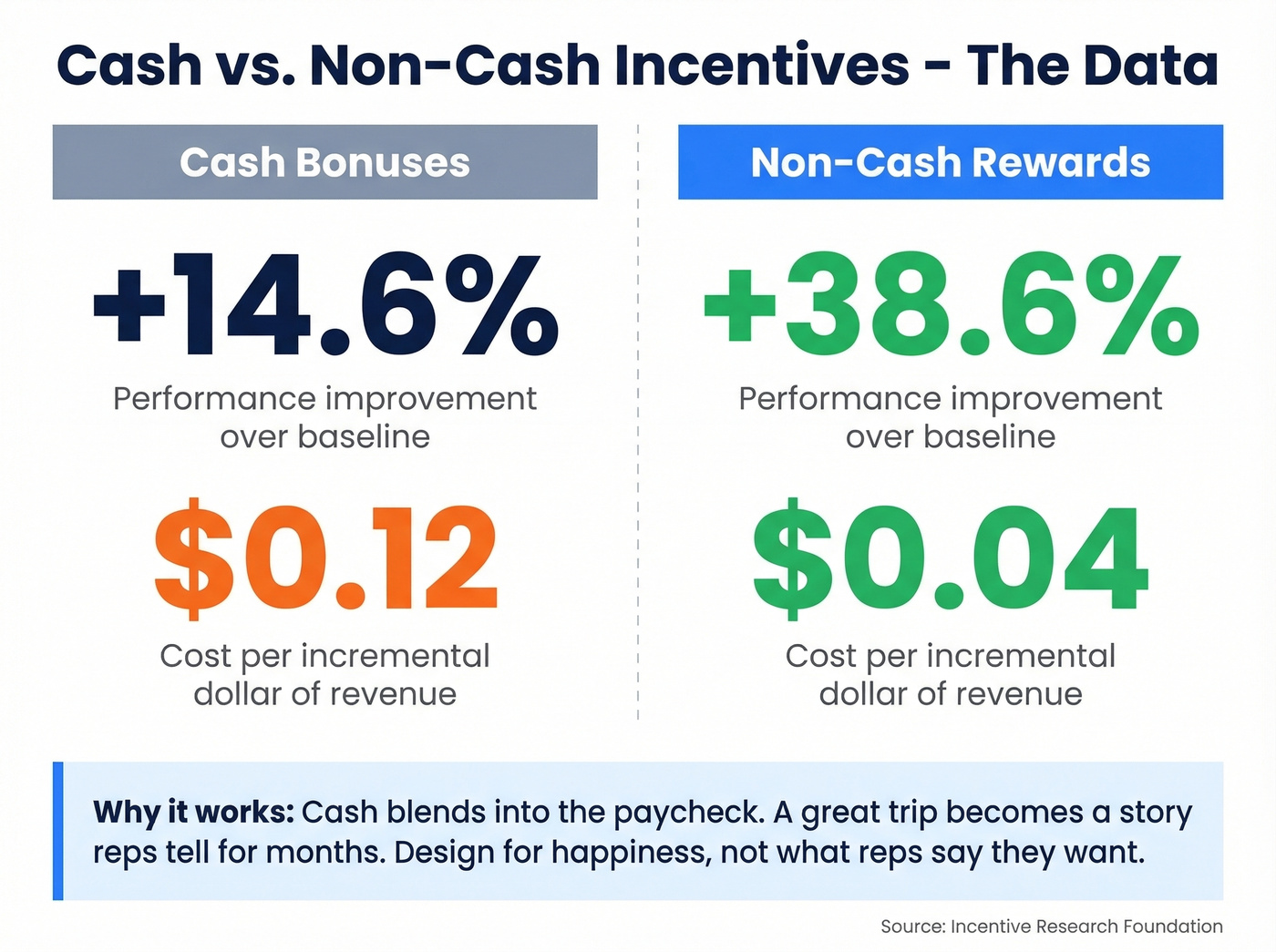
Non-cash incentives produce a +38.6% performance improvement over baseline. Cash produces +14.6%. The cost per incremental dollar of revenue: $0.04 for non-cash versus $0.12 for cash - a 3x efficiency gap. Thaler's mental accounting theory explains it: cash blends into the paycheck, but a great trip becomes a story reps tell for months.
Reps will always say they want cash. Design for happiness anyway - it drives better performance.
Hot take: If your average deal size is under $10k, you probably can't afford $1/lead data and elaborate incentive programs. Start with a clean commission structure and one quarterly non-cash contest. That's enough.

Non-cash incentives cost $0.04 per incremental dollar. Prospeo emails cost $0.01 each. Before you redesign your comp plan, make sure reps can actually reach buyers - 98% email accuracy means your SPIFFs drive pipeline, not frustration.
Fix the data before you fix the comp plan.
8 Incentive Ideas That Work
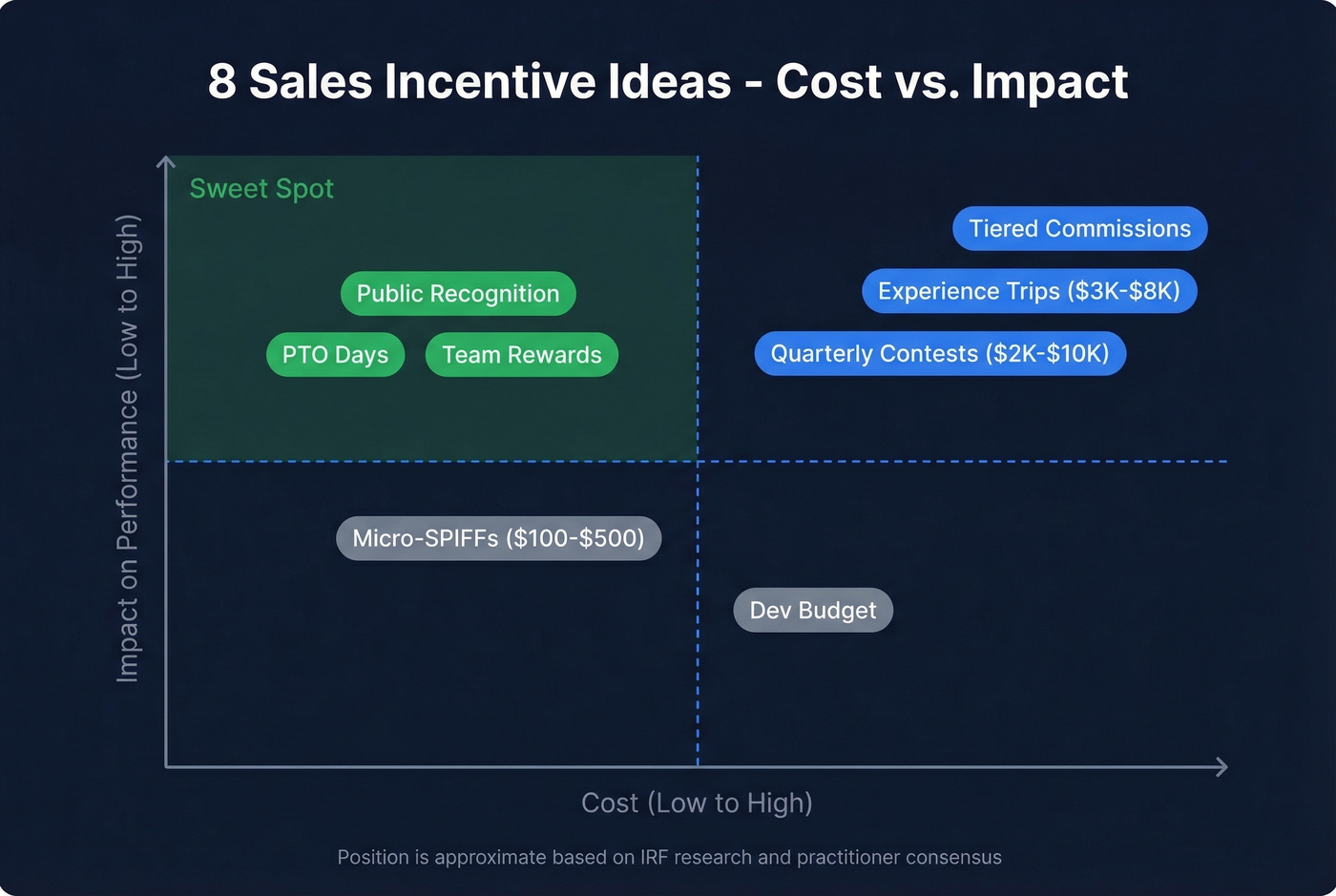
- Tiered commissions - the 10/12/15 structure above. The backbone of everything else.
- Micro-SPIFFs, $100-$500 - weekly, tied to a single behavior like booking demos or multi-threading into accounts.
- Quarterly contests, $2K-$10K prize pool - team-based to avoid turning reps into competitors. Leaderboard visibility matters more than prize size.
- Public recognition - Slack shoutouts, all-hands callouts, wall-of-fame boards. Costs nothing. Moves the needle more than most managers expect (and compounds with better sales communication).
- PTO days - an extra Friday off for hitting stretch targets. Younger reps value this more than a gift card.
- Experience trips, $3K-$8K per person - President's Club or quarterly dinners. The anticipation drives behavior for months before the event even happens.
- Team-based rewards - pod bonuses, team dinners, group experiences. Counteracts the collaboration-killing effect of individual-only incentives (especially in team selling).
- Professional development budget - conference tickets, courses, coaching. Signals you're investing in their career, not just extracting quota (tie it to sales training goals).
Why Most Incentive Programs Fail
The most common failure mode isn't bad design - it's bad operations.
A plan that looks elegant in a spreadsheet breaks the moment you layer on real-world complexity: 8% on core subscriptions, 12% on bundles, +2% for multi-year, minus a margin penalty above a certain discount threshold. Nobody can calculate their own commission anymore. Trust erodes fast.
Look - a SPIFF longer than four weeks isn't a SPIFF. It's a bad commission plan. Individual-only incentives turn teammates into competitors. Overcomplicated structures create unintended consequences where reps optimize for the metric, not the outcome. Keep it simple enough that a rep can explain their comp plan in two sentences.
There's also a failure mode nobody talks about: bad prospect data. Your beautifully designed SPIFF doesn't matter if reps can't reach the people they're supposed to sell to. In our experience, teams that fix data quality before redesigning comp plans see faster results with less disruption (start with data enrichment and a tighter lead generation workflow). The consensus on r/sales backs this up - threads about "comp plan frustration" almost always reveal a pipeline problem underneath.
Measuring ROI
Most teams launch incentive programs and never measure whether they worked. That's a mistake you can fix with four numbers.
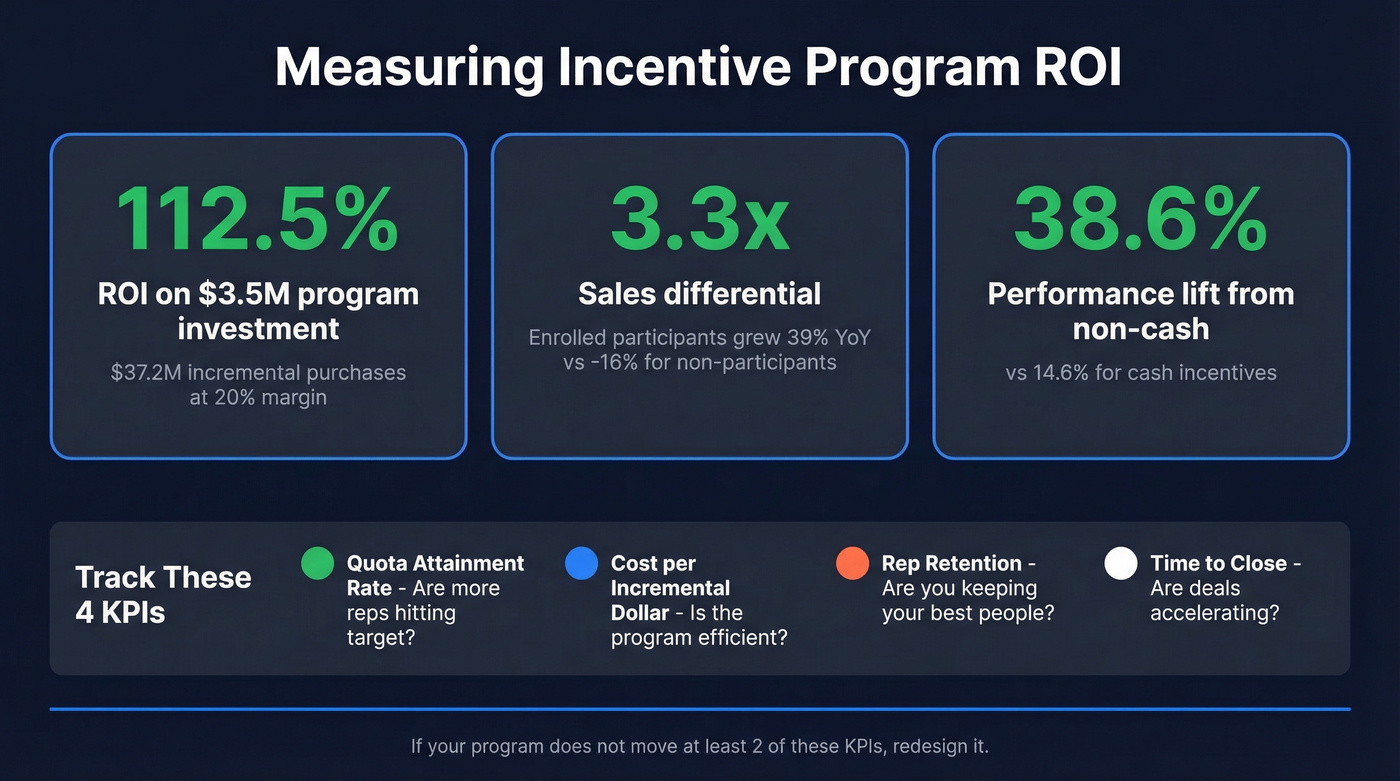
The Incentive Research Foundation found that a $3.5M program investment generated $37.2M in incremental purchases. At 20% gross margin, that's $7.44M in incremental profit - a 112.5% ROI. That's the number that gets budget approved.
In a channel incentive benchmark, enrolled participants grew sales 39% year-over-year while non-participants declined 16%. Same product line, same market conditions. A 3.3x differential.
Track four KPIs: quota attainment rate (are more reps hitting target?), cost per incremental dollar of revenue, rep retention (are you keeping your best people?), and time-to-close (are deals accelerating?). If your incentive program isn't moving at least two of these, redesign it (use pipeline health to diagnose what’s actually stuck).

Skip the comp plan overhaul if your reps' outreach is bouncing at 30-40%. One mid-market team using Prospeo dropped their bounce rate from 35% to under 4% within the first month, and that pipeline improvement showed up in quota attainment before any comp changes took effect (see email bounce rate benchmarks and fixes).
One team dropped their bounce rate from 35% to under 4% and saw quota attainment climb before touching their comp plan. When reps reach real buyers on every dial and every send, your incentive program finally has something to accelerate.
Stop incentivizing reps to send emails that bounce.
FAQ
How much should I budget for sales incentives?
Budget $100-$500 for weekly micro-SPIFFs and $2K-$10K for quarterly contests. Annual incentive trips run $3K-$8K per person. Assume prizes are taxable - coordinate with payroll before announcing anything.
Do non-cash incentives really outperform cash?
Yes. Non-cash incentives produce 38.6% greater performance improvement over baseline versus 14.6% for cash, at one-third the cost per incremental dollar. Design for non-cash rewards like experiences and PTO, not extra checks.
What's the fastest way to improve incentive program results?
Fix your prospect data first. Reps can't hit targets if emails bounce. Prospeo verifies emails and phone numbers in real time - 98% accuracy, 30% mobile pickup rate - so reps actually reach the people they're supposed to sell to.
How do I know if my quotas are set correctly?
Aim for 60-70% of your team hitting quota each quarter. Below 60% means quotas are unrealistic and your incentive structure is demotivating reps. Above 70% means you're under-targeting and leaving revenue on the table.