

How to Increase Win Rates in Sales (2026 Guide)
A post in r/sales told a familiar story: a rep watching teammates close at 15-40% while their own win rate sat in single digits. Every sales org has this person - and most have an entire team of them. The gap between top performers and everyone else isn't talent. It's process.
Here's the uncomfortable truth: 67% of B2B buyers now prefer a rep-free experience, and 45% used AI during their last purchase to compare vendors before ever talking to sales. The game has changed. If you want to increase win rates in sales, you need to fix what happens before the close - not the close itself.
The Short Version
Most win-rate problems are pipeline quality problems. The three highest-leverage fixes: adopt a qualification framework like MEDDIC, clean your prospect data so reps reach real decision-makers, and kill deals that stall past 50 days. Everything else is noise until those three are right.
What Is Sales Win Rate?
Win rate measures how often you win the deals you actually compete for:
Win Rate = (Won Opportunities / Total Closed Opportunities) x 100%
"Total closed" means won plus lost - deals that reached a decision. You exclude open pipeline and stalled deals that never got a yes or no. This gives you a clean read on competitive effectiveness, not just pipeline throughput.
Don't confuse win rate with close rate. Close rate divides closed deals by total opportunities created, meaning opportunities still open drag down the denominator. Win rate is the sharper metric because it only counts deals where a decision was made. If you're tracking close rate and calling it win rate, your numbers are artificially deflated.
B2B Win Rate Benchmarks
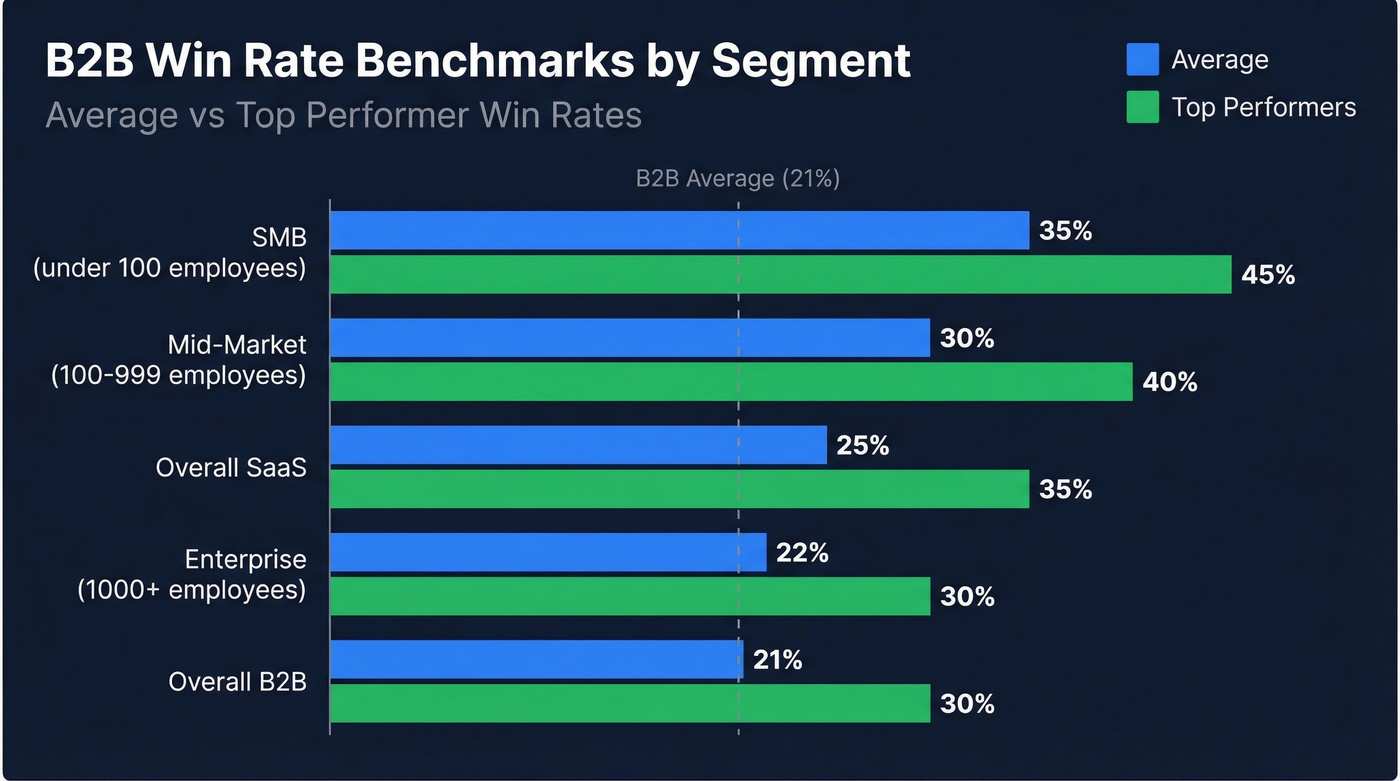
The overall B2B average win rate sits around 21%. That's across all industries, deal sizes, and motions. SaaS teams tend to run higher, but the range depends heavily on your segment.
| Segment | Avg Win Rate | Top Performers |
|---|---|---|
| Enterprise (1000+) | 20-25% | 30%+ |
| Mid-market (100-999) | 25-35% | 40%+ |
| SMB (<100) | 30-40% | 45%+ |
| Overall SaaS | 20-30% | 35%+ |
| Overall B2B | ~21% | 30%+ |
Enterprise win rates are lower for obvious reasons: longer cycles, more stakeholders, and bigger procurement hurdles. SMB deals close faster with fewer decision-makers, so win rates naturally run higher. The MQL-to-SQL conversion is where most pipelines hemorrhage volume - a 15% conversion rate at that stage means you're losing the majority of leads before they even become real opportunities.
If your team's blended win rate is below 20%, something structural is broken. Above 35%? You're either elite or you're not putting enough at-bats in the pipeline.
Why a 5-Point Lift Changes Everything
Win rate is the most underused growth metric in sales. A small improvement compounds fast because your cost structure stays fixed while revenue climbs.
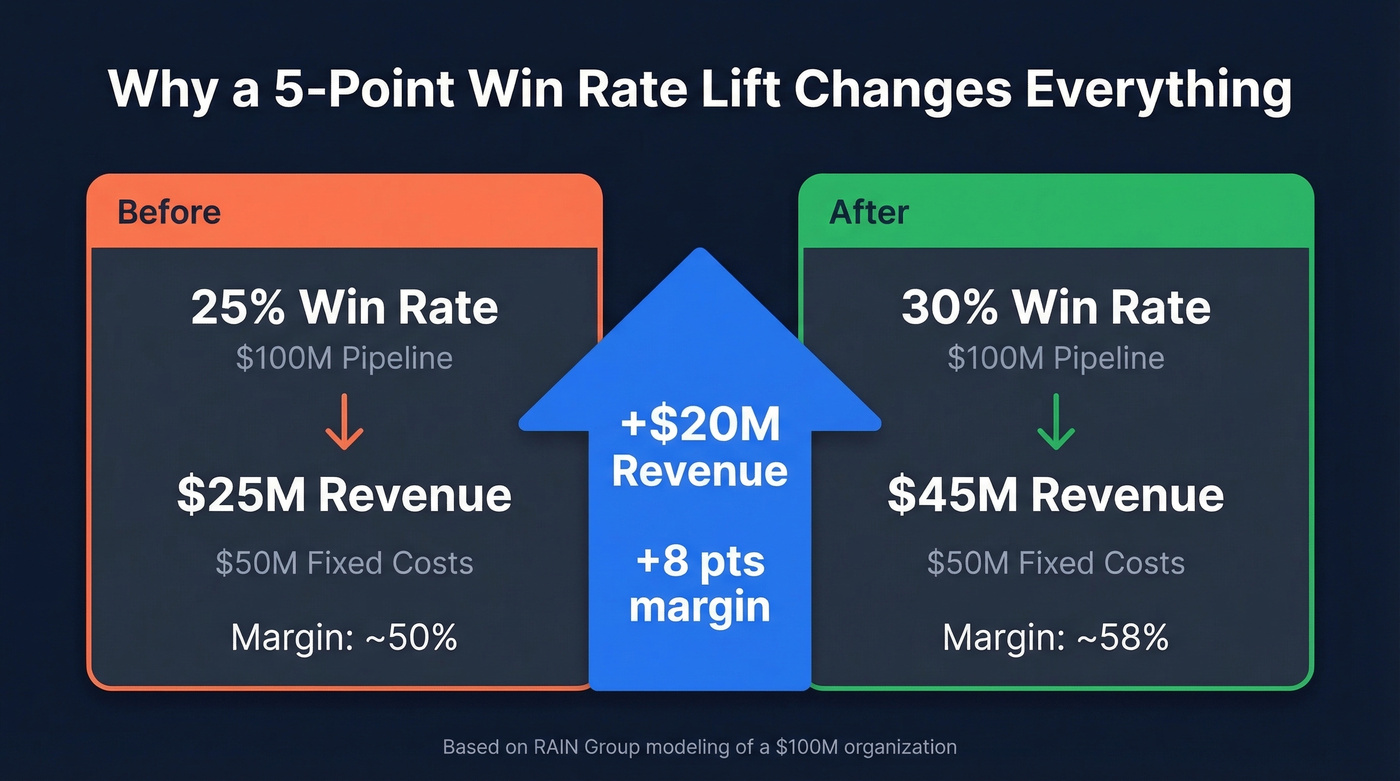
RAIN Group modeled this with a $100M organization: moving win rate from 25% to 30% generates roughly $20M in additional revenue. With $50M in fixed sales and overhead costs, that translates to 8+ percentage points of margin improvement. Their research identified three execution gaps that separate high-performing teams from the rest: value articulation, qualification discipline, and deal execution. Every tactic in this article maps to one of those three.
Most sales leaders chase pipeline volume when they hit a revenue wall. They add more SDRs, buy more leads, run more sequences. But if your win rate is 20%, doubling pipeline just doubles the waste. The smarter play is to improve conversion first - then every dollar you spend on pipeline generation works harder.

Stop paying for bounced emails. Prospeo verifies every contact with 98% accuracy, refreshed every 7 days.
Start free and only pay for verified contacts
Why Winning Deals Is Harder in 2026
Buyers don't need your reps the way they used to. 67% of B2B buyers now prefer a rep-free experience, according to a Gartner survey of 646 buyers. Even more telling: 45% used AI during a recent purchase to compare vendors, build shortlists, and evaluate pricing before ever talking to sales. By the time a prospect takes your call, 57% of the buying journey is already complete.
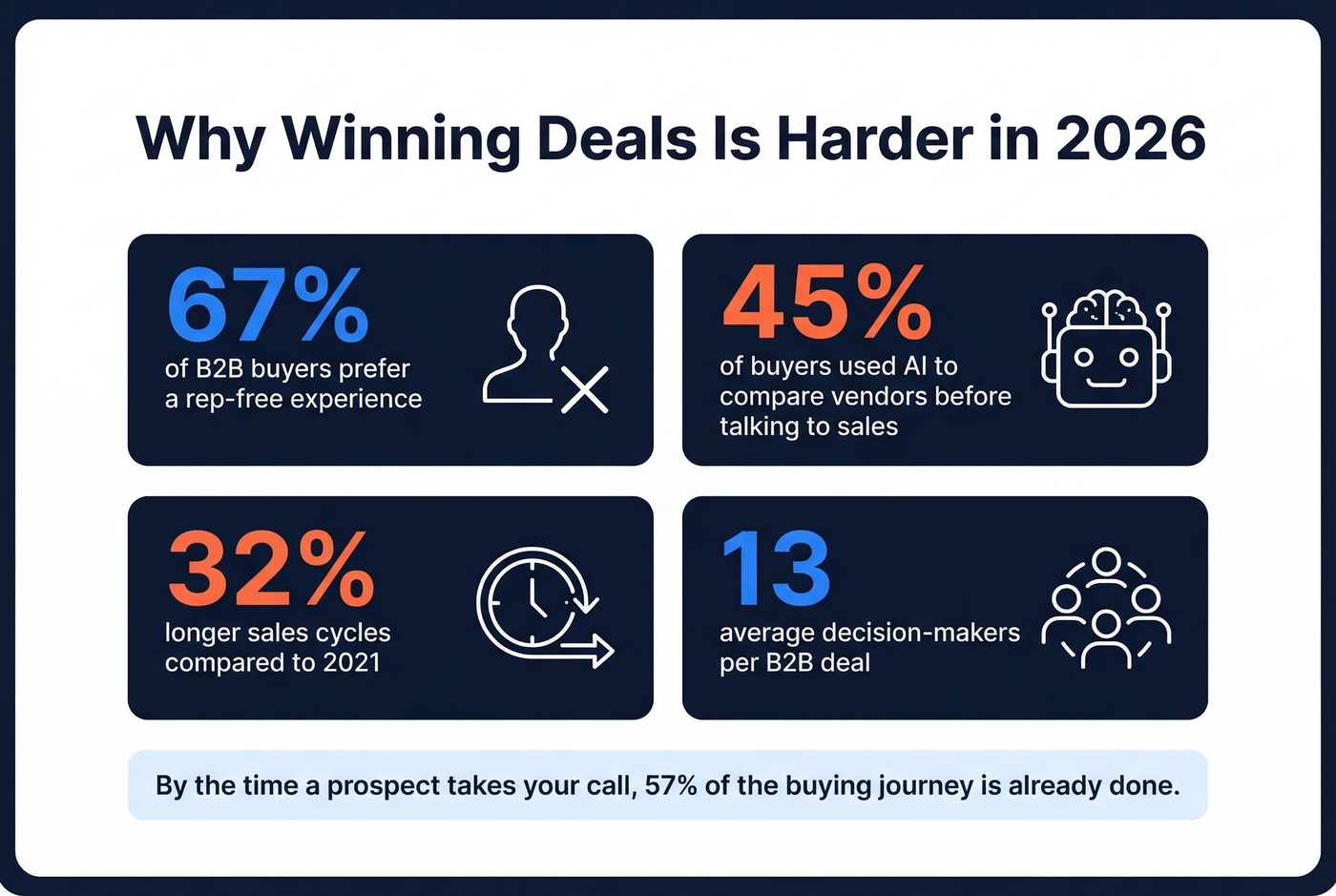
Sales cycles are 32% longer than they were in 2021. The average B2B deal now involves 13 decision-makers - more stakeholders to align, more internal politics to navigate, more chances for a deal to stall or die. Reps who relied on charm and a good demo are getting outmaneuvered by buying committees armed with better information than the seller has.
Hot take: If your deal size is under $15K and your sales cycle exceeds 45 days, you probably have a product-market fit problem disguised as a win-rate problem. No amount of sales tactics will fix that.
7 Ways to Boost Your Win Rate
1. Disqualify Faster with MEDDIC
The fastest way to improve your win rate is to stop working deals you can't win.
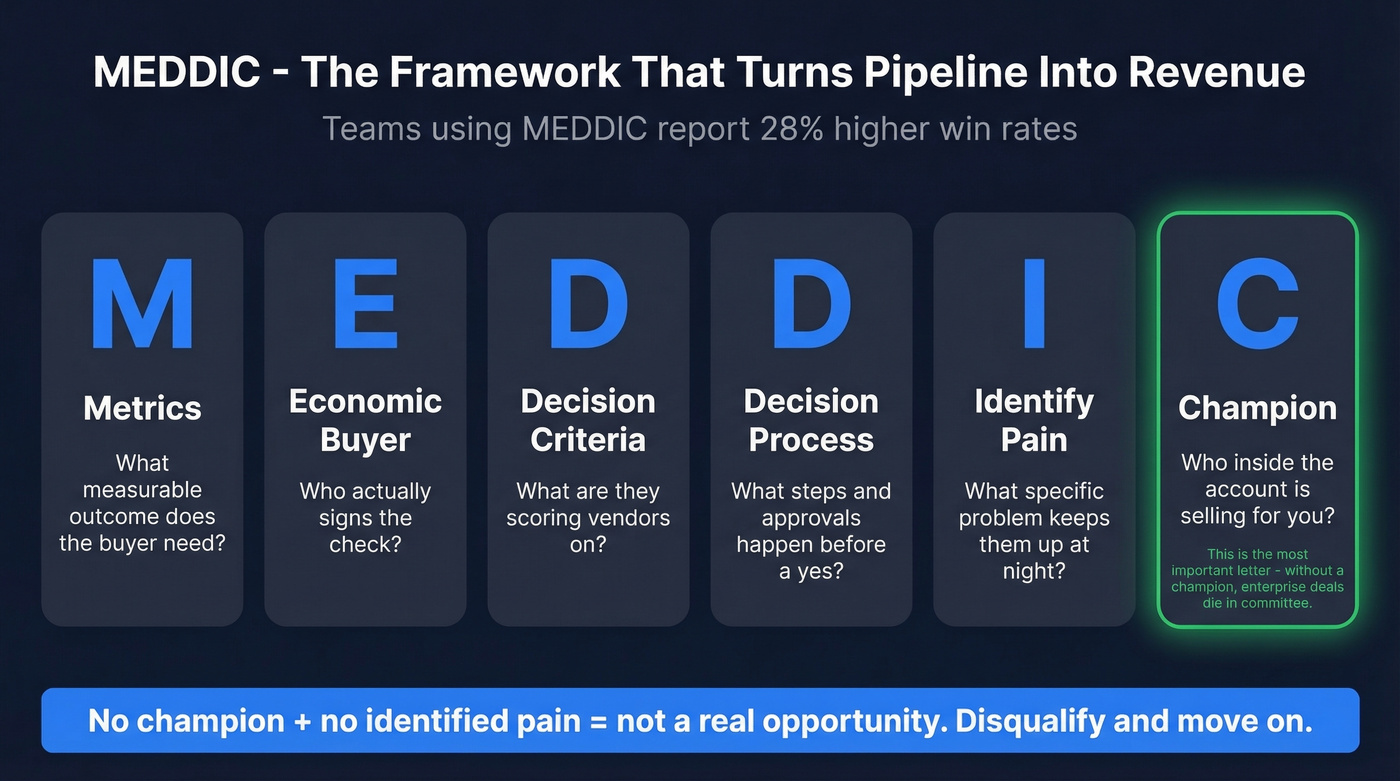
MEDDIC - Metrics, Economic Buyer, Decision Criteria, Decision Process, Identify Pain, Champion - was created in 1996 by Dick Dunkel at PTC. The company grew from roughly $300M to over $1B in revenue during the period they deployed it. Teams using structured qualification report 28% higher win rates than teams without a formal framework, with some organizations seeing a 30-40% boost within the first year.
The reason is straightforward: MEDDIC forces reps to answer six hard questions before investing time. If you can't identify the economic buyer or articulate the prospect's pain in their language, you don't have a real opportunity - you have a calendar event.
The most important letter is C. Without a champion inside the account who's actively selling for you when you're not in the room, enterprise deals die in committee. We've seen teams cut their pipeline by 30% after implementing MEDDIC and watch their win rate double. Smaller pipeline, bigger revenue. That's the counterintuitive math of qualification.
2. Fix Your Discovery Calls
Gong's data shows top-performing reps speak 43% of the time on calls, while average performers talk 65-70%. That's not a small gap - it's the difference between understanding the buyer's world and pitching into a void.
Calls lasting 30+ minutes achieve 580% higher success rates than calls under five minutes. If your reps are rushing through discovery in 15 minutes to "get to the demo," they're leaving money on the table. The demo isn't the value. Understanding the problem deeply enough to position your solution precisely - that's the value.
Here's what we recommend: record ten calls and listen to them. You'll find reps asking questions but not following up on the answers, jumping to features when the prospect mentions a pain point, and wrapping up before they've mapped the decision process. Fix those three habits and watch conversion from discovery to proposal climb. (If you need a tighter question set, start with these discovery questions.)
3. Compress Your Sales Cycle
Time kills deals. Outreach's data is unambiguous: opportunities closed within 50 days have a 47% win rate. After 50 days, win rate drops to 20% or lower. Every week a deal sits past that threshold, it's decaying.
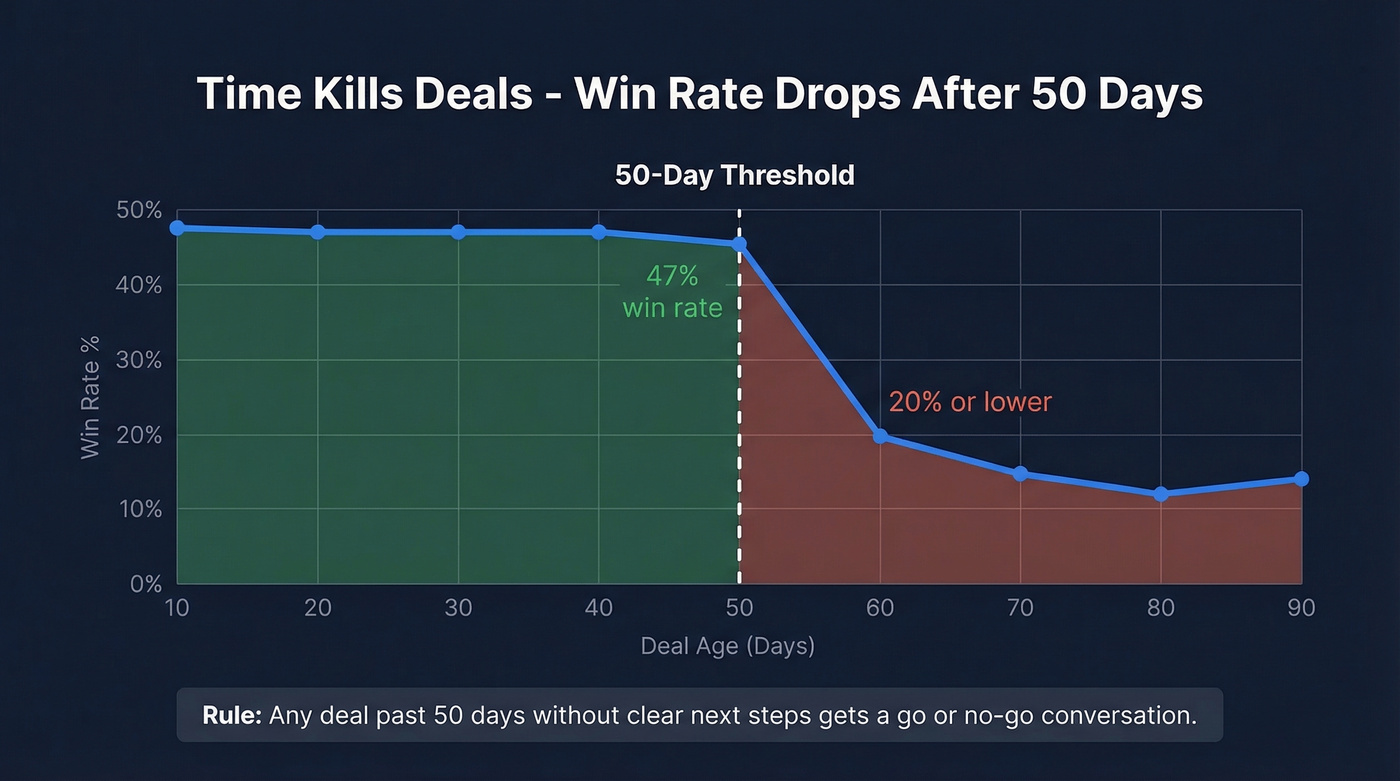
The fix isn't rushing buyers - it's eliminating dead time. Map your average deal timeline and find the gaps. Is legal review taking two weeks because nobody sent the MSA early? Send the MSA and NDA in parallel with the proposal, not sequentially. Contract friction is one of the most common cycle killers, and it's entirely self-inflicted. Are champions going dark between meetings because there's no mutual action plan? Outreach's coaching data shows deals supported by AI coaching close 11 days faster on average, with a 10 percentage-point lift in win rate for deals over $50K.
Set a hard rule: any deal past 50 days without clear next steps gets a go/no-go conversation. Either re-engage with a compelling event or move it to closed-lost. (If you’re diagnosing why deals stall, these sales pipeline challenges are usually the culprits.)
4. Clean Your Data Before You Prospect
Nobody talks about this in strategy meetings, but bad contact data is a silent win-rate killer. Bain estimates sellers spend only about 25% of their time actually selling. A huge chunk of the remaining 75% goes to finding contacts, verifying information, and dealing with bounced emails and wrong numbers.
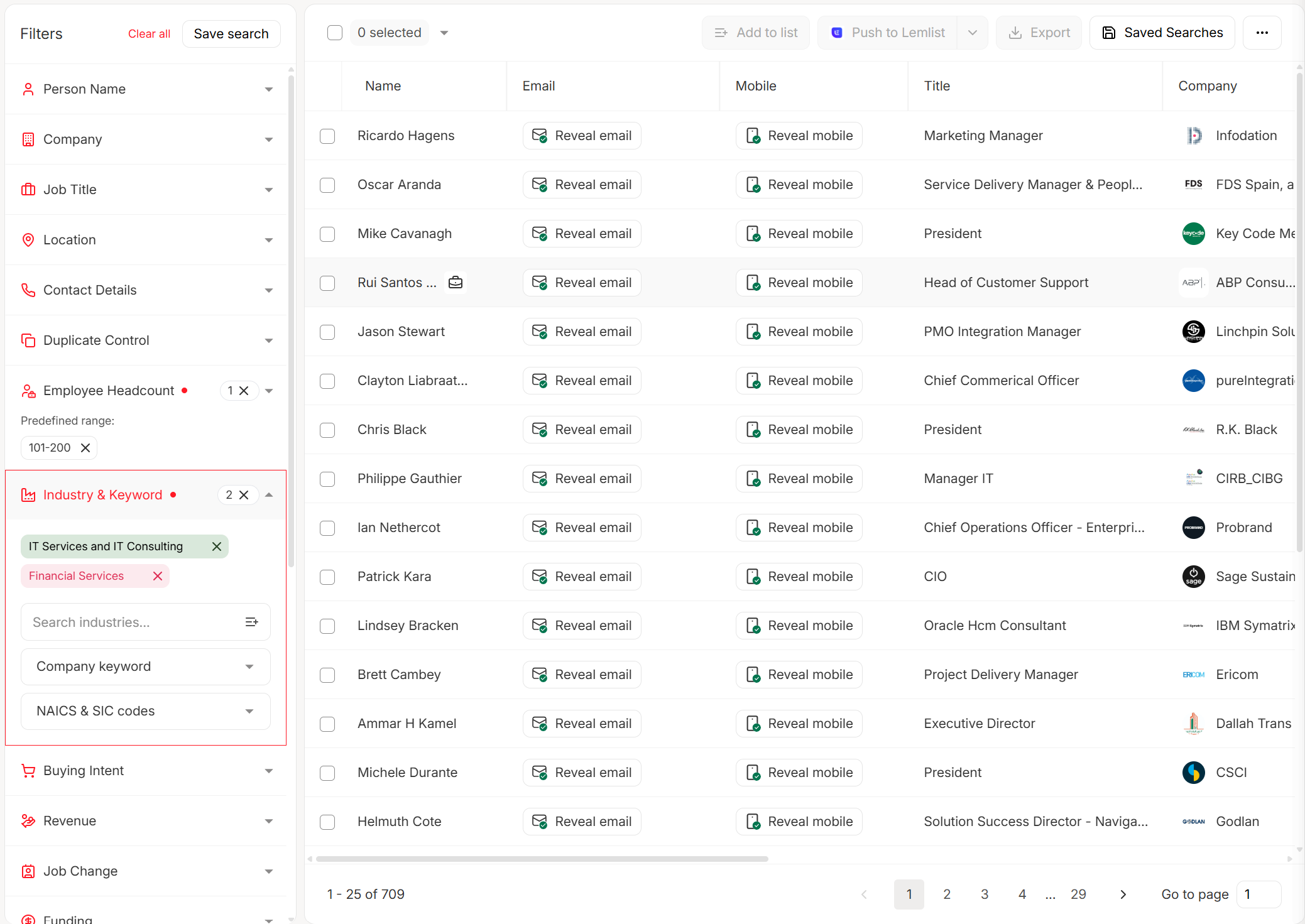
If you want to boost win rates, start by ensuring reps spend their hours on real prospects, not dead-end contacts. (For a stack-level view, compare data enrichment services and sales prospecting databases.)
5. Follow Up Relentlessly
Skip this section if your team already has automated multi-touch sequences. For everyone else: 44% of sales reps give up after a single follow-up, while 80% of sales require 5-12 follow-ups to close. Most reps are quitting right when persistence would start paying off.
Speed matters just as much as persistence. Leads are 9x more likely to convert when contacted within five minutes of expressing interest. The first vendor to respond wins 35-50% of the time. If your team takes 24 hours to follow up on an inbound lead, you've already lost to the competitor who called in four minutes.
Build follow-up cadences that are systematic, not heroic. The fifth email shouldn't be "just checking in." It should share a relevant case study, a competitive insight, or a specific ROI calculation tied to their use case. (If you want copy you can paste, use these sales follow-up templates.)
6. Run Real Win/Loss Analysis
60% of sellers are partially or completely wrong about why they lost a deal. And Salesforce's own data shows 91% of CRM data is incomplete, with 70% becoming inaccurate annually. So when your VP of Sales pulls up the "closed-lost reasons" report, they're looking at fiction.
Real win/loss analysis means talking to buyers - the ones who chose you and the ones who didn't. Klue outlines a four-stage maturity model that most teams never get past stage one: CRM dropdown reasons filled in by reps who are already working the next deal. Stage four is systematic buyer interviews with regular reviews and measurable actions tied to findings. The gap between "we think we lost on price" and "the buyer says our champion left mid-cycle and nobody re-engaged the new stakeholder" is the gap between guessing and knowing.
While you're at it, build competitive battlecards. Reps who can articulate why they win against specific competitors close at measurably higher rates than reps who wing it. (Here’s a practical guide to Sales Battle Cards.)
7. Use AI to Reclaim Selling Time
If sellers only spend 25% of their time selling, the biggest win-rate lever might be giving reps their time back. Bain estimates AI can drive 30%+ improvement in win rates by improving conversion at each funnel step and automating the non-selling work that eats most of a rep's day.
45% of teams are already running a hybrid AI-SDR model. AI handles initial outreach, qualification signals, and data enrichment while human reps focus on discovery, relationship-building, and closing. The teams that resist this shift aren't preserving the "human touch" - they're preserving the 75% of rep time spent on tasks a machine does better. (If you’re evaluating tooling, start with SDR tools and AI agents for sales.)
Look, AI won't fix a broken sales process. But if your process is sound and your reps are drowning in admin, it's the fastest path to more selling hours per rep per week. More selling hours applied to a clean pipeline is how you move the needle on deal conversion all quarter.
Case Study: 18% to 36% in 6 Months
TechVantage, a 50-rep B2B SaaS company, was sitting at an 18% win rate with a 60-day average sales cycle. The waste was staggering: 787 closed-lost deals in a single quarter, each consuming an average of 2.5 hours of rep time. That's 1,968 hours - 49 full work weeks - spent on deals that never closed.
The diagnosis revealed 72% of their pipeline was never going to close. The deals weren't lost at the negotiation table. They were lost at the top of the funnel: bad ICP matching, unverified contacts, and prospects who were never a fit. (If you need a scoring rubric, use an ideal customer profile template.)
The fix was upstream, not downstream. TechVantage tightened ICP criteria, implemented MEDDIC qualification, and cleaned their prospect data. Within six months, win rate hit 36%, deal cycles compressed from 60 to 47 days, and the team generated $3.2M in incremental ARR. Their playbook is a blueprint for improving sales win rates without hiring a single additional rep.
Mistakes That Kill Win Rates
Tracking a single blended number. Your inbound win rate and outbound win rate are completely different metrics. Blending them hides the real story. Segment by source, deal size, rep, and market segment - or you're flying blind. (A good starting point is tracking funnel metrics.)
Over-focusing on pipeline generated. SaaStr's advice for early-stage teams applies broadly: obsessing over top-of-funnel volume while ignoring later-stage conversion is how you build a big pipeline that produces small revenue.
Giving reps 11 tactics instead of 3 priorities. Every quarter, sales enablement rolls out a new playbook, a new framework, a new tool. Reps can't absorb all of it. Pick three things. Execute them well. Measure. Then iterate.
Relying on CRM dropdown loss reasons. We've covered this, but it bears repeating: 60% of reps are wrong about why they lost. If your strategy is built on CRM loss codes, your strategy is built on sand. Only 5% of B2B buyers say salespeople exceed expectations - and you won't close that gap by guessing at what went wrong.
Your outbound is only as good as your data. With 300M+ profiles and verified emails at ~$0.01 each, Prospeo keeps your pipeline full.
Try it free - no credit card required
FAQ
What is a good win rate in B2B sales?
The average B2B win rate is roughly 21%. SaaS companies typically range from 20-30%, with top performers hitting 35% or higher. Enterprise deals skew lower at 20-25% because of longer cycles and more stakeholders. SMB teams often see 30-40%.
How do you calculate sales win rate?
Win rate equals won opportunities divided by total closed opportunities (won plus lost), multiplied by 100%. Exclude open or stalled deals from the denominator. This isolates competitive effectiveness rather than pipeline throughput.
What's the difference between win rate and close rate?
Win rate measures won deals versus total decided deals (won plus lost). Close rate includes open opportunities in the denominator, making it a broader pipeline metric. Win rate is the sharper number for evaluating competitive performance.
What's the fastest way to improve sales win rates?
Disqualify faster. Implement MEDDIC, clean your contact data with a verified provider like Prospeo so reps reach actual decision-makers, and set a hard 50-day threshold for stalled deals. Teams that execute all three routinely see 10+ point improvements within a quarter.
How often should you measure win rate?
Monthly for trend tracking, quarterly for strategic decisions. Always segment by deal size, source, rep, and market segment. A blended number hides critical disparities - your inbound and outbound win rates likely tell very different stories.