

How to Follow Up on an Email Without Sounding Pushy or Passive-Aggressive
You've typed "kindly" and deleted it twice. Figuring out how to kindly follow up on an email shouldn't be this hard - but something about that word on screen reads... off. You're not wrong, and the fix is simpler than you think.
The Quick Version
- Drop "kindly." It reads as passive-aggressive to most native English speakers. Use direct, specific phrasing instead.
- Follow up 2-3 times max, spaced 2-5 business days apart. You've probably seen the claim that 80% of sales require five or more follow-ups. A dataset of 16.5M cold emails across 93 business domains tells a different story - the highest reply rate (8.4%) comes from a single email, and reply rates decline with each additional message. Once you hit 4+ emails in a sequence, unsubscribe and spam complaint rates more than triple.
- If you're getting zero replies, the problem might not be your wording - the email address could be invalid. Verify it before rewriting your follow-up for the fifth time.
Should You Actually Use "Kindly"?
Short answer: not if you're emailing someone in the US, UK, or Australia.
The word "kindly" has a specific problem. When you write "I just wanted to kindly follow up," you're modifying your own action - not making a request. As one r/etiquette poster observed, that construction sounds condescending because you're describing how gracious you are, not asking for anything specific. It gets worse when "kindly" replaces "please" entirely. An r/ENGLISH discussion nailed the reaction: it feels jarring, almost passive-aggressive, as if you're implying the recipient hasn't been kind enough already.
Here's the cultural nuance that matters. In South Asian business English, "kindly" is standard and expected - it's the default polite register. In American, British, and Australian business contexts, it lands differently. Writing to someone in Mumbai or Bangalore? "Kindly" is perfectly fine. Writing to someone in Chicago or London? Swap it out.
The verdict: replace "kindly" with something specific. Tell them what you need, not how graciously you're asking.
Phrases That Work Better
| Phrase | Tone | Best For |
|---|---|---|
| Wanted to check in on [specific thing] | Casual | Colleagues, warm contacts |
| Any update on [topic]? No rush | Relaxed | Networking, non-urgent asks |
| I'm trying to finalize [X] - does [option] work? | Direct | Sales, scheduling |
| Circling back on [topic] - let me know if anything's changed | Professional | Proposals, partnerships |
| Quick follow-up: [one-line summary of ask] | Efficient | Busy executives |
| Just bumping this up - [reason it matters now] | Casual-direct | Internal requests |
| Would [date] work for a quick call? Happy to adjust | Warm-direct | Meeting requests |
The r/sales community's go-to line is worth stealing: "I'm trying to finalize my schedule for next week - wanted to know if [date] worked for you?" It works because it gives a reason for the follow-up and makes replying easy.
One more thing: consider dropping the word "follow-up" from your subject line entirely. It can feel accusatory, as if you're blaming the recipient for not replying. "Quick question re: Q3 proposal" tends to perform better than "Following up on Q3 proposal." If you want more options, browse these email subject line examples.
When to Send Your Follow-Up
Timing matters more than most people realize. In Belkins' 16.5M-email dataset, the highest reply rate - 8.4% - comes from a sequence with a single email. Each additional follow-up sees diminishing returns, and company size changes the math significantly. (For a deeper timing breakdown, see When Should You Follow Up on an Email?.)
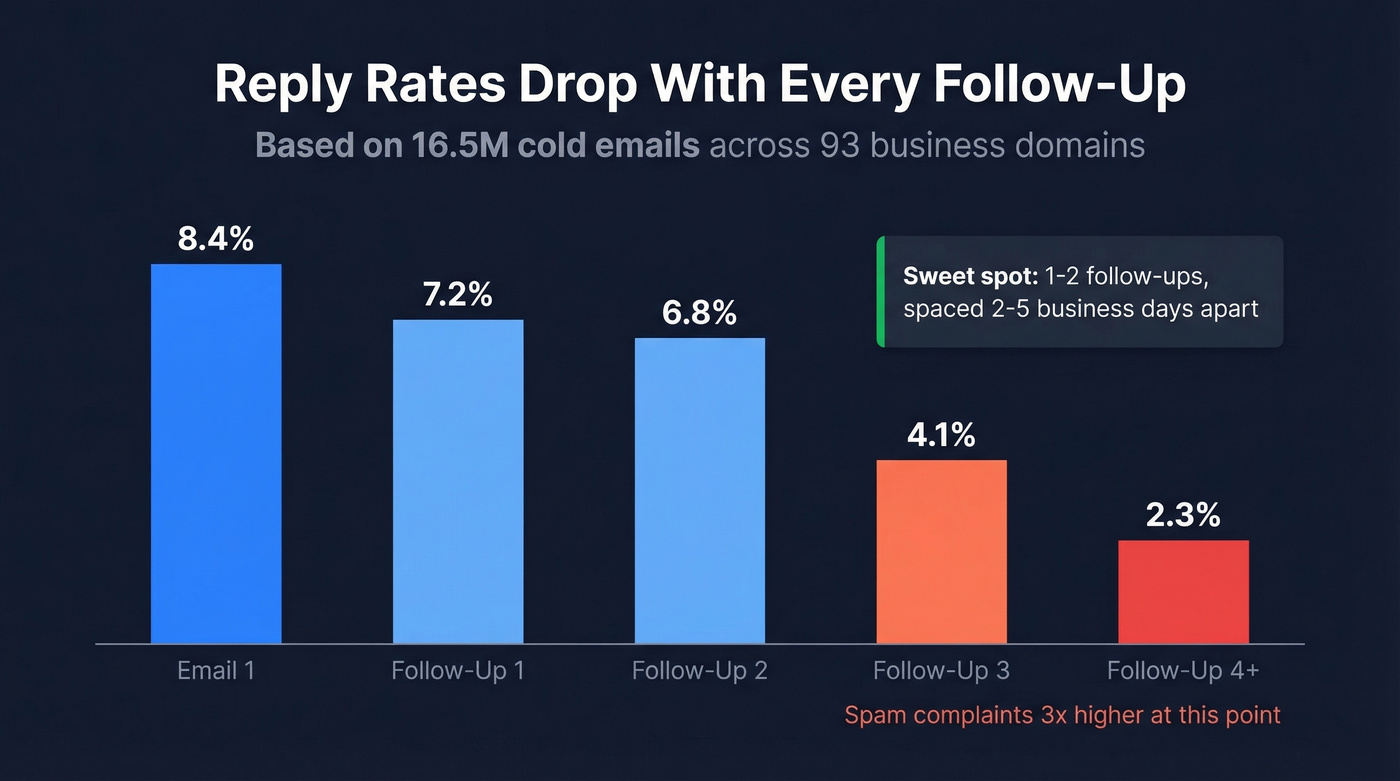
Small businesses (2-50 employees) tolerate follow-ups better. Initial emails pull a 9.2% reply rate, the first follow-up drops to 8.0%, and the second actually ticks back up to 8.4%. Enterprise contacts drop off faster - they're allergic to persistence.
| Scenario | First Follow-Up | Second Follow-Up | Stop After |
|---|---|---|---|
| Sales / business | 2-3 business days | 5-7 business days | 3rd attempt |
| Job application | 7-10 business days | 10-14 business days | 2nd attempt |
| Internal / urgent | 24-48 hours | 2-3 business days | 3rd attempt |
| Invoice / payment | 3-5 business days | 7-10 business days | Then call |
| Networking | 5-7 business days | 10-14 business days | 2nd attempt |
If you've sent three well-crafted follow-ups and heard nothing, a fourth email won't change the outcome. It'll just annoy them. If you need ready-to-send options, use these sales follow-up templates.

Zero replies after three follow-ups? The problem might not be your wording - it might be a dead email address. Prospeo's 5-step verification catches invalid emails before you send, keeping your bounce rate under 4% and your domain reputation intact.
Stop perfecting follow-ups to inboxes that don't exist.
Anatomy of a Follow-Up That Gets Replies
Every effective follow-up has four parts. We've tested dozens of follow-up sequences over the years, and the specific words matter far less than this structure. (If you're building a repeatable process, this sequence management guide helps.)
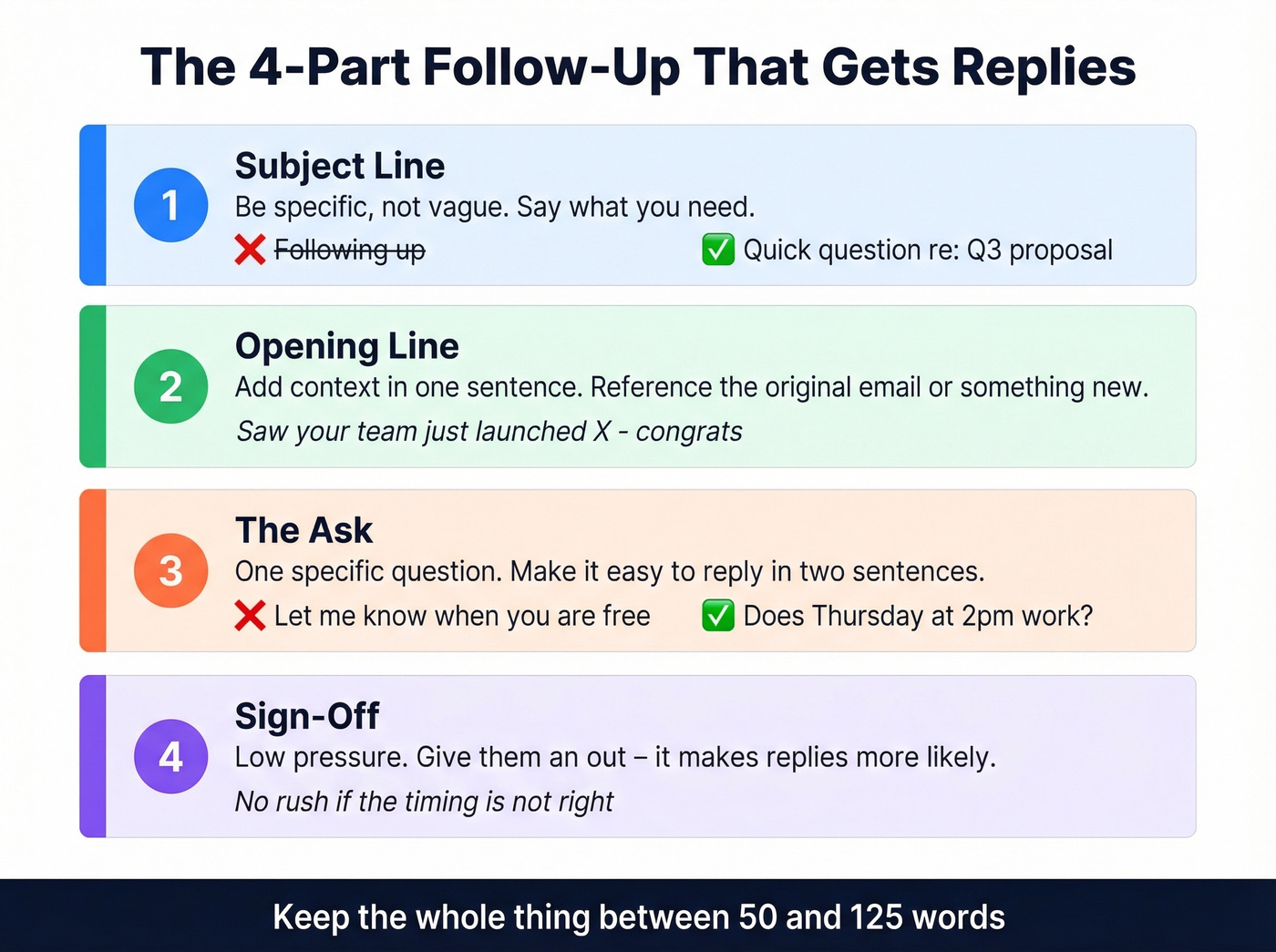
Subject line: HBR recommends subject lines that are as clear as possible and explicitly communicate purpose plus desired action. "Following up" tells the reader nothing. "Quick question re: Q3 proposal" tells them exactly what you need.
Opening line: Reference the original email or add something new. "Per our conversation last Tuesday" or "Saw your team just launched X - congrats" both work. The goal is context in one sentence.
The ask: One specific question, not an open-ended "thoughts?" Make it easy to reply in two sentences or less. "Does Thursday at 2pm work?" beats "Let me know when you're free" every single time. If you're trying to book time, use this email wording to schedule a meeting framework.
Sign-off: Low pressure. "No rush if the timing isn't right" or "Happy to adjust if this week doesn't work" gives them an out - which, counterintuitively, makes them more likely to respond.
Keep the whole thing between 50 and 125 words. Anything longer and you're writing a new email, not a follow-up. If you want to iterate on tone quickly, paste your draft into ChatGPT and ask it to make the email shorter and more direct - it's surprisingly good at trimming filler.
Follow-Up Templates by Scenario
After No Response (Casual)
Hi [Name], wanted to check in on [topic from original email]. Any update? No rush - just want to make sure this didn't get buried. [Your name]
After No Response (Formal)
Hi [Name], I'm following up on my [date] email regarding [specific topic]. I'd appreciate any update when you have a moment. Happy to provide additional context if helpful. Best, [Your name]
After a Meeting or Call
Hi [Name], great speaking with you on [day]. To recap: [key point], and you mentioned [their priority]. I've attached [resource]. Would [specific next step] work for you? [Your name]
After Sending a Proposal
Hi [Name], circling back on the proposal I sent [date]. I know these decisions take time - just wanted to see if any questions came up. Happy to hop on a quick call to walk through the numbers. [Your name]
Job Application
Hi [Name], I applied for the [role] position on [date] and wanted to express my continued interest. I'm particularly excited about [specific thing about the company]. Let me know if there's any additional information I can provide. Best, [Your name]
Invoice or Payment
Invoice #[number] - [amount] - sent [date].
Hi [Name], could you confirm this was received and let me know the expected payment timeline? Happy to resend if needed. Thanks, [Your name]
Internal Request
[Name] - need [specific thing] to move forward on [project]. Can you get this to me by [date]? Let me know if there's a blocker. Thanks, [Your name]
The Breakup Email
Hi [Name], I've reached out a couple of times about [topic] and haven't heard back. I'll close this out on my end - feel free to reach out if things change. [Your name]
Breakup emails work because giving someone explicit permission to say no reduces pressure, which often triggers a reply. Skip this template if you're following up on a job application - it reads as presumptuous when you're the one asking for something.
Mistakes That Kill Your Reply Rate
"Just following up" as your opener. It adds zero value and signals you have nothing new to say. Lead with a reason or new information instead. If you catch yourself writing "checking in," use these alternatives for just checking in professionally.
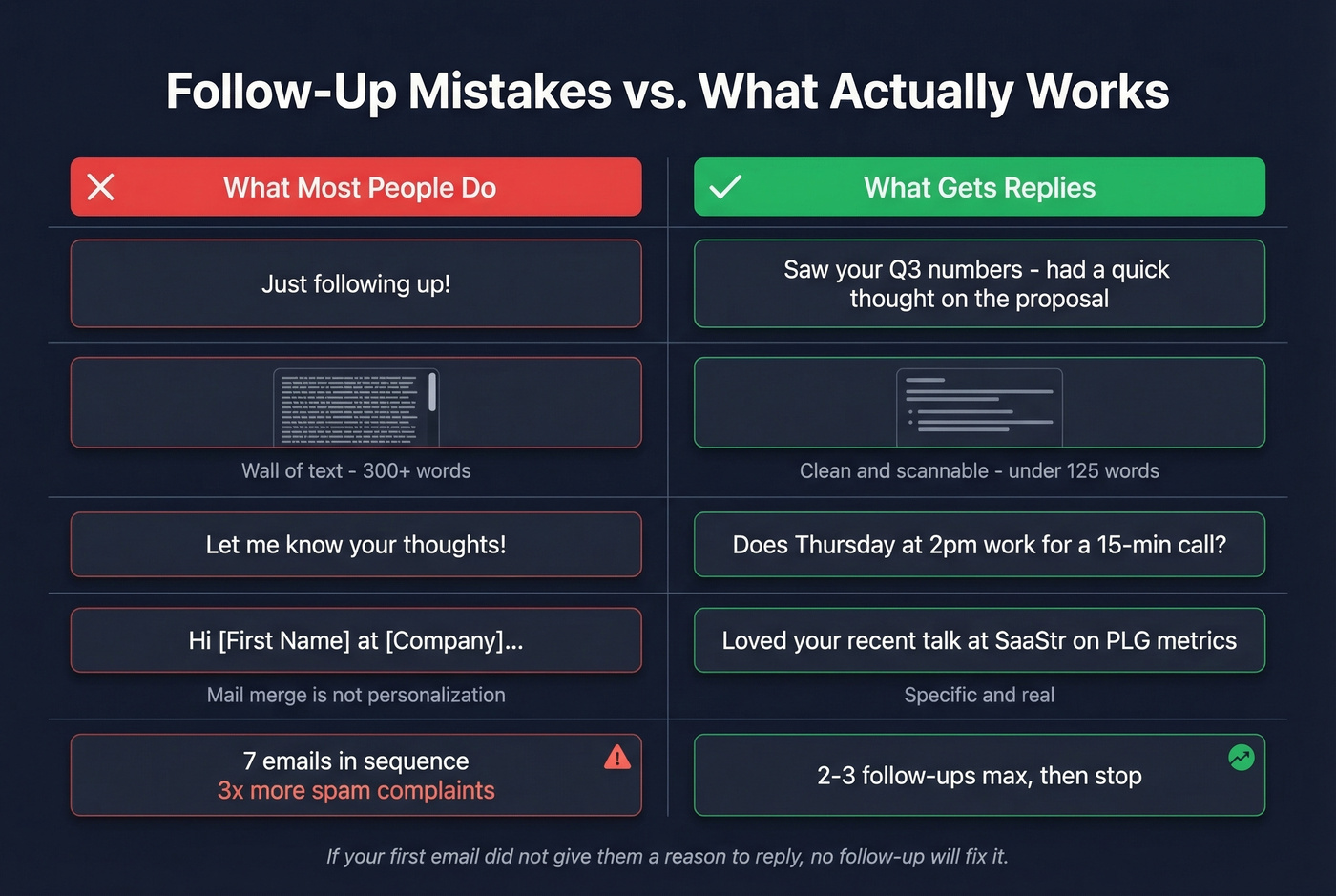
Wall of text. If your follow-up requires scrolling, it's too long. Keep it under 125 words with clear line breaks.
No clear ask. If the reader doesn't know what you want, they won't reply. End with one specific question.
Surface-level personalization. Dropping in [First Name] and [Company] isn't personalization - it's mail merge. Reference something specific: a recent launch, a shared connection, a detail from your last conversation. The Woodpecker blog has good examples of what real personalization looks like in follow-ups. For a more systematic approach, see our guide to personalized outreach.
Following up too many times. Four or more emails in a sequence more than triples unsubscribe and spam complaint rates. Cap at three follow-ups, then move on.
Let's be honest: most people obsess over follow-up wording when the real problem is they're following up on weak first emails. If your initial email didn't give someone a compelling reason to reply, no amount of polite nudging will fix it. Rewrite email one before you write email two. (This email copywriting guide can help.)
Respectful Follow-Ups Across Cultures
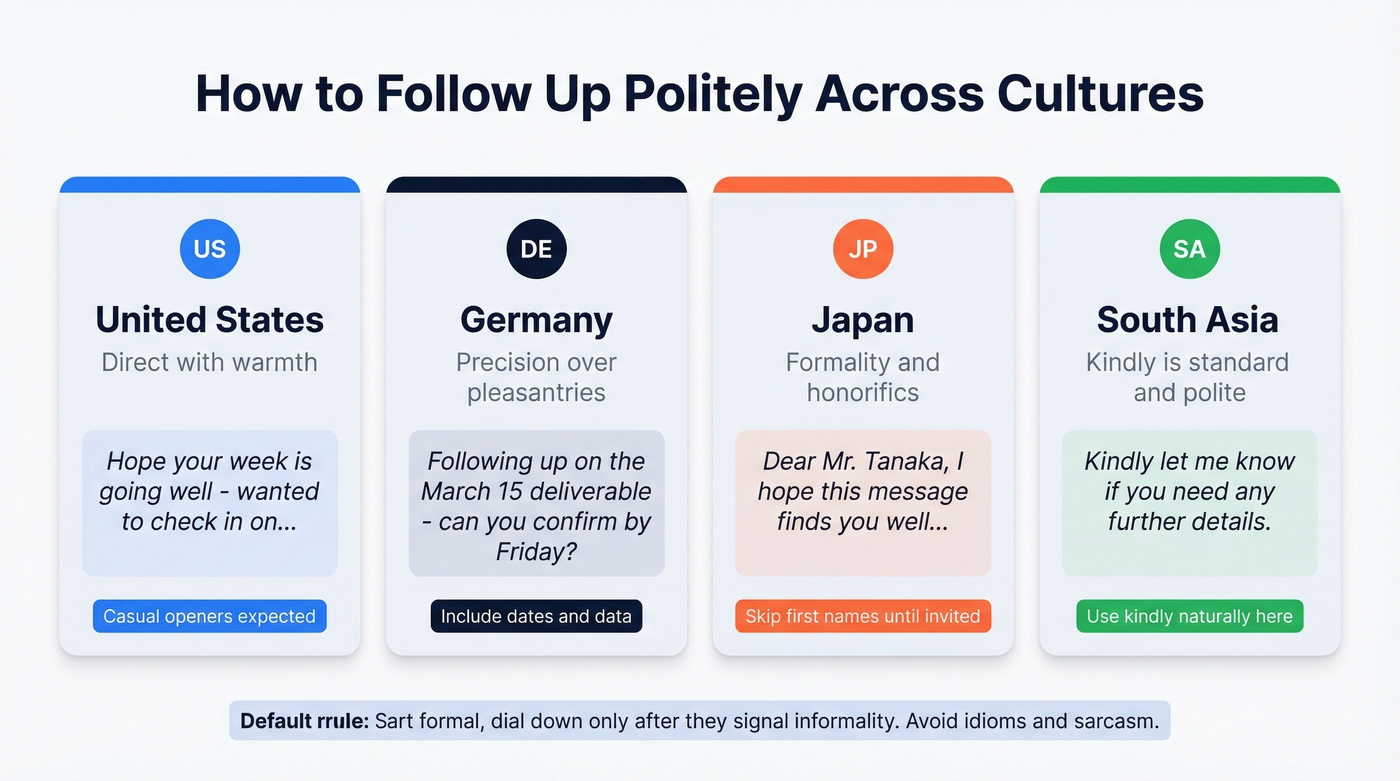
Your follow-up style should shift based on who's receiving it.
| Region | Expectation | Example Adjustment |
|---|---|---|
| US | Directness with warmth | "Hope your week's going well" opener is standard |
| Germany | Precision over pleasantries | Include specific dates, data, deliverables |
| Japan | Formality and honorifics | "Dear Mr. Tanaka" - skip first names until invited |
| South Asia | "Kindly" is standard register | Use it naturally; it's expected and polite |
The default rule from businessemailetiquette.com holds: start with the highest level of formality and dial it down only after the other party signals informality. Avoid idioms and sarcasm entirely - they don't translate. Following up nicely across cultures is less about specific words and more about matching the recipient's communication norms.
Still No Reply? Check the Address
Here's something most follow-up guides skip entirely. Silence doesn't always mean "not interested." Sometimes it means the email bounced, landed in spam, or went to an address that no longer exists.
Before you rewrite your polite follow-up for the fifth time, verify the address is actually valid. In our experience, bad contact data is the silent killer of outreach campaigns - we've seen teams rewrite sequences three or four times before realizing half their list was dead addresses. Prospeo's real-time email verification catches invalid addresses with 98% accuracy, and the free tier gives you 75 verifications per month. It takes seconds and eliminates the "did they even get my email?" variable entirely. If you're troubleshooting bounces, start with email bounce rate benchmarks and fixes.
If email follow-ups aren't landing at all, consider adding a second touchpoint alongside your outreach. Data from the same 16.5M-email study shows that combining messages with profile visits on professional networks can push reply rates to 11.87%. If deliverability is the issue, use an email deliverability guide to diagnose the root cause.

You just crafted the perfect follow-up - direct, specific, no "kindly" in sight. Now make sure it reaches a real person. Prospeo gives you 98% accurate emails and verified direct dials for 300M+ professionals, so your carefully written messages actually land.
Great copy deserves a real inbox. Find verified contacts at $0.01 each.
FAQ
How long should I wait before following up?
Two to three business days for sales emails, seven to 10 for job applications, and 24-48 hours for urgent internal requests. Match the urgency - too soon reads as impatient, too late and they've forgotten the context entirely.
How many follow-ups is too many?
Two to three is the ceiling for most scenarios. Reply rates decline after the first email, and four or more messages more than triples unsubscribe and spam complaint rates. Send a breakup email after your third attempt and move on.
What's a nice way to follow up without being annoying?
Reference something specific from your last exchange, add a new piece of value or context, and give the recipient an easy out. Saying "No rush if the timing isn't right" paradoxically makes people more likely to respond because it removes pressure.
Is "just checking in" a good opener?
No - it signals you have nothing new to say. Lead with a reason: a deadline, a new data point, or a simpler way to respond. Even a brief "Saw [relevant news] and thought of our conversation" adds more value than a generic check-in.
What if my follow-ups consistently get no replies?
The problem is often bad data, not bad wording. Verify the email address is valid - tools like Prospeo catch dead addresses in seconds with 98% accuracy and a free tier of 75 verifications per month. Also check your sender reputation with a deliverability tool and make sure you're not landing in spam. Fix the plumbing before you rewrite the message.