

How to Make Sales Calls Over the Phone: Scripts, Benchmarks, and the Framework That Works
Most phone sales guides hand you 25 generic tips and call it a day. Here's what actually moves the needle: the biggest variable isn't your script - it's your data. 87% of Americans ignore calls from unknown numbers, and 80% of cold calls go straight to voicemail. Dial unverified numbers and you're mostly talking to dead air.
We've spent years watching teams grind through hundreds of dials a day with nothing to show for it. The fix isn't more calls. It's better numbers.
What You Need Before Dialing
Verified phone numbers, a 90-second permission-based opener, and five rehearsed objection responses. Call Tuesday through Thursday between 8-11 AM local time. Everything else is optimization.
2026 Phone Sales Benchmarks
Know what "good" looks like before you touch a script.
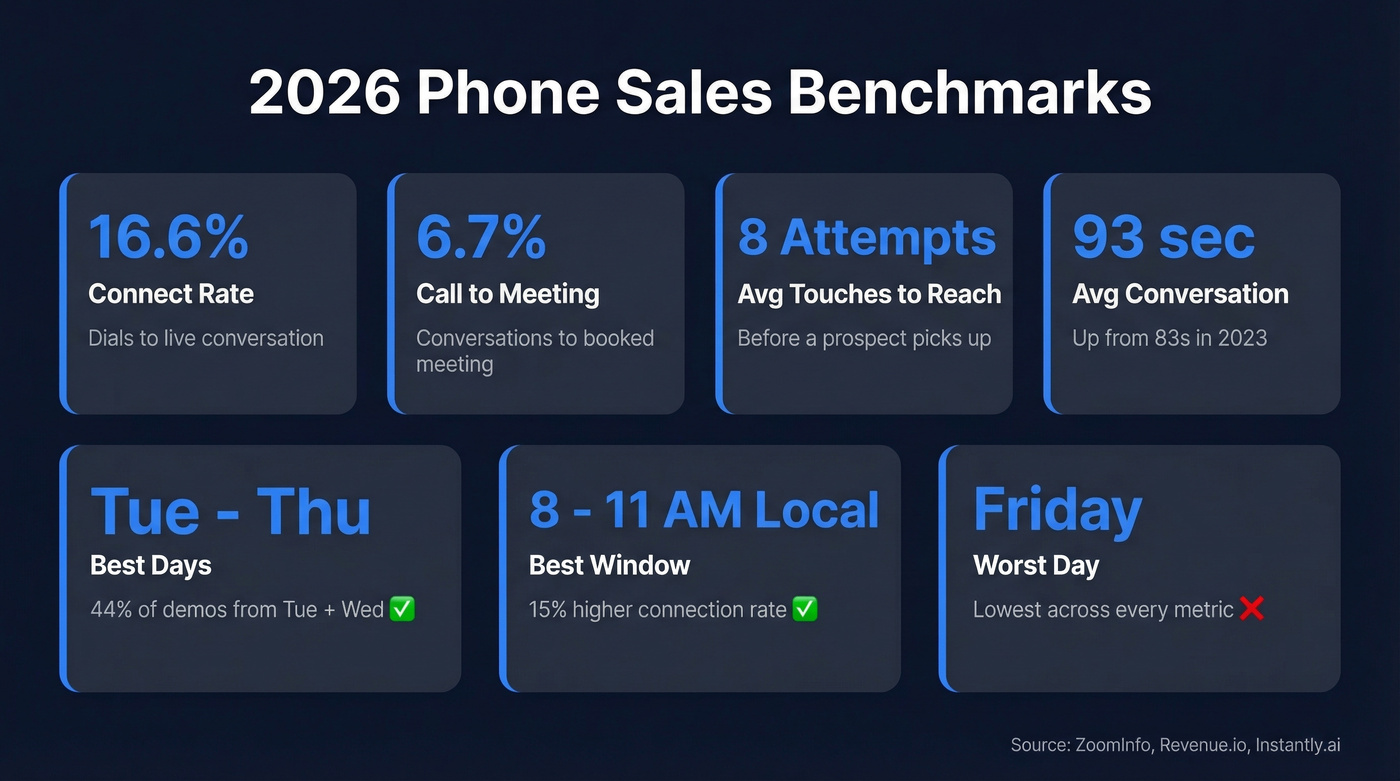
| Metric | Benchmark | Context |
|---|---|---|
| Connect rate | 16.6% | Dials to live conversation |
| Call-to-meeting | 6.7% | Conversations to booked meeting |
| Attempts to reach | 8 | Average before a prospect picks up |
| Avg conversation | 93 seconds | Up from 83s in 2023 |
| Best days | Tue-Thu | 44% of demos from Tuesday + Wednesday, per a 1.4M-call study |
| Best window | 8-11 AM local | 15% higher connection; some data shows a secondary 4-5 PM peak |
| Worst day | Friday | Lowest across every metric |
Mid-week mornings are your money window. Friday afternoon dials are charity work.
Before You Dial
Three things separate productive call blocks from wasted ones.
Research the prospect. Know the company, the contact's role, and one industry pain point. Reps who skip research talk too much and ask nothing useful - they're pitching into a void. If you need a tighter system, borrow a few sales prospecting techniques that force pre-call focus.
Verify your data. If 80% of your calls hit voicemail and most prospects ignore unknown numbers, list quality is the single lever that changes everything. One team we work with, Meritt, tripled their connect rate to 20-25% after switching to verified mobile data refreshed every seven days instead of the industry-standard six weeks. That's not a marginal improvement - it's a different game entirely. This is also where data enrichment services can help you fill gaps before you dial.
Set a call goal. Every dial needs a defined next step: a meeting, a referral, or a qualification answer. "Just checking in" isn't a goal (and if you catch yourself using it, here's how to say just checking in professionally).
Scripts That Actually Work
Scripts are guardrails, not teleprompter copy. Here are four you'll use constantly.
Cold Call Opener
Under 10 seconds. Permission-based openers give the prospect control, which keeps them on the line longer than you'd expect.
"Have you got 30 seconds for me to explain why I'm calling?"
A simple tweak that often helps: use first name plus company in your opener ("Hey Sarah, it's Mike at Acme") so you sound natural instead of like you're reading off a screen. If they say yes, you've earned attention. If no, ask when's better.
Gatekeeper Script
Ask the gatekeeper's name. Use it. Then:
"What's the best way to make that happen?"
This reframes the gatekeeper as an ally. Don't try to sneak past them - they'll remember, and they'll block you next time too.
Voicemail Script
Only 4.8% of cold voicemails get returned, but pairing a voicemail with a follow-up email can double email response rates.
"Hi [Name], it's [You] at [Company]. I'm calling because [one specific reason]. I'll send a quick email - my number is [number], that's [repeat number]."
Under 20 seconds. One reason. Repeat the number.
The "Send Me an Email" Pivot
This is almost always a brush-off.
"Happy to - could I ask one quick question first so I send you the right thing?"
That one question buys you 30 more seconds, often enough to surface real interest or disqualify cleanly. If you want to tighten the follow-through, keep a few sales follow-up templates ready so you can send the email immediately after the call.

Your script doesn't matter if nobody picks up. Prospeo gives you 125M+ verified mobile numbers refreshed every 7 days - not the 6-week-old data most providers sell. Meritt tripled their connect rate to 20-25% after switching. At $0.10 per mobile, one live conversation pays for hundreds of numbers.
Stop dialing dead numbers. Start reaching real buyers.
During the Call
The best framework maps like this: Discovery Question, Surface Pain, Deeper Pain, Value Prop, Customer Story. Each step earns the next. (If you want a deeper bank of prompts, pull from these discovery questions.)
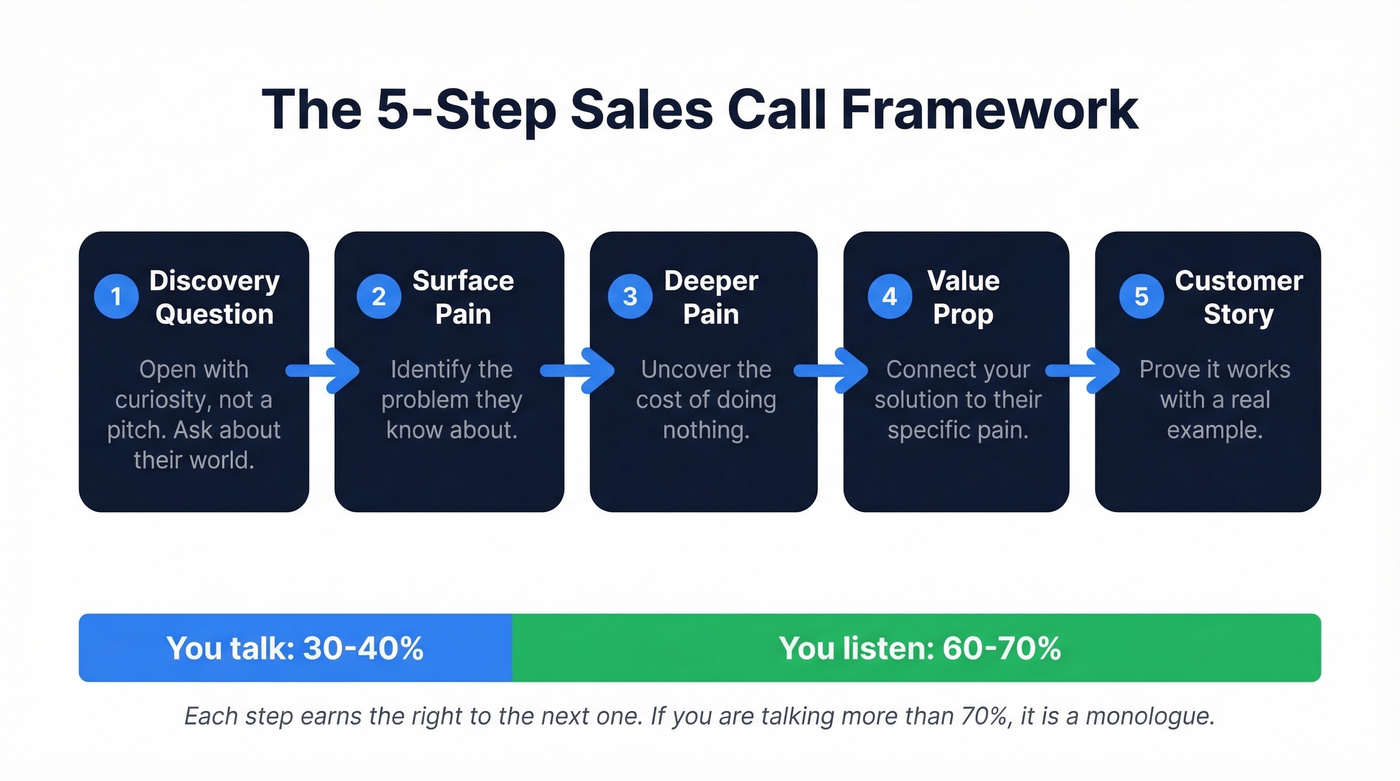
Talk 30-40% of the time. Listen 60-70%. If you're talking more than 70%, it's a monologue, not a conversation. Your intro should be under 10 seconds, then pivot to questions. Tone matters more than word choice here - a warm, confident delivery outperforms a perfect script read in monotone every single time.
When a prospect asks about pricing or implementation, reverse the question: "Great question - what's driving that?" Understanding why they're asking matters more than the answer itself.
Discuss budget early. It feels uncomfortable, but it saves both of you from a 30-minute call that ends with "we don't have budget this quarter." Record your calls and review them weekly. Most reps overestimate how much they listen.
Here's a strong opinion from our team: if your average deal size is under $10K, you probably don't need a 45-minute discovery call. A tight 15-minute qualifying conversation with a clear next step will outperform a bloated demo every time. The consensus on r/sales backs this up - shorter calls, faster disqualification, more pipeline. (If your demos are still running long, use a tighter product demo checklist.)
Objection Responses
60% of cold calls hit "I'm not interested." That's not a real objection - it's a reflex. Real objections are concerns worth addressing. Reflexive shields like "I'm busy" need a different approach: acknowledge, offer a tight time commitment, then deliver value fast. If this is a recurring issue, work on how to reduce sales objection rate across your first 30 seconds.
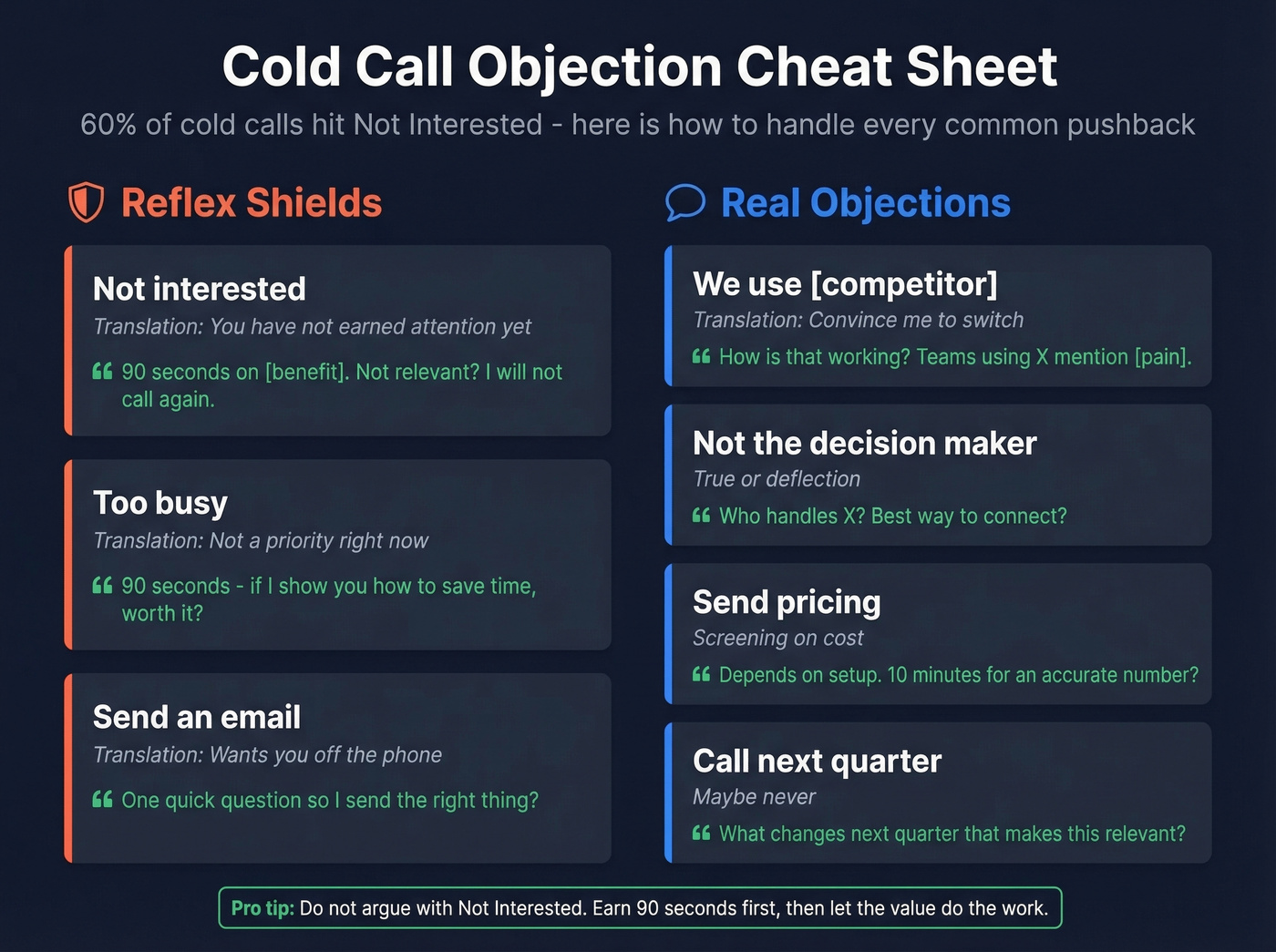
| Objection | What It Means | Your Response |
|---|---|---|
| "Not interested" | Haven't earned attention | "90 seconds on [benefit]. Not relevant? I won't call again." |
| "Too busy" | Not a priority | "90 seconds - if I show you how to [save time], worth it?" |
| "Send an email" | Wants you off the phone | "One quick question so I send the right thing?" |
| "We use [competitor]" | Convince me to switch | "How's that working? Teams using [X] mention [pain]." |
| "Not the decision maker" | True or deflection | "Who handles [X]? What's the best way to connect?" |
| "Send pricing" | Screening on cost | "Depends on setup. 10 minutes for an accurate number?" |
| "Call next quarter" | Maybe never | "What changes next quarter that makes this relevant?" |
Skip the urge to argue with "not interested." You haven't earned the right to push back yet - earn 90 seconds first, then let the value do the work.
After the Call
Three non-negotiables:
- Lock a next step before hanging up. A calendar invite, not a vague "let's circle back."
- Follow up within 24 hours. Voicemail plus email combo can double email response rates. Send the email even if they picked up. (If you're unsure about timing, use this guide on when should i follow up on an email.)
- Log it in your CRM. Notes, outcome, next action. If it's not in the CRM, it didn't happen. If your CRM hygiene is messy, start with a simple contact management software setup.
Structure your call blocks: 5 minutes of prep, 45 minutes of dials, 10 minutes of CRM notes. Sixty minutes, no context-switching. If you're hitting voicemail on 80%+ of dials, the problem isn't your timing - it's your list. That's a data quality problem, and no amount of script optimization fixes bad numbers.
Every benchmark in this guide improves when your data is fresh. Prospeo's 7-day refresh cycle and 30% mobile pickup rate mean fewer voicemails, more conversations, and call blocks that actually produce pipeline. GreyScout went from 38% bounce to under 4% and grew pipeline 140%.
Turn your next call block into booked meetings, not dead air.
Compliance Checklist
TCPA lawsuits surged ~95% year-over-year, and at least 15 states enforce mini-TCPA statutes. A single violation costs $500-$1,500 per call. Don't treat this as a footnote. (If you're considering adding SMS touches, read up on cold texting compliance first.)
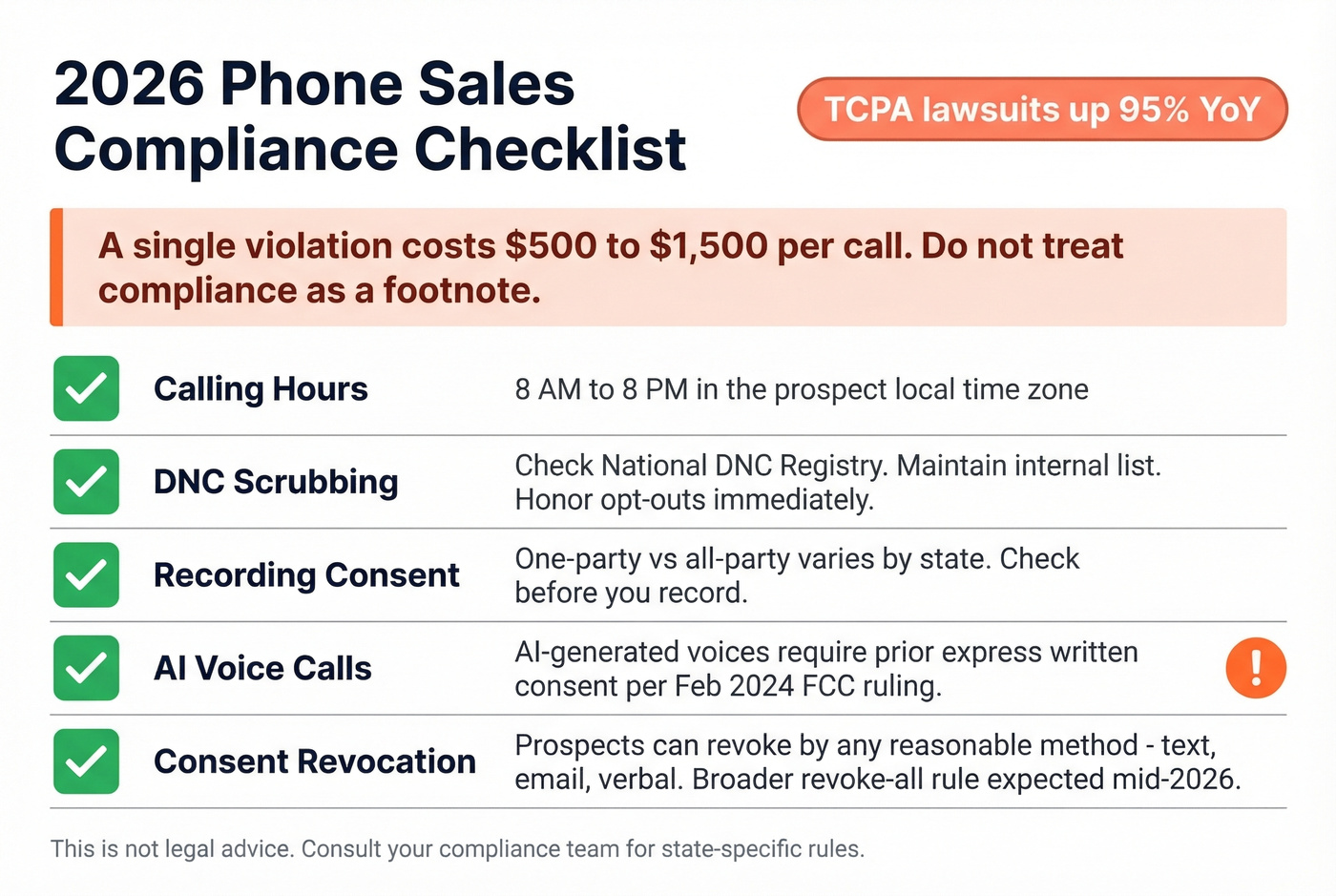
- Calling hours: 8 AM-8 PM in the prospect's local time zone.
- DNC scrubbing: Check the National DNC Registry. Maintain an internal list. Honor opt-outs immediately.
- Recording consent: One-party vs. all-party varies by state. Check before you record.
- AI voice calls: Under a February 2024 FCC ruling, AI-generated voices require prior express written consent.
- Consent revocation: Prospects can revoke consent by any reasonable method - text, email, verbal. A broader "revoke all" rule is expected by mid-2026 but remains under review.
FAQ
How many cold calls should I make per day?
Fifty to eighty quality dials. Fifty dials to verified numbers outperform 150 dials to an unverified list every time. Track decision-maker connects, not raw dial count - volume without accuracy is busy work.
What's a good cold call conversion rate?
Industry average is 6.7% call-to-meeting and 16.6% connect rate. High-performing teams with verified data consistently hit 20-25% connect rates, nearly double the benchmark.
Is cold calling still effective in 2026?
Yes. 41.2% of sales reps say the phone is their most effective tool. The shift: data quality and timing matter more than ever. Verified numbers, mid-week mornings, and a permission-based opener outperform spray-and-pray dialing by a wide margin. Let's be honest - the reps who say cold calling is dead are usually the ones dialing garbage lists and blaming the channel.