

How to Manage a Sales Team: The Operational Playbook for 2026
You just got the keys to the team. Maybe you were the top rep. Maybe you came in from outside. Either way, nobody handed you a manual - and 82% of sales leaders lack formal sales leadership training. Your reps are spending 60% of their time on non-selling tasks, 57% of sales professionals say the cycle is getting longer, your pipeline's a mess, and the CEO wants a forecast by Friday.
Here's the thing: learning how to manage a sales team isn't about motivation speeches or Slack check-ins. It's about building an operating system - repeatable structures that make good reps great and bad reps obvious. This playbook covers the operational pieces most management guides skip: comp design, cadence architecture, coaching frameworks, KPIs, and the data infrastructure that makes everything else work.
Start Here
Before you change anything, spend your first 30 days changing nothing. Observe, diagnose, then prescribe. When you're ready to act:
- Build your operating system first - a weekly cadence and 1:1 structure. Not a new tech stack. Not a new CRM. A rhythm.
- Fix comp before you fix culture - compensation is the #1 reason reps leave. If your plan doesn't retain, nothing else matters.
- Audit your data quality - if 30%+ of your emails bounce, no amount of coaching fixes pipeline. Verify a sample of your list and find out exactly how bad the problem is.
Choose Your Team Structure
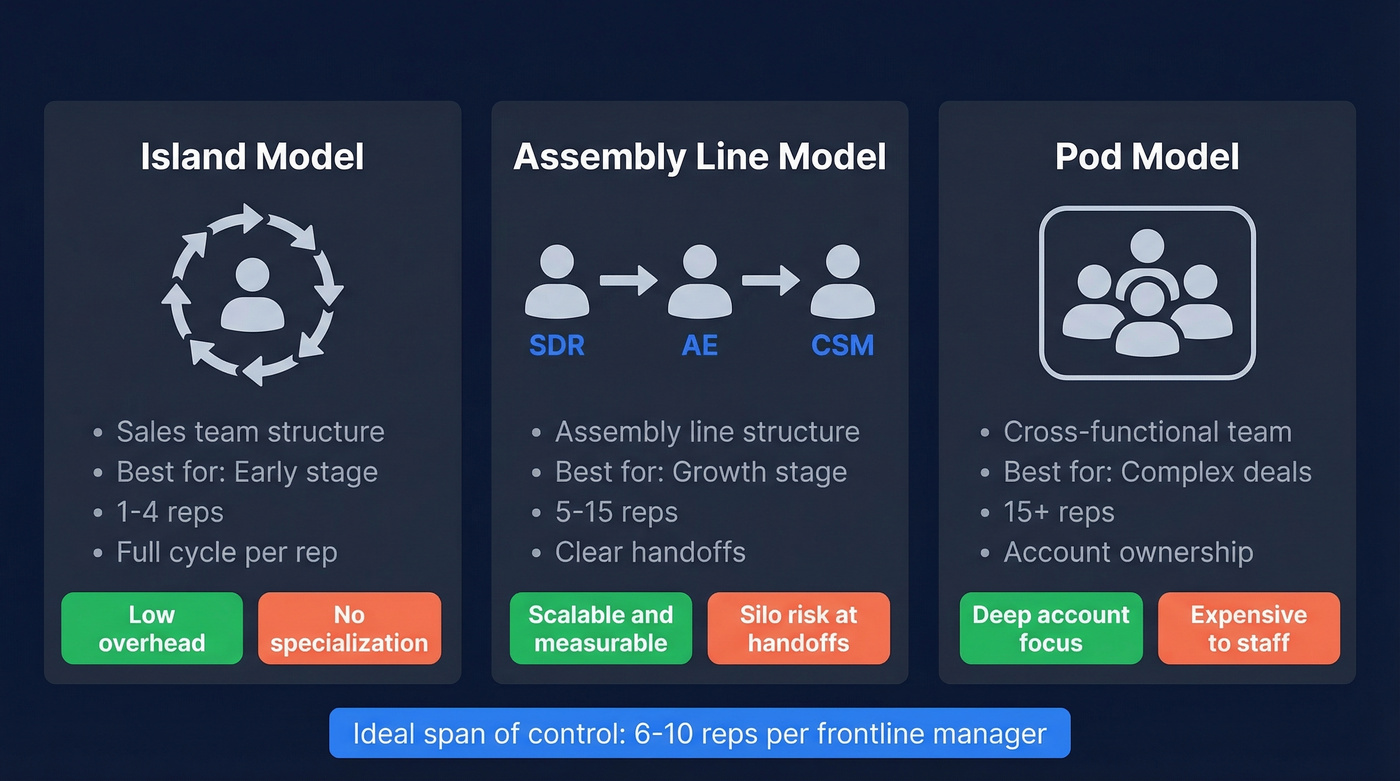
Your org structure determines how work flows, who owns what, and where deals get stuck. Three models are worth considering, and the right one depends almost entirely on headcount and deal complexity.
| Model | Best For | Headcount | Pros | Cons |
|---|---|---|---|---|
| Island | Simple product, early stage | 1-4 reps | Low overhead, autonomy | No specialization |
| Assembly Line | Growth stage, repeatable | 5-15 reps | Clear handoffs, scale | Silo risk |
| Pod | Complex deals, scaled orgs | 15+ reps | Account ownership | Expensive to staff |
Island works when you've got fewer than four reps and a straightforward product. Each rep runs the full cycle - prospecting through close. It's lean, but it doesn't scale.
Assembly Line is the default for growth-stage teams. SDRs qualify, AEs close, CSMs retain. The upside is specialization and clear metrics per stage. The downside? Finger-pointing at handoff points. "That lead wasn't qualified" is a phrase you'll hear weekly, and you'll need a clear SLA between roles to keep it from becoming toxic. (If you need a tighter definition of what “qualified” means, use a consistent framework like MEDDIC.)
Pod structures group a small cross-functional team around a set of accounts. It's the most expensive model to staff, but it creates real account ownership and works best where deal complexity justifies the overhead. If you're running 20+ reps, pods help prevent the communication breakdowns that plague flat structures.
When hiring for any of these structures, prioritize coachability and learning velocity over resume length. A hungry rep with two years of experience who implements feedback fast will outperform a ten-year veteran with calcified habits every single time, and we've seen this play out across dozens of teams we've worked with. Use structured interview scorecards - gut feel is how you end up with a team of people who remind you of yourself.
For all three models, aim for 6-10 reps per frontline manager. Enterprise teams skew toward 6; SMB and transactional teams can push toward 10. Go beyond that and coaching quality collapses.
Design a Comp Plan That Retains
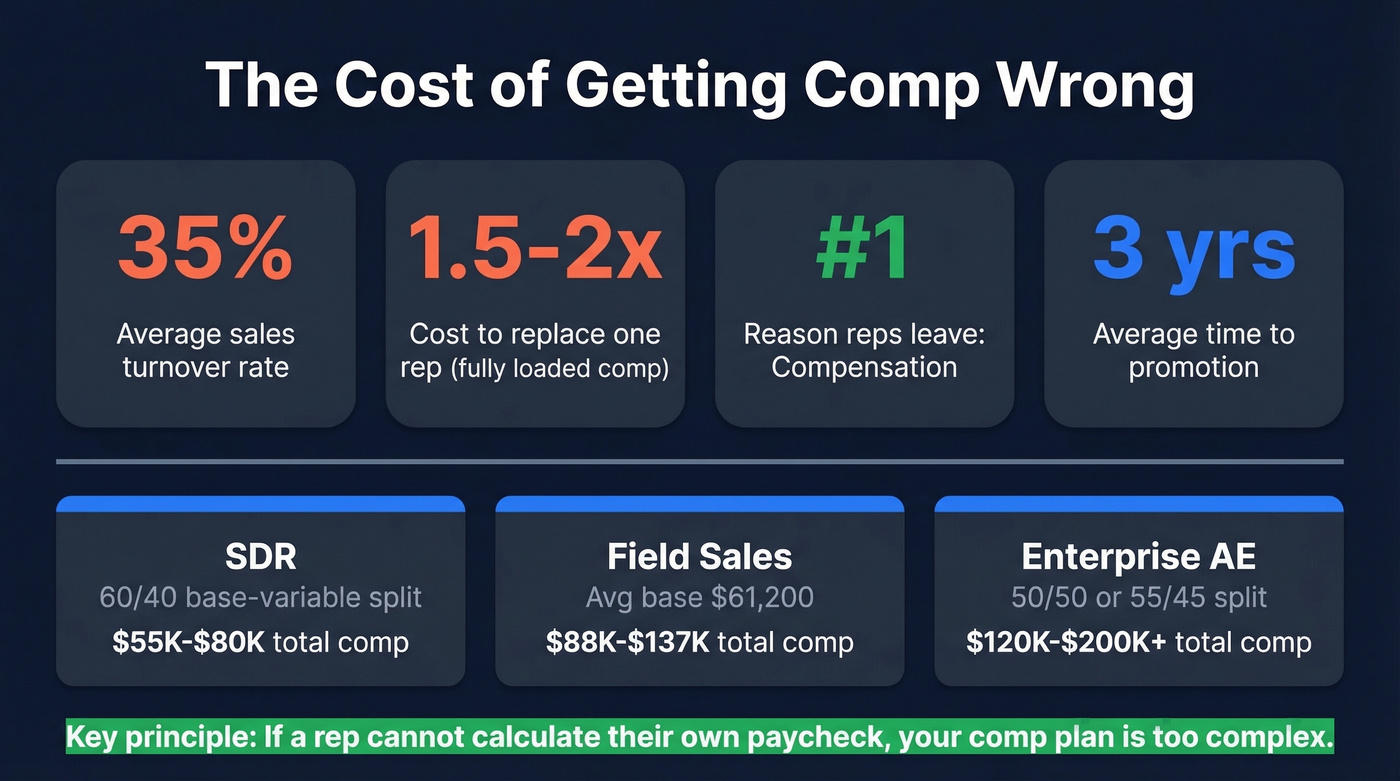
Sales turnover runs around 35%. The #1 reason reps leave is compensation. Not culture. Not management style. Money. Replacing a rep typically costs 1.5-2x their fully loaded comp once you factor in vacancy time, ramp, and lost pipeline. So getting the plan right isn't a finance exercise - it's a retention strategy. (If you want to sanity-check OTE math and ranges, see OTE in Sales.)
| Role | Base/Variable Split | 2026 Total Comp Range |
|---|---|---|
| SDR | 60/40 | $55K-$80K |
| Field Sales | Varies | $88K-$137K |
| Enterprise AE | 50/50 or 55/45 | $120K-$200K+ |
The 2026 field sales benchmarks put average base at $61,200 with total comp ranging $88K-$137K. Variable pay typically falls between 30-55% of total earnings depending on role and seniority. And it's not just money - repetitive work and slow promotion timelines (three years to promotion is a common industry average) compound the frustration.
A dozen commission structure types exist - tiered, residual, draw against commission, gross margin, and others. The structure matters less than the principle: reps should be able to calculate their own paycheck. If your comp plan requires a spreadsheet with nested IF statements, simplify it. Complexity breeds distrust, and distrust breeds turnover.
One opinion I'll stand behind: accelerators above quota are the single most effective retention mechanism for top performers. If your plan caps earnings or flattens above 100%, your best reps are already interviewing.
Build Your Weekly Operating System
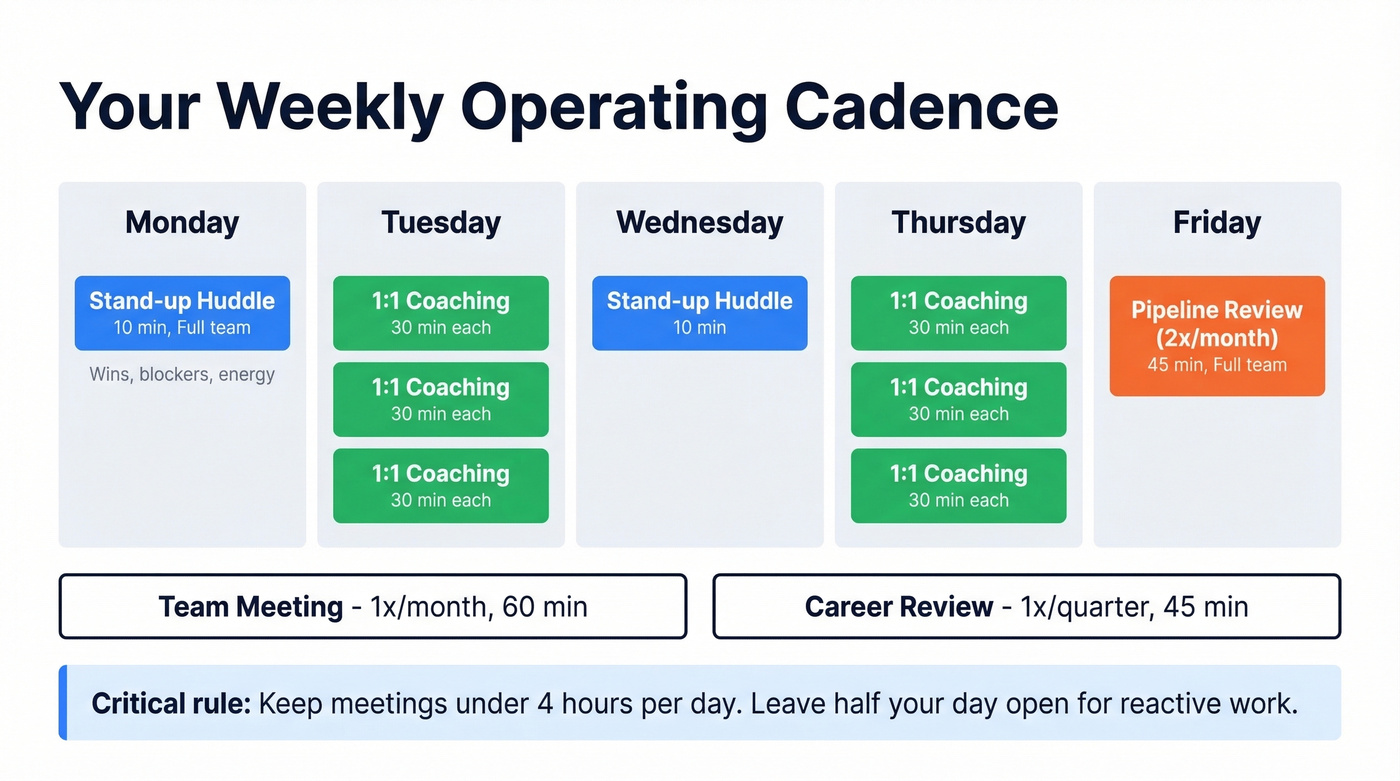
Managers need a management process the same way reps need a sales process. Without a cadence, your week gets eaten by reactive work - Slack fires, deal escalations, "quick questions" that take 45 minutes.
| Meeting | Frequency | Duration | Who | Purpose |
|---|---|---|---|---|
| Stand-up huddle | 2x/week | 10 min | Full team | Wins, blockers, energy |
| 1:1 | Weekly | 30 min | Manager + rep | Coaching (see below) |
| Pipeline review | 2x/month | 45 min | Full team | Deal inspection, forecast |
| Team meeting | 1x/month | 60 min | Full team | Recognition, updates |
| Career review | 1x/quarter | 45 min | Manager + rep | Development, retention |
The critical constraint: keep meetings under four hours per day. Leave half your day open for reactive work, because it's coming whether you schedule it or not. Make CRM hygiene a non-negotiable - if reps aren't logging activities and updating deal stages in real time, your pipeline reviews are fiction. (If you’re rebuilding your stack, start with these examples of a CRM to align on what “good” looks like.)
For the interruptions that don't fit the cadence, use a redirect script. When a rep walks over with a deal question, try: "Great question - bring that to our 1:1 on Thursday so we can dig into it properly." This isn't dismissive. It protects both your time and theirs. The Factor8 cadence framework calls this "redirecting drive-bys," and it's one of the highest-leverage habits a new manager can build.

You just read that 30%+ email bounce rates kill pipeline before coaching can fix it. Prospeo delivers 98% email accuracy with a 7-day data refresh cycle - so your reps spend time selling, not chasing dead leads. At $0.01 per email, fixing your data costs less than one rep's lunch.
Audit-proof your pipeline data before your next forecast call.
Run 1:1s That Reps Don't Dread
Most "coaching" sessions are actually pipeline interrogation. The manager opens the CRM, scrolls through deals, and asks "what's happening with Acme?" for 30 minutes. The rep leaves feeling inspected, not coached. Nothing changes.
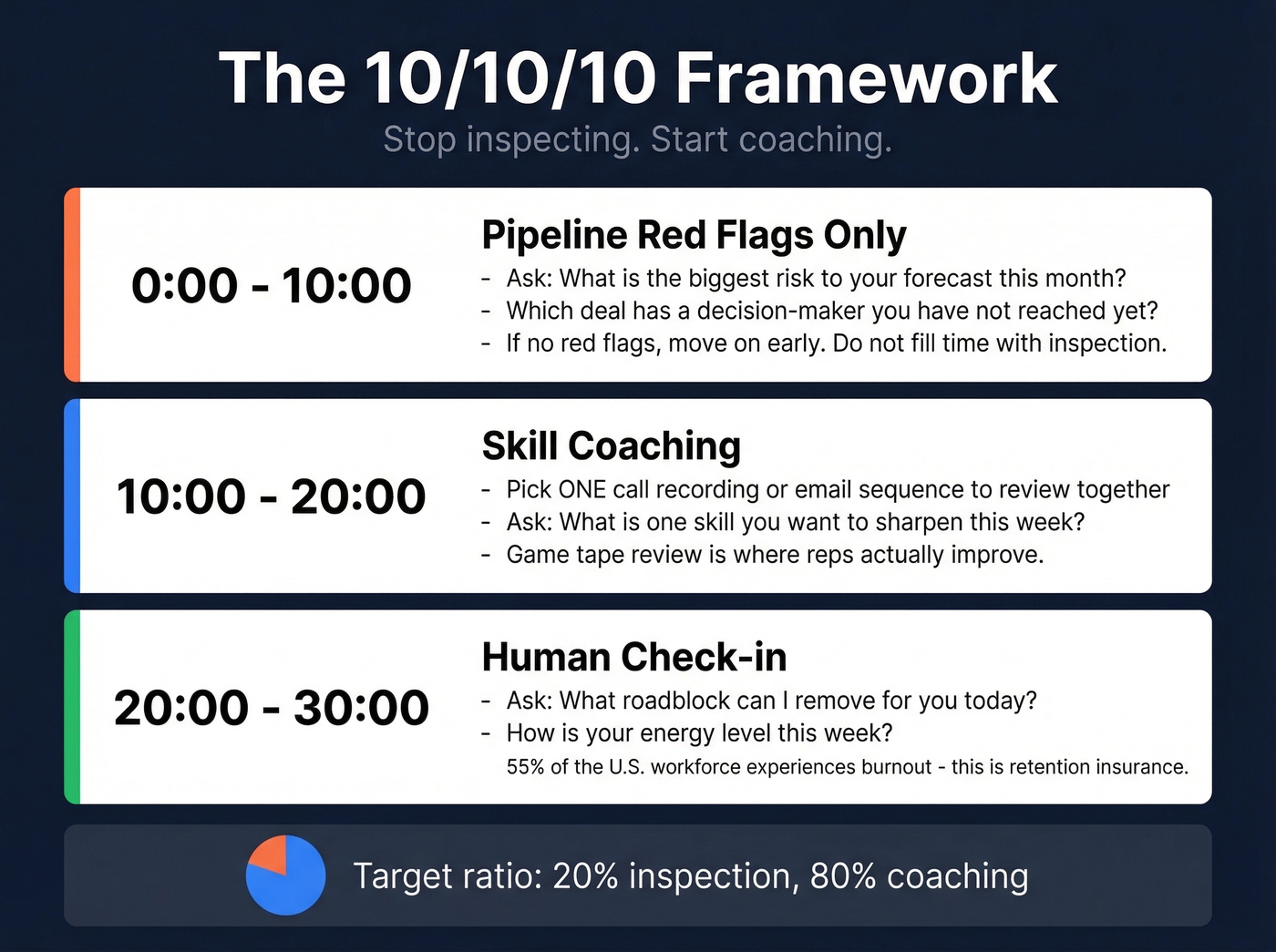
The fix is the 10/10/10 framework.
First 10 minutes - Pipeline red flags only. Don't review every deal. Ask: "What's the biggest risk to your forecast this month?" and "Which deal has a decision-maker you haven't reached yet?" If there aren't red flags, move on early. Don't fill the time with inspection for inspection's sake.
Second 10 minutes - Skill coaching. Pick one call recording or one email sequence and review it together. The question isn't "why didn't you close?" - it's "what's ONE skill you want to sharpen this week?" Game tape review is where reps actually improve. Everything else is accountability theater. (If you need a quick library of proven messaging, keep sales follow-up templates handy.)
Third 10 minutes - Human check-in. Ask: "What's a roadblock I can remove for you today?" and "How's your energy level this week?" With 55% of the U.S. workforce experiencing burnout and burnt-out employees nearly 3x more likely to leave within a year, this ten-minute check-in isn't soft - it's retention insurance.
Target ratio: 20% inspection, 80% coaching. If you're spending more than a third of your 1:1 on pipeline review, you're doing it wrong.
Coach for Revenue, Not Compliance
Here's a stat that should bother every VP of Sales: 63% of companies can't even define what coaching is. They say they coach, but what they actually do is review numbers and tell reps to "make more calls."
Real coaching has measurable ROI. Organizations that coach consistently are 15% more likely to hit revenue goals. Firms that coach their managers on how to coach see a 23% lift. And 75% of reps say they're more likely to hit targets when they have a coach or mentor. One underrated metric to track: coachability itself. How quickly does a rep implement feedback from a 1:1? That's a better predictor of long-term performance than raw quota attainment. (For a broader systems view, see sales performance management.)
AI tools won't replace your 1:1s, but they can scale the game-tape review piece. Right now, 88% of sales professionals say AI increases their odds of hitting targets, yet 33% of field sales teams still aren't using it at all. The most common use cases: email personalization (30%), conversation intelligence (28%), and CRM data entry automation (24%). (If you’re evaluating the category, start with generative AI sales tools.)
| Tool | What It Does | Starting Price |
|---|---|---|
| Gong | Conversation intelligence, deal analytics | ~$1,200-$1,600/user/yr |
| Chorus (ZoomInfo) | Call recording + AI analysis | ~$100-$150/user/mo |
| Hyperbound | AI role-play for ramp/practice | ~$40/user/mo |
If you're overseeing more than six reps and you're not recording calls, you're coaching blind. Full stop.
Set KPIs That Drive Behavior
The biggest trap for new managers is measuring activity instead of outcomes. If you're tracking call volume but not meetings booked, you're measuring effort, not impact. Reps can hide behind 80 dials a day while booking zero meetings - and your dashboard will show green. (If you need a clean list of what to track, use these sales activities examples.)
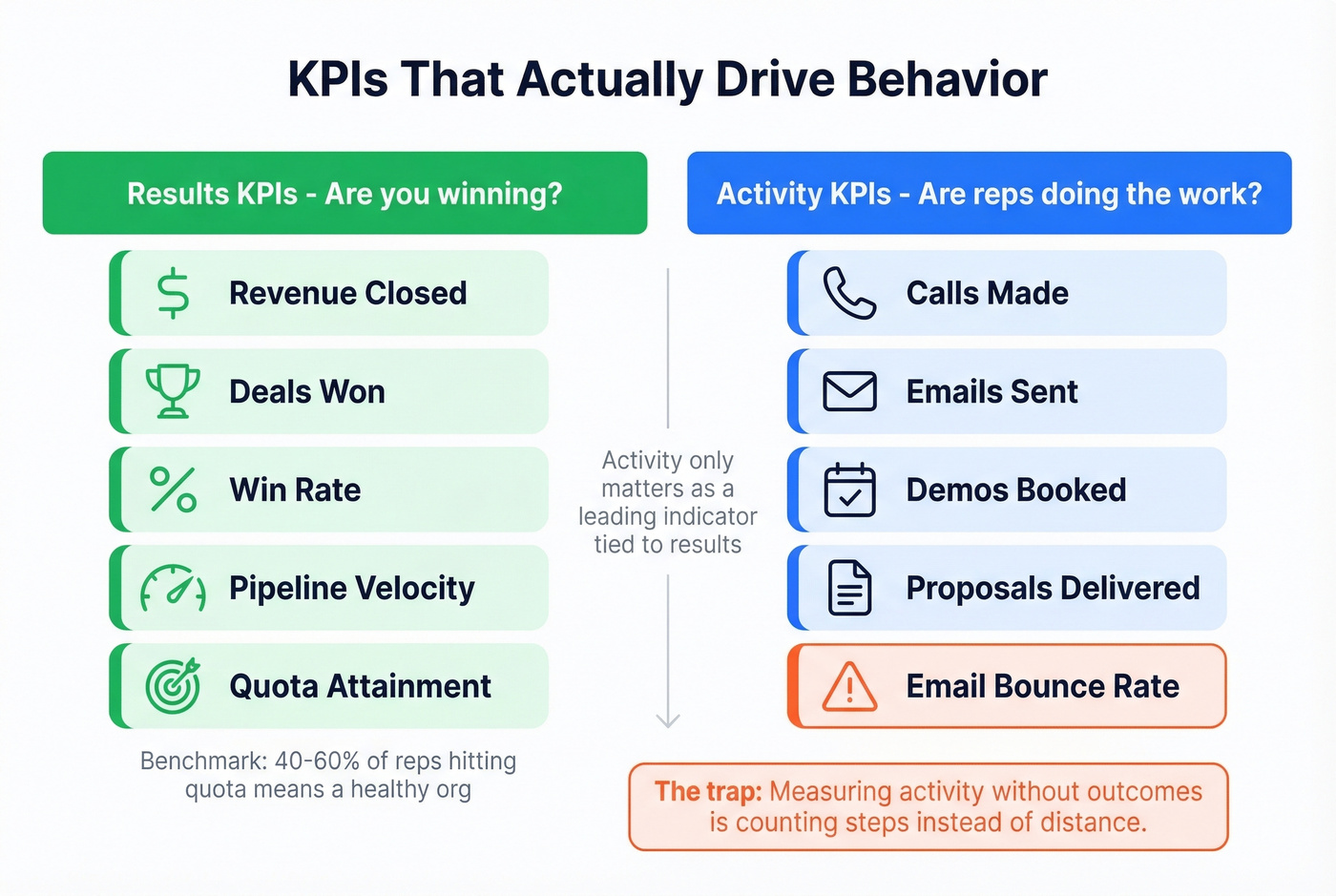
Results KPIs tell you whether the team is winning: revenue closed, deals won, win rate, pipeline velocity, quota attainment. For benchmarks, expect around 40-60% of reps to hit quota in a healthy org. Below 40%? The problem is likely territory design or lead quality, not rep effort. (To pressure-test your numbers, compare against sales pipeline benchmarks.)
Activity KPIs tell you whether reps are doing the work: calls made, emails sent, demos booked, proposals delivered. These matter, but only as leading indicators tied to results. Activity without outcome tracking is counting your reps' steps instead of their distance.
One KPI most managers ignore: email bounce rate. If your team's outbound is bouncing above 5%, your data quality is the problem, not your reps. Prospeo's 5-step verification keeps bounce rates under 4% for most teams at 98% email accuracy and roughly $0.01 per email - it's the fastest way to rule out data quality as the bottleneck before you start blaming reps for low pipeline. (If you want the deeper breakdown, see email bounce rate.)
Fix Your Data Before Your Process
Your SDR team hit 400 dials last week and booked two meetings. Before you fire anyone, ask a different question: how many of those dials went to wrong numbers? How many emails bounced? How many contacts had left the company six months ago?
When reps spend 60% of their time on non-selling tasks, a huge chunk of that waste is data cleanup - researching contacts, finding emails, verifying phone numbers, deduplicating records. That's not a training problem. It's an infrastructure problem. And it's the manager's job to fix it. (If you’re comparing vendors, start with data enrichment services.)
Let's look at what happens when teams actually address this. GreyScout cut rep ramp time from 8-10 weeks to 4 weeks after switching to verified contact data. New reps stopped spending their first month building lists from scratch and started selling in week two. (Pair that with a structured ramp like a 30-60-90 day plan for sales reps.)
Snyk had 50 AEs prospecting 4-6 hours per week with bounce rates of 35-40%. After cleaning up their data pipeline, bounces dropped under 5% and AE-sourced pipeline jumped 180% - over 200 new opportunities per month. We've seen this pattern repeat across teams of every size: fix the data, and the pipeline follows.

If your average deal size is under $15K, you probably don't need a $30K/year data platform. But you absolutely need verified emails and direct dials. Data quality is a management decision, not a RevOps afterthought. If your reps are working bad lists, every coaching session and every comp plan tweak is built on a broken foundation.
The best operating cadence in the world falls apart when reps can't reach decision-makers. Prospeo gives your team 125M+ verified mobile numbers with a 30% pickup rate and 300M+ profiles with 30+ filters - so pipeline reviews are about strategy, not excuses about bad contact data.
Stop coaching around bad data. Give your team contacts that connect.
Common Mistakes That Sink New Managers
Assuming everyone works like you. You were a top rep. Your style worked for you. It won't work for everyone. Diagnose each person individually.
Hiring on experience alone. A rep with 10 years and bad habits is harder to coach than a hungry rep with two years and coachability. Prioritize learning velocity.
Delaying firings. Every manager waits too long on their first termination. If a rep has been on a PIP for 90 days with no improvement, you're not being patient - you're being unfair to the rest of the team. The consensus on r/sales is that most managers regret waiting, not acting.
Measuring activity over outcomes. High call volume with zero meetings is not productivity. It's noise.
Tolerating low win rates. If a rep is closing 8% of opportunities while the team averages 22%, that's a qualification or skill problem. Address it directly.
Ignoring team dynamics. One toxic rep can tank an entire team's morale. New managers consistently underestimate how much one bad actor poisons culture - and how fast it spreads.
Crossing the ethics line. Expense padding, misrepresenting deals in the CRM, lying to customers - these aren't coaching moments. They're termination events. (If you need a clear line in the sand, see ethics in sales.)
FAQ
How many reps should one sales manager oversee?
Most frontline managers handle 6-10 reps effectively. Complex enterprise teams should stay closer to 6 for coaching depth; high-velocity SMB teams can stretch toward 10. Beyond 10, you become a forecast collector, not a coach.
How long does it take to ramp a new sales rep?
SMB reps typically ramp in 3-4 months, mid-market in 4-6, and enterprise in 6-9. Clean prospect data cuts these timelines significantly - GreyScout halved ramp from 8-10 weeks to 4 weeks by giving new reps verified contacts instead of making them build lists from scratch.
What's the biggest mistake first-time sales managers make?
Changing everything in week one instead of observing for 30 days. New managers feel pressure to prove themselves immediately, so they restructure territories, overhaul comp, and launch new tools simultaneously. Diagnose before you prescribe - spend month one in 1:1s, listening to calls, and mapping what's actually broken.
How much should a rep's variable pay be?
Variable compensation typically runs 30-55% of total earnings. SDRs usually sit at a 60/40 base-to-variable split, while AEs land closer to 50/50. The key principle: variable pay should be large enough to motivate but simple enough that reps can calculate their own paycheck without a spreadsheet.
The Short Version
Knowing how to manage a sales team comes down to four things: build the operating system so your week has structure, fix comp so your best reps stay, clean up the data so effort converts to pipeline, and coach for skills instead of compliance. Get those four right and the rest - motivation, culture, morale - follows. Get them wrong and no amount of Slack emojis will save you.